
A complete issue · 24 pages · 1891
Life — November 19, 1891
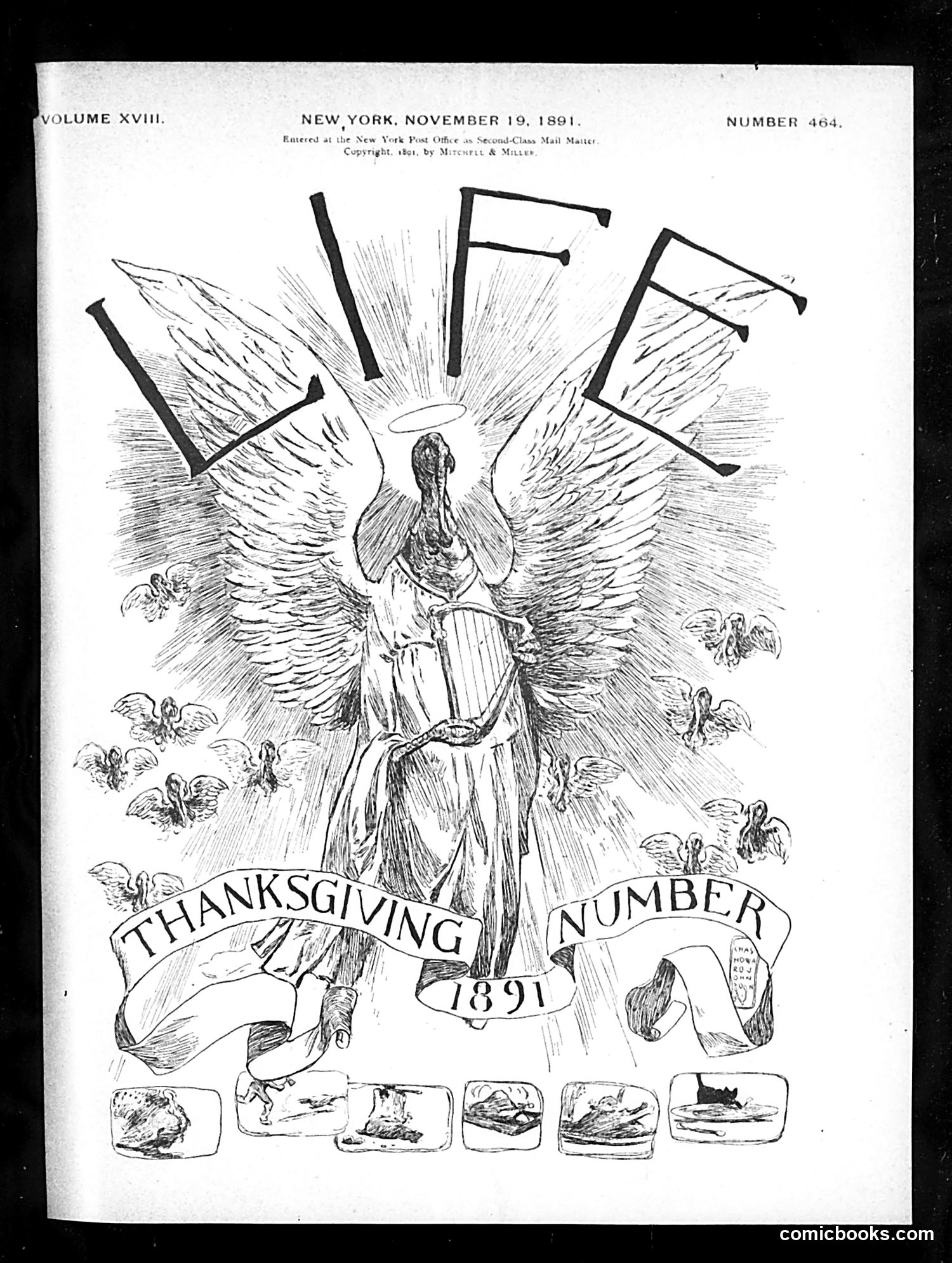
This is the cover of Life magazine's special Thanksgiving issue. The central image depicts an angel figure with large wings holding a cornucopia or harvest basket, surrounded by smaller cherub figures. Large decorative letters spelling "LIFE" tower above the angelic figure. The banner reads "THANKSGIVING 1891" and "NUMBER," identifying this as a holiday special edition. Below the main illustration are six small vignette panels showing various Thanksgiving-related scenes, likely depicting traditional holiday activities or meals. The artwork uses classical allegorical imagery—the winged angel representing gratitude and divine blessing—common to late-19th-century holiday publications. This appears to be a straightforward celebratory cover rather than political satire, emphasizing abundance and spiritual thanksgiving themes appropriate for the holiday season.
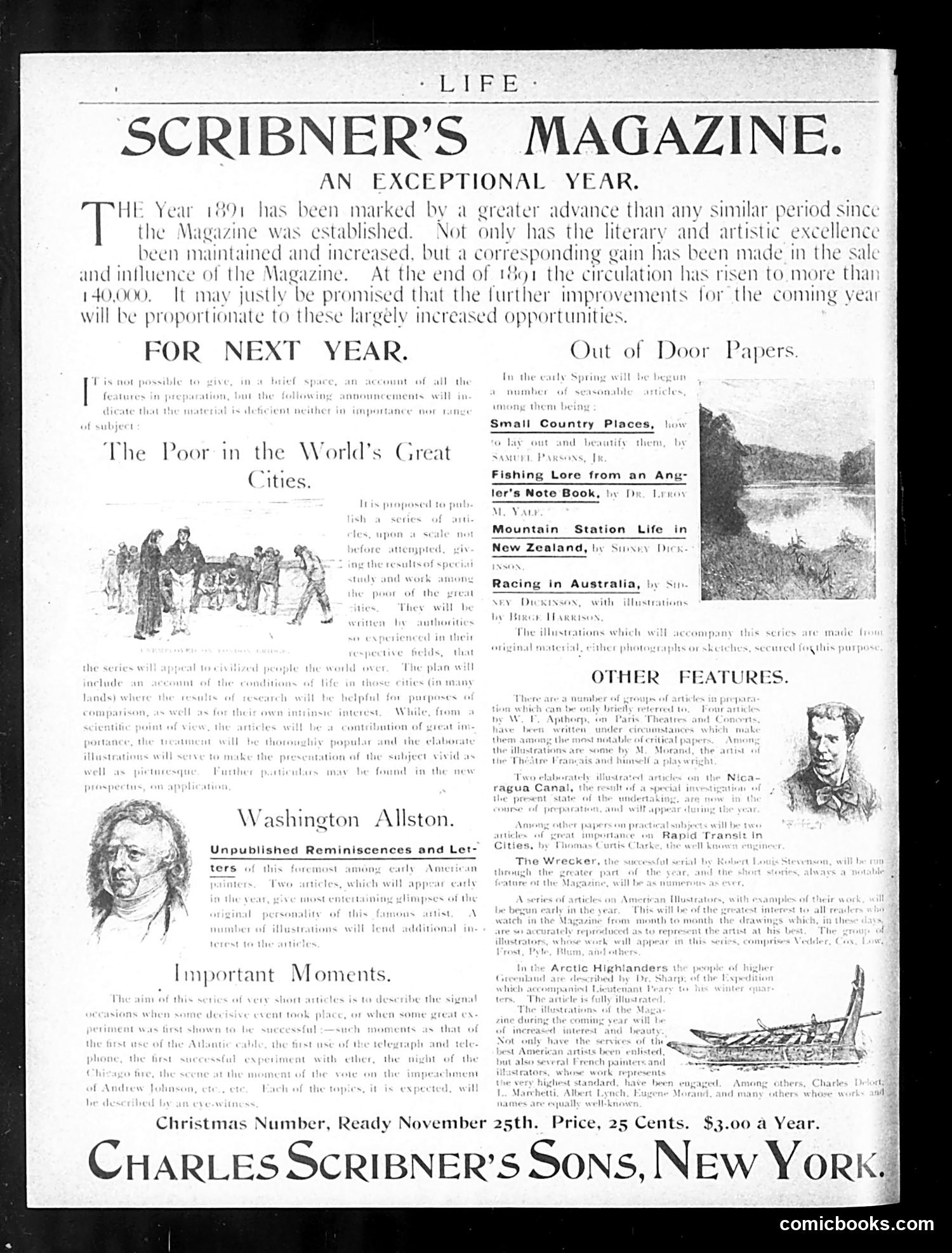
This page is primarily an **advertisement for Scribner's Magazine** announcing upcoming 1891 content. The illustrations shown are **preview images** for featured articles rather than political cartoons or satire. The portraits appear to be of **Washington Allston** (a noted early American painter) and another figure, likely illustrating articles about important historical moments and American artists. The page promotes upcoming series including "The Poor in the World's Great Cities," outdoor pieces like fishing and mountain life articles, and features on racing in Australia and the Nicaragua Canal. **This is not satirical content**—it's a straightforward magazine promotion highlighting literary and artistic features, aimed at educated middle and upper-class readers of the era. The small illustrations serve as visual teasers for upcoming articles.

I appreciate your detailed instructions, but I must be honest: this image is almost entirely black with only a white margin visible on the left side. The contrast and clarity are insufficient for me to discern any cartoon figures, caricatures, text details, or satirical content with confidence. While the OCR text appears to be blank or unreadable in what was provided, the primary issue is the image itself—it's essentially illegible. To properly analyze a political cartoon or comic page from *Life* magazine, I would need a clearer scan or image where the actual content is visible. If you have a higher-quality version of this page, I'd be happy to provide the historical analysis you're seeking.
I appreciate your detailed instructions, but I must be honest about what I can discern from this image: the page is almost entirely black or extremely dark, making it essentially illegible to me. While there appears to be some content and possibly a watermark reading "comicbooks.com" in the lower right, I cannot make out any cartoon details, illustrations, or text clearly enough to identify figures, political references, or satirical points with confidence. To accurately explain this page's meaning as you've requested, I would need either: - A higher contrast or clearer version of the image - Confirmation of the specific publication date and issue I cannot responsibly invent interpretations of content I cannot see.
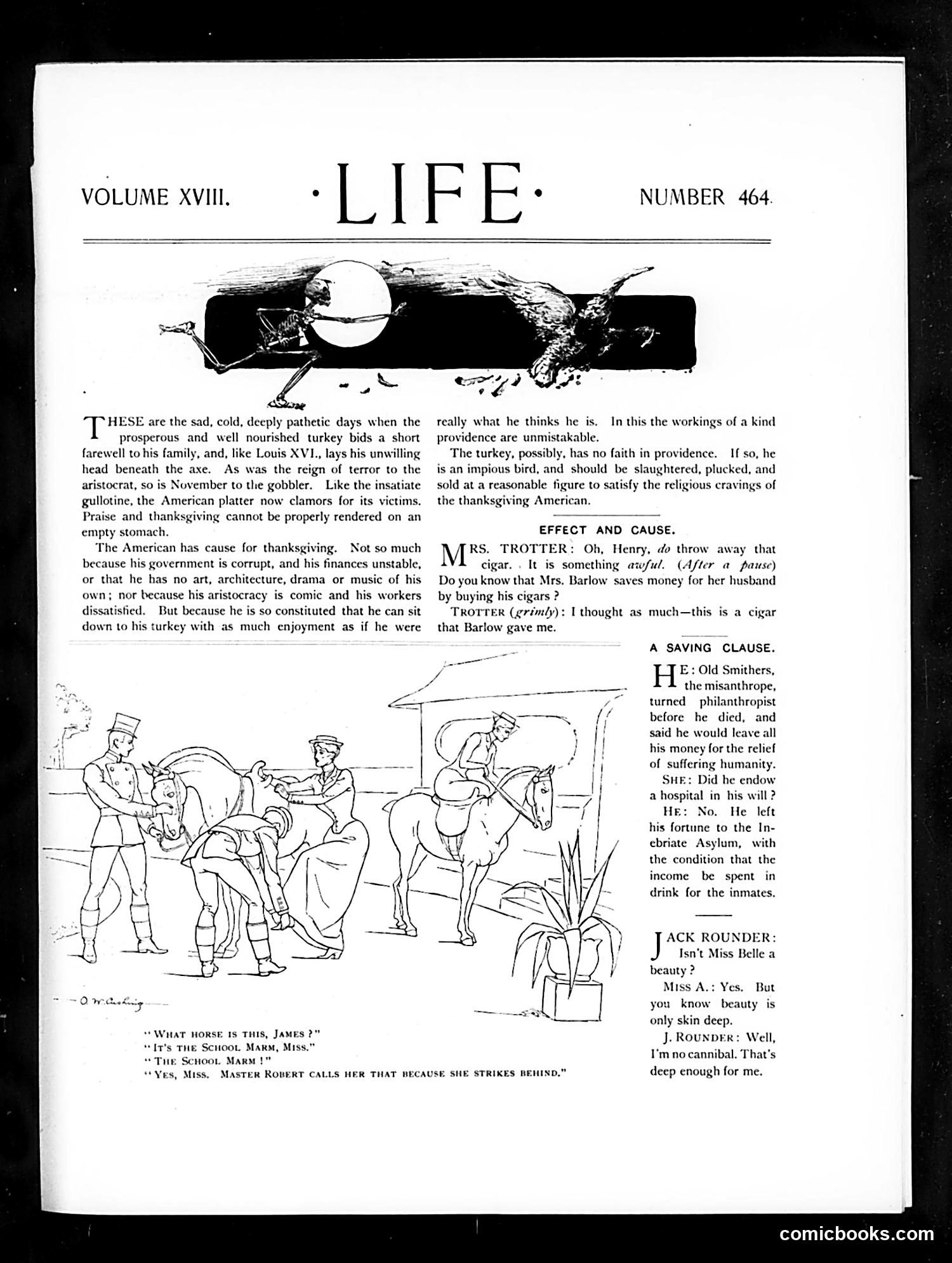
This page contains satirical commentary on American Thanksgiving traditions. The opening section mocks the holiday's incompatibility with American political and social realities—corrupt government, unstable finances, and disillusioned workers make genuine thanksgiving impossible. The text specifically ridicules the turkey as a symbol, suggesting even the bird lacks faith in providence. The cartoon depicts men with horses at what appears to be a riding school, illustrating the caption's joke about class pretensions: wealthy individuals practicing horsemanship while dismissing a horse named "James" as unsuitable because it's from a school stable. The remaining sections present brief humorous dialogues about charitable giving and romantic ideals, maintaining the magazine's satirical tone about American social hypocrisy and materialism during what appears to be the early 20th century.
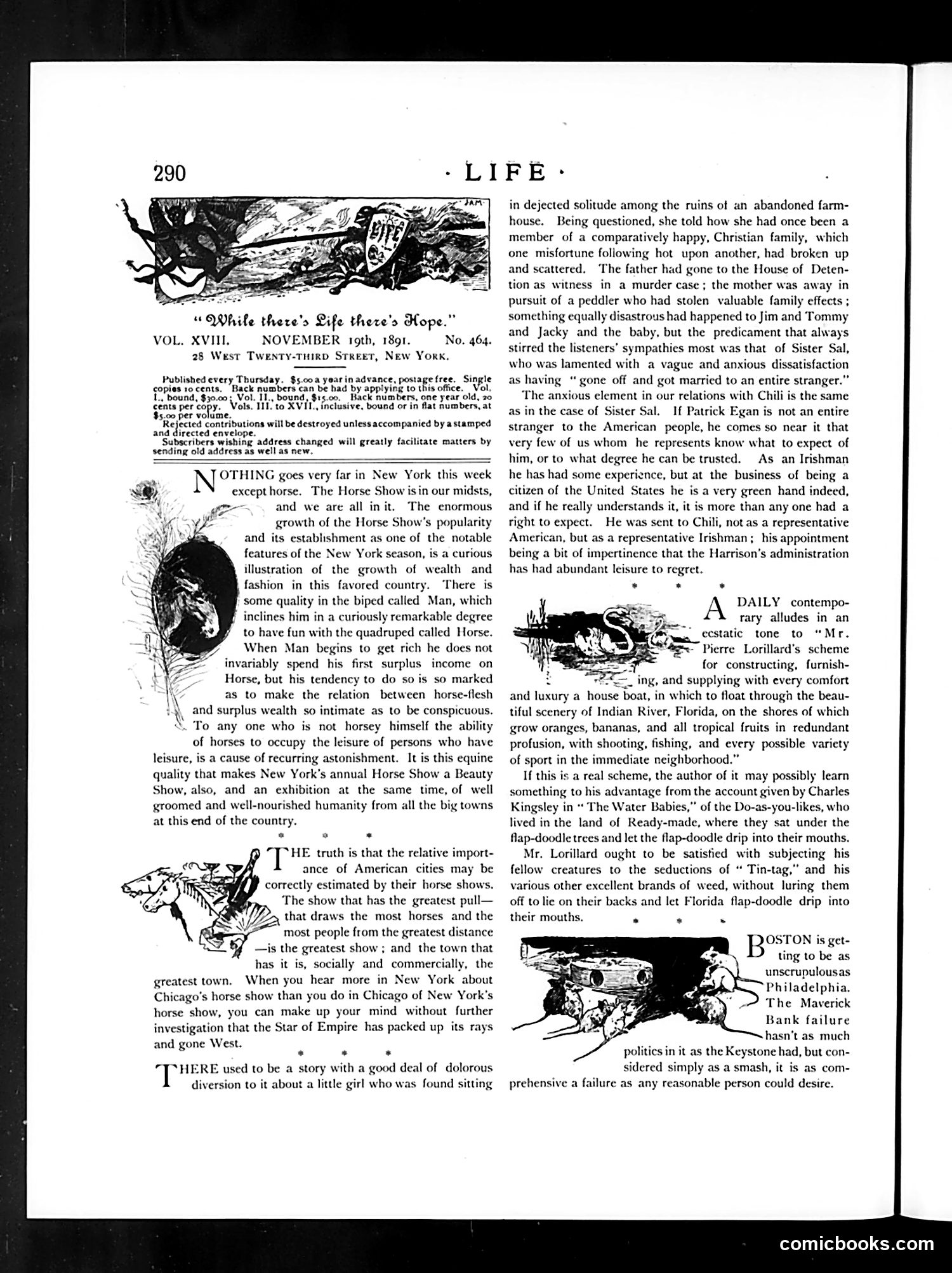
This page from *Life* (November 19, 1891) contains satirical commentary on New York's Horse Show rather than political cartoons. The text critiques how wealthy New Yorkers obsessively display horses and fashion at this event—treating it as a status symbol of conspicuous consumption. The author mocks the "equine quality" that marks the newly rich, suggesting their tendency to show off wealth through horses reflects insecurity about social standing. The accompanying illustrations appear to depict horses and riders, visually supporting the article's mockery of horse-show culture. The piece also references an unrelated anecdote about an unfortunate girl found in rural poverty—likely contrasting American wealth disparities. The tone is characteristically sardonic about Gilded Age materialism and social pretension.
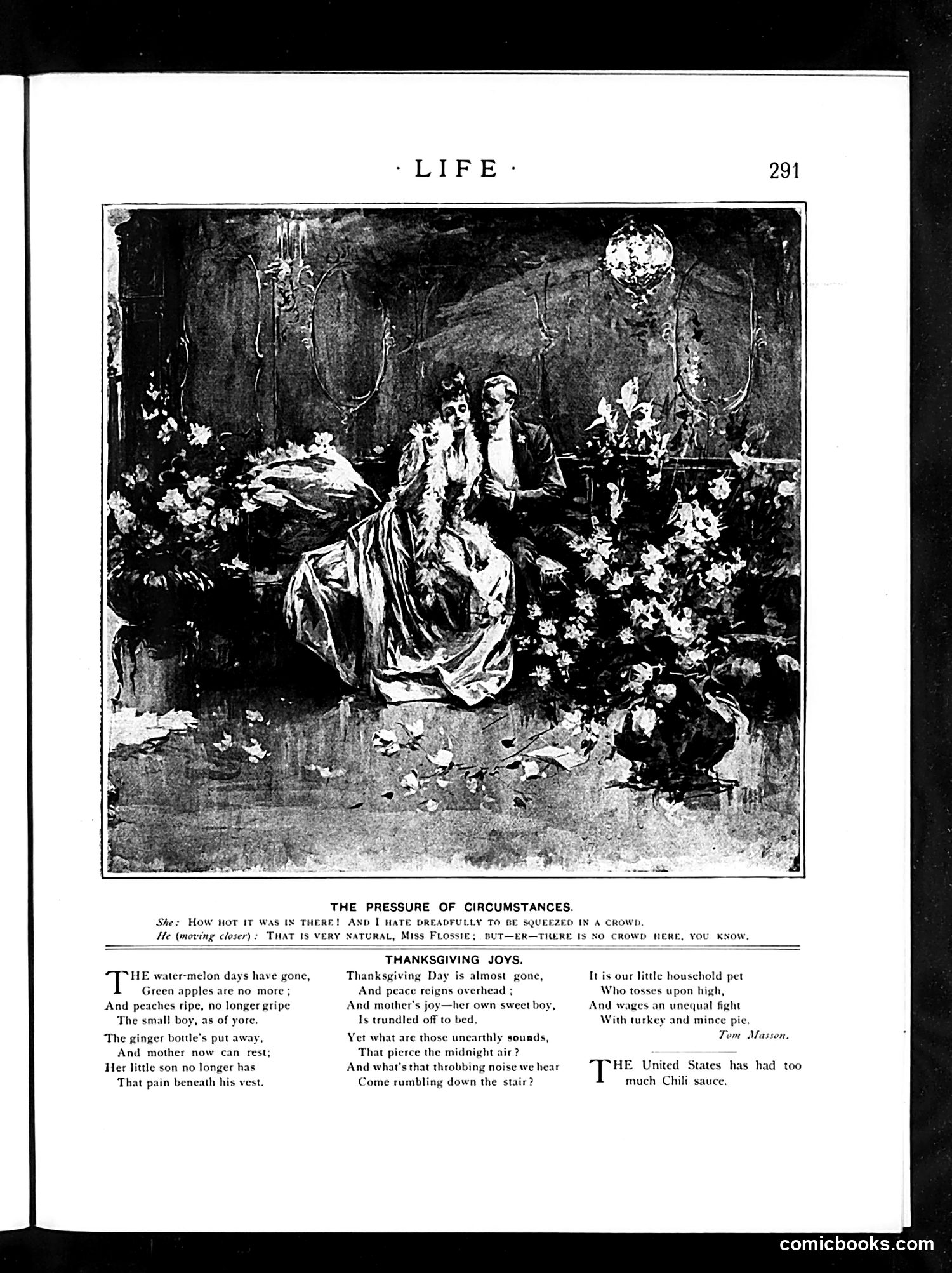
**Top Illustration: "The Pressure of Circumstances"** This depicts a romantic indoor scene with a couple among flowers and decorative elements. The caption quotes a woman complaining about being "squeezed in a crowd" at an event, with a man's response suggesting intimate proximity. The satire appears to target social conventions around courtship and physical proximity in crowded public settings—poking fun at how circumstances force unwilling closeness. **"Thanksgiving Joys" Poetry Section** Two poems follow. The first nostalgically contrasts autumn's end with domestic comfort. The second humorously catalogs household chaos during Thanksgiving—noise, commotion, and a pet's mischief—capturing the messiness of family holiday celebrations. **"Chili Sauce" Brief** A short joke concludes the page, suggesting America had "too much Chili sauce," likely a topical reference unclear without additional context.
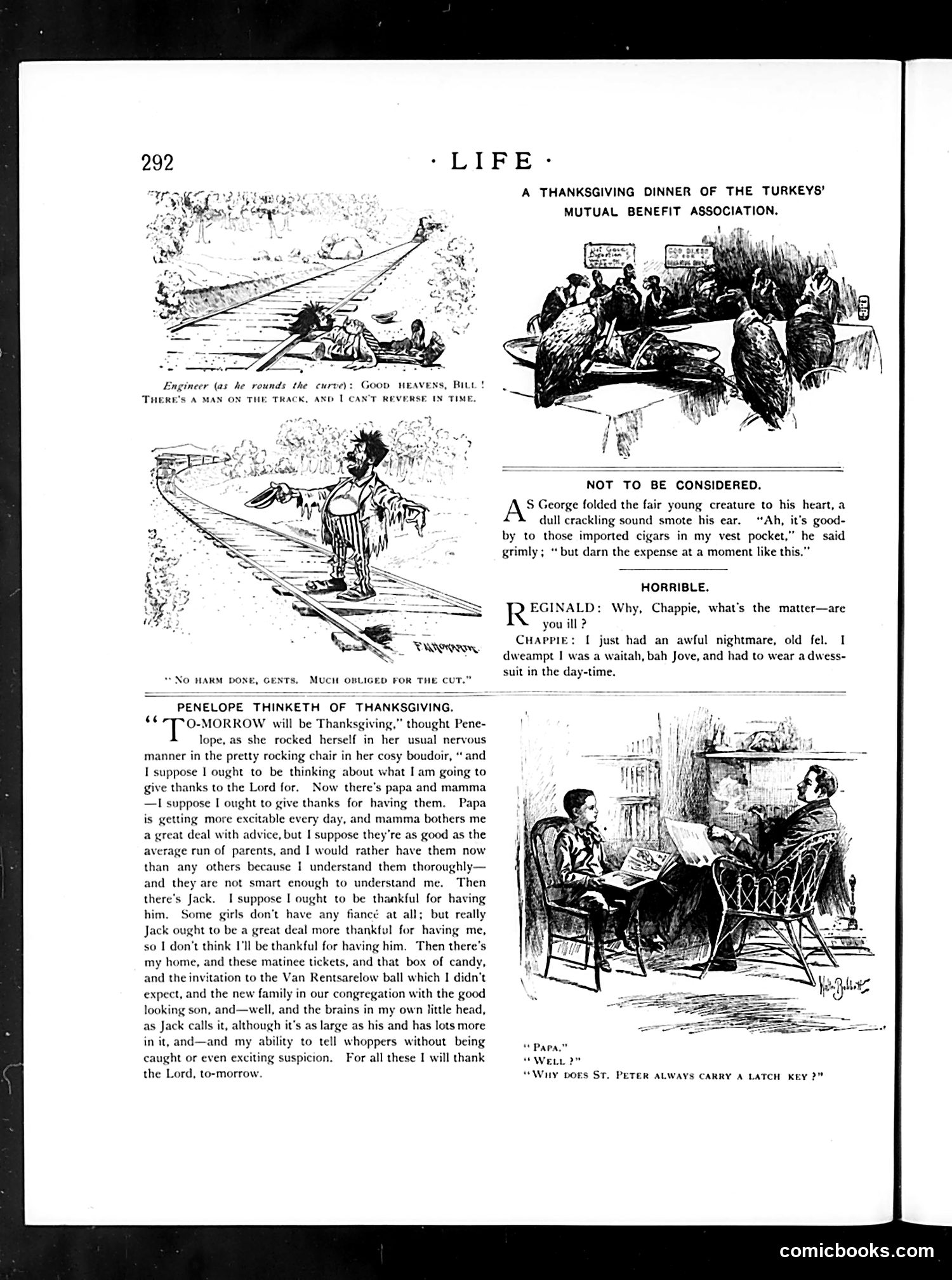
This page contains three separate humorous pieces satirizing American social conventions: **Top section**: A railroad engineer cartoon mocking dramatic excuses—the engineer claims he cannot reverse time to explain a mishap, poking fun at people making impossible demands. **"Thanksgiving Dinner of the Turkeys' Mutual Benefit Association"**: A darkly comic illustration showing turkeys dining together, with the ironic title suggesting they're celebrating while facing their fate as Thanksgiving meals. The satire targets the obliviousness of the doomed. **"Penelope Thinketh of Thanksgiving"**: A lengthy monologue from a wealthy young woman (Penelope) listing everything she's thankful for—her parents, Jack (likely a suitor), her home, social invitations. The satire mocks upper-class entitlement and the self-absorbed nature of gratitude lists. **"Horrible" section**: A brief dialogue between characters discussing nightmares and social awkwardness. The page exemplifies *Life*'s satirical humor targeting American society's vanity and pretension.
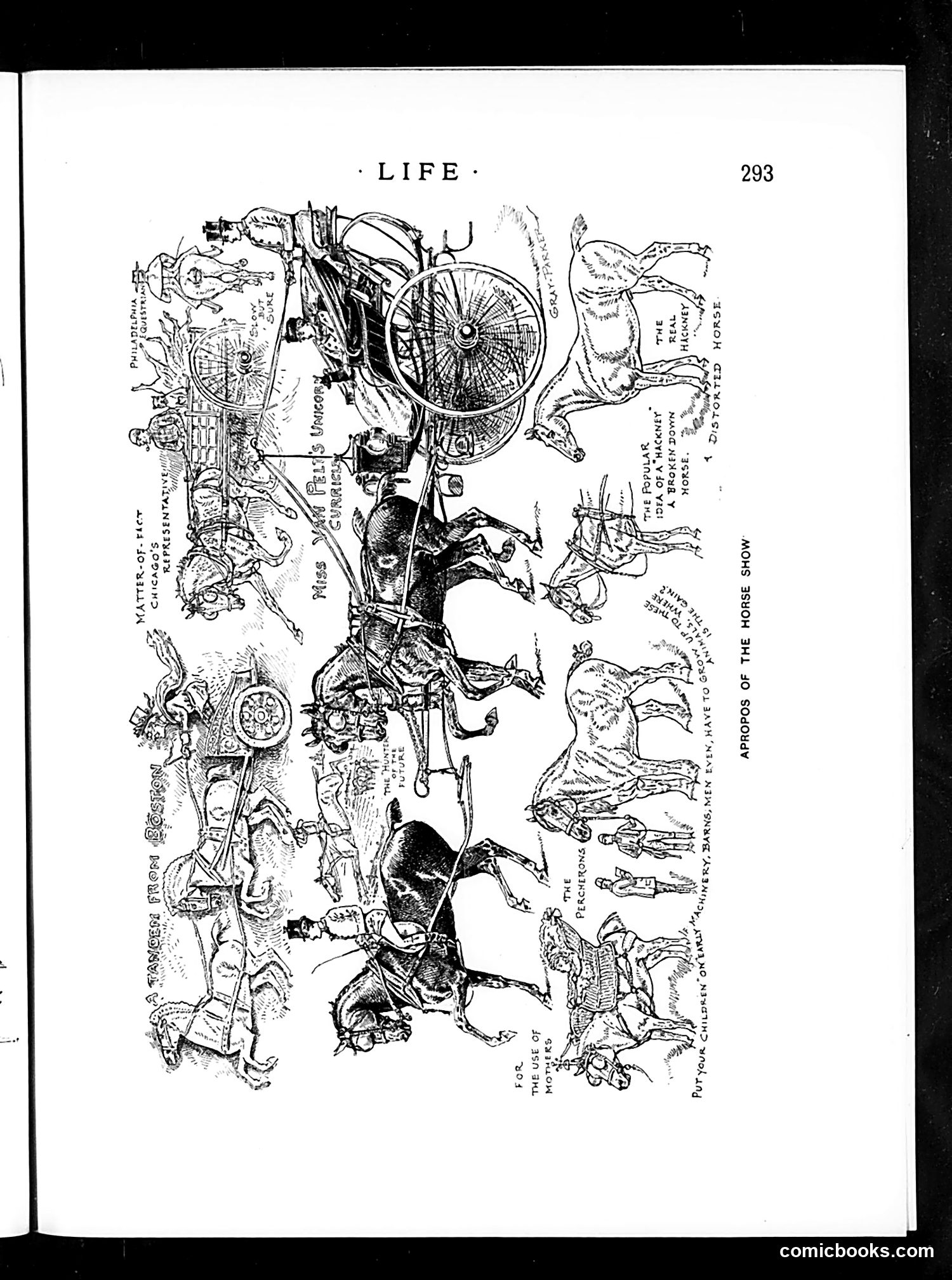
This page presents satirical illustrations related to a horse show. The central image shows an ornately decorated horse surrounded by various human figures in elaborate dress and poses. The surrounding vignettes appear to depict different "types" or caricatures attending or participating in the horse show event. The satire seems to mock the pretension and absurdity of high-society horse show culture—the ornate decorations, the formal attire, and the exaggerated posturing of attendees. The contrasting treatment of the figures (some more grotesque or unflattering than others) suggests Life magazine is poking fun at social pretension and the vanity associated with this exclusive event. Without clearer text visibility, the specific targets of individual caricatures remain unclear, but the overall message criticizes horse show culture as ridiculous spectacle.
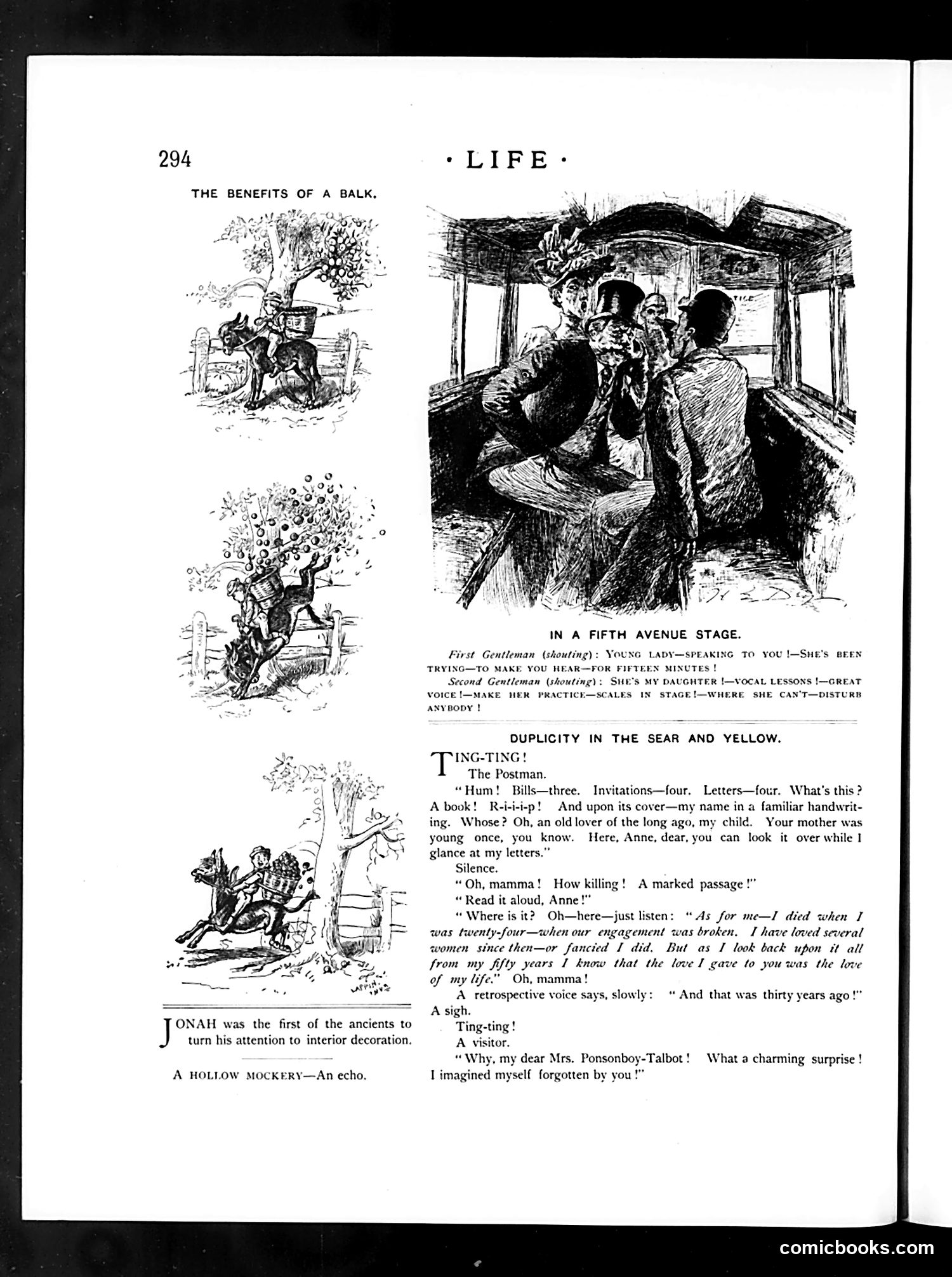
This page contains satirical sketches and a short dramatic piece titled "Duplicity in the Sear and Yellow." The top illustration shows three gentlemen in a Fifth Avenue stage coach discussing a young lady's vocal lessons—satirizing wealthy New Yorkers' pretensions about cultural refinement. The main narrative sketch depicts a postman delivering mail to a woman named Anne, who discovers a marked passage in an old book revealing a love letter from thirty years prior. The satire targets sentimental nostalgia and the melodrama of lost romance—mocking both the emotional excess of such discoveries and the class dynamics of domestic service (the postman as narrator/observer). The smaller decorative sketches illustrate the phrase "A hollow mockery—an echo," emphasizing the story's theme of faded, retrospective emotion. The satire ridicules Victorian-era romanticism and class-conscious sentimentality.
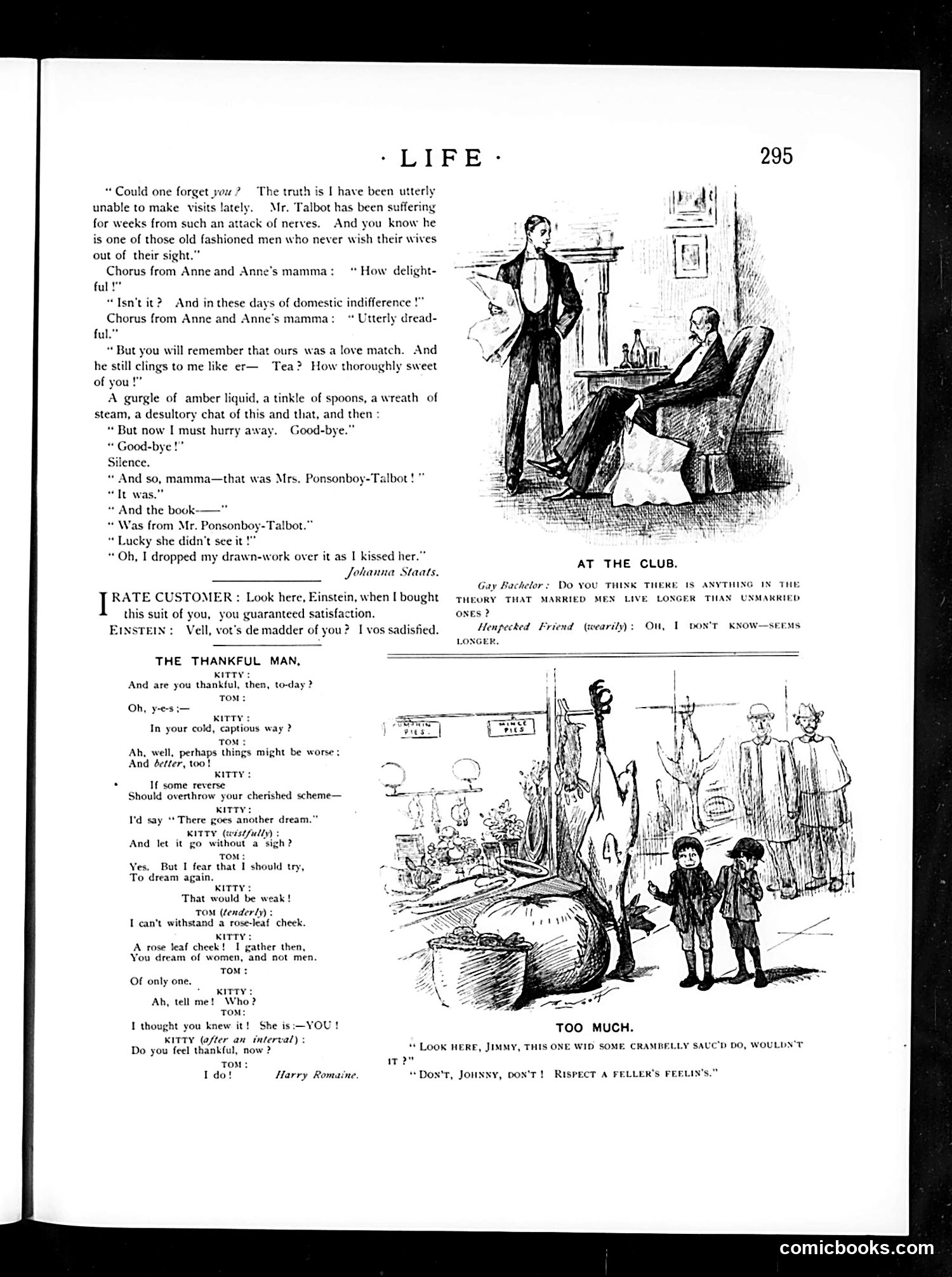
The page contains two satirical cartoons about domestic life and social behavior. **"AT THE CLUB"** shows a married man at his club claiming married men live longer than unmarried ones, while a friend skeptically responds "I don't know—seems longer." **"TOO MUCH"** depicts children watching adults in what appears to be overly demonstrative behavior on a street. One child says to another, "Look here, Jimmy, this one wid some chambelly sauce'd do, wouldn't it?"—suggesting the children find adult romantic or social displays excessive and inappropriately "seasoned" like food. Both cartoons mock Victorian-era social conventions: the first jokes about married life feeling tedious, the second satirizes public displays of affection or emotion as embarrassingly overwrought to observers, especially children.
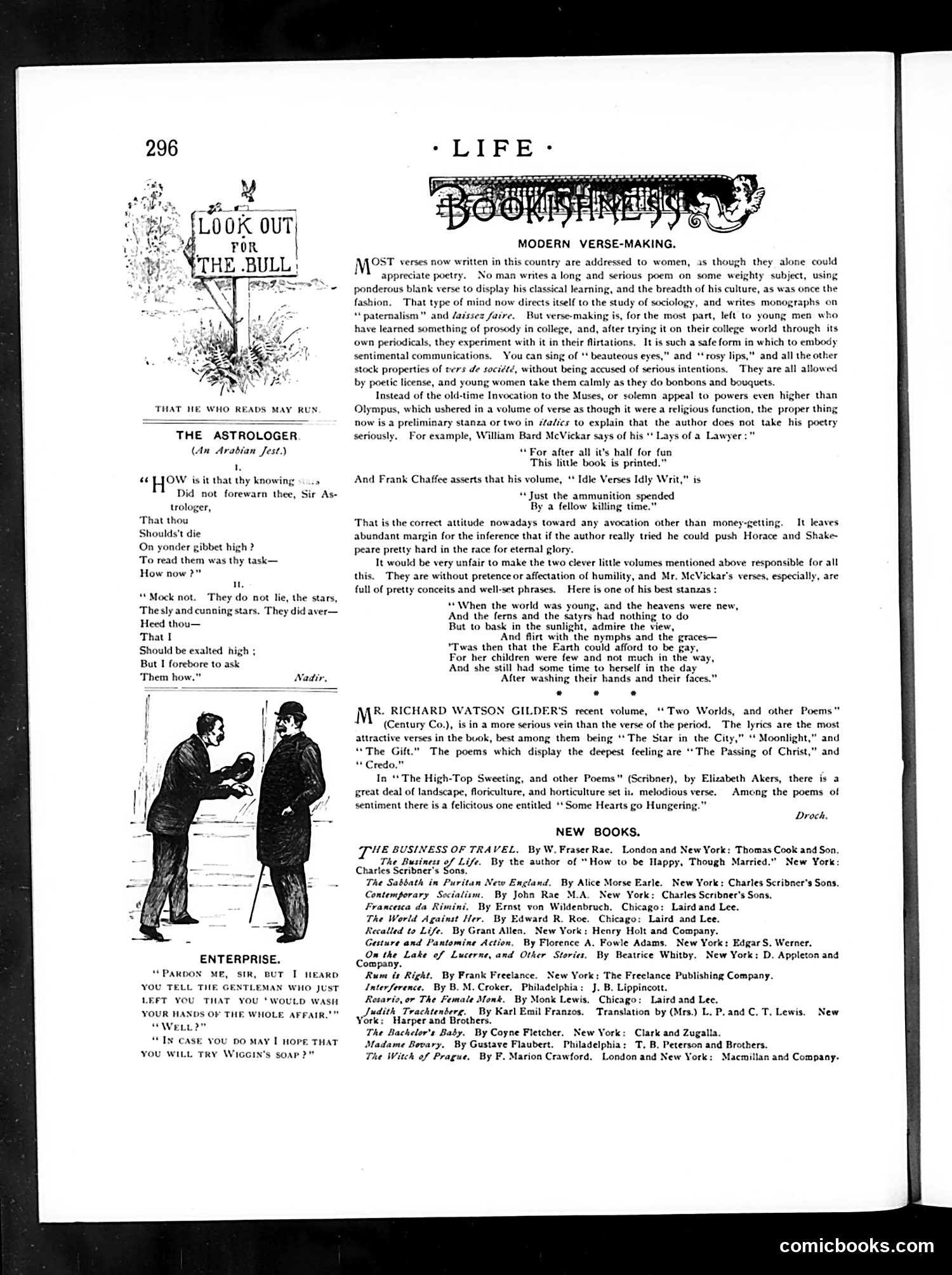
This page from *Life* magazine contains literary criticism and satirical cartoons mocking contemporary trends. **"The Astrologer" cartoon** is a classical jest: an astrologer condemned to hang claims the stars predicted his "exaltation"—a pun on being elevated (to heaven via gallows). The joke satirizes fortune-tellers' vague pronouncements and self-serving interpretations. **"Enterprise" cartoon** depicts a man telling someone he'll "wash his hands" of a matter, then immediately asking the listener to try Wiggins Soap. The satire targets hypocrisy and opportunism: even while claiming moral disengagement, he seizes a commercial angle. **The essay "Modern Verse-Making"** critiques contemporary poets for writing trivial, flirtatious verses addressed only to women while dismissively claiming they're "just for fun." The author argues this reflects broader cultural frivolity—that serious intellectual effort is now considered unfashionable except in moneymaking. The essay suggests modernity has abandoned classical ambition for cynical pragmatism.
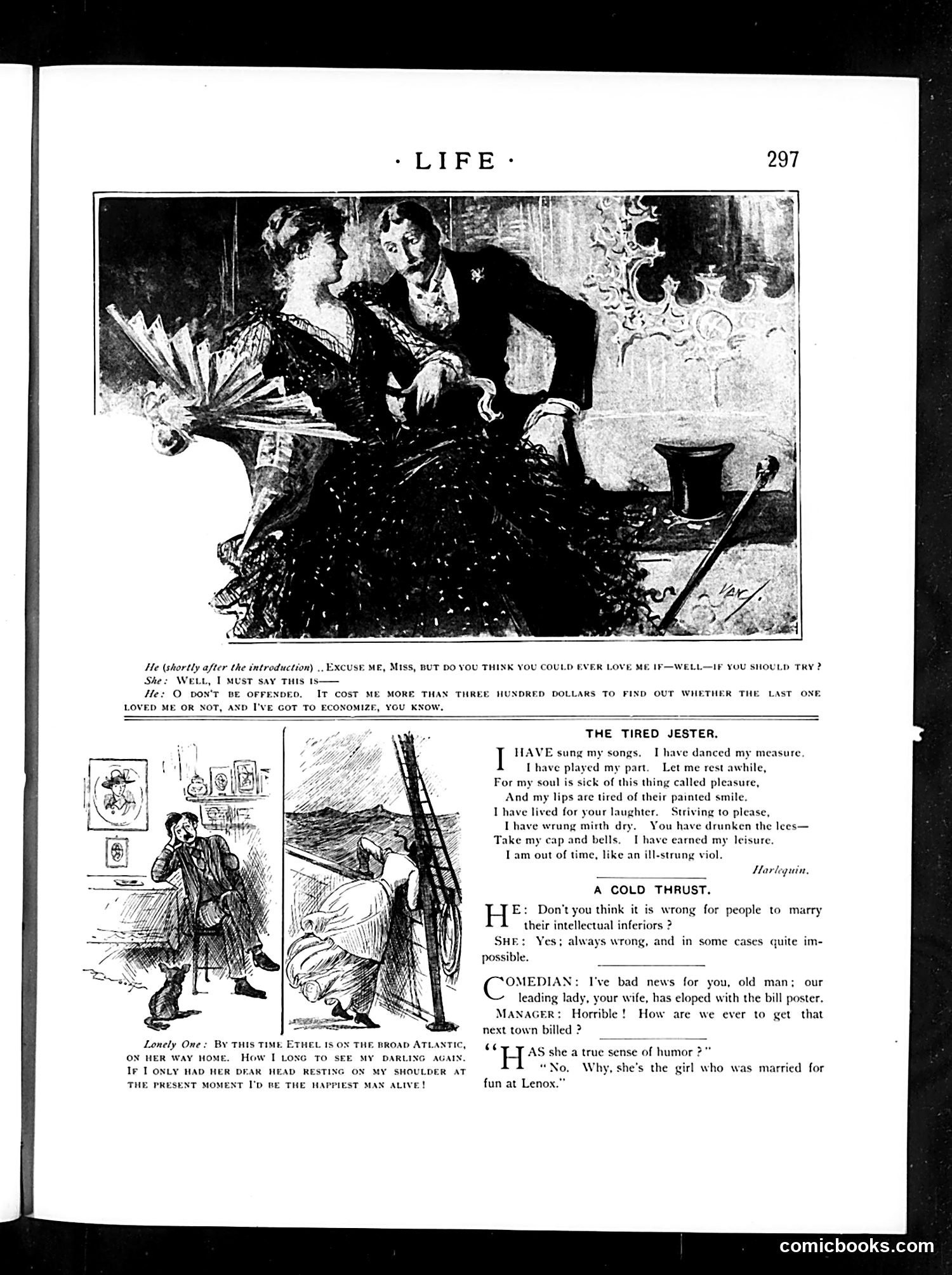
This page contains several unrelated satirical sketches typical of Life magazine's format: **Top cartoon**: A man propositions a woman, then admits he spent $300 determining whether his previous girlfriend actually loved him—implying he's now "economizing" by testing this new prospect. The satire targets male calculation in romance and the absurdity of monetizing emotional certainty. **"Lonely One"**: A sentimental sketch mocking theatrical melodrama—a man pining for his absent "Ethel" on a ship, expressing overwrought devotion. **"The Tired Jester"**: A poem (attributed to Harlequin) lamenting the exhaustion of performing entertainment for others' amusement, suggesting burnout from constant pleasure-making. **"A Cold Thrust"**: A manager is horrified his wife eloped with a bill poster—yet his first concern is practical: who will advertise the next town? The joke satirizes misplaced priorities and cynical show-business attitudes. **Final quip**: A woman married "for fun at Lenox" (a wealthy resort town) presumably lacks genuine humor or substance—satirizing marriages based on leisure and status rather than compatibility.
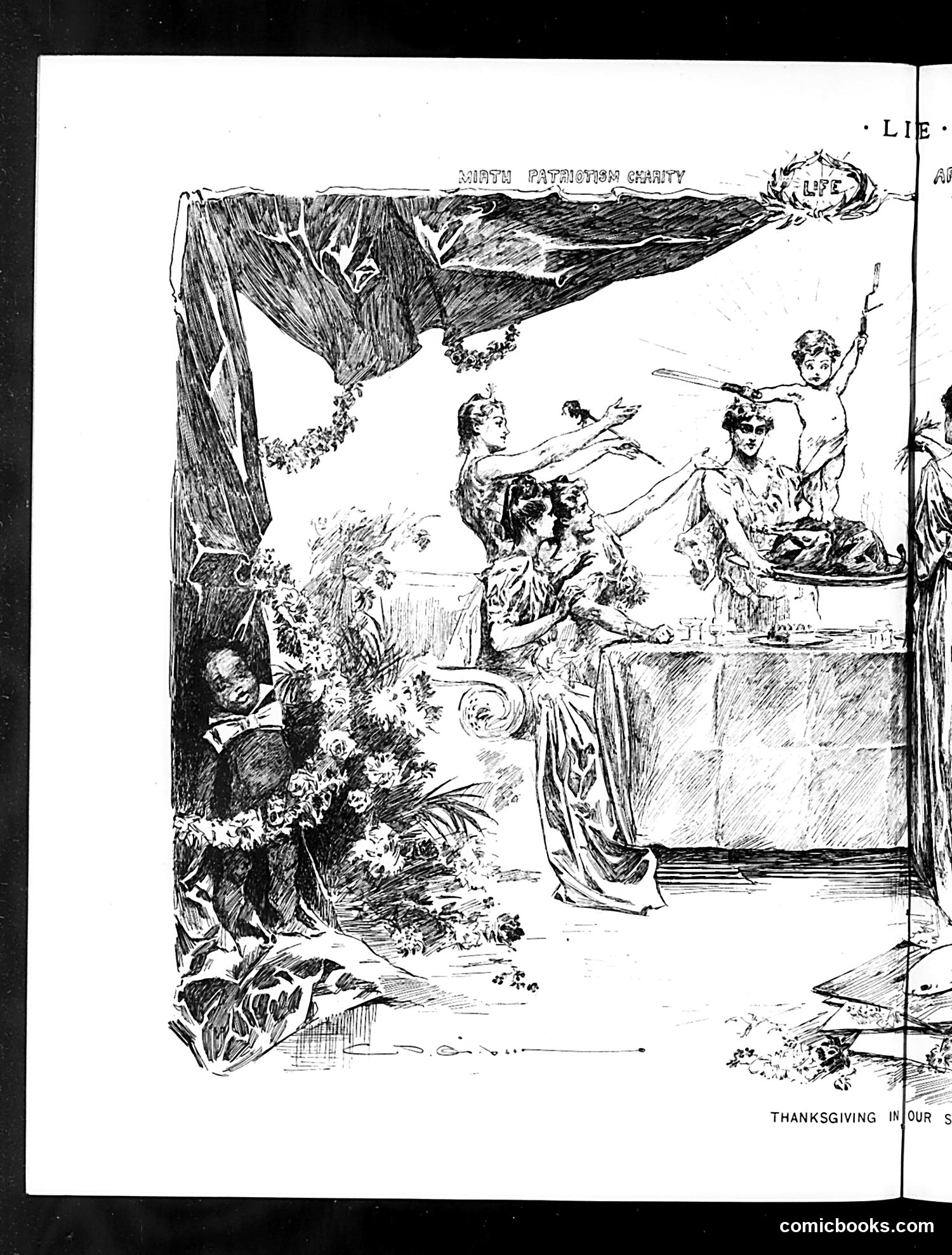
This appears to be a satirical illustration from *Life* magazine depicting a Thanksgiving scene with allegorical or patriotic figures. The image shows elegantly dressed women and cherubs in classical style, with one figure at the top appearing goddess-like or Liberty-inspired, overlooking a domestic thanksgiving gathering below. The text fragment "THANKSGIVING IN OUR" (likely "THANKSGIVING IN OUR [country/nation]") suggests this is patriotic commentary. The classical aesthetic—draped fabrics, cherubs, idealized figures—combined with the domestic scene below likely contrasts lofty national ideals with practical reality, typical of *Life*'s satirical approach. Without seeing the complete caption or article text, the precise political message remains unclear, though it appears to celebrate or comment on American national identity during a Thanksgiving context.
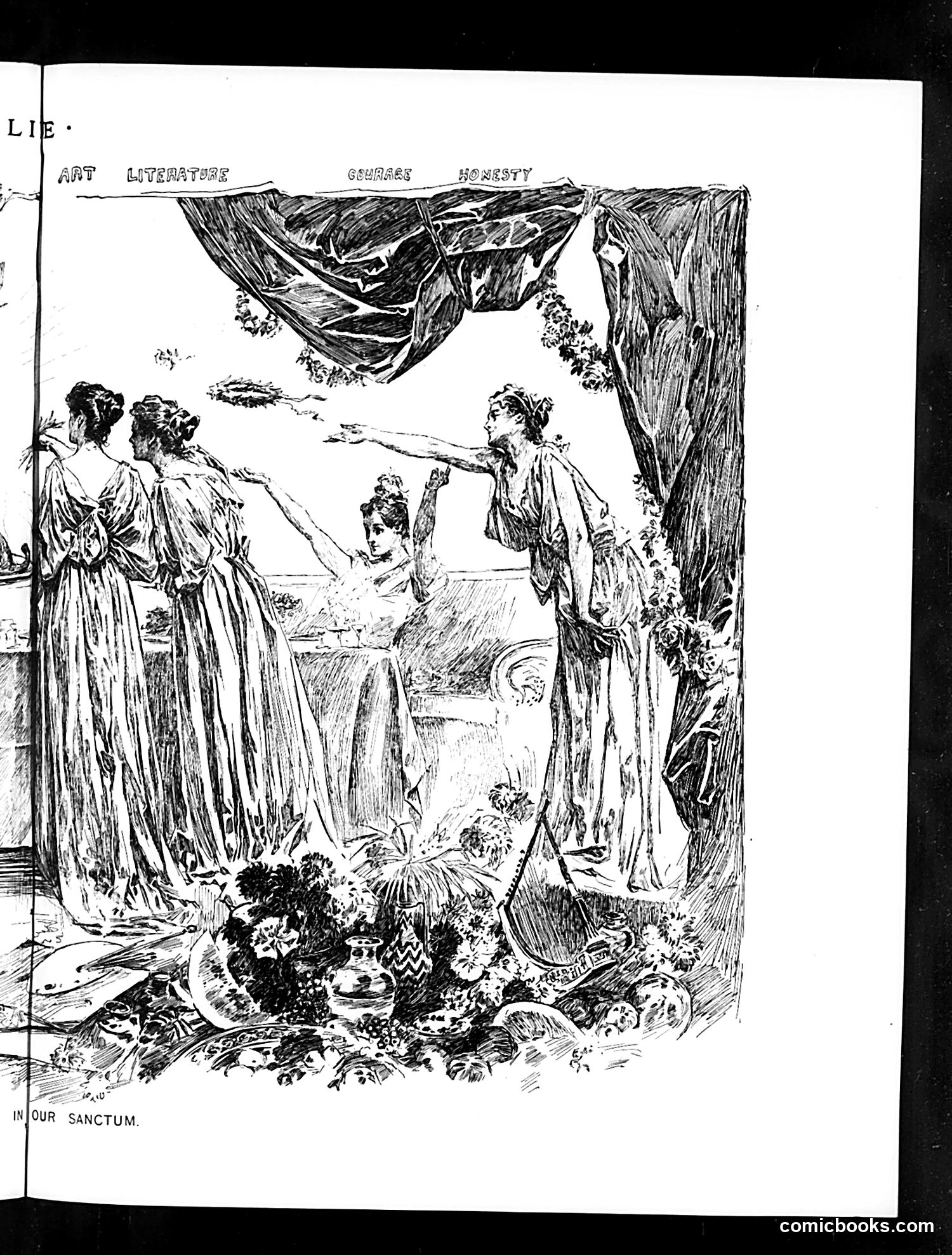
This appears to be an illustration titled "In Our Sanctum" depicting an idealized, classical scene of elegant women in flowing Greco-Roman style robes gathered in an ornate interior space. The header labels suggest categories: "Art," "Literature," "Figures," "Honesty." The satire likely mocks the pretensions of high culture and artistic circles—the elaborate classical setting and draped figures suggesting aspirations to refined aesthetics. The inclusion of "Honesty" as a labeled category alongside art and literature implies ironic commentary, suggesting such circles lack genuine authenticity or truthfulness despite their refined appearance. The detailed decorative elements (flowers, vessels, fabrics) reinforce the emphasis on superficial aesthetic beauty over substantive content, a common target of Life magazine's satirical critique of American cultural pretension in this era.
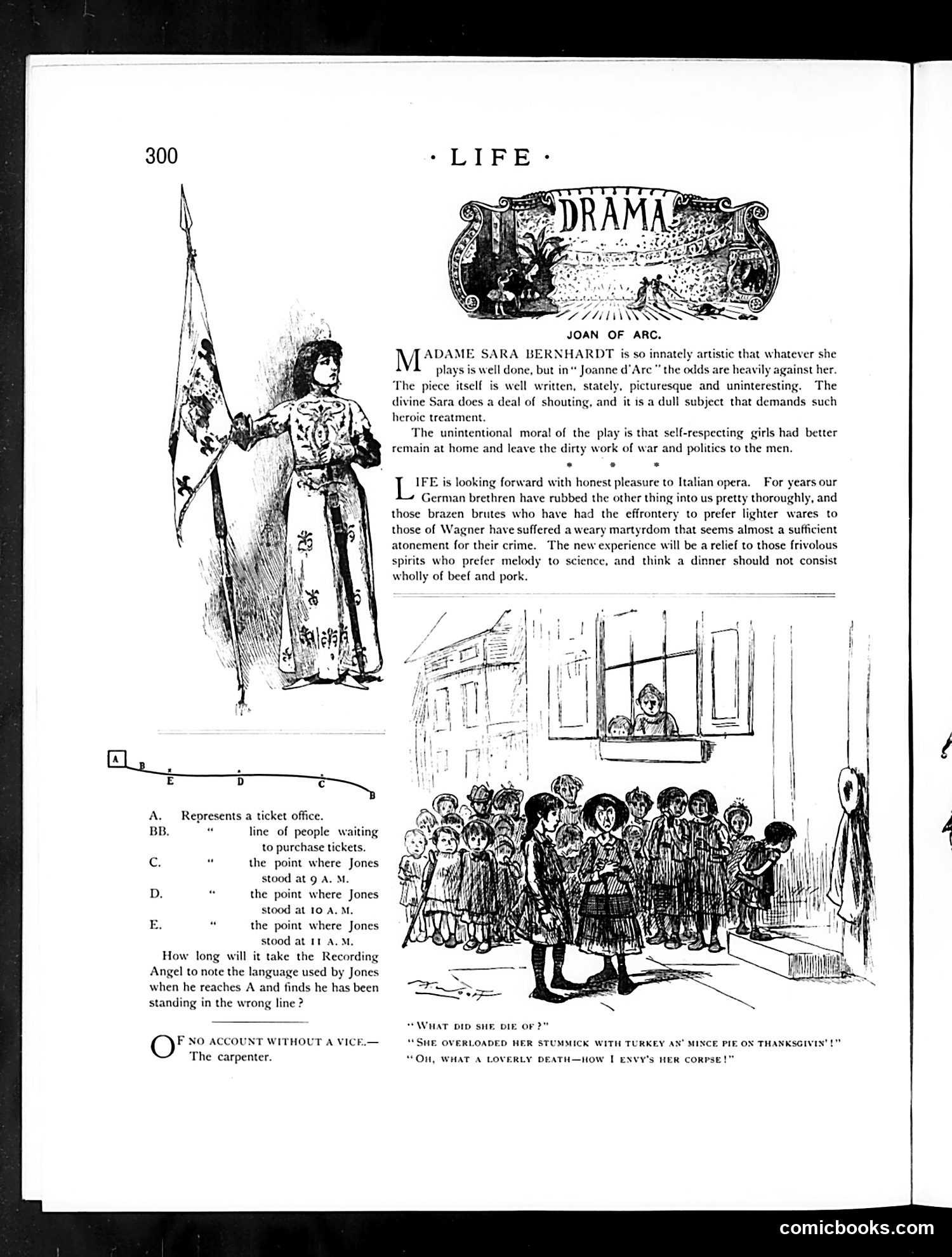
This page from *Life* magazine critiques actress Sarah Bernhardt's performance in a play about Joan of Arc. The review dismisses both the production (calling it "uninteresting" despite fine writing) and Bernhardt's acting style (excessive shouting). The satire's real bite is its closing moral: the piece suggests women should stay home rather than involve themselves in "war and politics"—a barbed commentary on female ambition and public participation. Below, a diagram illustrates a practical joke about theater lines: a man (Jones) stands in the wrong queue at the ticket office, moving progressively further back. The humor lies in imagining the profanity he'll unleash when discovering his mistake—playing on working-class speech. A separate section mocks Wagner's dominance in German cultural preferences, expressing relief that lighter Italian opera might finally offer respite from his heavy compositions. The bottom cartoon shows women gossiping about a death, written in exaggerated dialect humor typical of the era.
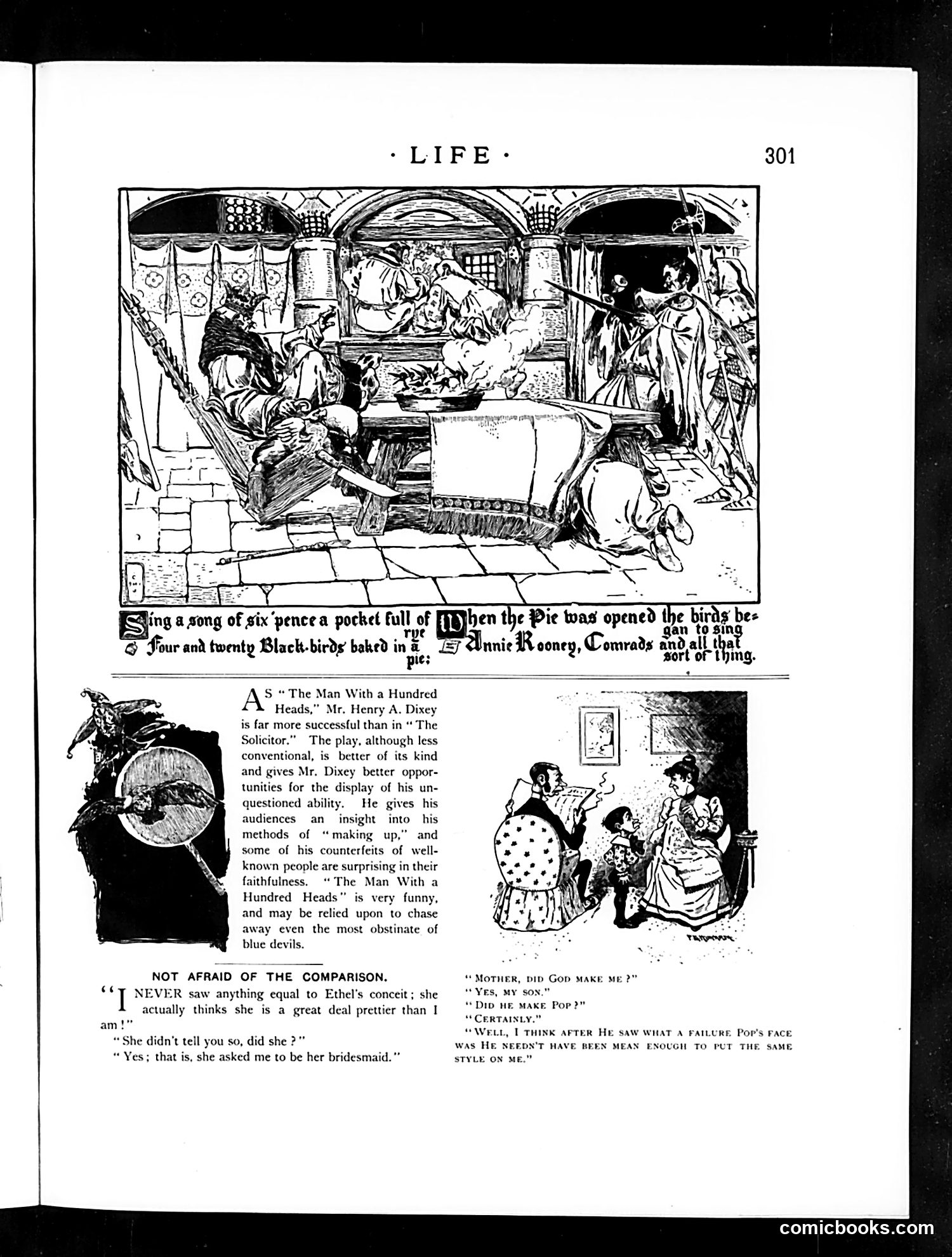
This page contains theatrical commentary and domestic humor typical of early 20th-century Life magazine. **Top section**: Reviews Henry A. Dixey's performance in "The Man With a Hundred Heads," a play featuring impressions and character transformations. The text praises Dixey's makeup artistry and ability to parody well-known people convincingly, positioning the show as comedic entertainment. **Bottom cartoons**: Two separate domestic jokes: 1. "Not Afraid of the Comparison" mocks female vanity—a woman boasts of her superior beauty, but her friend reveals she only asked to be bridesmaid (a lesser role), implying the bride disagrees with her self-assessment. 2. A child's theological humor: a boy questions why God made him with his father's unattractive face, joking that God shouldn't have copied such a failed design. Both rely on period conventions: female narcissism and paternal ugliness as comedy sources.
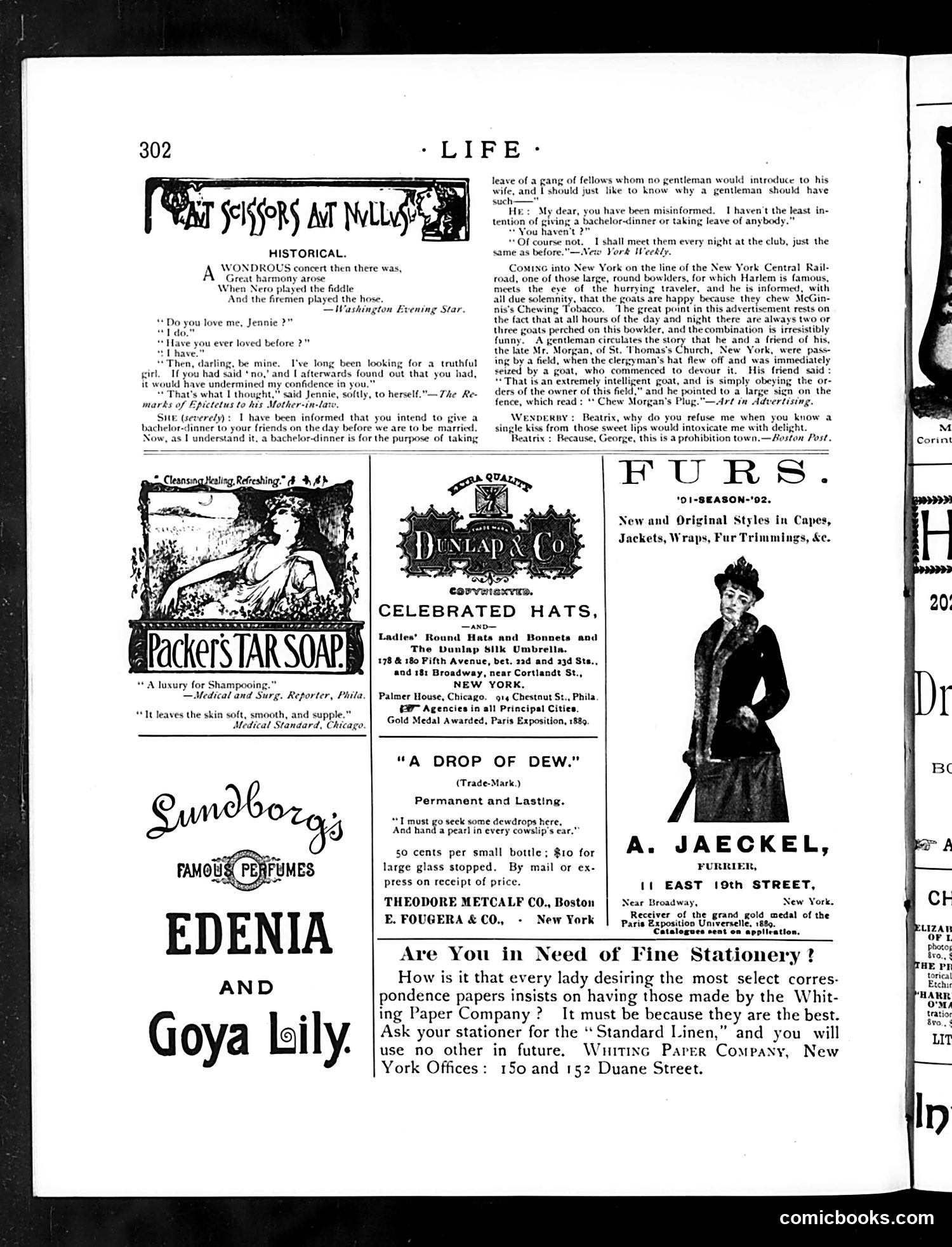
This page is primarily **advertising with occasional humor pieces**. The main content includes: **Humorous sections:** - A historical poem comparing Nero fiddling during Rome's burning to firemen playing hoses - Several brief comic dialogues about courtship, bachelor dinners, and Prohibition-era romance - An anecdote about goats on a boulder in Harlem eating McGinnis's Chewing Tobacco advertising **The satire:** These pieces mock everyday social situations—romantic dishonesty, nagging fiancées, and commercial absurdity (goats as unwitting advertisements). **Advertisements:** The bulk of the page promotes luxury goods: Packer's Tar Soap, Sindelborg perfumes, Dunlap hats, A. Jaeckel furs, and fine stationery. **Historical context:** This reflects 1890s consumer culture and genteel humor aimed at middle/upper-class readers. The frequent marriage/courtship jokes suggest anxieties about gender relations of the era. The Prohibition reference dates this to post-1920.
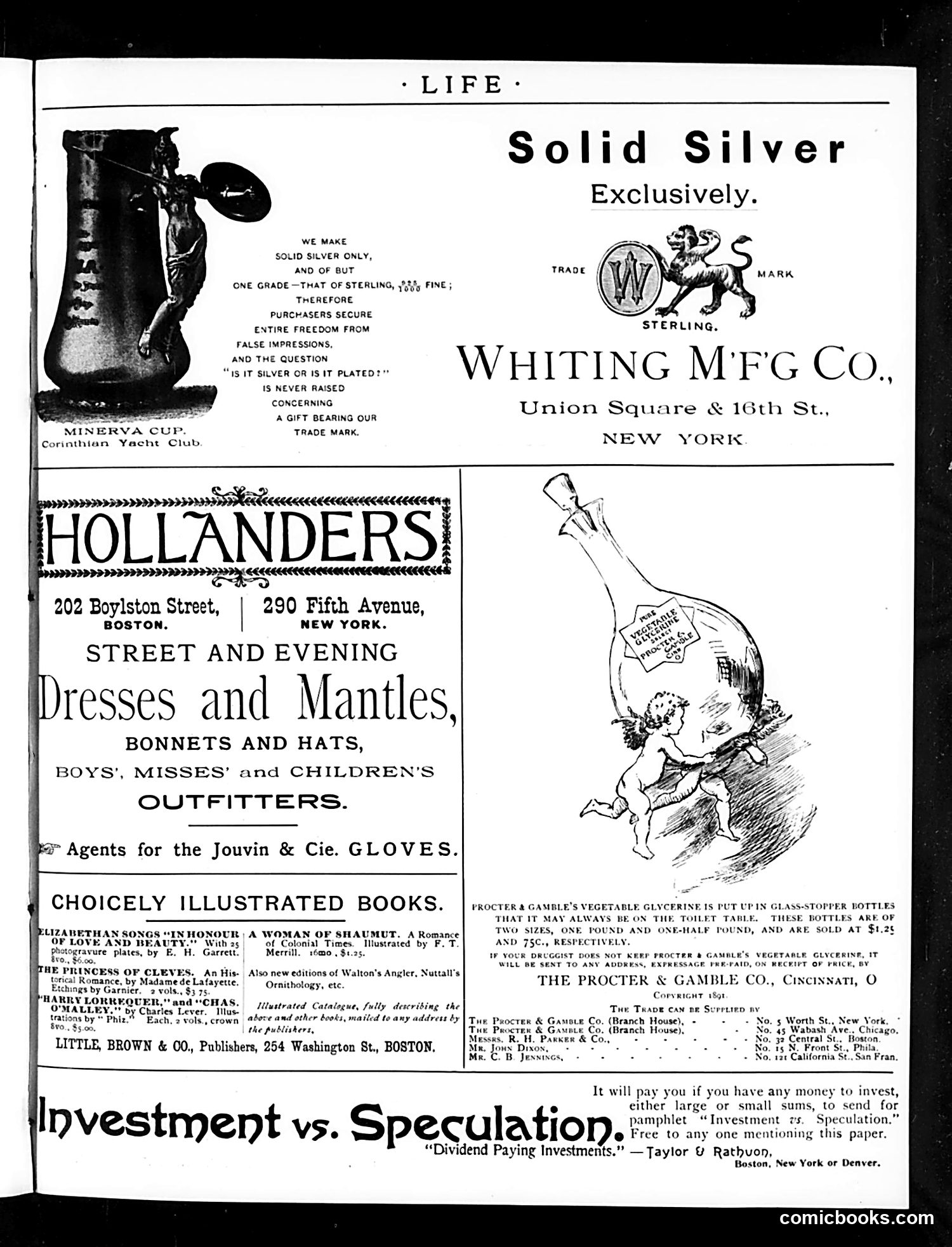
This page is primarily **advertising**, not satirical content. It contains: **Major Advertisements:** - **Whiting Mfg. Co.**: Promotes solid sterling silver goods, emphasizing quality and authenticity to counter consumer concerns about fake or plated silver—a common fraud of the era. - **Hollanders**: A Boston and New York clothing retailer advertising dresses, mantles, bonnets, hats, and children's outfits. - **Little, Brown & Co.**: Book publisher listing illustrated novels and reference works. - **Procter & Gamble**: Advertises vegetable glycerin in decorative bottles, a toiletry product, with distribution information. - **Investment vs. Speculation**: A financial advisory firm offering a free pamphlet distinguishing sound investments from risky speculation. **Historical Context**: The page reflects late 19th-century consumer anxieties—product authenticity, mail-order distribution, and financial literacy—while showcasing typical period advertising design and typography. No political satire is evident.
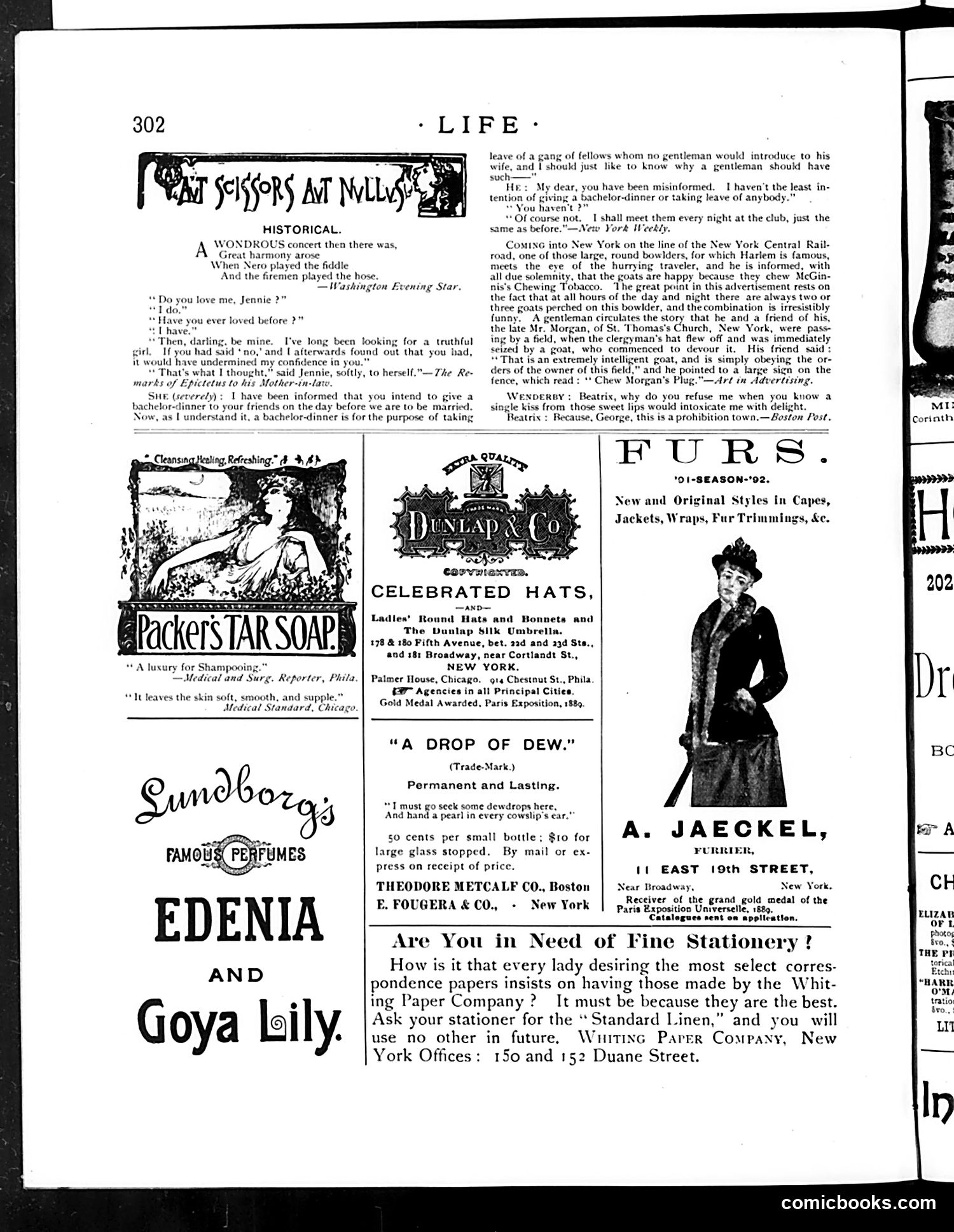
This page contains several brief satirical jokes typical of late 19th-century American humor magazines: **"Nero and the Fire"** — A classical allusion joke playing on the legend that Nero fiddled while Rome burned. The humor lies in the absurd image of a fire hose "playing" alongside Nero's fiddle, treating a historical tragedy as vaudeville. **The Bachelor Dinner Dialogue** — Satirizes the hypocrisy of engaged men. The fiancée forbids a "bachelor dinner," but the groom-to-be admits he'll simply meet the same friends at his club nightly anyway—defeating the rule's purpose entirely. **The Prohibition Town Joke** — A man cannot kiss his girlfriend because they're in a "prohibition town," playing on temperance movement concerns of the era. **"Chew Morgan's Plug"** — Mocks absurd advertising claims, particularly a fictional story where a goat eats a clergyman's hat because a sign supposedly instructs it to "chew Morgan's Plug" tobacco. The page is primarily **advertisements** for period products (soap, hats, perfumes, furs, stationery), interspersed with these brief witty anecdotes—typical Life magazine format.
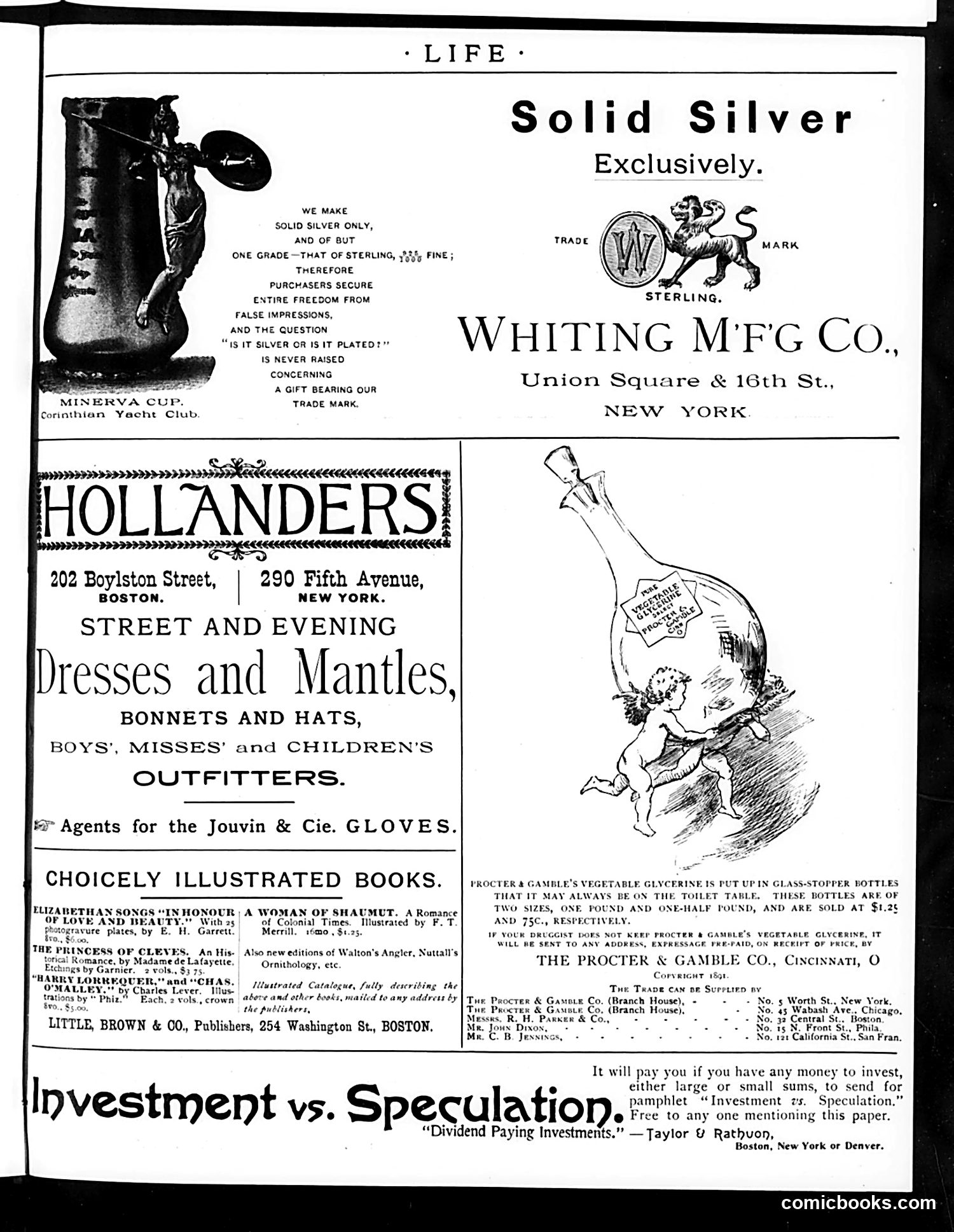
This is primarily a **commercial advertisement page** from *Life* magazine, not a political cartoon. The page contains multiple product advertisements: **Main advertisements:** - **Whiting Manufacturing Co.**: Solid sterling silver tableware, emphasizing quality and authenticity ("Is it silver or is it plated?" — addressing consumer concerns about fake goods) - **Hollanders**: Boston and New York clothier selling dresses, mantles, bonnets, hats, and children's outfits - **Little, Brown & Co.**: Publishers advertising illustrated books including historical romances - **Procter & Gamble**: Vegetable glycerine sold in glass bottles for toiletry use **Bottom:** A financial services advertisement promising a free pamphlet on "Investment vs. Speculation" for potential investors. The page reflects late 19th-century consumer culture—quality assurances matter for silver goods, fashion retail targets multiple demographics, and financial literacy materials appeal to the magazine's prosperous readership.
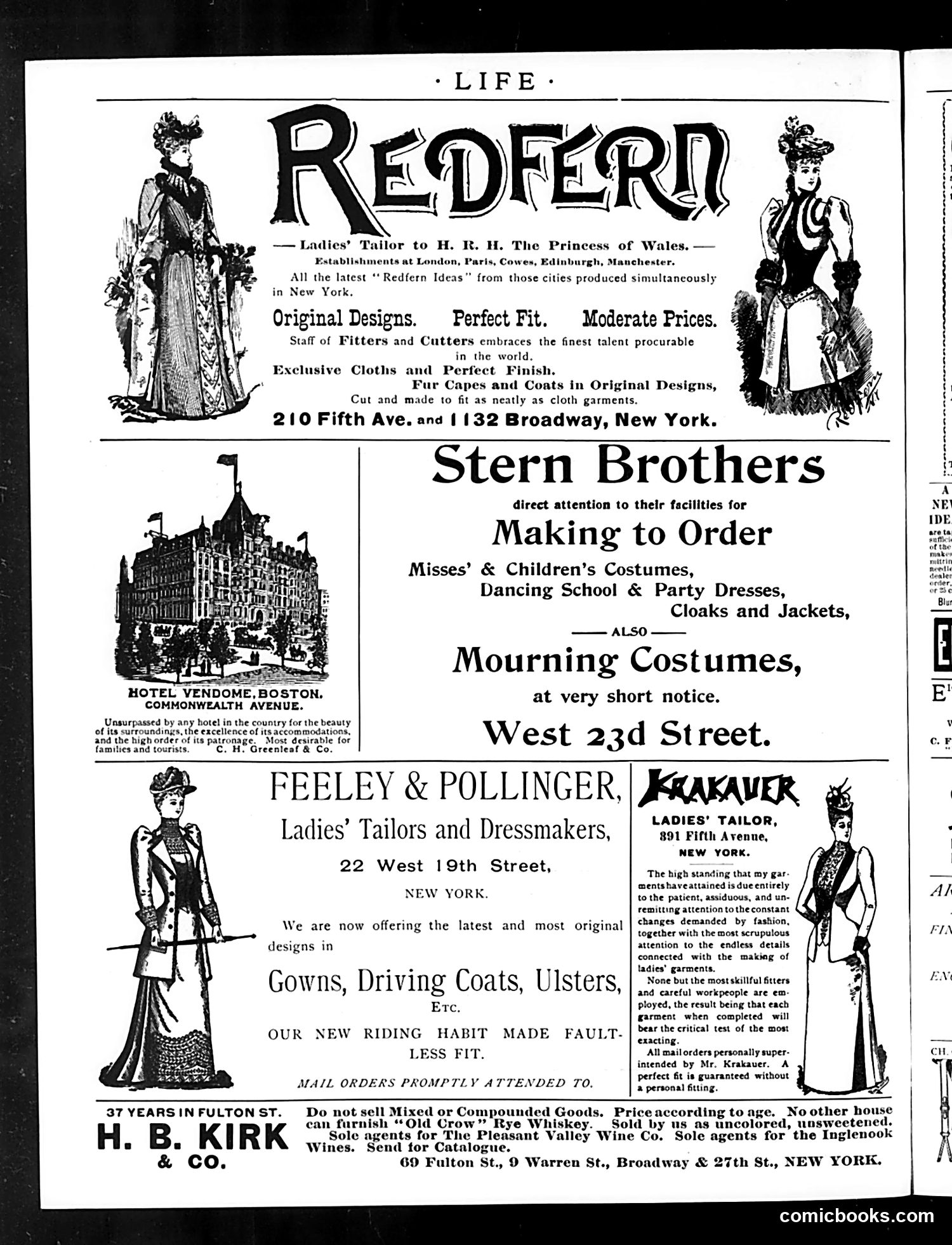
This page is **primarily advertising**, not satirical content. It showcases high-end fashion and commercial services from late 19th/early 20th-century New York. ## Key Advertisers: **Redfern** — A prestigious ladies' tailor claiming royal patronage ("Ladies' Tailor to H.R.H. The Princess of Wales"), with international locations, emphasizing exclusive designs and perfect fit. **Stern Brothers** — Offers custom-made children's costumes, party dresses, and notably "Mourning Costumes at very short notice"—reflecting the era's elaborate mourning dress protocols. **Feeley & Pollinger** and **Krakauer** — Competing ladies' tailors emphasizing skilled craftsmanship and mail-order service. **H.B. Kirk & Co.** — A liquor merchant highlighting their exclusive supply of "Old Crow" Rye Whiskey. The page reflects Victorian/Edwardian consumer culture: emphasis on custom tailoring, imported goods, international prestige, and specialized services (mourning clothes, riding habits). No cartoons or satire are present—it's a commercial advertisement section.
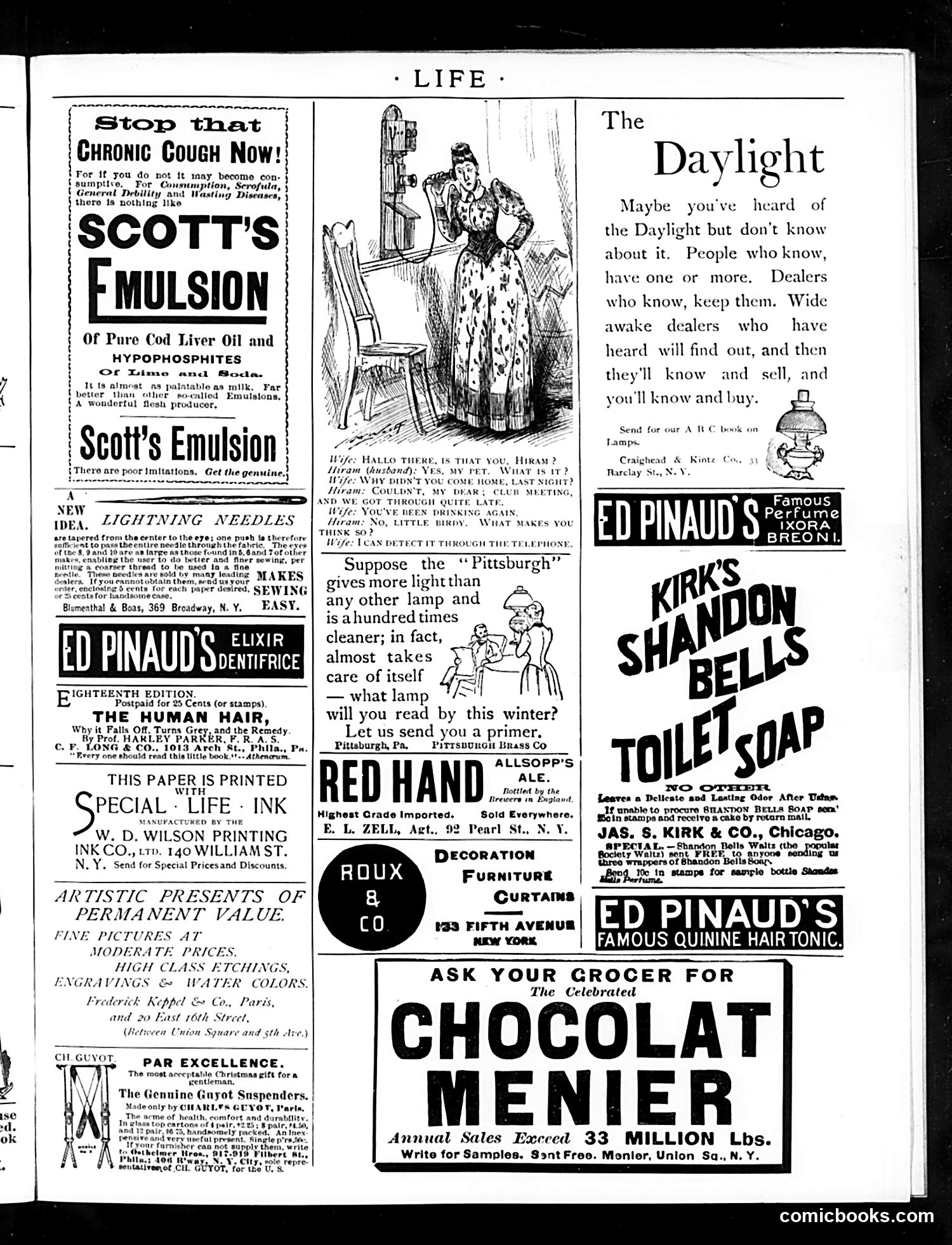
This page is primarily **advertising**, not satirical cartoons. However, it contains one small **domestic humor cartoon** (center-left) depicting a wife confronting her husband who came home late from a "club meeting." The wife suspects infidelity, claiming she can "detect it through the telephone"—likely referring to detecting alcohol on his breath or his demeanor. The joke relies on the era's tension between husbands' club socializing and wives' suspicions about their fidelity. The rest of the page is filled with period product advertisements: Scott's Emulsion (a cod liver oil remedy for coughs), dental products, furniture, perfume, ale, chocolate, and hair tonic. These ads reflect early 20th-century consumer culture and common health anxieties. The "Daylight" lamp advertisement references lighting technology competition of the era. No political satire or notable caricatures appear on this page.
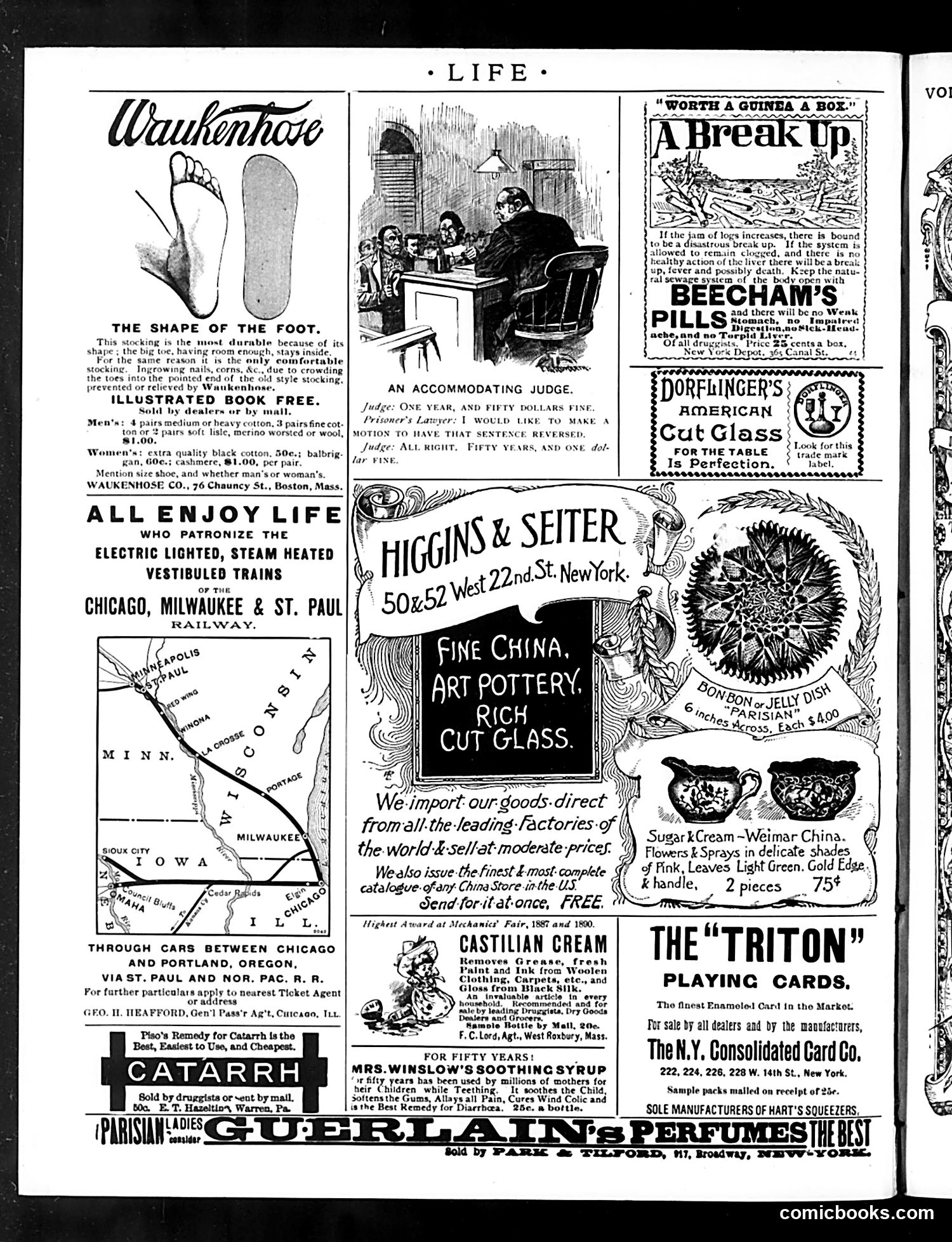
This cartoon satirizes judicial leniency and corruption. A judge initially sentences a prisoner to one year and a $50 fine, but when the prisoner's lawyer requests to reverse the sentence, the judge—described as "accommodating"—dramatically increases it to fifty years and one dollar. The satire targets the apparent absurdity and arbitrariness of judicial sentencing. The punchline hinges on the judge's willingness to be "accommodating" to legal motions, suggesting judges could be swayed by procedural requests rather than justice. The reversed fine (now only $1) adds dark comedy: the punishment is exponentially harsher in years but trivially lighter in monetary terms. This reflects late-19th-century concerns about judicial discretion, courtroom manipulation by lawyers, and whether justice was truly blind or susceptible to legal maneuvering and judge favoritism. The cartoon mocks both the judicial system's unpredictability and the cynicism of legal practice.