
Life, 1891-11-19 · page 12 of 24
Life — November 19, 1891 — page 12: what you’re looking at
What you’re looking at
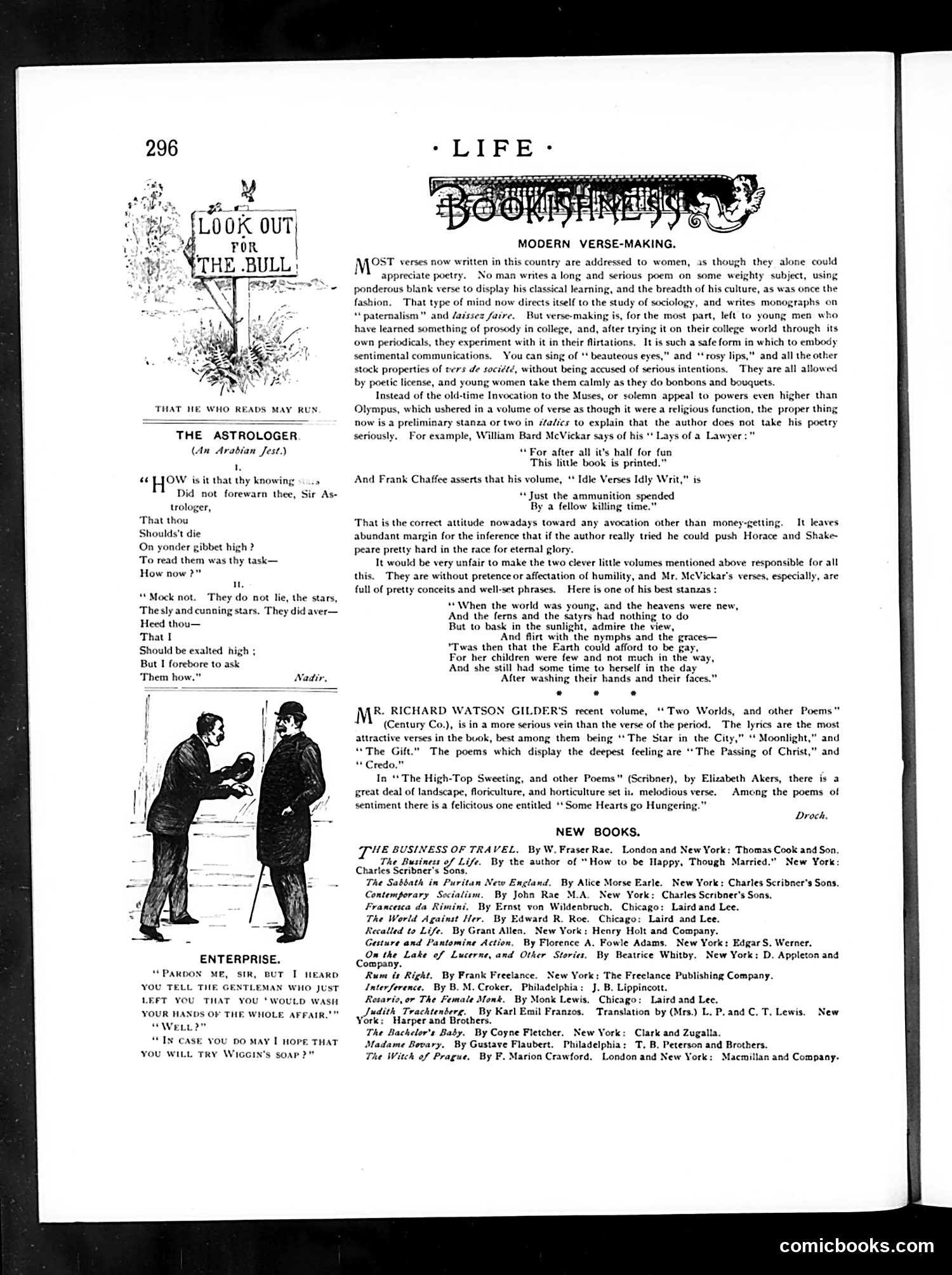
This page from *Life* magazine contains literary criticism and satirical cartoons mocking contemporary trends. **"The Astrologer" cartoon** is a classical jest: an astrologer condemned to hang claims the stars predicted his "exaltation"—a pun on being elevated (to heaven via gallows). The joke satirizes fortune-tellers' vague pronouncements and self-serving interpretations. **"Enterprise" cartoon** depicts a man telling someone he'll "wash his hands" of a matter, then immediately asking the listener to try Wiggins Soap. The satire targets hypocrisy and opportunism: even while claiming moral disengagement, he seizes a commercial angle. **The essay "Modern Verse-Making"** critiques contemporary poets for writing trivial, flirtatious verses addressed only to women while dismissively claiming they're "just for fun." The author argues this reflects broader cultural frivolity—that serious intellectual effort is now considered unfashionable except in moneymaking. The essay suggests modernity has abandoned classical ambition for cynical pragmatism.
📄 Transcribed text from this page (OCR, searchable)
Machine-transcribed from the original scan — historical spelling and the odd misread are preserved.
LOOK oun A ror THE .BULL: rm ¥ DT, THAT NE WHO READS MAY RUN THE ASTROLOGER (An Arabian Jest.) iy ¢¢ LJOW is it that thy knowing «\..5 Did not forewarn thee, Sir As- trologer, ‘That thou Shoulds’t die On yonder gibbet high ? To read them was thy task— How now ?” Me ock not. ‘They do not lie, the stars, ‘Thesly and cunning stars. They did aver— Heed thou— That I Should be exalted high ; But I forebore to ask ‘Them how. H | I ENTERPRISE. “PARDON ME, SIR, BUT T HEARD YOU TELL THE GENTLEMAN WHO JUST LEFT YOU THAT YoU ‘WOULD Wasi YOUR HANDS OF THE WHOLE AFFAIR.'” Wenn?” In CASE You po May I Hore THAT YOU WILL TRY WiGGIN's Soap?” MODERN VERSE-MAKING. MOST verses now written in this country are addressed to women, as though they alone could SY appreciate poetry. No man writes a long and serious poem on some weighty subject, using ponderous blank verse to display his classical learning, and the breadth of his culture, as was once the fashion, That type of mind now directs itself to the study of sociology, and writes monographs on “paternalism” and /arssez faire. But verse-making is, for the most part, left to young men who have learned something of prosody in college, and, after trying it on their college world through its own periodicals, they experiment with it in their flirtations, It is such a safe form in which to embody sentimental communications. You can sing of ** beauteous eyes,” and “rosy lips,” and all the other stock properties of vers de société, without being accused of serious intentions. They are all allowed by poetic license, and young women take them calmly as they do bonbons and bouquets. Instead of the old-time Invocation to the Muses, or solemn appeal to powers even higher than Olympus, which ushered in a volume of verse as though it were a religious function, the proper thing now is a preliminary stanza or two in ‘fafics to explain that the author does not take his poetry seriously. For example, William Bard McVickar says of his ‘+ Lays of a Lawyer :” “For after all it's half for fun This little book is printed.” And Frank Chaffee asserts that his volume, ‘* Idle Verses Idly Writ,” is “Just the ammunition spended By a fellow killing time.” That is the correct attitude nowadays toward any avocation other than money-getting. It leaves abundant margin for the inference that if the author really tried he could push Horace and Shake- peare pretty hard in the race for eternal glory. It would be very unfair to make the two clever little volumes mentioned above responsible for all this, They are without pretence or affectation of humility, and Mr. McVickar's verses, especially, are full of pretty conceits and well-set phrases. Here is one of his best stanzas : “When the world was young, and the heavens were new, And the ferns and the satyrs had nothing to do But to bask in the sunlight, admire the view, And flirt with the nymphs and the graces— 'Twas then that the Earth could afford to be gay, For her children were few and not much in the way, And she still had some time to herself in the day After washing their hands and their faces.” * ° * M® RICHARD WATSON GILDER'S recent volume, “Two Worlds, and other Poems” (Century Co.), is in a more serious vein than the verse of the period. The lyrics are the most attractive verses in the buok, best among them being ‘The Star in the City,” Moonlight,” and “The Gift." The poems which display the deepest feeling are “The Passing of Christ,” and “ Credo.” In “The High-Top Sweeting, and other Poems" (Scribner), by Elizabeth Akers, there is a great deal of landscape, floriculture, and horticulture set it. melodious verse. Among the poems of sentiment there is a felicitous one entitled ‘ Some Hearts go Hungering.”” Droch. NEW BOOKS. THE BUSINESS OF TRAVEL, By W. Fraser Rae. London and New Yor The Business of Life. Chartes Sertbact's Sons! The Sabbath in Puritan New England. By Alice Morse Earle. New York: Charles Scribner's Sons, Contemporary Socialism. By John Rae M.A. New York: Charles Scribner's Sons, Franceca da Rimini, By Ernst von Wildenbruch. Chicago: Laird and Lee. The World Against Her. By Edward R. Roe. Chicago: Laird and Lee. Recalled to Life. By Grant Allen, New York: Henry Holt and Company. Gesture and Pantomine Action. By Florence A. Fowle Adams. New York: Edgar $. Werner, On the Lake of Lucerne, and Other Stories. By Beatrice Whitby. New York: D. Appleton and Company. Rum is Right, Thomas Cook and Son, By the author of “How to be Happy, Though Married." New York: By Frank Freelance. New York: The Freelance Publishing Company. Interference. By B. M. Croker. Philadelphia: J, B. Lippincott. Resario, or The Female Monk. By Monk Lewis, Chicago: Laird and Lee. Judith Trachtenberg. By Karl Emil Franzos. Translation by (Mrs.) L, P, and C, T. Lewis. York: Harper and Brothers. The Bachelor's Baby. By Coyne Fletcher. Madame Bovary. By Gustave Flaubert. The Witch of Prague, New New York: Clark and Zugalla. Philadelphia: T, B. Peterson and Brothers. By F. Marion Crawford. London and New York: Macmillan and Company. comicbooks.com