
Life, 1891-11-19 · page 6 of 24
Life — November 19, 1891 — page 6: what you’re looking at
What you’re looking at
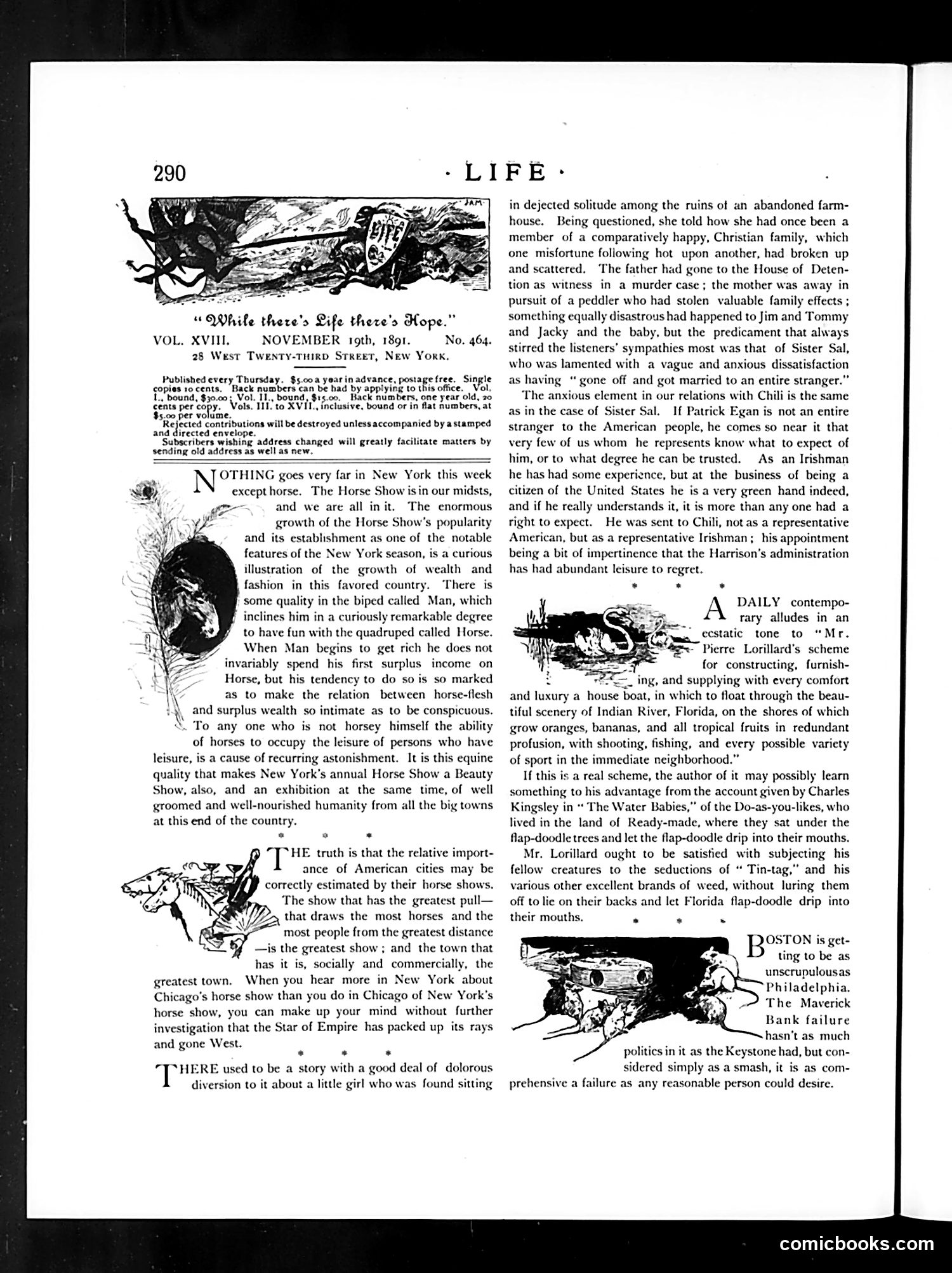
This page from *Life* (November 19, 1891) contains satirical commentary on New York's Horse Show rather than political cartoons. The text critiques how wealthy New Yorkers obsessively display horses and fashion at this event—treating it as a status symbol of conspicuous consumption. The author mocks the "equine quality" that marks the newly rich, suggesting their tendency to show off wealth through horses reflects insecurity about social standing. The accompanying illustrations appear to depict horses and riders, visually supporting the article's mockery of horse-show culture. The piece also references an unrelated anecdote about an unfortunate girl found in rural poverty—likely contrasting American wealth disparities. The tone is characteristically sardonic about Gilded Age materialism and social pretension.
📄 Transcribed text from this page (OCR, searchable)
Machine-transcribed from the original scan — historical spelling and the odd misread are preserved.
“While there's Life there's Hope.” XVII. NOVEMBER oth, 1891. No. 464. 28 West Twenty-Tirp Street, New York, VOL. Published every Thursday. $5.00 year in advance, postage free. Single copies ro cents, Back numbers can be had by applying to this office. Vol. 1., bound, $30.00; Vol. I1., bound, $15.00. Back numbers, one year old, 20 cents per copy. Vols. III. to XVIT, inclusive, bound or in flat numbers, at $5.00 per volume. Rejected contributions will be destroyed unless accompanied by a stamped and directed envelope. . Subscribers wishing address changed will greatly facilitate matters by sending old address as well as new. } OTHING goes very far in New York this week except horse. The Horse Show isin our midsts, and we are all init. The enormou: growth of the Horse Show's popularity and its establishment as one of the notable features of the New York season, is a curious illustration of the growth of wealth and fashion in this favored country. There is some quality in the biped called Man, which inclines him in a curiously remarkable degree to have fun with the quadruped called Horse. When Man begins to get rich he does not invariably spend his first surplus income on Horse, but his tendency to do so is so marked as to make the relation between horse-flesh and surplus wealth so intimate as to be conspicuous. To any one who is not horsey himself the ability of horses to occupy the leisure of persons who have leisure, is a cause of recurring astonishment. It is this equine quality that makes New York's annual Horse Show a Beauty Show, also, and an exhibition at the same time, of well groomed and well-nourished humanity from all the big towns at this end of the country, « ® . | a C *\ “7"HE truth is that the relative import- ance of American cities may be correctly estimated by their horse shows. The show that has the greatest pull— that draws the most horses and the most people from the greatest distance the greatest show ; and the town that has it is, socially and commercially, the greatest town. When you hear more in New York about Chicago's horse show than you do in Chicago of New York's horse show, you can make up your mind without further investigation that the Star of Empire has packed up its rays and gone West. . * . “TPHERE used to be a story with a good deal of dolorous diversion to it about a little girl who was found sitting in dejected solitude among the ruins of an abandoned farm- house. Being questioned, she told how she had once been a member of a comparatively happy, Christian family, which one misfortune following hot upon another, had broken up and scattered. The father had gone to the House of Deten- tion as witness in a murder case ; the mother was away in pursuit of a peddler who had stolen valuable family effects ; something equally disastrous had happened to Jim and Tommy and Jacky and the baby, but the predicament that always stirred the listeners’ sympathies most was that of Sister Sal, who was lamented with a vague and anxious dissatisfaction as having “gone off and got married to an entire strange! The anxious element in our relations with Chili is the same as in the case of Sister Sal. If Patrick Egan is not an entire stranger to the American people, he comes so near it that very few of us whom he represents know what to expect of him, or to what degree he can be trusted. As_an Irishman he has had some experience, but at the business of being a citizen of the United States he is a very green hand indeed, and if he really understands it, it is more than any one had a right to expect. He was sent to Chili, not as a representative American, but as a representative Irishman; his appointment being a bit of impertinence that the Harrison's administration has had abundant leisure to regret. DAILY contempo- rary alludes in an ‘ (a tone to “Mr. Bo '4ex- Pierre Lorillard’s scheme for constructing, furnish- =~. ing, and supplying with every comfort and luxury a house boat, in which to float through the beau- tiful scenery of Indian River, Florida, on the shores of which grow oranges, bananas, and all tropical fruits in redundant profusion, with shooting, fishing, and every possible variety of sport in the immediate neighborhood.” If this is a real scheme, the author of it may possibly learn something to his advantage from the account given by Charles Kingsley in “ The Water Babies,” of the Do-as-you-likes, who lived in the land of Ready-made, where they sat under the flap-doodle trees and let the flap-doodle drip into their mouths. Mr. Lorillard ought to be satistied with subjecting his fellow creatures to the seductions of “ Tin-tag," and his various other excellent brands of weed, without luring them off to lie on their backs and let Florida flap-doodle drip into their mouths. I OSTON is get- ting to be as unscrupulousas Philadelphia. The Maverick Bank failure hasn’t as much politics in it as the Keystone had, but con- sidered simply as a smash, it is as com- on could desire. prehensive a failure as any reasonable pers comicbooks.com