
A complete issue · 16 pages · 1891
Life — October 22, 1891
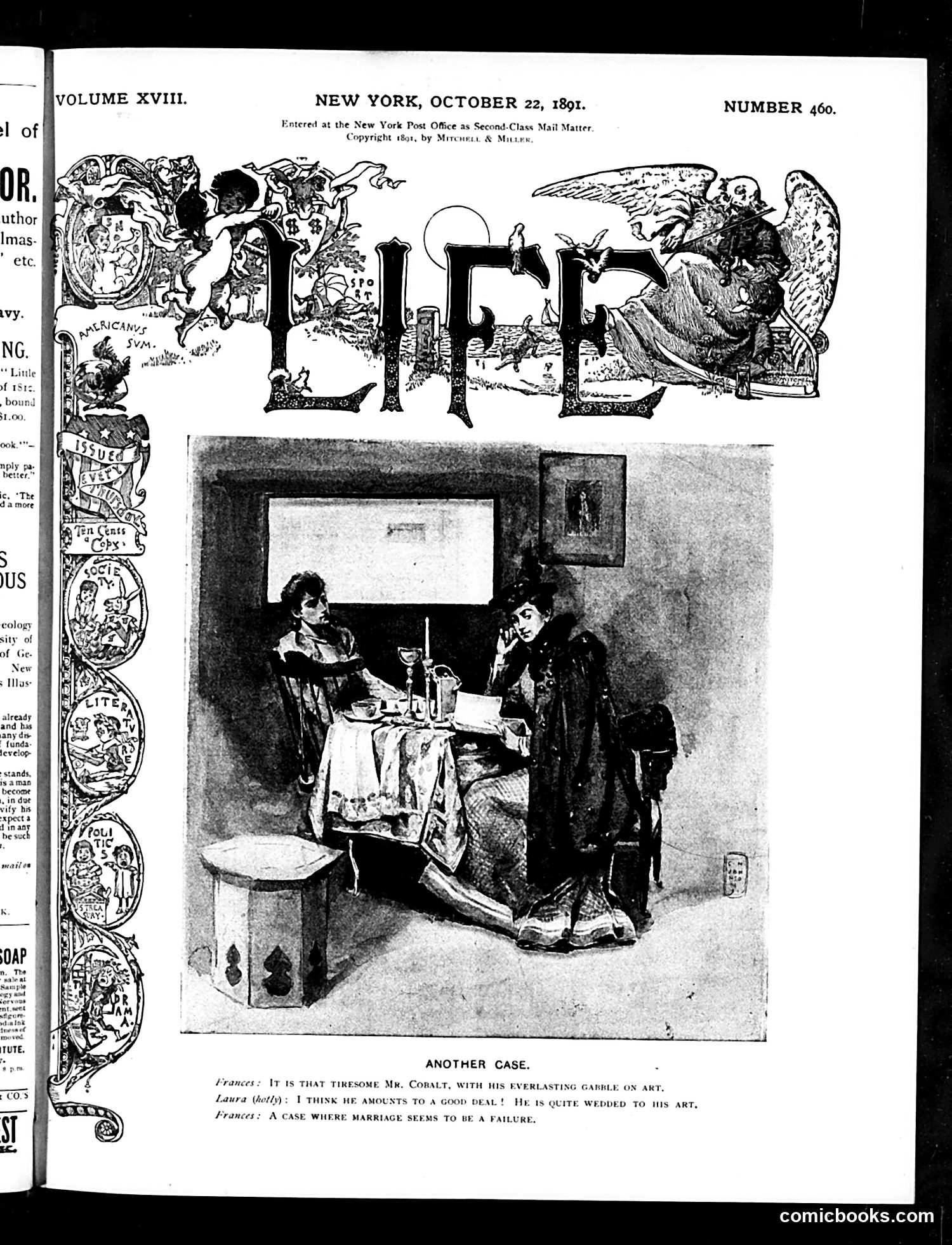
This page features a cartoon titled "Another Case" depicting two figures in an intimate domestic scene. The caption identifies one as "Mr. Cobalt" and references his "everlasting garble on art." The dialogue suggests marital discord—one character notes he "amounts to a good deal" and is "quite wedded to his art," while another observes "a case where marriage seems to be a failure." The satire appears to target artistic pretension and failed marriages among the wealthy or culturally aspirational classes. The specific reference to "Mr. Cobalt" remains unclear without additional context, though the cartoon mocks the tension between devotion to artistic pursuits and domestic obligations. The elaborate decorative borders and typography are typical of *Life* magazine's aesthetic approach to satirical commentary on contemporary social issues.
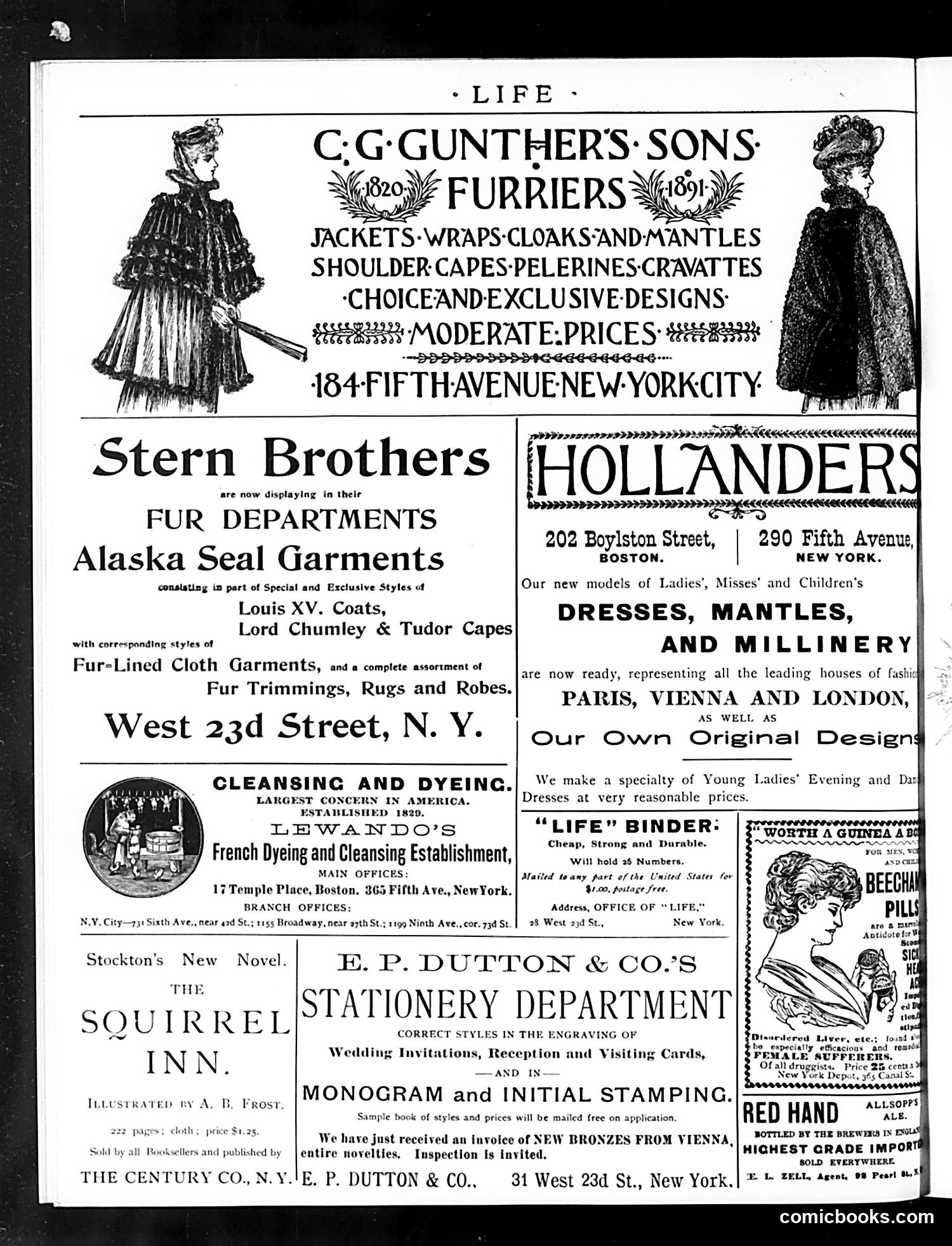
This page is primarily **advertising**, not satirical content. It features commercial notices for late 19th-century New York businesses: - **C.G. Gunther's Sons**: furrier offering cloaks, jackets, and mantles at "moderate prices" - **Stern Brothers**: department store advertising Alaska Seal garments and fur-lined clothing - **Hollanders**: Boston and New York retailer of dresses, mantles, and millinery - **French Dyeing and Cleansing Establishment**: laundry services - **E.P. Dutton & Co.**: stationery department for invitations and monogramming - **Stockton's Novel**: "The Squirrel Inn," illustrated book advertisement The illustrations show fashionable women in period dress wearing elaborate fur garments and cloaks—typical promotional imagery for upscale retailers targeting wealthy female consumers of the era. No political satire is present; this is standard Life magazine revenue-generating advertising content.
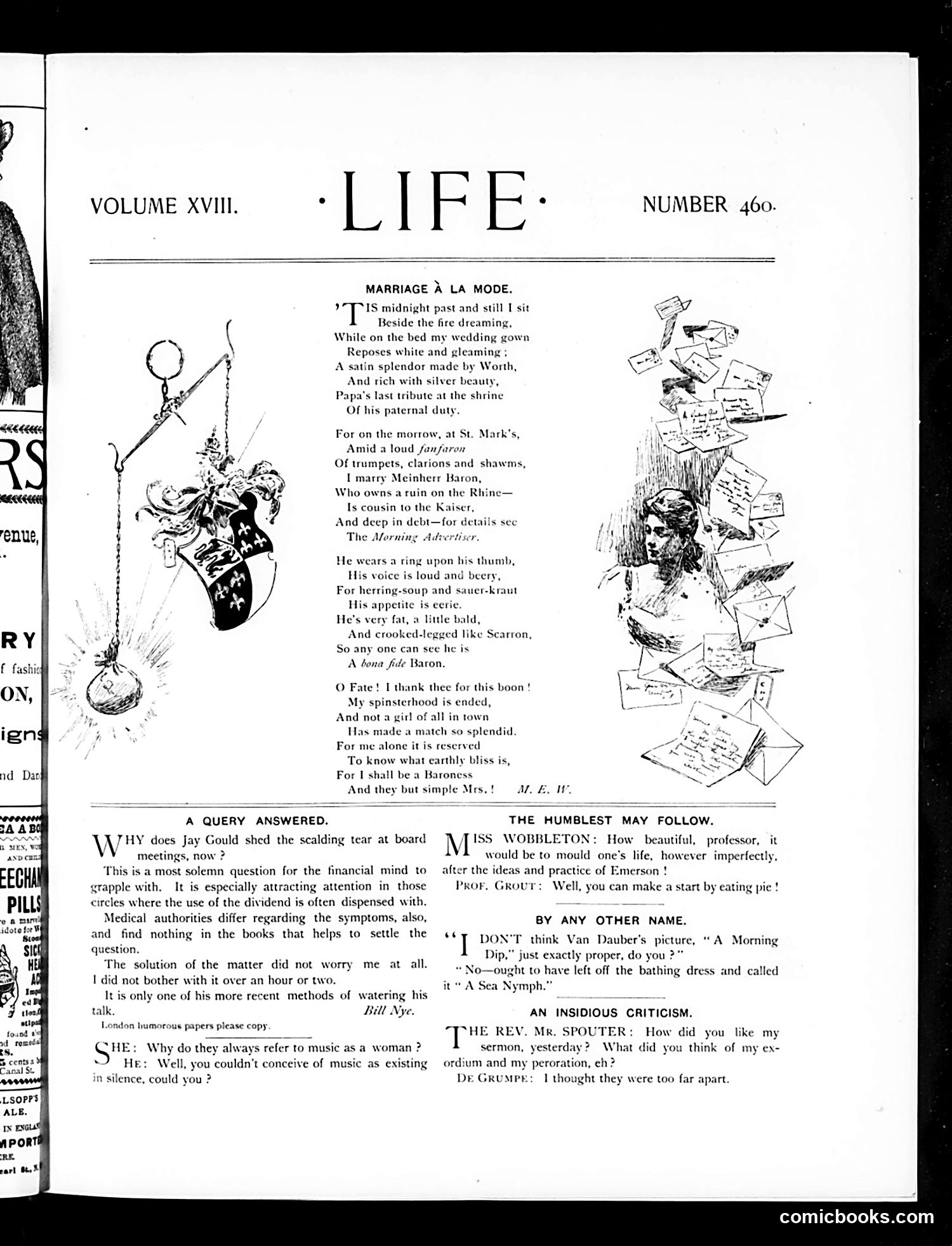
This page contains satirical humor pieces rather than political cartoons. "Marriage à la Mode" is a poem mocking a fashionable wedding announcement—the bride marries a German baron (identifiable by the heraldic shield with cross symbols) who owns a "ruin on the Rhine" and enjoys heavy German food like herring-soup and sauerkraut. The satire targets both the pretentiousness of marrying into European nobility and ethnic German stereotypes popular in early 20th-century American humor. The accompanying illustrations show scattered wedding invitations and a caricatured figure with exaggerated Germanic features, emphasizing the joke's reliance on national stereotyping. The remaining pieces are short humorous Q&As on unrelated topics—typical filler content for the magazine.
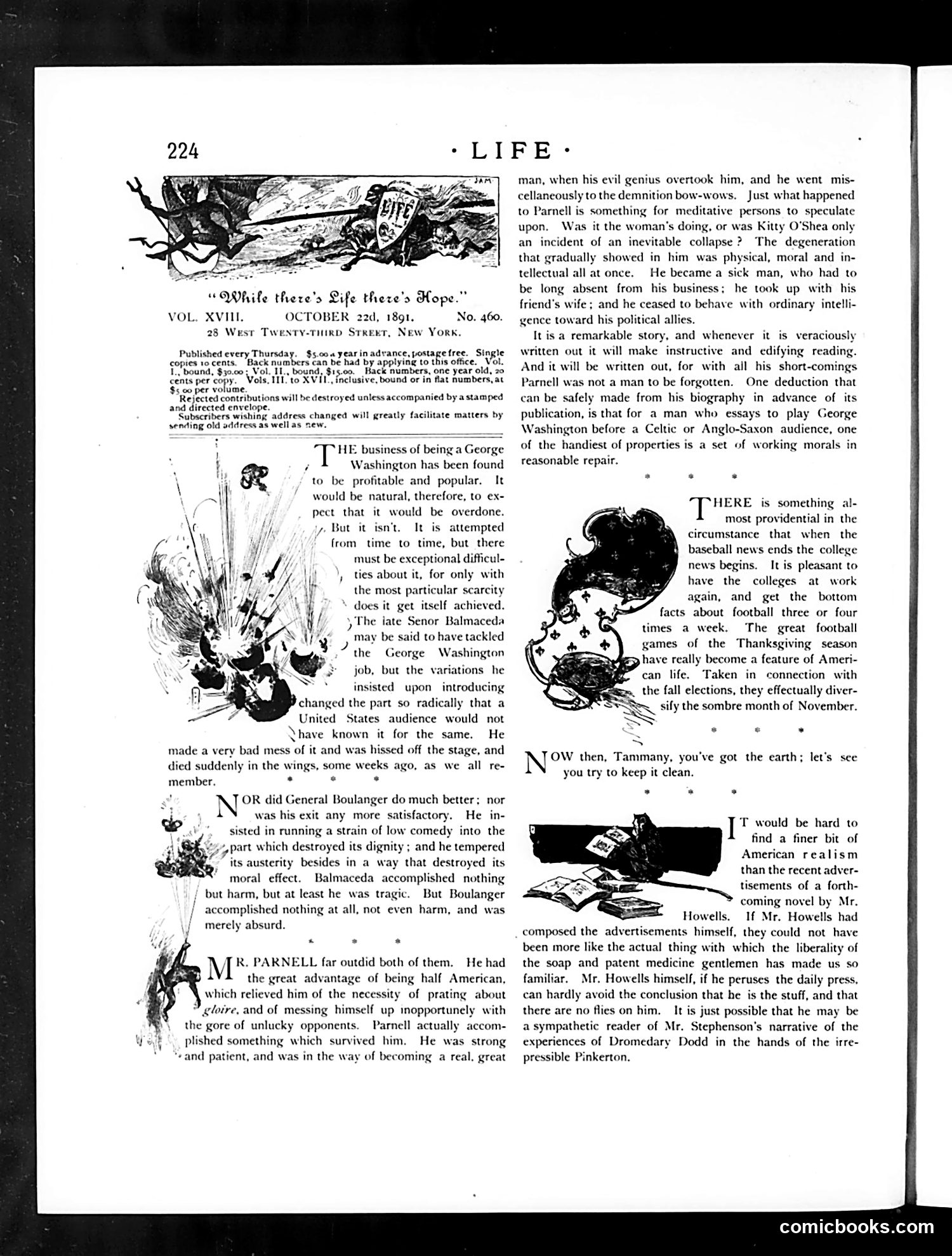
This page contains editorial commentary on theatrical figures rather than political cartoons. The text discusses George Washington play productions, specifically critiquing performances by actors Senor Balmaceda and General Boulanger in the title role. The author suggests these productions were problematic—Balmaceda's version was "a very bad mess," while Boulanger's exit "was merely absurd." The main focus is Mr. Parnell, described as "half American," who apparently succeeded where others failed through patience and strength, though his career ultimately suffered a mysterious collapse. The article emphasizes Parnell's "American realism" as superior to competitors, making this primarily theatrical criticism with nationalist undertones rather than direct political satire.
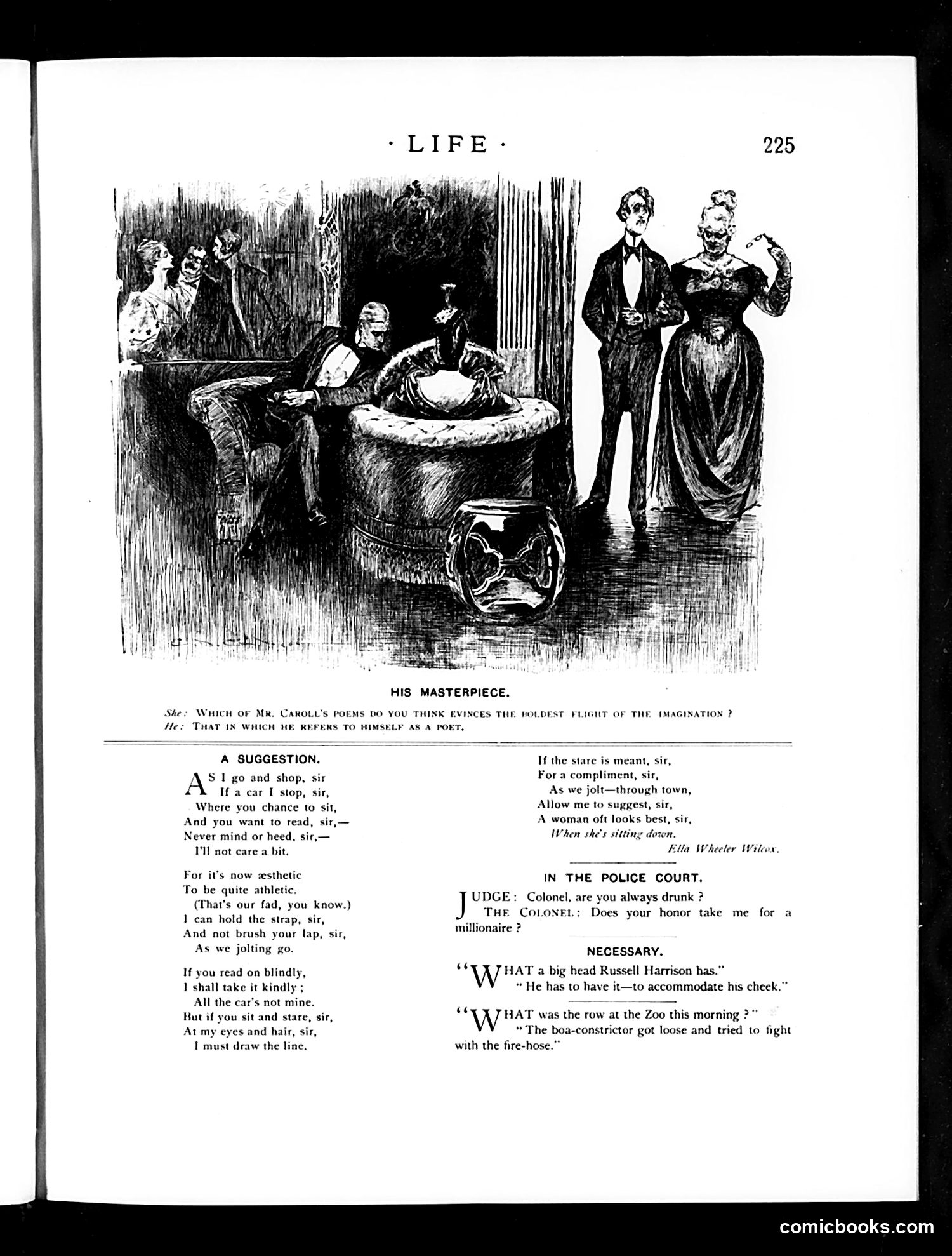
The top cartoon titled "HIS MASTERPIECE" satirizes pretentious literary criticism. A man reclines while others stand discussing poetry, with the caption showing a woman asking what poem best demonstrates "the boldest flight of the imagination," and a man responding it's the one where the poet "refers to himself as a poet." The satire mocks self-aggrandizing poets who treat self-referential work as profound genius—a critique of affected artistic pretension common in late 19th/early 20th-century literary circles. Below are three brief humor pieces: "A SUGGESTION" (a poem about aesthetic manners), "IN THE POLICE COURT" (a joke about a drunk colonel), and two one-liners about Russell Harrison's head size and a zoo incident. These are typical of *Life* magazine's mixed-content format combining visual satire with short comedic pieces.
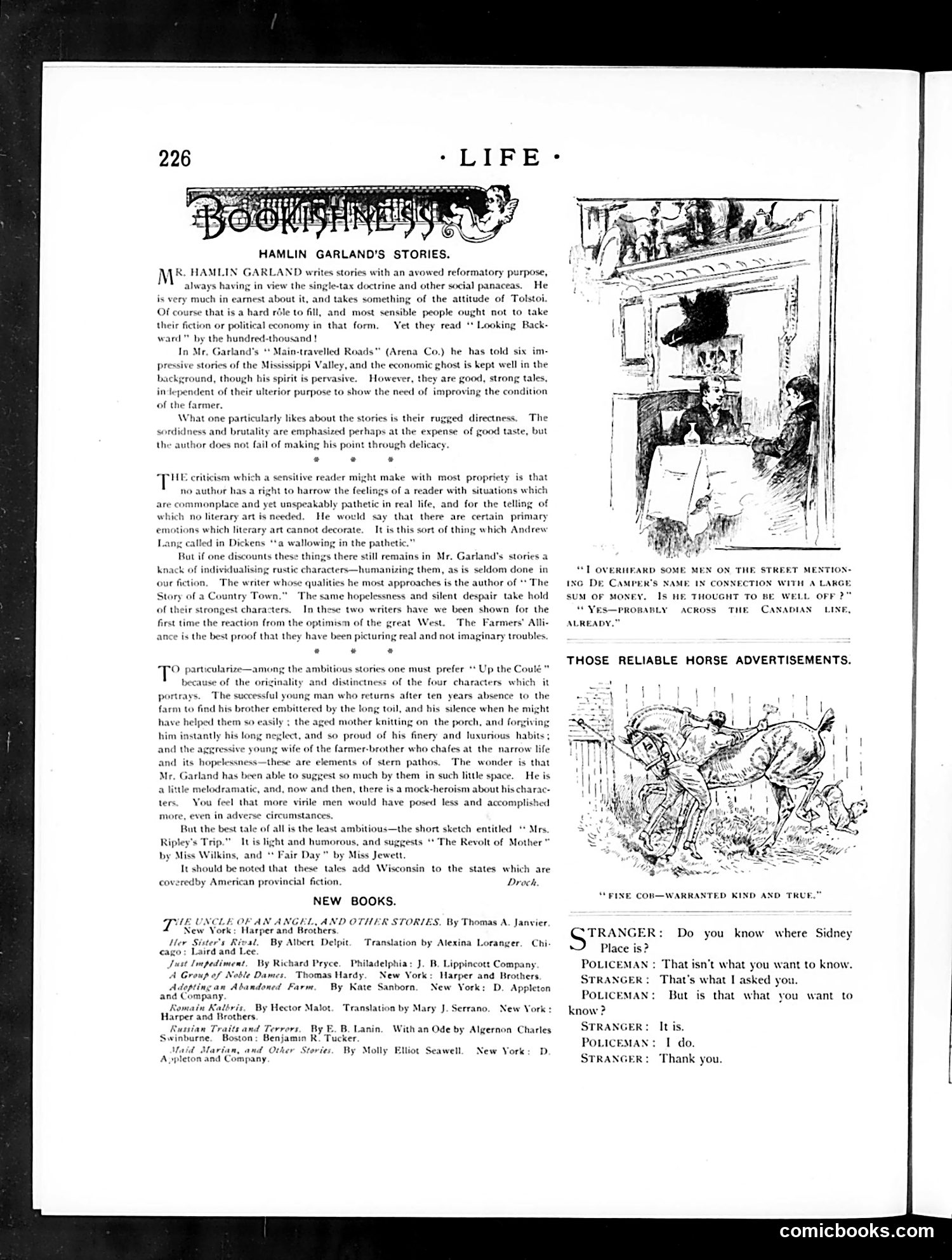
This cartoon satirizes deceptive advertising practices, particularly for horses. The illustration shows a horse that appears comically broken-down or decrepit—limbs splayed awkwardly, body in poor condition—contrasting sharply with the caption "FINE COB—WARRANTED KIND AND TRUE." The joke targets the gap between how horses were advertised (with glowing, false claims like "warranted kind and true") versus their actual condition. This was apparently a widespread consumer complaint, as the accompanying dialogue between a Stranger and Policeman discusses a man being "thought to be well off" despite connection to "a large sum of money"—suggesting fraud through misrepresentation. The cartoon mocks unscrupulous horse dealers who sold inferior animals while making inflated claims in advertisements.
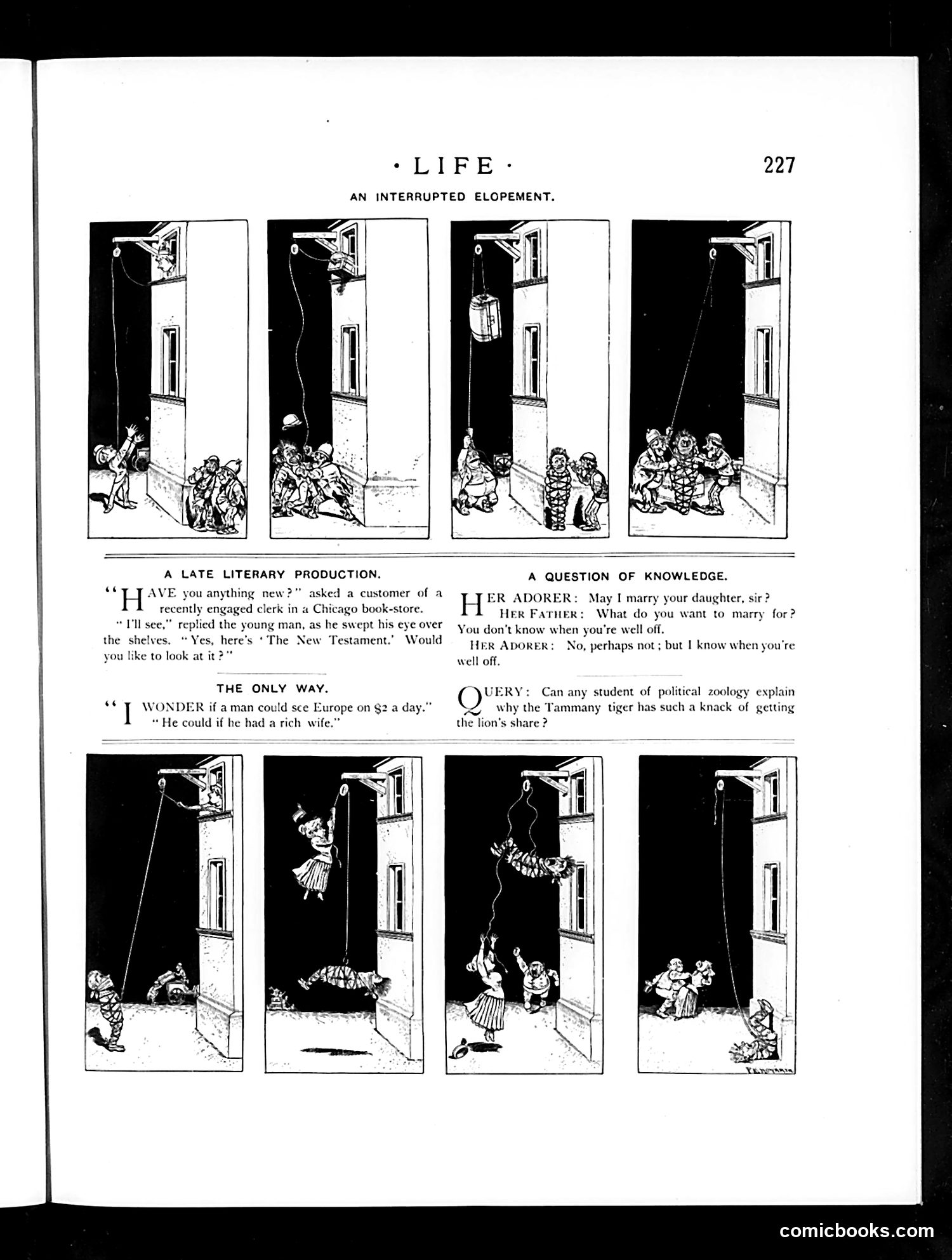
This page contains three separate satirical pieces: 1. **"An Interrupted Elopement"** (top): A wordless comic strip showing figures being lowered from a building on a rope, repeatedly interrupted by what appears to be a bucket or object descending from above—a visual gag about romantic escape attempts thwarted by circumstance. 2. **"A Late Literary Production"**: A brief joke about a bookstore customer asking about "The New Testament," suggesting confusion or absurdist humor around religious texts. 3. **"A Question of Knowledge"**: A dialogue joke mocking a suitor's claim that he can "tell when you're well off"—satirizing presumptuous courtship. 4. **"The Only Way"**: A quip about viewing Europe affordably through marriage rather than tourism. The bottom section appears to be another wordless comic strip with similar elopement/descent themes. The humor relies on sight gags and ironic social commentary typical of early-20th-century American satire.
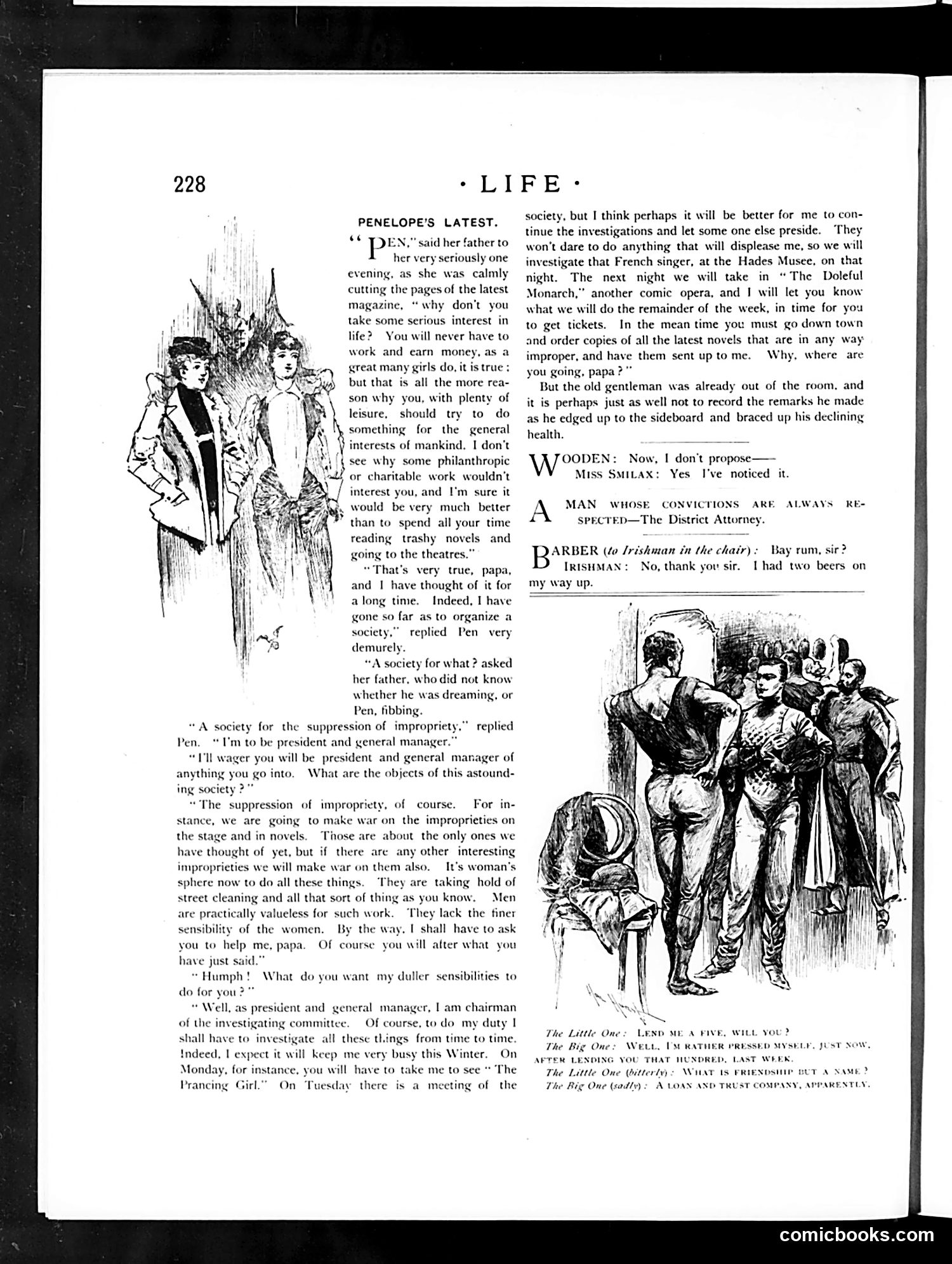
This page satirizes women's social reform movements of the early 20th century. The narrative centers on "Pen," a young woman proposing a "Society for the Suppression of Impropriety." Her father, skeptical but indulgent, agrees to let her serve as "president and general manager." The satire mocks the earnest reformist impulse by showing Pen's vague, expansive goals—fighting stage impropriety, street cleaning, and "all that sort of thing." Her father's dry response highlights the absurdity: women should tackle these "practical valueless" tasks while men handle serious work. The accompanying street scene illustrations depict working-class figures, emphasizing the gap between Pen's upper-class moral ambitions and actual urban social problems. The humor lies in depicting well-meaning but naive female activism as both ineffectual and presumptuous.
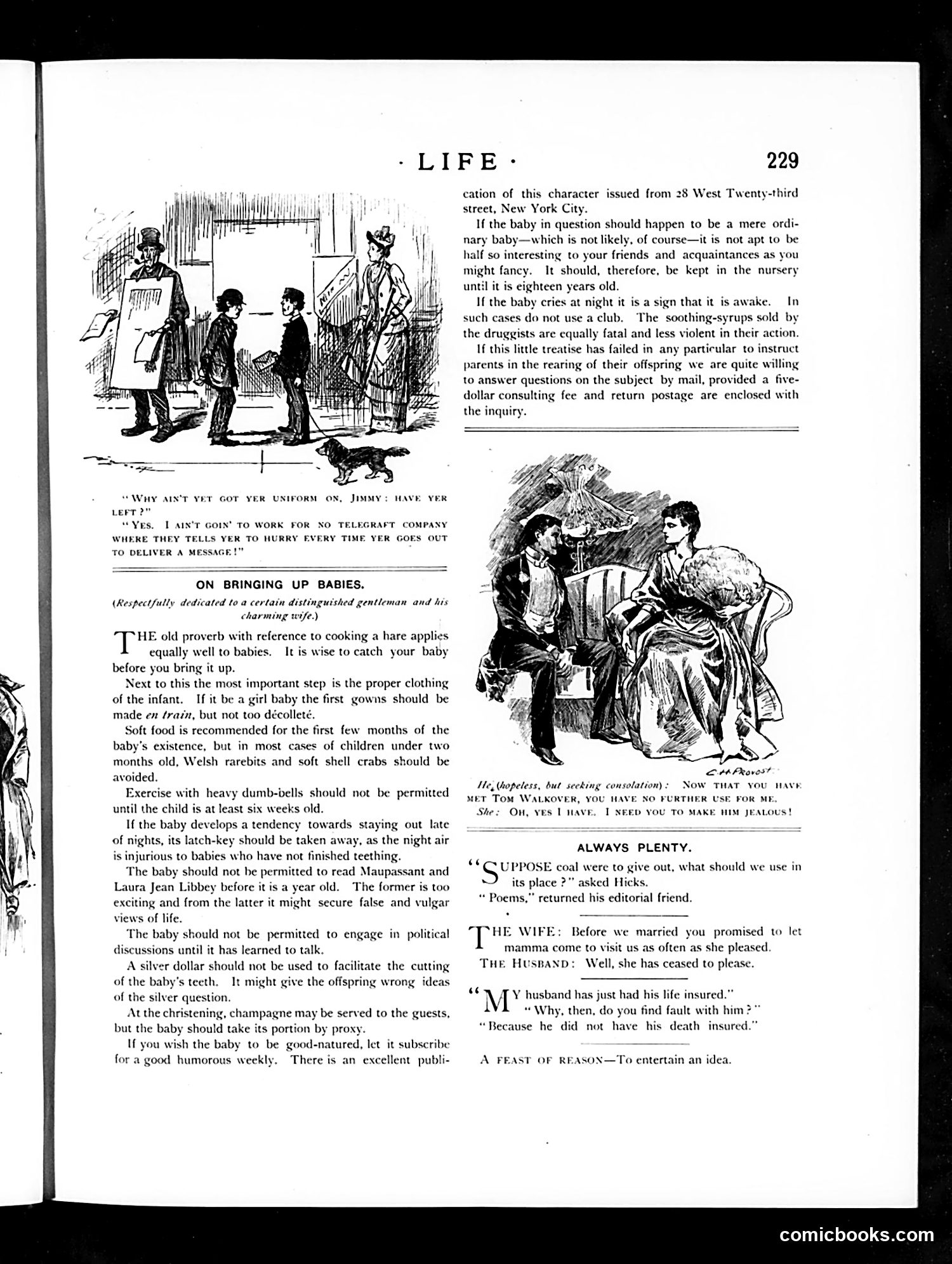
This page contains satirical humor and advice rather than political cartoons. The top cartoon depicts a street scene where someone questions "Jimmy" about lacking a telegraph company uniform, with Jimmy responding that he won't work for a telegraph company that constantly demands he hurry for message deliveries. Below is an article titled "ON BRINGING UP BABIES," offering tongue-in-cheek parenting advice (dedicated to "a certain distinguished gentleman and his charming wife"). It includes absurd suggestions like using Welsh rabbits and soft-shell crabs for infant nutrition, and permits babies to read Maupassant. The remaining content comprises brief humorous anecdotes about marriage and domestic life, including exchanges about wives visiting and life insurance—typical of Life magazine's satirical social commentary targeting middle-class Victorian-era conventions and gender relations.
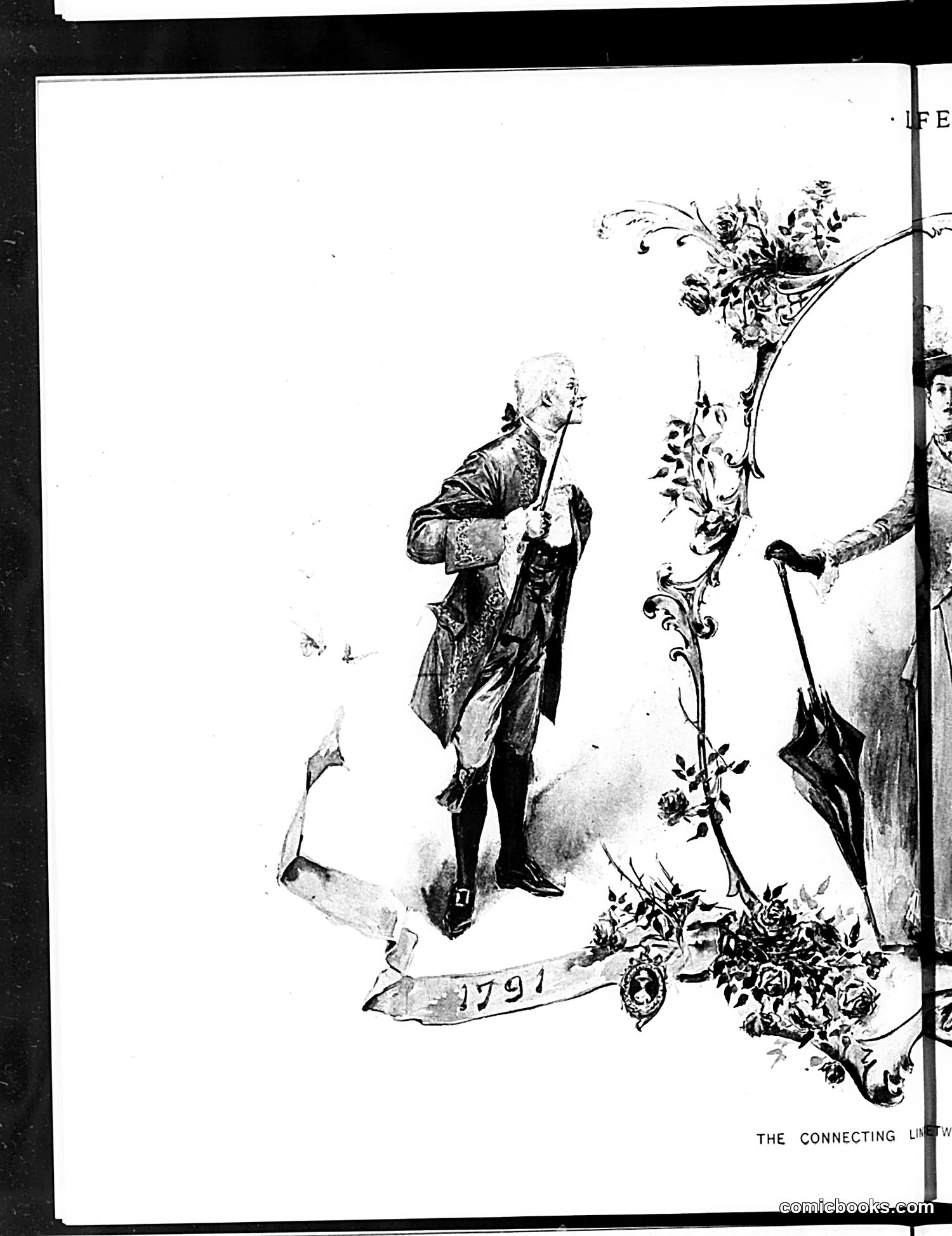
This appears to be a political cartoon from Life magazine dated 1791 (visible on a banner in the image). The illustration shows an elderly gentleman in 18th-century dress holding a pruning tool, standing among flowering plants and vines. The title reads "THE CONNECTING LI[NE]" (text cut off). Without additional context or visible captions identifying the figure, I cannot definitively state who this person represents or what specific political event or figure is being satirized. The 1791 date suggests it relates to events during the early American republic or French Revolutionary period, and the gardening/pruning imagery may carry symbolic meaning about cultivation, growth, or political "trimming," but I cannot assert the specific meaning with certainty based solely on what's visible here.
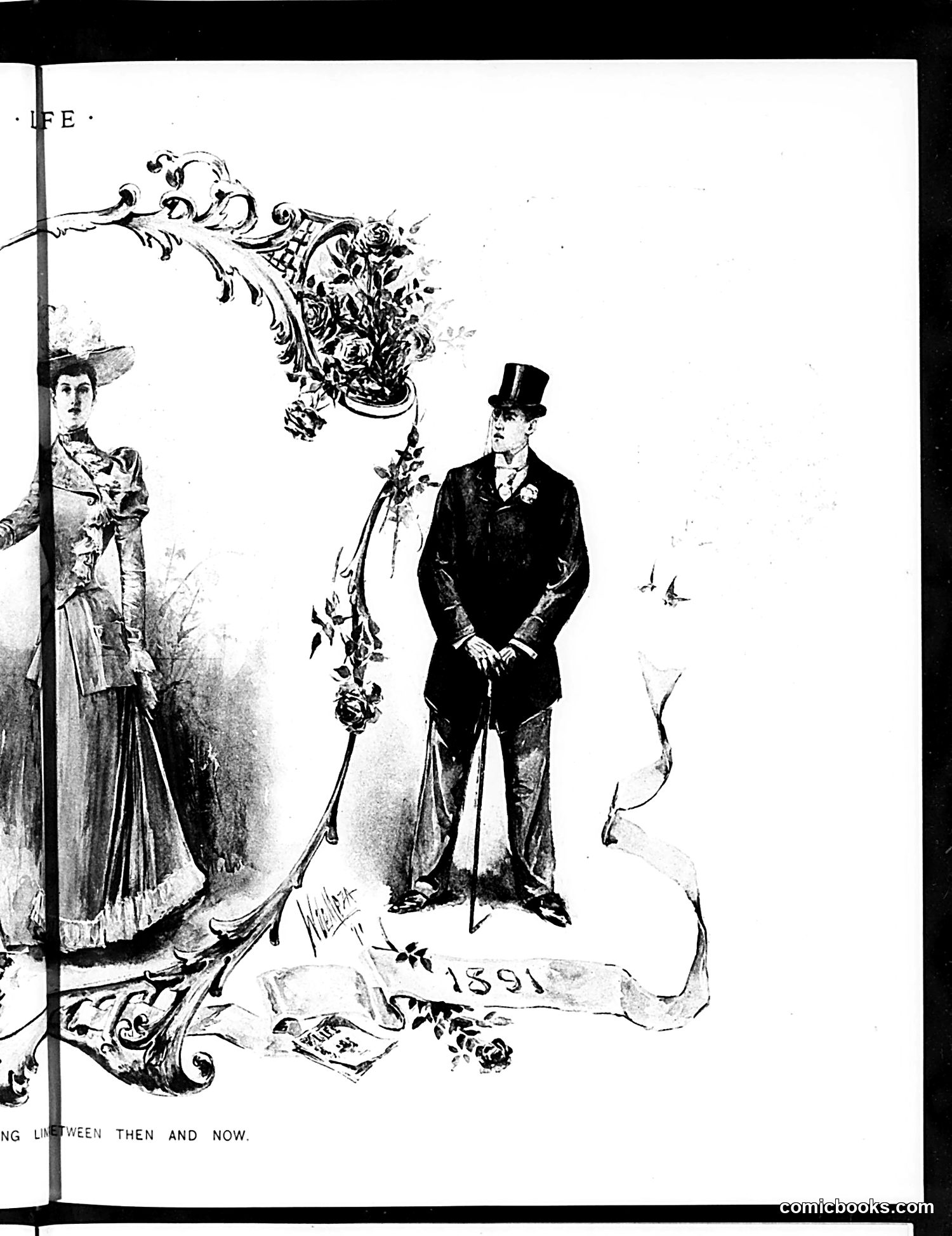
This satirical illustration contrasts Victorian society's rigid formality with contemporary (1891) changes. On the left stands a formally dressed woman in elaborate period costume, representing traditional values. On the right, a gentleman in modern dress and top hat appears more relaxed and individualistic. The ornate decorative elements at top—likely representing old-fashioned ornamentation and artifice—contrast with the simpler, more natural design elements scattered below, suggesting a shift toward modernization and simplification of social customs. The caption "Life Between Then and Now" indicates *Life* magazine's commentary on how rapidly American society was transforming during the 1890s, contrasting stiff Victorian conventions with emerging modern attitudes toward fashion, behavior, and social interaction.
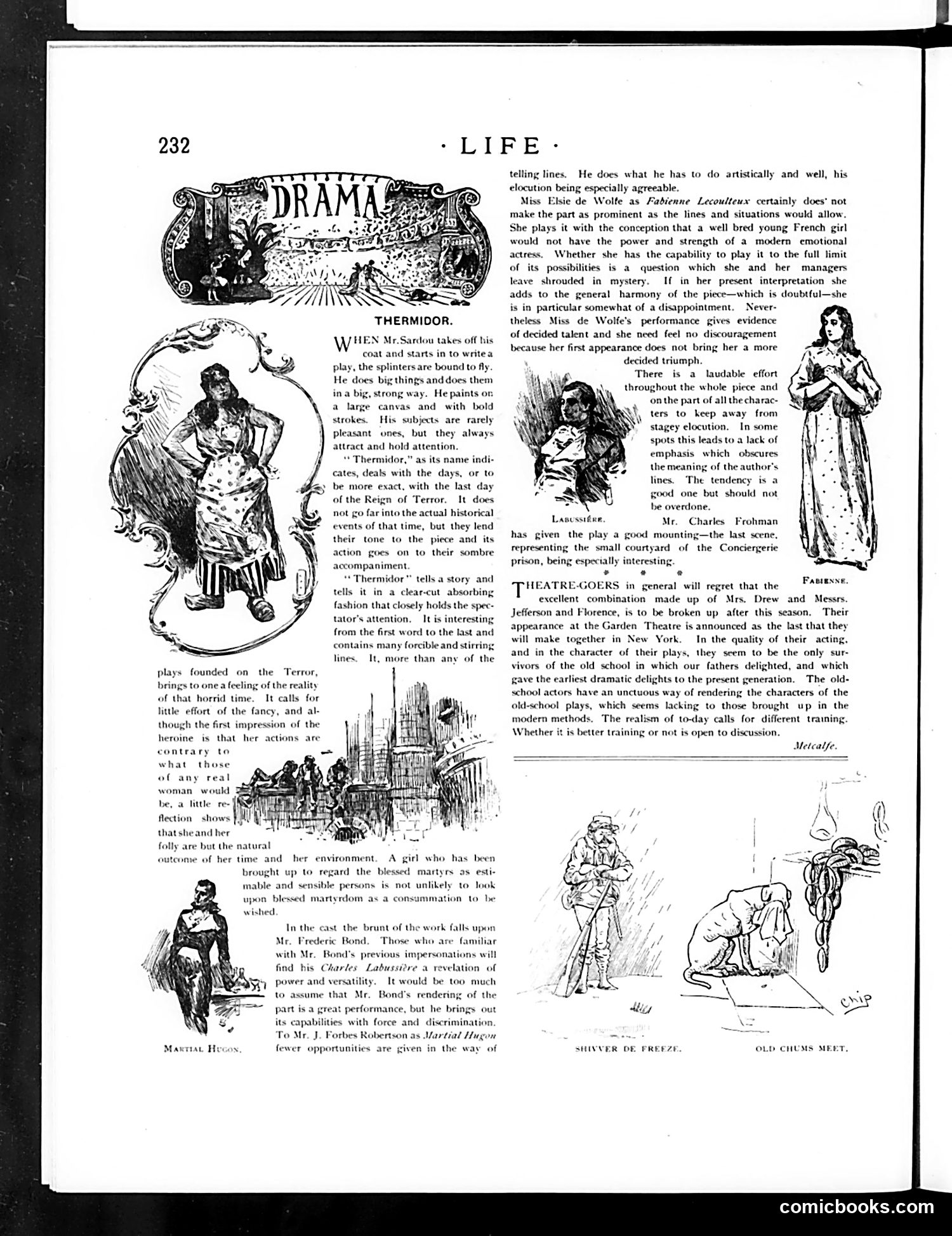
This is a theater review page from *Life* magazine covering a production of "Thermidor," a play by French dramatist Victorien Sardou about the French Revolution's Reign of Terror (specifically its final day). The page critiques the performances and production values. Key figures reviewed include: - **Frederic Bond** as Charles Labussière (praised for "power and versatility") - **Elsie de Wolfe** as Fabienne Lecoulteux (criticized for underplaying the role, though shown "decided talent") - **J. Forbes Robertson** as Martial Hugon (noted for fewer starring opportunities) - Producer **Charles Frohman** (praised for mounting) The review also notes the upcoming dissolution of an acting company featuring Mrs. Drew and Messrs. Jefferson and Florence—described as "survivors of the old school," suggesting nostalgia for earlier theatrical traditions. The accompanying illustrations appear to be character sketches from the production, though specific identities aren't labeled in the visible portions.
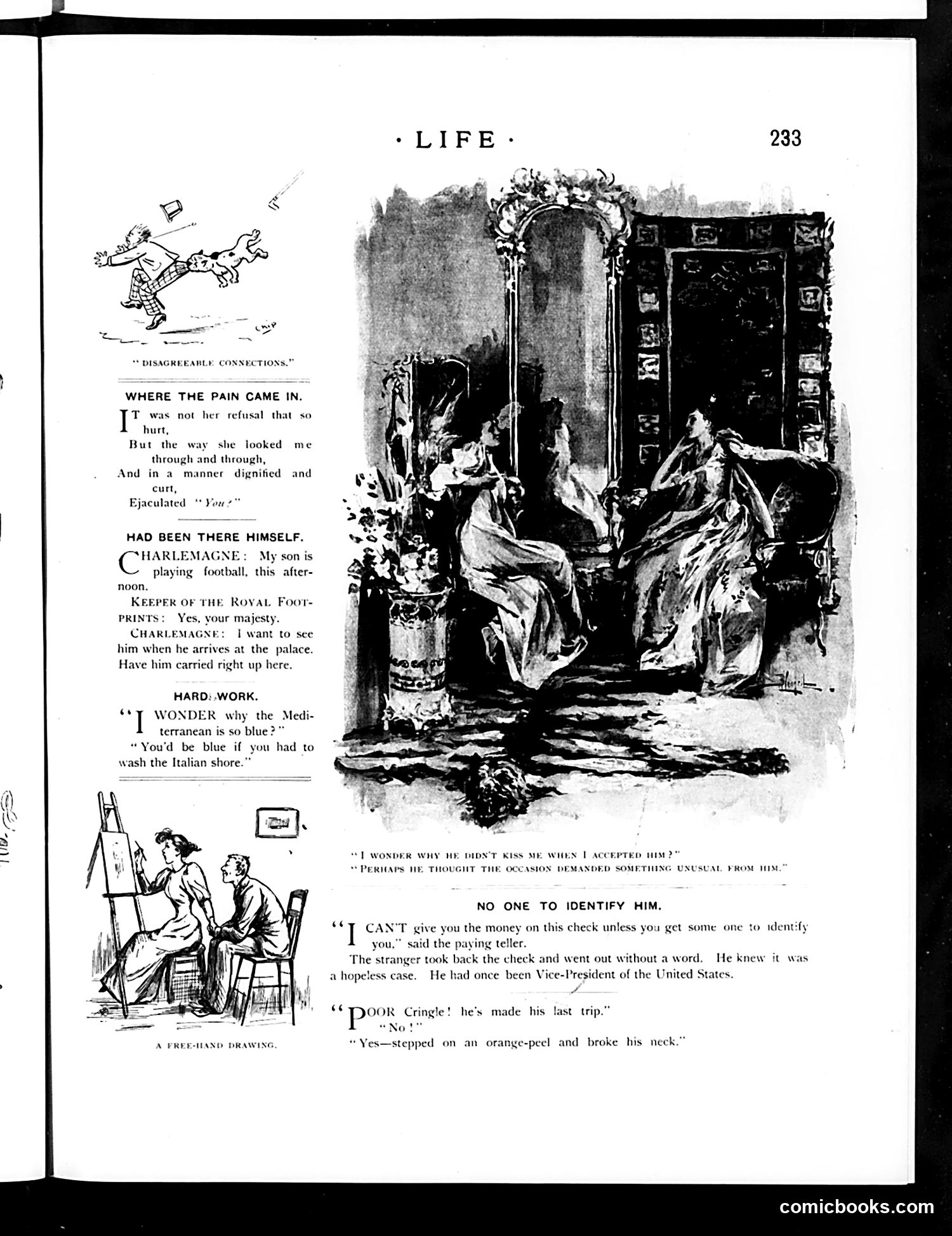
This page contains multiple unrelated satirical pieces typical of early 20th-century *Life* magazine: **"Where the Pain Came In"** mocks a rejected suitor, with the humor centered on a woman's dismissive, haughty rejection—she looks through him "dignified and curt," wounding his pride more than a simple refusal would. **"Harlemagne" section** jokes about a character (possibly a nobleman or public figure, unclear) wanting his son carried to a palace viewing while playing football—satirizing pretentious parental behavior. **"Hard Work"** contains ethnic humor about the Mediterranean being blue, with a punchline about washing "the Italian shore"—reflecting period stereotypes about Italian labor. **"No One to Identify Him"** tells of a stranger unable to cash a check without identification, revealed to be a *former Vice-President*—the satire mocks how quickly political figures lose status and recognition after leaving office. The final joke about "Cringle" stepping on an orange-peel is dark humor about a trivial accident causing death. These reflect *Life*'s style: sophisticated mockery of romance, class pretension, ethnic stereotypes, and political irrelevance.
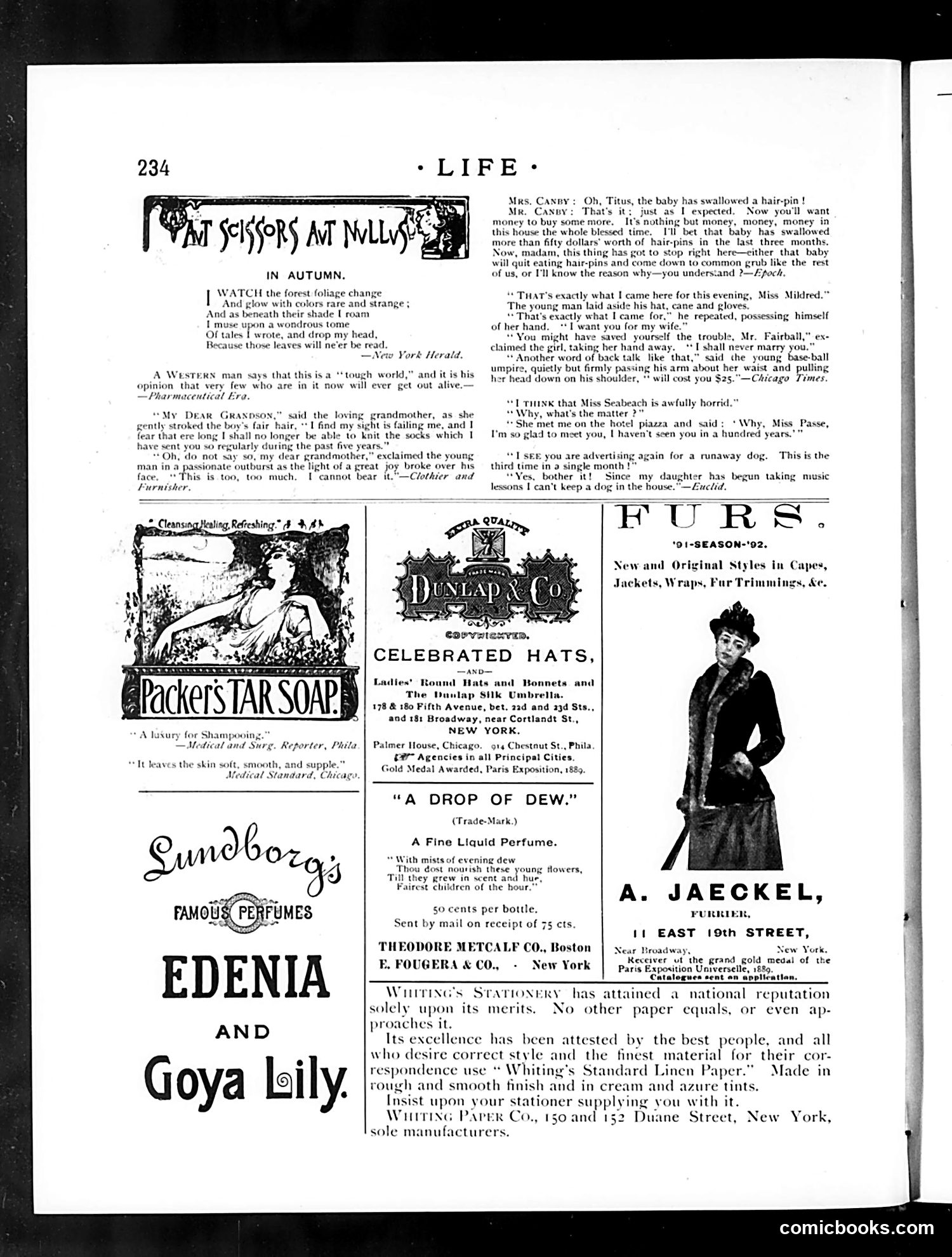
This page contains several humorous short anecdotes reflecting late-Victorian domestic life, with minimal political content. The jokes target: 1. **Domestic frustration**: A husband's exasperation over a baby repeatedly swallowing hair-pins, escalating into absurd financial complaints—satirizing both parental anxiety and marital money tensions. 2. **Romantic rejection**: A young man's proposal is rejected; he's an umpire who responds with possessive aggression ("cost you $25")—mocking masculine entitlement and the growing assertiveness of women refusing unwanted proposals. 3. **Social awkwardness**: A woman's over-familiarity is deemed "horrid," poking fun at artificial politeness. 4. **Urban problems**: A man repeatedly advertising for a runaway dog, blamed on his daughter's music lessons—a gentle jab at noisy urban living and music education fads. The page is primarily **advertising**—for Packer's Star Soap, Sunbozzi perfumes, Dunlap hats, A. Jaeckel furs, and Whiting's stationery. No major political figures or events are referenced; the satire is social rather than political.
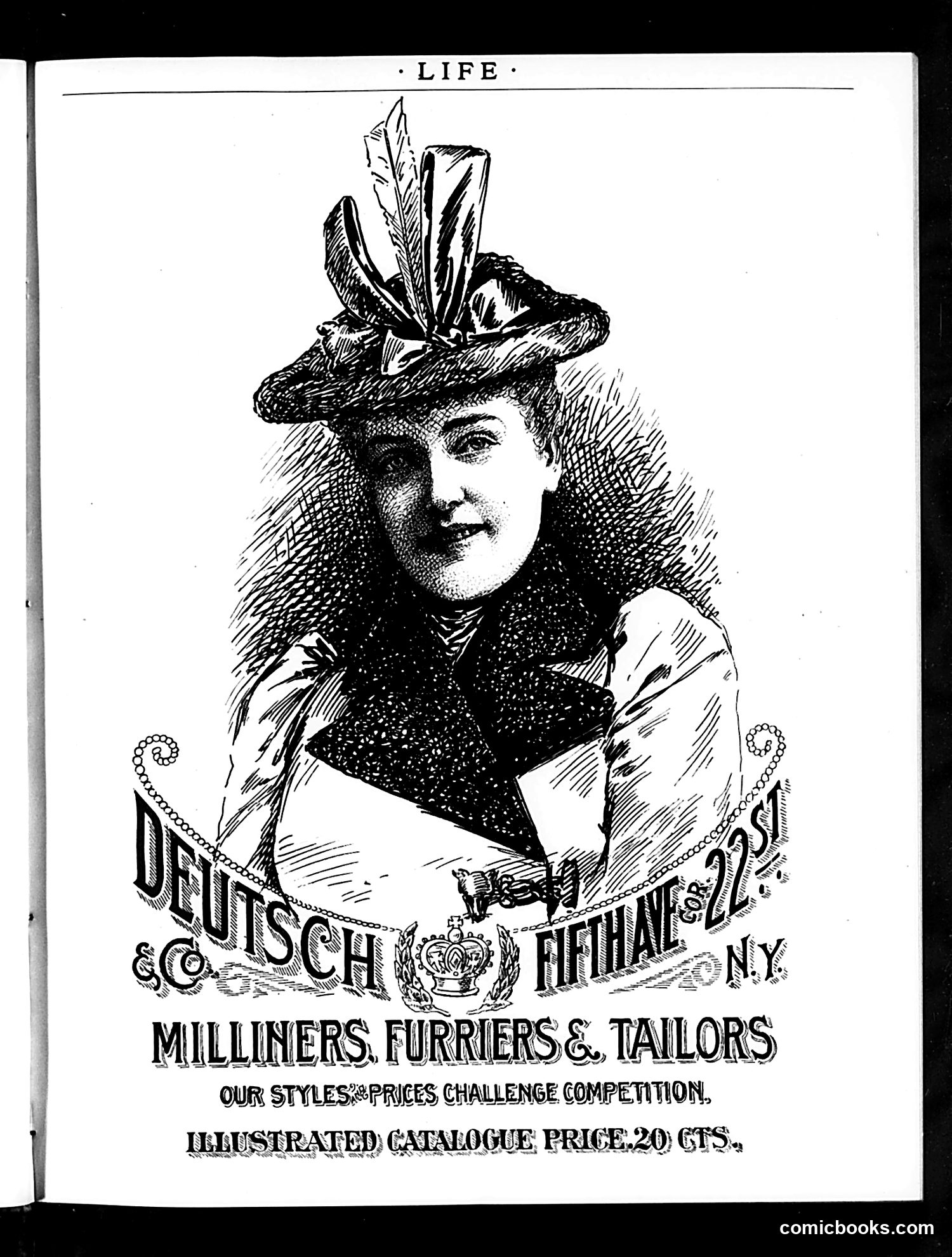
This is primarily an **advertisement**, not a political cartoon. It appears from Life magazine's pages and promotes "Deutsch Fifthave & Co." located at 225 Fifth Avenue, New York. The image shows a fashionably dressed woman wearing an elaborate feathered hat, textured coat with fur collar, and white blouse—typical haute couture of the period. She embodies the fashionable "Gibson Girl" aesthetic popular in early 1900s America. The ad targets three businesses: milliners (hat makers), furriers, and tailors, advertising their "styles" and "prices challenge competition." The illustrated catalog cost 20 cents. This is straightforward commercial advertising rather than satire—it showcases the luxury fashion business catering to wealthy American women of that era.
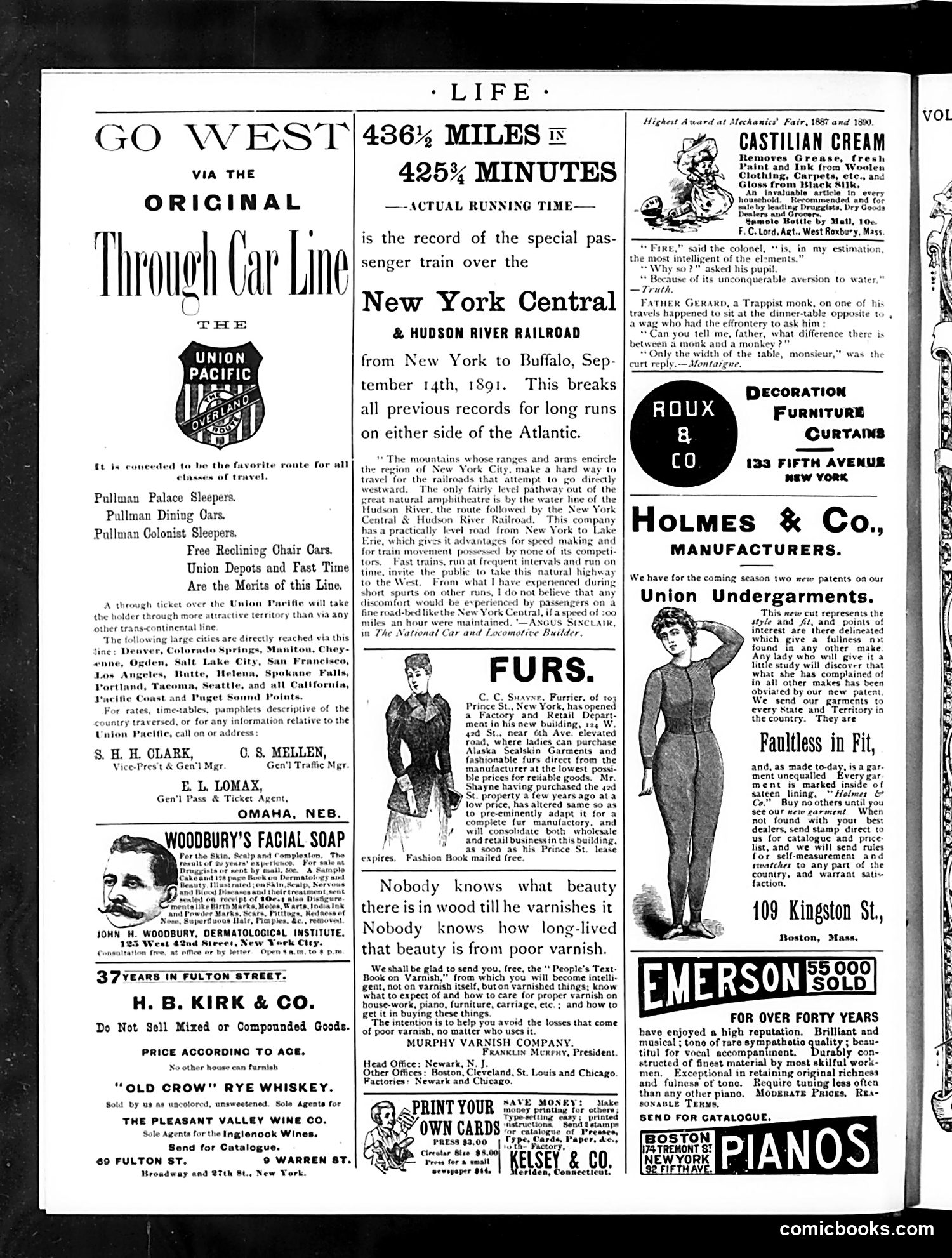
This page is primarily **advertising**, not political satire. It's from Life magazine (late 1800s), when the publication carried extensive commercial content alongside editorial material. The main advertisement promotes the Union Pacific Railway's "Through Car Line" offering Pullman sleepers and dining cars for westward travel—part of the era's expansion narrative. A featured article highlights a New York Central & Hudson River Railroad speed record: 436½ miles in 425½ minutes (September 1891). Other advertisements include period products: Woodbury's Facial Soap, Murphy Varnish, Old Crow whiskey, and various NYC retailers (furrier Shayne, furniture company Roux & Co., piano dealer Emerson). The small illustrations are product endorsements or decorative elements typical of 1890s magazines—not political cartoons. There are **no identifiable political figures or satirical commentary** on this particular page. It reflects the commercial interests and consumer goods of the Gilded Age.