
Life, 1891-10-22 · page 6 of 16
Life — October 22, 1891 — page 6: what you’re looking at
What you’re looking at
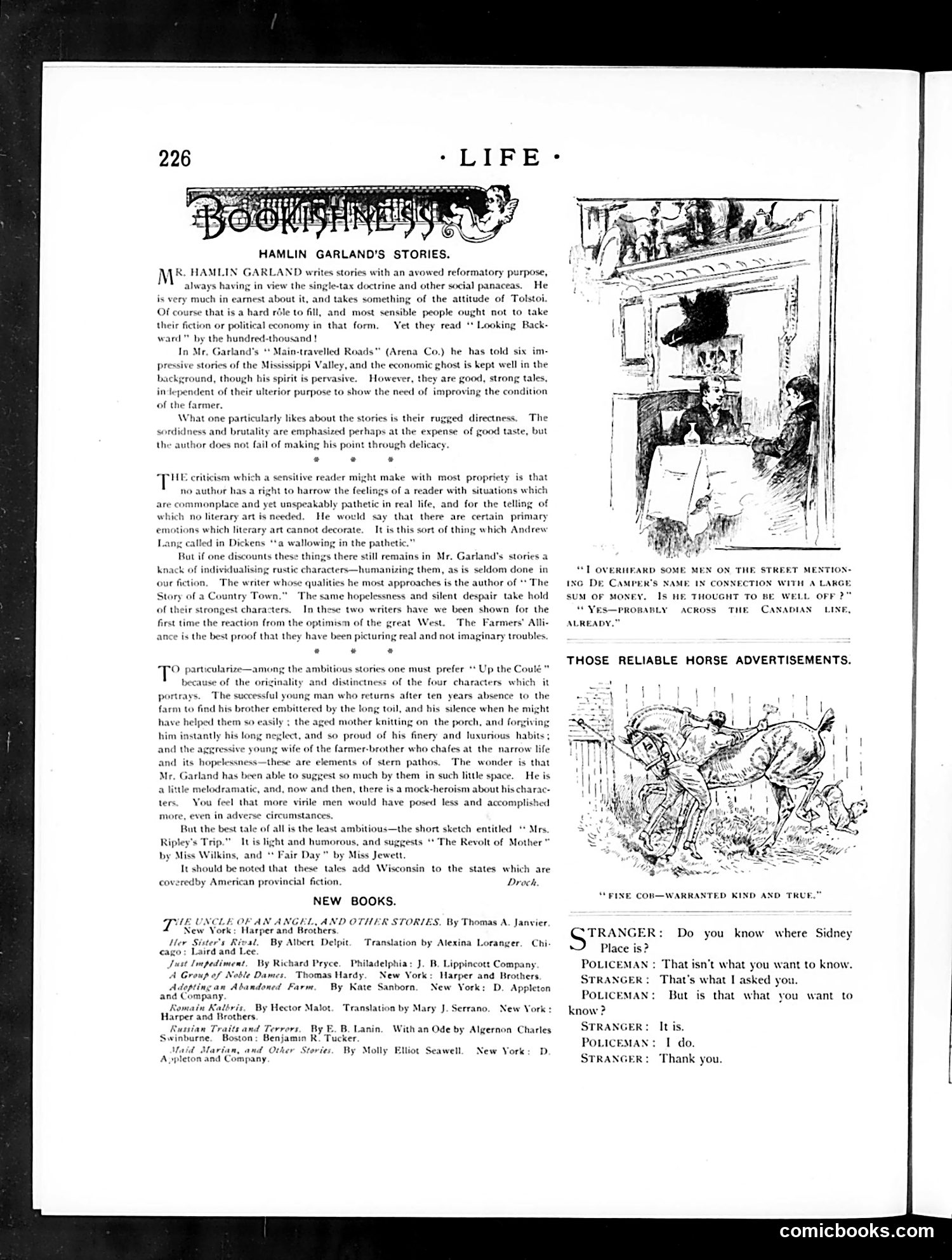
This cartoon satirizes deceptive advertising practices, particularly for horses. The illustration shows a horse that appears comically broken-down or decrepit—limbs splayed awkwardly, body in poor condition—contrasting sharply with the caption "FINE COB—WARRANTED KIND AND TRUE." The joke targets the gap between how horses were advertised (with glowing, false claims like "warranted kind and true") versus their actual condition. This was apparently a widespread consumer complaint, as the accompanying dialogue between a Stranger and Policeman discusses a man being "thought to be well off" despite connection to "a large sum of money"—suggesting fraud through misrepresentation. The cartoon mocks unscrupulous horse dealers who sold inferior animals while making inflated claims in advertisements.
📄 Transcribed text from this page (OCR, searchable)
Machine-transcribed from the original scan — historical spelling and the odd misread are preserved.
HAMLIN GARLAND'S STORIES. MM: HAMLIN GARLAND writes stories with an avowed reformatory purpose, always having in view the single-tax doctrine and other social panaceas. He gz of the attitude of Tolstoi. ¢ that is a hard rile to fill, and most sensible people ought not to take their fiction or political economy in that form. Yet they read * Looking Back- ward by the hundred-thousand ! In Mr, Garland’s ** Main-travelled Roads” (Arena Co.) he has told six im- pressive stories of the Mississippi Valley, and the economic ghost is kept well in the very much in earnest about it, and takes somethi background, though his spirit is pervasive. However, they are good, strong tales, in tepe of their ulterior purpose to show the need of improving the condition of the farmer. What one particularly likes about the stories is their rugged directness. The sordidness and brutality are emphasized perhaps at the expense of good taste, but the author does not fail of making his point through delicacy. * . . “THE criticism which a sensitive reader might make with most propriety is that no author has a right to harrow the feelings of a reader with situations which commonplace and yet unspeakably pathetic in real life, and for the telling of which no literary art is needed. He would say that there are certain primary emotions which literary art cannot decorate. It is this sort of thing which Andrew Lang called in Dicken wallowing in the pathetic. But if one discounts these things there still remains in Mr. Garland’s stories a knack of individualising rustic characters—humanizing them, as is seldom done in our fiction, The writer whose qualities he most approaches is the author of * The Story of a Country Town.” ‘The same hopelessness and silent despair take hold of their strongest characters. In these two writers have we been shown for the first time the reaction from the optimism of the great West. The Farmers’ Alli- ance is the best proof that they have been picturing real and not imaginary troubles TO paricularize—among the ambitious stories one must prefer ** Up the Coulé ” because of the originality and distinctness of the four characters which it portrays. The successful young man who returns after ten years absence to the farm to find his brother embittered by the long toil, and his silence when he might have helped them so easily ; the aged mother knitting on the porch, and forgiving him instantly his long neglect, and so proud of his finery and luxurious habits; d the aggressive young wife of the farmer-brother who chafes at the narrow life and its hopelessness—these are elements of stern pathos. The wonder is that Mr. Garland has been able to suggest so much by them in such little space. He is a little melodramatic, and, now and then, there is a mock-heroism about hischarac- ters. You feel that more virile men would have posed less and accomplished more, even in adverse circumstances, But the best tale of all is the least ambitious—the short sketch entitled * Mrs Ripley's Trip.” I is light and humorous, and suggests‘ The Revolt of Mother” by Miss Wilkins, and * Fair Day” by Miss Jewett. It should be noted that these tales add Wisconsin to the states which are coveredby American provincial fiction Droch. NEW BOOKS. VIE UNCLE OF AN ANGEL, AND OTHER STORIES. By Thomas A. Janvier. New York: Harperand Brothers. Her Sister's Rival. By Albert Delpit. Translation by Atexina Loranger. Chi- cago: Laird and Lee Just Impediment, Vy Richard Pryce, Philadelphia: J. B. Lippincott Company Thomas Hardy. New York: Harper and Brothers. ingan Abandoned Farm. By Kate Sanborn. New York: D. Appleton mpany. Komain Kalbris, By Hector Malot. Translation by Mary J. Serrano. New Vork : Harper and Brothers. itsand Terrors. By E. B. Lanin. With an Ode by Algernon Charles joston: Benjamin R. Tucker. mand Other tes. By Molly Elliot Seawell. New York: D d Company “T OVERHEARD SOME MEN ON THE STREET MENTION- ING De CAMPERS NAME IN CONNECTION WITH A LAR SUM OF MONEY, Is HE THOUGHT TO BE WELL OFF PROBABLY ACROSS THE CANADIAN LINE “ FINE CON—WARRANTED KIND AND TRUE.” <TRANGER: Do you know where Sidney Place is? : That isn’t what you want to know. That's what I asked you. POLICEMAN: But is that what you want to know ? STRANGER: It is. POLICEMAN: I do. STRANGER: Thank you. comicbooks.com