
Life, 1891-10-22 · page 12 of 16
Life — October 22, 1891 — page 12: what you’re looking at
What you’re looking at
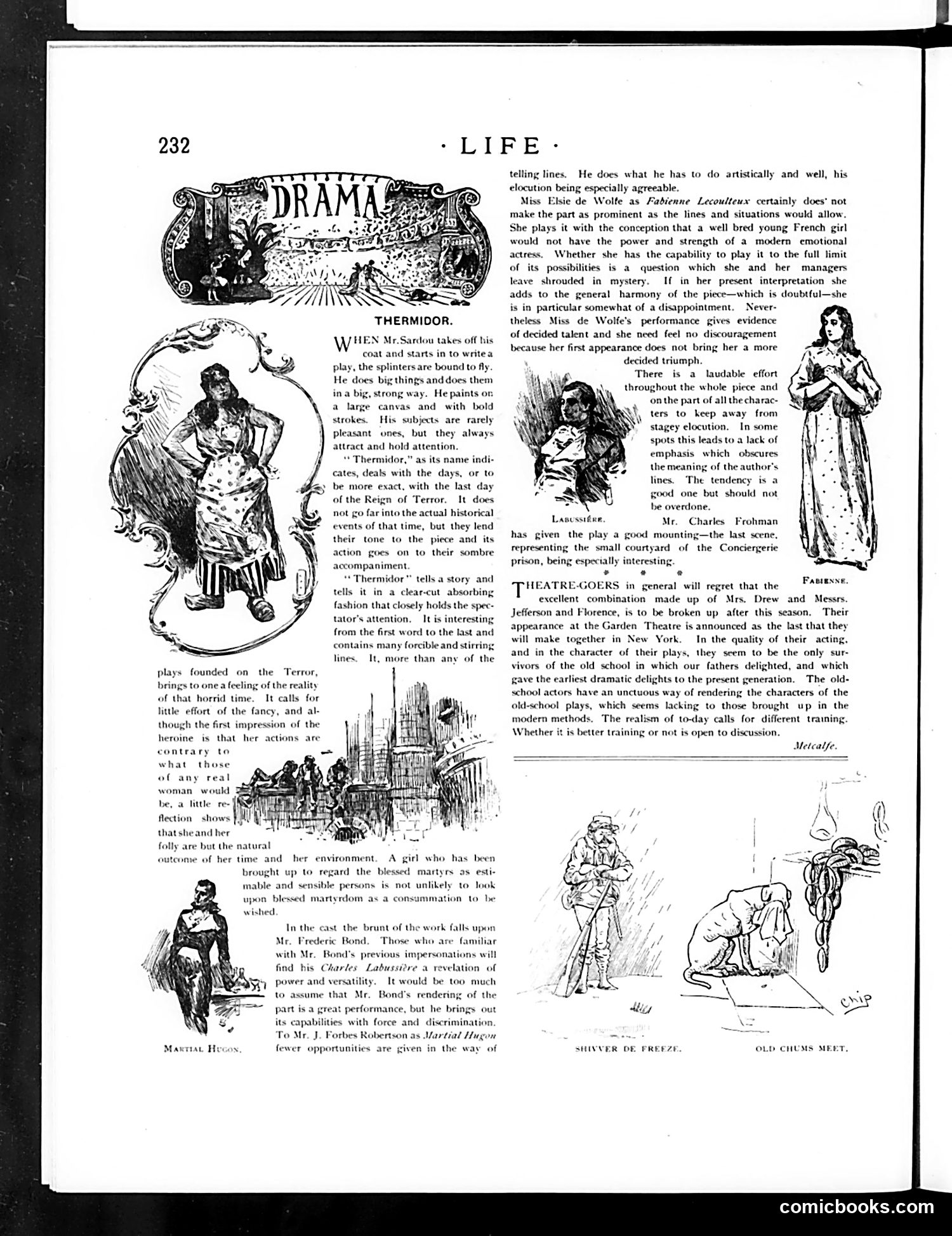
This is a theater review page from *Life* magazine covering a production of "Thermidor," a play by French dramatist Victorien Sardou about the French Revolution's Reign of Terror (specifically its final day). The page critiques the performances and production values. Key figures reviewed include: - **Frederic Bond** as Charles Labussière (praised for "power and versatility") - **Elsie de Wolfe** as Fabienne Lecoulteux (criticized for underplaying the role, though shown "decided talent") - **J. Forbes Robertson** as Martial Hugon (noted for fewer starring opportunities) - Producer **Charles Frohman** (praised for mounting) The review also notes the upcoming dissolution of an acting company featuring Mrs. Drew and Messrs. Jefferson and Florence—described as "survivors of the old school," suggesting nostalgia for earlier theatrical traditions. The accompanying illustrations appear to be character sketches from the production, though specific identities aren't labeled in the visible portions.
📄 Transcribed text from this page (OCR, searchable)
Machine-transcribed from the original scan — historical spelling and the odd misread are preserved.
*~ LIFE: WHEN Mr.Sardou takes off his coat and starts in to writea play, the splinters are bound to fly. He does big things and does them ina big a larg strokes, pleasant strong way. He paints or canvas and with bold His subjects are rarely ones, but they always attract and hold attention. * Thermidor,” as its name indi- cates, deals with the days, or to be more exact, with the last day of the Reign of Terror. It does not go far into the actual historical events of that time, but they lend their tone to the piece and its action goes on to their sombre accompaniment “ Thermidor” tells a story and tells it in a clear-cut absorbing fashion that closely holds the spec- tator’s attention, — It is interesting from the first word to the last and contains many forcible and stirring lines. It, more than any of the plays founded on the Terror, brings to onea feeling of the reality of that horrid time, It calls for little effort of the fancy, and al- though the first impression of the heroine is that h contrary to what of any actions are those real would be, a litte nr woman flection that sheand her folly are but the natu of her time and her environment. brought up mable and sensible persons is not unlikely to look outcome A girl who has been » regard the blessed martyrs as est upon blesed martyrdom as a consummation to be wished In the cast the brunt of the work falls upon Mr. Frederic Bond. with Mr. Bond’s previous impersona find his Charles Labussidre power and versatility. to assume that Mr. Those who are familia ons will a revelation of be too much ndering of the It wou! Bond's part is a great performance, but he bi its capabilities with force and discrimination. To Mr. J. Forbes Robertson as Martial Hugon fewer opportunities are given in the way of telling lines. He does what he has to do artistically and well, his elocution being especially agreeable. Miss Elsie de Wolte as Fabienne Lecoulteux certainly does’ not make the part as prominent as the lines and situations would allow. She plays it with the conception that a well bred young French girl would not have the power and strength of a modern emotional actress. Whether she has the capability to play it to the full limit of its possibilities is a question which she and her managers leave shrouded in mystery. If in her present interpretation she adds to the general harmony of the piece—which is doubtful—she is in particular somewhat of a disappointment. theless Miss de Wolfe's performance gives evidence of decided talent and she need feel no discouragement because her first appearance does not bring her a more decided triumph. There is a laudable effort throughout the whole piece and onthe part of all the charac- ters to keep away from stagey elocution, In some spots this leads to a lack of emphasis. which obscures the meaning of the author's lines. The tendency is a good one but should not be overdone. Lasussitea, Mr. Charles Frohman has given the play a good mounting—the last scene, representing the small courtyard of the Conciergerie prison, being especially interesting. aie _ . e jever- TRE-GOERS in general will regret that the PABIESN®. excellent combination made up of Mrs. Drew and Messrs. Jefferson and Florence, is to be broken up after this season, Their appearance at the Garden Theatre is announced as the last that they will make together in New York. In the quality of their acting. and in the character of their plays, they seem to be the only sur- vivors of the old school in which our fathers delighted, and which gave the earliest dramatic delights to the present generation. The old- school actors have an unctuous way of rendering the characters of the old-school plays, which seems lacking to those brought up in the modern methods. ‘The realism of to-day calls for different training. Whether it is better training or not is open to discussion. Metcalfe. SHIVVER DE FREEZE OLD CHUMS MEET, comicbooks.com