
A complete issue · 16 pages · 1891
Life — October 15, 1891
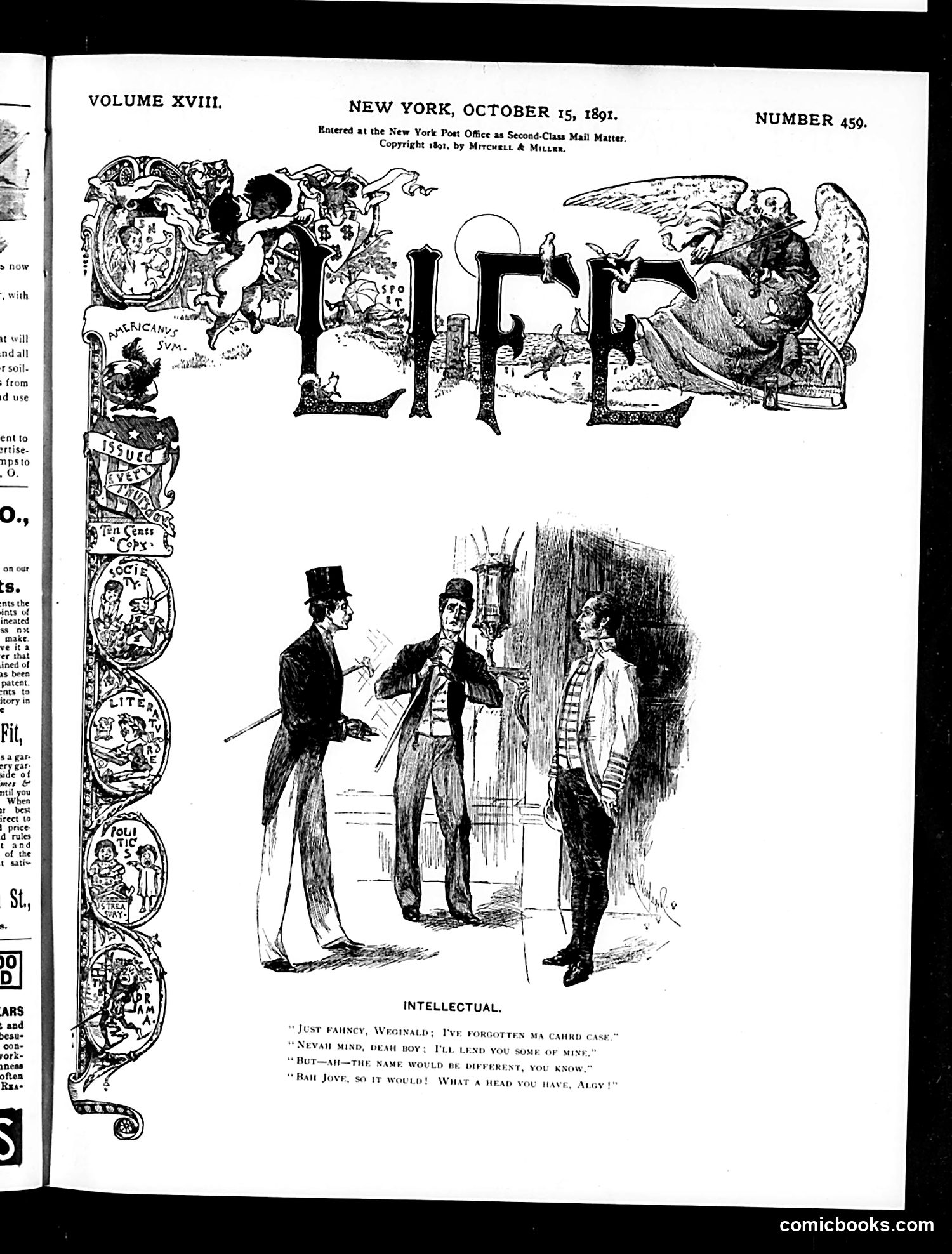
This cartoon satirizes pretentious intellectuals discussing a forgotten legal case. Three well-dressed men in top hats debate whether to recall a case name, with one suggesting they simply rename it to something different. The humor lies in mocking academic and legal circles who prioritize appearance of sophistication over actual knowledge. The exchange—"Just fancy, Weiggald, I've forgotten ma cairn case" / "Never mind, dear boy; I'll lend you some of mine" / "But—ah—the same would be different, you know" / "Hah! Jove, so it would! What a head you have, Algy!"—satirizes how gentlemen of that era might bluff their way through intellectual discussions rather than admit ignorance. The ornate decorative border on the left suggests this is from *Life* magazine's regular satirical commentary on contemporary social pretensions and class affectation.
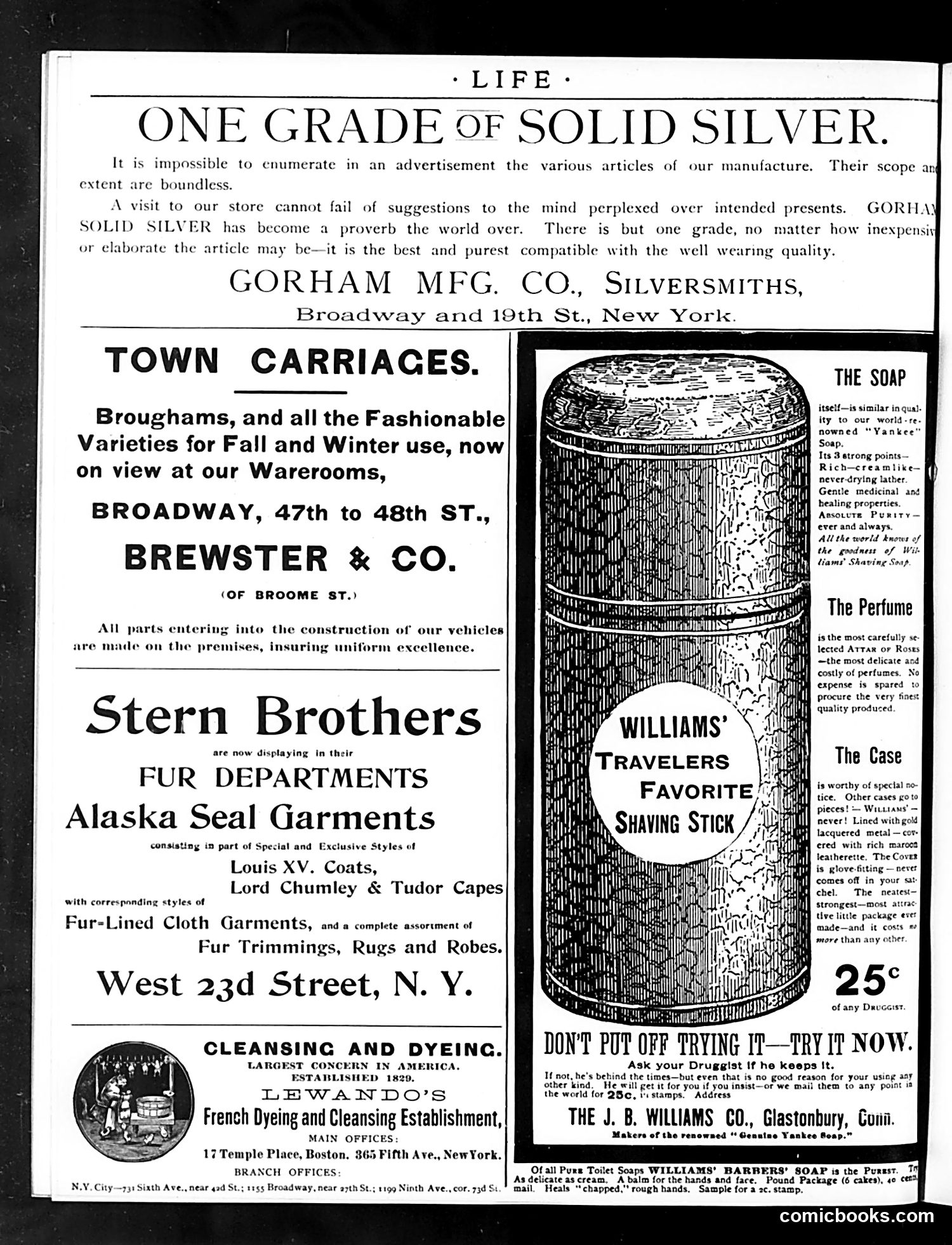
This page contains **no political cartoons or satire**. It is entirely **commercial advertising** from what appears to be an early 20th-century issue of *Life* magazine. The ads promote: - Gorham Manufacturing Company's solid silver goods - Brewster & Co.'s town carriages - Stern Brothers' fur garments and Alaska seal coats - Lewando's French dyeing and cleaning services - Williams' Travelers Favorite Shaving Stick (25 cents) The shaving stick ad emphasizes product qualities (soap, perfume, case design) and encourages immediate purchase. All advertisements use typical period marketing language emphasizing quality, exclusivity, and established reputation to appeal to affluent urban consumers.
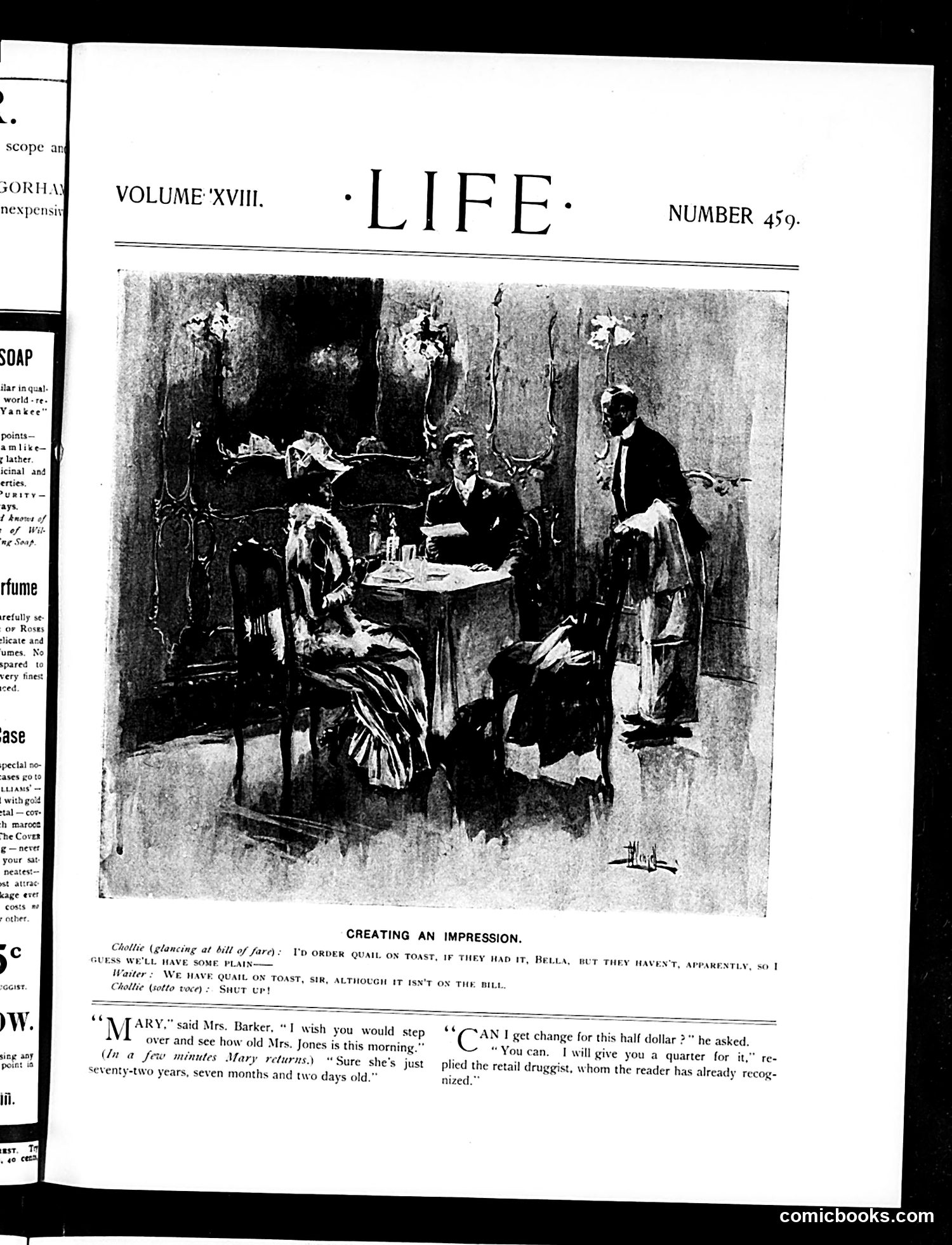
This cartoon satirizes restaurant deception and class pretense. The scene shows a waiter and restaurant staff attempting to impress diners with fake refinement—serving "plain quail on toast" while calling it something fancier because actual quail is unavailable. The dialogue reveals the con: a customer asks for change for fifty cents, and the druggist (apparently the restaurant's proprietor) promises a quarter back—suggesting overcharging and petty fraud. The satire targets turn-of-the-century dining establishments that misrepresented cheap dishes as haute cuisine to wealthy patrons. It mocks both the dishonest restaurateurs and the pretentious diners fooled by such performances, exposing the gap between appearance and reality in social aspiration.
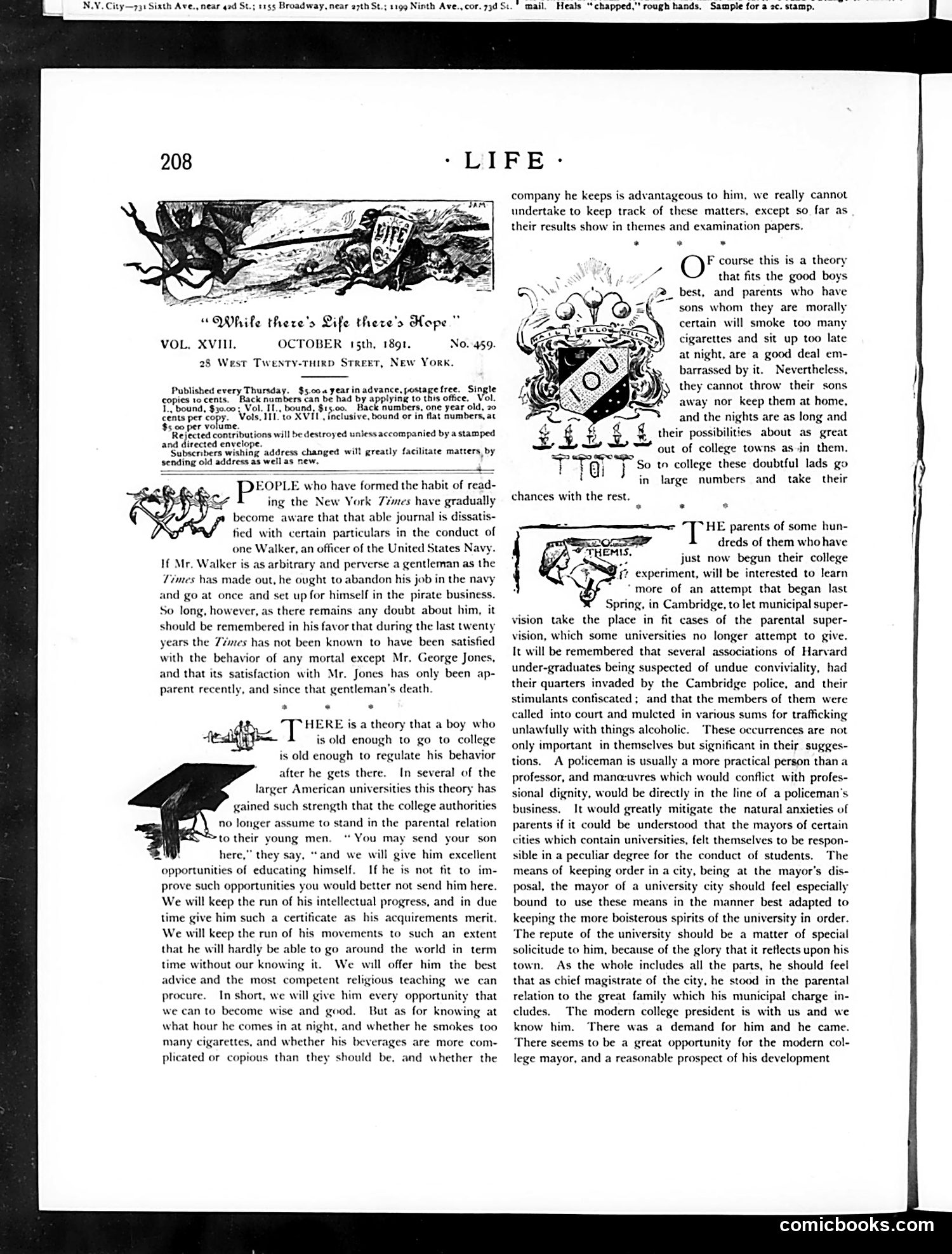
The main editorial discusses college life and parental supervision of young men. The text critiques universities that no longer maintain parental authority over students' behavior—particularly regarding late nights, smoking cigarettes, and alcohol consumption. The cartoon at top left (captioned "While there's Life there's Hope") appears to show a wrecked ship or vessel, likely symbolizing the chaos of unsupervised college life. The decorative illustrations throughout are typical Victorian-era vignettes unrelated to specific political figures. The piece argues that college administrators should act more like civic authorities (comparing their role to mayors), enforcing moral conduct rather than allowing students unchecked freedom. This reflects late 19th-century anxieties about youth morality and institutional responsibility.
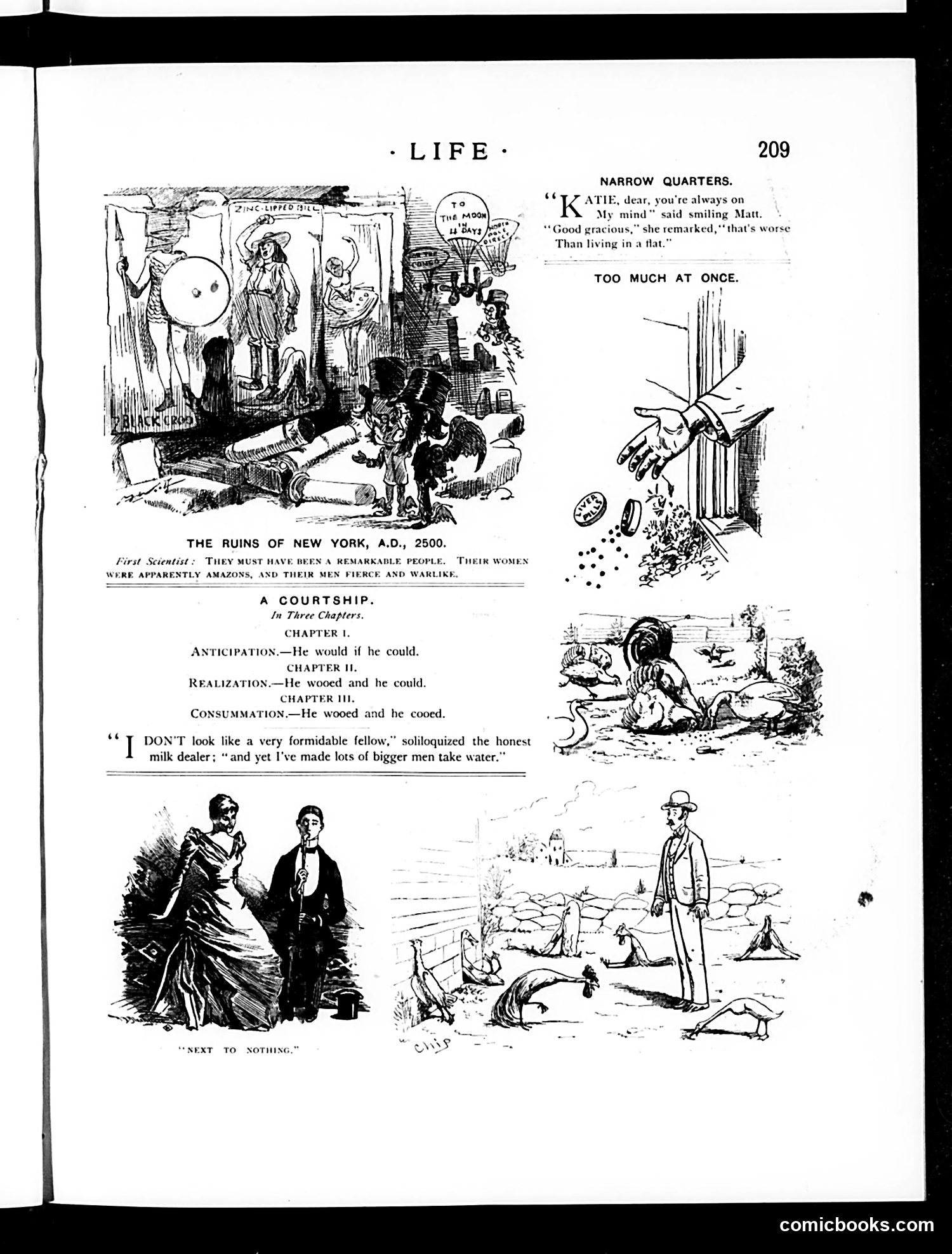
This page contains several satirical sketches with social commentary: **"The Ruins of New York, A.D. 2500"** imagines a post-apocalyptic future where remarkably fierce women and warlike men have apparently destroyed civilization—likely satirizing contemporary anxieties about women's increasing assertiveness and changing gender roles. **"A Courtship in Three Chapters"** presents a cynical progression: anticipation, realization, then consummation—where desire cools once achieved, a common theme mocking romantic ideals. **"Too Much at Once"** and **"Next to Nothing"** appear to offer contrasting social critiques, though their specific targets are unclear from the visible text. The milk dealer's quote about making "bigger men take water" remains ambiguous without fuller context. Overall, the page reflects turn-of-century anxieties about gender relations and social change.
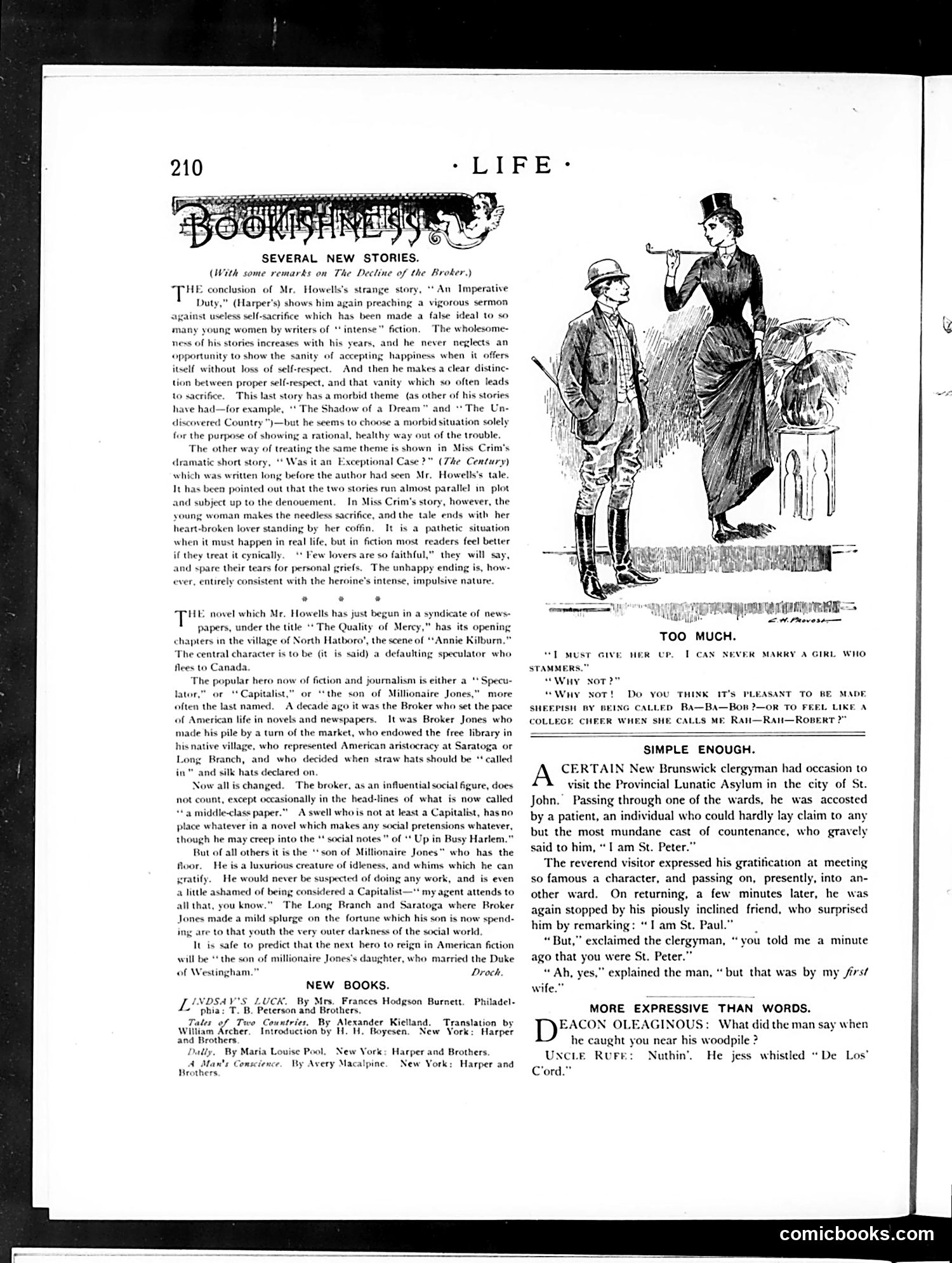
The page contains book reviews and short humor pieces rather than political cartoons. The main illustration labeled "TOO MUCH" depicts two men in Victorian-era clothing—one appearing to be a military or official figure confronting another man. The accompanying dialogue jokes about refusing to marry a girl who "stammers," with characters named "Ra-ha-bob" and "Robert," creating humor through the stammer itself. Below, "SIMPLE ENOUGH" presents a brief anecdote about a clergyman visiting an asylum who encounters patients claiming to be saints (St. Peter, St. Paul), with a punchline about the clergyman's wife being his "first" wife. The satire is genteel and focused on social awkwardness and wordplay rather than political commentary. The page reflects Life's typical early-20th-century humor style: domestic situations and linguistic jokes rather than topical satire.
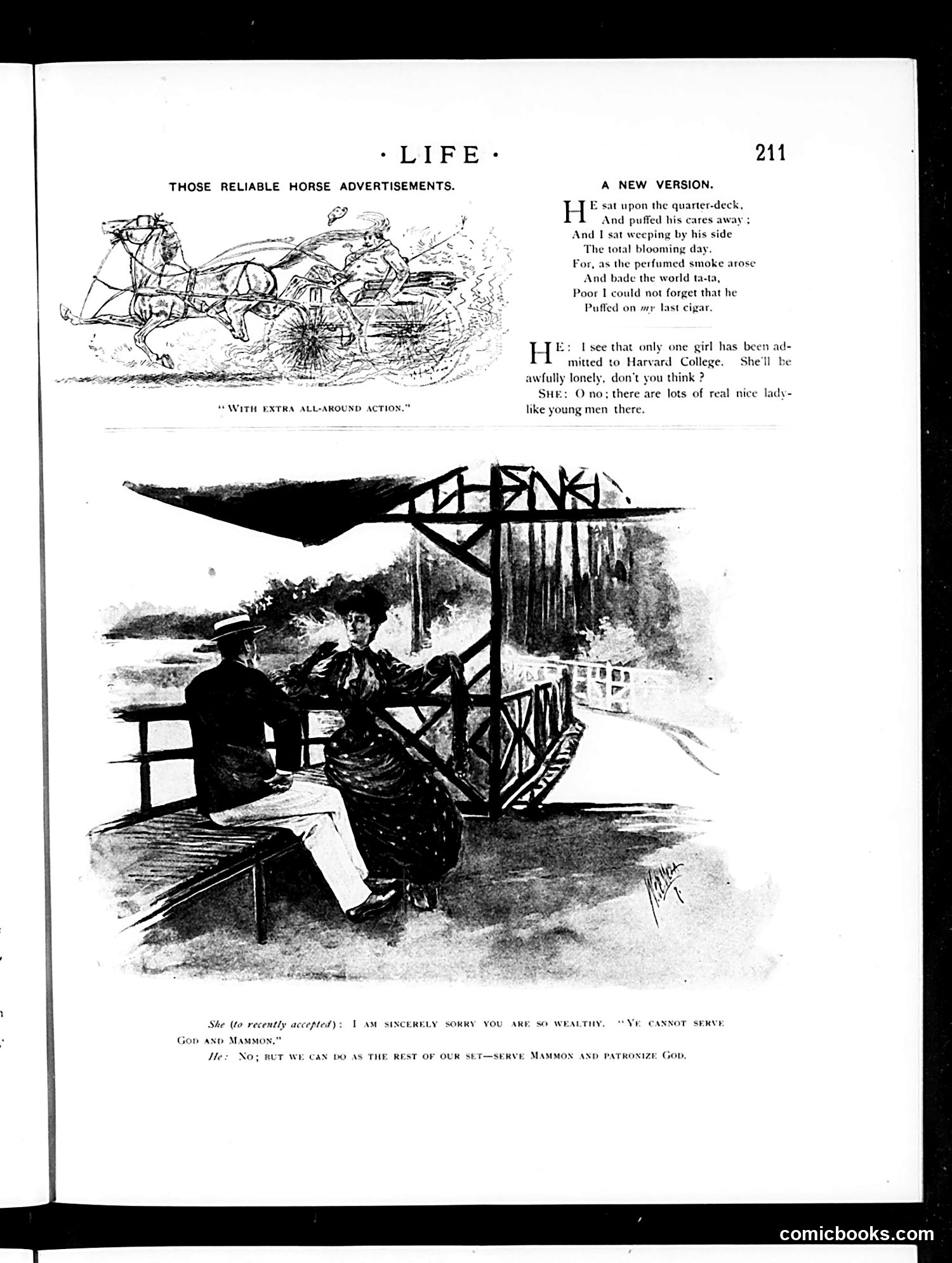
This page contains two distinct pieces: **Top cartoon** ("Those Reliable Horse Advertisements"): A satirical sketch of a chaotic horse-drawn carriage accident, mocking exaggerated claims in period horse/carriage advertisements that promised reliability and control. **Bottom cartoon** ("A New Version"): A dialogue between a man and woman on a bench overlooking water. The woman mentions only one girl admitted to Harvard College, lamenting loneliness. The caption below addresses wealth and religious hypocrisy—the woman claims she "cannot serve God and Mammon" (cannot be both pious and wealthy), to which the man responds they can "serve Mammon and patronize God" instead. This satirizes wealthy Americans' selective morality and charitable pretense masking materialistic values. Both pieces critique contemporary American attitudes toward reliability claims and moral inconsistency among the privileged classes.
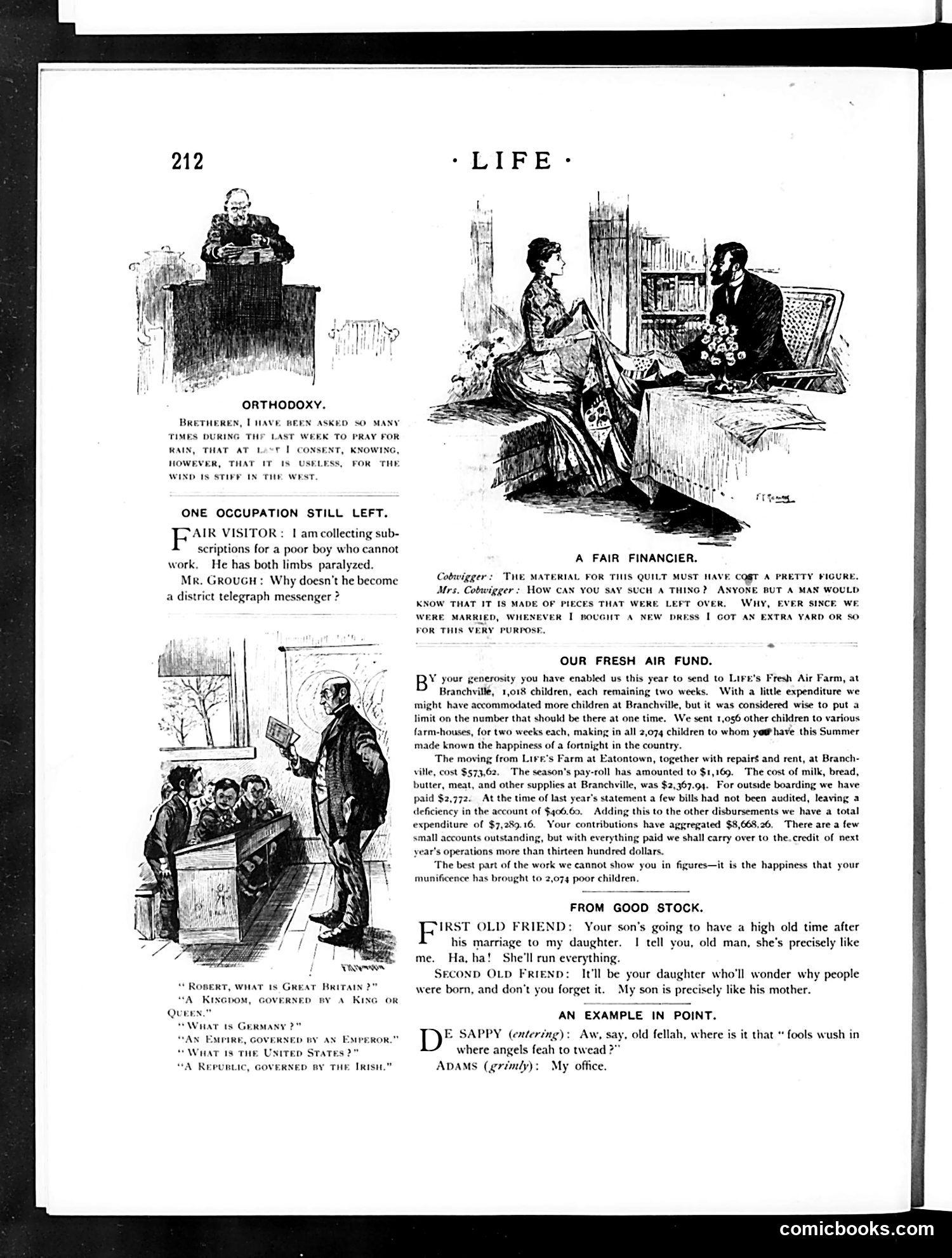
This page contains several unrelated satirical pieces and jokes typical of Life's format: 1. **"Orthodoxy"** - A brief joke about someone being asked to consent to rain, playing on the idea of accepting inevitable circumstances. 2. **"One Occupation Still Left"** - A dialogue where a Fair Visitor asks if a poor boy with paralyzed limbs could work as a telegraph messenger, mocking the limited opportunities available to disabled individuals. 3. **"A Fair Financier"** - A conversation about a quilt made from fabric scraps, satirizing waste and making do with leftover materials. 4. **"Our Fresh Air Fund"** - A charitable appeal describing Life's program sending urban children to farms for summer breaks, with specific financial accounting. 5. **"From Good Stock"** and **"An Example in Point"** - Brief humorous dialogues about inheritance and human nature. The page reflects early 20th-century social concerns: poverty, disability employment, charitable giving, and class dynamics.
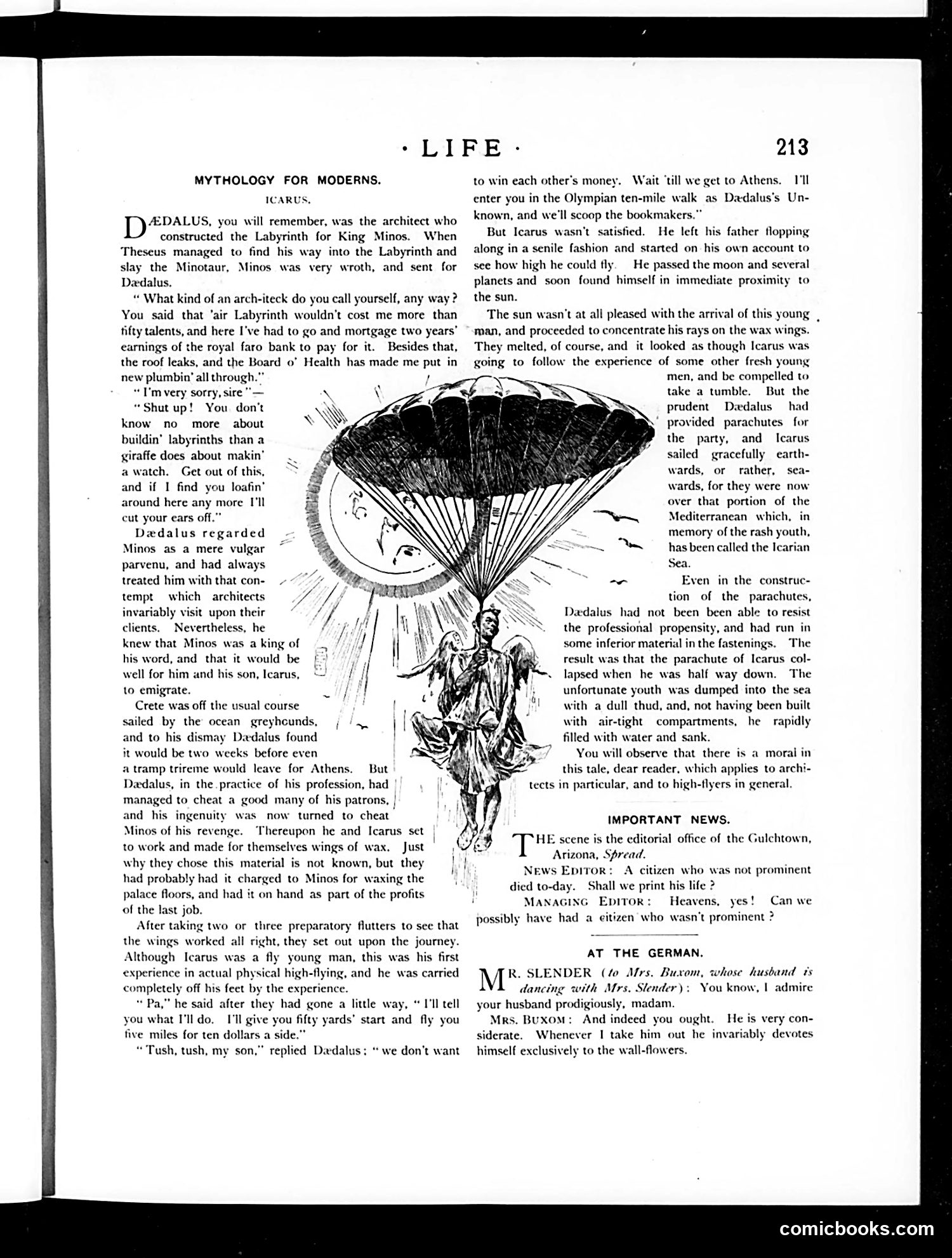
This satirical retelling of the Icarus myth updates the classical story for contemporary American readers. The illustration shows Icarus with mechanical wings (wax replaced by modern materials), descending with a parachute after his flight toward the sun. The satire critiques modern ambition and get-rich-quick schemes. Daedalus represents a practical professional; Icarus embodies reckless youth pursuing impossible dreams. The narrative jokes about Icarus's failed engineering (inferior fasteners cause the parachute to malfunction), mocking both newfangled technology and youthful overconfidence. The moral, stated explicitly, warns architects and "high-flyers" against hubris—suggesting Life's readers recognize themselves in Icarus's cautionary tale about exceeding one's limitations through modern shortcuts.
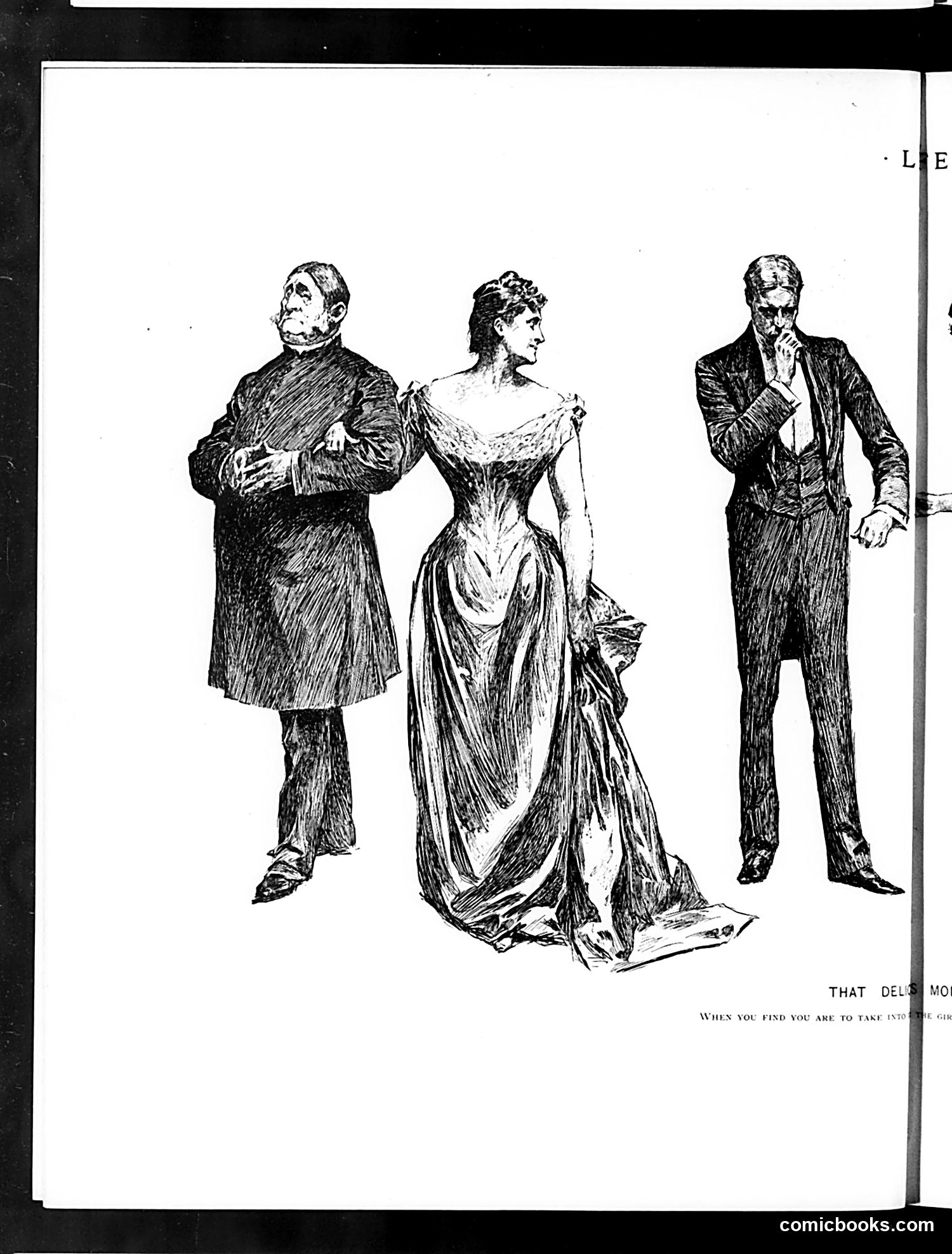
This appears to be a satirical illustration showing three figures in formal Victorian-era dress. The central figure is an elegantly dressed woman in a gown with a train, flanked by two men in suits. The partial text at bottom reads "THAT DEL[?] MO[?]" and "WHEN YOU RISE YOU ARE TO TAKE INTO[?] THE GI[?]" Based on the formal attire and composition, this likely depicts a social commentary on courtship, marriage, or gender relations of the period. The woman's prominent central position and the men's body language suggest satire about romantic or matrimonial dynamics. However, without complete text or clearer identifying details, I cannot definitively identify the specific figures or event being satirized. The illustration's style and subject matter are typical of Life magazine's social commentary from the late 19th or early 20th century.
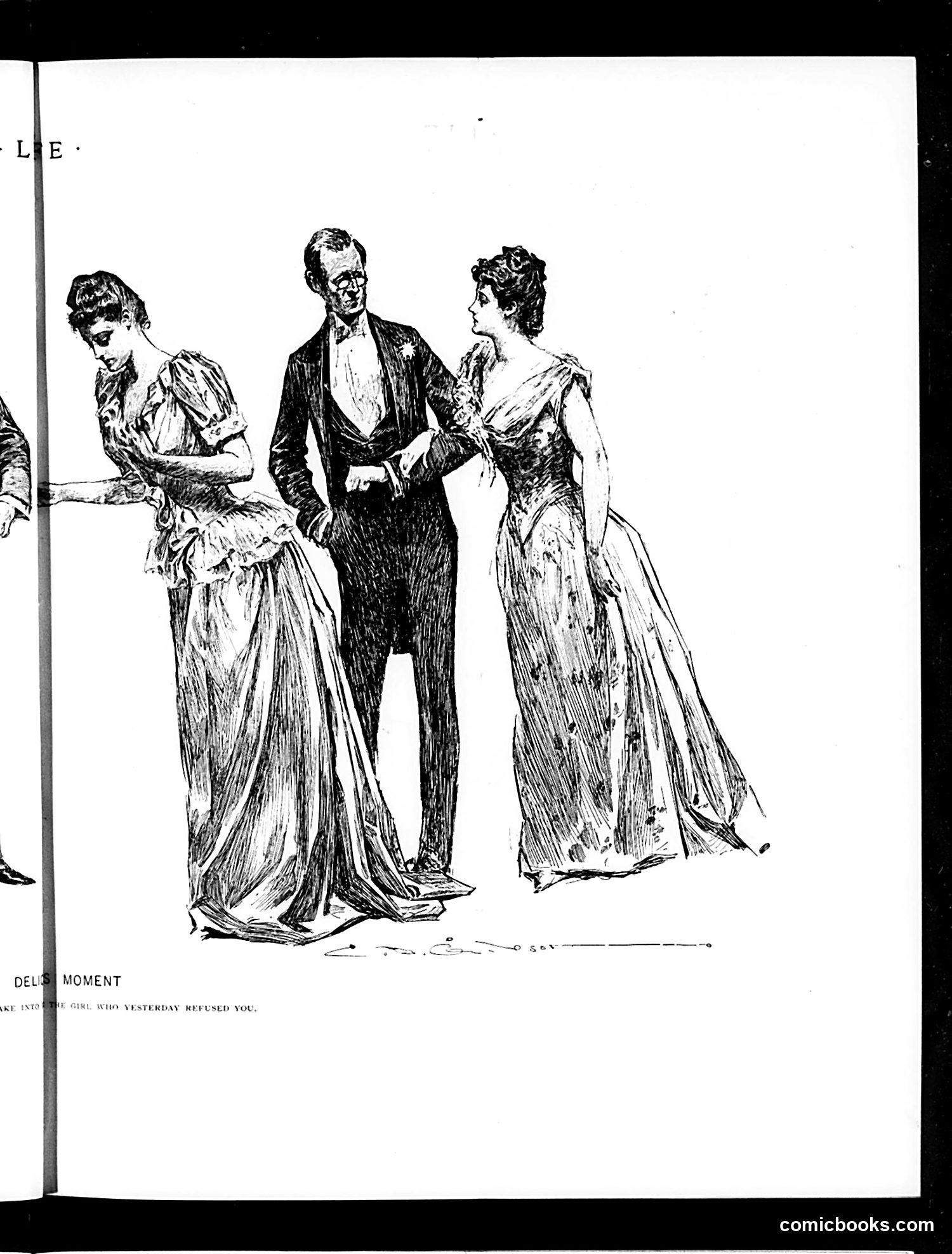
This illustration depicts a social scene at what appears to be a formal event. The caption reads: "A DELICIOUS MOMENT / ...AND THE GIRL WHO YESTERDAY REFUSED YOU." The satire centers on romantic rejection and social awkwardness. A well-dressed man in formal attire stands between two elegantly gowned women. The "delicious moment" referenced is presumably when the man encounters the woman who previously rejected him—now observing him with another woman, creating an ironic or vindicating situation for the rejected suitor. The joke plays on masculine pride and the desire for romantic vindication through appearing desirable to someone else. It's a commentary on early 20th-century courtship dynamics and the social performance of romantic success, where being seen with an attractive companion served as public validation after rejection.
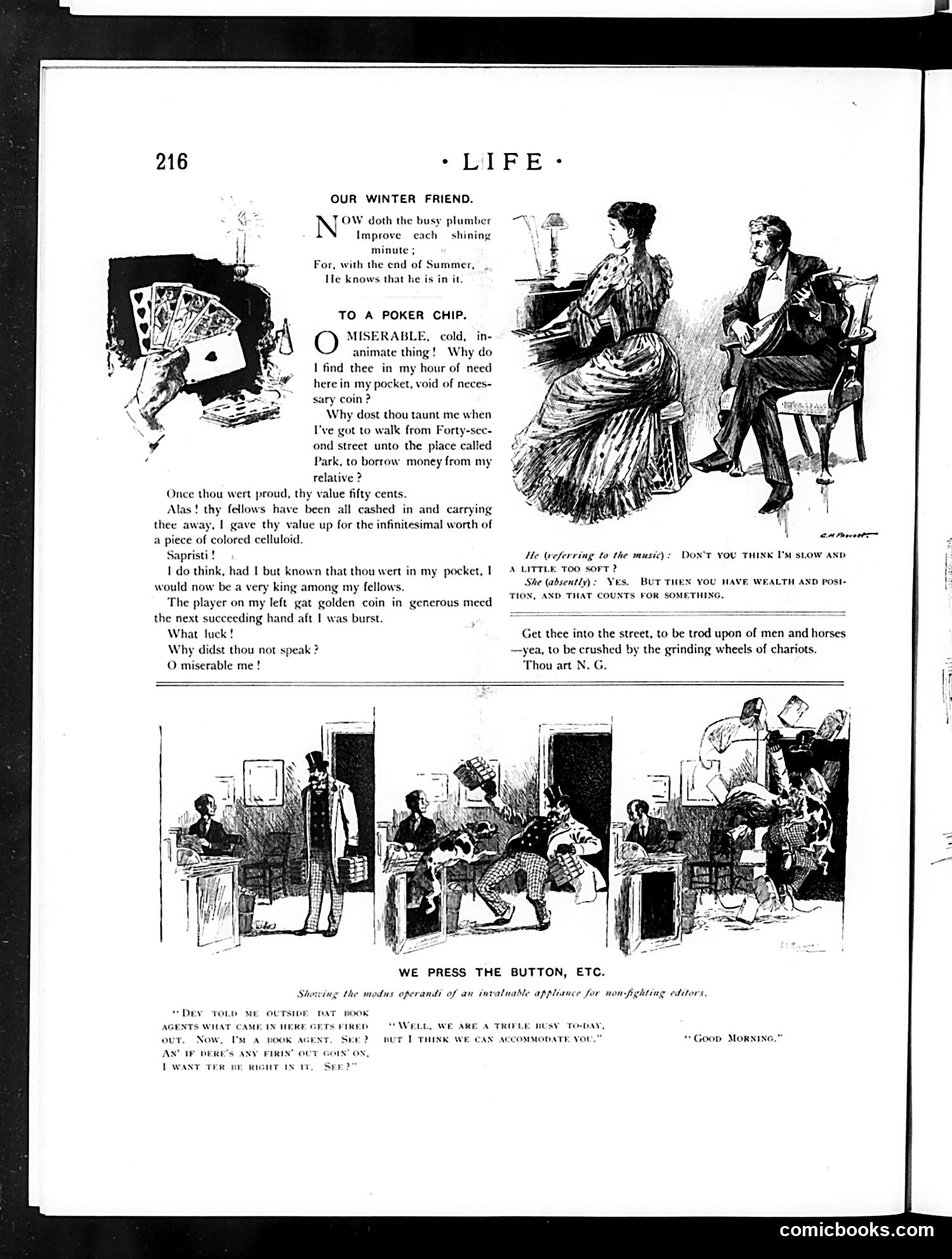
This page from *Life* magazine contains three separate satirical pieces: 1. **"Our Winter Friend"** and **"To a Poker Chip"**: Humorous poetry mocking a plumber's seasonal profiteering and a gambler's regret at losing money—the poker chip is personified as a worthless remainder after gambling losses. 2. **Upper illustration**: A domestic scene where a man (apparently slow-witted or unmusical) asks a woman if she thinks he's "slow and a little too soft." She replies that while he may lack talent, his wealth compensates—satirizing how money excuses social inadequacy among the upper classes. 3. **"We Press the Button, Etc."**: A three-panel comic showing an editor's solution for handling unwanted book agents: a mechanical device that removes them from the office. The agent boasts he's a "book agent" and won't be fired; the final panel shows him gone. This satirizes both aggressive sales tactics and editors' frustration with solicitation. The overall tone mocks class pretension, financial anxiety, and workplace annoyances common to turn-of-the-century urban American life.
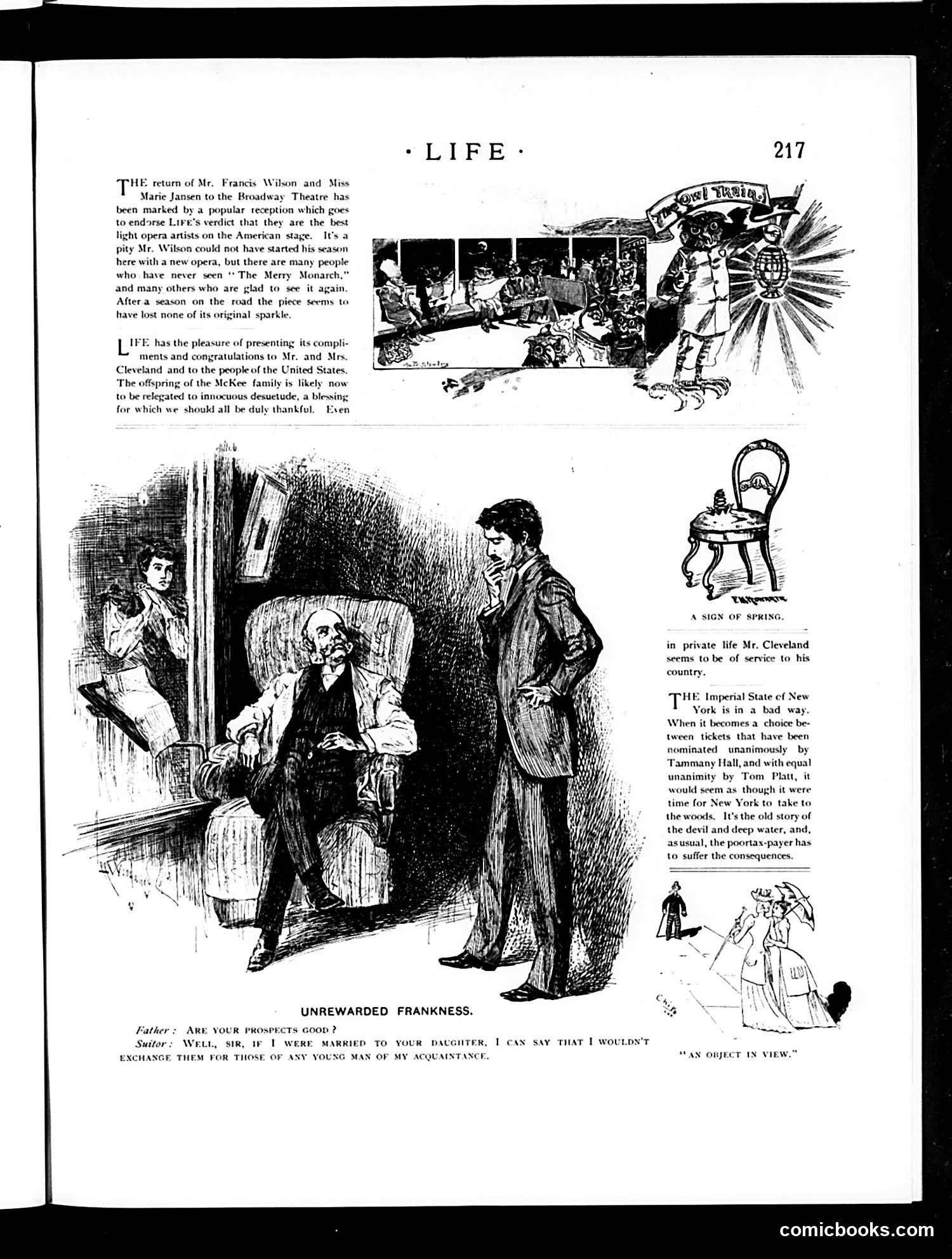
This page contains three distinct satirical items from an early 20th-century American magazine: **Opera Review (top):** Celebrates the return of light opera stars Francis Wilson and Marie Jansen to Broadway, praising them as America's finest in the genre. **Cleveland Congratulations (middle):** Offers tongue-in-cheek congratulations to President Cleveland and his wife on their newborn child, sarcastically calling it a blessing that will relegate the "McKee family" to obscurity. This appears to reference a previous political scandal or rival family. **New York Politics (middle-right):** Criticizes New York's political situation, specifically the conflict between Tammany Hall (the Democratic machine) and Tom Platt (Republican boss), forcing voters to choose between bad options—"the devil and deep water." **"Unrewarded Frankness" Cartoon (bottom):** A father-daughter courtship scene where a suitor tactlessly compliments his own prospects by saying he wouldn't trade places with any rival—accidentally insulting the daughter's value. The satire targets backhandedly insulting behavior dressed as honesty.
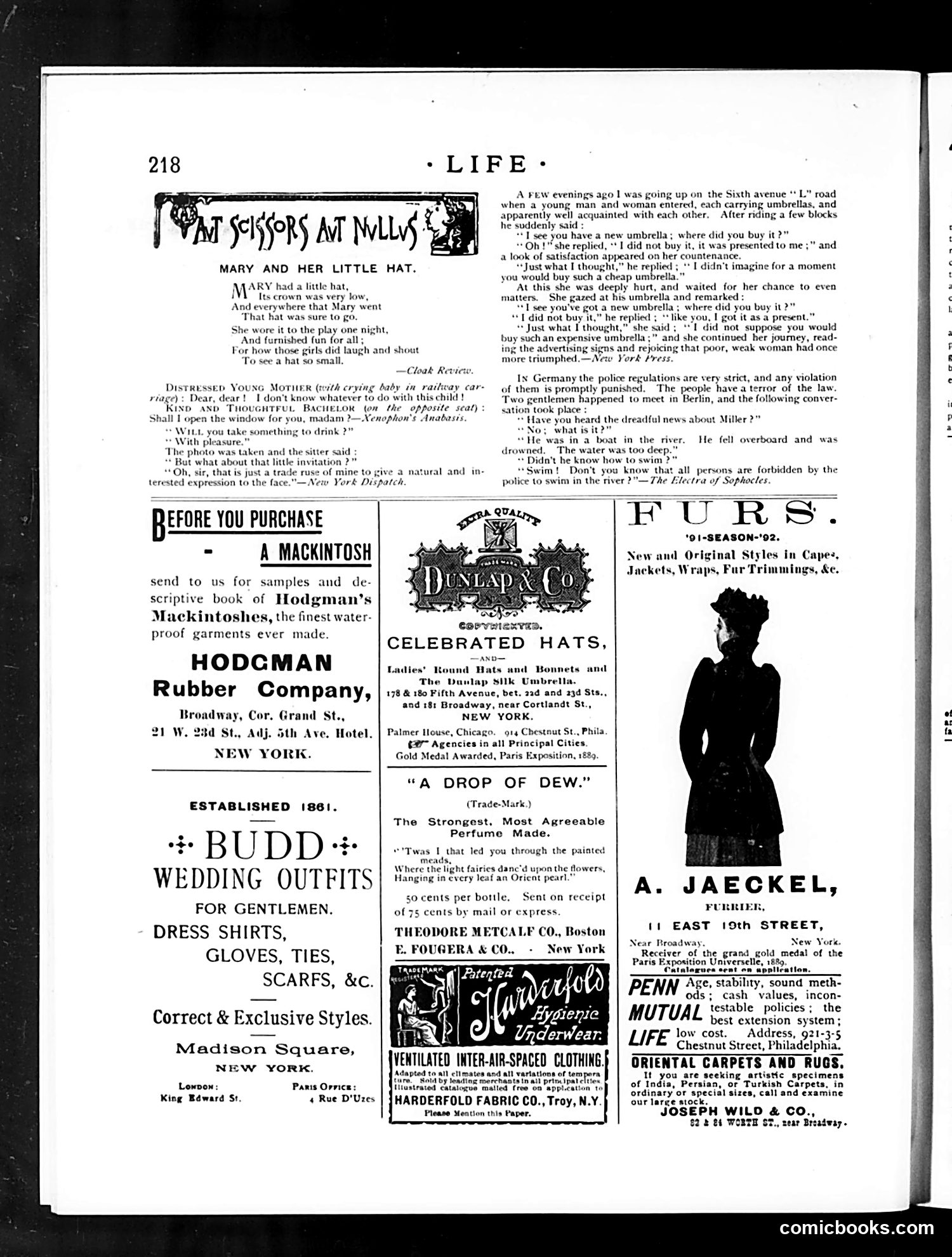
This page contains several short humorous pieces typical of Life magazine's satirical format. The main cartoon, "Mary and Her Little Hat," jokes about the fashion trend of extremely small hats worn by women in the 1890s. The accompanying anecdotes—including one about a distressed mother with a crying baby on a train, another about an umbrella conversation revealing social pretension, and a third satirizing German bureaucratic rigidity—illustrate common social situations used for gentle comedic effect. The humor targets contemporary life: overcrowded public transportation, status anxiety around consumer goods, and absurd adherence to rules. The German anecdote is the sharpest, mocking rigid bureaucracy that would prevent someone from swimming to save their life. The remainder of the page is primarily advertising for period products: mackintoshes (raincoats), formal wear, hats, perfume, and furs—reflecting consumer culture of the 1890s era.
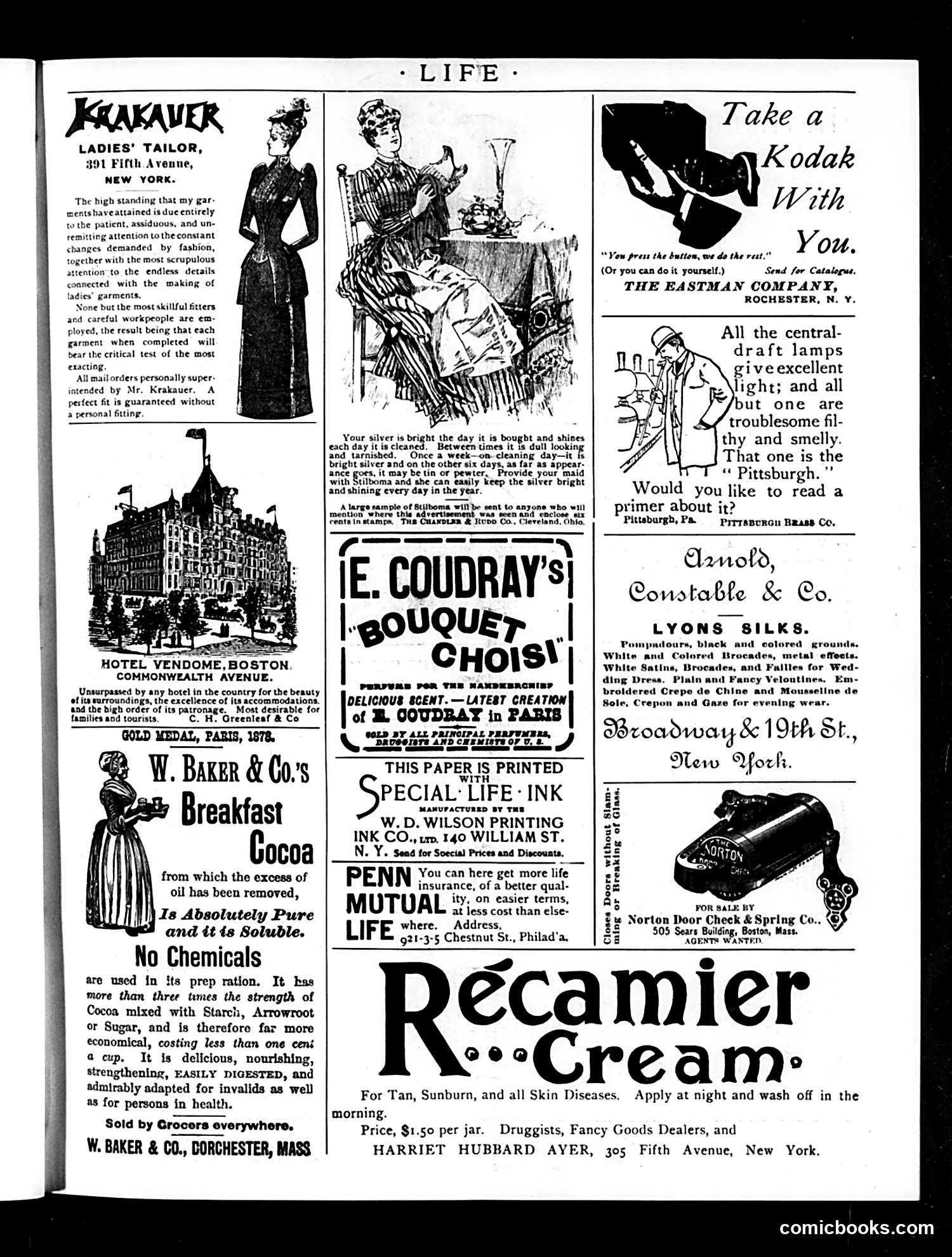
This is primarily an **advertising page** from Life magazine, not a political cartoon. It features various late 19th-century product advertisements with minimal editorial content. The notable satirical element appears in the **Pittsburgh lamp advertisement**: it humorously criticizes all competing central-draft lamps as "troublesome filthy and smelly," positioning only Pittsburgh's product as the solution. This is typical period advertising hyperbole—crude but direct product disparagement. The page otherwise showcases luxury goods marketed to affluent readers: tailoring services, cocoa, silk fabrics, perfume, and skincare products. One ad notes a Gold Medal from Paris 1878, reflecting how European validation was marketable to American consumers. The **Kodak advertisement** is culturally significant—promoting amateur photography as accessible ("you can do it yourself")—but contains no satire here. Collectively, these ads reflect Gilded Age consumer culture: emphasis on quality, European prestige, and products for leisure or personal presentation among the wealthy classes.
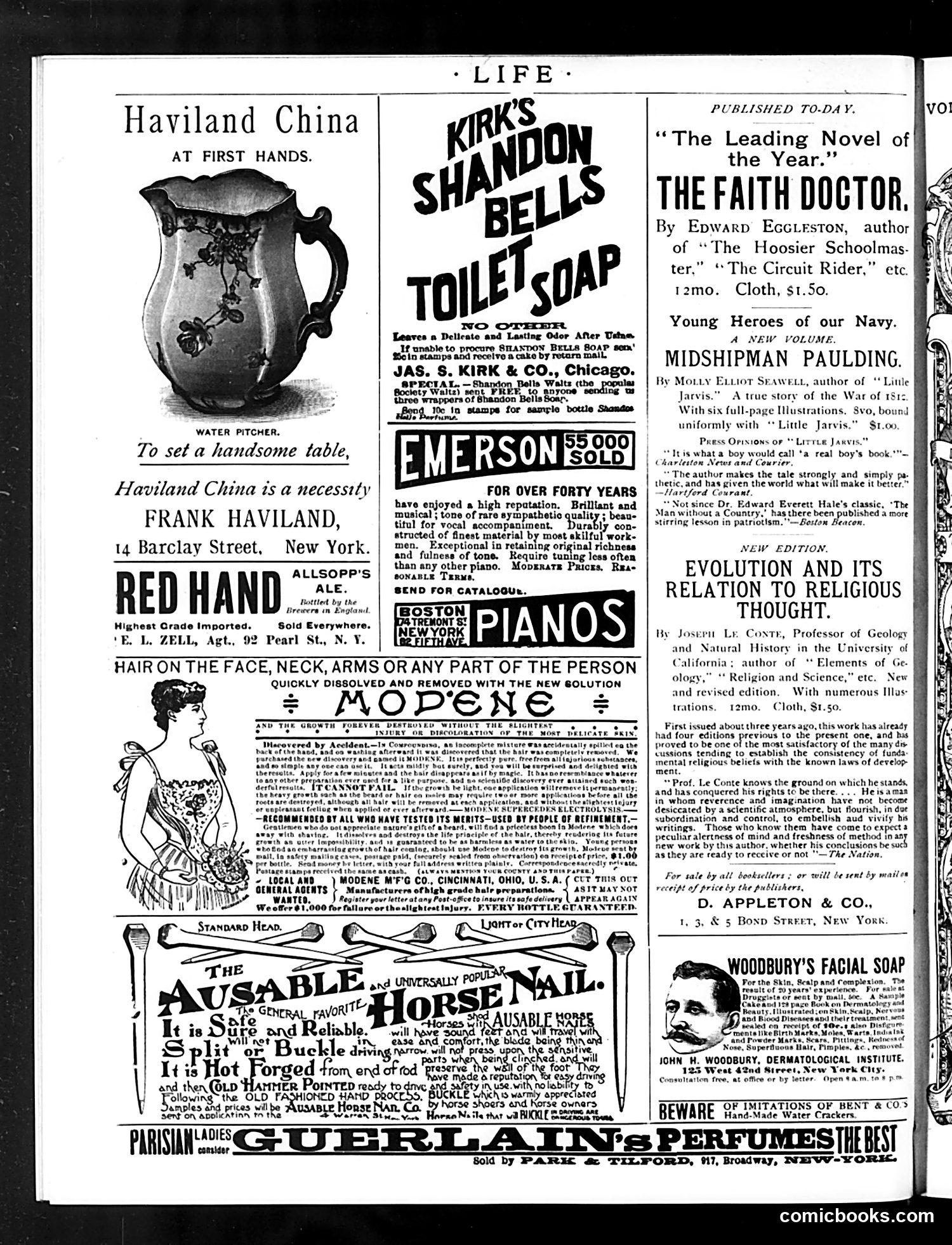
This page is primarily **advertising and book announcements** from a late 19th-century American publication. Rather than political satire, it features commercial notices for household goods and literary releases. The advertisements include luxury items (Haviland china dinnerware), imported ale, soap, pianos, and patent medicines—typical of period publications. One notable ad promotes "Modene," a hair-removal product using chemical solution, marketed with anatomical diagrams. The book section announces three publications: *The Faith Doctor* by Edward Eggleston (described as "the leading novel of the year"), *Midshipman Paulding* (a naval adventure story for young readers), and *Evolution and Its Relation to Religious Thought* by Joseph Le Conte—reflecting late-Victorian interests in reconciling science with religious belief. The page reflects period consumer culture and publishing rather than containing satirical commentary or political messaging.