
Life, 1891-10-15 · page 4 of 16
Life — October 15, 1891 — page 4: what you’re looking at
What you’re looking at
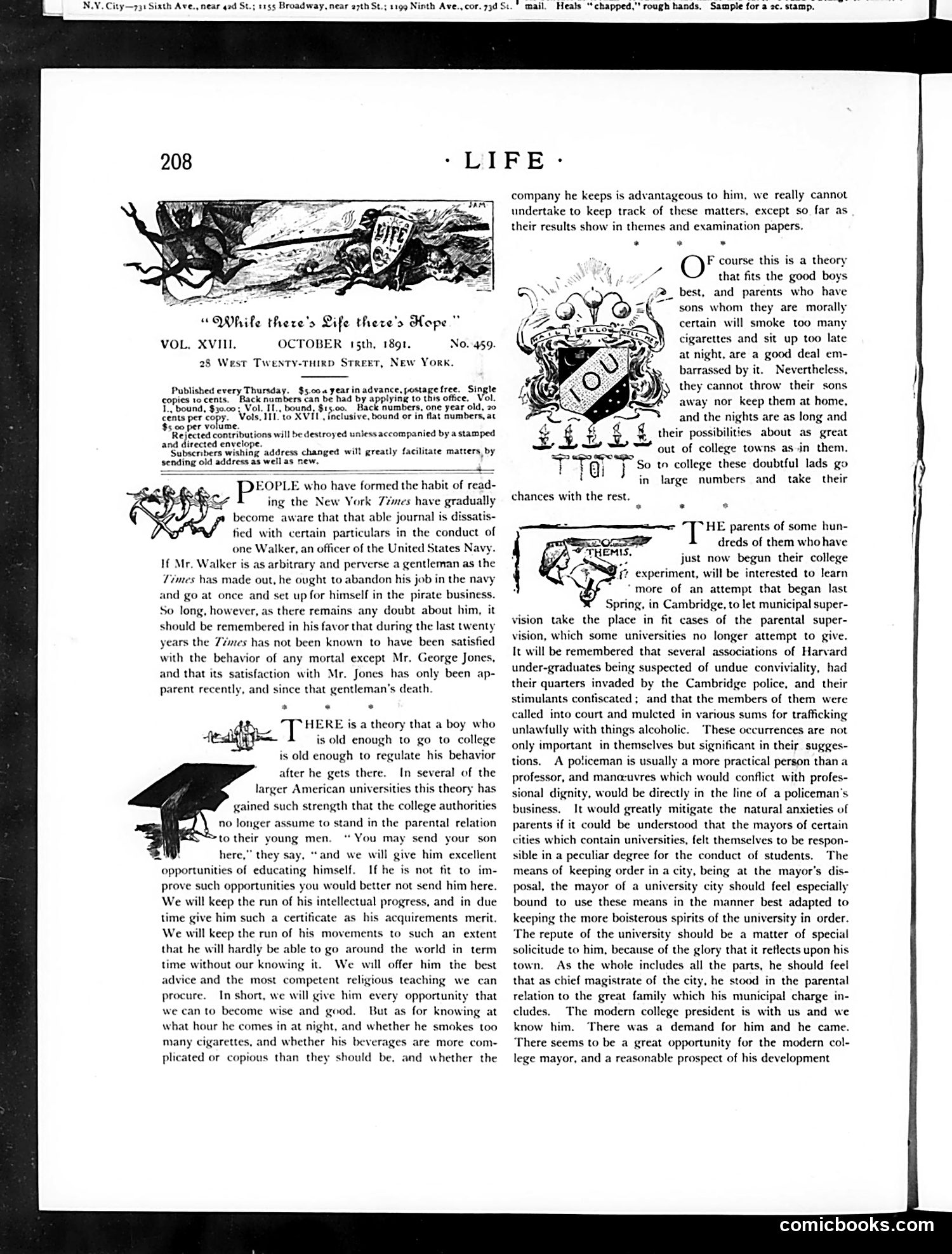
The main editorial discusses college life and parental supervision of young men. The text critiques universities that no longer maintain parental authority over students' behavior—particularly regarding late nights, smoking cigarettes, and alcohol consumption. The cartoon at top left (captioned "While there's Life there's Hope") appears to show a wrecked ship or vessel, likely symbolizing the chaos of unsupervised college life. The decorative illustrations throughout are typical Victorian-era vignettes unrelated to specific political figures. The piece argues that college administrators should act more like civic authorities (comparing their role to mayors), enforcing moral conduct rather than allowing students unchecked freedom. This reflects late 19th-century anxieties about youth morality and institutional responsibility.
📄 Transcribed text from this page (OCR, searchable)
Machine-transcribed from the original scan — historical spelling and the odd misread are preserved.
N.Y. City—731 Sixth Ave,, near gad St.; 1155 Broadway, near a7th St.; “While there's Life there's Hope ” VOL. XVIII. OCTOBER 15th, 1891. No. 459. 28 West Twenty-THIRD Street, New York. Published every Thursday. $5.00. year in advance, postage free. Single copies 10 cents. Back numbers can be had by applying to this office. Vol. T., bound, $30.00; Vol. IT., bound, $ts.00. Back numbers, one year old, 20 cents per copy. Vols. III. to XVIL, inclusive, bound of in flat numbers, at $5.00 per volume. Rejected contributions will be destroyed unlessaccompanied by a stamped and directed envelope. Subscribers wishing address changed will greatly facilitate matters, by sending old address as well as new. EOPLE who have formed the habit of read- ing the New York 7zmes have gradually become aware that that able journal is dissatis- fied with certain particulars in the conduct of one Walker, an officer of the United States Navy. If Mr. Walker is as arbitrary and perverse a gentleman as the Times has made out, he ought to abandon his job in the navy and go at once and set up for himself in the pirate business. So long, however, as there remains any doubt about him, it should be remembered in his favor that during the last twenty rs the 77mes has not been known to have been satisfied with the behavior of any mortal except Mr. George Jones, and that its satisfaction with Mr. Jones has only been ap- parent recently, and since that gentleman's death is old enough to regulate his behavior after he gets there. In several of the larger American universities this theory has gained such strength that the college authorities * . . HERE is a theory that a boy who is old enough to go to college no longer assume to stand in the parental relation to their young men. “You may send your son A here,” they say, “and we will give him excellent opportunities of educating himself. If he is not fit to im- prove such opportunities you would better not send him here. We will keep the run of his intellectual progress, and in due time give him such a certificate as his acquirements merit. We will keep the run of his movements to such an extent that he will hardly be able to go around the world in term time without our knowing it. We will offer him the best advice and the most competent religious teaching we can procure. In short, we will give him every opportunity that we can to become wise and good. But as for knowing at what hour he comes in at night, and whether he smokes too many cigarettes, and whether his beverages are more com- plicated or copious than they should be, and whether the 1199 Ninth Ave., cor. 73d St. " tail, Heals “chapped,” rough hands. Sample forasc.stamp. company he keeps is advantageous to him, we really cannot undertake to keep track of these matters, except so far as their results show in themes and examination papers. . ° . F course this is a theory that fits the good boys. _ best, and parents who have . ~~ sons whom they are morally certain will smoke too many cigarettes and sit up too late at night, are a good deal em- barrassed by it. Nevertheless, they cannot throw their sons away nor keep them at home, and the nights are as long and their possibilities about as great out of college towns as.in them. “So to college these doubtful lads go in large numbers and take their 7 chances with the rest. . 2 ~HE parents of some hun- dreds of them who have now begun their college experiment, will be interested to learn more of an attempt that began last Spring, in Cambridge, to let municipal super- vision take the place in fit cases of the parental super- vision, which some universities no longer attempt to give. It will be remembered that several associations of Harvard under-graduates being suspected of undue conviviality, had their quarters invaded by the Cambridge police, and their stimulants confiscated ; and that the members of them were called into court and mulcted in various sums for trafficking unlawfully with things alcoholic. These occurrences are not only important in themselves but significant in their sugges- tions. A policeman is usually a more practical person than a professor, and manacuvres which would conflict with profes- sional dignity, would be directly in the line of a policeman’s business. It would greatly mitigate the natural anxieties of parents if it could be understood that the mayors of certain cities which contain universities, felt themselves to be respon- sible in a peculiar degree for the conduct of students. The means of keeping order in a city, being at the mayor's dis- posal, the mayor of a university city should feel especially bound to use these means in the manner best adapted to keeping the more boisterous spirits of the university in order. The repute of the university should be a matter of special solicitude to him, because of the glory that it reflects upon his town. As the whole includes all the parts, he should feel that as chief magistrate of the city, he stood in the parental relation to the great family which his municipal charge in- cludes. The modern college president is with us and we know him. There was a demand for him and he came. There seems to be a great opportunity for the modern col- lege mayor, and a reasonable prospect of his development comicbooks.com