
Life, 1891-10-15 · page 9 of 16
Life — October 15, 1891 — page 9: what you’re looking at
What you’re looking at
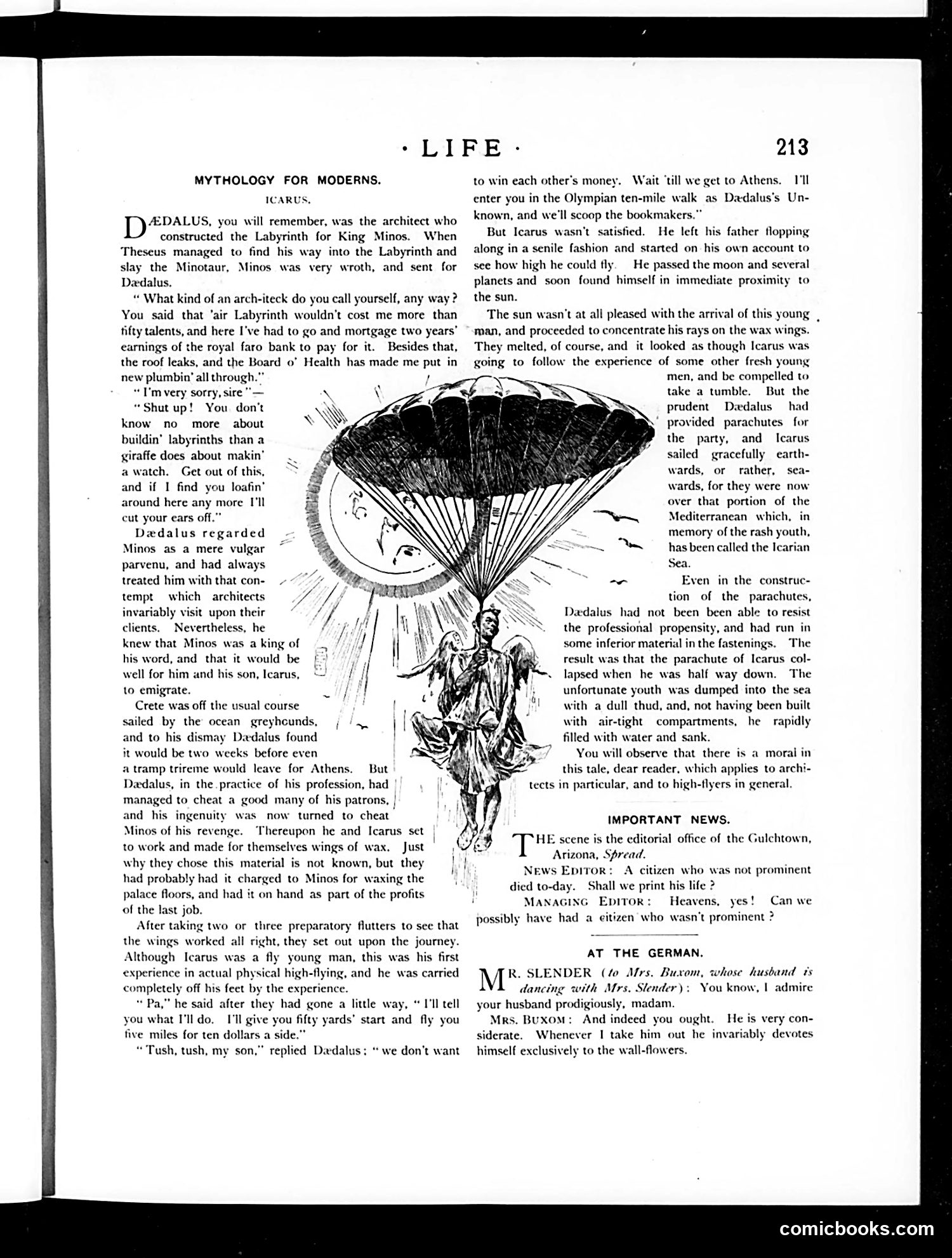
This satirical retelling of the Icarus myth updates the classical story for contemporary American readers. The illustration shows Icarus with mechanical wings (wax replaced by modern materials), descending with a parachute after his flight toward the sun. The satire critiques modern ambition and get-rich-quick schemes. Daedalus represents a practical professional; Icarus embodies reckless youth pursuing impossible dreams. The narrative jokes about Icarus's failed engineering (inferior fasteners cause the parachute to malfunction), mocking both newfangled technology and youthful overconfidence. The moral, stated explicitly, warns architects and "high-flyers" against hubris—suggesting Life's readers recognize themselves in Icarus's cautionary tale about exceeding one's limitations through modern shortcuts.
📄 Transcribed text from this page (OCR, searchable)
Machine-transcribed from the original scan — historical spelling and the odd misread are preserved.
* LIFE - MYTHOLOGY FOR MODERNS. ICARUS, AEDALUS, you will remember, was the architect who constructed the Labyrinth for King Minos. When Theseus managed to find his way into the Labyrinth and slay the Minotaur, Minos was very wroth, and sent for Dardalus. “ What kind of an arch-iteck do you call yourself, any way ? You said that ‘air Labyrinth wouldn't cost me more than fifty talents, and here I've had to go and mortgage two years’ earnings of the royal faro bank to pay for it. Besides that, the roof leaks, and the Board 0’ Health has made me put in new plumbin’ all through.”” I'm very sorry, sire" — “Shut up! You don’t know no more about buildin’ labyrinths than a giraffe does about makin’ a watch. Get out of this, and if I find you loafin’ around here any more I'll cut your ears off.” Dedalus regarded Minos as a mere vulgar parvenu, and had always treated him with that con- tempt which architects invariably visit upon their clients. Nevertheless, he knew that Minos was a king of his word, and that it would be well for him and his son, Icarus, to emigrate. Crete was off the usual course sailed by the ocean greyhounds, and to his dismay Dadalus found it would be two weeks before even a tramp trireme would leave for Athens. But Daedalus, in the.practice of his profession, had managed to cheat a good many of his patrons, | and his ingenuity was now turned to cheat Minos of his revenge. Thereupon he and Icarus set to work and made for themselves wings of wax, Just why they chose this material is not known, but they had probably had it charged to Minos for waxing the palace floors, and had it on hand as part of the profits of the last job. After taking two or three preparatory flutters to see that the wings worked all right, they set out upon the journey. Although Icarus was a fly young man, this was his first experience in actual physical high-flying, and he was carried completely off his feet by the experience. “Pa,” he said after they had gone a little way, “I'll tell you what I'll do. I'll give you fifty yards’ start and fly you five miles for ten dollars a side.” “Tush, tush, my son,” replied Daedalus: “ we don’t want 213 to win each other's money. Wait ‘till we get to Athens. I'll enter you in the Olympian ten-mile walk as Dadalus’s Un- known, and we'll scoop the bookmakers.” But Icarus wasn't satisfied. He left his father flopping along in a senile fashion and started on his own account to see how high he could fly. He passed the moon and several planets and soon found himself in immediate proximity to the sun. The sun wasn’t at all pleased with the arrival of this young , man, and proceeded to concentrate his rays on the wax wings. They melted, of cour: id it looked as though Icarus was going to follow the experience of some other fresh young men, and be compelled to take a tumble. But the prudent Deedalus had provided parachutes for the party, and Icarus sailed gracefully earth- wards, or rather, sea- wards, for they were now over that portion of the Mediterranean which, in memory of the rash youth, has been called the Icarian Even in the construc- tion of the parachutes, Daedalus had not been been able to resist the professional propensity, and had run in some inferior material in the fastenings. The result was that the parachute of Icarus col- lapsed when he was half way down. The unfortunate youth was dumped into the sea with a dull thud, and, not having been built with air-tight compartments, he rapidly filled with water and sank. You will observe that there is a moral in this tale, dear reader, which applies to archi- tects in particular, and to high-flyers in general. IMPORTANT NEWS. cene is the editorial office of the Gulchtown, Arizona, Spread. News Epiror: A citizen who was not prominent died to-day. Shall we print his life ? MANAGING EpivoR: Heavens, yes! Can we possibly have had a eitizen who wasn’t prominent ? AT THE GERMAN. R. SLENDER (¢0 Mrs. Buxom, whose husband ts dancing with Mrs. Slender); You know, | M your husband prodigiously, madam. Mrs. Buxom: And indeed you ought. admire He is very con- siderate. Whenever I take him out he invariably devotes himself exclusively to the wall-flowers. comicbooks.com