
Life, 1891-10-15 · page 6 of 16
Life — October 15, 1891 — page 6: what you’re looking at
What you’re looking at
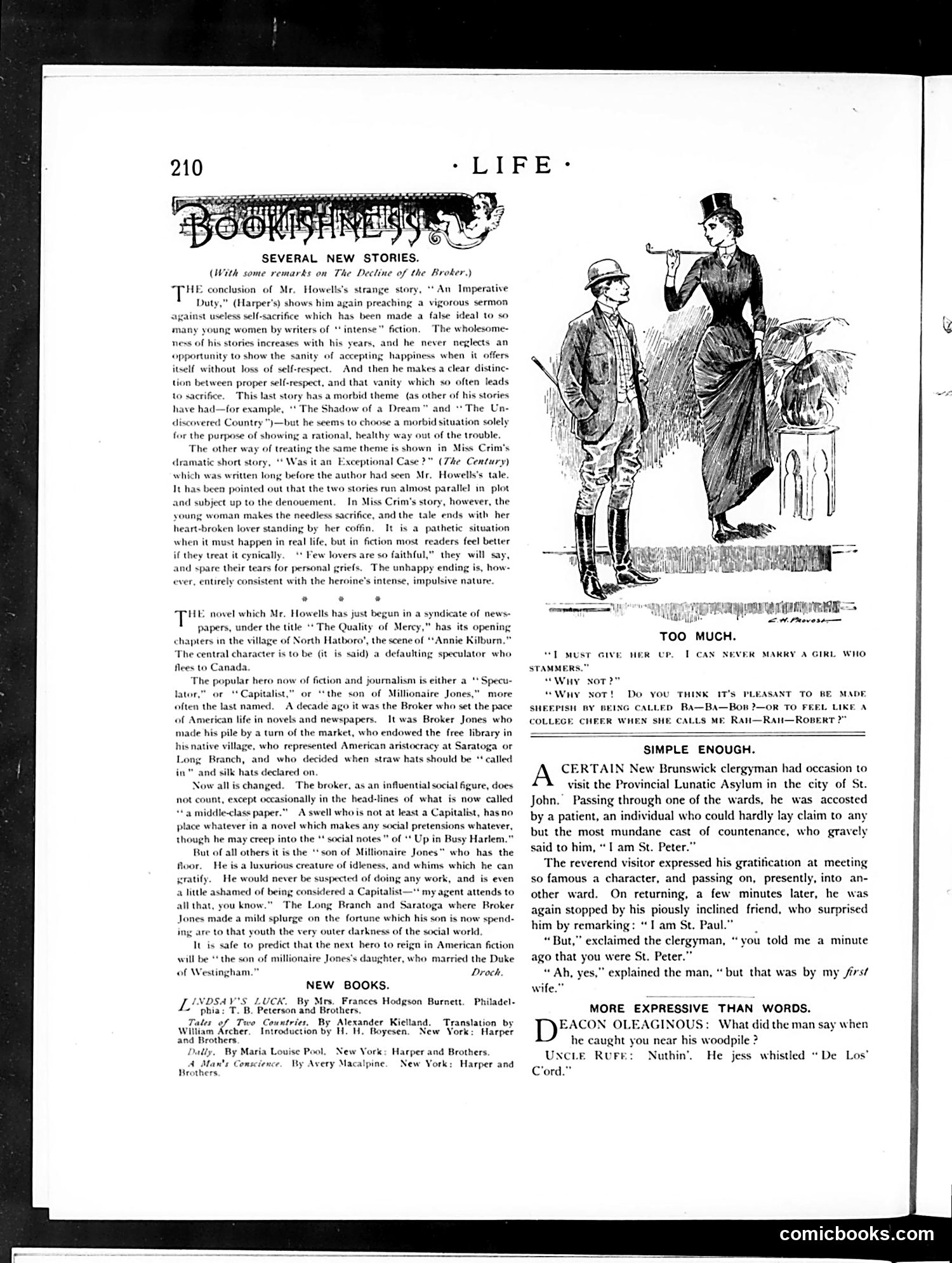
The page contains book reviews and short humor pieces rather than political cartoons. The main illustration labeled "TOO MUCH" depicts two men in Victorian-era clothing—one appearing to be a military or official figure confronting another man. The accompanying dialogue jokes about refusing to marry a girl who "stammers," with characters named "Ra-ha-bob" and "Robert," creating humor through the stammer itself. Below, "SIMPLE ENOUGH" presents a brief anecdote about a clergyman visiting an asylum who encounters patients claiming to be saints (St. Peter, St. Paul), with a punchline about the clergyman's wife being his "first" wife. The satire is genteel and focused on social awkwardness and wordplay rather than political commentary. The page reflects Life's typical early-20th-century humor style: domestic situations and linguistic jokes rather than topical satire.
📄 Transcribed text from this page (OCR, searchable)
Machine-transcribed from the original scan — historical spelling and the odd misread are preserved.
SEVERAL NEW STORIES. (With some remarks on The Decline of the Broker.) THE conclusion of Mr, Howells's strange story, “* An Imperative Duty,” (Harper's) shows him again preaching a vigorous sermon against useless self-sacrifice which has been made a false ideal to so many young women by writers of “intense” fiction. ‘The wholesome- his stories increases with his years, and he never neglects an portunity to show the sanity of accepting happiness when it offers itself without loss of self-respect. And then he makes a clear distine- tion between proper self-respect, and that vanity which so often leads to sacrifice. This last story has a morbid theme (as other of his stories example, “The Shadow of a Dream” and “The Un- Country ")—but he seems to choose a morbid situation solely for the purpose of showing a rational, healthy way out of the trouble. The other way of treating the same theme is shown in Miss Crim’s dramatic short story, ‘Was it an Exceptional Case?” (Zhe Century) which was written long before the author had seen Mr, Howells’s tale. It has been pointed out that the two stories run almost parallel in plot In Miss Crim’s story, however, the 4g woman makes the needless sacrifice, and the tale ends with her n lover standing by her coffin, It is a pathetic situation when it must happen in real life, but in fiction most readers feel better if they treat it cynically.‘ Few lovers are so faithful,” they will say, ars for personal griefs, The unhappy ending is, how- ever, entirely consistent with the heroine's intense, impulsive nature. have had— and subject up to the denouement. and spare their ® * * HE novel which Mr. Howells has just begun in a syndicate of news- papers, under the title “The Quality of Mercy,” has its opening chapters in the village of North Hatboro’, the scene of “Annie Kilburn,” The central character is to be (it is said) a defauking speculator who fees to Canada. The popular hero now of fiction and journalism is either a ** Specu- lator.” of Capitalist,” or ‘the son of Millionaire Jones," more often the last named. A decade ago it was the Broker who set the pace of American life in novels and newspapers. It was Broker Jones who made his pile by a turn of the market, who endowed the free library in hisnative village, who represented American aristocracy at Saratoga or Long Branch, and who decided when straw hats should be ‘called in” and silk hats declared Now all is changed. The broker, as an influential social figure, does not count, except occasionally in the head-lines of what is now called +a middle-class paper.” A swell whois not at least a Capitalist, hasno place whatever in a novel which makes any social pretensions whatever, though he may creep into the ** social notes " of ** Up in Busy Harlem. But of all others it is the ‘son of Millionaire Jones” who has the floor. He is a luxurious creature of idleness, and whims which he can gratify. He would never be suspected of doing any work, and is even a little ashamed of being, considered a Capitalist—" my agent attends to all that, you know.” The Long Branch and Saratoga where Rroker Jones made a mild splurge on the fortune which his son is now spend- ing are to that youth the very outer darkness of the social world It is safe to predict that the next hero to reign in American fiction will be ‘the son of millionaire Jones's daughter, who married the Duke of Westingham.” Droch. NEW BOOKS. "DSAV'S LUCK. By Mrs. Frances Hodgson Burnett phia: T. B. Peterson and Brothers, tes of Two Countries, By Alexander Kielland. im Archer. Introduction by H. H. Boyesen. and Brothers Dally. By Maria Louise Pool, A Man's Conscience. Brothers Philadel- Translation by New York: Harper New Vork By Avery Macalpine. Harper and Brothers. New York: Harper and TOO MUCH. “To musr HER UP. STAMMERS.” “Why nor?” Wnuy sot! Do you THINK IT's PLEASANT TO RE SHEEPISH BY BE CALLED Ba—Ba—Bon ?—OR TO FRE COLLEGE CHEER WHEN SHE CALLS ME Ran—Rant—Roper’ ave 1 CAN NEVER MARRY A GIRL WHO MADE LIKE A SIMPLE ENOUGH. A CERTAIN New Brunswick clergyman had oc visit the Provincial Lunatic Asylum in the city of St. John. Passing through one of the wards, he was accosted by a patient, an individual who could hardly lay claim to any but the most mundane cast of countenance, who gravely said to him, “I am St. Peter.” The reverend visitor expressed his gratification at meeting so famous a character, and passing on, presently, into an- other ward. On returning, a few minutes later, he was again stopped by his piously inclined friend, who surprised him by remarking: “Tam St. Paul.” “ But,” exclaimed the clergyman, “you told me a minute ago that you were St. Peter.” “Ah, yes,” explained the man, “but that was by my first wife.” MORE EXPRESSIVE THAN WORDS. TPAcox OLEAGINOUS: What did the man say when he caught you near his woodpile ? Uxc Rureé: Nuthin’. He jess whistled “De L Cord.” comicbooks.com