
A complete issue · 14 pages · 1891
Life — May 7, 1891
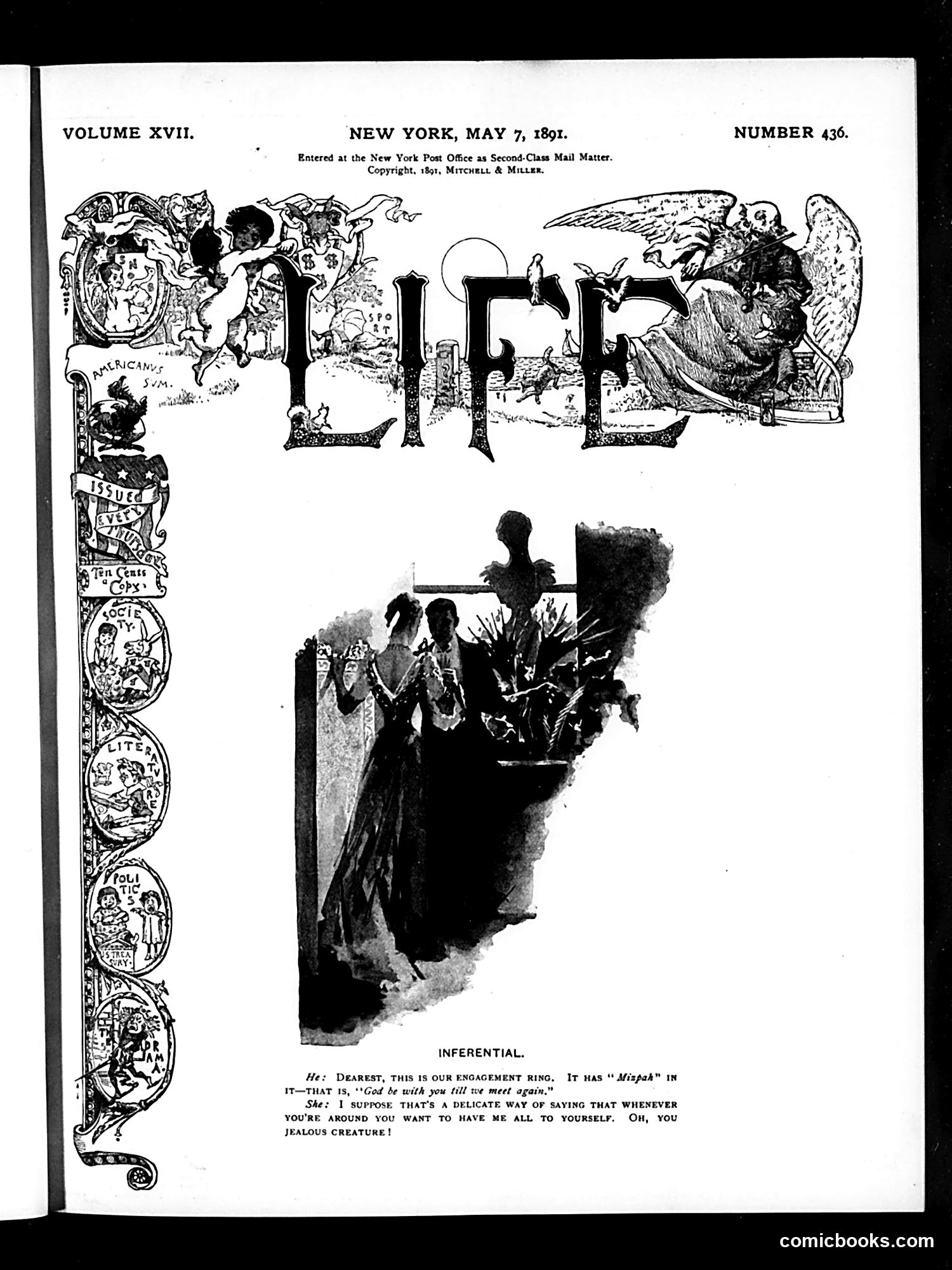
This cartoon depicts a romantic scene with two figures examining an engagement ring. The dialogue reveals the satire's target: the woman protests that an engagement ring with "Mizpah" engraved on it—meaning "God be with you till we meet again"—is an odd choice, as it suggests separation rather than togetherness. She sarcastically notes this is "a delicate way of saying that whenever you're around you want to have me all to yourself. Oh, you jealous creature!" The humor lies in the ironic contradiction: a Mizpah ring supposedly expresses devotion, yet its inscribed message implies the couple will be apart. The woman infers from this "sentimental" choice that her fiancé actually wants to monopolize her company—revealing his jealous nature through his supposedly romantic gift choice.
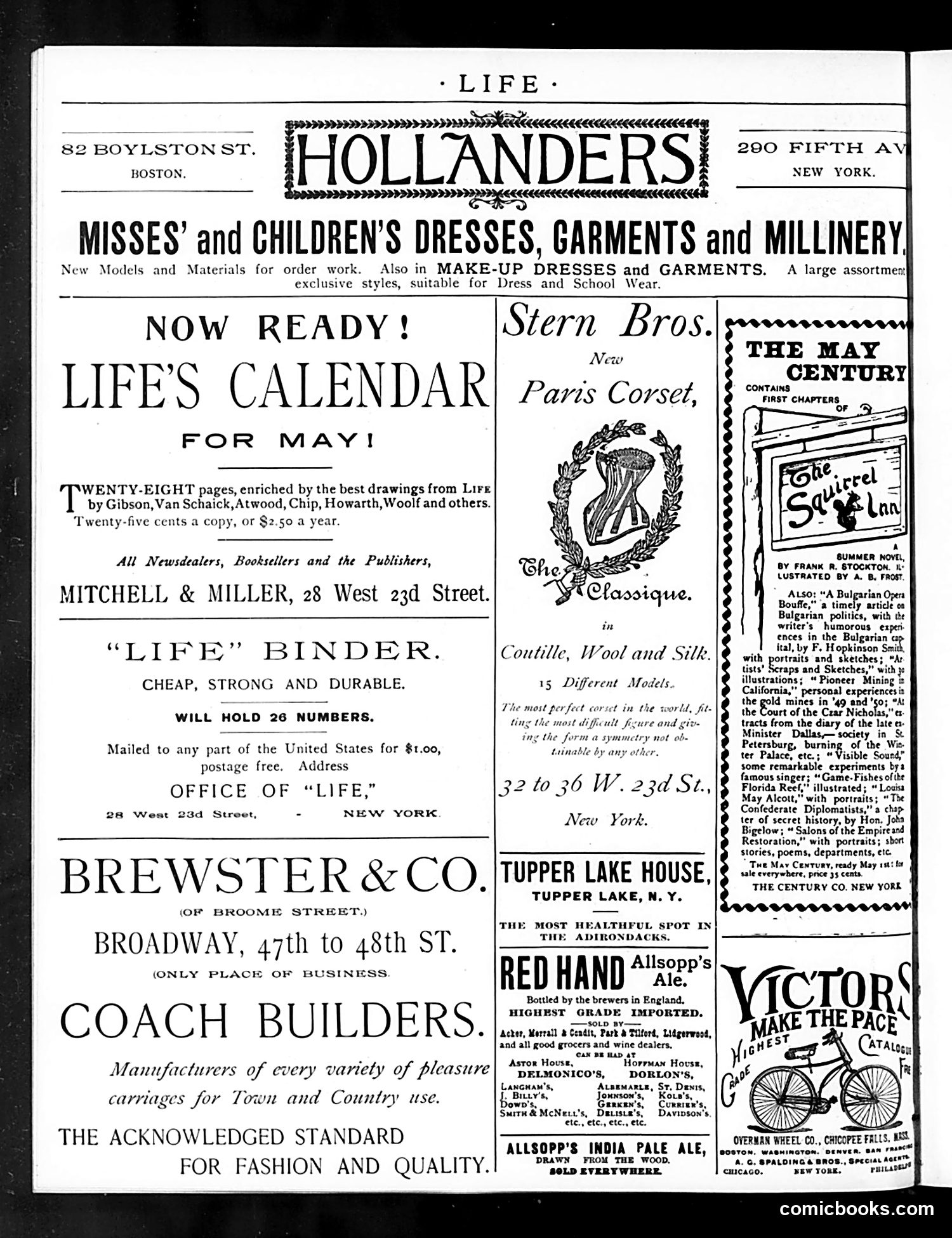
This page is primarily **advertising content** rather than editorial cartoons or satire. It contains multiple commercial advertisements from the early 1900s, including: - Hollanders (children's clothing) - Life's Calendar for May - Stern Bros. (corsets) - Brewster & Co. (coach builders) - Tupper Lake House (resort) - Red Hand Ale - Victors bicycles The only illustrated element with potential satirical content is the corset advertisement featuring a classical-style drawing, though this appears to be standard product imagery rather than political commentary. The page reflects the magazine's business model: mixing editorial content with paid advertising to support publication. No identifiable political figures, events, or social satire are evident on this particular page.
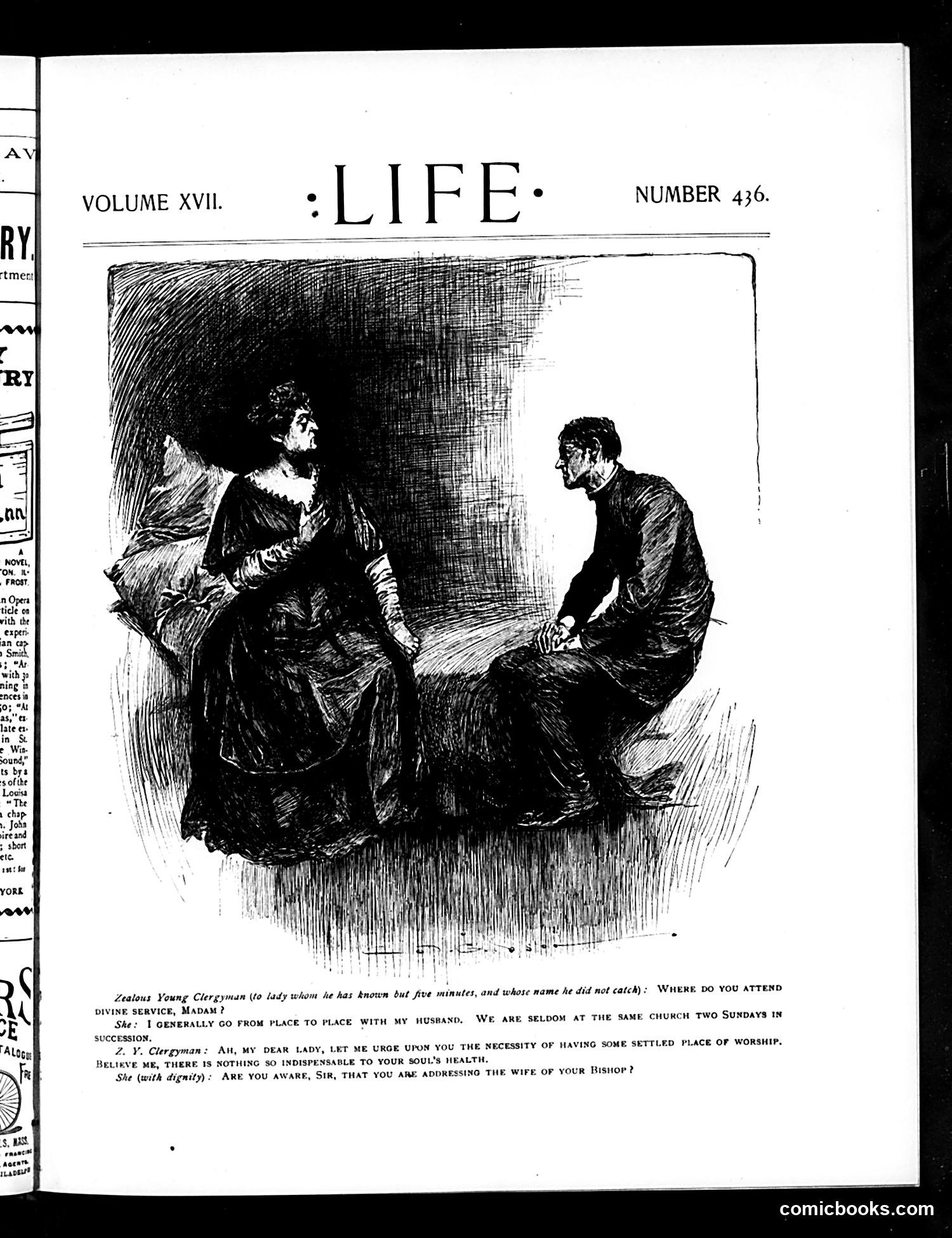
This sketch depicts a social satire about religious practice and marital discord. A "zealous young clergyman" confronts a woman about her inconsistent church attendance, noting she and her husband rarely attend the same service on consecutive Sundays. The clergyman lectures her on the necessity of "settled place of worship" for spiritual health, then pointedly asks if she's aware that her bishop's wife regularly attends church—implying the woman should follow this example of proper devotion. The satire targets upper-class hypocrisy: the couple's inability to attend together suggests marital tension or social scheduling conflicts, while the clergyman's appeal to the bishop's wife's example highlights how religious duty becomes a matter of social class performance rather than genuine faith.
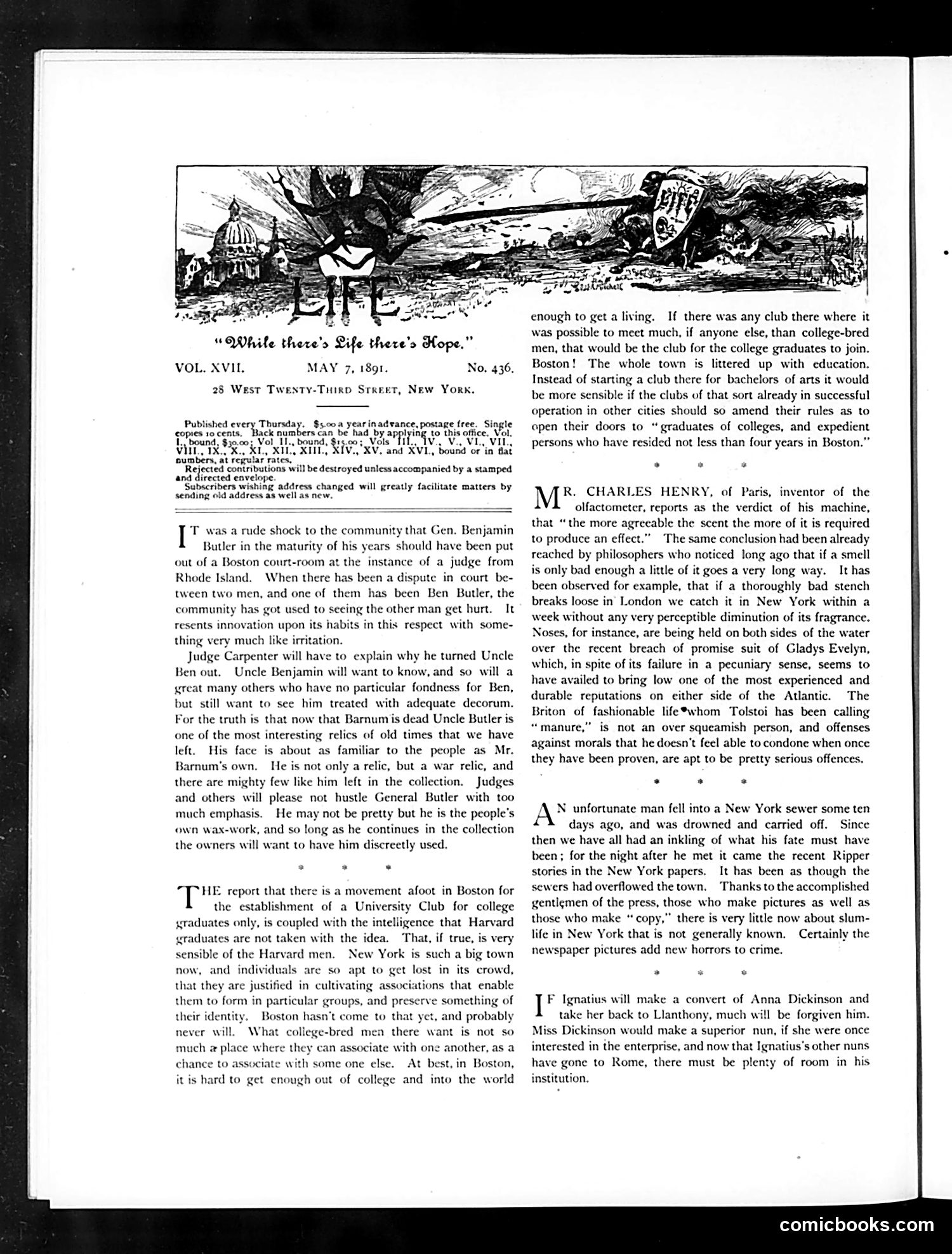
The masthead illustration depicts a winged figure (likely representing "Life" itself) surveying a landscape with classical architecture—a common allegorical device for the magazine's satirical identity. The text discusses several contemporary issues: a controversy involving General Benjamin Butler and a Boston court case; a proposal for a Harvard-affiliated University Club for college graduates in Boston; and gossip about various social figures including references to "Anna Dickinson" and someone named Ignatius. The magazine's humor relies on insider knowledge of Boston's social elite and institutional politics. Without additional context about the specific scandals or individuals referenced, the precise satirical targets remain unclear to modern readers, though the tone suggests mockery of Boston's establishment pretensions and Harvard's social exclusivity.
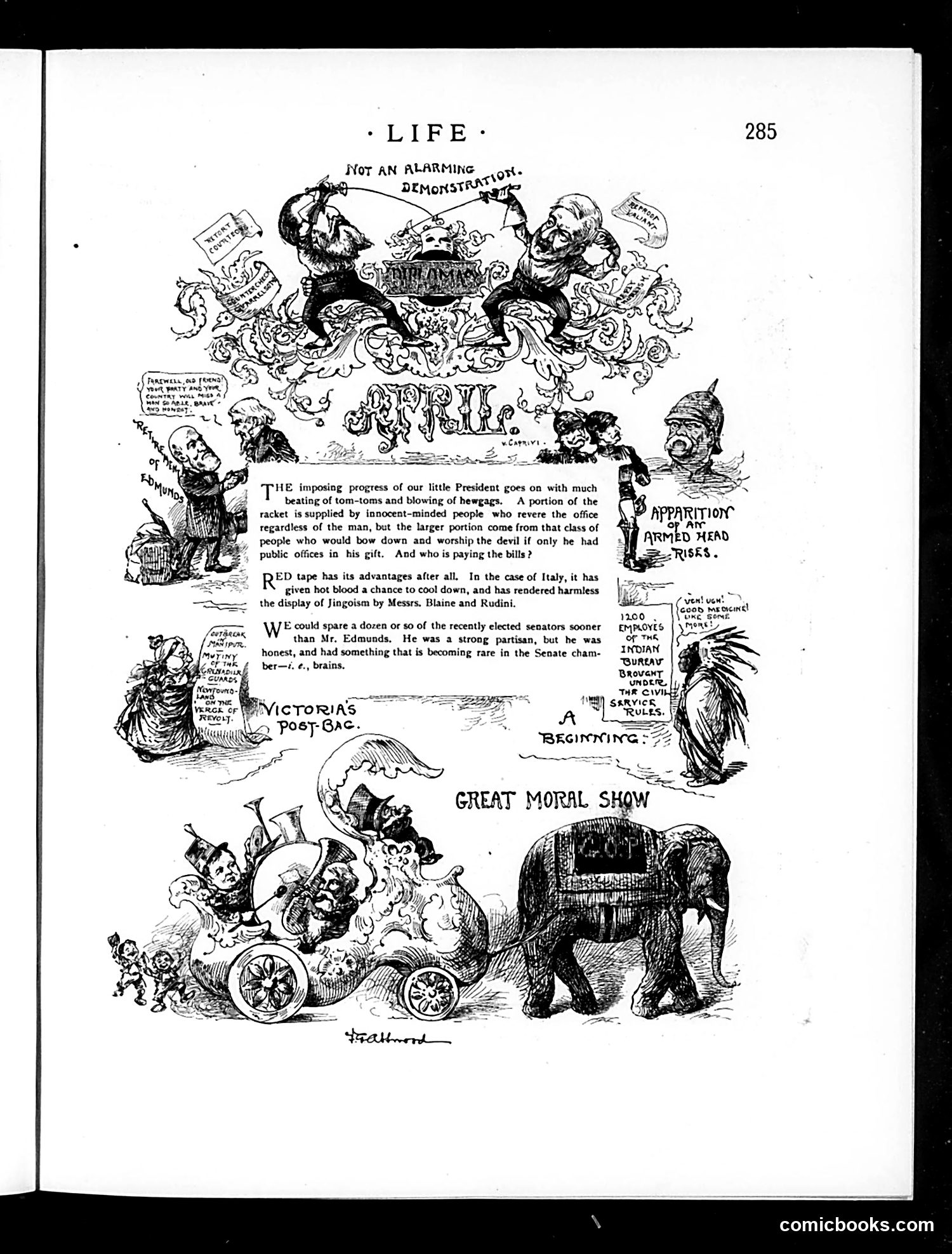
This page satirizes President Theodore Roosevelt's administrative activities and controversies. The top section mocks "not an alarming demonstration"—likely referring to Roosevelt's aggressive policies or public actions that supporters claimed were routine but critics found troubling. The text discusses the president's "imposing progress," mentioning tom-toms and bazaars, suggesting criticism of his policies as spectacle. References to "Red tape" and Italy (possibly relating to diplomatic incidents) appear alongside commentary about senators and Mr. Edmunds. The "Great Moral Show" section at bottom depicts an elephant—the Republican Party symbol—pulling a circus wagon, suggesting Roosevelt's administration is portrayed as performative politics or a theatrical display rather than serious governance. The overall tone is critical of Roosevelt's methods and showmanship.
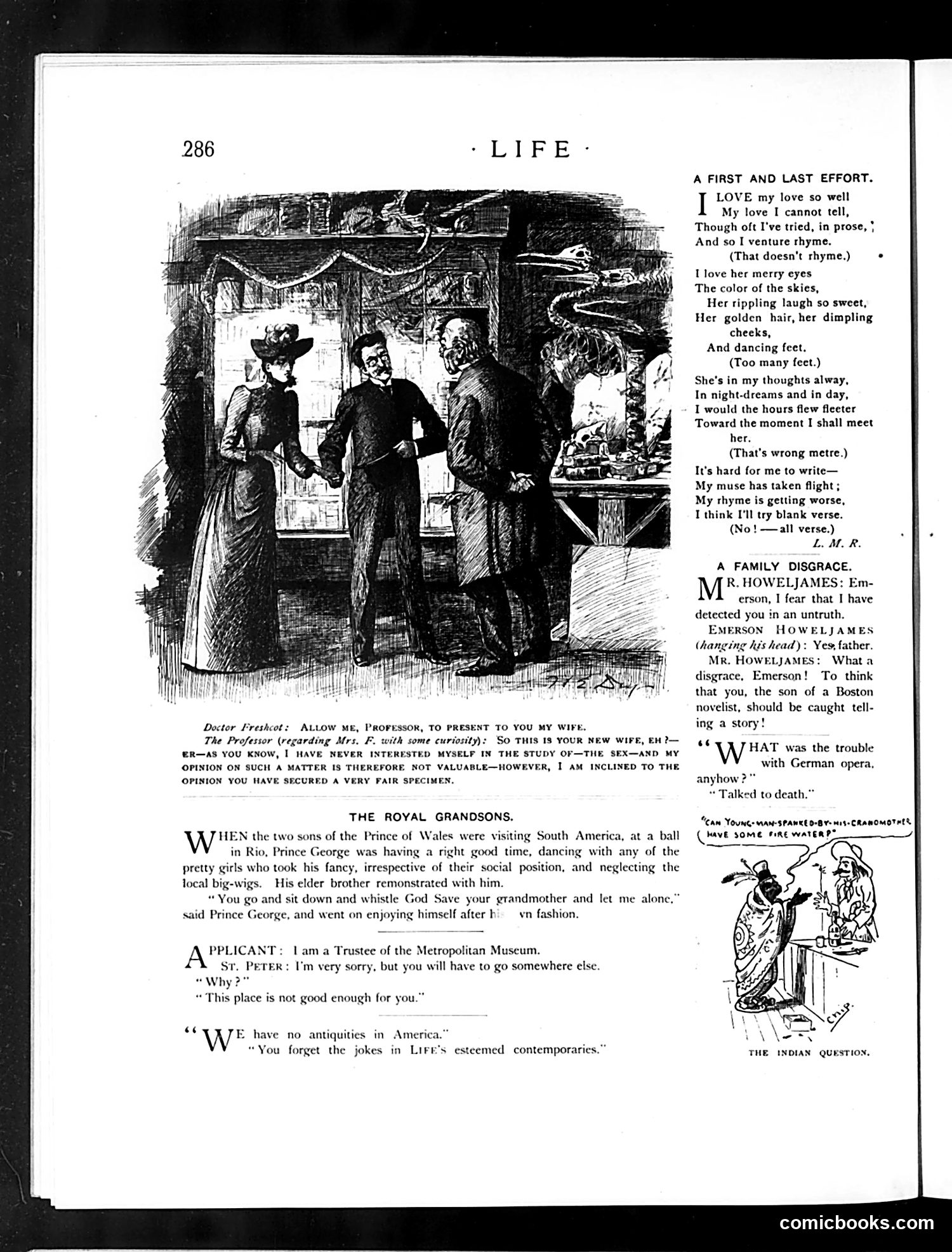
**Main Content:** This page contains three satirical pieces targeting social pretension and cultural attitudes of the era. **"A First and Last Effort"** is a humorous poem mocking amateur poets attempting to write love verses—the speaker struggles with rhyme and meter, admitting blank verse failure. **"A Family Disgrace"** shows a dialogue where Mr. Howeljames accuses his son (a Boston novelist) of disgracing the family by writing fiction. The satire targets Victorian attitudes treating novel-writing as disreputable work. **"The Royal Grandsons"** and subsequent anecdotes mock American pretensions regarding European culture and social hierarchy, including a joke about American museums lacking "antiquities." **The cartoons** reinforce themes of social climbing and cultural snobbery typical of Life's satirical focus on Gilded Age American society.
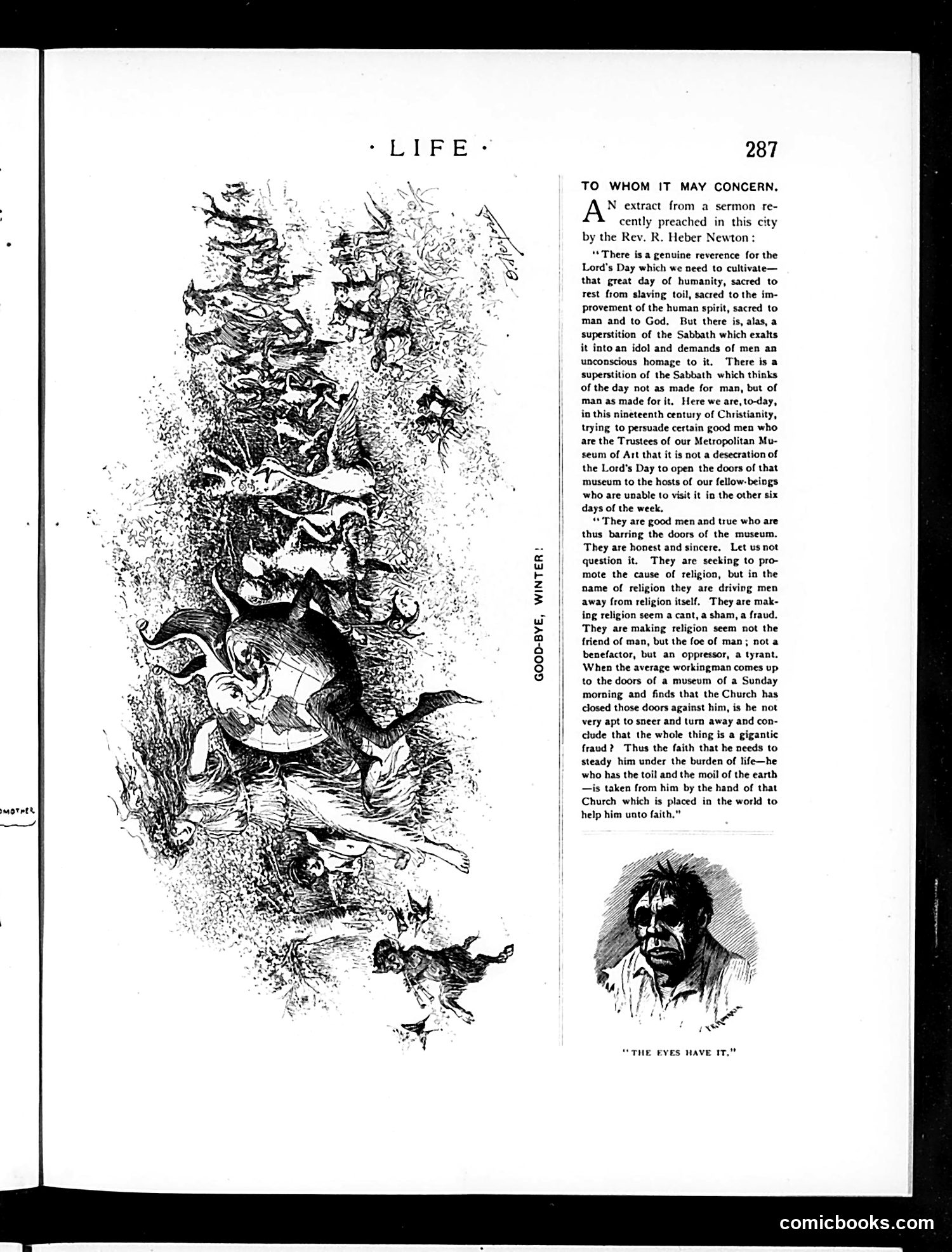
This page contains a sermon excerpt by Rev. R. Heber Newton criticizing what he calls a "gigantic fraud"—efforts by certain "good men" to close museum doors on Sundays to prevent working-class visitors from accessing cultural institutions on their only day off. Newton argues these men are using religion as pretext to restrict public access, calling them oppressors rather than benefactors. He contends that closing churches to working people creates justified skepticism about organized religion's true motives. The large illustration (credited "GOODWIN WRITER") appears to be a detailed sketch depicting human suffering or toil—likely visualizing Newton's concern about burdened laborers. The smaller portrait below shows a weathered face labeled "THE EYES HAVE IT," possibly representing working-class perspective. This reflects late-19th-century debates over Sabbath observance, class access to culture, and institutional hypocrisy.
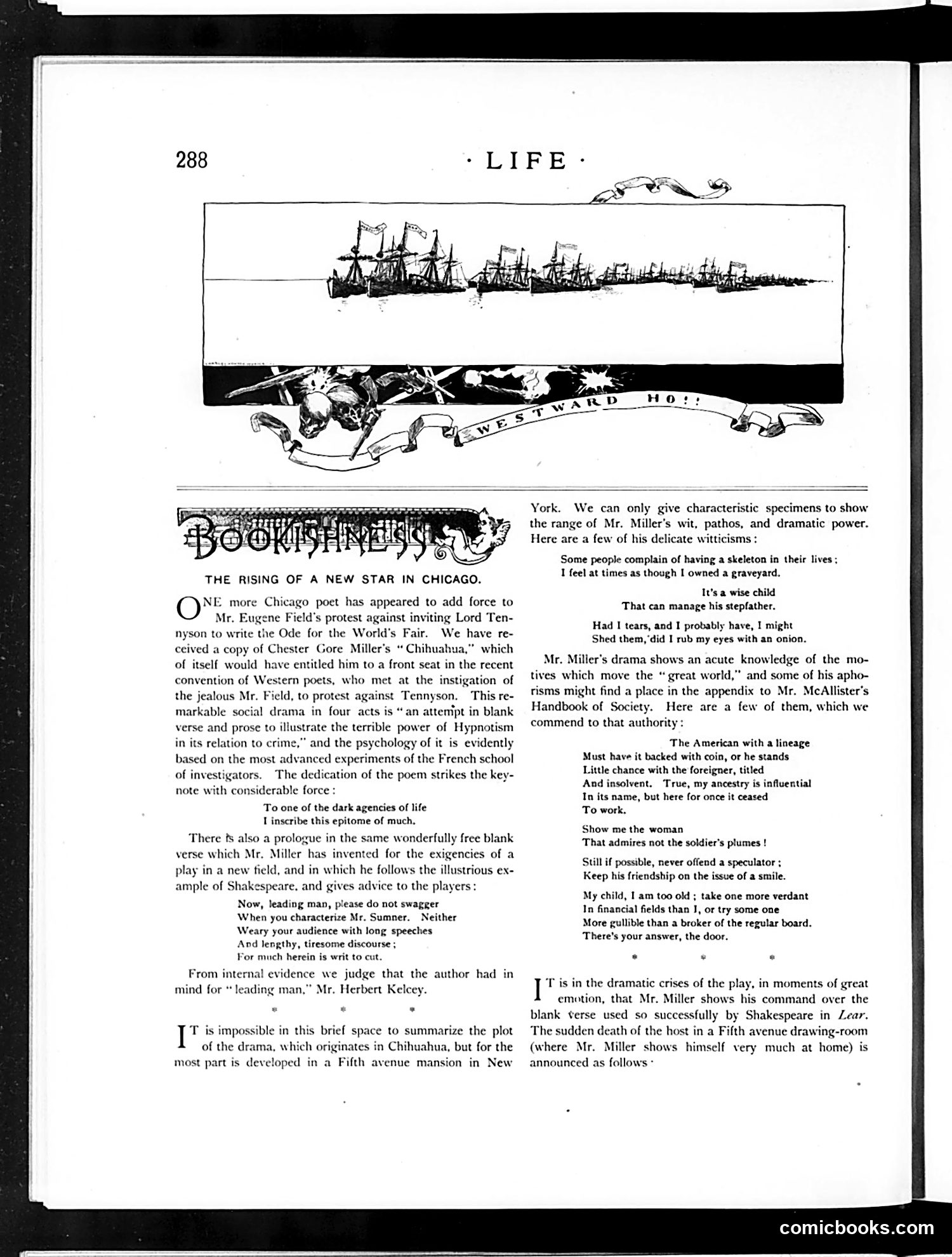
This page reviews Chester Gore Miller's new dramatic work "Chihuahua," a play about hypnotism and its psychological effects. The review appears satirical—the author criticizes Miller's ambitious but flawed blank-verse drama set in a Fifth Avenue mansion in New York. The text mocks both Miller's theatrical pretensions and provides comedic excerpts from the play itself, including advice to characters like "don't own a graveyward" and observations about American lineage and financial matters. The review suggests Miller attempted high literary drama (comparing him to Shakespeare) but the actual dialogue provided contradicts this lofty ambition, creating humor through the gap between pretension and execution. The ship illustration at top appears decorative rather than specifically tied to the content.
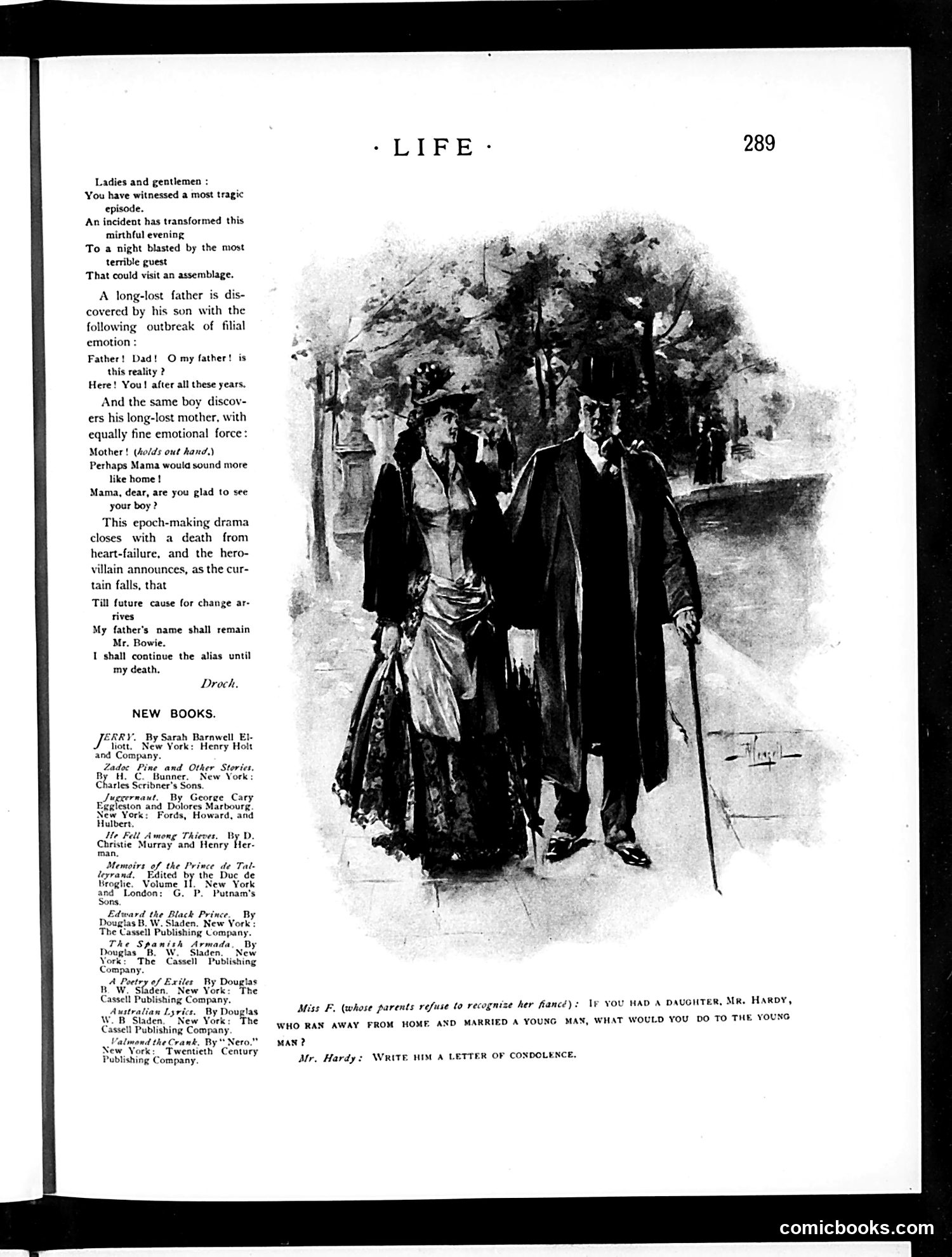
This page features a dramatic illustration accompanying a theatrical scene description. The text describes a melodramatic plot involving a long-lost father and mother reuniting with their son, concluding with a death from "heart-failure." The villain announces he'll change his identity, keeping the name "Mr. Bowie" and the alias "until my death." The illustration shows three figures in period dress meeting on a tree-lined path—likely depicting this emotional reunion scene. The page also lists "New Books" by contemporary authors including works by Sarah Orne Jewett and Douglas Fairbanks. The lower portion includes what appears to be a reader advice column directing someone named "Mr. Hardy" to write a letter of condolence regarding a young woman who left home and married.
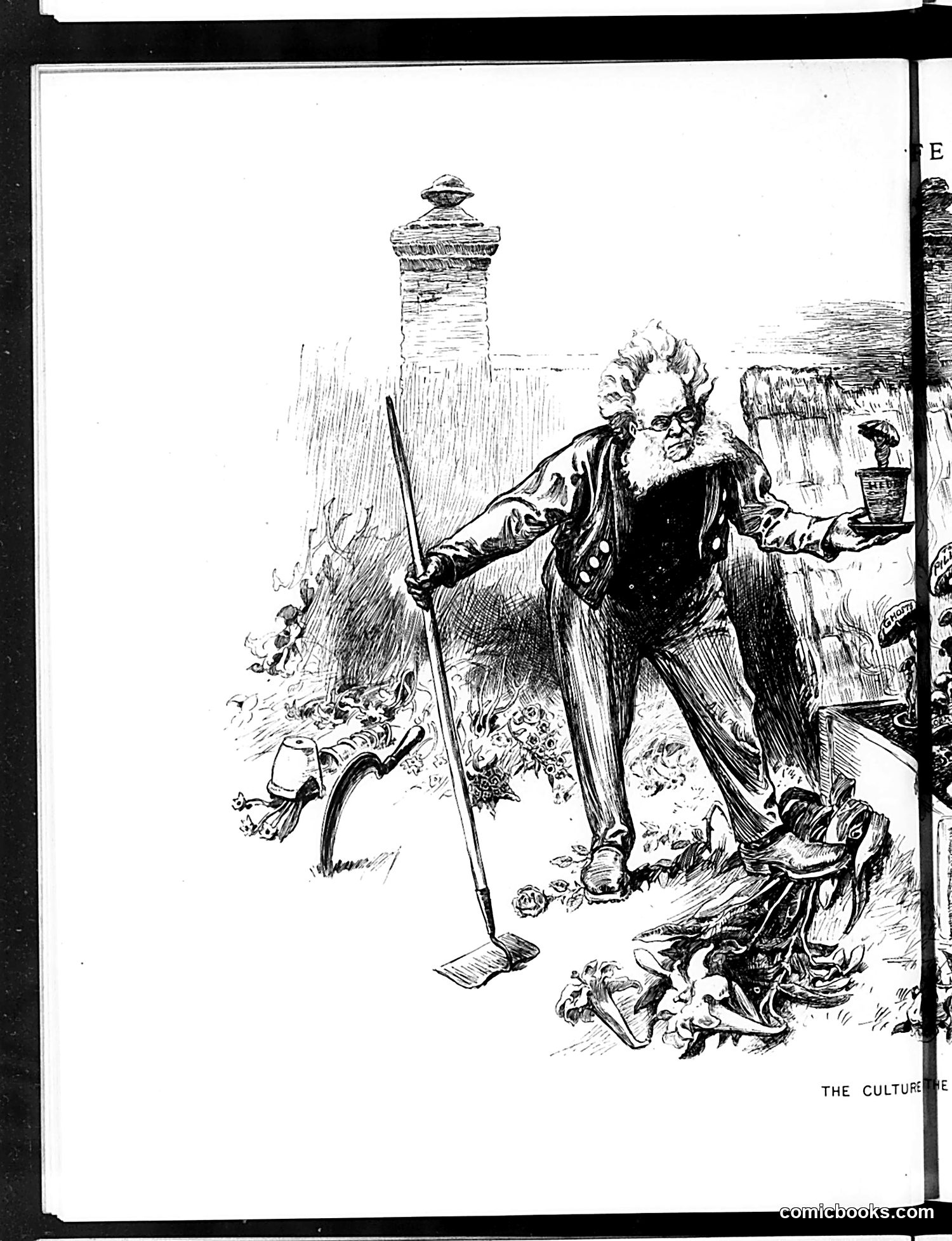
This appears to be a satirical cartoon from *Life* magazine titled "The Culture" (partially visible at bottom right). The image depicts a well-dressed gentleman with white hair, holding a long-handled shovel, standing amid scattered garbage and refuse. He holds what appears to be a drink in his raised hand. The satire likely critiques wealthy or upper-class pretensions to "culture" while ignoring or creating societal filth and waste. The contrast between the figure's refined appearance and gentlemanly pose against the literal garbage surrounding him suggests hypocrisy—that claims of cultural sophistication mask complicity in (or indifference to) social problems or waste. Without a visible date or caption beyond the title, the specific historical context remains unclear, though the style suggests early-to-mid 20th century.
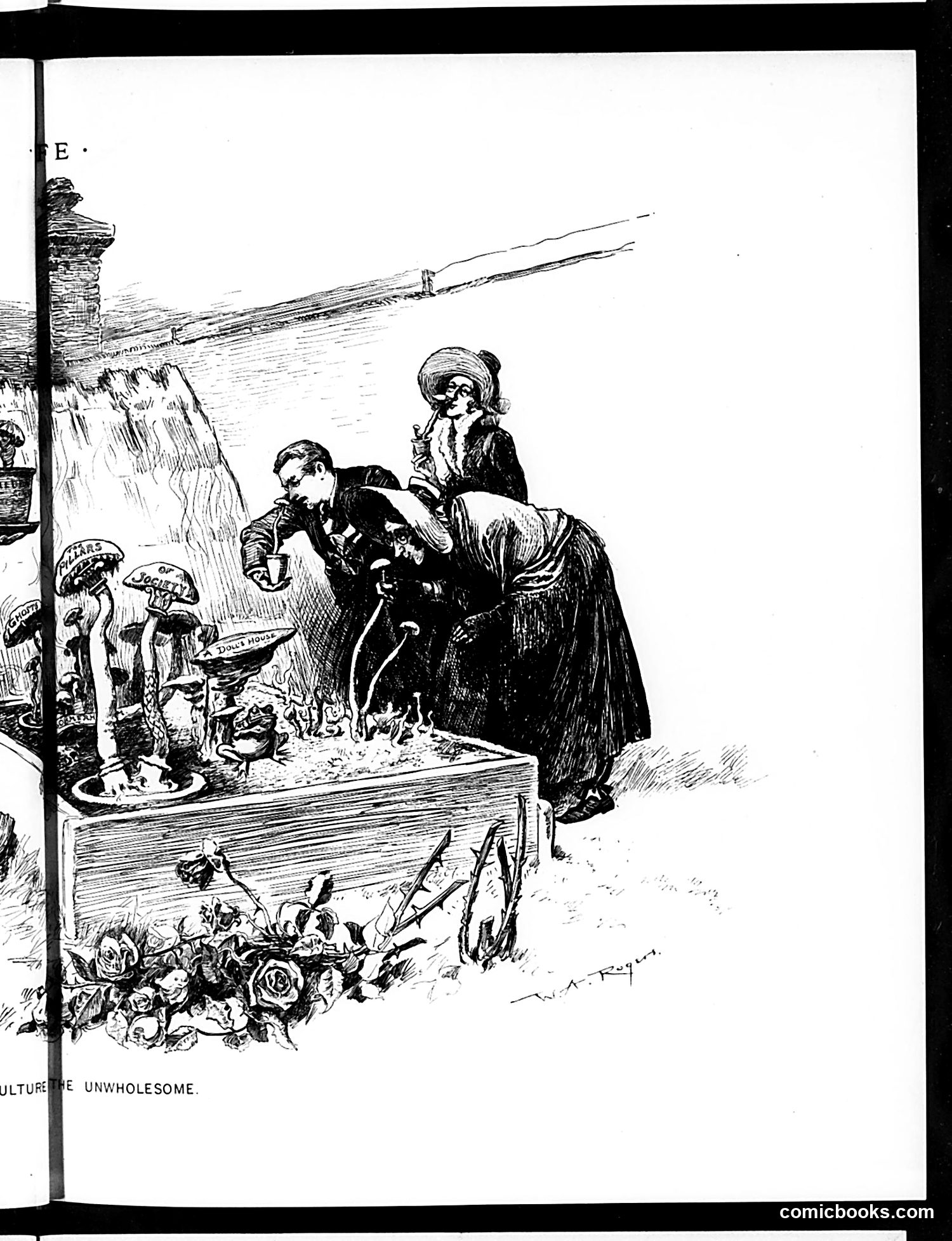
This political cartoon depicts a gruesome scene of what appears to be food preparation or butchering. The caption reads "VULTURE BE UNWHOLESOME" (though partially obscured). The image shows figures working with a wooden box or trough containing various items, with flowers and tools scattered below. The style and composition suggest social commentary on food safety, public health, or possibly corrupt food industry practices. However, **I cannot definitively identify the specific historical event, political figures, or publication date** this references. The OCR text is fragmentary and unclear. Without more context about which Life magazine issue this is from, or clearer visible text, I cannot accurately explain what particular scandal, industry practice, or political situation this satirizes. The dark, crude execution suggests serious criticism of something "unwholesome," but the specific target remains uncertain from this image alone.
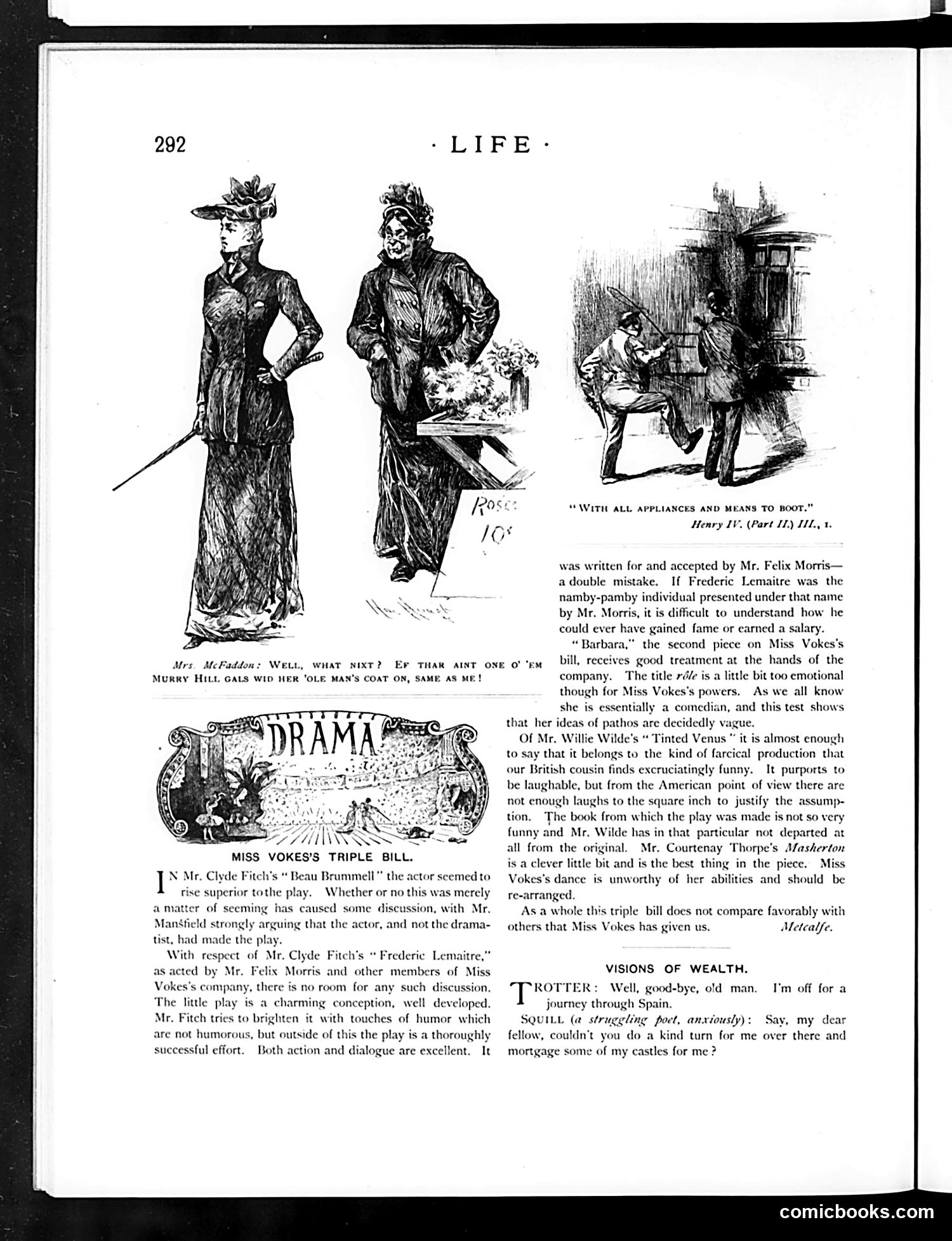
This page contains **theatrical criticism and social satire** from Life magazine, circa early 1900s. The top sketches mock **working-class women** adopting upper-class fashion—specifically wearing men's overcoats as a fashion statement. The caption's dialect ("Murry Hill gals") satirizes the pretension of lower-income women imitating wealthy neighborhoods' style. The main section reviews **Miss Vokes's theatrical triple bill** (three short plays). The critic evaluates performances by actors including Felix Morris and Willie Wilde, judging the plays' quality and the actors' suitability to their roles. The review is largely dismissive, suggesting Miss Vokes (a comedian) poorly handles emotional dramatic material. The bottom cartoon, "Visions of Wealth," depicts a **trotter** (a wealthy person) and **Squill** (a poor poet). The joke exploits the contrast: Squill, desperately poor, sarcastically references "castles" he owns—clearly fictional—asking the rich man to mortgage them. This satirizes the economic gulf between wealthy and struggling artists.
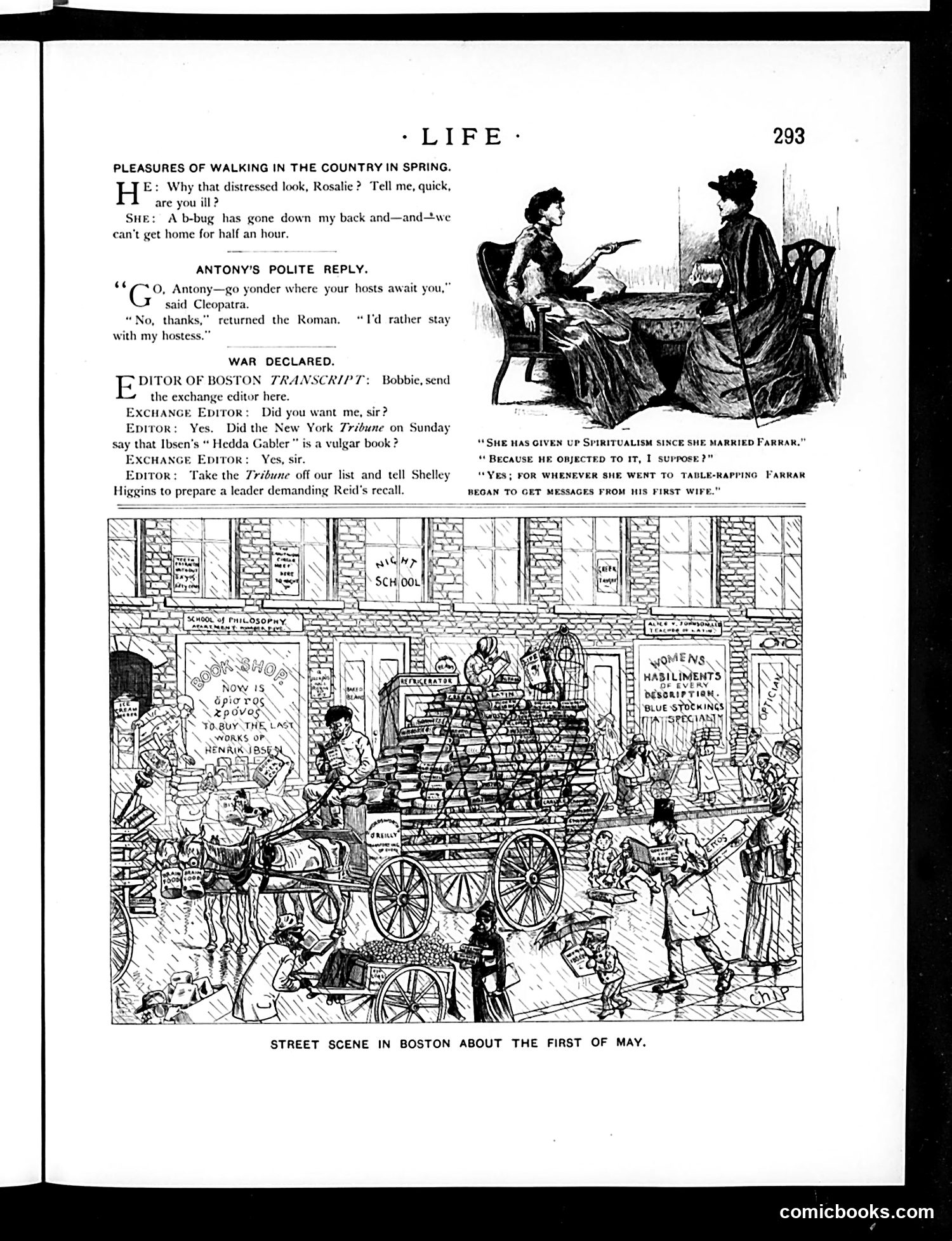
This page from *Life* magazine contains three separate satirical pieces: 1. **"Pleasures of Walking in the Country in Spring"**: A woman's distress over a bug in her clothing satirizes Victorian ladies' delicate sensibilities and their dependence on male assistance for minor problems. 2. **"Antony's Polite Reply"**: References the classical story of Antony and Cleopatra, satirizing exaggerated politeness and courtly behavior by having Antony refuse to leave his hostess—a joke about prioritizing social propriety over duty. 3. **"War Declared"**: Mocks the Boston *Transcript* editor's petty literary feuding. The exchange ridicules newspaper editors who remove publications from their lists over disagreements about book reviews (specifically Ibsen's *Hedda Gabler*), treating intellectual disputes with mock-military seriousness. 4. **Street Scene**: The detailed illustration depicts Boston's bustling commercial district in May, showing urban life with storefronts advertising "Women's Habiliments" and "Blue Stockings"—references to women's fashion and intellectual women. The page satirizes Victorian social conventions, literary pretension, and newspaper rivalry.
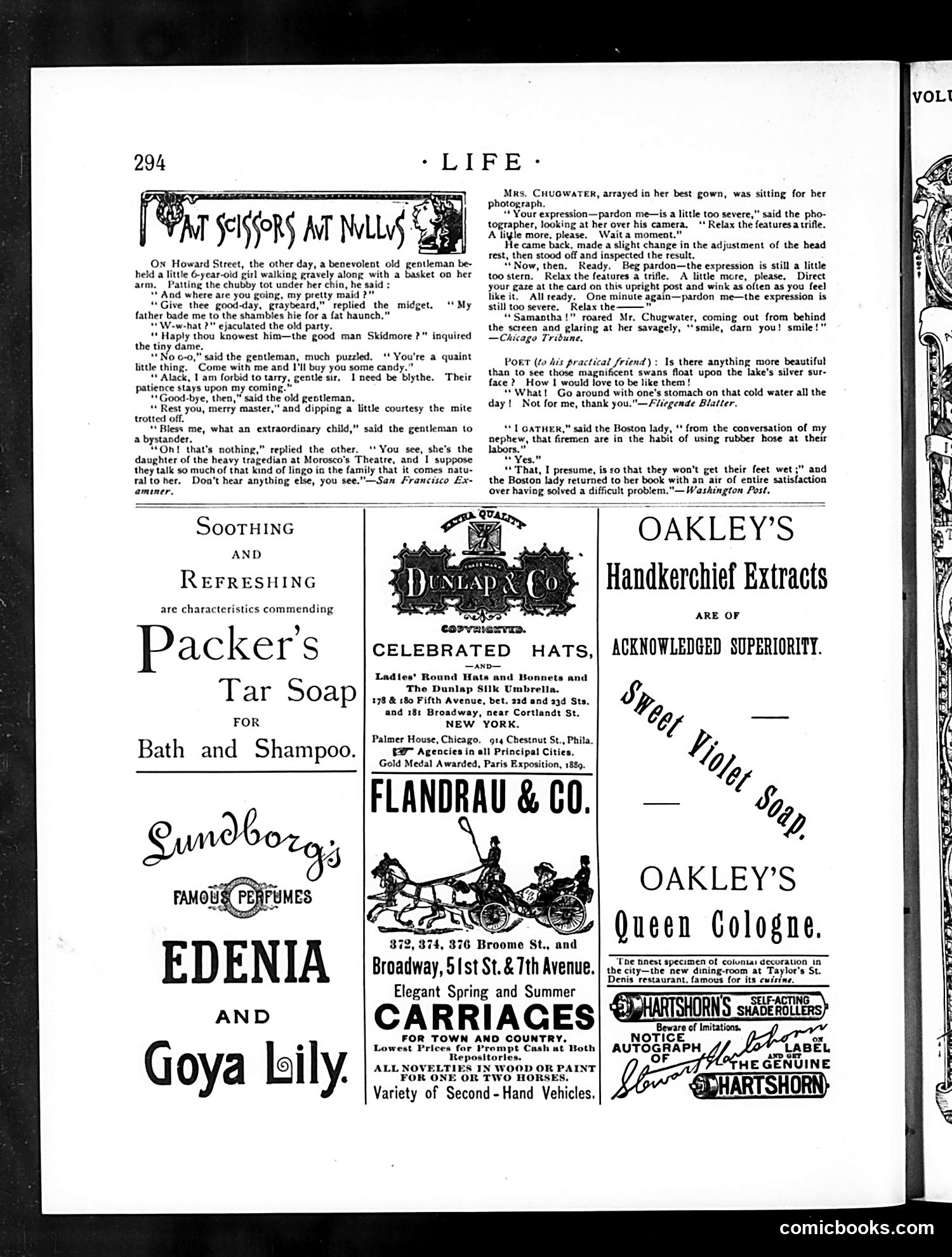
This page is primarily **advertising with framing humor content**. The layout contains three brief comic anecdotes flanked by period product advertisements. The top story satirizes affected speech: a six-year-old girl speaks in Shakespearean English ("Alack," "blythe") because her father is a Shakespearean actor—the joke being that theatrical mannerisms pervade even household children. The middle anecdote mocks photography sessions: a photographer repeatedly asks Mrs. Chugwater to "relax" her stern expression until her exasperated husband shouts at her to smile, inverting the photographer's authority. The final brief joke plays on literal interpretation: a Boston lady misunderstands firefighters' rubber hoses, assuming they prevent wet feet rather than serving their actual purpose—gentle mockery of provincial naiveté. The advertisements—for Packer's Tar Soap, Dunlap Hats, Flandrau carriages, Lundborg's perfumes, and Oakley's products—occupy roughly half the page, typical of *Life*'s business model during this period.