
Life, 1891-05-07 · page 7 of 14
Life — May 7, 1891 — page 7: what you’re looking at
What you’re looking at
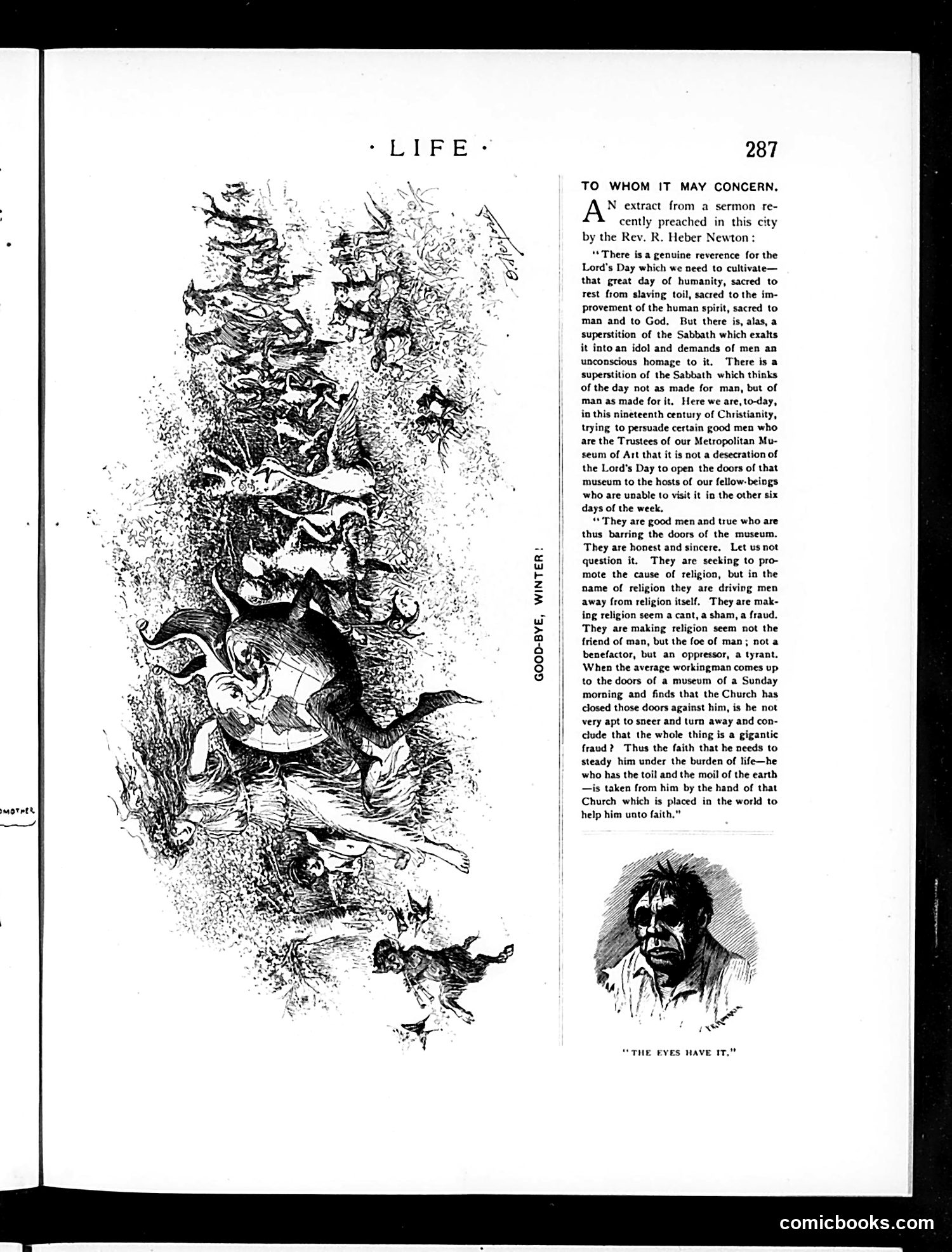
This page contains a sermon excerpt by Rev. R. Heber Newton criticizing what he calls a "gigantic fraud"—efforts by certain "good men" to close museum doors on Sundays to prevent working-class visitors from accessing cultural institutions on their only day off. Newton argues these men are using religion as pretext to restrict public access, calling them oppressors rather than benefactors. He contends that closing churches to working people creates justified skepticism about organized religion's true motives. The large illustration (credited "GOODWIN WRITER") appears to be a detailed sketch depicting human suffering or toil—likely visualizing Newton's concern about burdened laborers. The smaller portrait below shows a weathered face labeled "THE EYES HAVE IT," possibly representing working-class perspective. This reflects late-19th-century debates over Sabbath observance, class access to culture, and institutional hypocrisy.
📄 Transcribed text from this page (OCR, searchable)
Machine-transcribed from the original scan — historical spelling and the odd misread are preserved.
Ss w E z 3 wa > ao a Q fe} cc 287 TO WHOM IT MAY CONCERN. N extract from a sermon re- cently preached in this city by the Rev. R. Heber Newton: “There is a genuine reverence for the Lord's Day which we need to cultivate— that great day of humanity, sacred to rest from slaving toil, sacred to the im- provement of the human spirit, sacred to man and to God, But there is, alas, a superstition of the Sabbath which exalts it into an idol and demands of men an unconscious homage to it. There is a superstition of the Sabbath which thinks of the day not as made for man, but of man as made for it, Here we are, to-day, in this nineteenth century of Christianity, trying to persuade certain good men who are the Trustees of our Metropolitan Mu- seum of Art that it is not a desecration of the Lord's Day to open the doors of that museum to the hosts of our fellow-beings who are unable to visit it in the other six days of the week, “They are good men and true who are thus barring the doors of the museum. They are honest and sincere. Let us not question it. They are seeking to pro- mote the cause of religion, but in the name of religion they are driving men away from religion itself, They are mak- ing religion seem a cant, a sham, a fraud. They are making religion seem not the friend of man, but the foe of man; not a benefactor, but an oppressor, a tyrant. ‘When the average workingman comes vp to the doors of a museum of a Sunday morning and finds that the Church has closed those doors against him, is he not very apt to sneer and turn away and con- clude that the whole thing is a gigantic fraud? Thus the faith that he needs to steady him under the burden of life—he who has the toil and the moil of the earth —is taken from him by the hand of that Church which is placed in the world to help him unto faith.” “THE EYES HAVE IT," comicbooks.com