
Life, 1891-05-07 · page 12 of 14
Life — May 7, 1891 — page 12: what you’re looking at
What you’re looking at
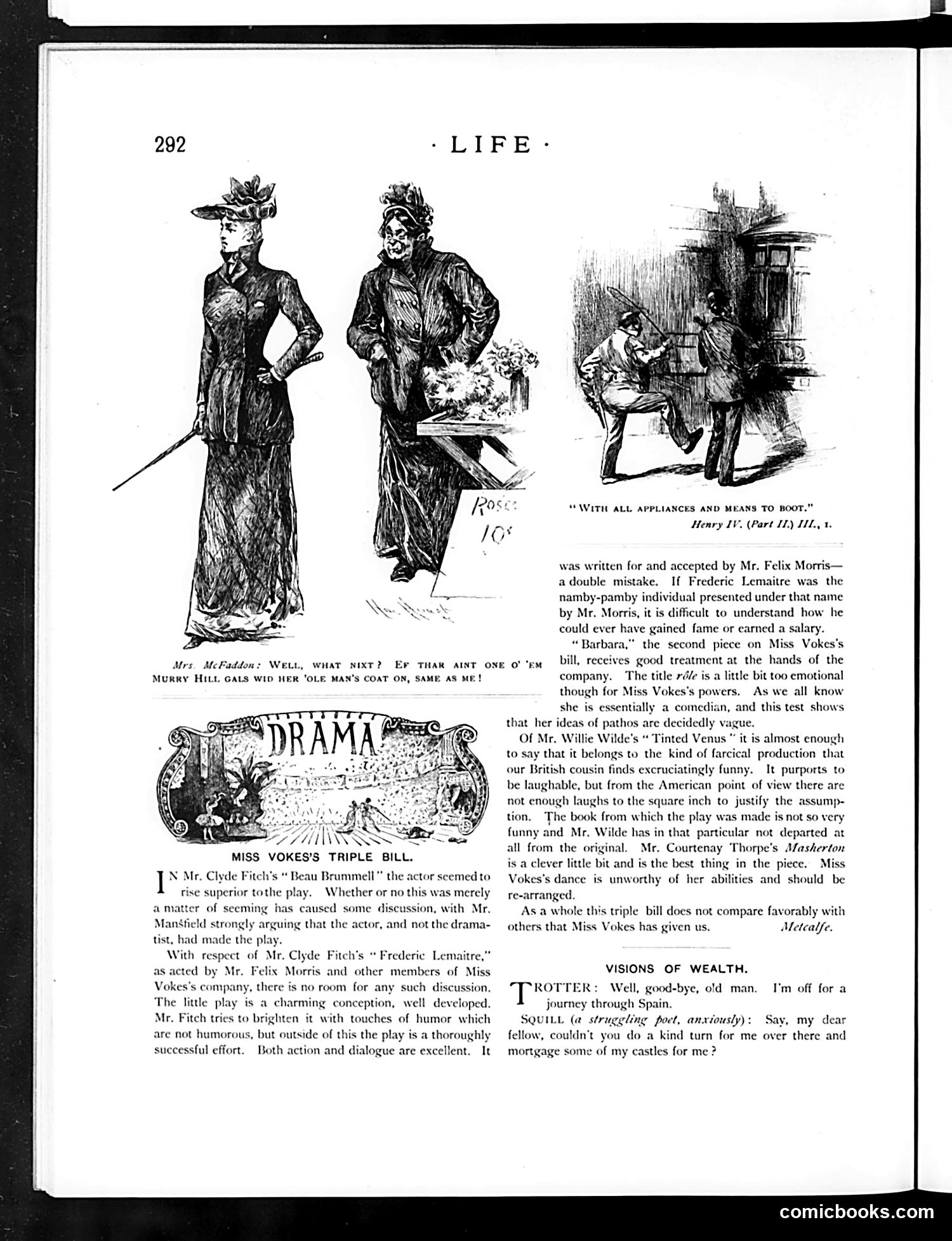
This page contains **theatrical criticism and social satire** from Life magazine, circa early 1900s. The top sketches mock **working-class women** adopting upper-class fashion—specifically wearing men's overcoats as a fashion statement. The caption's dialect ("Murry Hill gals") satirizes the pretension of lower-income women imitating wealthy neighborhoods' style. The main section reviews **Miss Vokes's theatrical triple bill** (three short plays). The critic evaluates performances by actors including Felix Morris and Willie Wilde, judging the plays' quality and the actors' suitability to their roles. The review is largely dismissive, suggesting Miss Vokes (a comedian) poorly handles emotional dramatic material. The bottom cartoon, "Visions of Wealth," depicts a **trotter** (a wealthy person) and **Squill** (a poor poet). The joke exploits the contrast: Squill, desperately poor, sarcastically references "castles" he owns—clearly fictional—asking the rich man to mortgage them. This satirizes the economic gulf between wealthy and struggling artists.
📄 Transcribed text from this page (OCR, searchable)
Machine-transcribed from the original scan — historical spelling and the odd misread are preserved.
Mrs, McFaddon: Weir, MURRY HILL. GALS WID HER 'OLE MAN'S COAT ON, SAME AS ME! MISS VOKES’S TRIPLE BILL. N Mr. Clyde Fitch's “ Beau Brummell” the actor si Whether or no this w used some discussion, with Mr. ManStield strongly arguing that the actor, and not the drama- tist, had made the play. With respect of Mr. Clyde Fitch's * Frederic Lemaitre,” as acted by Mr. Felix Morris and other members of Miss Vokes's company, there is no room for any such discussion, The little play is a charming conception, well developed. Mr. Fitch tries to brighten it with touches of humor which are not humorous, but outside of this the play successful effort. rise superior tothe play. a matter of seeming has ¢: thoroughly Both action and dialogue are excellent. It WHAT NIXT? EF THAR AINT ONE O' ‘EM “AVITH ALL APPLIANCES AND MEANS TO BOOT.” Henry IV. (Part 11) HL, was written for and accepted by Mr. Felix Morris— adouble mistake. If Frederic Lemaitre was the namby-pamby individual presented under that name by Mr. Morris, it is difficult to understand how he could ever have gained fame or earned a ry. the second piece on Miss Vokes’s bill, receives good treatment at the hands of the company. The title 7é/e is a little bit too emotional though for Miss Vokes’s powers. As we all know ally a comedian, and this test shows that her ideas of pathos are decidedly vague. Of Mr. Willie Wilde's “ Tinted Venus " it is almost enough. to say that it belongs to the kind of farcical production that our British cousin finds excruciatingly funny. It purports to be laughable, but from the American point of view there are not enough laughs to the square inch to justify the assump- tion, The book from which the play w funny and Mr. Wilde has in that particular not departed at all from the original. Mr. Courtenay Thorpe’s Afasherton is a clever little bit and is the best thing in the piece. Miss Vokes’s dance is unworthy of her abilities and should be re-arranged. As a whole this triple bill does not compare favorably with others that Miss Vokes has given us. Metcalfe. she is essent made is not so very VISIONS OF WEALTH. ROTTER: Well, good-bye, old man. journey through . SQUILL (a struggling poet, anxiously): Say, my dear fellow, couldn’t you do a kind turn for me over there and mortgage some of my castles for me ? I'm off for a comicbooks.com