
Life, 1891-05-07 · page 4 of 14
Life — May 7, 1891 — page 4: what you’re looking at
What you’re looking at
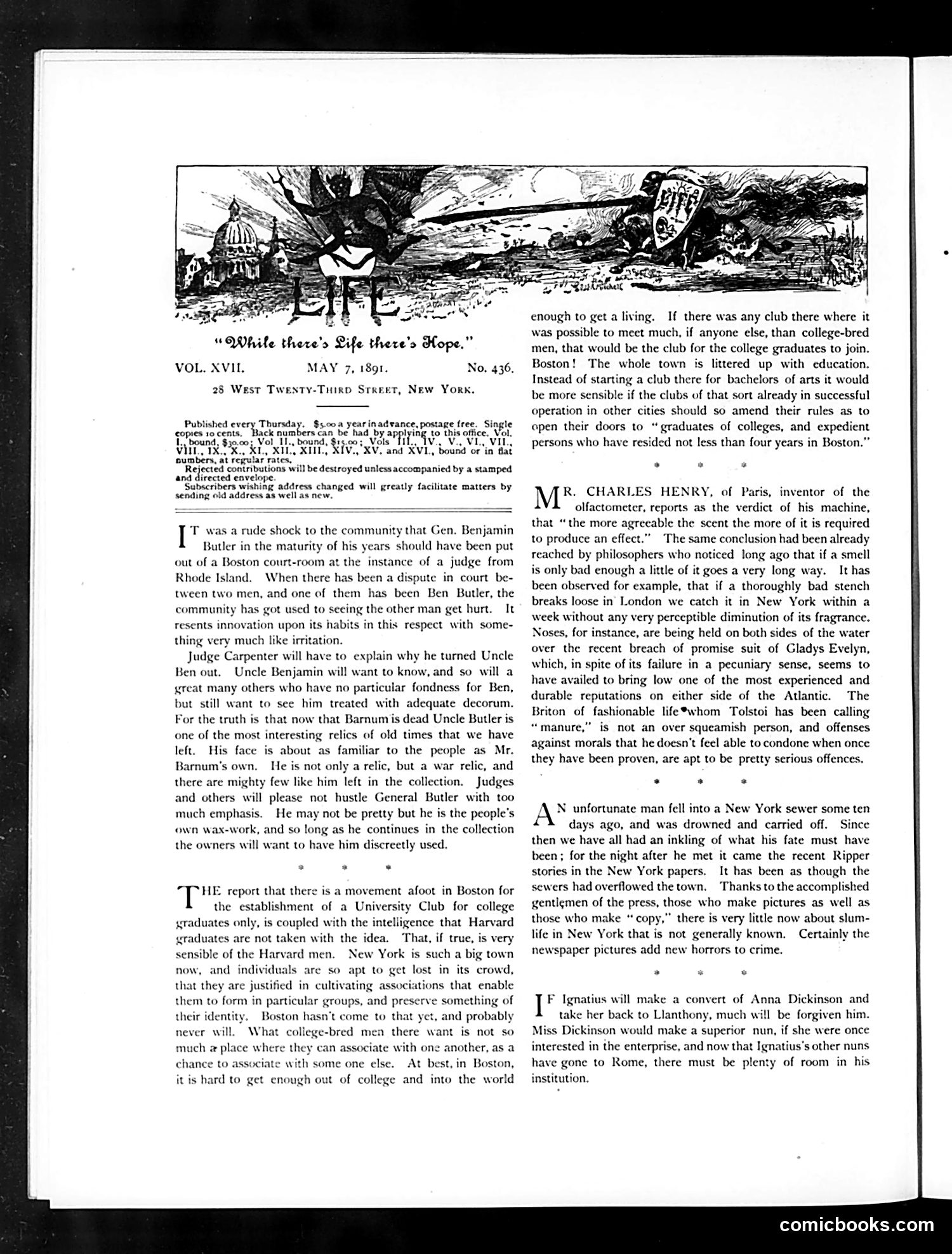
The masthead illustration depicts a winged figure (likely representing "Life" itself) surveying a landscape with classical architecture—a common allegorical device for the magazine's satirical identity. The text discusses several contemporary issues: a controversy involving General Benjamin Butler and a Boston court case; a proposal for a Harvard-affiliated University Club for college graduates in Boston; and gossip about various social figures including references to "Anna Dickinson" and someone named Ignatius. The magazine's humor relies on insider knowledge of Boston's social elite and institutional politics. Without additional context about the specific scandals or individuals referenced, the precise satirical targets remain unclear to modern readers, though the tone suggests mockery of Boston's establishment pretensions and Harvard's social exclusivity.
📄 Transcribed text from this page (OCR, searchable)
Machine-transcribed from the original scan — historical spelling and the odd misread are preserved.
VOL. XVII. MAY 7, 1891. 28 West Twenty-Tiird Sree No. 436. New York. Published every Thursday. $5.00 year in advance, postage free. Single bers ing 0 this office, Vor. copies ro cents, Back num| L., bound, $30.00; Vol 1 Vi, 1X.2X., 1, XI sumbers, at regular rates, Rejected contributions will be destroyed unless accompanied by a stamped and directed envelope. ‘Subscribers wishing address changed will greatly facilitate matters by sending old address as well as new, can_be had by appl Dound, $15.003.Vols TIL, AV, V. Vie VIL. XIIL, XIV.,’XV. and XVL, bound or ‘in flat I T was a rude shock to the community that Gen. Benjamin Butler in the maturity of his y should have been put out of a Boston court-room at the instance of a judge from Rhode Island. When there has been a dispute in court be- tween two men, and one of them has been Ben Butler, the community has got used to seeing the other man get hurt. It resents innovation upon its habits in this respect with some- thing very much like irritation. Judge Carpenter will have to explain why he turned Uncle Ben out. Uncle Benjamin will want to know, and so will a great many others who have no particular fondness for Ben, but still want to see him treated with adequate decorum. For the truth is that now that Barnum is dead Uncle Butler is one of the most interesting relics of old times that we have left. His face is about as familiar to the people as Mr. Barnum's own. He is not only a relic, but a war relic, and there are mighty few like him left in the collection. Judges and others will please not hustle Butler with too much emphasis. He may not be pretty but he is the people's own wax-work, and so long as he continues in the collection the owners will want to have him discreetly used. ° * * HE report that there is a movement afoot in Boston for the establishment of a University Club for college graduates only, is coupled with the intelligence that Harvard graduates are not taken with the idea. That, if true, is very sensible of the Harvard men. New York is such a big town now, and individuals are so apt to get lost in its crowd, that they are justified in cultivating associations that enable them to form in particular groups, and preserve something of their identity, Boston hasn't come to that yet, and probably What college-bred men there want is not so ce where they can associate with one another, as a ¢ with some one else. At best, in Boston, enough out of college and into the world never will. much 2 pla chance to ass it is hard to get enough to get a living. If there was any club there where it was possible to meet much, if anyone else, than college-bred men, that would be the club for the college graduates to join. Boston! The whole town is littered up with education. Instead of starting a club there for bachelors of arts it would be more sensible if the clubs of that sort already in successful operation in other cities should so amend their rules as to open their doors to “graduates of colleges, and expedient persons who have resided not less than four years in Boston.” ° ® * R. CHARLES HENRY, of Paris, inventor of the olfactometer, reports as the verdict of his machine, that “the more agreeable the scent the more of it is required to produce an effect.” The same conclusion had been already reached by philosophers who noticed long ago that if a smell is only bad enough a little of it goes a very long way. It has been observed for example, that if a thoroughly bad stench breaks loose in London we catch it in New York within a week without any very perceptible diminution of its fragrance. Noses, for instance, are being held on both sides of the water over the recent breach of promise suit of Gladys Evelyn, which, in spite of its failure in a pecuniary sense, seems to have availed to bring low one of the most experienced and durable reputations on cither side of the Atlantic. The Briton of fashionable life*whom Tolstoi has been calling “manure,” is not an over squeamish person, and offenses against morals that he doesn’t feel able to condone when once they have been proven, are apt to be pretty serious offences. . * * N unfortunate man fell into. a New York sewer some ten days ago, and was drowned and carried off. Since then we have all had an inkling of what his fate must have been; for the night after he met it came the recent Ripper stories in the New York papers. It has been as though the sewers had overflowed the town. Thanks to the accomplished gentlgmen of the press, those who make pictures as well as who make “ copy,” there is very little now about slum- life in New York that is not generally known. Certainly the newspaper pictures add new horrors to crime. * * ° 1° Ignatius will make a convert of Anna Dickinson and take her back to Llanthony, much will be forgiven him. Miss Dickinson would make a superior nun, if she were once interested in the enterprise, and now that Ignatius’s other nuns have gone to Rome, there must be plenty of room in his institution. comicbooks.com