
A complete issue · 14 pages · 1891
Life — April 16, 1891
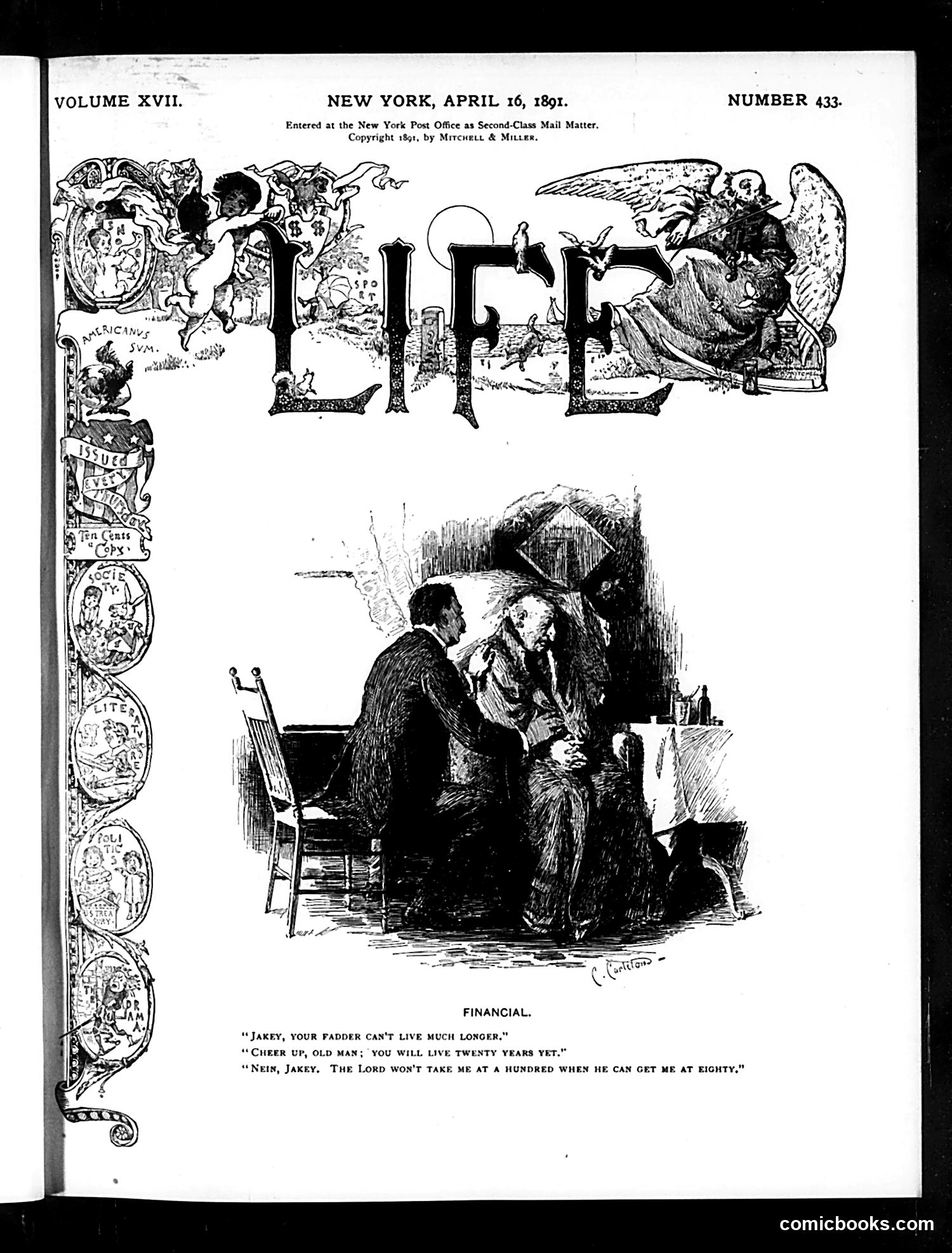
This cartoon satirizes financial hardship during economic struggle. The title "Financial" and dialogue suggest commentary on poverty and aging. The scene depicts two men in what appears to be modest circumstances. One man tells "Jakey" that "your padder can't live much longer," to which an older man responds optimistically that he'll "live twenty years yet." The third line, "Nein, Jakey. The Lord won't take me at a hundred when he can get me at eighty," suggests dark humor about prolonged poverty—implying death would be preferable to continued destitution. The cartoon likely reflects 1891 economic conditions and social commentary on the desperation of working-class life, where even death was viewed as potential relief from financial misery.
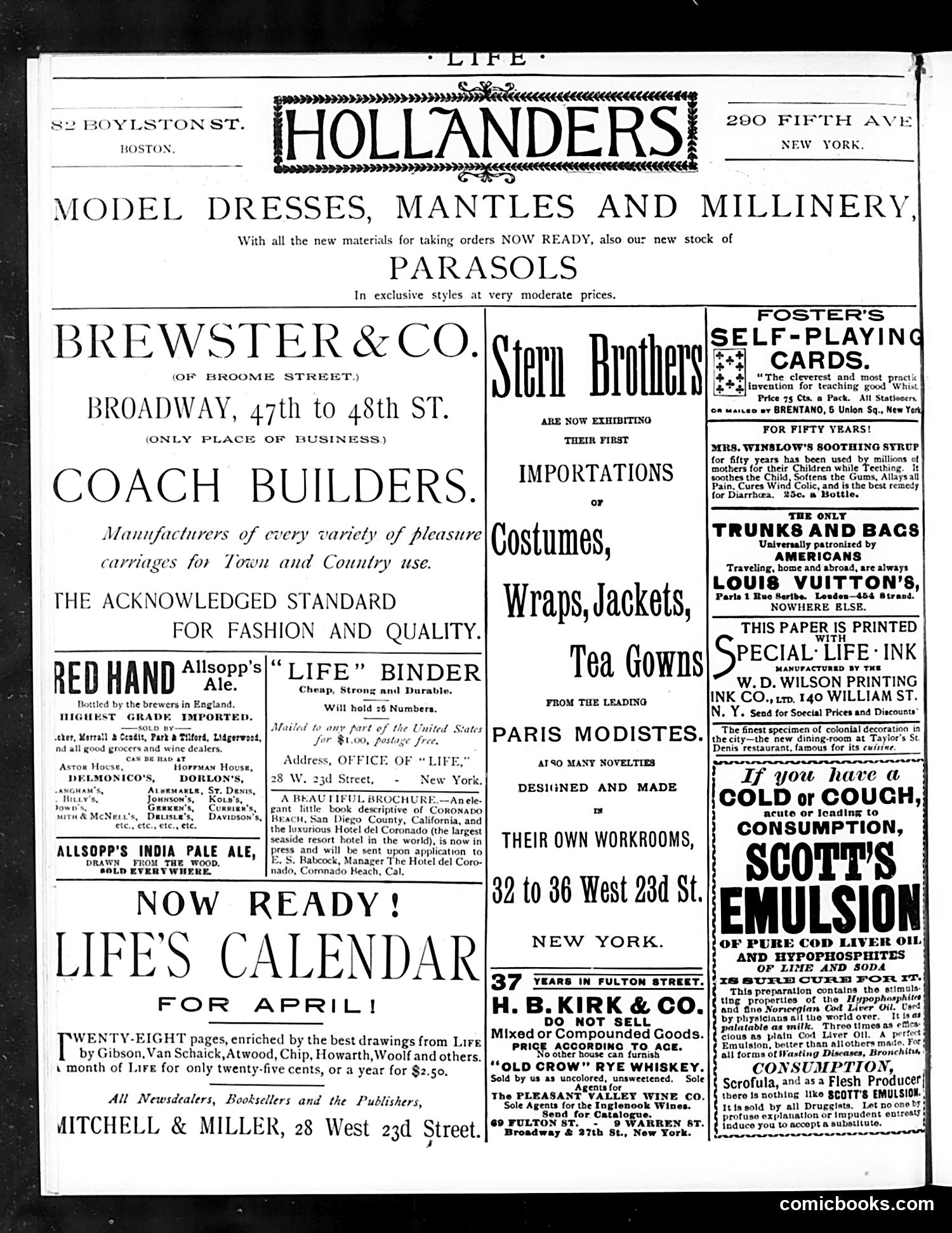
This page is **primarily advertising**, not satirical content. It's from Life magazine's back pages and consists almost entirely of commercial advertisements from the late 19th or early 20th century. Key advertisements include: - **Hollanders** (Boston/New York): Model dresses, mantles, millinery, and parasols - **Brewster & Co.**: Coach builders on Broadway - **Stern Brothers**: Importing costumes, wraps, jackets, tea gowns from Paris - **Life's Calendar for April**: Available through newsdealers - **Scott's Emulsion**: Patent medicine for colds/consumption - Various other goods (ale, whiskey, wine, trunks) There are no identifiable political cartoons or satirical figures visible. The page reflects consumer culture and commercial interests of the period rather than political commentary.
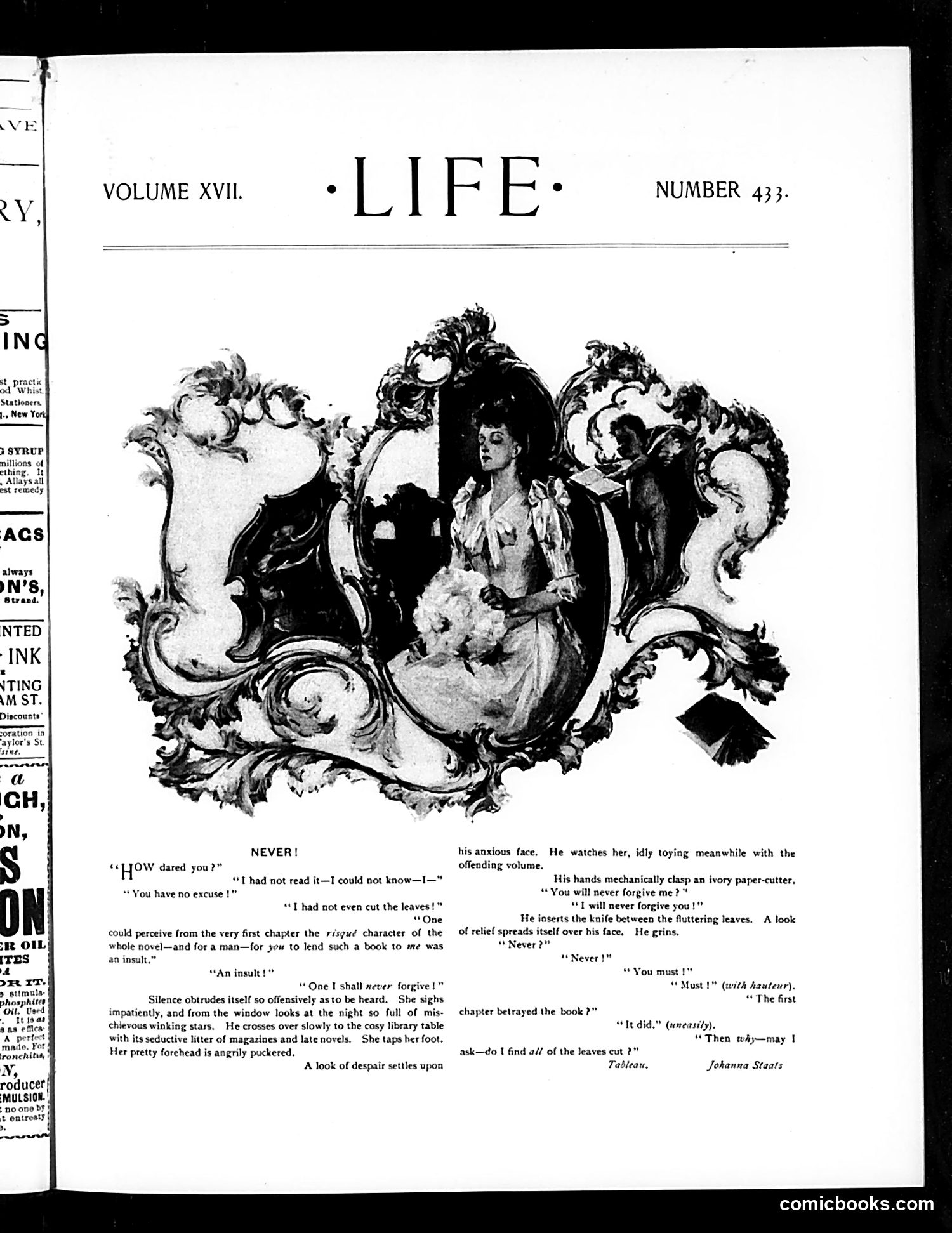
This appears to be a literary satire, not a political cartoon. The ornate illustration depicts a dramatic domestic scene—likely from a Victorian or early 20th-century novel—showing a woman confronting a man about a book he hasn't read. The dialogue reveals the joke: the man claims he couldn't read the book because he "had not even cut the leaves"—a reference to uncut book pages that readers had to physically separate before reading. The woman's escalating accusations ("You have no excuse!") and emotional declarations ("I will never forgive you!") mock melodramatic fiction writing. The satire targets both the overwrought emotional prose of the era's popular novels and readers' pretenses about their literary habits—a timeless jab at those who own but don't actually read their books.
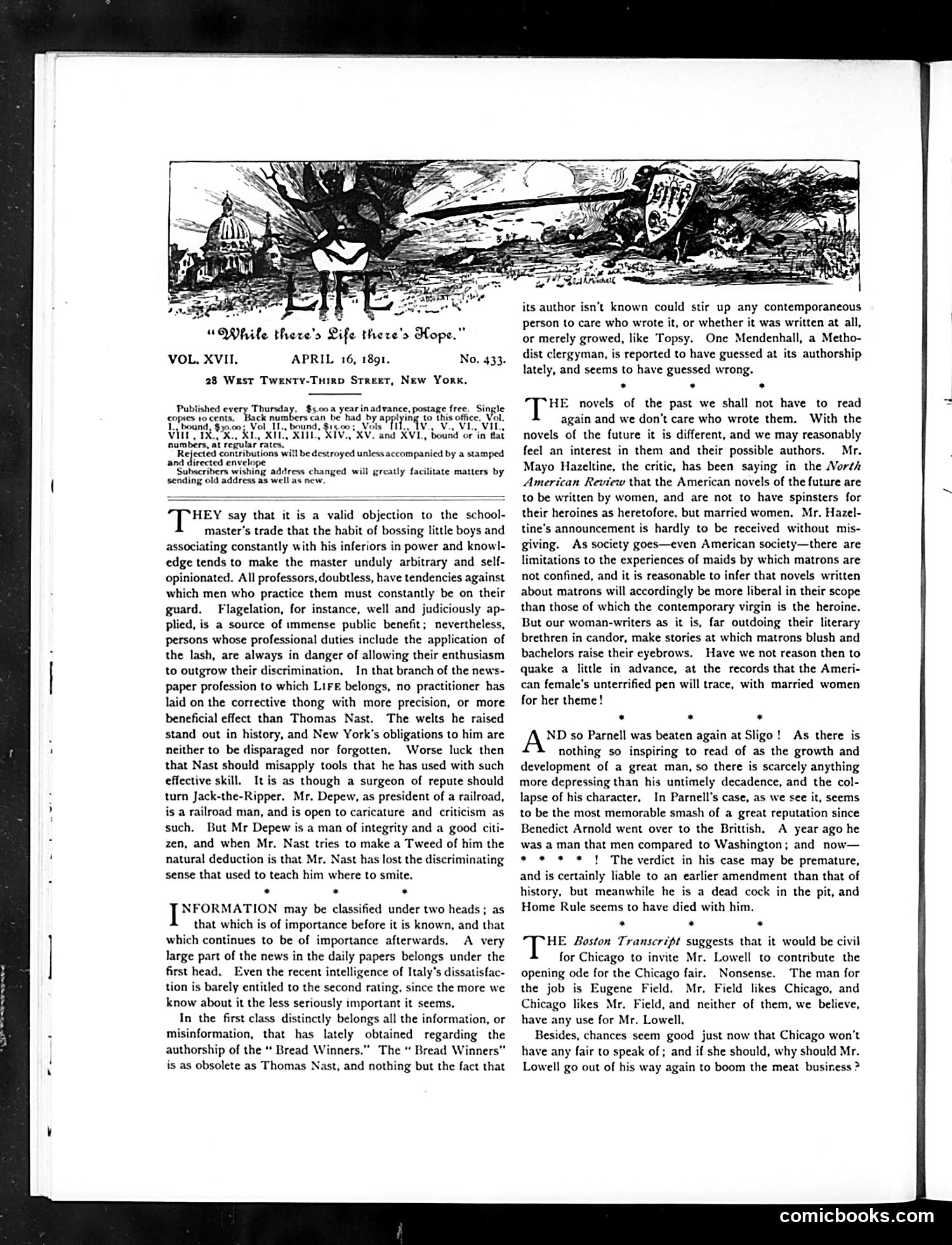
The masthead cartoon depicts a figure in formal dress sitting amid ruins and destruction, with a gravestone visible. The caption reads "While there's Life there's Hope." The text discusses several contemporary issues: 1. **Schoolmaster discipline**: Debate over whether teachers' use of corporal punishment (bosses boys) creates arbitrary authority or necessary order. 2. **American female novelists**: Commentary on recent announcements that future American novels will feature married women protagonists rather than unmarried heroines—a progressive shift reflecting changing social attitudes. 3. **Parnell scandal**: References the recent downfall of Irish politician Charles Stewart Parnell, whose reputation collapsed dramatically. 4. **Chicago cultural promotion**: Discusses inviting James Russell Lowell to contribute an opening ode for Chicago's new library. The magazine blends social criticism with gossip typical of 1890s satirical journalism.
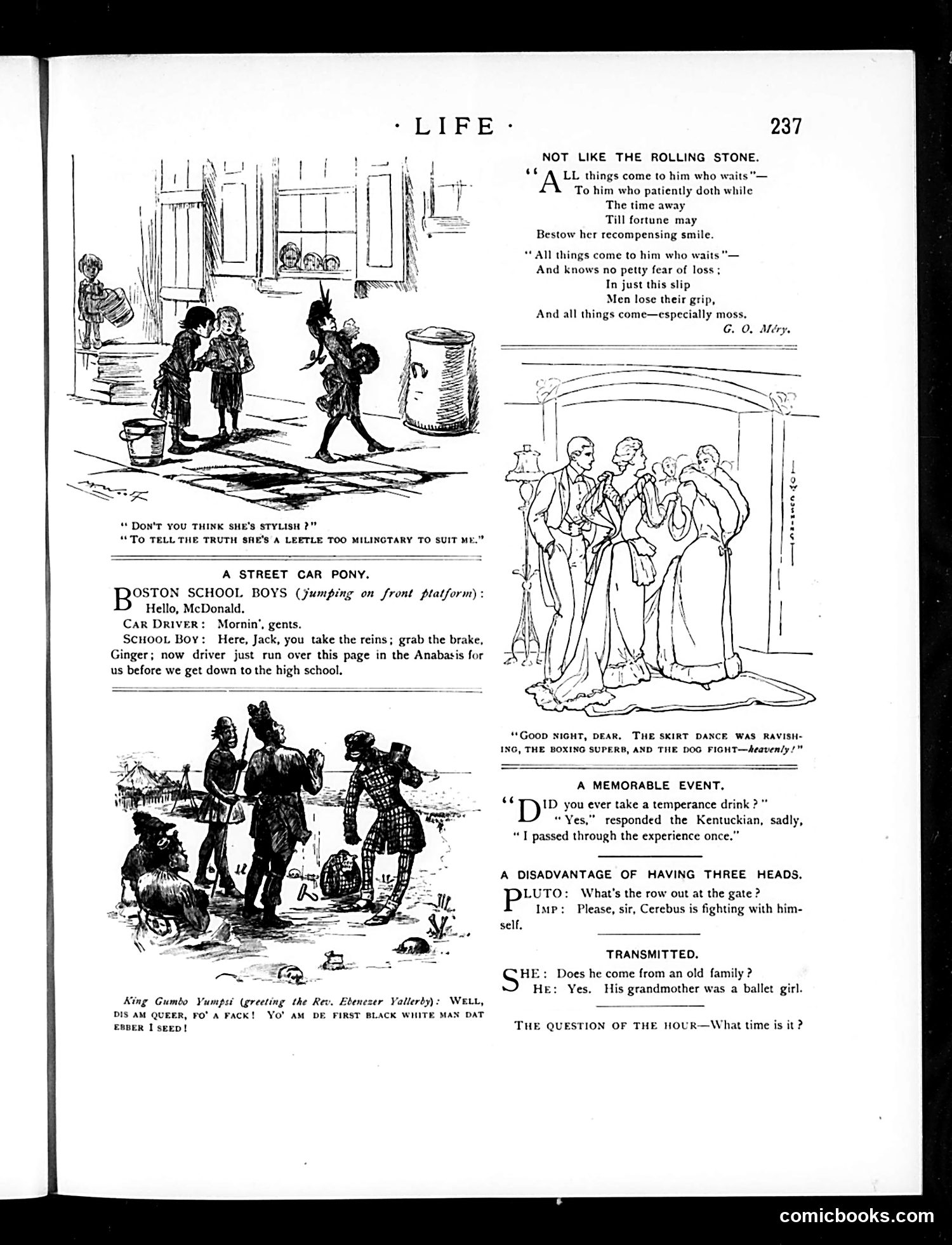
This page contains several unrelated humorous sketches and short comedic pieces typical of Life's satirical format. **"A Street Car Pony"** depicts Boston schoolboys boarding a trolley, with dialogue about grabbing the brake before reaching high school—a joke about youthful mischief. **"King Gambo Yumpti"** shows a figure in colonial/stereotypical African dress, using exaggerated dialect humor common to the era's entertainment. The remaining items are brief comic vignettes: observations about patience and moss, commentary on a woman's militaristic fashion sense, a Kentucky temperance anecdote, and mythological humor about Cerberus and Pluto. The overall tone reflects turn-of-the-century American humor relying heavily on dialect jokes, social observation, and literary references—entertainment now dated by its casual ethnic caricatures and class-based comedy.
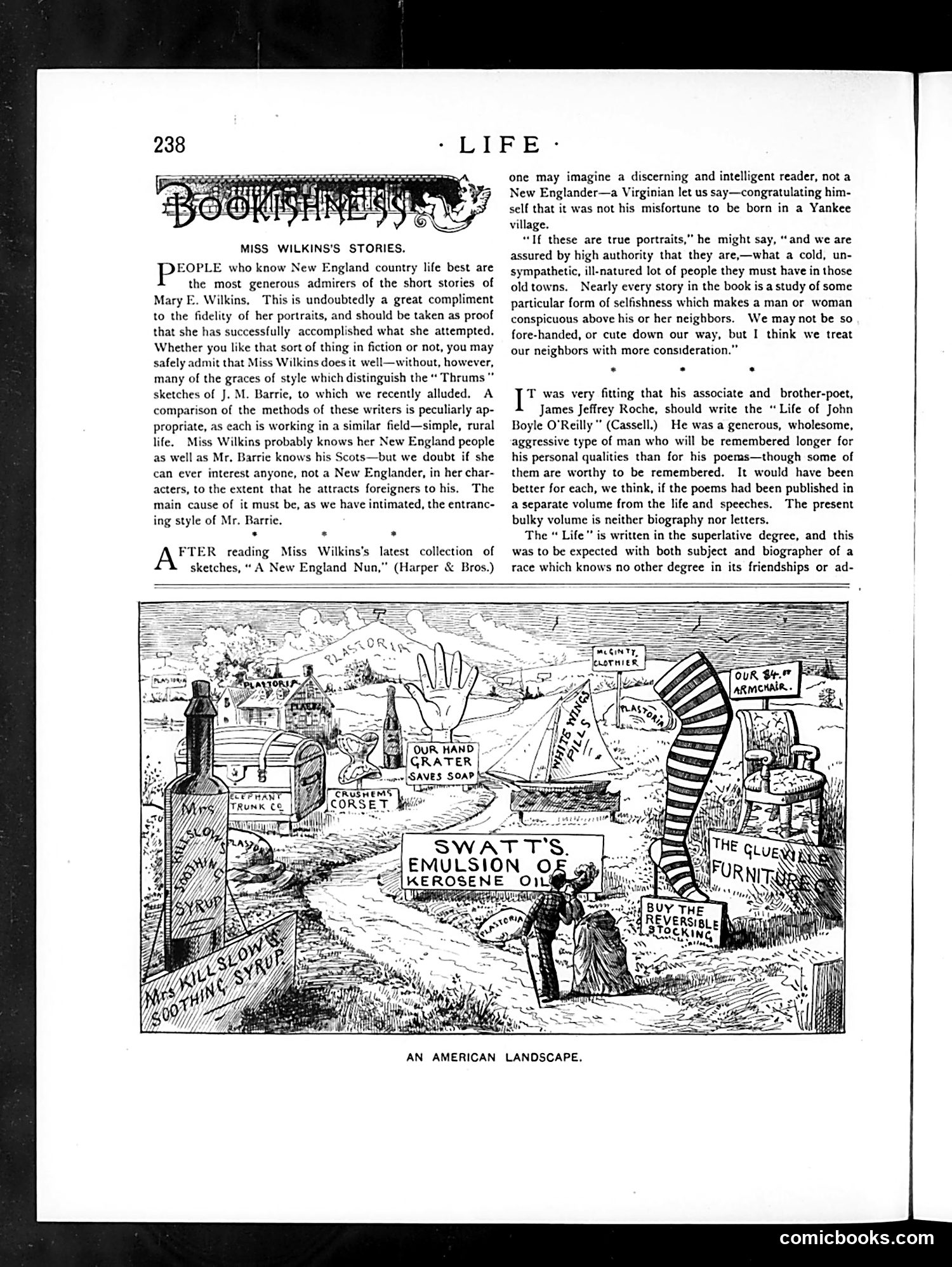
This cartoon satirizes American commercial culture through a surreal landscape dominated by product advertisements and brand names. Rather than natural features, the "landscape" consists of giant bottles, packages, and signs for products like Swatt's Emulsion of Kerosene Oil, Glueware Furniture, and various patent medicines and household goods. A couple walks through this commercialized terrain as if it were countryside. The satire targets how advertising and consumer products have become the defining features of the American environment—replacing actual nature. This reflects late-19th/early-20th century anxieties about industrialization and commercialism overwhelming traditional landscapes. The tone is darkly humorous, suggesting Americans navigate a world fundamentally shaped by marketing and consumption rather than natural beauty.
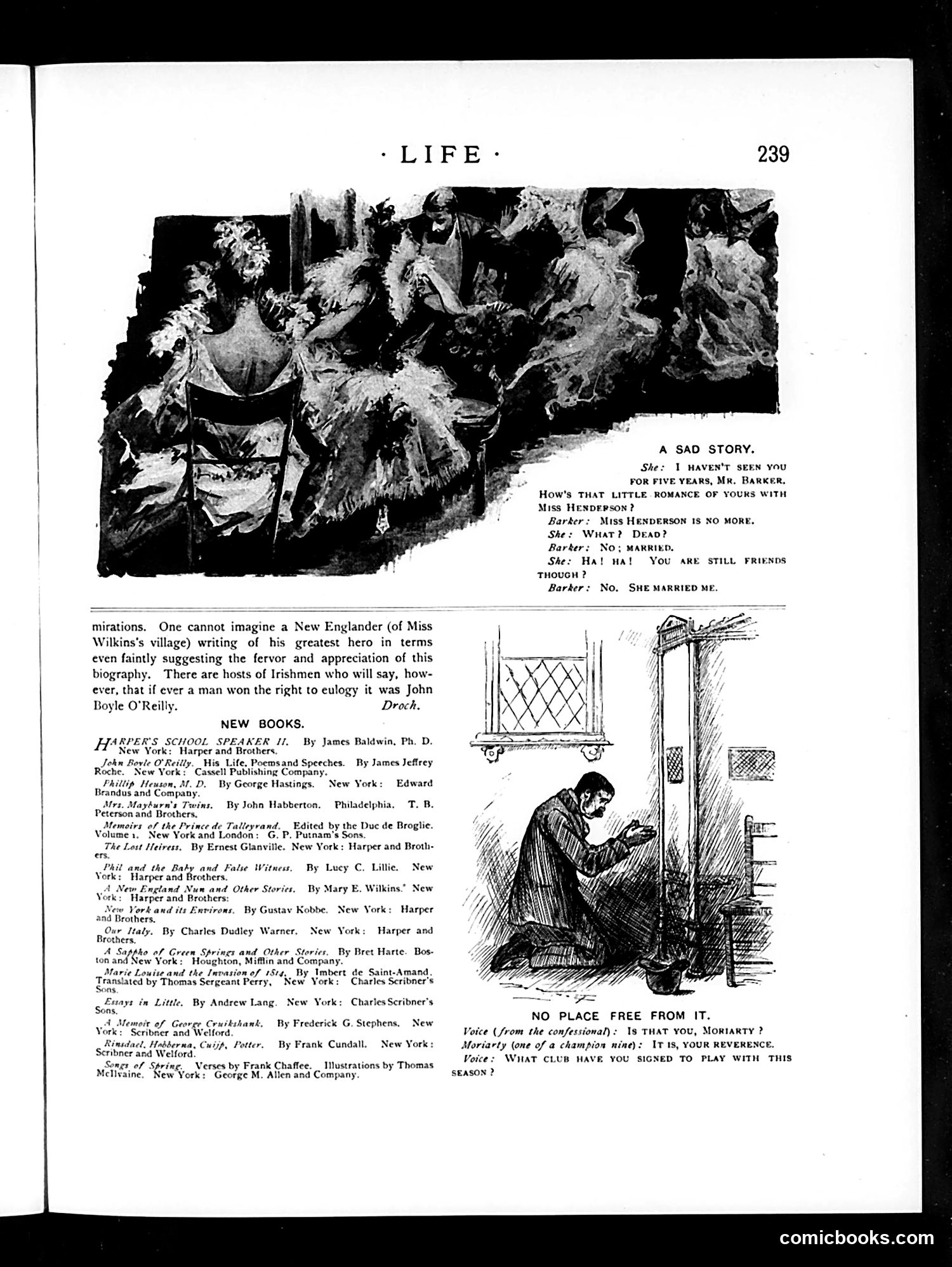
**Top Cartoon ("A Sad Story"):** This depicts a dialogue between two characters—a man (Barker) and a woman (Miss Henderson). The exchange reveals that they haven't seen each other for five years, during which time Miss Henderson married someone else, yet they claim to still be friends. The satire mocks the awkward social pretense of maintaining friendly relations with a former romantic interest after one has married another person—highlighting the discomfort and false civility of such situations. **Bottom Illustration ("No Place Free From It"):** This sketch shows a solitary, distressed figure hunched indoors, with dialogue suggesting someone named Moriarty (apparently a boxing champion) has confronted them about signing up for a season. The humor appears to target inescapable social or professional obligations that follow one everywhere. The page also lists new book publications below the cartoons.
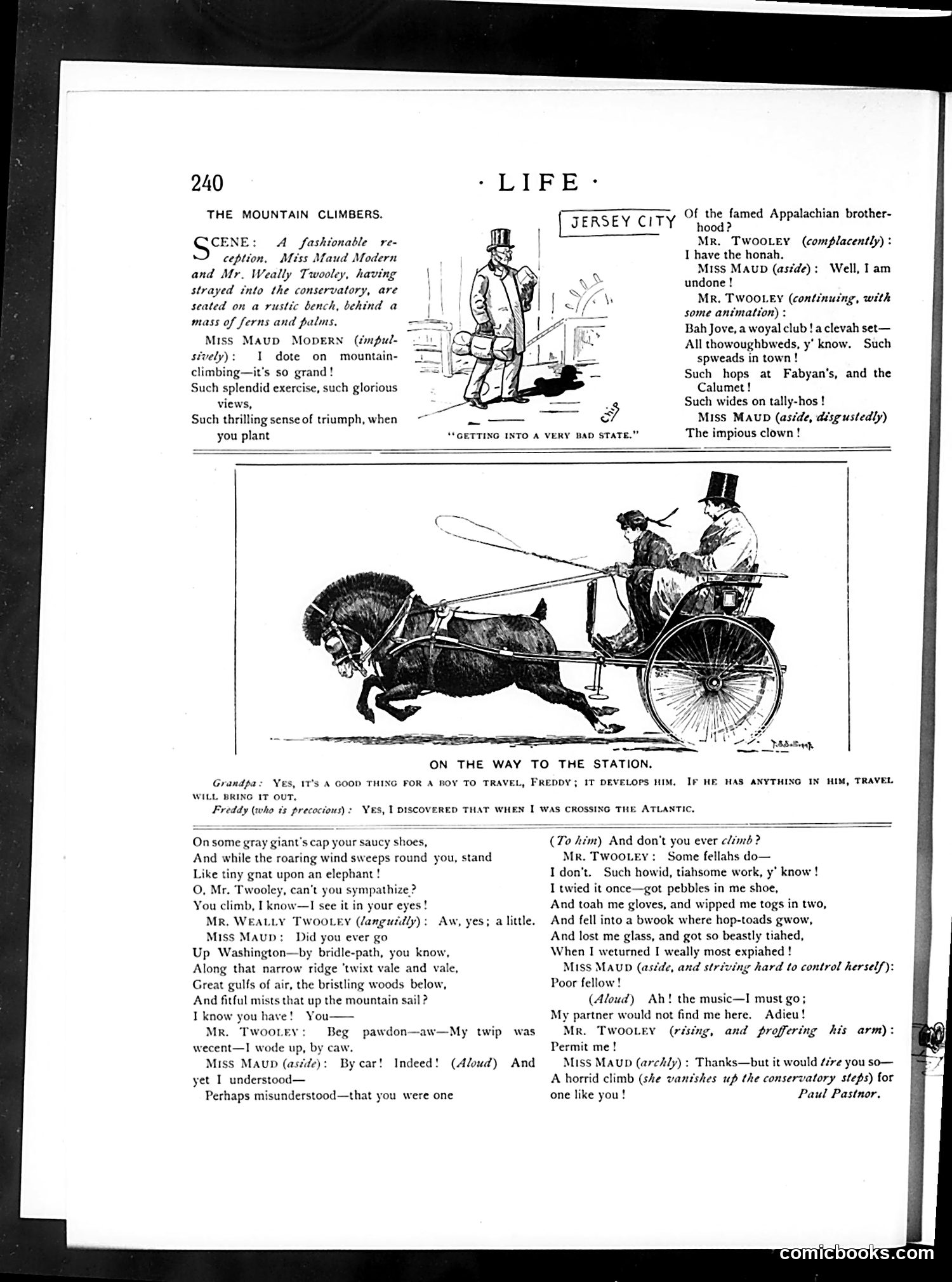
This page features a comedic sketch about mountain climbing presented as a fashionable social activity. The scene depicts Miss Maud Modern and Mr. Freddy Twooley at a conservatory reception, where Miss Maud enthusiastically describes the thrills of mountain climbing—its "glorius views" and "sense of triumph." The joke becomes clear in subsequent dialogue: Mr. Twooley reveals his climbing experience involved crossing the Atlantic and subsequent mishaps (losing his glass, getting "beastly tamed"). The satire mocks the era's nouveau riche pretensions and fashionable pursuits among the upper class, where people boast of adventurous activities that prove laughably trivial or exaggerated. The accompanying illustration of a horse-drawn carriage humorously undercuts any claims of genuine adventure among this elite set.
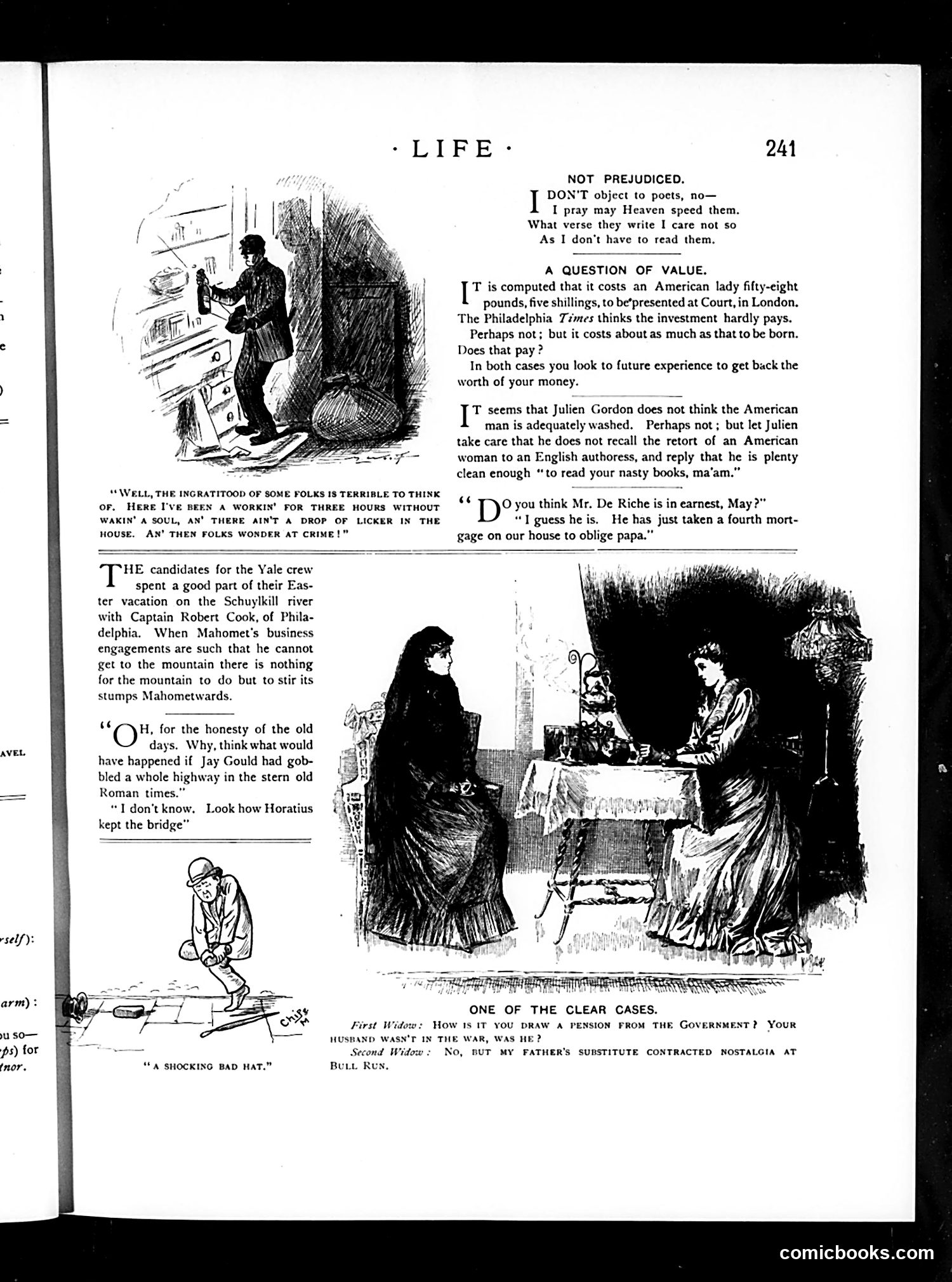
This page contains three distinct satirical pieces: 1. **"Not Prejudiced"** critiques indifference to poetry by someone who won't read verses. 2. **"A Question of Value"** mocks an American woman's legal expenses (£58) in London court, comparing the cost to childbirth. It also satirizes writer Julien Gordon's apparent disdain for American cleanliness versus English standards. 3. **"One of the Clear Cases"** (bottom cartoon) depicts two widows discussing war pensions. The joke hinges on one widow's bitter revelation that her late husband wasn't actually killed in war—she's receiving a pension meant as a substitute for his actual wartime service, implying government compensation for emotional rather than actual loss. The cartoons employ dark humor typical of early 20th-century Life magazine's social commentary.
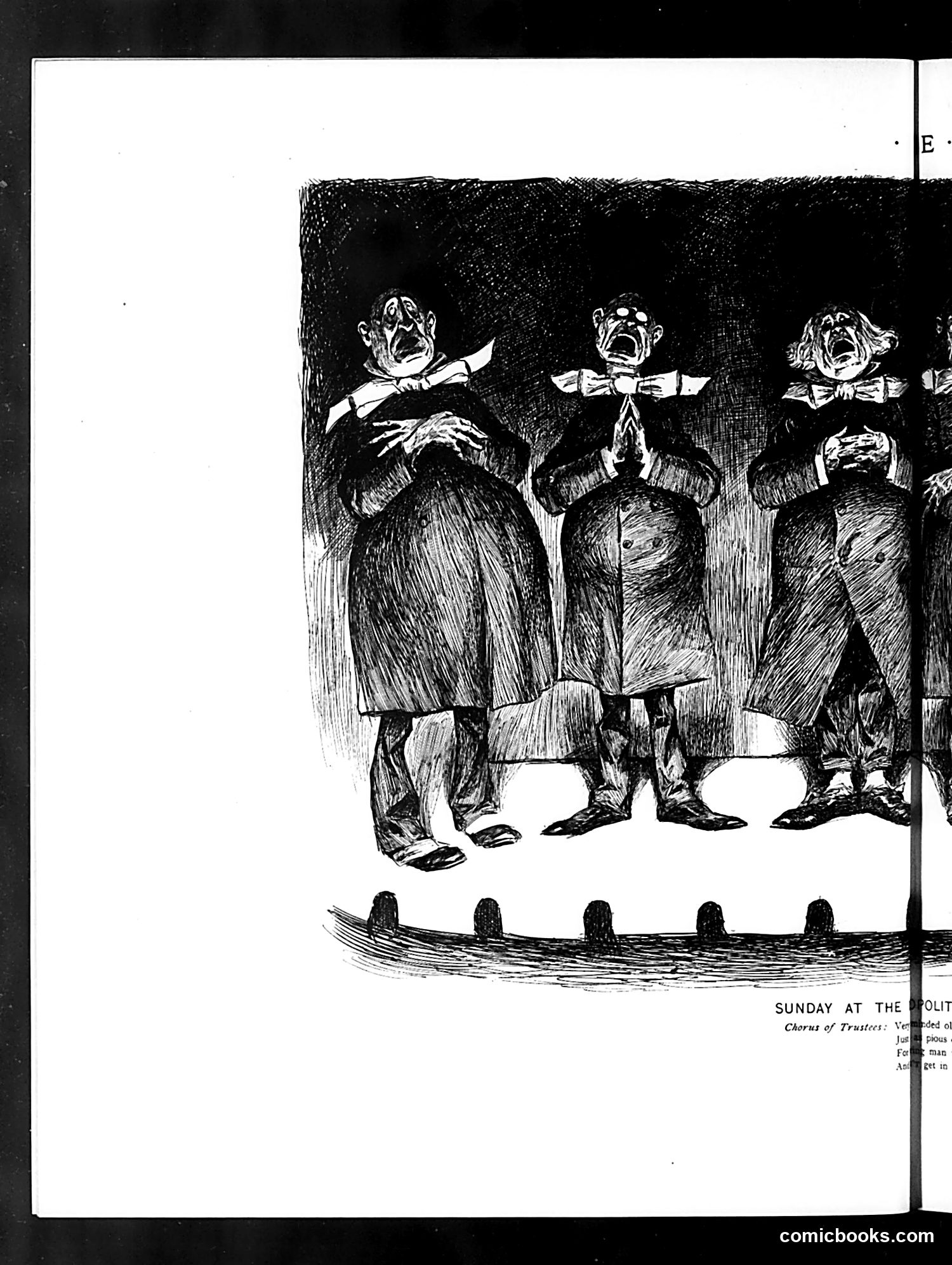
This appears to be a satirical cartoon titled "Sunday at the Poult" (likely "Poultry" abbreviated). The image depicts several well-dressed men in formal attire with exaggerated, distressed facial expressions, their mouths open as if singing or calling out. They're positioned like a chorus line. The OCR text references "Chorus of Traitors" with partially legible names (Joe, Bos, Fe, Ac visible), suggesting these figures represent political figures or public personalities accused of betrayal or disloyalty. The cartoon's humor appears to derive from depicting these "traitors" in a theatrical, performative manner—perhaps mocking their public statements or synchronized responses to some political issue. Without clearer text or date context, the specific historical reference remains unclear, though the composition suggests early 20th-century American political satire.
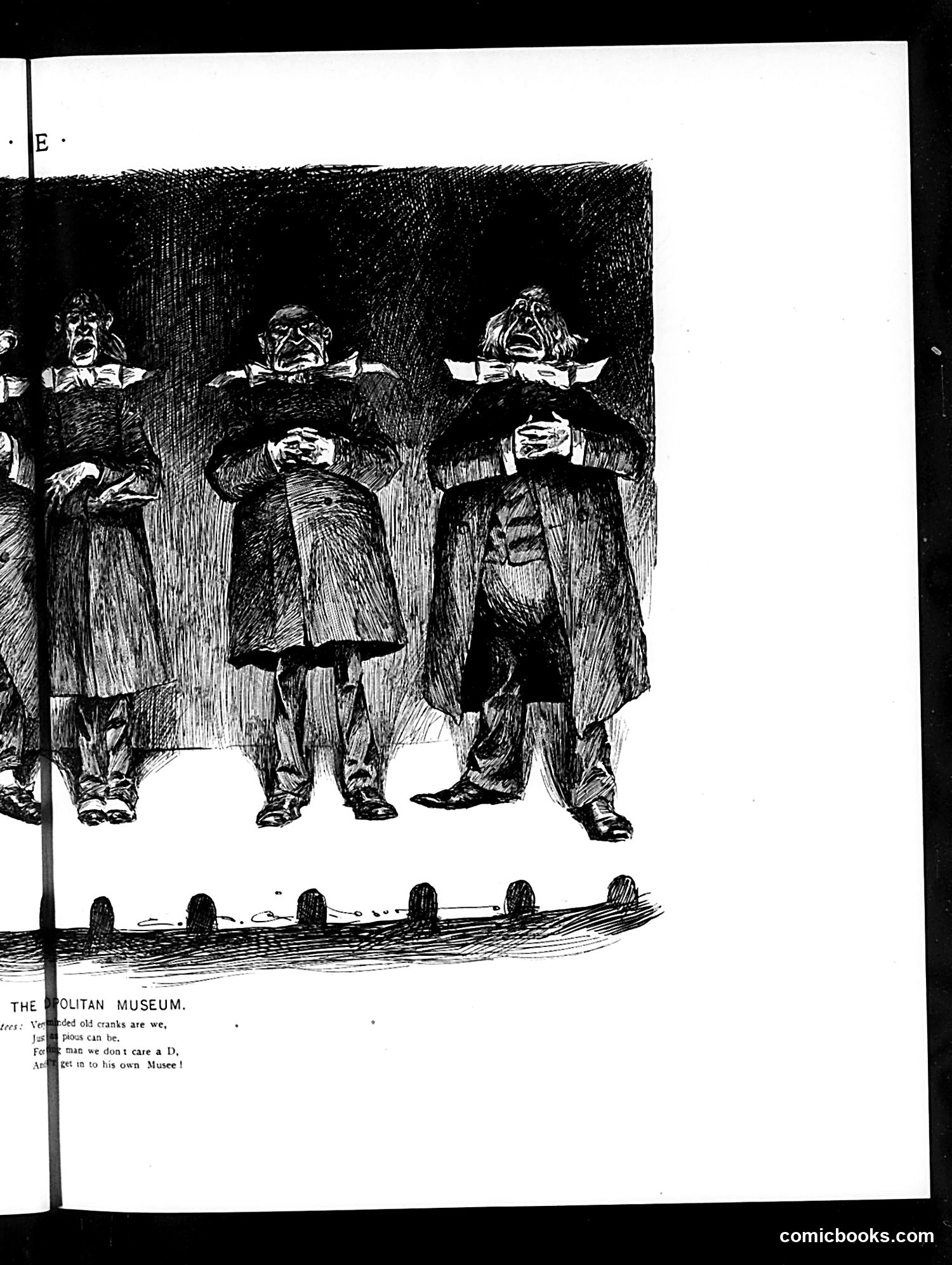
This satirical cartoon depicts several grotesque figures displayed as museum exhibits—literally standing on pedestals like statues. The style and exaggerated facial features suggest these are caricatures of specific public figures, though the image alone doesn't clearly identify them. The caption reads: "Ye old cracks are we, / Such pillar can be, / For man we don't care a D[amn], / Let us to his own Musee!" The satire appears to mock either wealthy collectors displaying dubious artifacts, or possibly ridicules certain public figures by presenting them as museum "pieces." The crude drawing style and grotesque characterizations emphasize the cartoonist's contempt for the subjects. Without additional context about *Life* magazine's publication date and contemporary figures, the specific targets remain unclear.
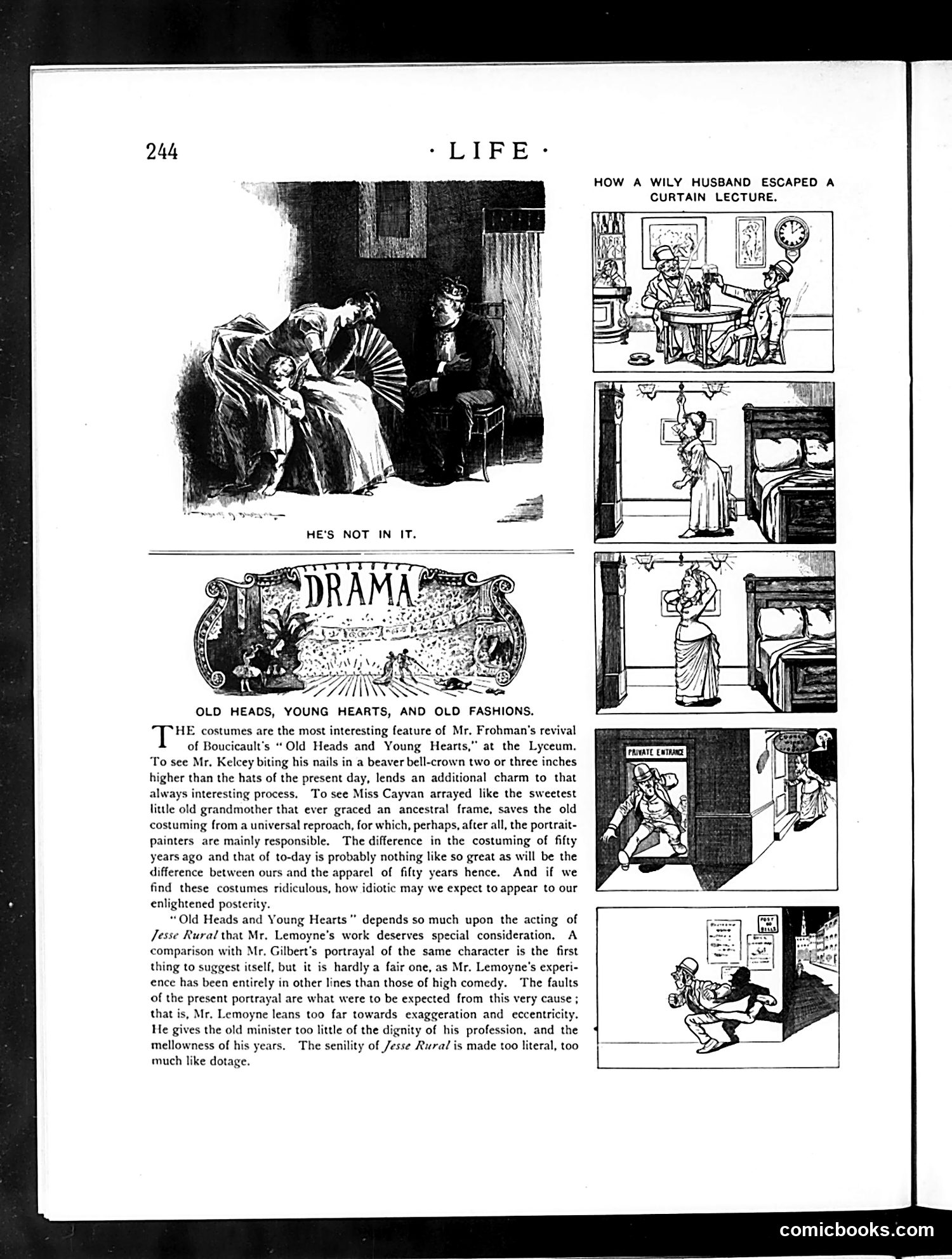
This page contains two distinct pieces of theatrical criticism from Life magazine. **"He's Not In It"** (top sketch): A domestic comedy showing a wife apparently scolding her husband while others listen. The caption suggests the husband has cleverly avoided a "curtain lecture"—a period term for a wife's private scolding delivered behind closed curtains. The humor lies in marital dynamics of the era. **"Old Heads and Young Hearts"** (main review): Criticism of a Boucicault play revival at the Lyceum theater. The reviewer discusses actors Mr. Kelcey and Miss Cayvan in period costumes, praising the historical accuracy. The review critiques Mr. Lemoyne's performance as "Jesse Rural" (appears to be a character name), claiming he exaggerates the role's senility rather than capturing dignified "high comedy." The reviewer suggests his inexperience in this genre shows through excessive, dotage-like portrayal rather than subtle acting. The page is primarily theater criticism aimed at contemporary audiences familiar with these productions and performers.
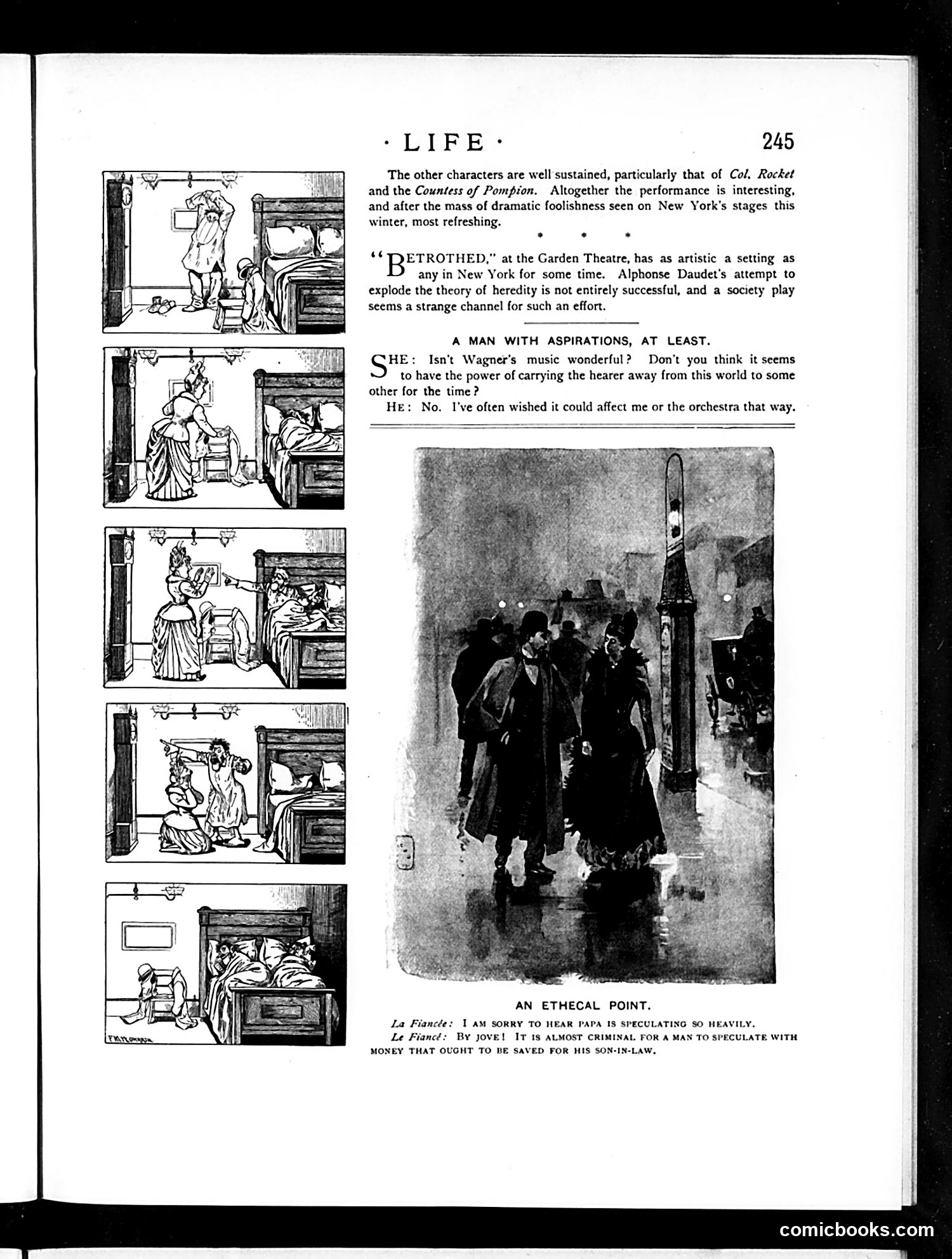
This *Life* magazine page contains theater reviews and two separate satirical cartoons mocking social attitudes of the era. **Top section:** Reviews of Broadway plays, including "Betrothed" at the Garden Theatre, which attempts to challenge heredity theory—a scientific debate of the period. **"A Man with Aspirations":** A husband-wife joke about Wagner's music. She romanticizes it as transcendent; he darkly jokes he wishes it could make the orchestra disappear—a jab at both Wagner's notoriously long operas and artistic pretension. **"An Ethical Point":** A fiancé complains that his future father-in-law is gambling away money that should be reserved for the son-in-law's inheritance. The satire mocks the mercenary logic of marriage arrangements among the wealthy—the fiancé's concern isn't moral outrage at gambling, but indignation that family money meant to benefit *him* is being risked.
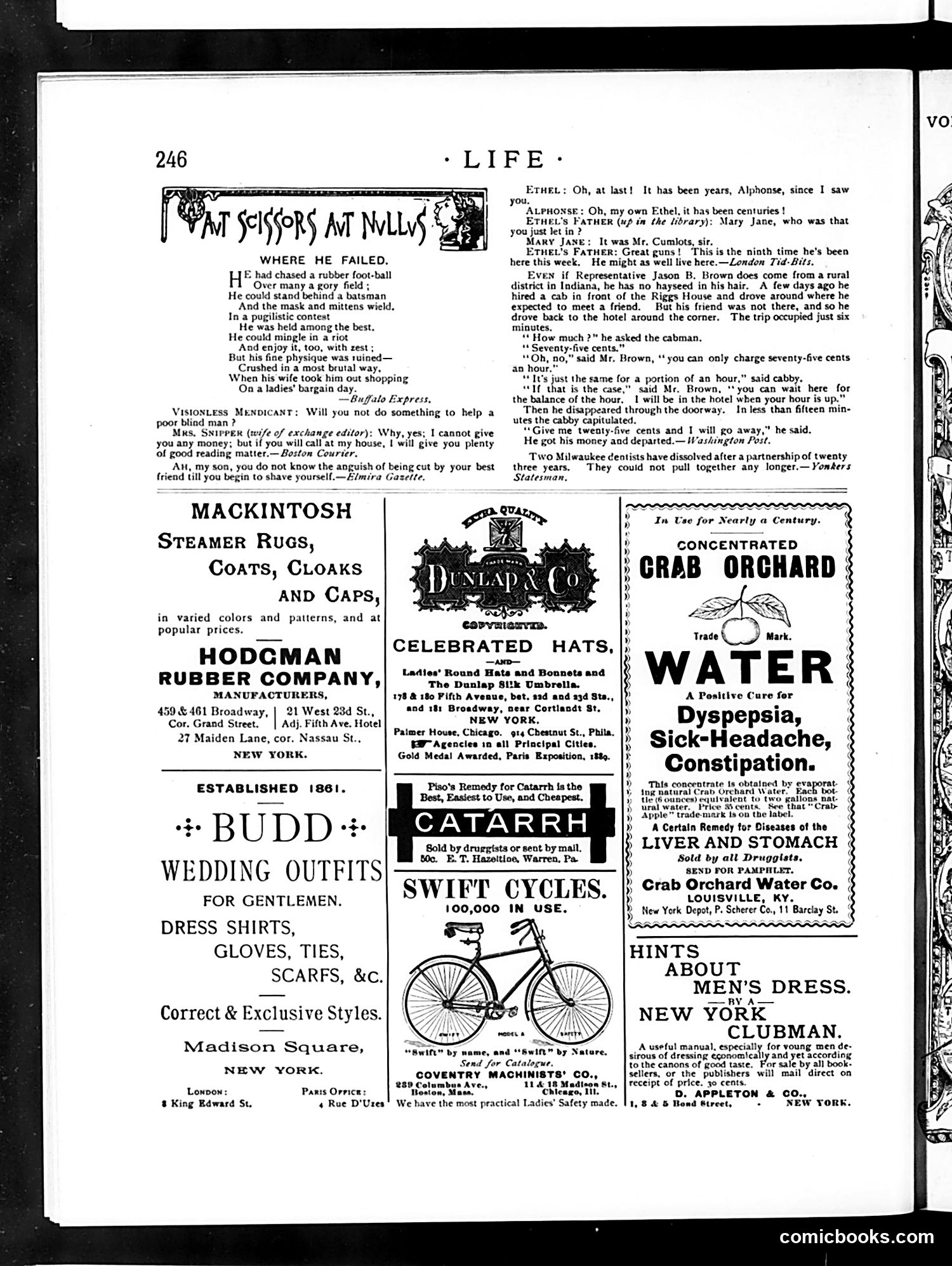
This satirical poem mocks masculine athletic prowess—a man proficient at football, baseball, boxing, and rioting—yet "ruined" by something supposedly trivial: accompanying his wife on a ladies' bargain-day shopping trip. The joke reflects a common late-19th-century theme: that domestic life and commerce emasculate men. The title appears to reference Roman senator Cato's famous demand to "destroy Carthage," here suggesting the shopping excursion is the man's equivalent catastrophe. Below are three brief anecdotes: a blind beggar offered "good reading matter" instead of money; a wealthy man (Alphonse) separated from his love for "centuries"; and Representative Jason B. Brown outwitting a cabdriver by hiring him for an hour then making him wait, paying only for time used—a joke celebrating the congressman's shrewdness over working-class greed. The page is primarily **advertising** for rubber goods, hats, cycles, and patent medicines (notably "Crab Orchard Water").