
Life, 1891-04-16 · page 6 of 14
Life — April 16, 1891 — page 6: what you’re looking at
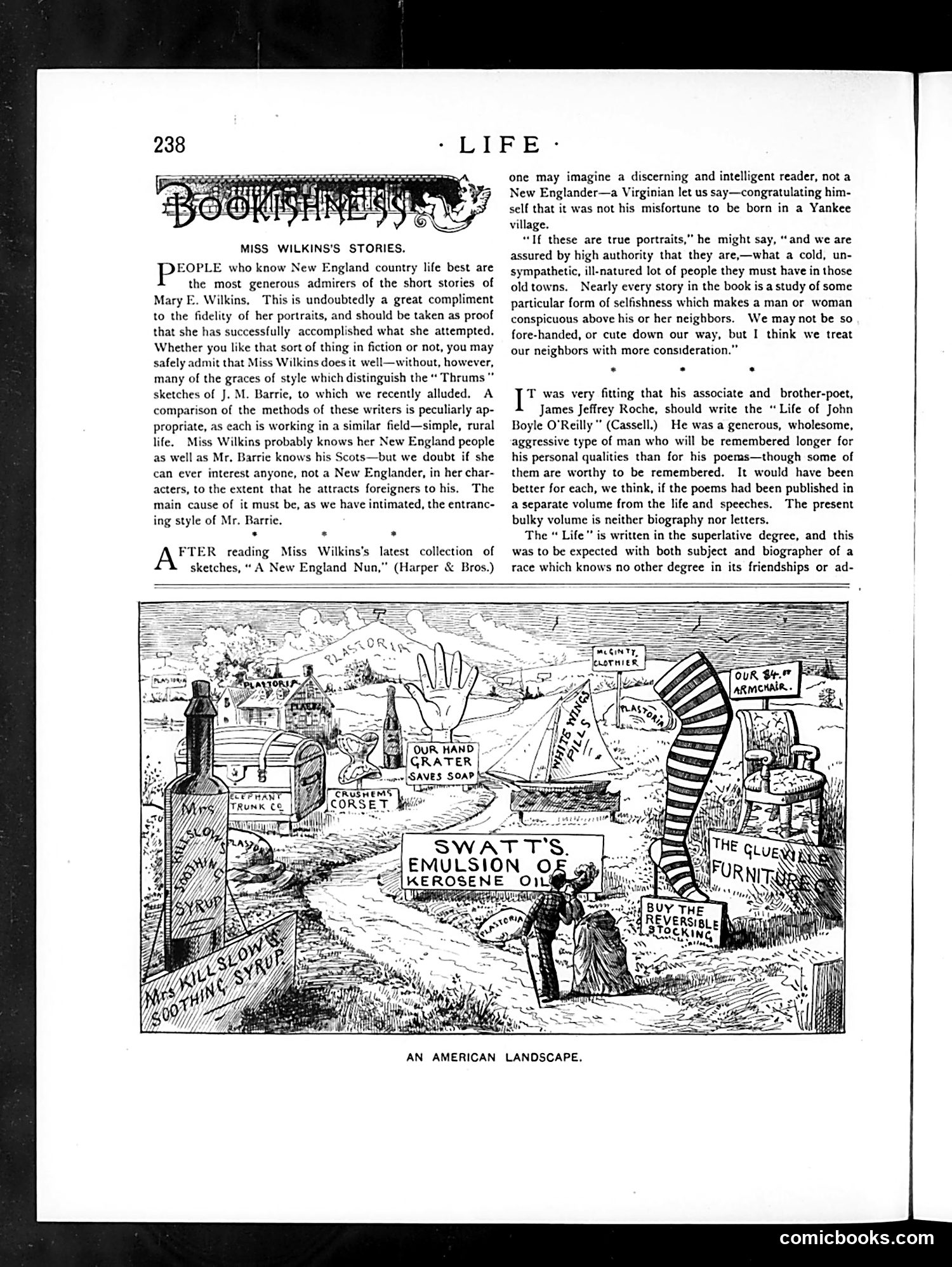
What you’re looking at
This cartoon satirizes American commercial culture through a surreal landscape dominated by product advertisements and brand names. Rather than natural features, the "landscape" consists of giant bottles, packages, and signs for products like Swatt's Emulsion of Kerosene Oil, Glueware Furniture, and various patent medicines and household goods. A couple walks through this commercialized terrain as if it were countryside. The satire targets how advertising and consumer products have become the defining features of the American environment—replacing actual nature. This reflects late-19th/early-20th century anxieties about industrialization and commercialism overwhelming traditional landscapes. The tone is darkly humorous, suggesting Americans navigate a world fundamentally shaped by marketing and consumption rather than natural beauty.
📄 Transcribed text from this page (OCR, searchable)
Machine-transcribed from the original scan — historical spelling and the odd misread are preserved.
MISS WILKINS’S STORIES. EOPLE who know New England country life best are the most generous admirers of the short stories of Mary E. Wilkins, This is undoubtedly a great compliment to the fidelity of her portraits, and should be taken as proof that she has successfully accomplished what she attempted. Whether you like that sort of thing in fiction or not, you may safely admit that Miss Wilkins does it well—without, however, many of the graces of style which distinguish the * Thrums sketches of J. M. Barrie, to which we recently alluded, A comparison of the methods of these writers is peculiarly ap- propriate, as each is working in a similar field—simple, rural life. Miss Wilkins probably knows her New England people as well as Mr. Barrie knows his Scots—but we doubt if she can ever interest anyone, not a New Englander, in her char- acters, to the extent that he attracts foreigners to his. The main cause of it must be, as we have intimated, the entranc- ing style of Mr. Barrie. . At R_ reading Miss Wilkins’s latest collection of sketches, “ A New England Nun,” (Harper & Bros.) -~ LIFE: one may imagine a discerning and intelligent reader, not a New Englander—a Virginian let us say—congratulating him- self that it was not his misfortune to be born in a Yankee village. “If these are true portraits,” he might say, “and we are assured by high authority that they are,—what a cold, un- sympathetic, ill-natured lot of people they must have in those old towns. Nearly every story in the book is a study of some particular form of selfishness which makes a man or woman conspicuous above his or her neighbors. We may not be so fore-handed, or cute down our way, but I think we treat our neighbors with more consideration.” . . . T was very fitting that his associate and brother-poet, James Jeffrey Roche, should write the “Life of John Boyle O'Reilly” (Cassell.) He was a generous, wholesome, aggressive type of man who will be remembered longer for his personal qualities than for his poems—though some of them are worthy to be remembered. It would have been better for each, we think, if the poems had been published in a separate volume from the life and speeches. The present bulky volume is neither biography nor letters. The “ Life" is written in the superlative degree, and this was to be expected with both subject and biographer of a race which knows no other degree in its friendships or ad- [OUR HAND] JGRATER | 4 AN AMERICAN LANDSCAPE, = Ra E LOT HIER comicbooks.com