
Life, 1891-04-16 · page 4 of 14
Life — April 16, 1891 — page 4: what you’re looking at
What you’re looking at
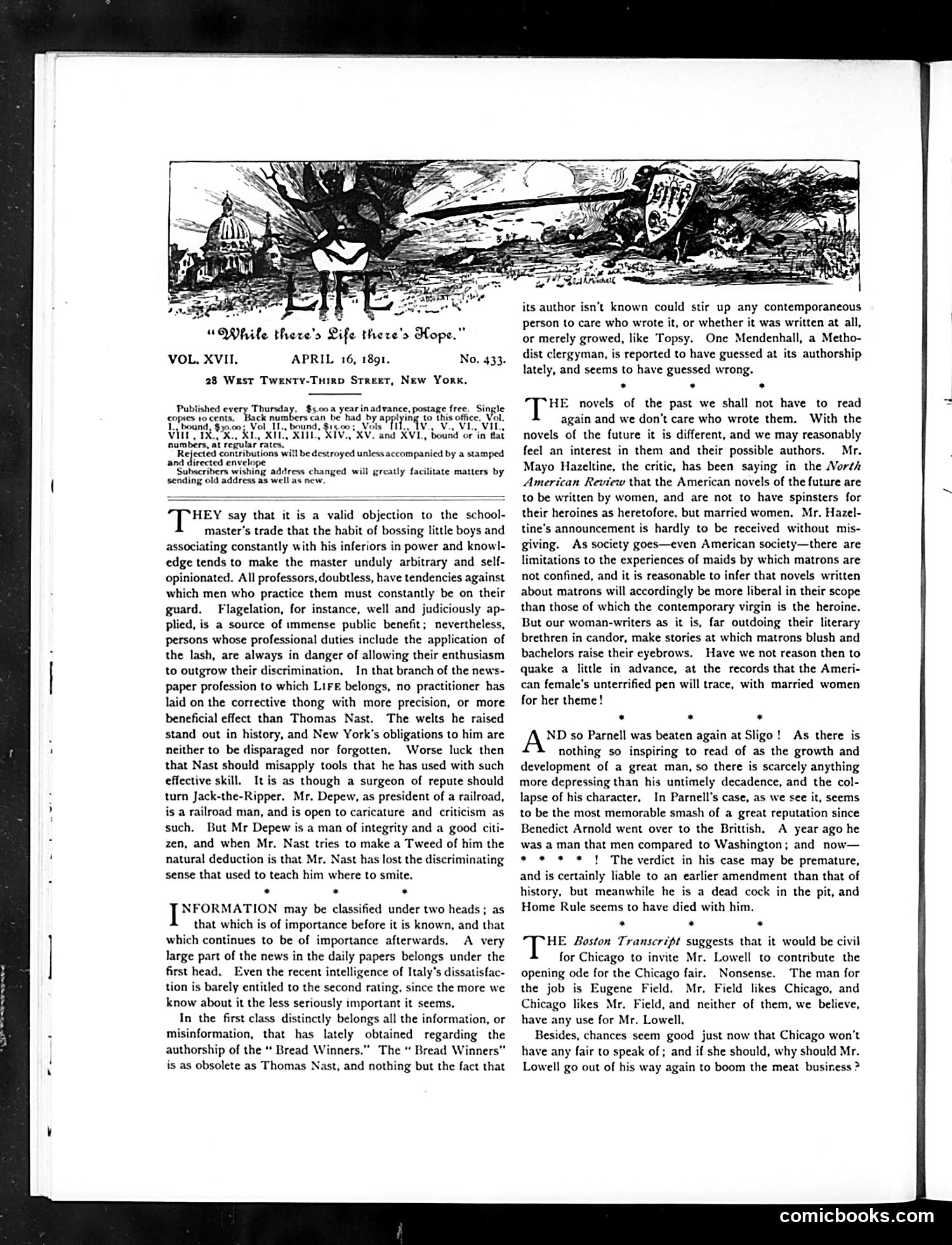
The masthead cartoon depicts a figure in formal dress sitting amid ruins and destruction, with a gravestone visible. The caption reads "While there's Life there's Hope." The text discusses several contemporary issues: 1. **Schoolmaster discipline**: Debate over whether teachers' use of corporal punishment (bosses boys) creates arbitrary authority or necessary order. 2. **American female novelists**: Commentary on recent announcements that future American novels will feature married women protagonists rather than unmarried heroines—a progressive shift reflecting changing social attitudes. 3. **Parnell scandal**: References the recent downfall of Irish politician Charles Stewart Parnell, whose reputation collapsed dramatically. 4. **Chicago cultural promotion**: Discusses inviting James Russell Lowell to contribute an opening ode for Chicago's new library. The magazine blends social criticism with gossip typical of 1890s satirical journalism.
📄 Transcribed text from this page (OCR, searchable)
Machine-transcribed from the original scan — historical spelling and the odd misread are preserved.
“Mile there's Life there's Hope.” VOL, XVII. APRIL 16, 1891. No. 433. 28 West Twenty-Tuirp Street, New York. Published every Thursday. $5.00 year inadvance, postage free. Single goptes ro cents. hack numbers can be had by applying 20 this office. J. ybound, $a.00; Vol, It.. bound, $15.00; Vols evite BHT Te OR ext Xe 1 XV. and XVI, bound or in Bad numbers, at regular'r rates, Rejected contributions will be destroyed unlessaccompanied by a stamped and directed envelope Subscribers wishing address changed will greatly facilitate matters by sending old address as well as new. THEY s say that it is a valid objection to the school- master’s trade that the habit of bossing little boys and associating constantly with his inferiors in power and knowl- edge tends to make the master unduly arbitrary and self- opinionated. All professors, doubtless, have tendencies against which men who practice them must constantly be on their guard. Flagelation, for instance, well and judiciously ap- plied, is a source of immense public benefit; nevertheless, persons whose professional duties include the application of the lash, are always in danger of allowing their enthusiasm to outgrow their discrimination, In that branch of the news- paper profession to which Lire belongs, no practitioner has laid on the corrective thong with more precision, or more beneficial effect than Thomas Nast. The welts he raised stand out in history, and New York's obligations to him are neither to be disparaged nor forgotten. Worse luck then that Nast should misapply tools that he has used with such effective skill, It is as though a surgeon of repute should turn Jack-the-Ripper. Mr. Depew, as president of a railroad, is a railroad man, and is open to caricature and criticism as such. But Mr Depew is a man of integrity and a good citi- zen, and when Mr. Nast tries to make a Tweed of him the natural deduction is that Mr. Nast has lost the discriminating sense that used to teach him where to smite. . . . I SE ORATION may be classified under two heads ; as that which is of importance before it is known, and that which continues to be of importance afterwards. A very large part of the news in the daily papers belongs under the first head. Even the recent intelligence of Italy's dissatisfac- tion is barely entitled to the second rating, since the more we know about it the less seriously important it seems, In the first class distinctly belongs all the information, or misinformation, that has lately obtained regarding the authorship of the “ Bread Winners.” The “ Bread Winners” is as obsolete as Thomas Nast, and nothing but the fact that its author isn’t known could stir up any contemporaneous person to care who wrote it, or whether it was written at all, or merely growed, like Topsy. One Mendenhall, a Metho- dist clergyman, is reported to have guessed at its authorship lately, and seems to have guessed wrong. . . . HE novels of the past we shall not have to read again and we don’t care who wrote them, With the novels of the future it is different, and we may reasonably feel an interest in them and their possible authors. Mr. Mayo Hazeltine, the critic, has been saying in the North American Review that the American novels of the future are to be written by women, and are not to have spinsters for their heroines as heretofore. but married women, Mr. Hazel- tine’s announcement is hardly to be received without mis- giving. As society goes—even American society—there are limitations to the experiences of maids by which matrons are not confined, and it is reasonable to infer that novels written about matrons will accordingly be more liberal in their scope than those of which the contemporary virgin is the heroine. But our woman-writers as it is, far outdoing their literary brethren in candor, make stories at which matrons blush and bachelors raise their eyebrows. Have we not reason then to quake a little in advance, at the records that the Ameri- can female's unterrified pen will trace, with married women for her theme! . . . A» so Parnell was beaten again at Sligo! As there is nothing so inspiring to read of as the growth and development of a great man, so there is scarcely anything more depressing than his untimely decadence, and the col- lapse of his character. In Parnell’s case, as we see it, seems to be the most memorable smash of a great reputation since Benedict Arnold went over to the Brittish, A year ago he was a man that men compared to Washington; and now— * * * * J! The verdict in his case may be premature, and is certainly liable to an earlier amendment than that of history, but meanwhile he is a dead cock in the pit, and Home Rule seems to have died with him. . . . HE Boston Transcript suggests that it would be civil for Chicago to invite Mr. Lowell to contribute the opening ode for the Chicago fair. Nonsense. The man for the job is Eugene Field. Mr. Field likes Chicago, and Chicago likes Mr. Field, and neither of them, we believe, have any use for Mr. Lowell. Besides, chances seem good just now that Chicago won't have any fair to speak of; and if she should, why should Mr. Lowell go out of his way again to boom the meat business > comicbooks.com