
A complete issue · 14 pages · 1891
Life — April 9, 1891
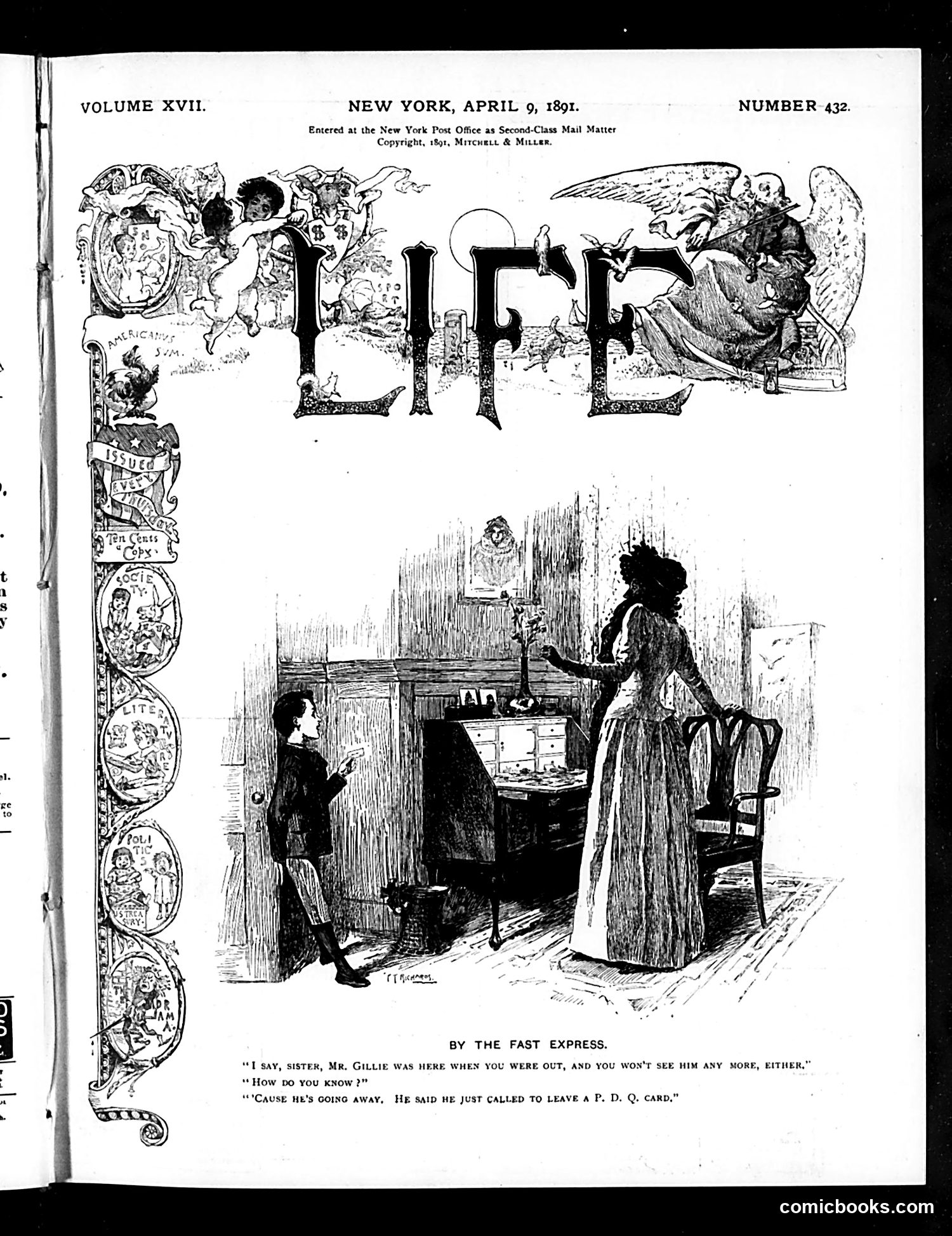
This domestic comedy sketch depicts a woman confronting a man about another visitor. The dialogue reveals the humor: a woman named "Mr. Gillie" visited while the husband was out, and he's now leaving by sending a calling card (P.D.Q. card—period slang for "pretty damn quick"). The joke plays on Victorian social conventions around male visitors and marital suspicion. The woman's confrontation, the man's apparent nervousness, and his hasty departure via the "fast express" suggest comedic infidelity or impropriety. The ornate border and decorative header typical of Life magazine's satirical style frame this domestic farce. The humor relies on period understanding of social calling etiquette and the anxieties surrounding unchaperoned male-female interactions in proper Victorian households.
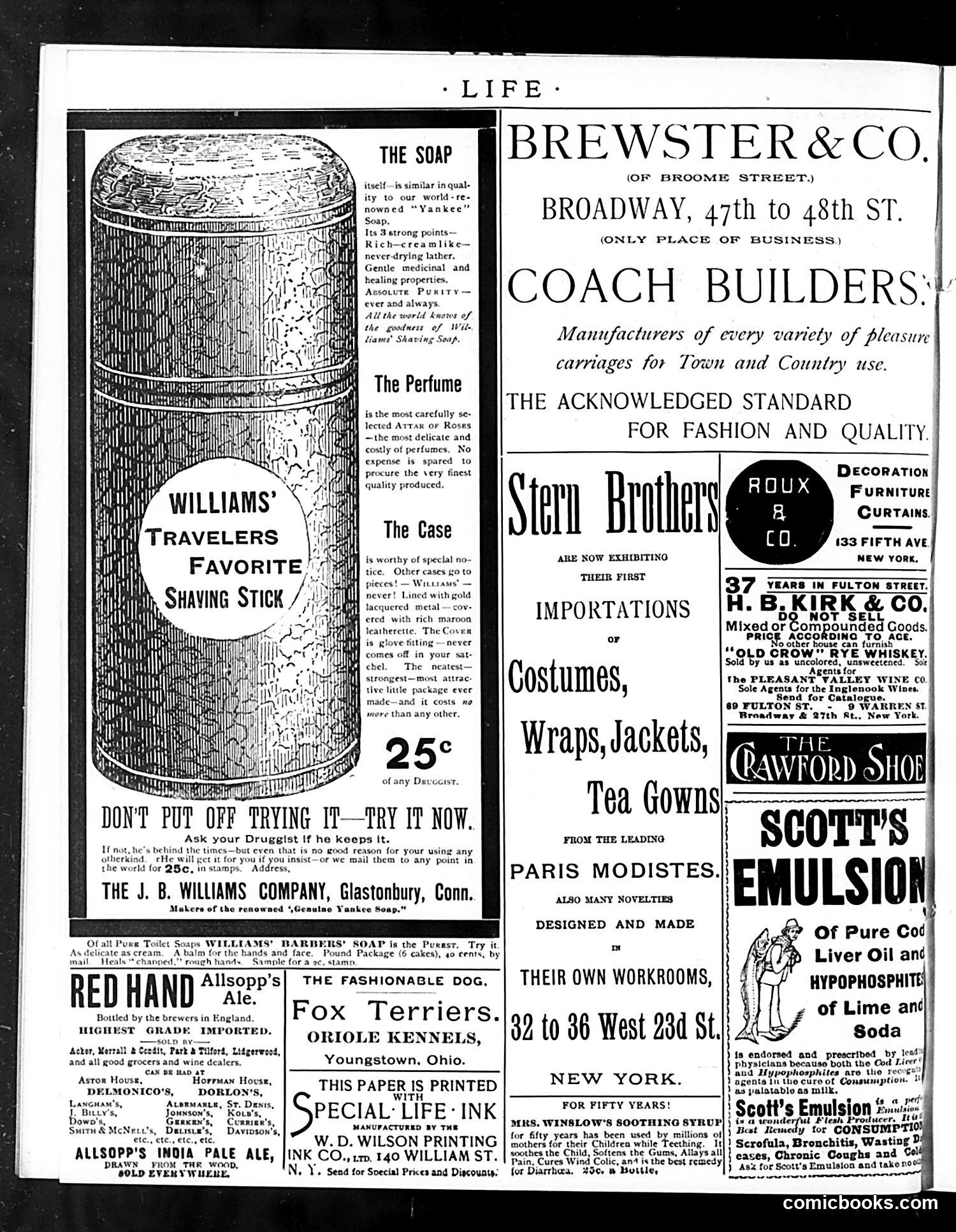
This page is **primarily advertising**, not satirical content. It contains commercial advertisements for various late 19th/early 20th-century products and services: - **Williams' Travelers Favorite Shaving Stick** (25¢) - **Brewster & Co.** (coach builders on Broadway) - **Stern Brothers** (importers of fashionable women's clothing) - **Scott's Emulsion** (cod liver oil supplement) - **Various other products**: shoes, whiskey, wine, furniture, dog breeds The only potentially humorous element is "The Fashionable Dog" section featuring Fox Terriers and Oriole Kennels, which appears to be a light society column rather than satire. This represents Life magazine's business model: the publication subsidized its satirical content through paid advertising. There is no political cartoon or social satire visible on this particular page.
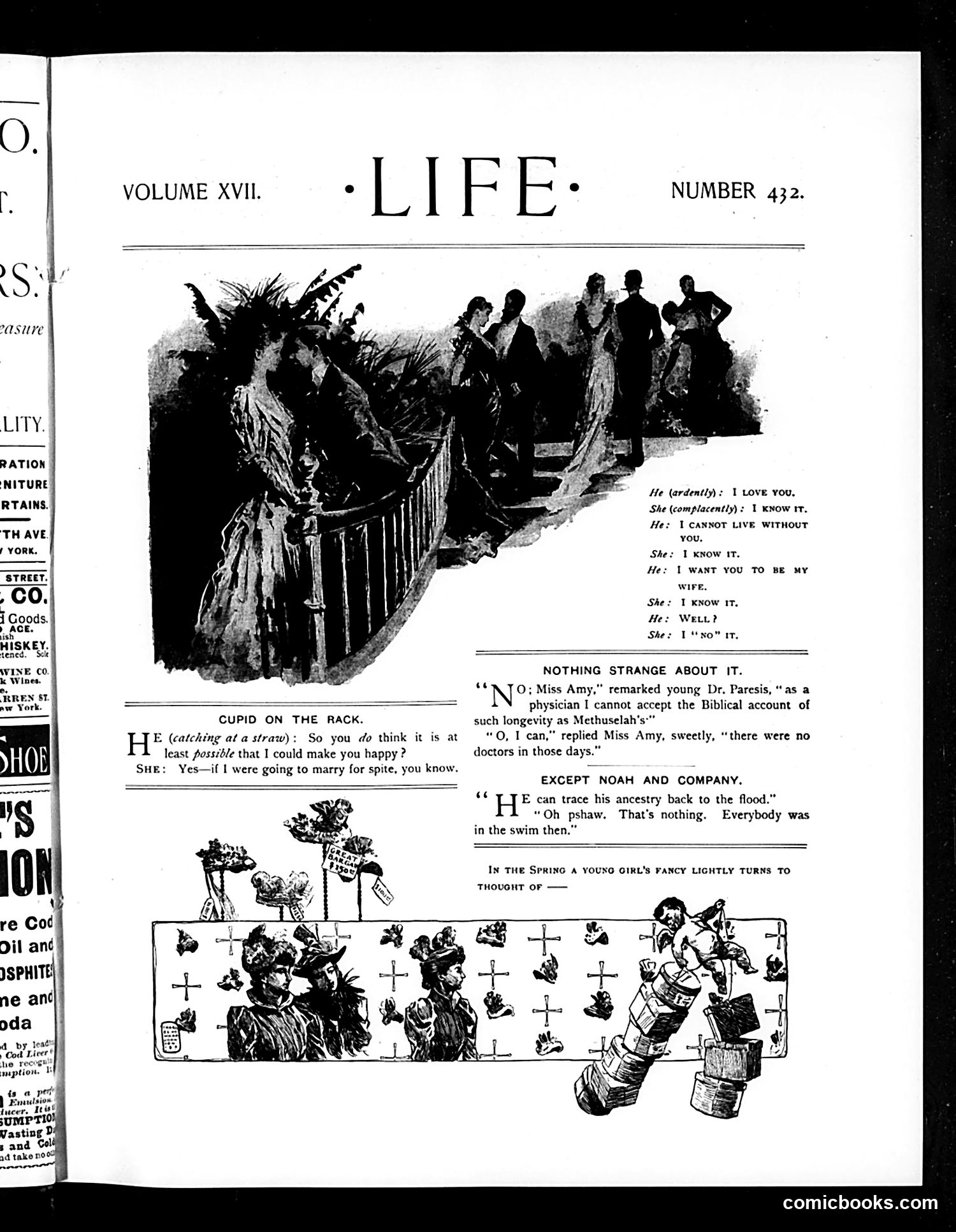
This page contains humorous romantic/relationship content typical of early 20th-century Life magazine satire. **"Cupid on the Rack"** depicts a romantic negotiation where a man attempts to convince a woman of his marriageability. She replies she'd only marry "for spite," establishing the joke's cynical tone about matrimonial motivation. **"Nothing Strange About It"** features dialogue between "Miss Amy" and "Dr. Parsis" debating the Biblical flood account. The humor relies on a casual dismissal of religious authority—the doctor's skepticism is undercut by the girl's lighthearted response that ancestry tracing is unremarkable since "everybody was in the swim then." The lower illustration appears to depict spring romance fantasies, showing a young woman's imaginative thoughts about suitors and domestic life.
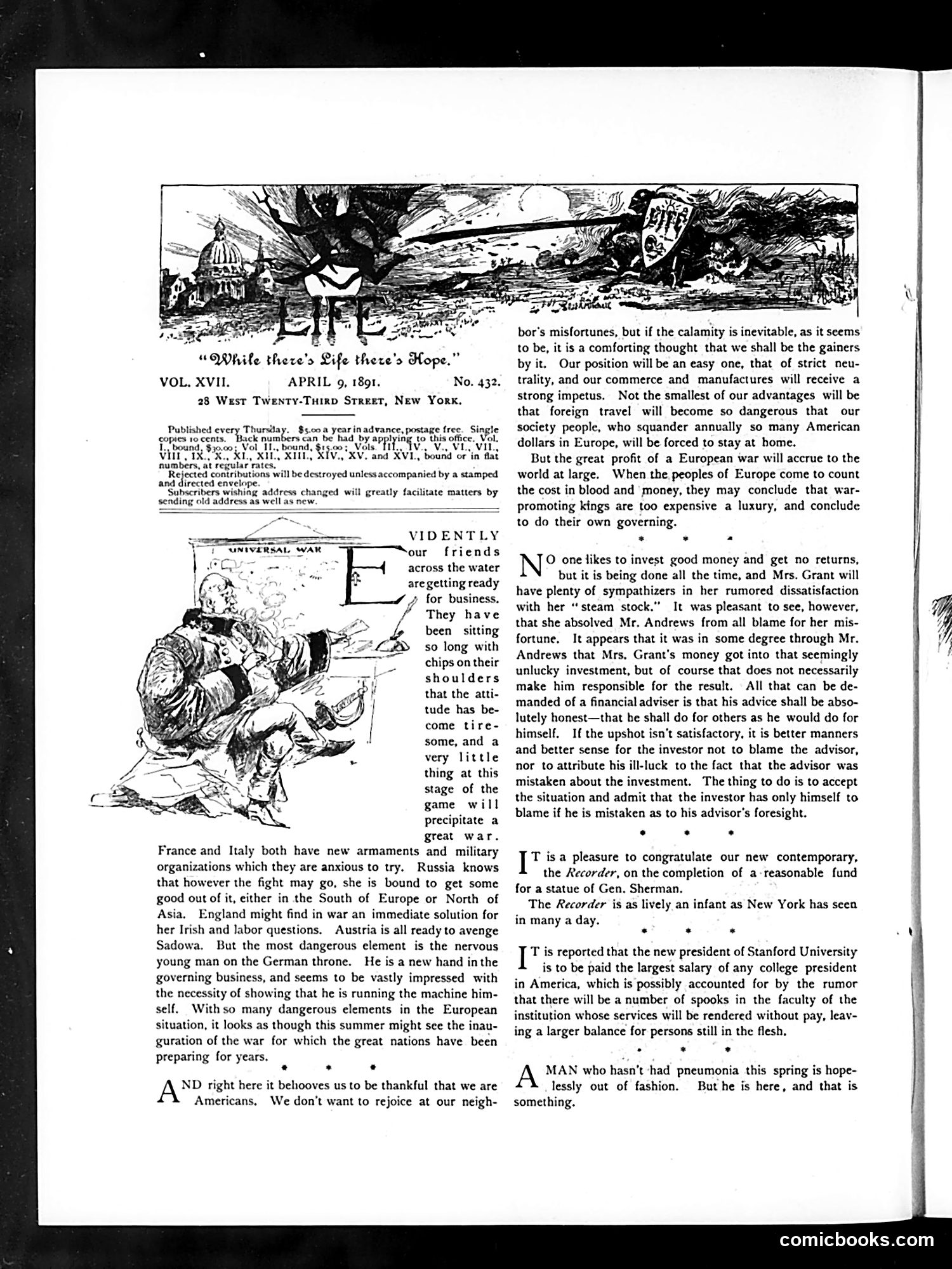
The main cartoon titled "Universal War" depicts a figure (likely representing a European power or military leader) standing atop a globe, wielding weapons while chaos erupts around him. The satirical point appears to critique European militarism and the arms race—the accompanying editorial text discusses how France, Italy, Russia, and Austria are all building up military forces, creating dangerous tensions. The cartoon suggests that this competitive European armament threatens global stability. The editorial expresses American gratitude for being geographically isolated from these conflicts, while warning that such international instability could eventually affect American interests. The overall message is satirical commentary on pre-World War I European military posturing and imperial competition.
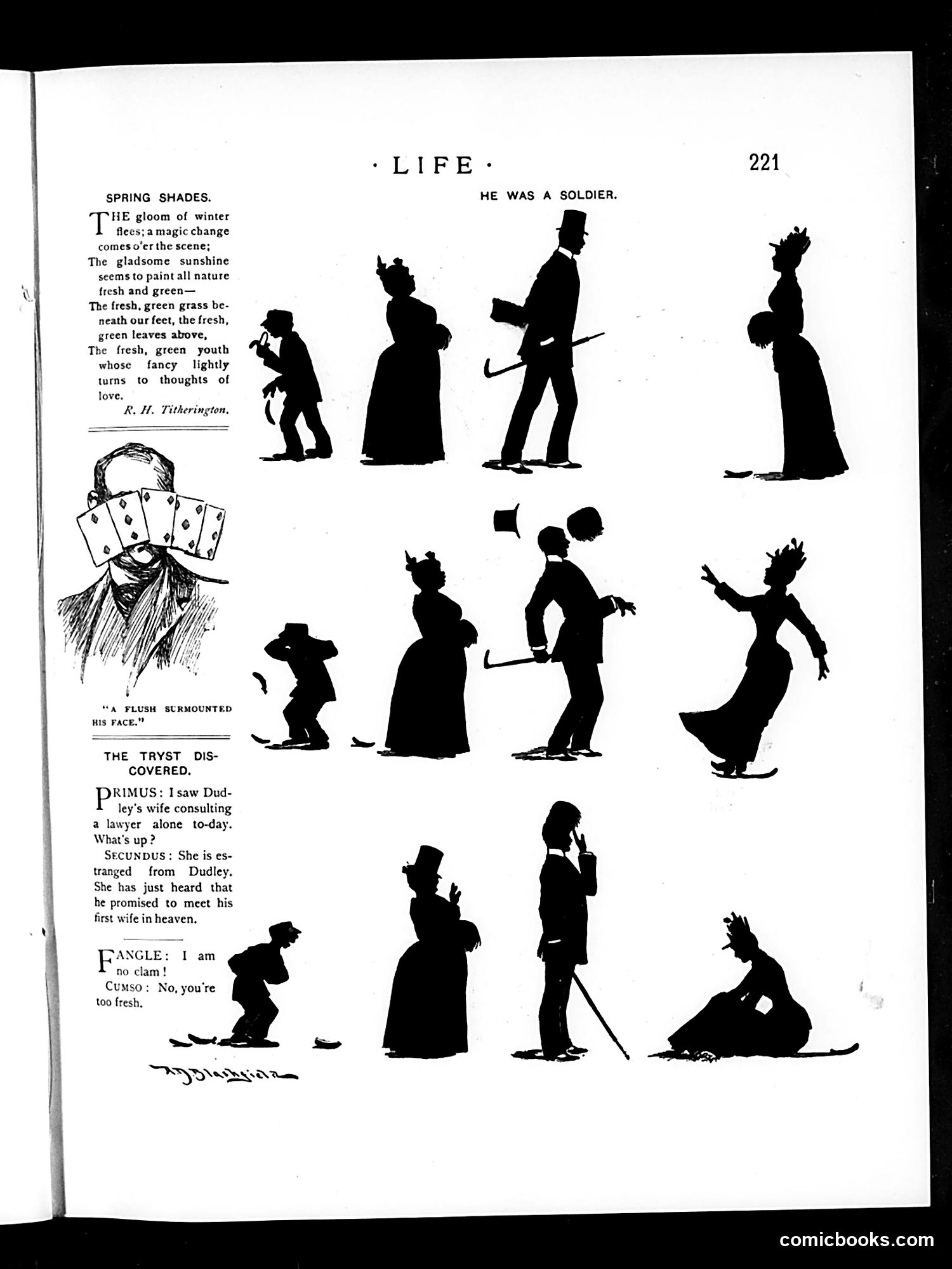
This page features silhouettes illustrating various social scenarios, likely from an early 20th-century Life magazine. The title "He Was a Soldier" suggests commentary on military service and its aftermath. The accompanying dialogue excerpts ("The Tryst Discovered," "Fangle" and "Cumso") appear to reference romantic entanglements and social embarrassment. One snippet mentions a man promised to meet "his first wife in heaven," implying remarriage or infidelity complications. The silhouettes depict domestic scenes—couples in conflict, figures in formal dress, and what appears to be social awkwardness. This likely satirizes post-war adjustment challenges for returning soldiers or broader marital/social complications of the era. The page also includes "Spring Shades," a poem by R.H. Titerington about seasonal renewal, contrasting with the somewhat darker domestic humor dominating the page.
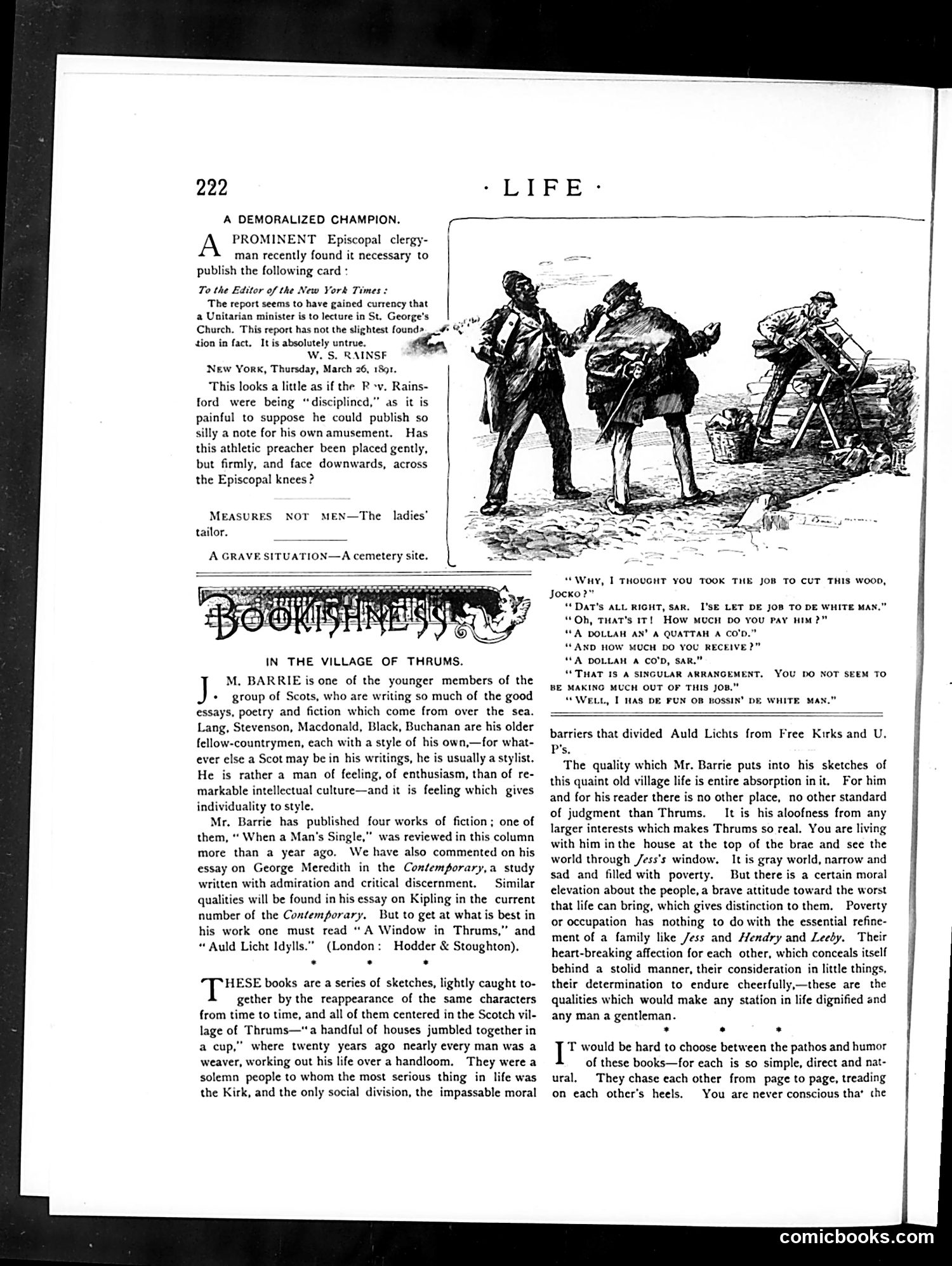
The page contains a book review of J.M. Barrie's sketches of village life in Thurums, Scotland. The illustration depicts three men in Scottish dress having a conversation about woodcutting wages—a scene exemplifying the working-class Scottish village characters Barrie depicted. The cartoon's humor hinges on a dialectical exchange about payment: a worker negotiates his fee while the employer establishes racial/social hierarchy ("white man's work"). This reflects late-19th-century attitudes about labor, class, and racial divisions—treating wage negotiations between working-class figures as inherently comedic material. The review praises Barrie's ability to capture moral dignity and affection among impoverished Scots, contrasting their poverty with their character and determination. The satire gently mocks both rural Scottish life and contemporary class pretensions.
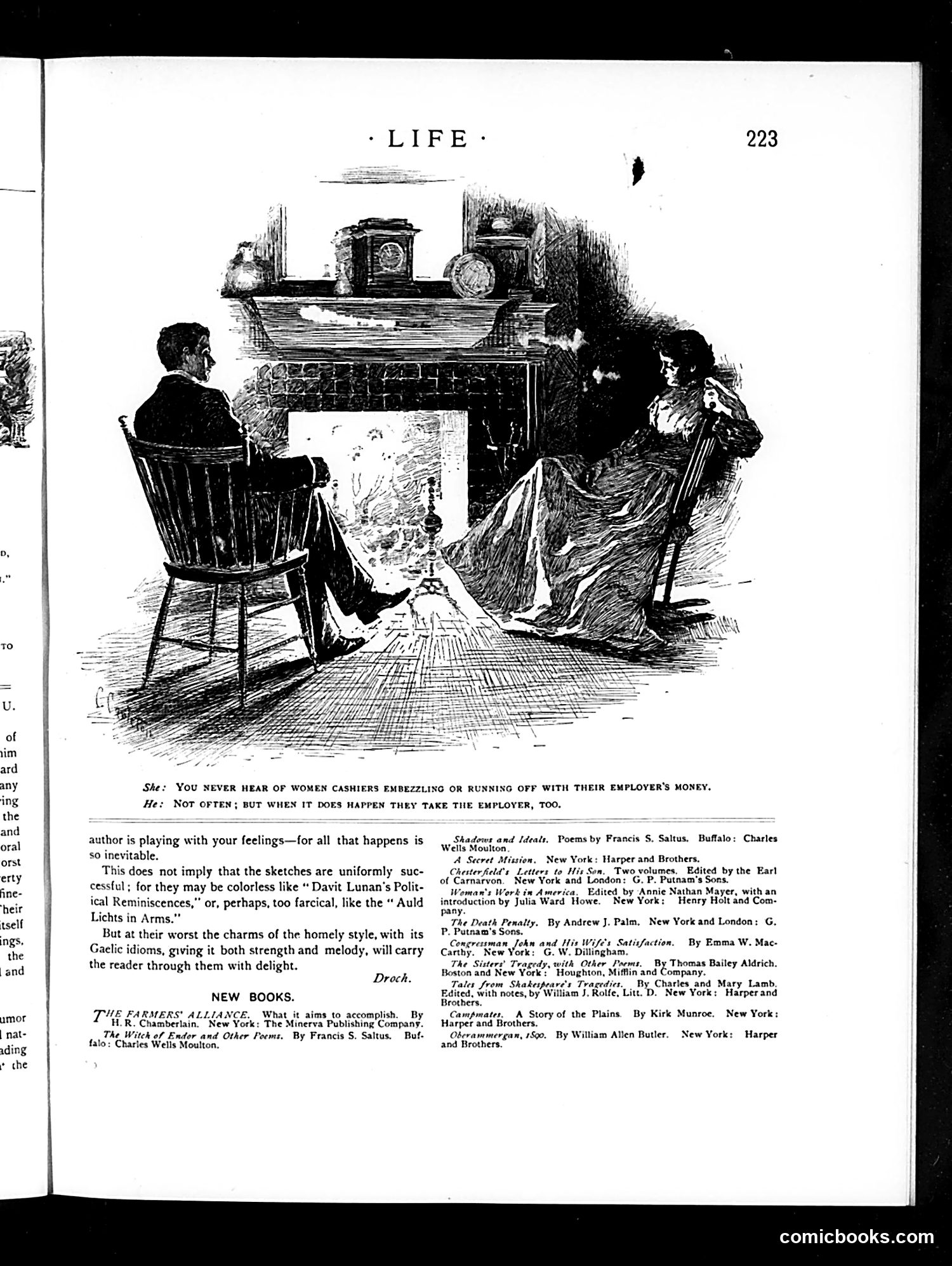
This page from *Life* magazine (page 223) contains a satirical cartoon about workplace misconduct. The dialogue reads: **She:** "You never hear of women cashiers embezzling or running off with their employer's money." **He:** "Not often; but when it does happen they take the employer, too." The joke plays on gender stereotypes of the era. The woman claims female cashiers are more trustworthy than male ones, implying moral superiority. The man's retort subverts this by suggesting that when women *do* commit theft, they steal something more valuable than money—the employer himself (implying romantic/sexual entanglement or elopement). It's satirizing both workplace assumptions about women's honesty and contemporary attitudes toward romance and social propriety. The illustration shows a domestic interior scene with two figures in conversation.
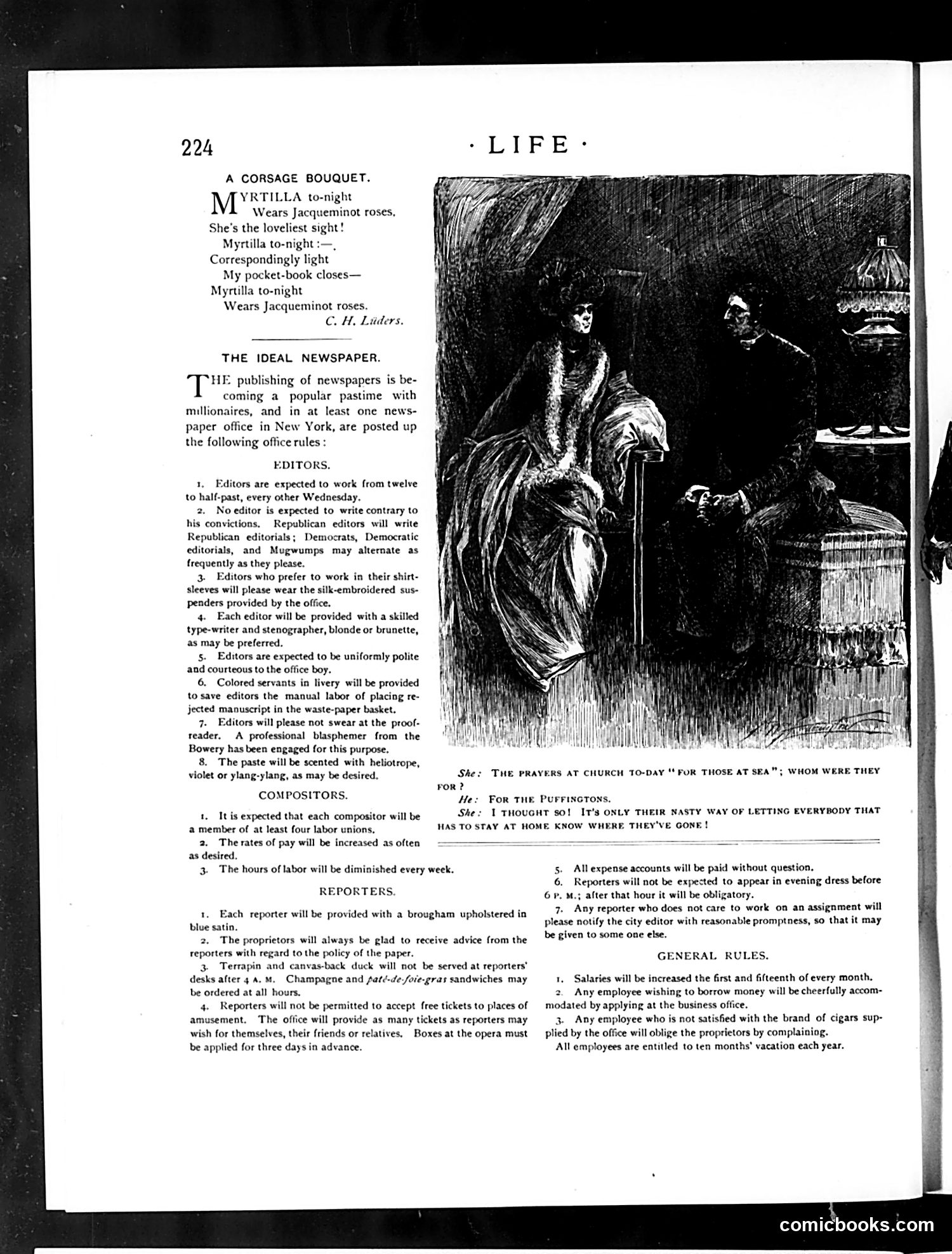
This page contains satirical office rules presented as "The Ideal Newspaper." The humor targets newspaper publishing practices of the era, likely early 1900s based on the style. The main illustration shows what appears to be a fashionable woman in fur coat speaking with men in an office setting, captioning a dialogue about church prayers "for those at sea" and the Puffingtons family. The text provides mock "rules" governing editors, compositors, and reporters—satirizing workplace hierarchies and class divisions. Notable satirical points include: provisions for "colored servants in livery," editors' political alignment expectations (Republican or Democratic), and perks like champagne sandwiches. The joke targets newspaper industry pretensions, labor conditions, and the arbitrary authority of proprietors over employees. The rules present actual workplace absurdities as formal policy, creating comedic effect through exaggeration.
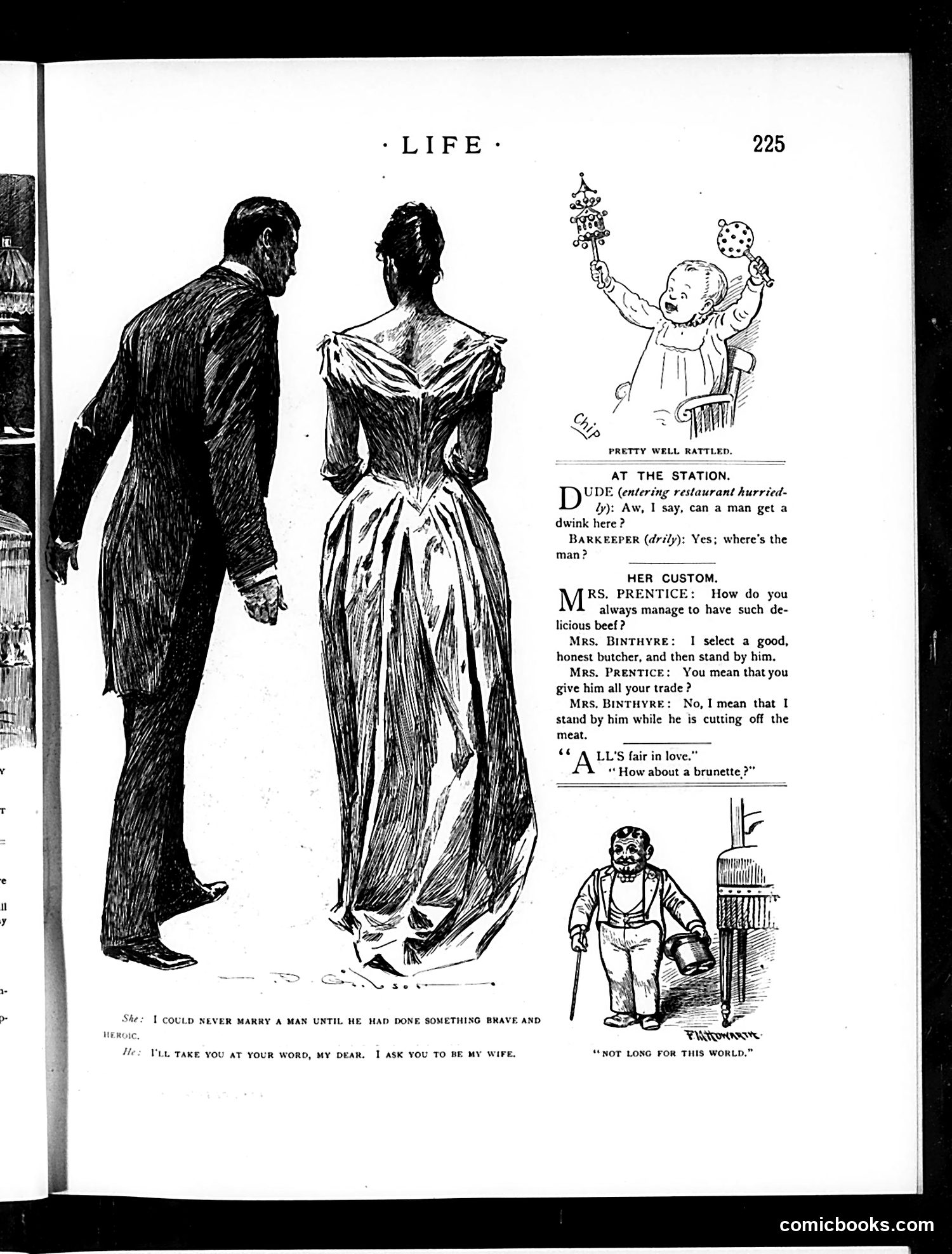
This page contains several satirical sketches and humorous dialogue snippets typical of Life's social commentary. The main illustration shows a well-dressed couple in Victorian/Edwardian attire, with the woman's dialogue stating she requires a man to perform "something brave and heroic" before marriage. The man agrees to marry her. Additional vignettes satirize domestic life: "At the Station" jokes about a drunk asking for a drink; "Her Custom" mocks wives who manage household affairs by selecting butchers and controlling trade; and "All's Fair in Love" makes a quip about brunettes. The humor targets gender relations and marriage expectations of the era—specifically women's standards for suitors and wives' domestic authority. The cartoons reflect period anxieties about courtship, femininity, and marital power dynamics among the middle and upper classes.
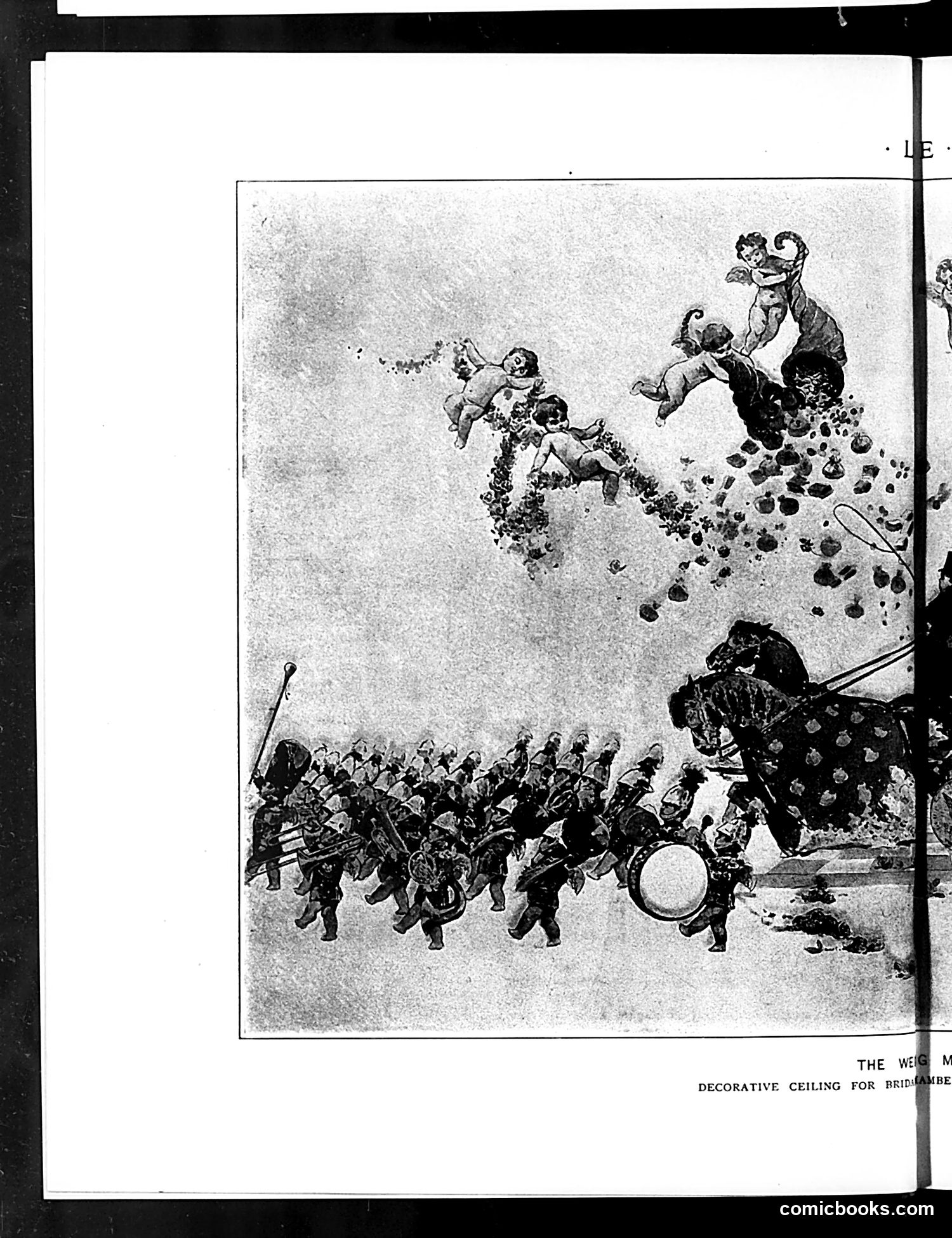
The caption reads "THE WEIG... DECORATIVE CEILING FOR BRID[GEGATE]" (text cut off), suggesting this depicts a decorative ceiling design for a bridge or building project. The illustration shows a fantastical, whimsical scene: cherubs or putti (baby figures) float in the sky scattering flowers or coins downward onto a marching procession of soldiers below. A large decorative umbrella or parasol appears on the right side. This appears to be satirizing either an ornate civic decoration project or possibly mocking grandiose architectural ambitions. The contrast between the fanciful celestial imagery and the orderly military procession below suggests commentary on public spending or decoration—perhaps criticizing elaborate artistic projects while soldiers march below, though the exact political reference is unclear without the complete caption and publication date.
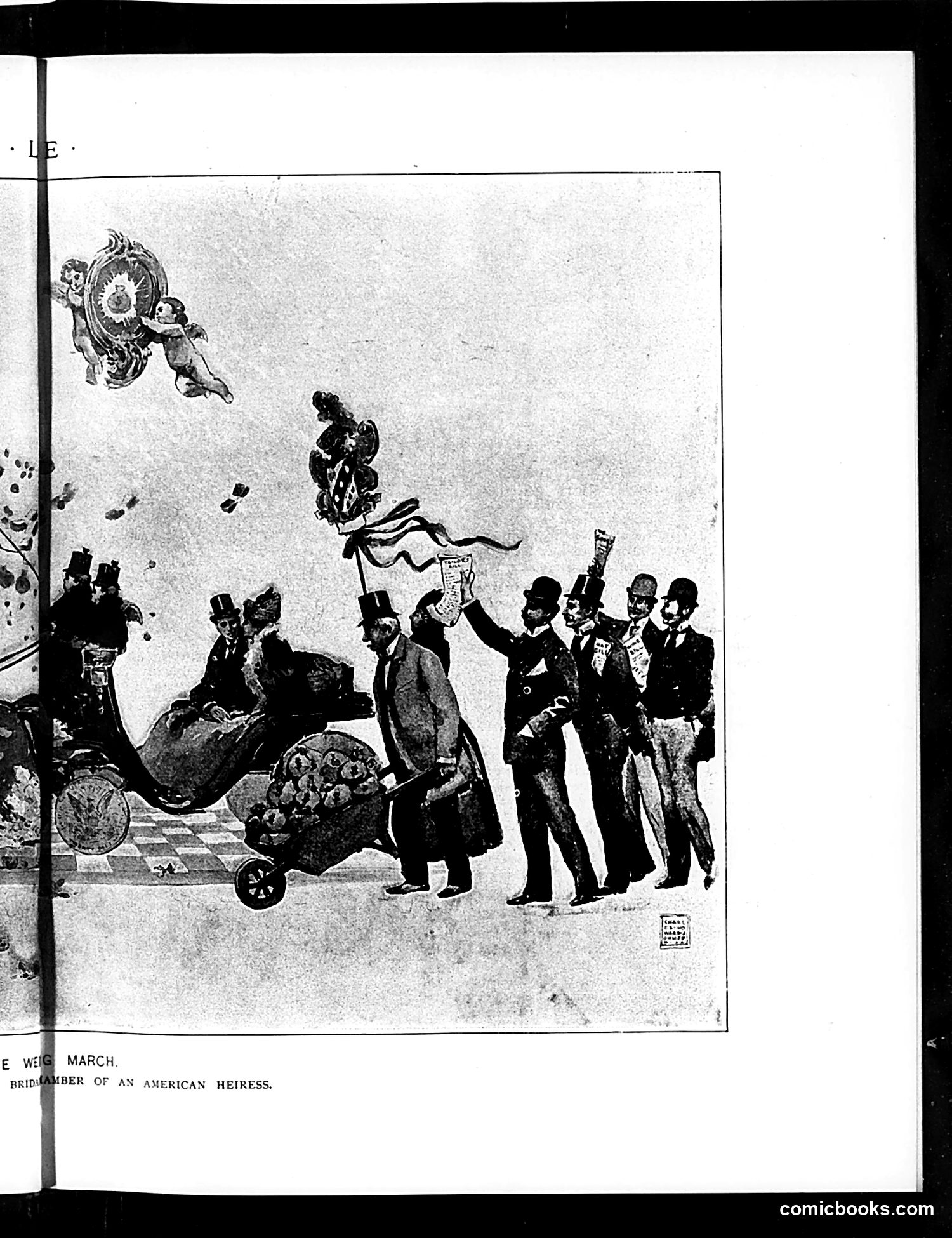
This Life magazine cartoon satirizes the wealth and ostentatious display of an American heiress, likely from the Gilded Age era. The image shows fashionably dressed men in top hats attending to an elaborate carriage or vehicle laden with ornate decorative elements. Cherubs or putti float above, suggesting divine or inflated importance. The figures appear to be servants or attendants, while the procession suggests a grand, almost absurd parade of wealth. The satire targets the excess of wealthy American heiresses—women whose primary social significance derived from inherited fortunes rather than accomplishment. The over-decorated conveyance and the entourage of formally-dressed men emphasize how wealth translated into conspicuous consumption and social performance. The caption reference to "bridechamber of an American heiress" suggests commentary on marriages of convenience between wealthy American women and foreign nobility, a common phenomenon of this period.
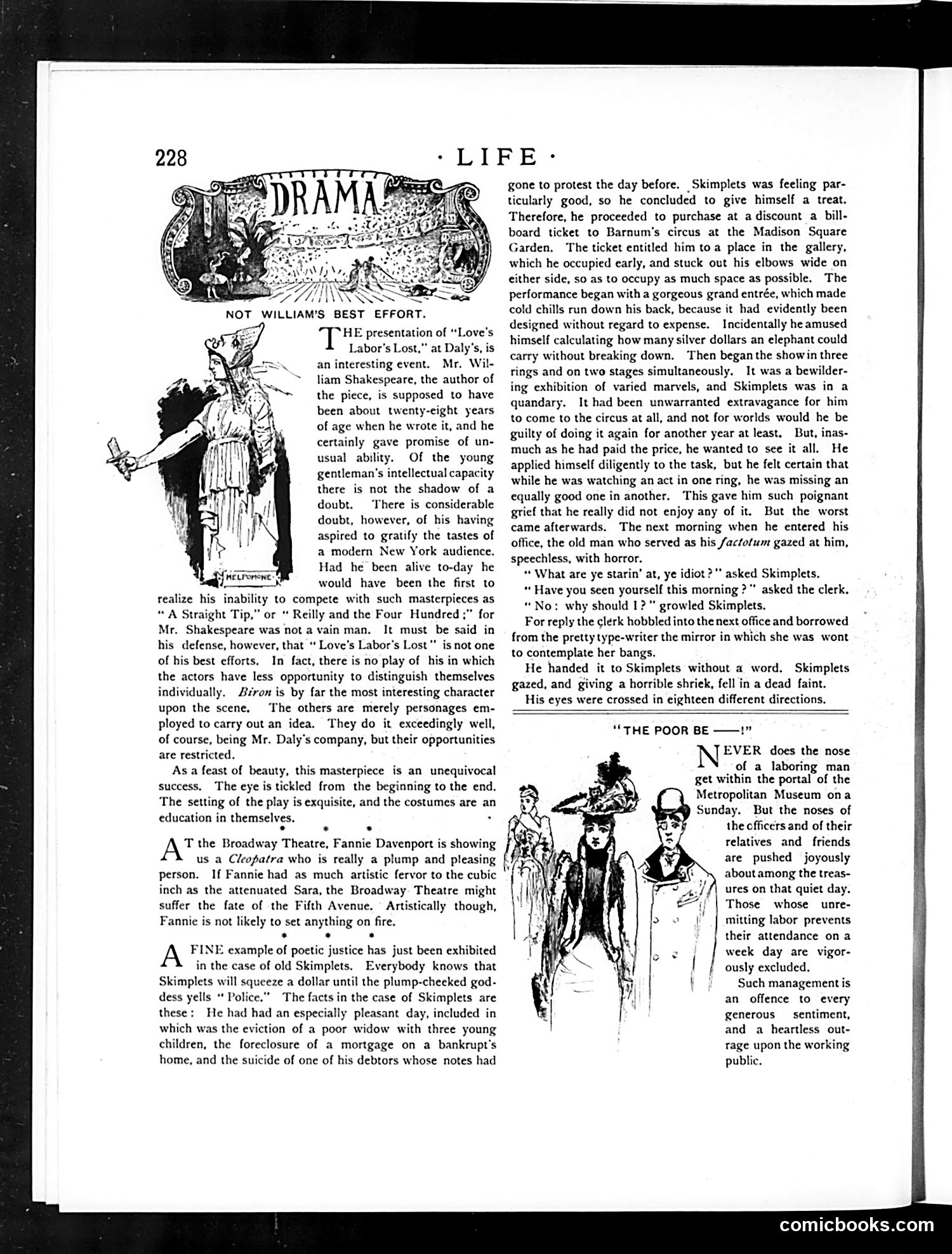
This page satirizes contemporary theater and a miserly character named Skimplets. The first section mocks a production of Shakespeare's "Love's Labor's Lost" at Daly's Theatre, sarcastically praising Shakespeare as a promising young author while suggesting his play couldn't compete with modern Broadway hits like "A Straight Tip" or "Reilly and the Four Hundred"—likely contemporary popular comedies. The satire implies modern audiences prefer shallow commercial entertainment over Shakespeare. The second narrative satirizes greed and miserliness through Skimplets, a ruthless creditor who evicts poor widows and forecloses mortgages. When he finally treats himself to a Barnum circus ticket (the famous P.T. Barnum's spectacle), his penny-pinching anxiety ruins the experience—he obsesses over money while watching, unable to enjoy himself. The final section criticizes museum policies that exclude working-class visitors on weekdays, calling it heartless discrimination against laborers.
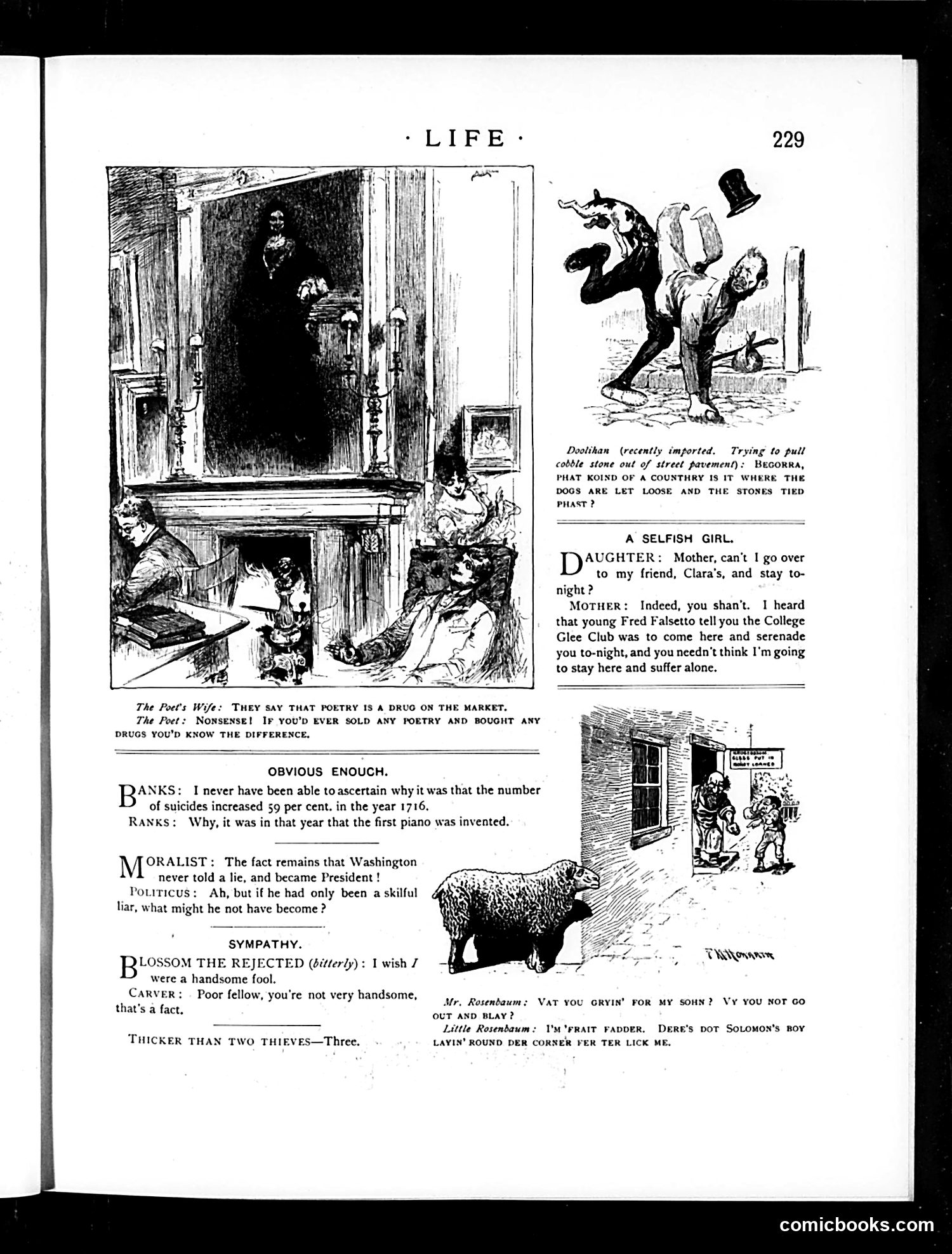
This page contains several short satirical jokes typical of early Life magazine humor: **"A Selfish Girl"** mocks a mother who won't let her daughter visit a friend because she wants to enjoy a serenade from a college glee club herself—prioritizing entertainment over her child's social life. **"Obvious Enough"** jokes that suicides increased when the piano was invented, implying pianos drive people to despair (likely mocking both excessive sentimentality in music and the instrument's popularity). **"The Poet's Wife"** puns on "drug on the market" (unsellable), suggesting poetry sales are as worthless as actual drugs. **"Moralist vs. Politicus"** cynically contrasts Washington's honesty against political success, implying dishonesty is necessary for advancement. The remaining sketches mock Irish immigrants ("Doothian"), rejected suitors, and Yiddish-speaking Jewish immigrants through dialect humor. The cartoons reflect period attitudes—crude ethnic stereotyping mixed with social observation about class, courtship, and artistic failure.
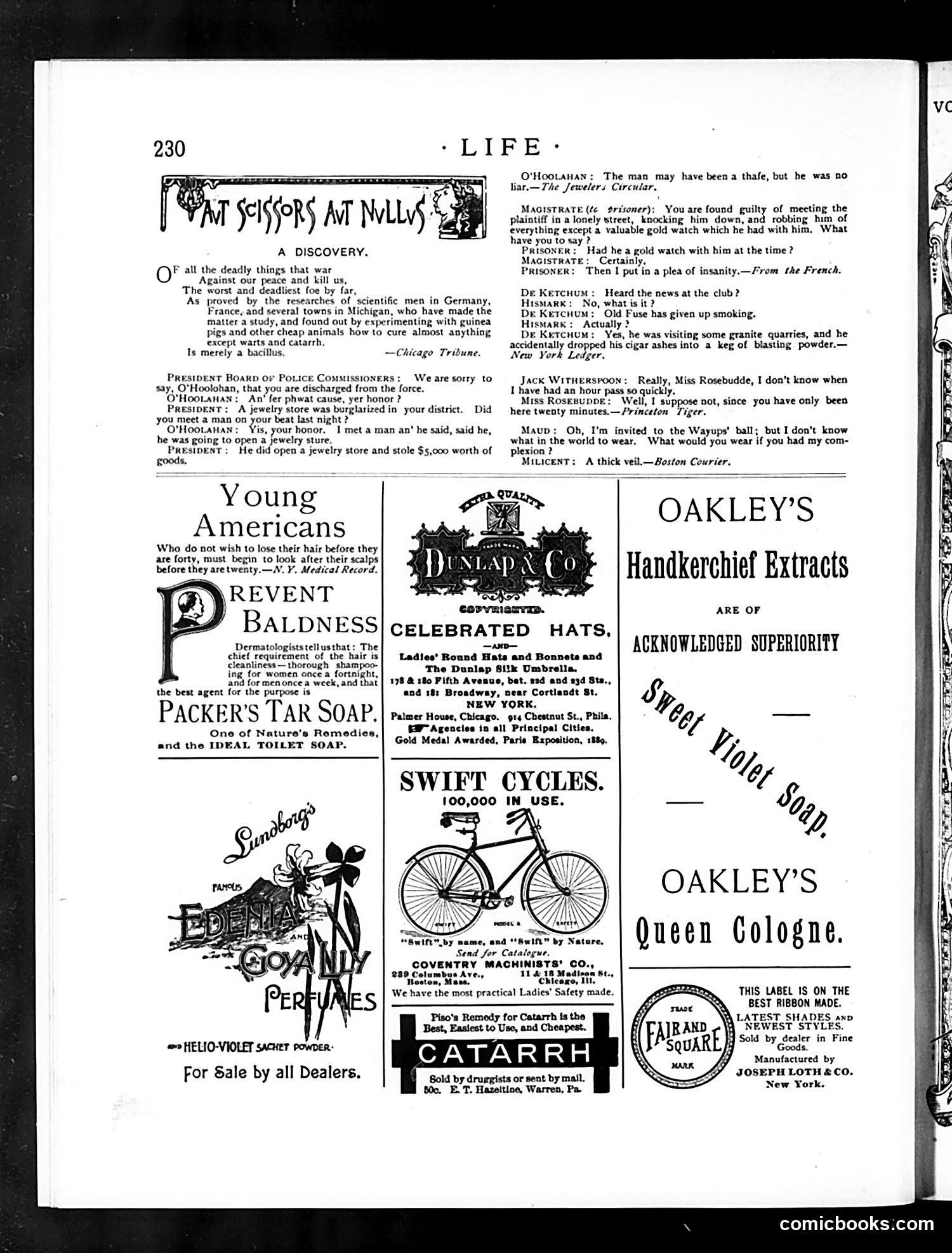
This page contains multiple brief satirical jokes typical of *Life* magazine's humor, interspersed with period advertisements. **Main cartoons/jokes:** 1. **"Pat Scissors at Nulls"** – A joke about a bacillus (germ) being humanity's deadliest enemy, referencing contemporary scientific research. 2. **O'Hoolahan police story** – An Irish-accented officer is fired after a jewelry store robbery in his district. The humor: he'd warned the burglar was "going to open a jewelry store" but didn't arrest him, taking the man at his word. The punchline emphasizes the absurdity—the thief may be a criminal, but at least he wasn't a liar. 3. **Additional short jokes** follow similar patterns: a magistrate can't prosecute a robbery if the victim still possessed the stolen watch; a man drops a cigar into blasting powder; social awkwardness between young people. **Context:** These represent *Life*'s typical style—brief, absurdist humor often playing on logical contradictions or ethnic stereotypes (note the Irish dialect). The advertisements reflect 1890s consumer goods and patent medicines.