
Life, 1891-04-09 · page 12 of 14
Life — April 9, 1891 — page 12: what you’re looking at
What you’re looking at
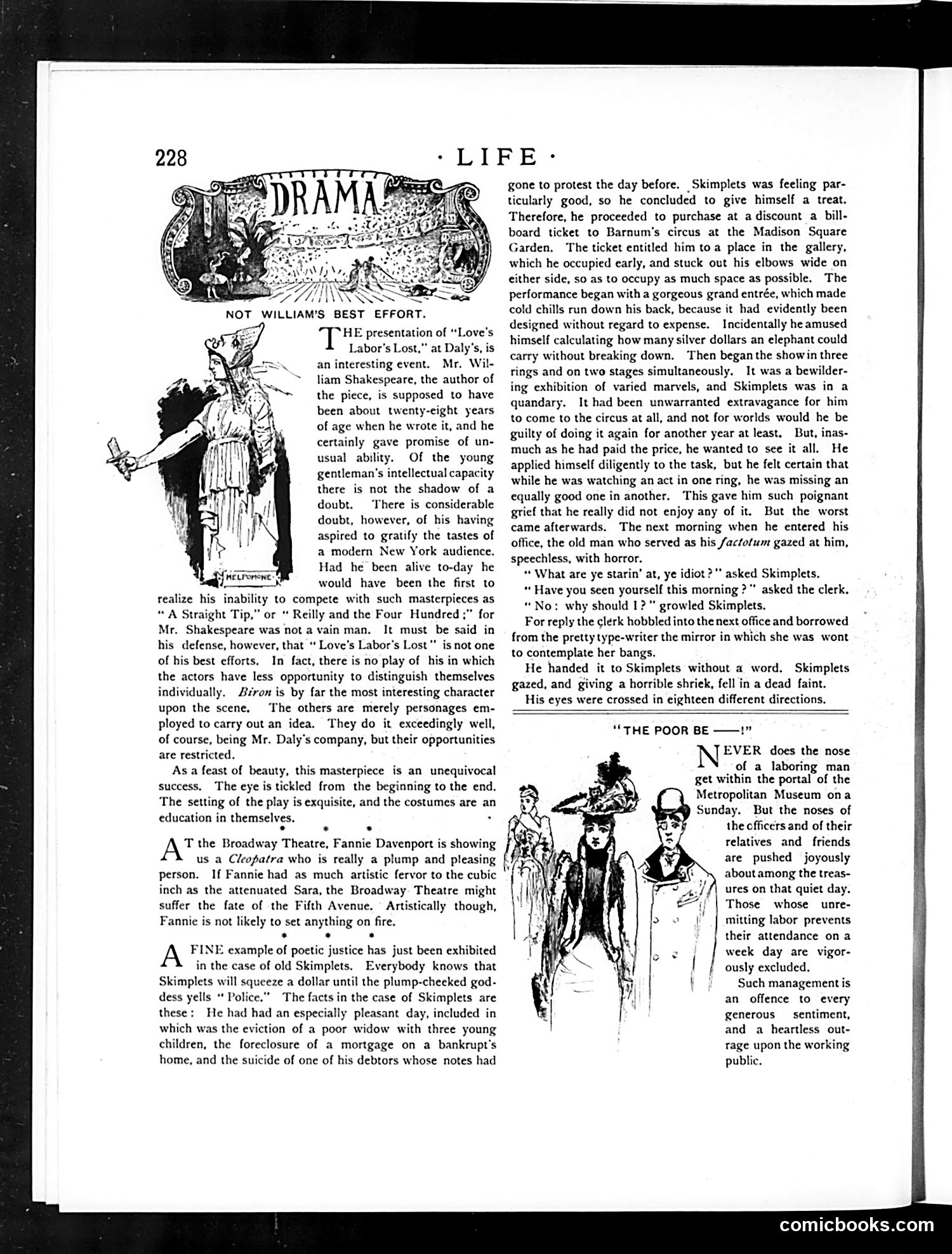
This page satirizes contemporary theater and a miserly character named Skimplets. The first section mocks a production of Shakespeare's "Love's Labor's Lost" at Daly's Theatre, sarcastically praising Shakespeare as a promising young author while suggesting his play couldn't compete with modern Broadway hits like "A Straight Tip" or "Reilly and the Four Hundred"—likely contemporary popular comedies. The satire implies modern audiences prefer shallow commercial entertainment over Shakespeare. The second narrative satirizes greed and miserliness through Skimplets, a ruthless creditor who evicts poor widows and forecloses mortgages. When he finally treats himself to a Barnum circus ticket (the famous P.T. Barnum's spectacle), his penny-pinching anxiety ruins the experience—he obsesses over money while watching, unable to enjoy himself. The final section criticizes museum policies that exclude working-class visitors on weekdays, calling it heartless discrimination against laborers.
📄 Transcribed text from this page (OCR, searchable)
Machine-transcribed from the original scan — historical spelling and the odd misread are preserved.
-LIFE: HE presentation of “Love's Labor's Lost,” at Daly's, is an interesting event. Mr. Wil- liam Shakespeare, the author of the piece, is supposed to have been about twenty-eight years of age when he wrote it, and he certainly gave promise of un- usual ability. Of the young gentleman's intellectual capacity there is not the shadow of a doubt. There is considerable doubt, however, of his having aspired to gratify the tastes of a modern New York audience. Had he been alive to-day he would have been the first to realize his inability to compete with such masterpieces as “ A Straight Tip,” or “ Reilly and the Four Hundred ;” for Mr. Shakespeare was not a vain man. It must be said in his defense, however, that “ Love's Labor's Lost" is not one of his best efforts. In fact, there is no play of his in which the actors have less opportunity to distinguish themselves individually. Bsron is by far the most interesting character upon the scene, The others are merely personages em- ployed to carry out an idea. They do it exceedingly well, of course, being Mr. Daly's company, but their opportunities are restricted. As a feast of beauty, this masterpiece is an unequivocal success, The eye is tickled from the beginning to the end. The setting of the play is exquisite, and the costumes are an education in themselves. . . . T the Broadway Theatre, Fannie Davenport is showing us a Cleopatra who is really a plump and pleasing person. If Fannie had as much artistic fervor to the cubic inch as the attenuated Sara, the Broadway. Theatre might suffer the fate of the Fifth Avenue, Artistically though, Fannie is not likely to set anything on fire. . * . FINE example of poetic justice has just been exhibited in the case of old Skimplets. Everybody knows that Skimplets will squeeze a dollar until the plump-cheeked god- dess yells “Police.” The facts in the case of Skimplets are these: He had had an especially pleasant day, included in which was the eviction of a poor widow with three young children, the foreclosure of a mortgage on a bankrupt’s home, and the suicide of one of his debtors whose notes had gone to protest the day before. Skimplets was feeling par- ticularly good, so he concluded to give himself a treat. Therefore, he proceeded to purchase at a discount a bill- board ticket to Barnum’s circus at the Madison Square Garden, The ticket entitled him toa place in the gallery, which he occupied early, and stuck out his elbows wide on either side, so as to occupy as much space as possible. The performance began with a gorgeous grand entrée, which made cold chills run down his back, because it had evidently been designed without regard to expense. Incidentally he amused himself calculating how many silver dollars an elephant could carry without breaking down. Then began the showin three rings and on two stages simultaneously. It was a bewilder- ing exhibition of varied marvels, and Skimplets was in a quandary. It had been unwarranted extravagance for him to come to the circus at all, and not for worlds would he be guilty of doing it again for another year at least. But, inas- much as he had paid the price, he wanted to see it all. He applied himself diligently to the task, but he felt certain that while he was watching an act in one ring, he was missing an equally good one in another. This gave him such poignant grief that he really did not enjoy any of it. But the worst came afterwards. The next morning when he entered his office, the old man who served as his factofum gazed at him, speechless, with horror. “What are ye starin’ at, ye idiot ?"* asked Skimplets. “ Have you seen yourself this morning ?" asked the clerk. “No: why should 1?” growled Skimplets. For reply the clerk hobbled into the next office and borrowed from the pretty type-writer the mirror in which she was wont to contemplate her bangs. He handed it to Skimplets without a word. Skimplets gazed, and giving a horrible shriek, fell in a dead faint. His eyes were crossed in eighteen different directions, ‘*THE POOR BE ——!” EVER does the nose of a laboring man get within the portal of the Metropolitan Museum ona Sunday. But the noses of the officers and of their relatives and friends are pushed joyously about among the treas- ures on that quiet day. Those whose unre- mitting labor prevents their attendance on a week day are vigor- ously excluded, Such managementis an offence to every generous sentiment, and a heartless out- rage upon the working public. comicbooks.com