
Life, 1891-04-09 · page 6 of 14
Life — April 9, 1891 — page 6: what you’re looking at
What you’re looking at
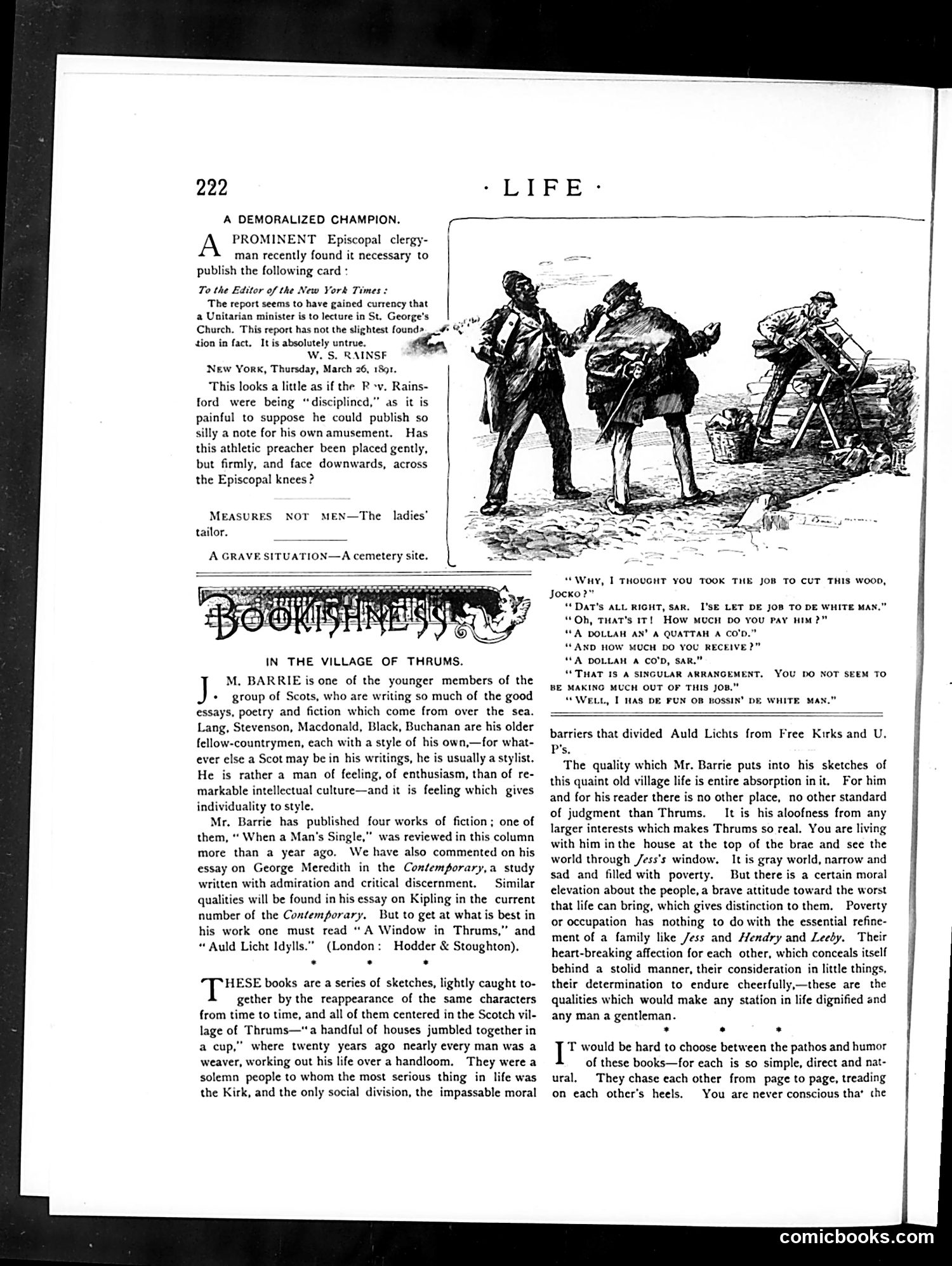
The page contains a book review of J.M. Barrie's sketches of village life in Thurums, Scotland. The illustration depicts three men in Scottish dress having a conversation about woodcutting wages—a scene exemplifying the working-class Scottish village characters Barrie depicted. The cartoon's humor hinges on a dialectical exchange about payment: a worker negotiates his fee while the employer establishes racial/social hierarchy ("white man's work"). This reflects late-19th-century attitudes about labor, class, and racial divisions—treating wage negotiations between working-class figures as inherently comedic material. The review praises Barrie's ability to capture moral dignity and affection among impoverished Scots, contrasting their poverty with their character and determination. The satire gently mocks both rural Scottish life and contemporary class pretensions.
📄 Transcribed text from this page (OCR, searchable)
Machine-transcribed from the original scan — historical spelling and the odd misread are preserved.
222 A DEMORALIZED CHAMPION. PROMINENT Episcopal clergy- man recently found it necessary to publish the following card : To the Editor of the New York Times: ‘The report seems to have gained currency that a Unitarian minister is to lecture in St. George's Church. This report has not the slightest founds tion in fact. It is absolutely untrue. W. S. RAINSF New York, Thursday, March 26, 1891. This looks a little as if the R -v. Rains- ford were being “disciplined,” as it is painful to suppose he could publish so silly a note for his own amusement. Has this athletic preacher been placed gently, but firmly, and face downwards, across the Episcopal knees? MEASURES NOT MEN—The ladies’ tailor. A GRAVE SITUATION—A cemetery si IN THE VILLAGE OF THRUMS. M. BARRIE is one of the younger members of the J * group of Scots, who are writing so much of the good essays, poetry and fiction which come from over the sea. Lang, Stevenson, Macdonald, Black, Buchanan are his older fellow-countrymen, each with a style of his own,—for what- ever else a Scot may be in his writings, he is usually a stylist. He is rather a man of feeling, of enthusiasm, than of re- markable intellectual culture—and it is feeling which gives individuality to style. Mr. Barrie has published four works of fiction; one of them, “ When a Man's Single,” was reviewed in this column more than a year ago. We have also commented on his essay on George Meredith in the Contemporary,a study written with admiration and critical discernment. Similar qualities will be found in his essay on Kipling in the current number of the Contemporary. But to get at what is best in his work one must read “A Window in Thrums,” and “ Auld Licht Idylls.” (London: Hodder & Stoughton). . . . HESE books are a series of sketches, lightly caught to- gether by the reappearance of the same characters from time to time, and all of them centered in the Scotch vil- lage of Thrums—‘‘a handful of houses jumbled together in a cup,” where twenty years ago nearly every man was a weaver, working out his life over a handloom. They were a solemn people to whom the most serious thing in life was the Kirk, and the only social division, the impassable moral “Why, I THOUGHT YoU TOOK THE JoB TO CUT THIS WooD, JocKxo?” “Dat's ALL RIGHT, SAR, I'SE LET DE JOB TO DE WHITE MAN.” “Oh, THAT's IT! How MUCH DO You Pay HIM?” “A DOLLAH AN’ A QUATTAH A CO'D. “AND HOW MUCH DO YOU RECEIVE?” “(A DOLLAH A CO'D, SAR.” ‘THAT IS A SINGULAR ARRANGEMENT, BE MAKING MUCH OUT OF THIS JOB." “WELL, I HAS DE FUN OB BOSSIN’ DE WHITE MAN.” You po NOT SEEM TO barriers that divided Auld Lichts from Free Kirks and U. P's, The quality which Mr. Barrie puts into his sketches of this quaint old village life is entire absorption in it, For him and for his reader there is no other place, no other standard of judgment than Thrums. It is his aloofness from any larger interests which makes Thrums so real. You are living with him inthe house at the top of the brae and see the world through Jess's window, It is gray world, narrow and sad and filled with poverty. But there is a certain moral elevation about the people, a brave attitude toward the worst that life can bring, which gives distinction to them. Poverty or occupation has nothing to do with the essential refine- ment of a family like Jess and Hendry and Leeby. Their heart-breaking affection for each other, which conceals itself behind a stolid manner, their consideration in little things, their determination to endure cheerfully,—these are the qualities which would make any station in life dignified and any man a gentleman. . . . T would be hard to choose between the pathos and humor of these books—for each is so simple, direct and nat- ural, They chase each other from page to page, treading on each other's heels. You are never conscious tha’ che comicbooks.com