
A complete issue · 14 pages · 1891
Life — April 2, 1891
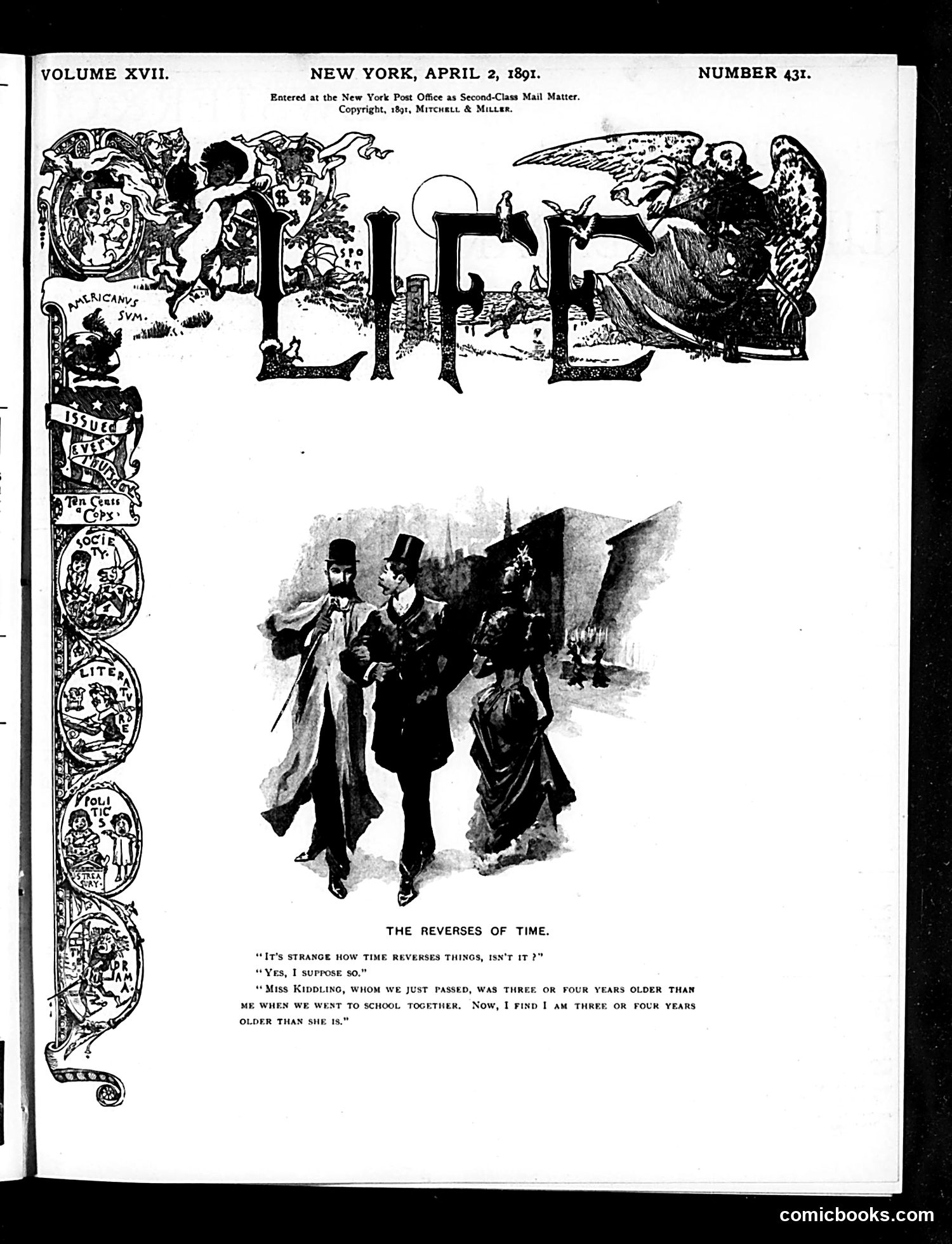
This satirical cartoon illustrates a social observation about aging and perception. Three fashionably dressed figures encounter each other on a city street. The dialogue explains the joke: the speaker remarks how strange it is that time reverses things—specifically, that Miss Kidling, who was three or four years *older* than the speaker in school, now appears three or four years *younger*. The humor targets vanity and the visible effects of aging. The implication is that Miss Kidling has likely used cosmetics, fashion, or other means to artificially reduce her apparent age, creating an ironic "reversal" where she now looks younger than her former schoolmate despite being chronologically older. It's a commentary on women's efforts to maintain youthful appearance.
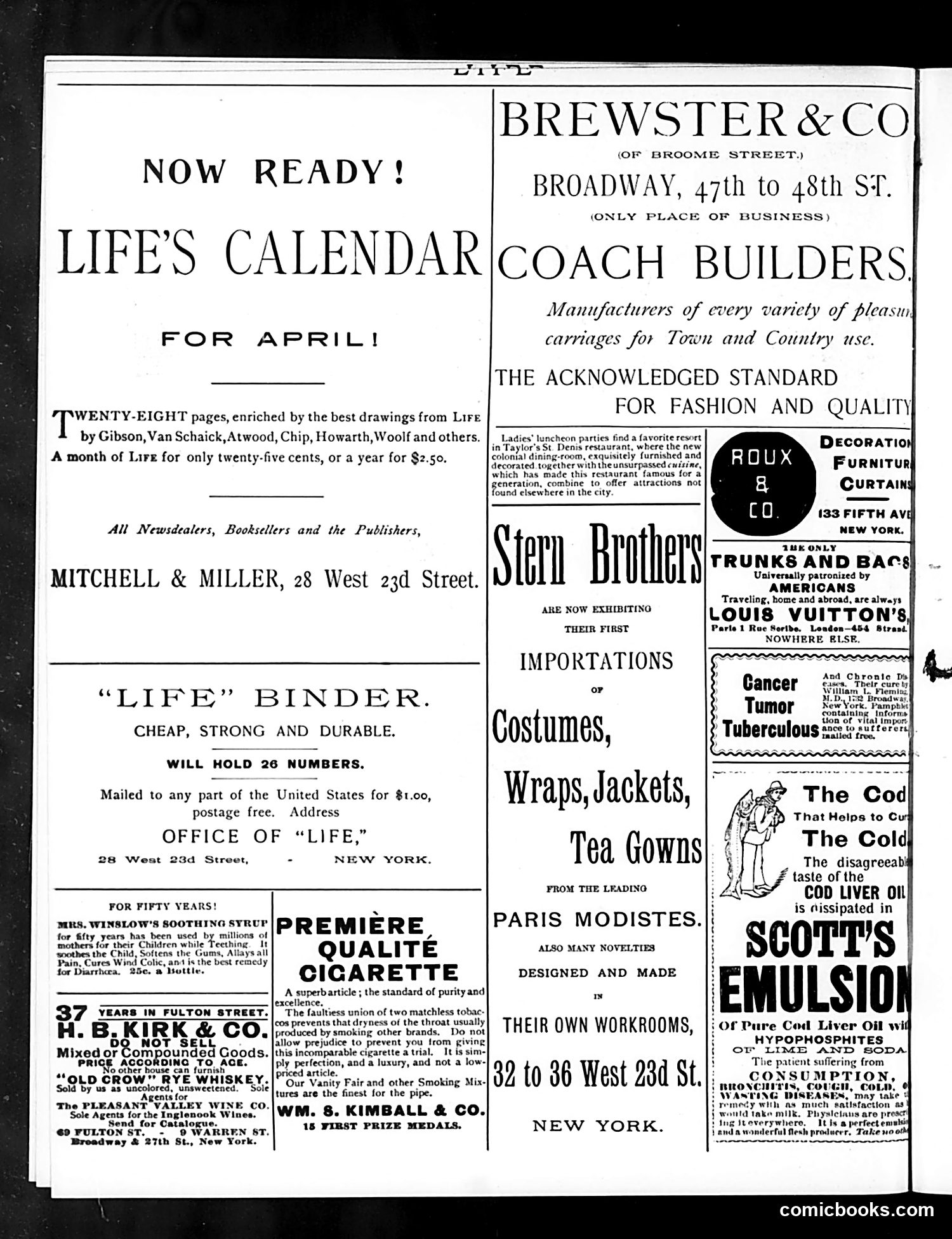
This page is **primarily advertising** with no discernible political cartoons or satirical content. The left column advertises Life magazine's April calendar (28 pages with drawings), a Life binder, and Mrs. Winslow's Soothing Syrup (a 19th-century infant sedative). The right side features commercial advertisements: Brewster & Co. (coach builders), Stern Brothers (costume importers), Roux & Co. (furniture), Louis Vuitton (trunks), and Scott's Emulsion (cod liver oil patent medicine). The only illustrated element is a small figure advertising Scott's Emulsion, but it's a generic product image rather than political or social commentary. This appears to be a standard magazine back page devoted entirely to commercial promotion, typical of period publications that subsidized content through advertising revenue.
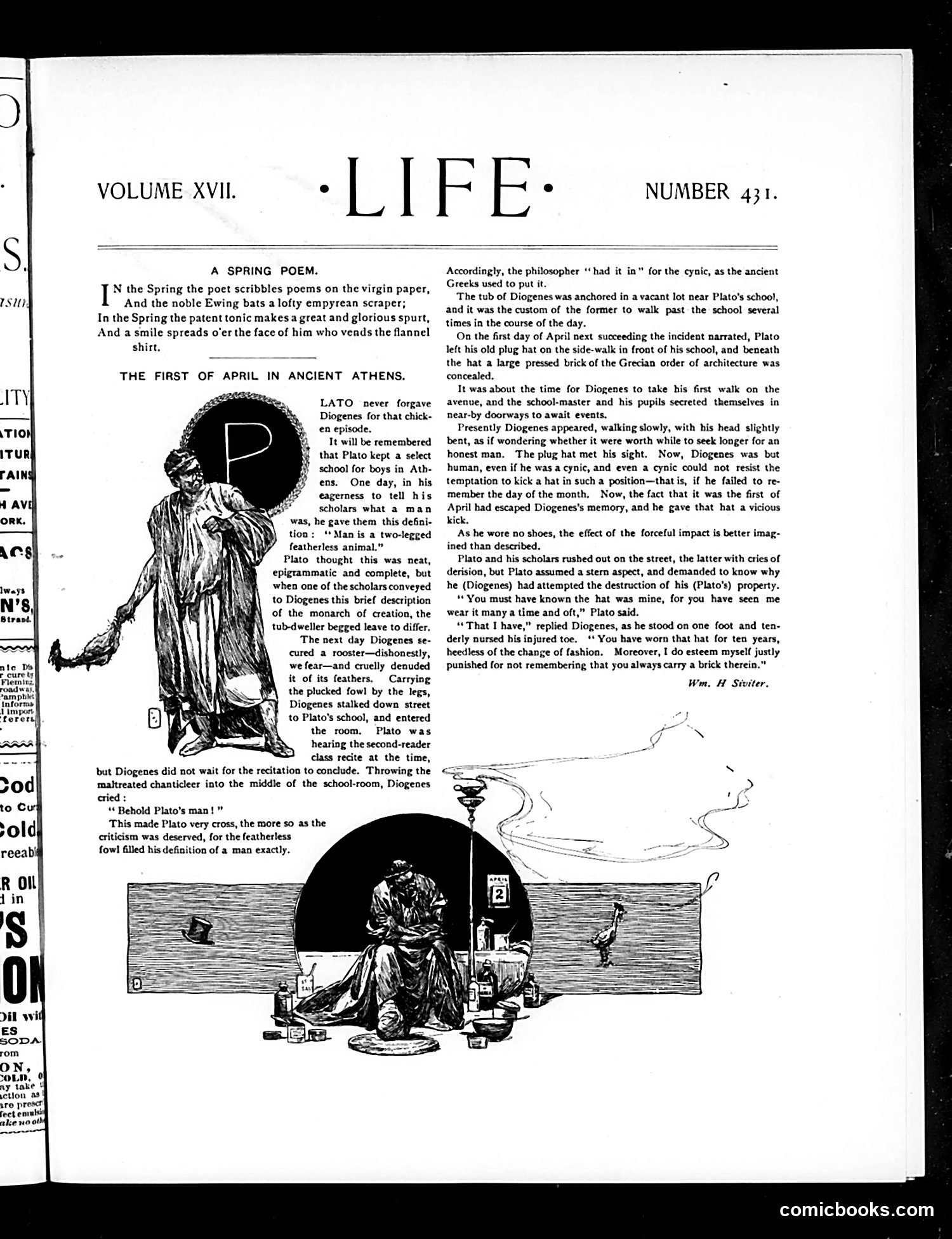
This is a humorous spring poem about an April Fools' Day prank in ancient Athens. The narrative describes Plato's student Diogenes, who famously kept a rooster at Plato's school, playing a trick: he plucks the rooster's feathers and releases it in the schoolroom during Plato's lecture, interrupting proceedings. The joke satirizes philosophical pedantry. When Plato defines man as "a two-legged featherless animal," Diogenes triumphantly presents his plucked rooster as proof the definition is inadequate—it technically fits Plato's description despite clearly not being human. The accompanying illustrations show Diogenes with the plucked bird and a contemplative figure by the sea, visualizing the classical anecdote as light spring entertainment for *Life* magazine's readers.
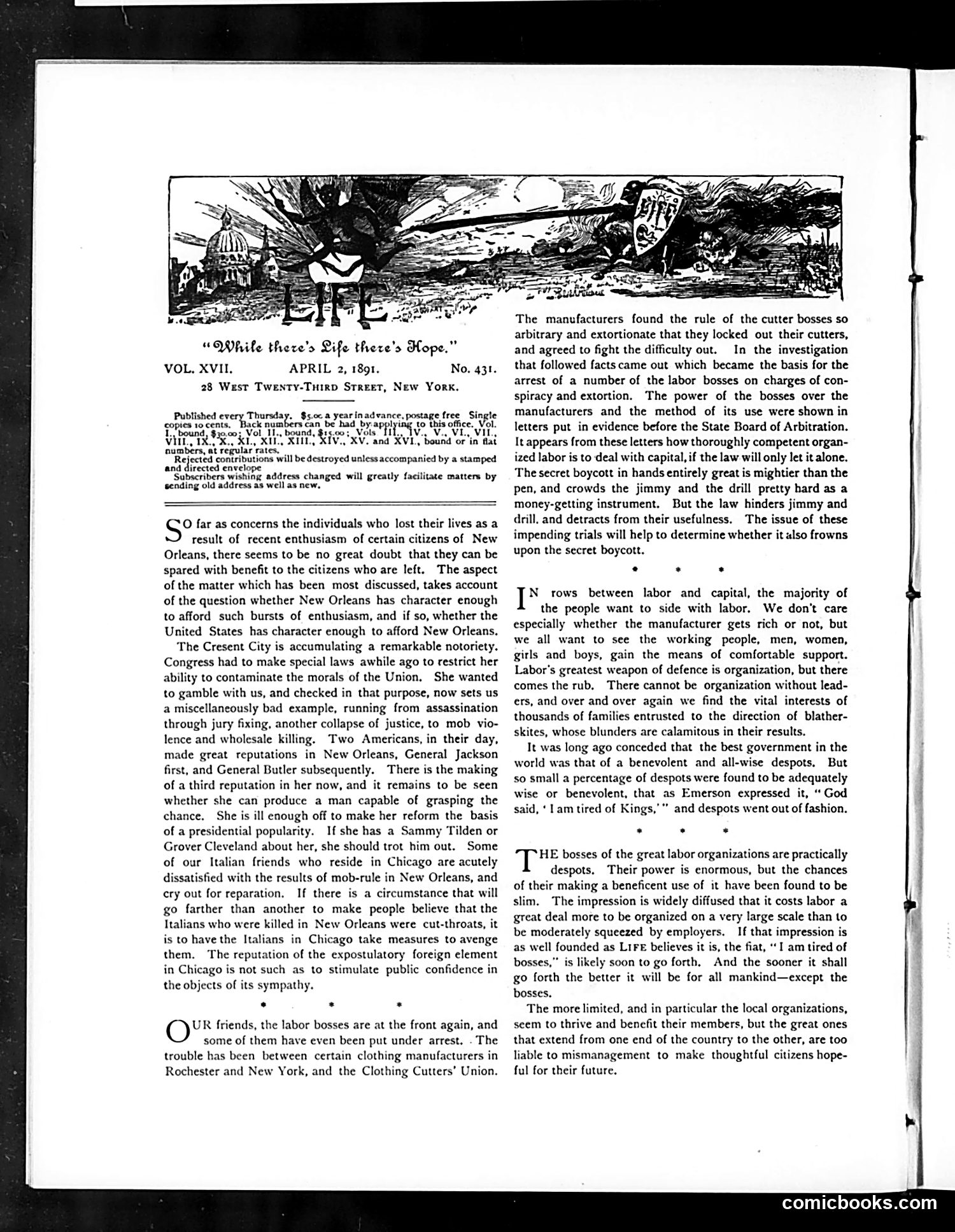
The cartoon's banner "While there's Life there's Hope" ironically frames an article about recent labor violence, likely referencing deaths in New Orleans. The illustration depicts industrial conflict with dramatic imagery suggesting upheaval and destruction. The accompanying text critiques both labor bosses and manufacturers. It discusses how "cutter bosses" controlled workers through arbitrary rules, leading to labor disputes and arrests in Rochester and New York's clothing industry. The article condemns secret boycotts as ineffective while acknowledging labor's legitimate grievances about working conditions and fair wages. The piece appears skeptical of both sides—criticizing labor bosses' despotic power while questioning whether violent confrontation serves workers' interests. It advocates for worker organization as labor's "greatest weapon of defence" against exploitation.
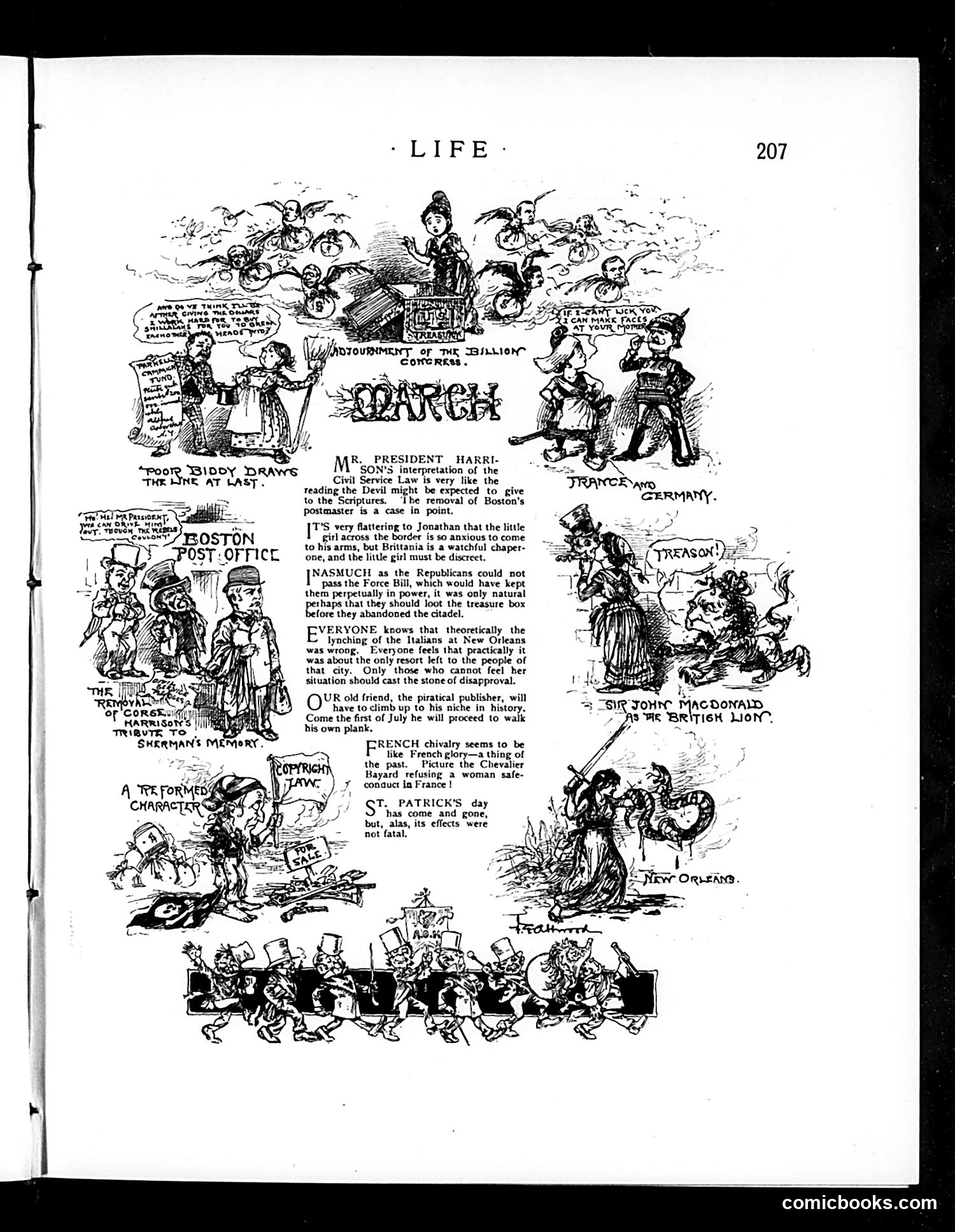
This page satirizes early-1900s political and diplomatic events through interconnected cartoons: **"Indictment of the Billion Congress"** mocks wasteful spending by Congress members depicted as devils/demons. **Civil Service Law critique**: The text references President Harrison's interpretation of civil service reforms, comparing it to "giving the Devil a reading desk"—suggesting the law's implementation was ineffective or hypocritical. **Regional commentary**: Separate vignettes mock various American locations (Boston Post Office, New Orleans, Irish situations) for political corruption or mismanagement. **International references**: France, Germany, and Britain appear as characters, likely commenting on diplomatic tensions. The overarching theme criticizes government inefficiency, corruption, and failed reforms across multiple levels—Congress, civil service, and regional administrations—through satirical caricature and dark humor typical of Gilded Age political cartooning.
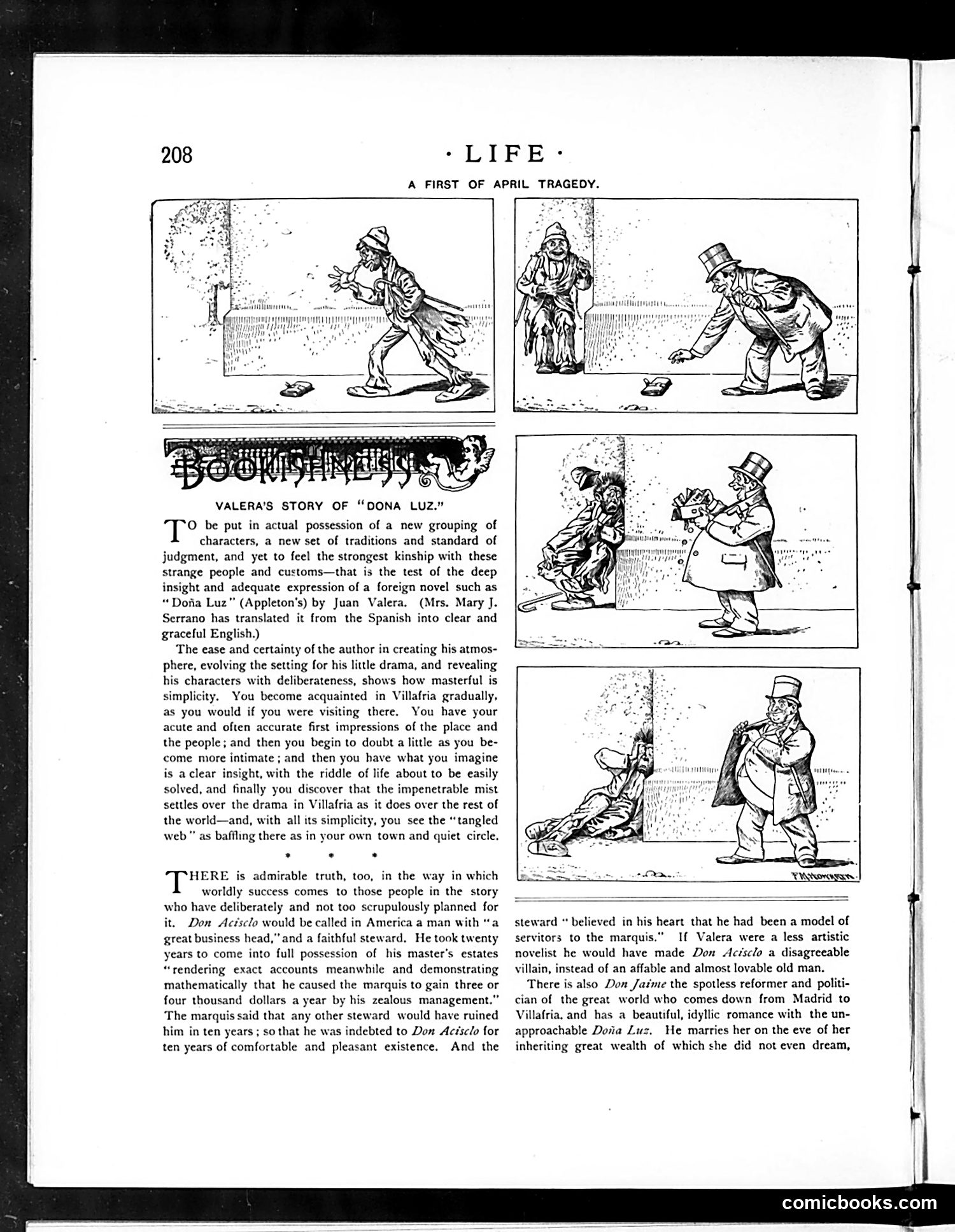
This is a humorous visual sequence (likely an April Fools' Day feature) depicting a practical joke gone wrong. The cartoon shows a man in a top hat repeatedly attempting to trick another character with what appears to be a "boomerang" or returning object—a classic prank device. The sequence progresses from the initial trick attempt, through the victim's confusion, to escalating comedic consequences as the object returns unexpectedly, hitting the prankster instead. The joke plays on the ironic reversal common to slapstick humor: the trickster becomes the victim of his own scheme. The accompanying text discusses Juan Valera's Spanish novel "Doña Luz," analyzing its literary merit and character development—unrelated to the cartoon's physical comedy.
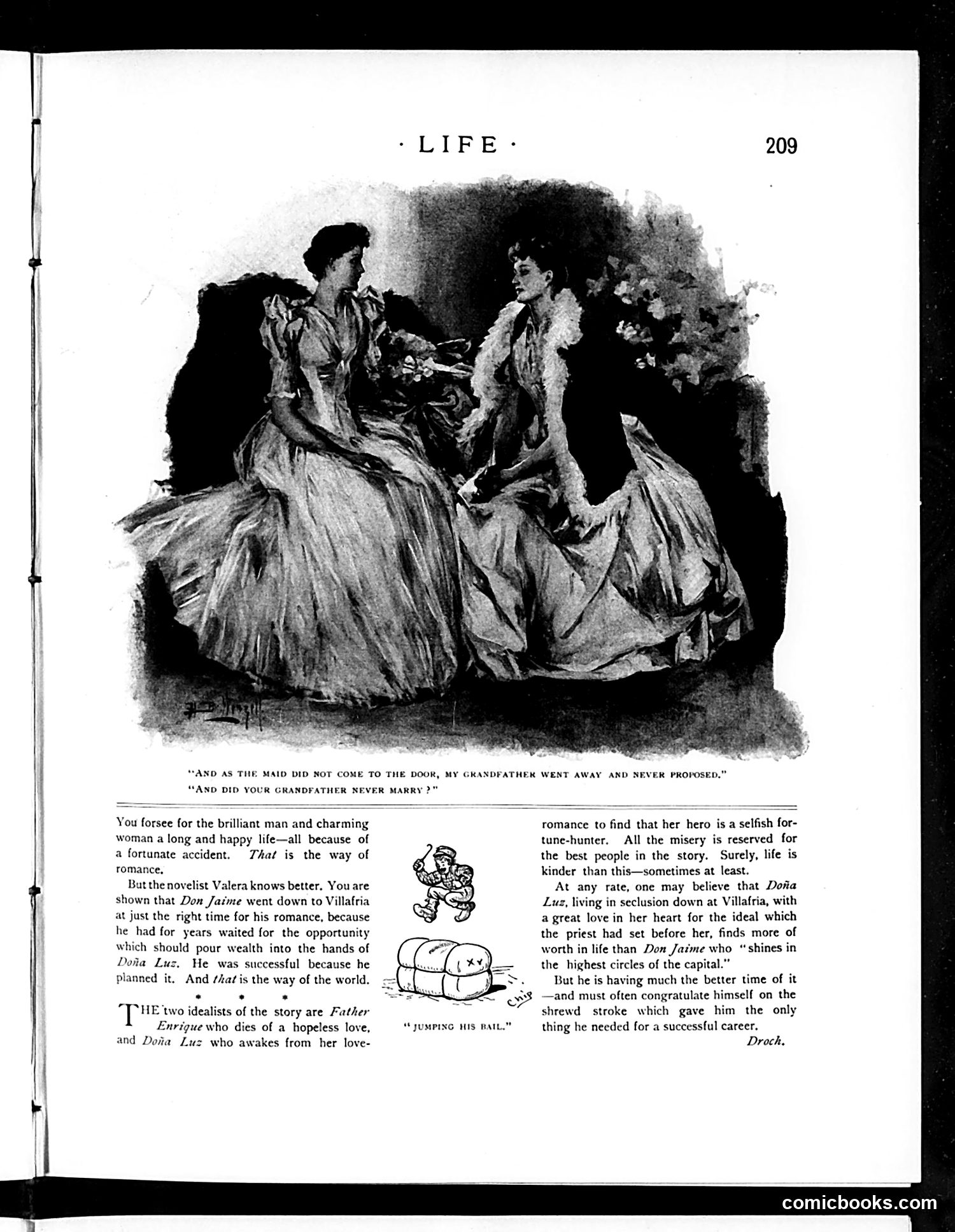
This page discusses literary romance and social class through references to fictional works. The main illustration shows two elegantly dressed women in conversation, captioned with dialogue about marriage proposals and grandfathers. The text critiques romantic fiction by contrasting two character archetypes: "Father Enrique" (who dies of hopeless love) and "Doña Luz" (who awakens from her lover-romance to find a better match). The author argues that novelist Valera presents a more realistic view than typical romance stories—the protagonist Doña Luz achieves happiness through a practical marriage into "the highest circles of the capital" rather than pursuing doomed romantic idealism. The satire mocks sentimental fiction conventions while praising pragmatic approaches to love and social advancement. The small illustration labeled "Jumping his Bail" appears to be a separate humorous cartoon, though its meaning is unclear without additional context.
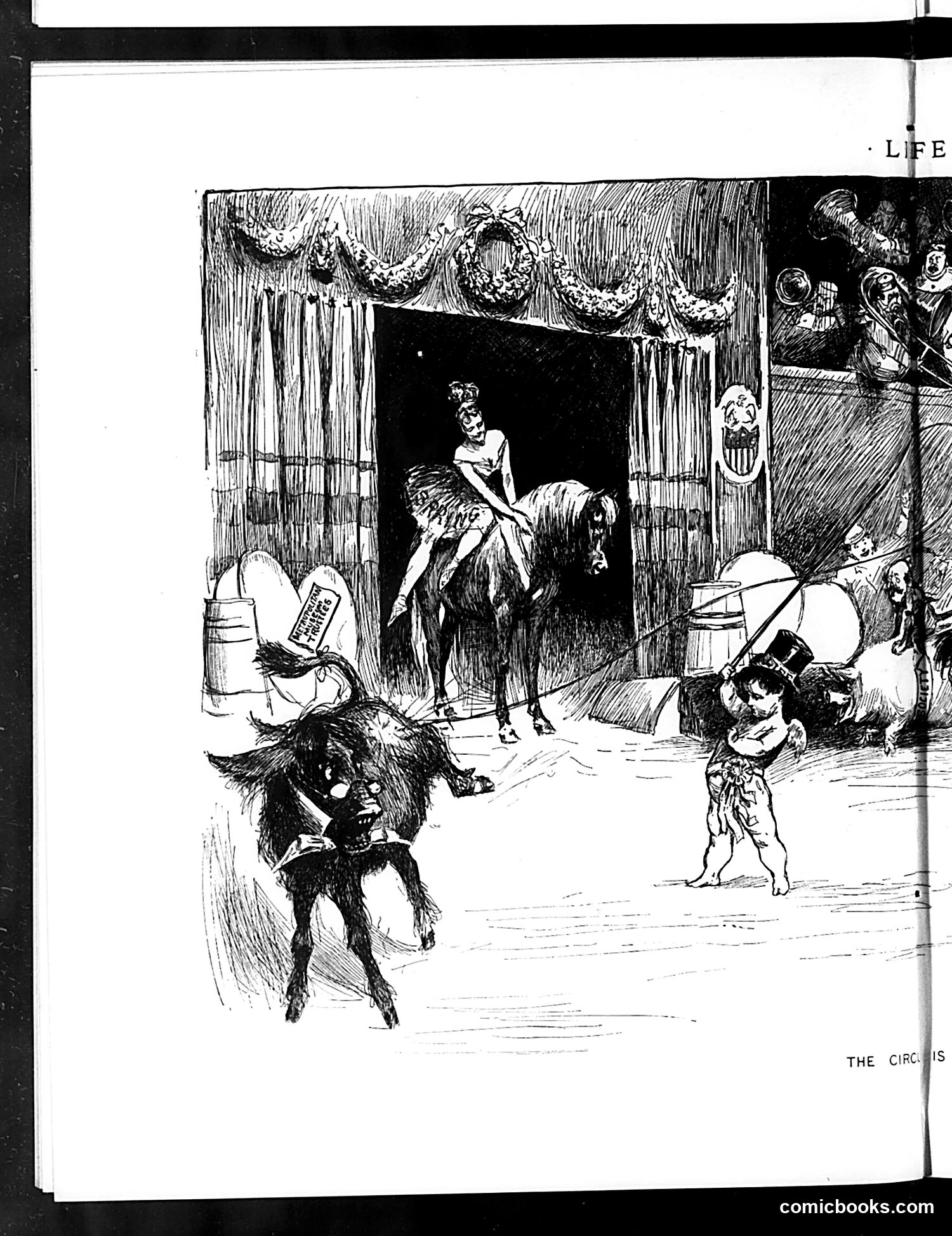
This illustration depicts a circus scene with a woman riding a horse emerging from an ornate tent entrance, while various circus performers and animals populate the ring below. A chimpanzee in formal attire appears prominently in the foreground, alongside other performers and what appear to be circus animals. The cartoon likely satirizes high society or theatrical performance, using the circus as a metaphor. The juxtaposition of the well-dressed woman on horseback with the costumed animals and performers suggests commentary on social pretension or the artificiality of fashionable entertainment. The formal dress of the chimp particularly emphasizes the absurdist humor—mocking those who parade themselves in elaborate settings. Without additional context or visible captions, the specific political or social target remains unclear, though the satire targets societal vanity and spectacle.
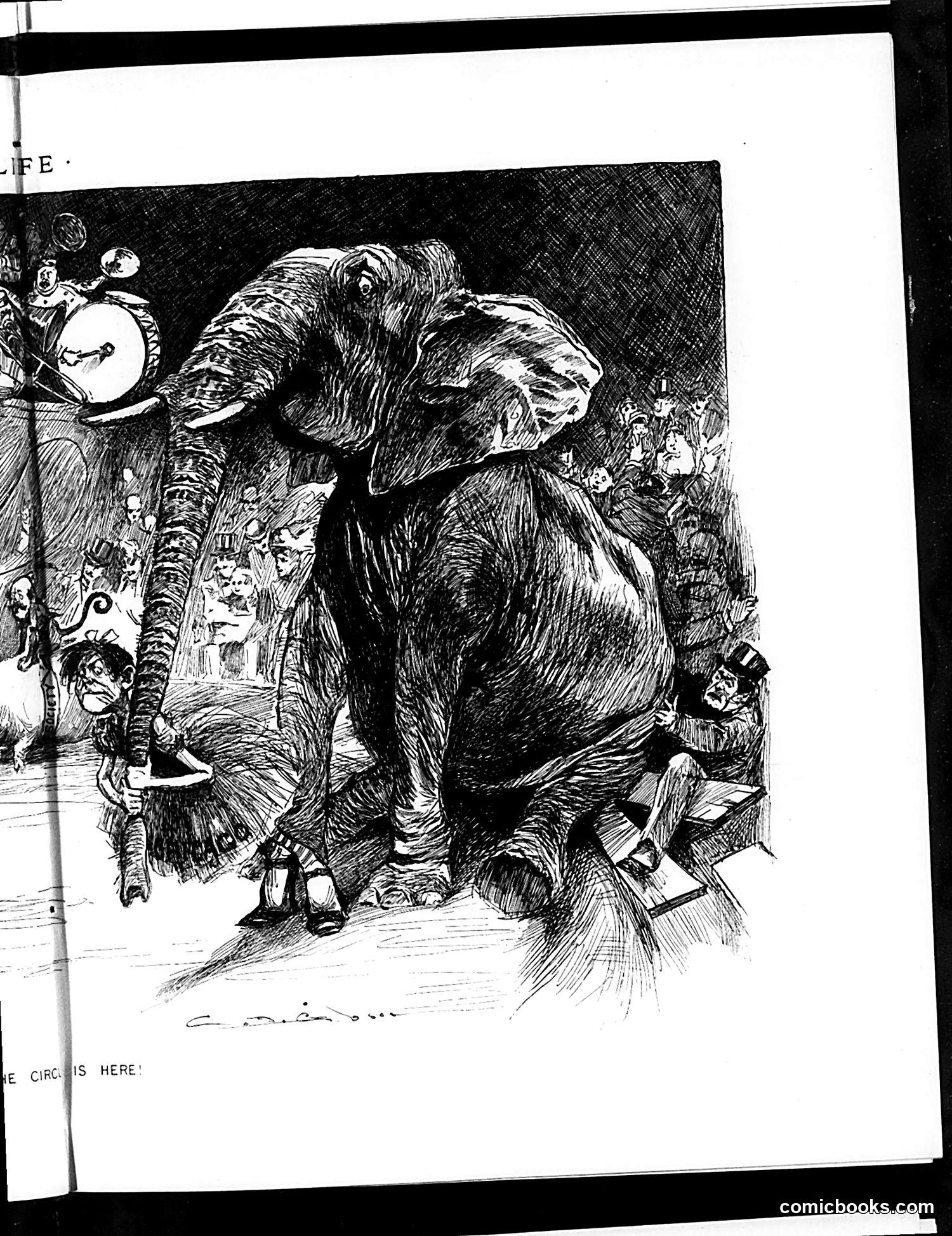
This political cartoon depicts a circus scene with an elephant as the central figure, surrounded by crowds and circus performers. The visible text fragments reference "THE CIRCUS IS HERE," suggesting this is satirical commentary on a major public event or spectacle. The elephant likely represents a political figure or party (the Republican Party traditionally uses the elephant as its symbol). The circus setting—complete with band, crowds, and performers—implies the subject is treating serious political matters as entertainment or theatrical performance. Without clearer text or date information, I cannot definitively identify which specific politician or event this targets, but the cartoon appears critical of someone conducting politics as public spectacle rather than serious governance.
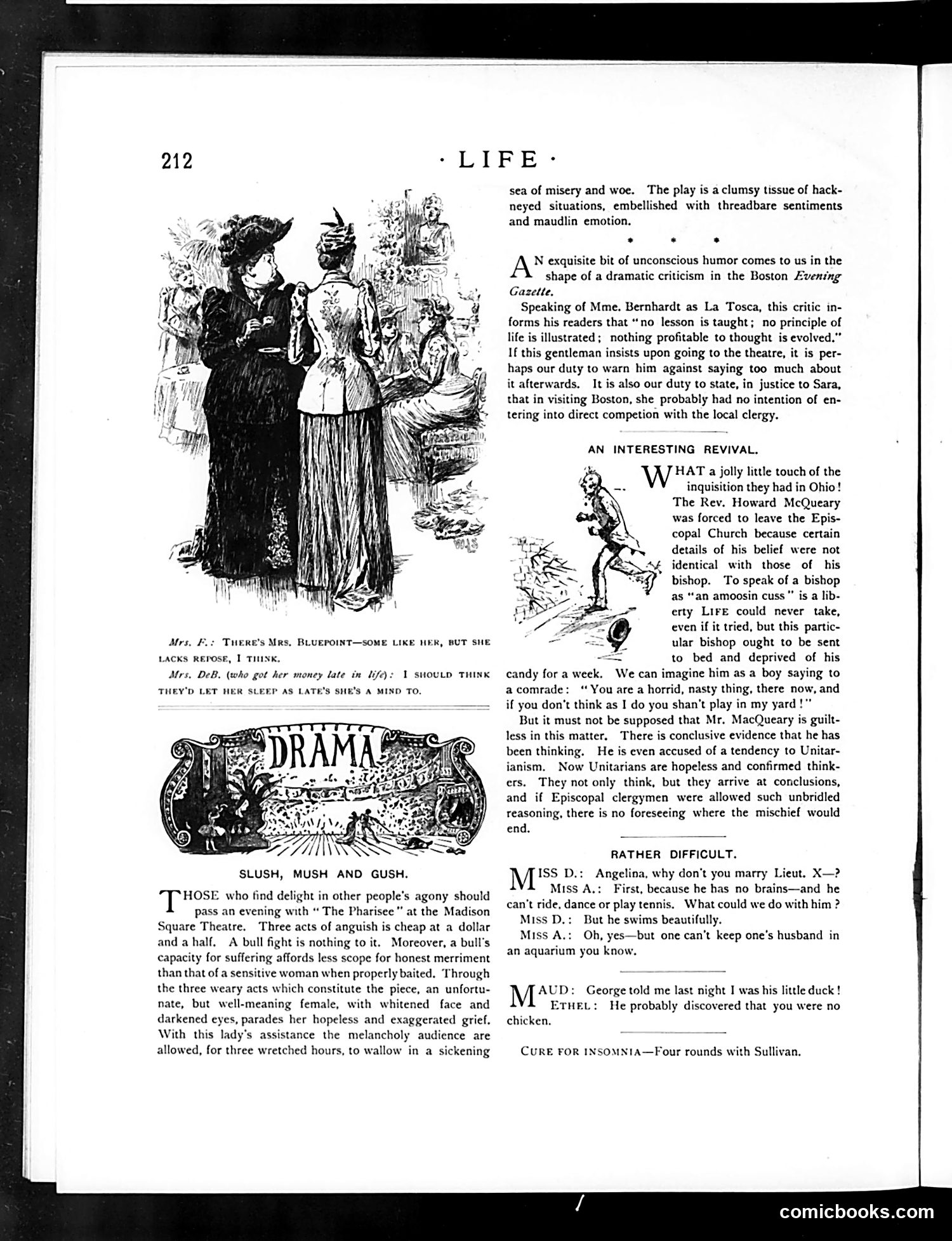
This page from *Life* magazine contains theater criticism and humorous social commentary rather than political cartoons. The main text critiques Mme. Bernhardt's performance as La Tosca, calling the play "clumsy" with "threadbare sentiments." There's also commentary on Rev. Howard McQueary being forced to leave the Episcopal Church over doctrinal disagreements with his bishop—satirizing as an "amusing cuss" the strict theological boundaries Unitarians supposedly lack. The bottom section contains joke exchanges about courtship and marriage—including jabs at a woman whose husband "swims beautifully" but can't ride or dance, and another about someone discovering their spouse has no brains. These are typical *Life* magazine humor pieces mocking social pretensions and romantic mismatches common to early 20th-century society.
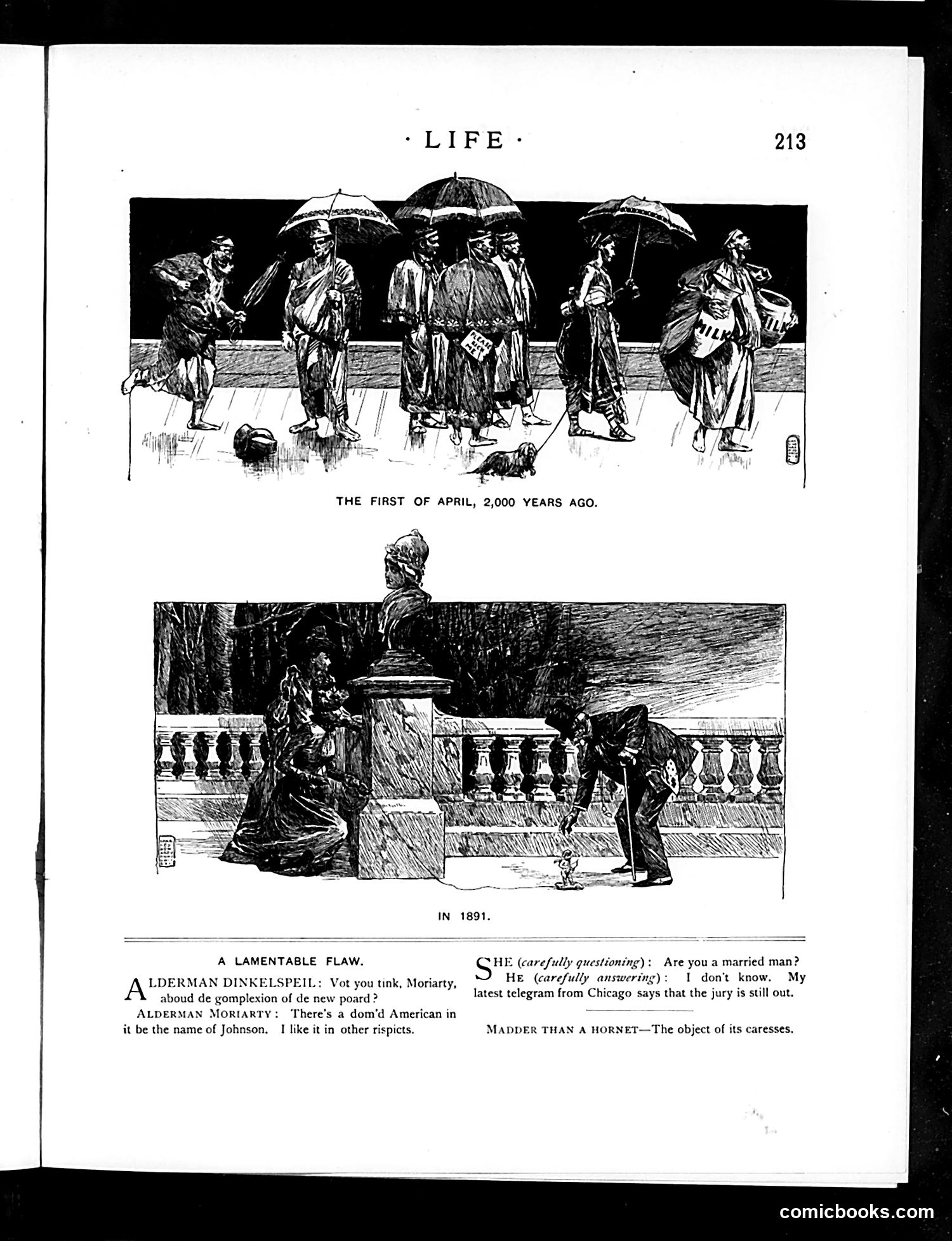
This page contains two satirical illustrations contrasting April Fools' Day customs across 2,000 years. The **top cartoon** depicts ancient Roman figures with umbrellas in a rainstorm, captioned "The First of April, 2,000 Years Ago." It suggests Romans practiced April Fools' pranks similarly to modern times. The **bottom illustration** shows a 19th-century scene (captioned "In 1891") with figures near a classical monument, representing contemporary American April Fools' observance. The accompanying text includes a brief joke about "A Lamentable Flaw," where characters Alderman Dinkelspeil and Alderman Moriarty discuss an unfamiliar term—suggesting confusion about modern American customs or language differences. The satire appears to mock how April Fools' traditions persist across centuries, or possibly critiques how Americans adopt or misunderstand foreign customs.
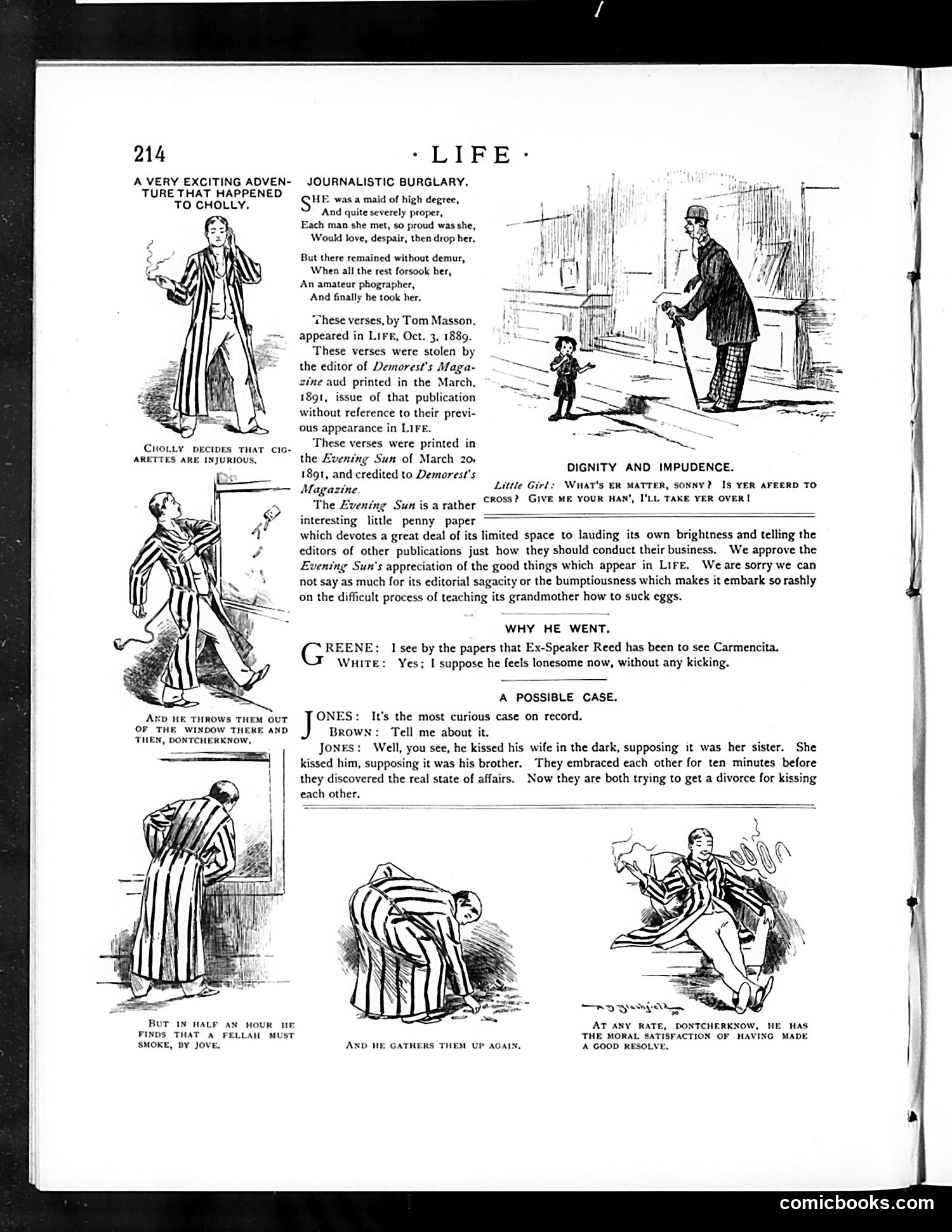
This page contains multiple satirical items from Life magazine (circa 1889-1891): **"Cholly" comic strip**: Mocks a wealthy, affected character ("Dontcherknow") who impulsively quits smoking for moral reasons, then immediately resumes—satirizing the weakness of upper-class affectation and willpower. **"Journalistic Burglary"**: Life calls out *Demorest's Magazine* and the *Evening Sun* for plagiarizing Tom Masson's poem without credit. Life sarcastically praises the Evening Sun's self-importance while mocking its hypocrisy and arrogance ("teaching its grandmother to suck eggs"—a period idiom meaning unnecessary instruction). **Other items**: Brief jokes about Ex-Speaker Reed visiting performer Carmencita, and a absurdist anecdote about a couple nearly divorcing after kissing each other in darkness—each mistaking the spouse for a sibling. The page exemplifies Life's approach: satirizing both wealthy pretension and journalistic dishonesty through humor and illustration.
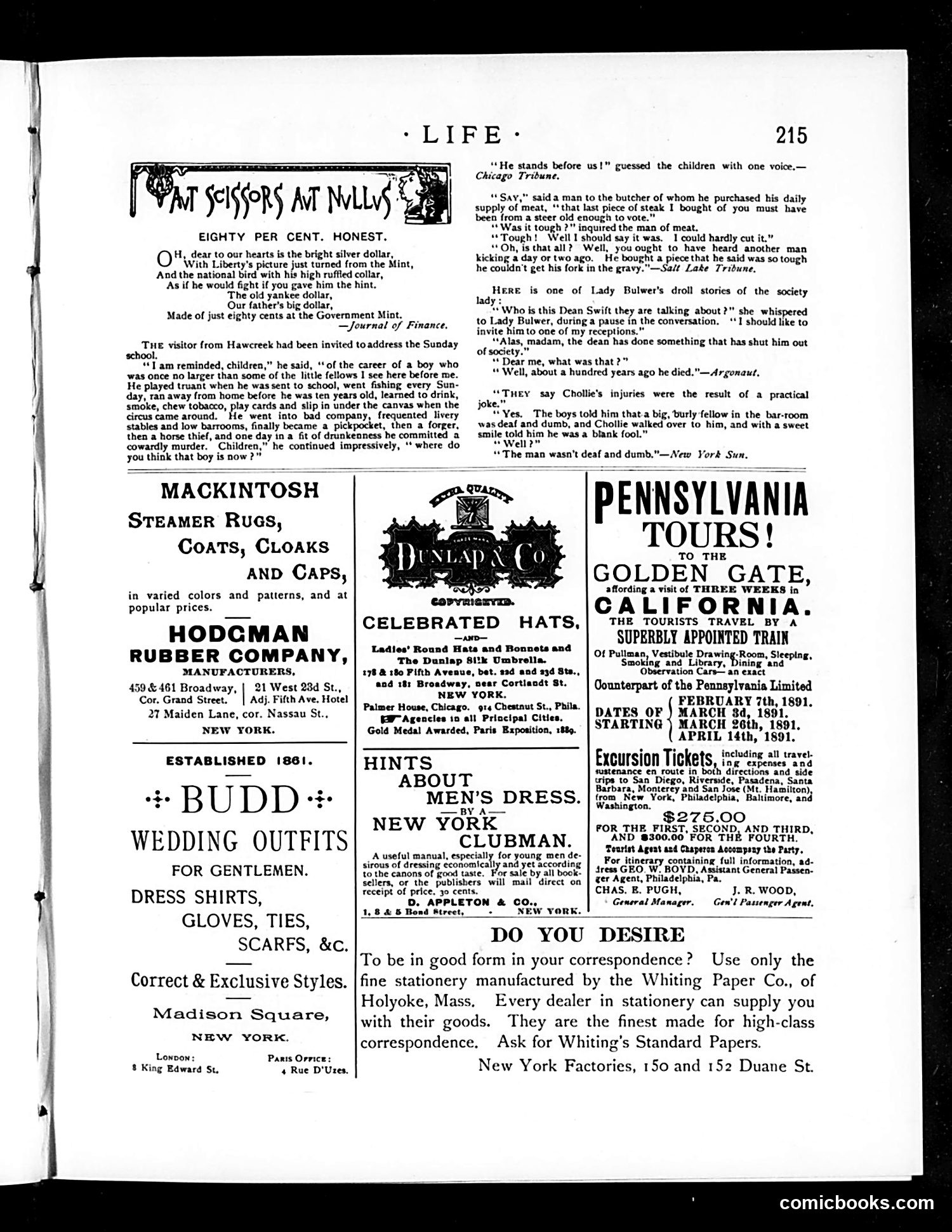
This page is primarily **advertisements and short humor pieces**, not a political cartoon. The small comic anecdotes satirize everyday absurdities: 1. **"Eighty Per Cent. Honest"** mocks U.S. currency, claiming silver dollars contain only 80 cents' worth of metal—a jab at monetary policy or mint practices. 2. **The Hawcreek Visitor** is a classic joke structure: a moralistic stranger lectures children about a boy's descent into crime, only for the children to realize he's describing *himself*. 3. **The Steak/Gravy joke** exaggerates toughness to absurd extremes—a fork can't penetrate gravy. 4. **Lady Bulwer anecdote** mocks social pretension: the society woman wants to invite Dean Swift (18th-century writer) without knowing he died a century prior. 5. **Chollie's Practical Joke** backfires when he insults someone he believed was deaf and dumb. The remaining content is period commercial advertising for clothing, stationery, and travel tours.
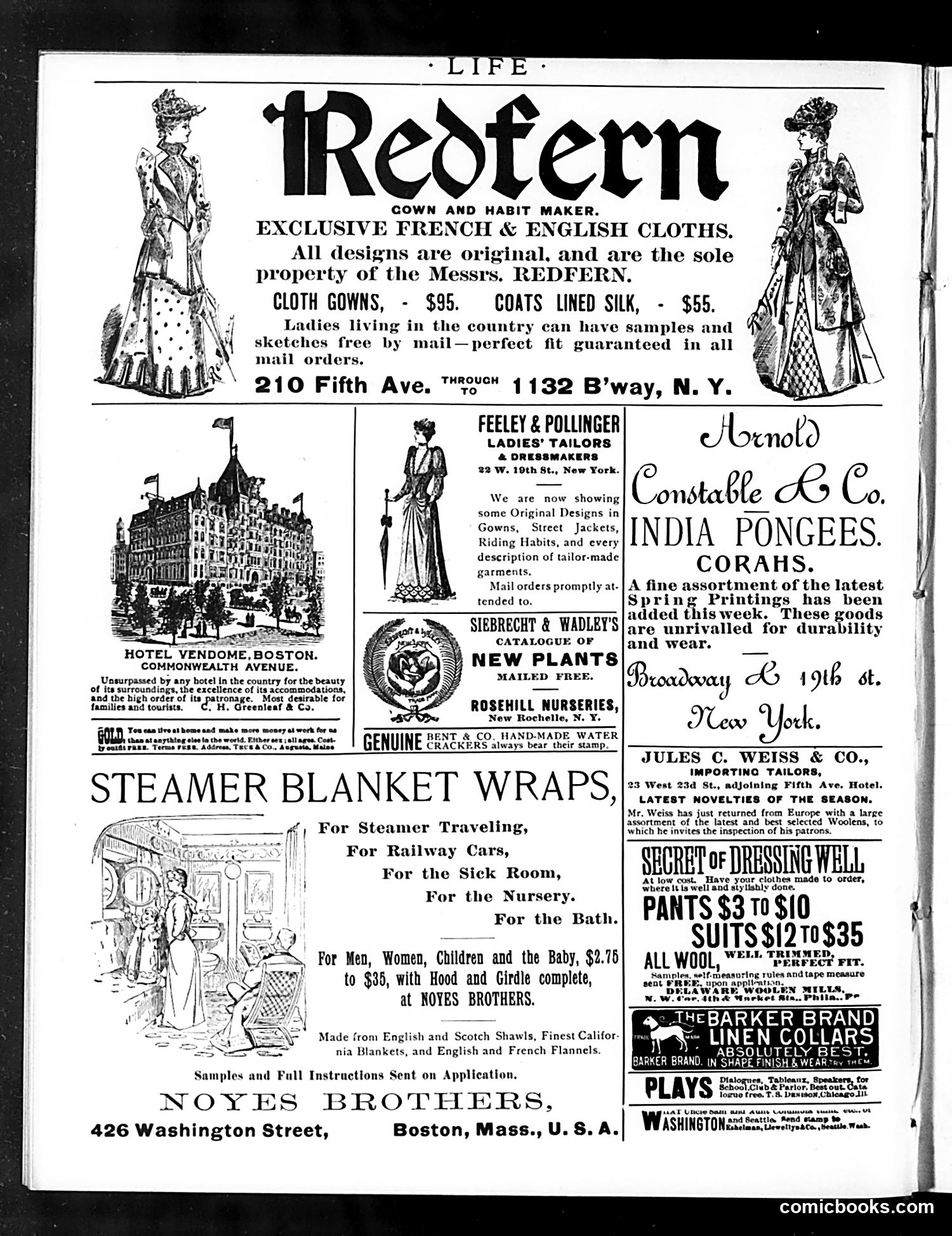
This page contains **no political cartoons or satirical content**. It is primarily a **commercial advertisement section** from Life magazine, likely from the early 1900s based on styling and fashion references. The page features numerous ads for: - **Fashion/tailoring**: Redfern gowns ($95), Jules C. Weiss tailoring, Secret of Dressing Well suits ($12-$35) - **Travel goods**: Steamer blanket wraps from Noyes Brothers - **Textiles**: India pongees and corahs from Constable & Co. - **Hotel/hospitality**: Hotel Vendome in Boston - **Miscellaneous**: Plant nurseries, linen collars, crackers The illustrations show women in period dress and the Hotel Vendome building, serving as promotional images rather than satirical commentary. **Modern context**: This reflects the economic focus and consumer culture of early 20th-century American magazines, where advertising revenue subsidized publication costs.