
Life, 1891-04-02 · page 3 of 14
Life — April 2, 1891 — page 3: what you’re looking at
What you’re looking at
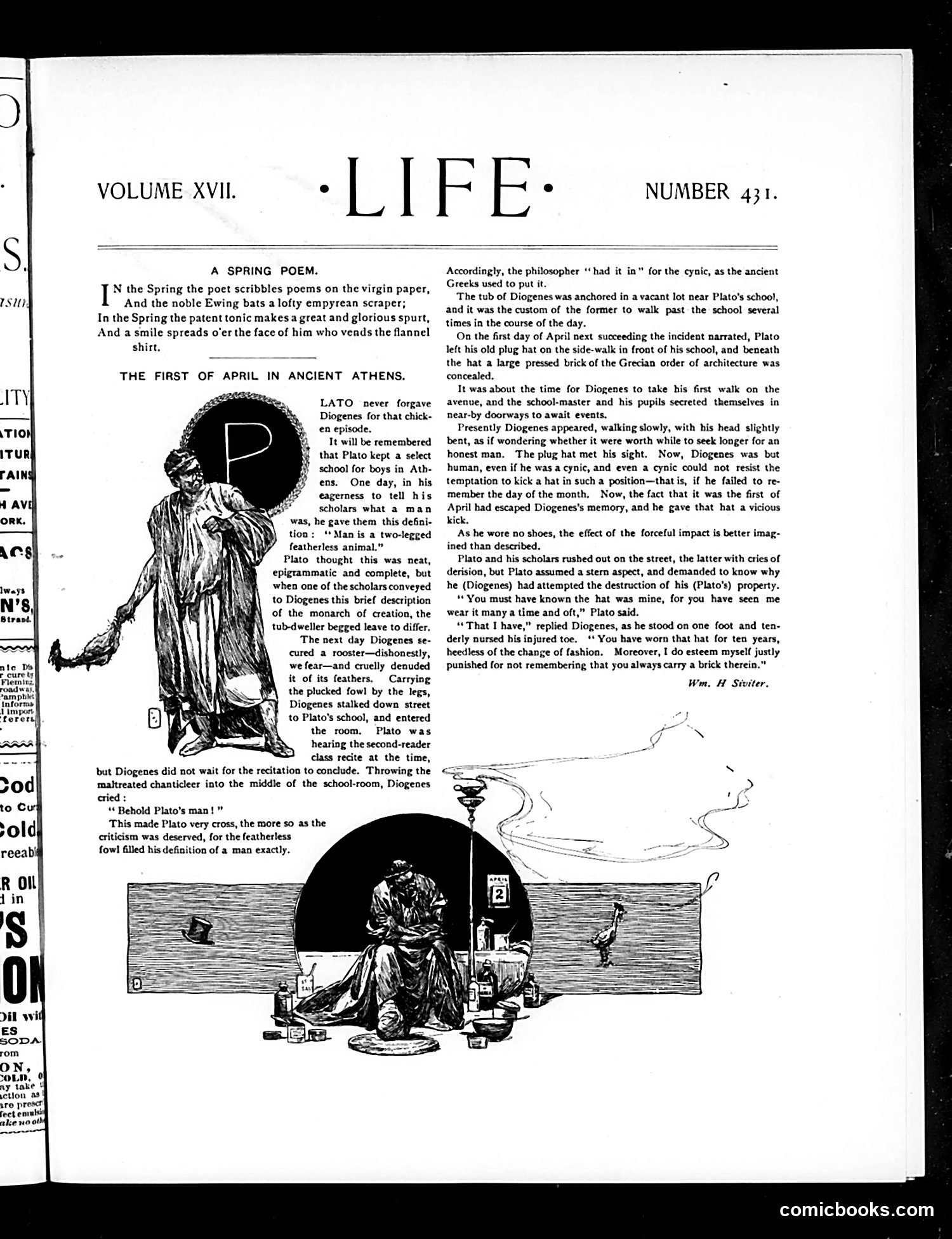
This is a humorous spring poem about an April Fools' Day prank in ancient Athens. The narrative describes Plato's student Diogenes, who famously kept a rooster at Plato's school, playing a trick: he plucks the rooster's feathers and releases it in the schoolroom during Plato's lecture, interrupting proceedings. The joke satirizes philosophical pedantry. When Plato defines man as "a two-legged featherless animal," Diogenes triumphantly presents his plucked rooster as proof the definition is inadequate—it technically fits Plato's description despite clearly not being human. The accompanying illustrations show Diogenes with the plucked bird and a contemplative figure by the sea, visualizing the classical anecdote as light spring entertainment for *Life* magazine's readers.
📄 Transcribed text from this page (OCR, searchable)
Machine-transcribed from the original scan — historical spelling and the odd misread are preserved.
Dil wit ction as aro presct| Feet emul VOLUME XVII. LF IE NUMBER 431. A SPRING POEM. I N the Spring the poet scribbles poems on the virgin paper, And the noble Ewing bats a lofty empyrean scraper; In the Spring the patent tonic makes a great and glorious spurt, And a smile spreads o’er the face of him who vends the flannel shirt. THE FIRST OF APRIL IN ANCIENT ATHENS. LATO never forgave Diogenes for that chick- en episode. Tt will be remembered that Plato kept a select school for boys in Ath- ens. One day, in his eagerness to tell his scholars what a man was, he gave them this defini- tion: ‘Man is a two-legged featherless animal.” Plato thought this was neat, epigrammatic and complete, but when one of the scholars conveyed to Diogenes this brief description of the monarch of creation, the tub-dweller begged leave to differ. ‘The next day Diogenes se- cured a rooster—dishonestly, we fear—and cruelly denuded it of its feathers, Carrying the plucked fowl by the legs, Diogenes stalked down street to Plato's school, and entered the room, Plato was hearing the second-reader class recite at the time, but Diogenes did not wait for the recitation to conclude. Throwing the maltreated chanticleer into the middle of the school-room, Diogenes cried : “* Behold Plato's man!" This made Plato very cross, the more so as the criticism was deserved, for the featherless fowl filled his definition of a man exactly. Accordingly, the philosopher ‘had it in" for the cynic, as the ancient Greeks used to put it. The tub of Diogenes was anchored in a vacant lot near Plato's school, and it was the custom of the former to walk past the school several times in the course of the day. On the first day of April next succeeding the incident narrated, Plato left his old plug hat on the side-walk in front of his school, and beneath the hat a large pressed brick of the Grecian order of architecture was concealed. It was about the time for Diogenes to take his first walk on the avenue, and the school-master and his pupils secreted themselves in near-by doorways to await events, Presently Diogenes appeared, walking slowly, with his head slightly bent, as if wondering whether it were worth while to seek longer for an honest man. The plug hat met his sight. Now, Diogenes was but human, even if he was a cynic, and even a cynic could not resist the temptation to kick a hat in such a position—that is, if he failed to re- member the day of the month, Now, the fact that it was the first of April had escaped Diogenes’s memory, and he gave that hat a vicious kick, As he wore no shoes, the effect of the forceful impact is better imag- ined than described, Plato and his scholars rushed out on the street, the latter with cries of derision, but Plato assumed a stern aspect, and demanded to know why he (Diogenes) had attempted the destruction of his (Plato's) property. “You must have known the hat was mine, for you have seen me wear it many a time and oft,” Plato said. “That I have,” replied Diogenes, as he stood on one foot and ten- derly nursed his injured toe.‘ You have worn that hat for ten years, heedless of the change of fashion. Moreover, I do esteem myself justly punished for not remembering that you always carry a brick therein." Wm, H Siviter, comicbooks.com