
Life, 1891-04-02 · page 4 of 14
Life — April 2, 1891 — page 4: what you’re looking at
What you’re looking at
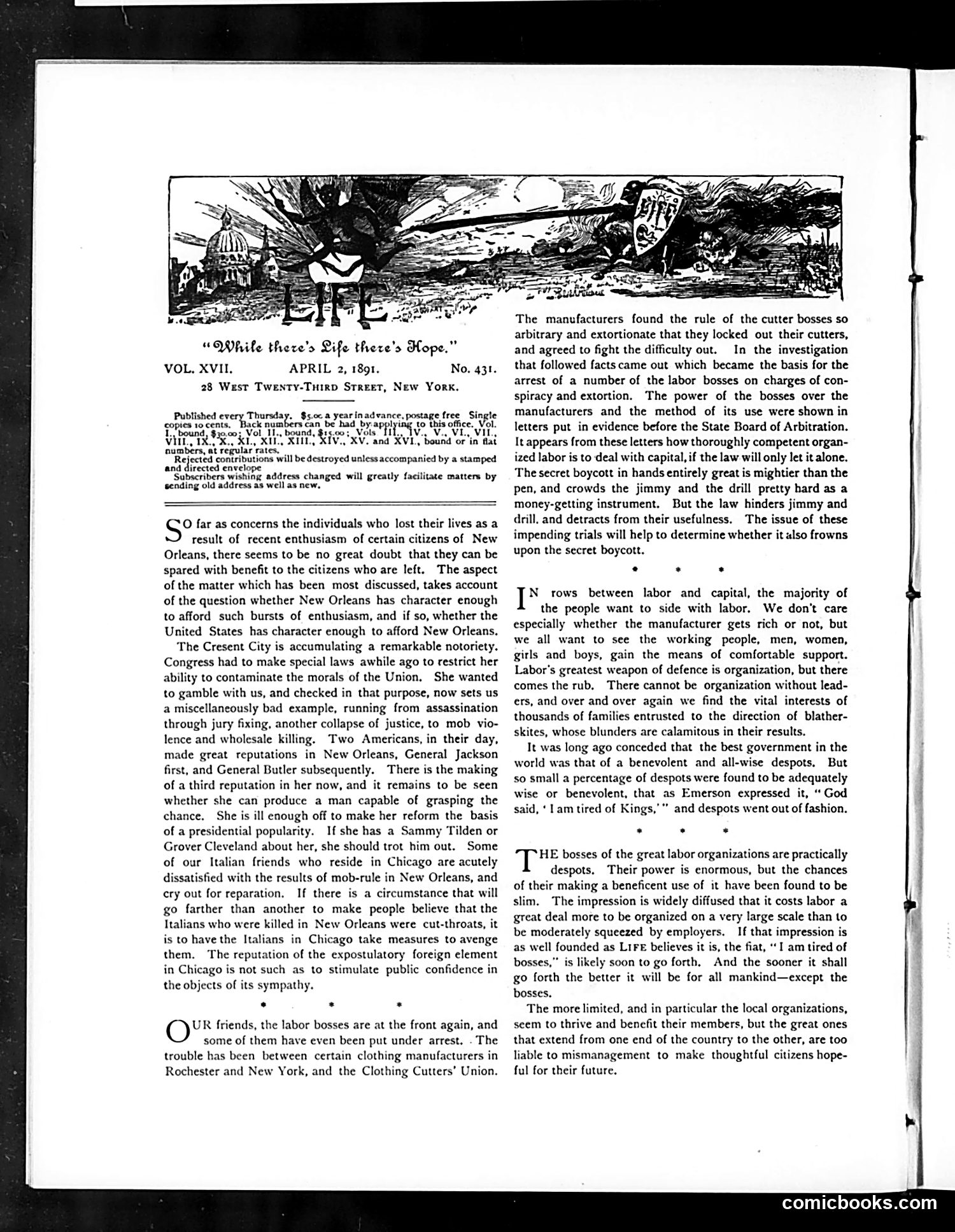
The cartoon's banner "While there's Life there's Hope" ironically frames an article about recent labor violence, likely referencing deaths in New Orleans. The illustration depicts industrial conflict with dramatic imagery suggesting upheaval and destruction. The accompanying text critiques both labor bosses and manufacturers. It discusses how "cutter bosses" controlled workers through arbitrary rules, leading to labor disputes and arrests in Rochester and New York's clothing industry. The article condemns secret boycotts as ineffective while acknowledging labor's legitimate grievances about working conditions and fair wages. The piece appears skeptical of both sides—criticizing labor bosses' despotic power while questioning whether violent confrontation serves workers' interests. It advocates for worker organization as labor's "greatest weapon of defence" against exploitation.
📄 Transcribed text from this page (OCR, searchable)
Machine-transcribed from the original scan — historical spelling and the odd misread are preserved.
“Mile there's Life there's Hope.” VOL. XVII. APRIL 2, 1891. No. 431. 28 West Twenty-Tuirp Street, New York. Published every Thursday, $s.0c a yearinadvance, postage free Single copies to cents. Hack numbers can be had byapplying to this office. Vor. 1, bound, § Vol 11. Round, S00; Vols tive V.. Vi. VIL. Vill, 1X. X., XL, XI, XIE, XIV, XV. and XVI, bound of’in flat umbers, at regular rates.” | Rejected contributions will be destroyed unless accompanied by a stamped and directed envelope ‘Subscribers wishing address changed will greatly facilitate matters by sending old address as well as new, O far as concerns the individuals who lost their lives as a result of recent enthusiasm of certain citizens of New Orleans, there seems to be no great doubt that they can be spared with benefit to the citizens who are left. The aspect of the matter which has been most discussed, takes account of the question whether New Orleans has character enough to afford such bursts of enthusiasm, and if so, whether the United States has character enough to afford New Orleans. ‘The Cresent City is accumulating a remarkable notoriety. Congress had to make special laws awhile ago to restrict her ability to contaminate the morals of the Union. She wanted to gamble with us, and checked in that purpose, now sets us a miscellaneously bad example, running from assassination through jury fixing, another collapse of justice, to mob vio- lence and wholesale killing. Two Americans, in their day, made great reputations in New Orleans, General Jackson first, and General Butler subsequently. There is the making of a third reputation in her now, and it remains to be seen whether she can produce a man capable of grasping the chance. She is ill enough off to make her reform the basis of a presidential popularity. If she has a Sammy Tilden or Grover Cleveland about her, she should trot him out. Some of our Italian friends who reside in Chicago are acutely dissatisfied with the results of mob-rule in New Orleans, and cry out for reparation. If there is a circumstance that will go farther than another to make people believe that the Italians who were killed in New Orleans were cut-throats, it is to have the Italians in Chicago take measures to avenge them. The reputation of the expostulatory foreign element in Chicago is not such as to stimulate public confidence in the objects of its sympathy. UR friends, the labor bosses are at the front again, and some of them have even been put under arrest. . The trouble has been between certain clothing manufacturers in Rochester and New York, and the Clothing Cutters’ Union. The manufacturers found the rule of the cutter bosses so arbitrary and extortionate that they locked out their cutters, and agreed to fight the difficulty out. In the investigation that followed facts came out which became the basis for the arrest of a number of the labor bosses on charges of con- spiracy and extortion. The power of the bosses over the manufacturers and the method of its use were shown in letters put in evidence before the State Board of Arbitration. It appears from these letters how thoroughly competent organ- ized labor is to deal with capital, if the law will only let it alone. The secret boycott in hands entirely great is mightier than the pen, and crowds the jimmy and the drill pretty hard as a money-getting instrument. But the law hinders jimmy and drill. and detracts from their usefulness. The issue of these impending trials will help to determine whether it also frowns upon the secret boycott. . . . [* rows between labor and capital, the majority of the people want to side with labor, We don't care especially whether the manufacturer gets rich or not, but we all want to see the working people, men, women, girls and boys, gain the means of comfortable support. Labor's greatest weapon of defence is organization, but there comes the rub, There cannot be organization without lead- ers, and over and over again we find the vital interests of thousands of families entrusted to the direction of blather- skites, whose blunders are calamitous in their results. It was long ago conceded that the best government in the world was that of a benevolent and all-wise despots. But so small a percentage of despots were found to be adequately wise or benevolent, that as Emerson expressed it, “ God said, ‘ lam tired of Kings,’ and despots went out of fashion. . . * T= bosses of the great labor organizations are practically despots, Their power is enormous, but the chances of their making a beneficent use of it have been found to be slim. The impression is widely diffused that it costs labor a great deal more to be organized on a very large scale than to be moderately squeezed by employers. If that impression is as well founded as LiFe believes it is, the fiat, “I am tired of bosses,” is likely soon to go forth, And the sooner it shall go forth the better it will be for all mankind—except the bosses. The more limited, and in particular the local organizations, seem to thrive and benefit their members, but the great ones that extend from one end of the country to the other, are too liable to mismanagement to make thoughtful citizens hope- ful for their future. comicbooks.com