
Life, 1891-04-02 · page 6 of 14
Life — April 2, 1891 — page 6: what you’re looking at
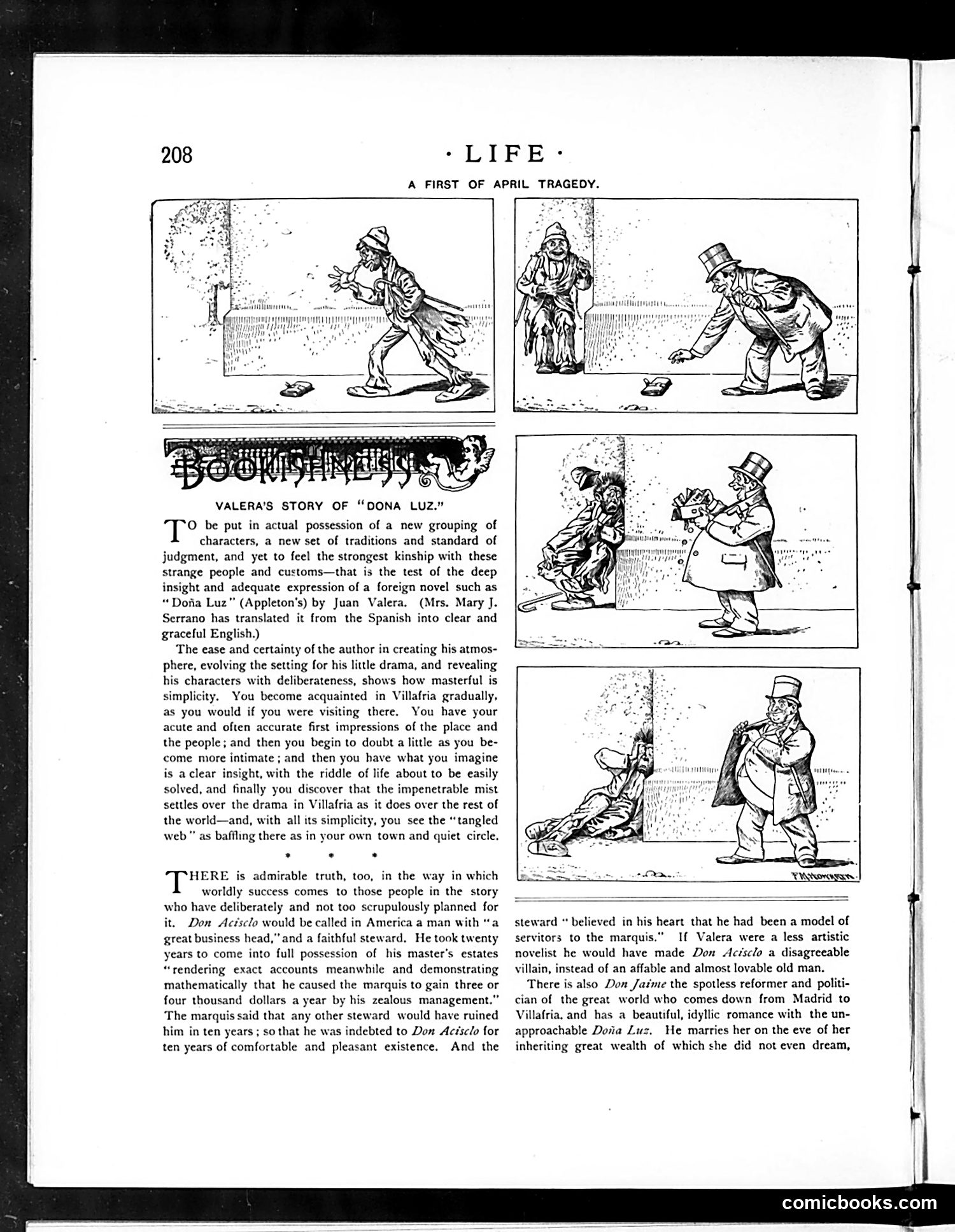
What you’re looking at
This is a humorous visual sequence (likely an April Fools' Day feature) depicting a practical joke gone wrong. The cartoon shows a man in a top hat repeatedly attempting to trick another character with what appears to be a "boomerang" or returning object—a classic prank device. The sequence progresses from the initial trick attempt, through the victim's confusion, to escalating comedic consequences as the object returns unexpectedly, hitting the prankster instead. The joke plays on the ironic reversal common to slapstick humor: the trickster becomes the victim of his own scheme. The accompanying text discusses Juan Valera's Spanish novel "Doña Luz," analyzing its literary merit and character development—unrelated to the cartoon's physical comedy.
📄 Transcribed text from this page (OCR, searchable)
Machine-transcribed from the original scan — historical spelling and the odd misread are preserved.
* LIFE: A FIRST OF APRIL TRAGEDY. VALERA'S STORY OF “DONA LUZ.” ‘O be put in actual possession of a new grouping of characters, a new set of traditions and standard of judgment, and yet to feel the strongest kinship with these strange people and customs—that is the test of the deep insight and adequate expression of a foreign novel such as “Dona Luz” (Appleton's) by Juan Valera. (Mrs. Mary J. Serrano has translated it from the Spanish into clear and graceful English.) The ease and certainty of the author in creating his atmos- phere, evolving the setting for his little drama, and revealing his characters with deliberateness, shows how masterful is simplicity. You become acquainted in Villafria gradually, as you would if you were visiting there. You have your acute and often accurate first impressions of the place and the people; and then you begin to doubt a little as you be- come more intimate ; and then you have what you imagine is aclear insight, with the riddle of life about to be easily solved, and finally you discover that the impenetrable mist settles over the drama in Villafria as it does over the rest of the world—and, with all its simplicity, you see the “tangled web " as baffling there as in your own town and quiet circle. HERE is admirable truth, too, in the way in which worldly success comes to those people in the story who have deliberately and not too scrupulously planned for it. Don Acisclo would be called in America a man with “a great business head,” and a faithful steward. He took twenty years to come into full possession of his master’s estates “rendering exact accounts meanwhile and demonstrating mathematically that he caused the marquis to gain three or four thousand dollars a year by his zealous management.” The marquis said that any other steward would have ruined him in ten years ; so that he was indebted to Don Actsclo for ten years of comfortable and pleasant existence. And the steward “ believed in his heart that he had been a model of servitors to the marquis.” If Valera were a less artistic novelist he would have made Don Acisclo a disagreeable villain, instead of an affable and almost lovable old man. There is also Don Jaime the spotless reformer and politi- cian of the great world who comes down from Madrid to Villafria, and has a beautiful, idyllic romance with the un- approachable Dovia Luz. He marries her on the eve of her inheriting great wealth of which she did not even dream, comicbooks.com