
A complete issue · 14 pages · 1891
Life — March 19, 1891
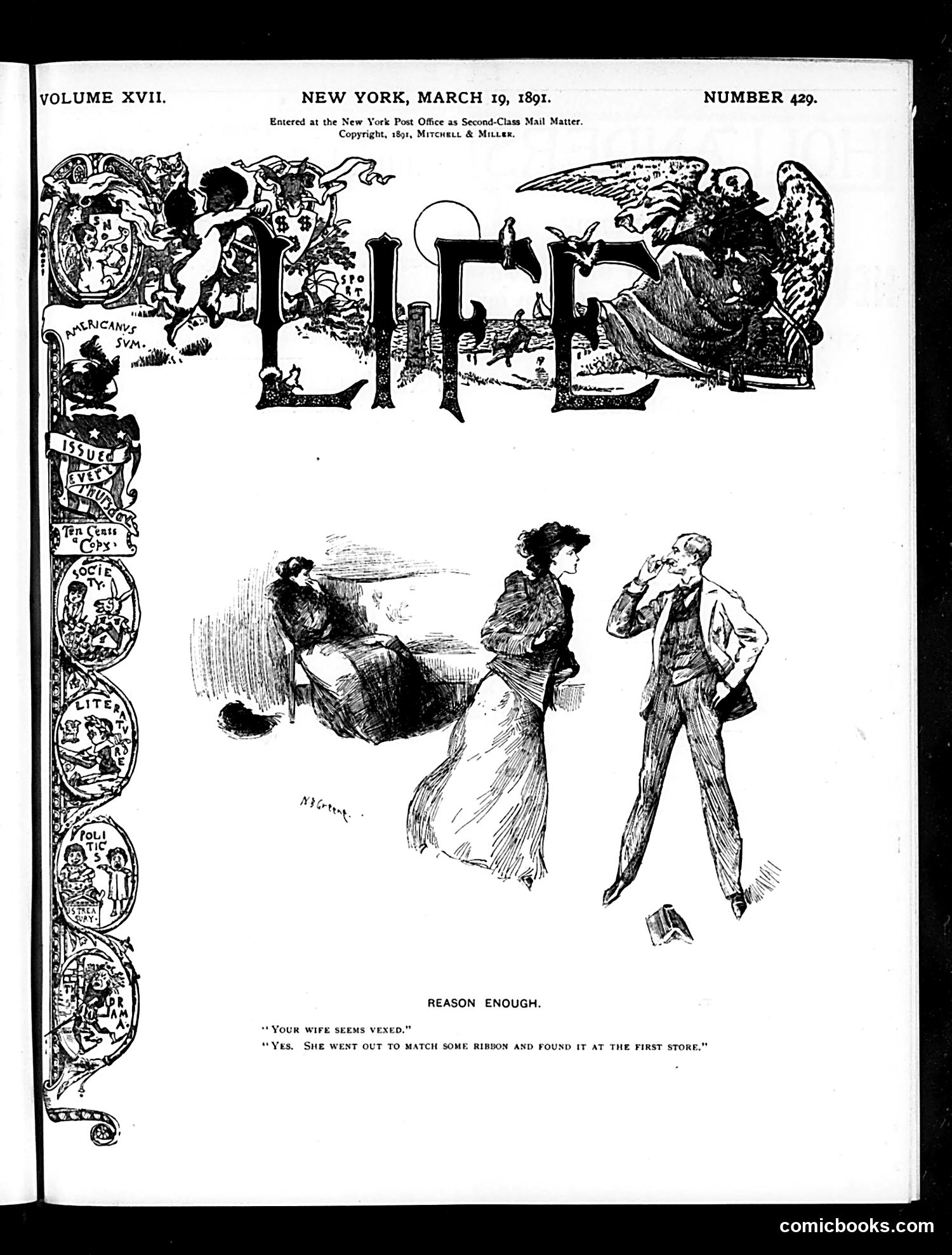
This cartoon presents a domestic humor sketch titled "Reason Enough." Two men converse; one reports his wife "seems vexed." The other explains she went shopping for ribbon, found it at the first store, and returned immediately—implying she's upset because the shopping trip ended too quickly. The joke satirizes women's shopping habits in the 1890s, suggesting wives enjoyed extended retail expeditions more than successful quick purchases. It reflects period stereotypes about feminine consumerism and leisure shopping as entertainment rather than necessity. The ornate left border containing small illustrated vignettes was typical Life magazine decoration of this era. The publication was America's leading satirical weekly during the 1890s, known for social commentary through humor and illustration.
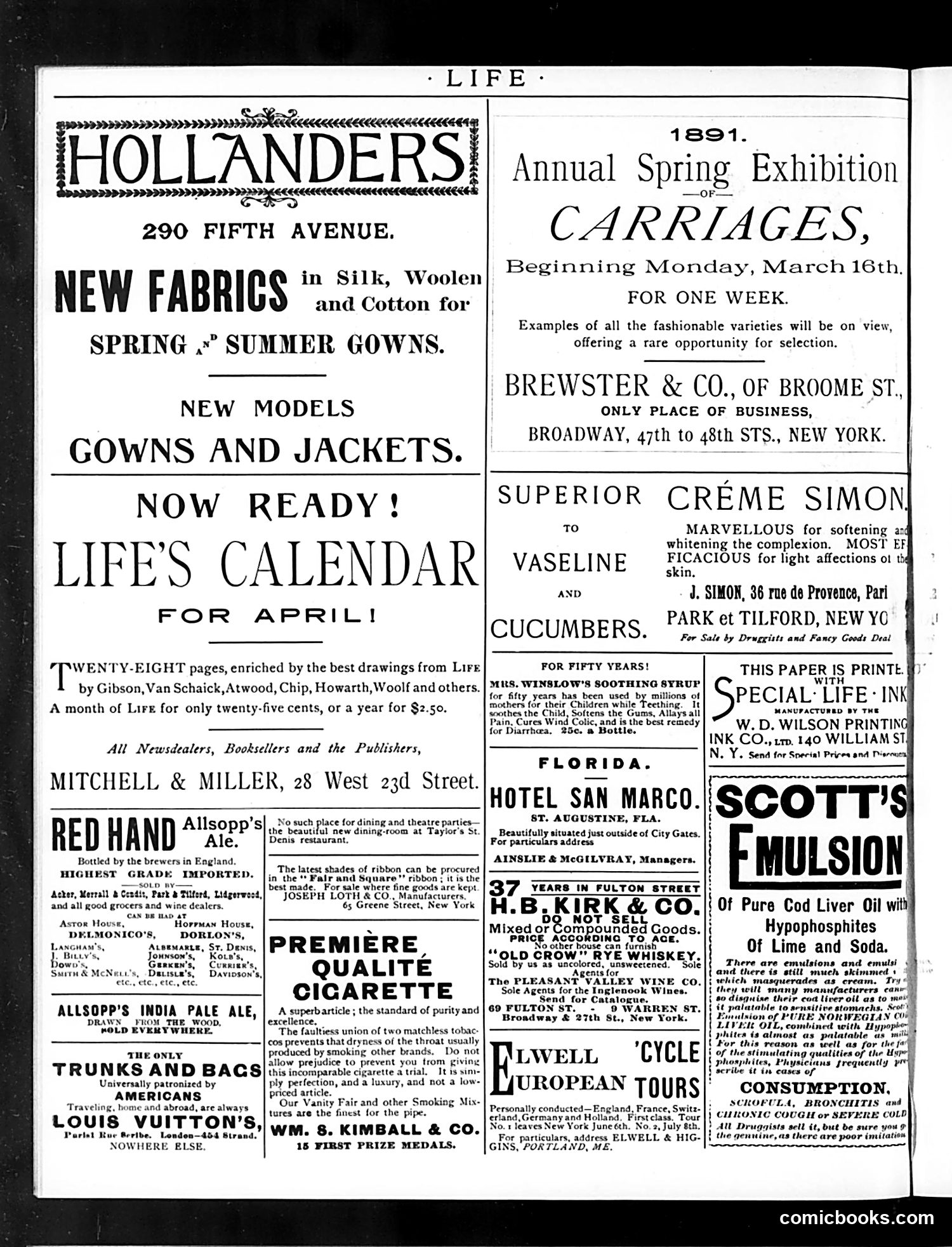
This page is **primarily advertising** from Life magazine's 1891 spring issue, not satirical content. The advertisements showcase commercial products and services typical of the era: fabric and clothing from Hollanders, Life's calendar, carriages from Brewster & Co., cosmetics (Vaseline, Simon's Crème), food products (Allsopp's Ale, whiskey), and luxury goods (Louis Vuitton trunks, Scott's Emulsion cod liver oil). The only potentially notable item is the "Première Qualité Cigarette" advertisement by Wm. S. Kimball & Co., which emphasizes purity standards—reflecting contemporary marketing around tobacco products before health concerns became prominent. No political cartoons or satirical content is visible on this page.
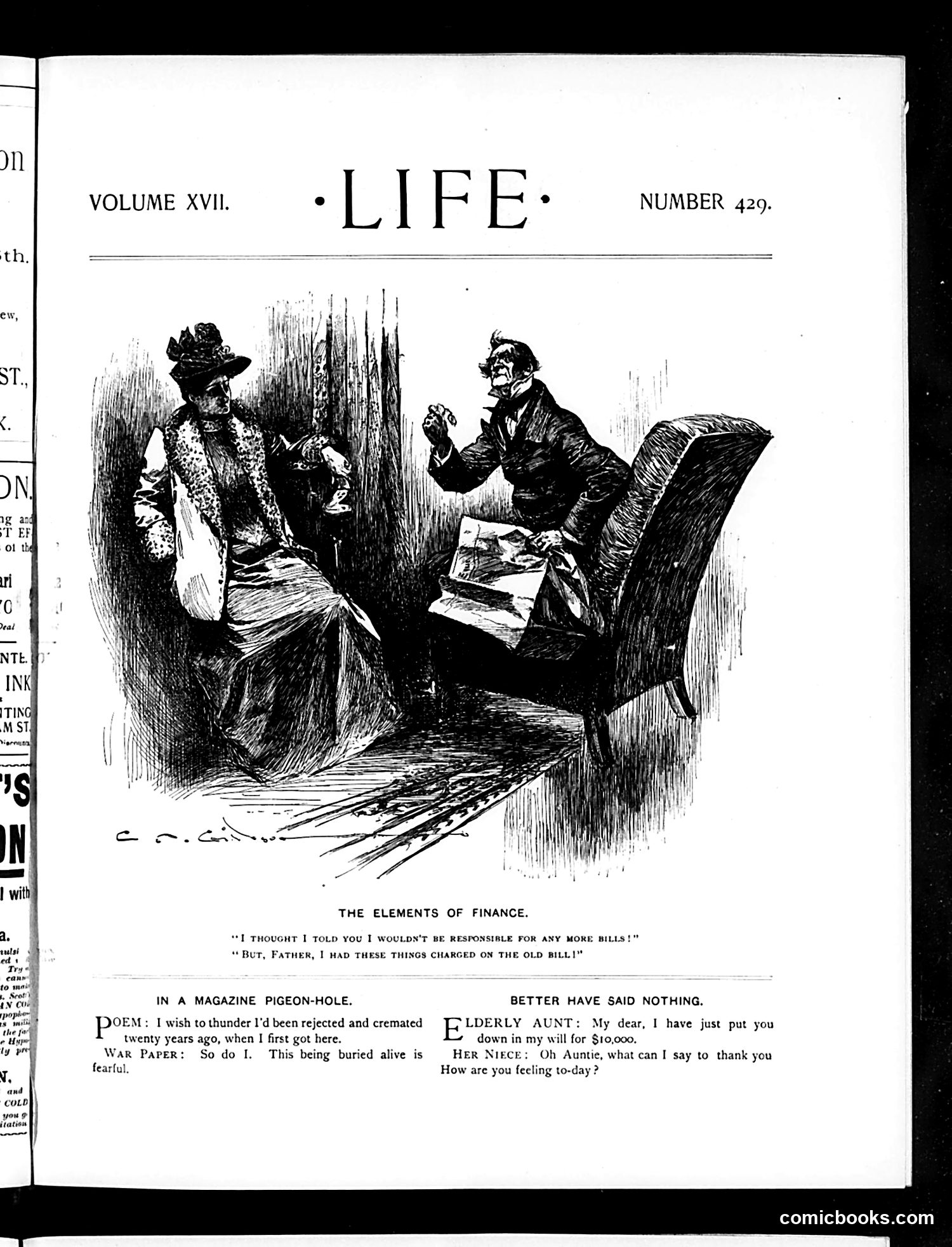
This page from *Life* magazine satirizes financial irresponsibility and family conflict over debt. The main illustration shows two figures in an animated argument about bills, with the caption quoting: "I thought I told you I wouldn't be responsible for any more bills!" and "But, Father, I had these things charged on the old bill!" The satire targets generational financial mismanagement—a son or dependent continuing to accumulate charges despite a parent's explicit refusal to pay. The accompanying comic snippets ("In a Magazine Pigeon-Hole" and "Better Have Said Nothing") extend the theme of financial folly and poor communication about money matters. The overall message critiques wasteful spending habits and the consequences of ignoring financial limits, likely resonating with early 20th-century anxieties about consumer debt and family fiscal responsibility.
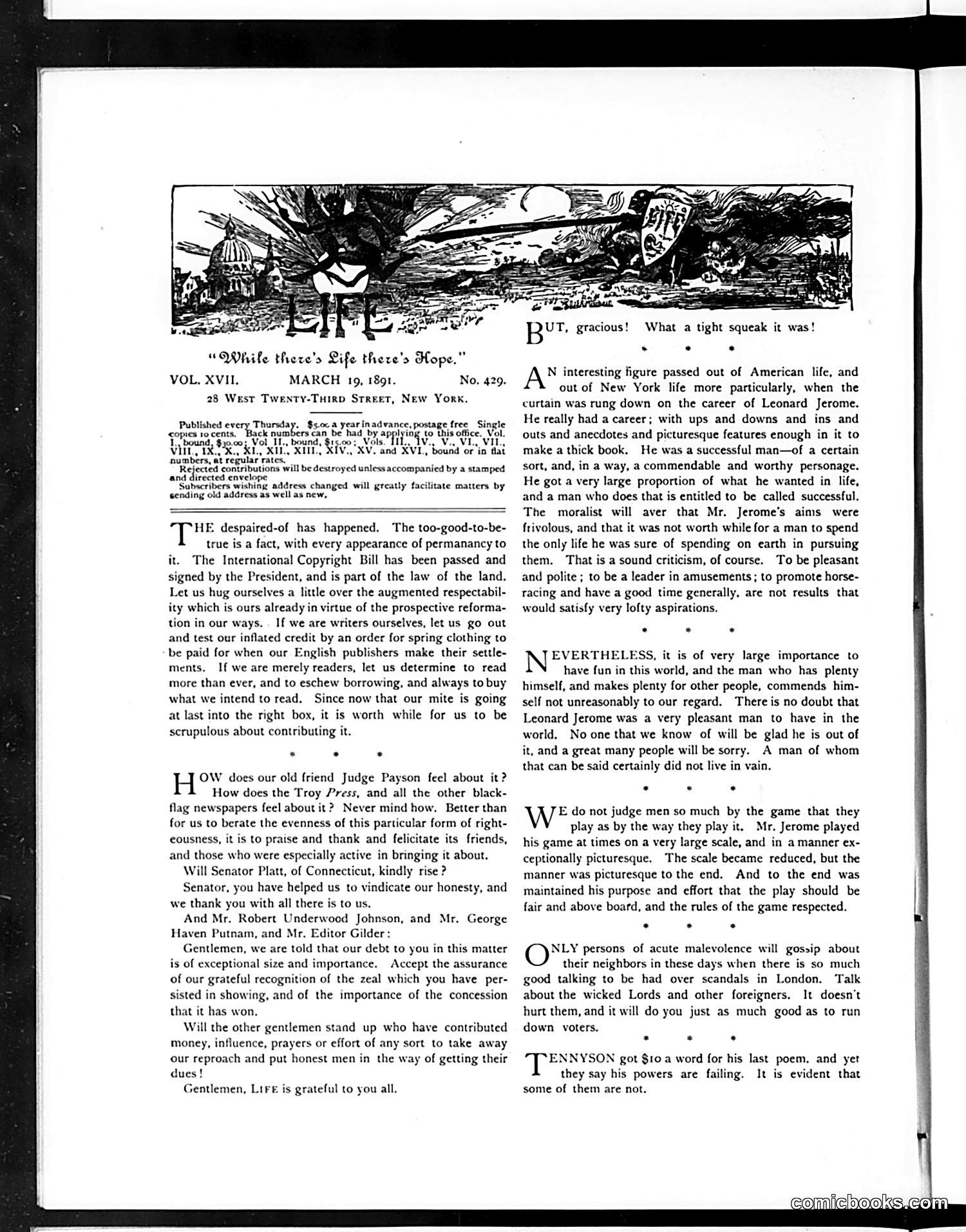
The page features editorial content about copyright law and Leonard Jerome's death. The illustration at top shows a nighttime cityscape with a moon and buildings—likely depicting New York or London. The main text discusses the International Copyright Bill's passage, praising protection for writers and publishers. It thanks supporters including Judge Payson, the Troy *Press*, Senator Platt of Connecticut, Robert Underwood Johnson, and George Haven Putnam for advocating honest copyright practices. The page also eulogizes Leonard Jerome, a prominent New York financier and sportsman, praising his successful life and generous pursuits, though noting some criticized his focus on pleasure rather than social reform. The editors defend Jerome's right to enjoy life as he wished.
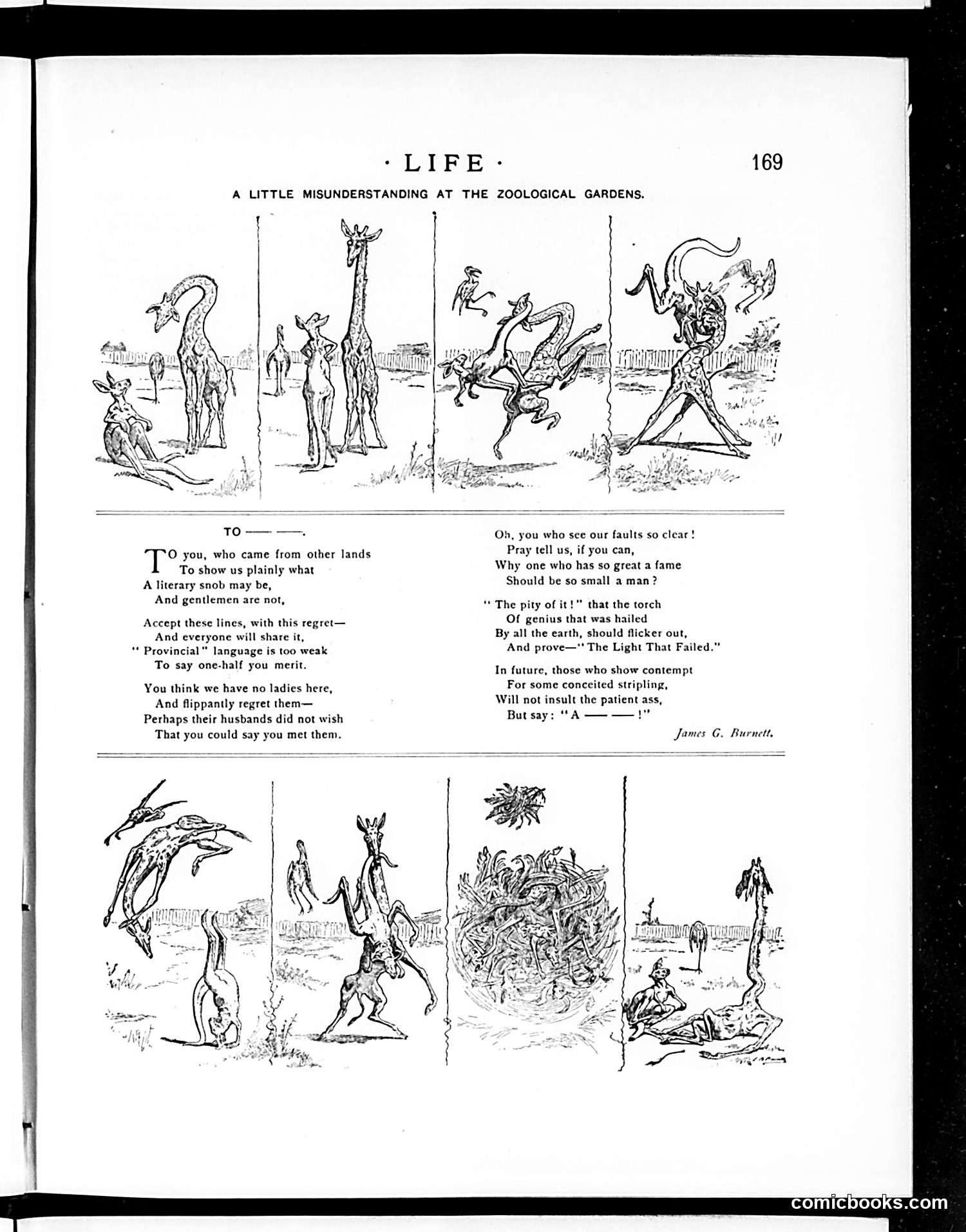
This page satirizes visitors' behavior at zoos through anthropomorphized animals mimicking human social conduct. The top panel shows people interacting with various animals (giraffes, primates, etc.), while the bottom depicts animals behaving like humans in social situations. The accompanying poem by James G. Burnett criticizes literary snobs and conceited individuals who disparage others. It appears to mock provincial intellectuals and those with unearned pretension—people who dismiss others while claiming superiority. The satire's central joke: zoo animals imitating human social follies. By depicting animals adopting human behaviors (posturing, social climbing, affected manners), the cartoonist suggests humans' "civilized" conduct is itself bestial or undignified. It's social commentary wrapped in zoological humor.
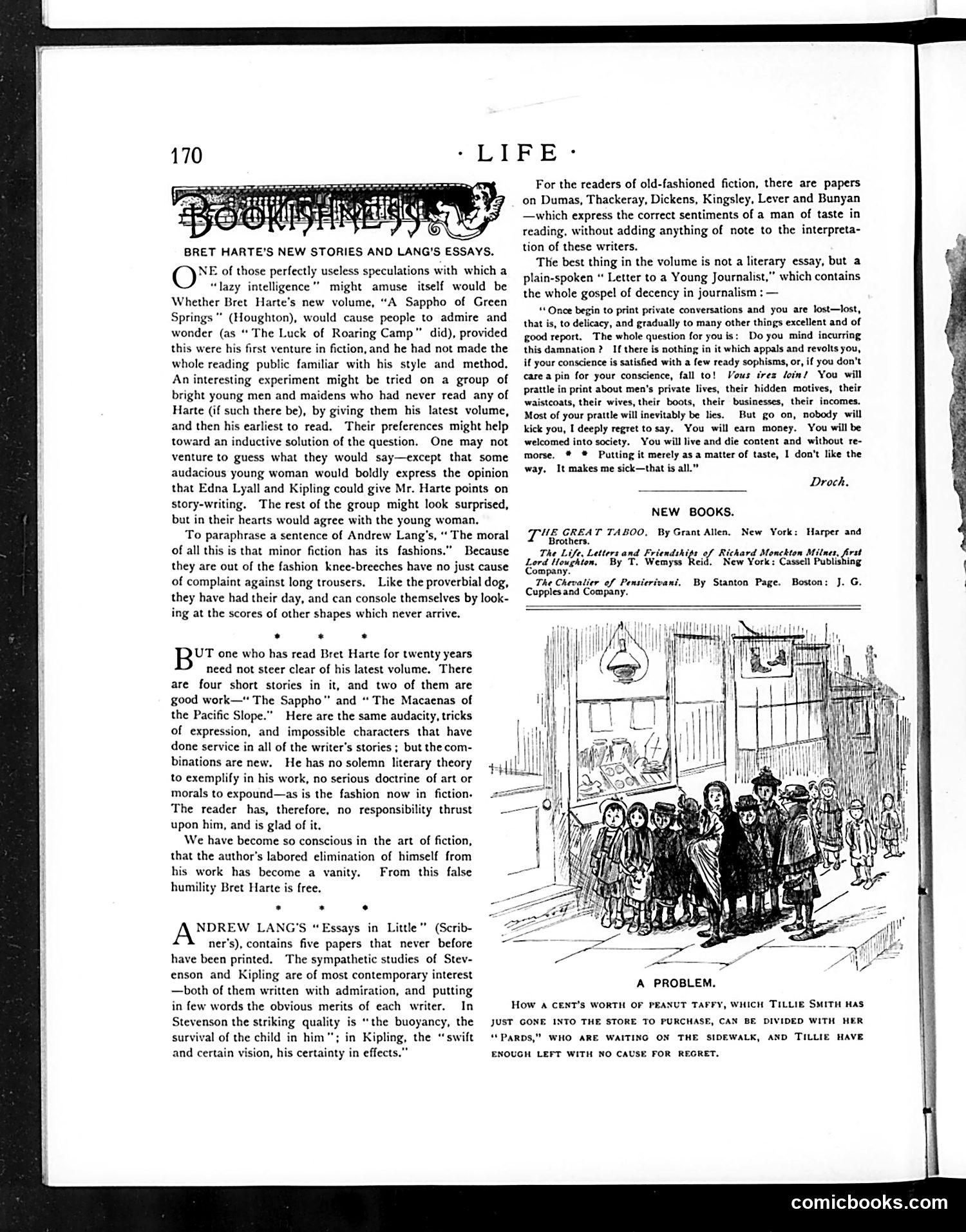
This page primarily contains literary criticism rather than political cartoons. The text reviews Bret Harte's new stories and Andrew Lang's essays, praising their literary merit while critiquing their lack of moral instruction—fashionable among contemporary fiction writers. The only illustration is titled "A Problem," depicting children on a street outside a store. The caption explains it shows Tillie Smith dividing a ten-cent piece with her "pards" (companions) who waited on the sidewalk. This appears to be a gentle social satire about childhood economics and peer obligation—a relatable domestic scenario rather than political commentary. The humor lies in the commonplace predicament of sharing limited resources among friends.
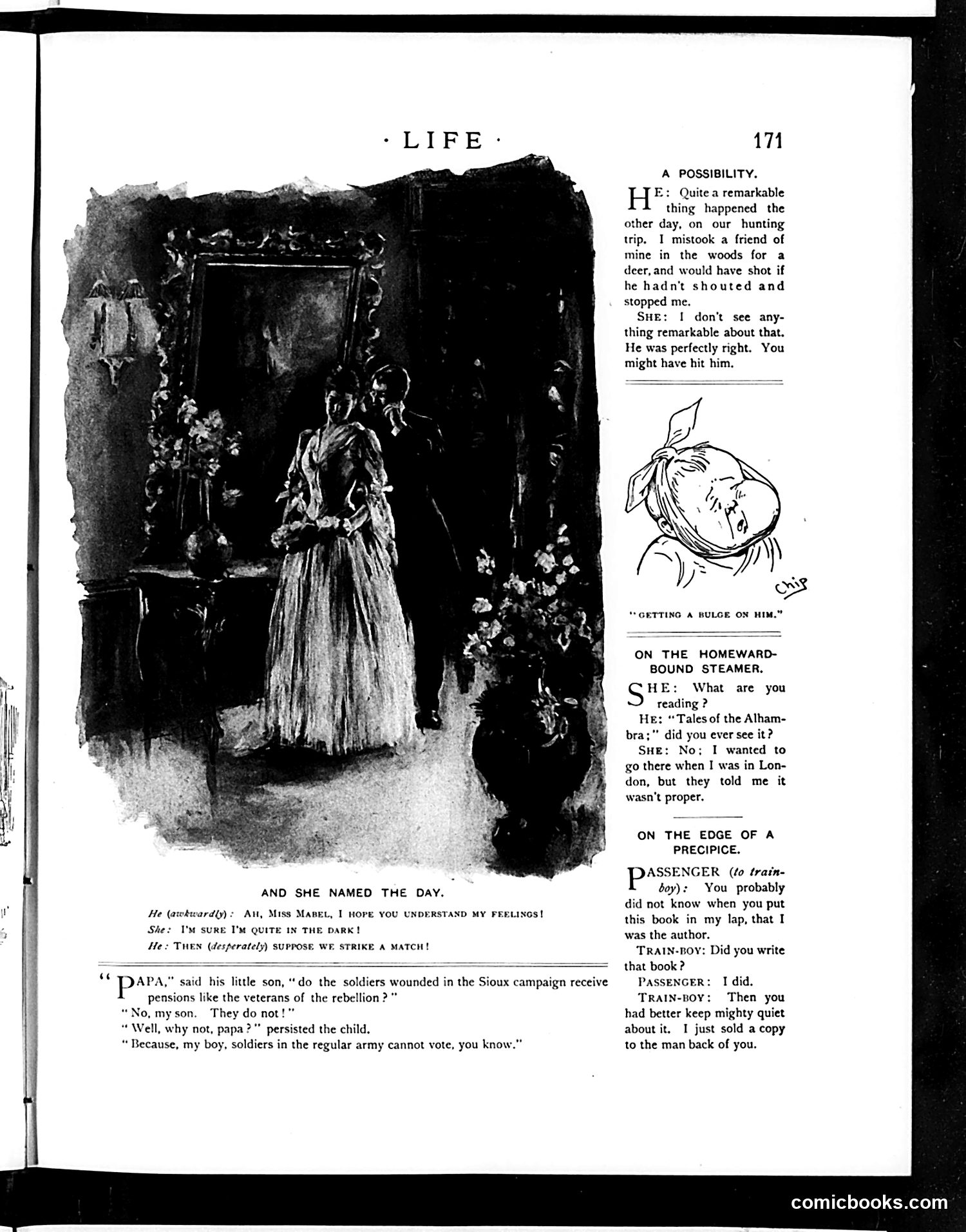
This page contains several satirical vignettes typical of early 20th-century Life magazine humor: **"A Possibility"** mocks gender dynamics—a woman dismisses her husband's near-fatal hunting accident as unremarkable, suggesting he deserved it. **"Getting a Huge on Him"** (small cartoon) appears to be a visual pun about physical contact or embrace. **"On the Homeward-Bound Steamer"** depicts a social exchange where a woman claims "Tales of the Alhambra" was considered improper reading for women in London—satirizing Victorian moral prudishness. **"On the Edge of a Precipice"** shows a train-boy confronting a passenger-author about selling his book, with humorous tension over the author's anonymity and the boy's brazen sales tactics. **"Papa" dialogue** satirizes military pensions policy, showing a child's innocent persistence questioning why wounded Sioux campaign soldiers don't receive veterans' benefits like regular army soldiers.
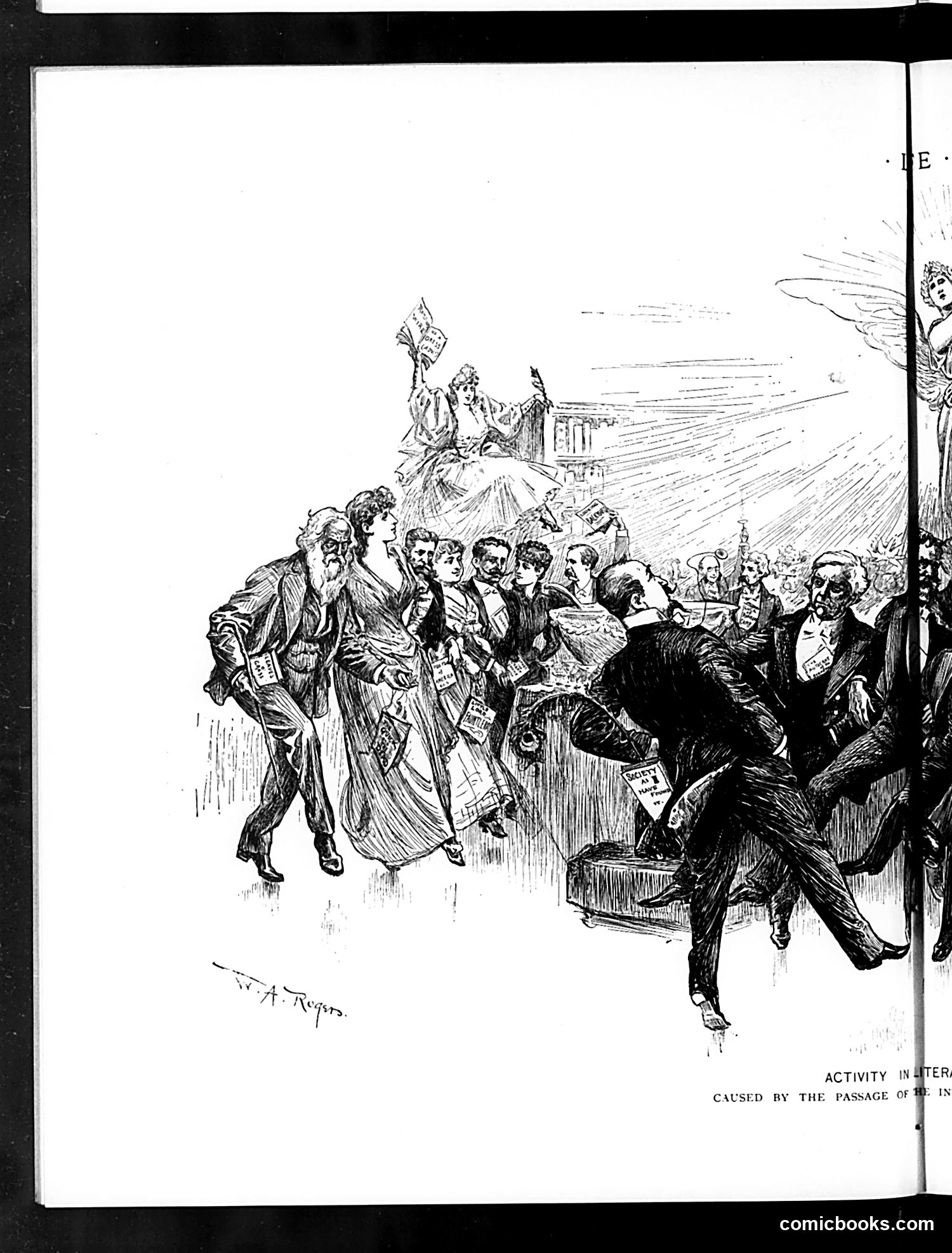
This appears to be a political cartoon from Life magazine depicting a scene of social or political upheaval. The illustration shows a woman (likely representing Liberty or Justice, based on the classical allegorical style) gesturing dramatically from an elevated position, while below her a crowd of well-dressed men in formal attire appears agitated or in motion. The partially visible caption references "ACTIVITY IN [something] CAUSED BY THE PASSAGE OF [incomplete text]," suggesting this comments on reactions to a specific legislative measure or policy change. The artist's signature appears in the lower left. Without the complete caption, I cannot identify the specific historical event or legislation being satirized, though the formal dress and composed style suggest late 19th or early 20th-century political controversy.
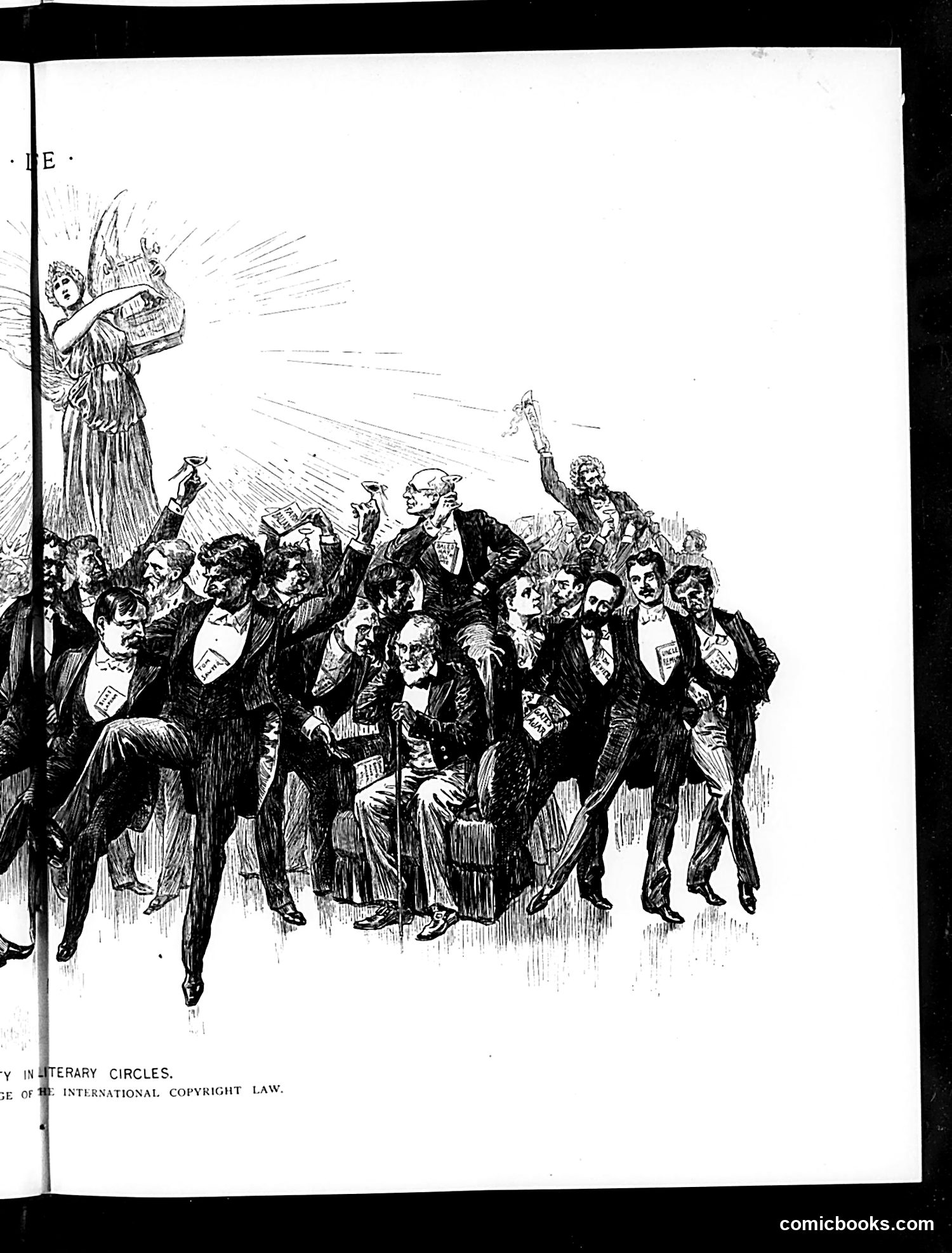
This engraving satirizes literary circles, showing a gathered crowd of well-dressed men in formal 19th-century attire, with an angelic or allegorical female figure (likely representing Literature or the Muse) hovering above them radiating light. The men appear to be authors, critics, or society figures engaged in literary discourse. The satire likely mocks the pretension and self-importance of the literary establishment—the formal dress, dramatic poses, and reverent gazes suggest these men take themselves very seriously. The heavenly figure adds ironic commentary, implying they believe they're engaged in something sacred or divinely inspired, when the cartoon suggests otherwise. The visible text mentions "IN LITERARY CIRCLES" and references international copyright law, situating this among contemporary literary industry debates.
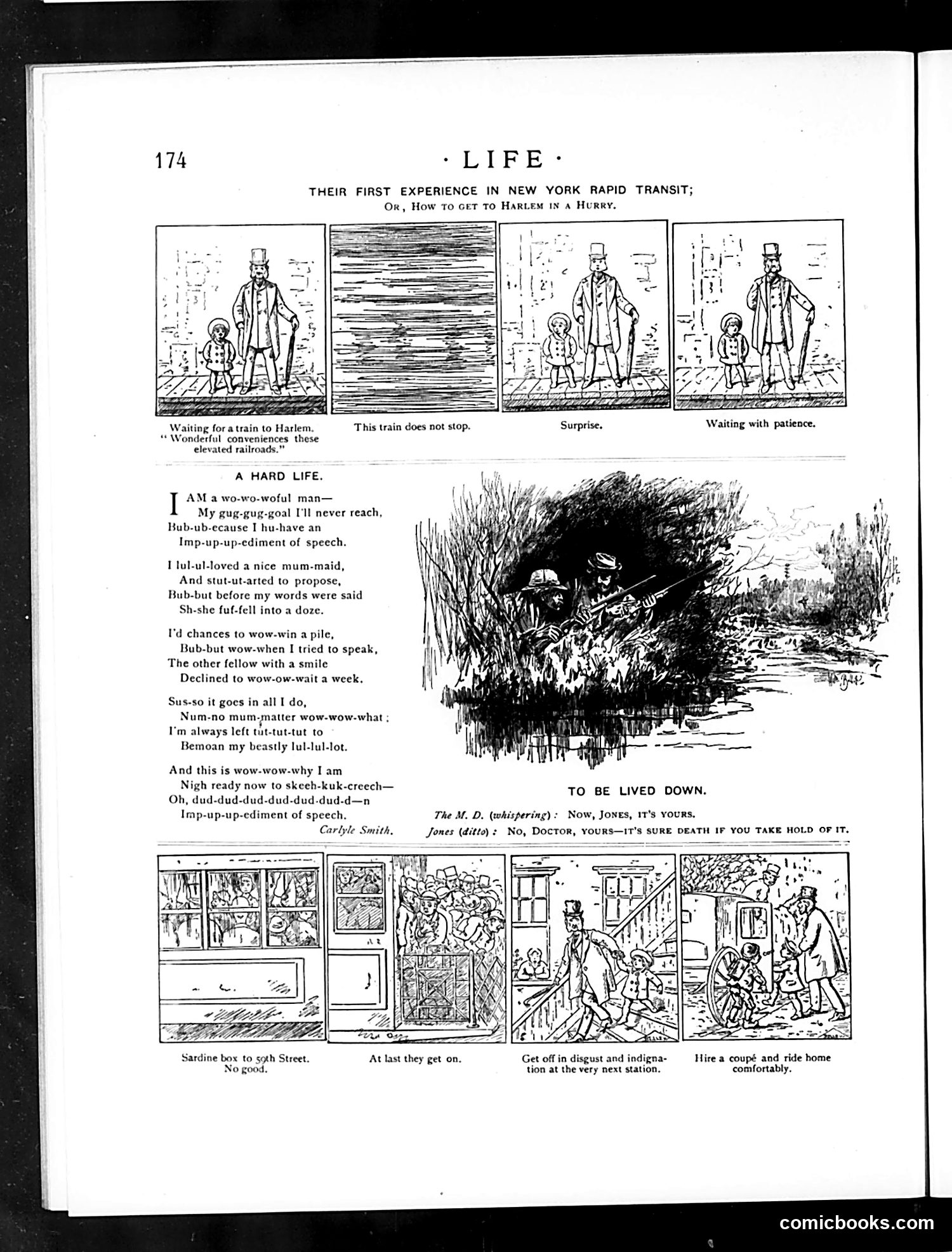
This page satirizes the experience of newcomers to New York City navigating the rapid transit system to reach Harlem. **Top strip**: Shows a man and child waiting for a Harlem train. The joke is that trains pass without stopping ("This train does not stop"), leading to surprise and eventually resigned patience—capturing the frustration of New York's unreliable transit. **Middle section**: A humorous poem titled "A Hard Life" by Carlyle Smith depicts someone with a severe stutter, unable to complete sentences or court a woman ("Hubub-cause I hub-ave an Imp-up-up-ediment of speech"). **Bottom strip**: Illustrates the actual journey—sardine-packed conditions at 125th Street, crowding on cars, and finally arriving home by carriage. The satire critiques both transit inefficiency and the chaos of urban travel during this era.
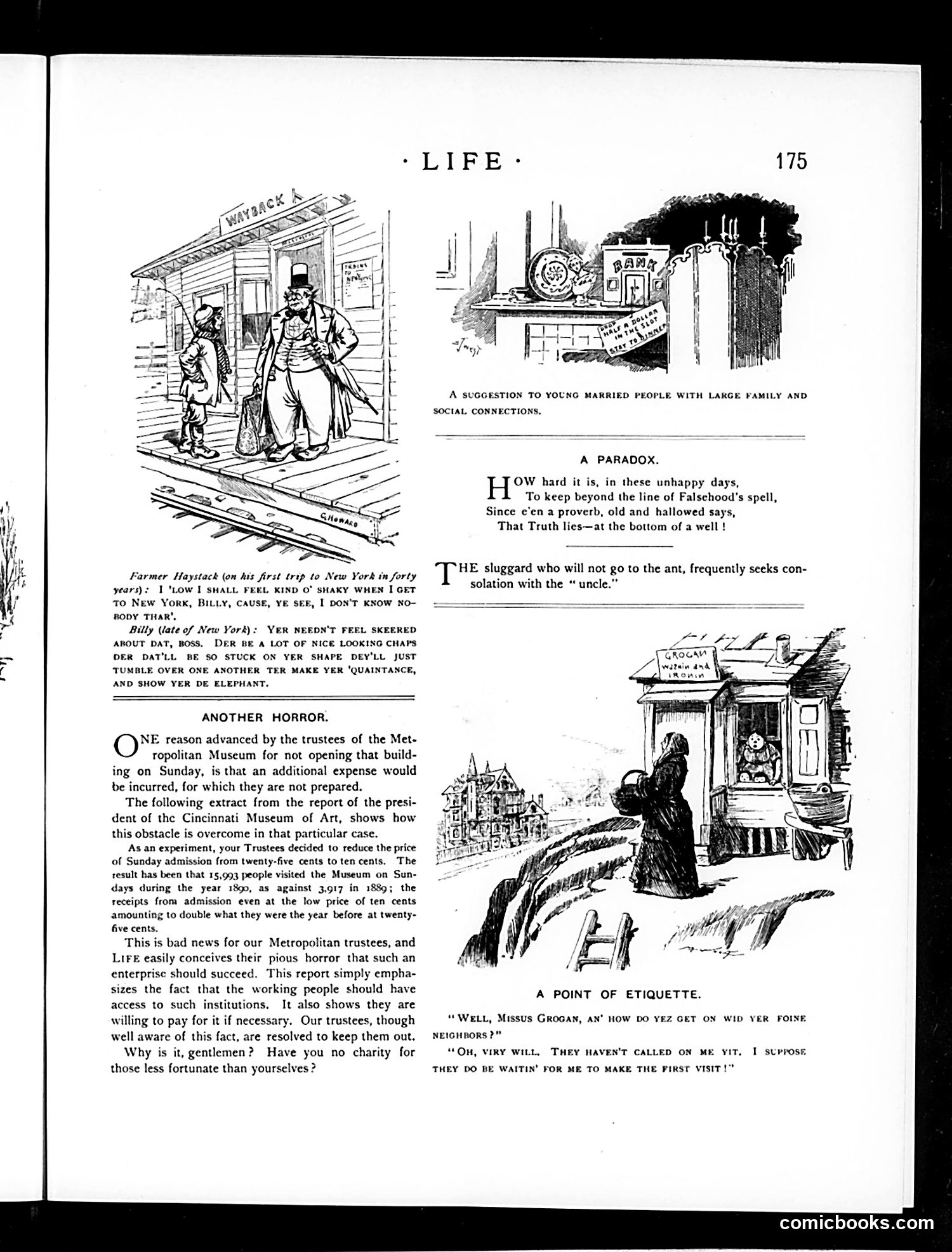
This page contains three satirical cartoons commenting on early 20th-century urban social issues: 1. **"Another Horror"** criticizes the Metropolitan Museum's trustees for not opening Sundays, citing working-class access concerns. It references a Cincinnati Museum experiment reducing admission prices, which increased Sunday visitors from 3,017 to 15,093—arguing cultural institutions should serve working people. 2. **"A Paradox"** uses rural dialogue to satirize how truthfulness is socially devalued, particularly among the upper classes. 3. **"A Point of Etiquette"** depicts a fashionable woman who won't visit new neighbors unless they call first, satirizing rigid social hierarchies and the burden of formal visiting protocols that governed "respectable" society. The cartoons collectively mock class divisions and exclusionary social customs.
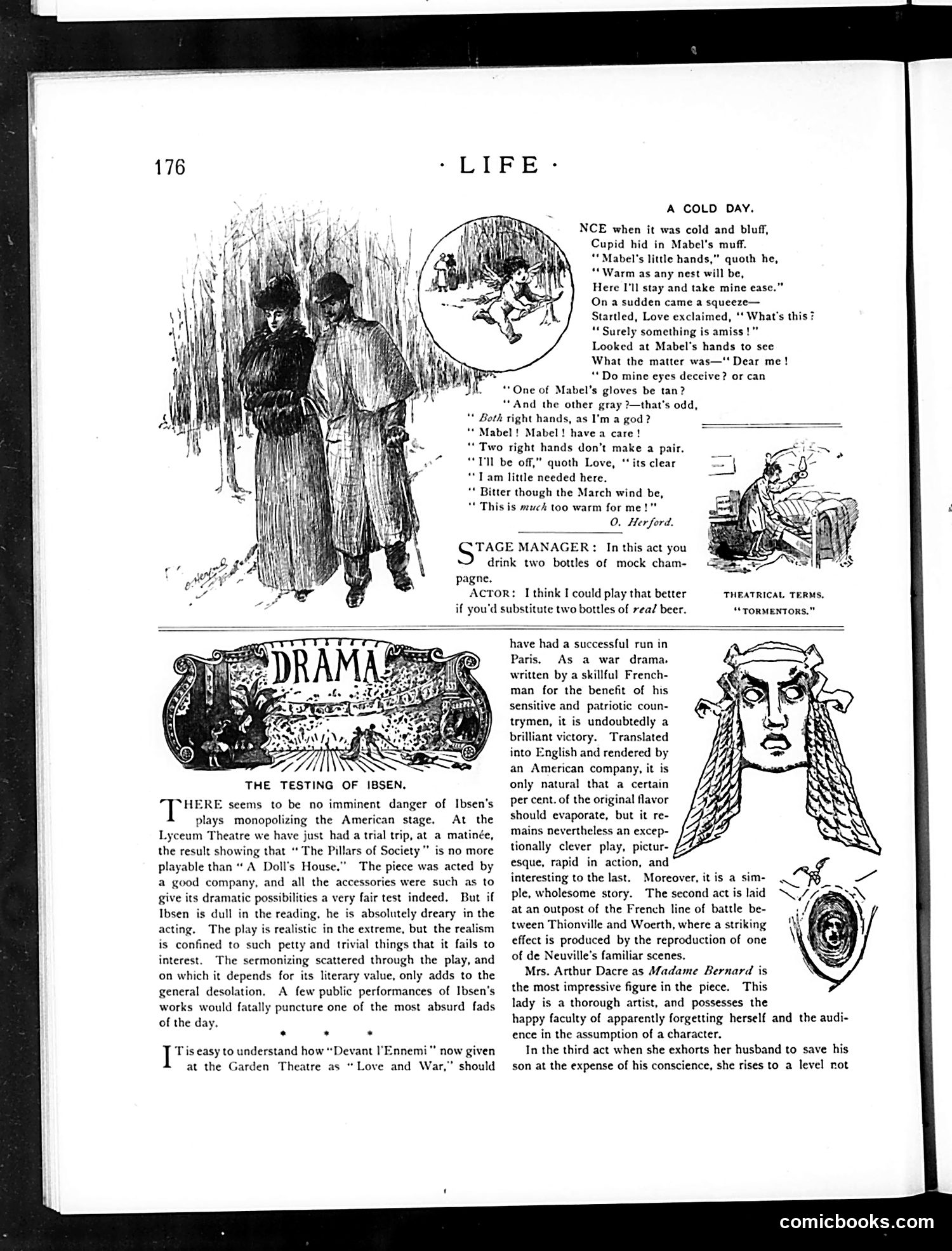
This page contains three theatrical items: **"A Cold Day"** (top): A humorous poem by O. Herford about Cupid hiding in a woman's muff (a fur hand-warmer). The joke hinges on Cupid discovering Mabel is wearing two right-hand gloves—an obvious tailor's error. Offended at being unnecessary, Cupid flees. This is gentle social satire mocking poor craftsmanship and absurd situations. **"Theatrical Terms: Tormentors"** (right): A brief joke where a stage manager asks an actor to drink mock champagne, and the actor requests real beer instead—poking fun at theatrical pretense and actors' actual preferences. **"The Testing of Ibsen"** (lower): A critical essay dismissing Henrik Ibsen's plays (*The Pillars of Society*, *A Doll's House*) as dull and overly realistic. The writer argues Ibsen is "absolutely dreary" when performed, calling his influence on American theatre an "absurd fad." The page also briefly reviews "Love and War," a French war drama, praising actress Mrs. Arthur Dacre's performance.
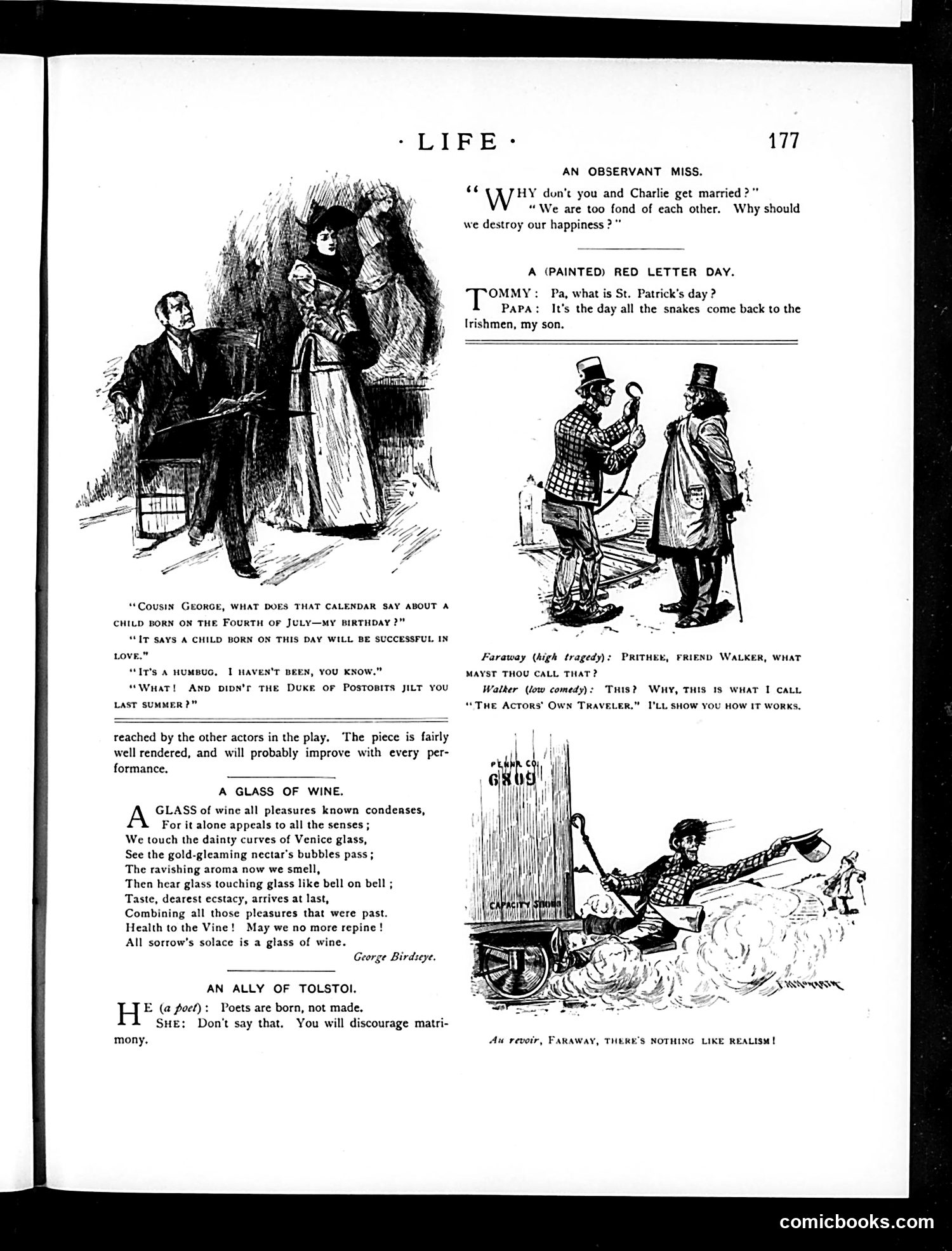
This page contains several unrelated humorous pieces typical of Life's satirical format: **"An Observant Miss"** jokes about a woman rejecting marriage despite loving her suitor, claiming matrimony would destroy their happiness—satirizing the paradox of romantic love versus married life. **"A Painted Red Letter Day"** presents an Irish stereotype joke where a father explains St. Patrick's Day to his son by claiming it's when snakes return to Irishmen, playing on the Saint Patrick legend of driving snakes from Ireland. **"An Ally of Tolstoi"** features a brief exchange between a poet (claiming poets are born, not made) and a woman (arguing this discourages marriage)—likely mocking pretentious artistic philosophy. **"The Actors' Own Traveler"** contrasts theatrical exaggeration ("high tragedy") with realistic performance, satirizing different acting styles. The page also includes George Birdseye's sentimental poem "A Glass of Wine" celebrating wine's sensory pleasures. The illustrations support each piece's humorous point.
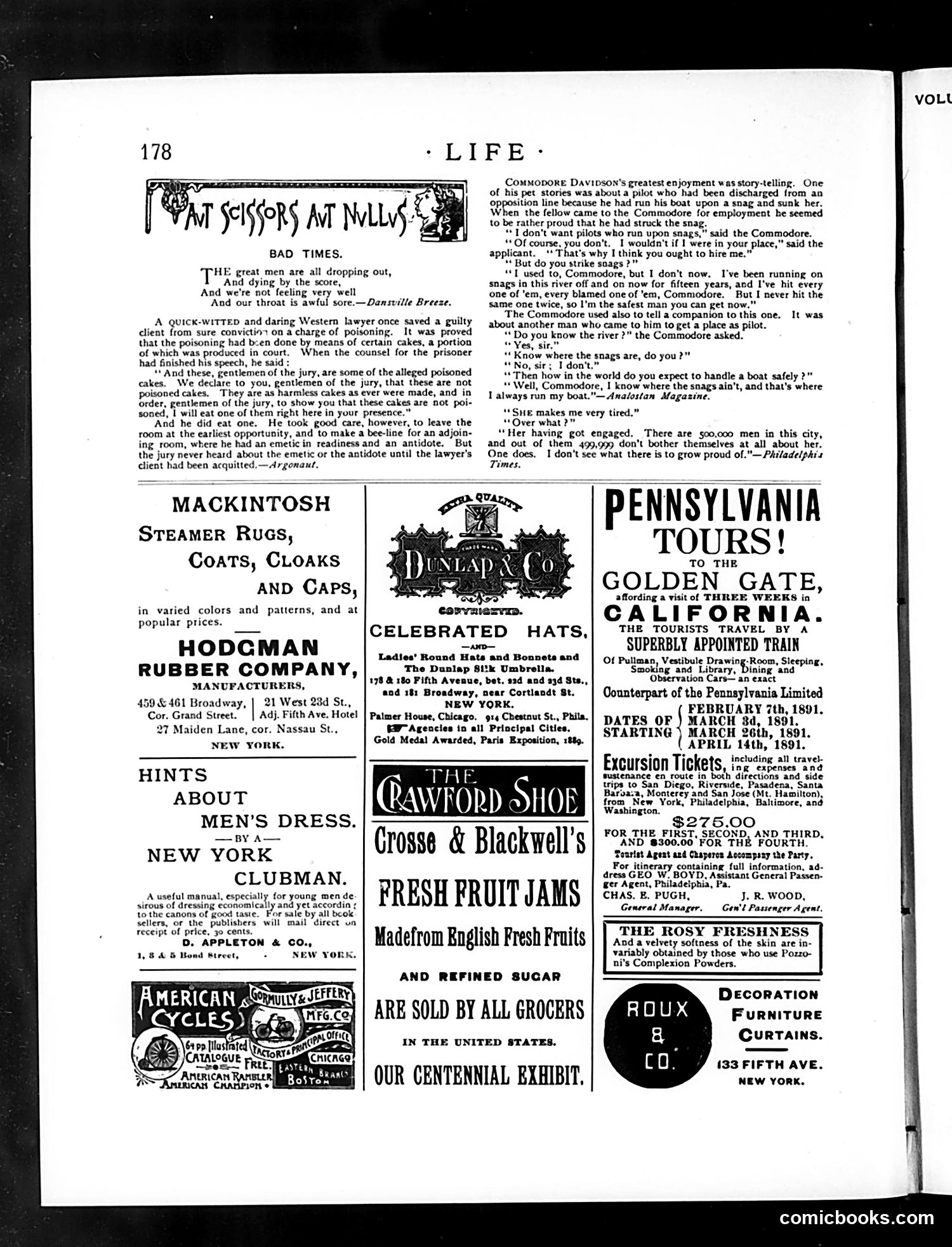
This page consists primarily of **advertisements and humor pieces**—not political cartoons in the traditional sense. The main text contains three humorous anecdotes: one about a Western lawyer who ate poisoned cake (using a trick with emetics), one about Commodore Davidson hiring river pilots who'd memorized where snags *weren't* rather than where they *were*, and a brief joke about a woman engaged to one man among 500,000 in her city. These are **lighthearted period humor**—the kind Life magazine published regularly. The lawyer story mocks courtroom trickery; the pilot stories celebrate cunning and experience. There's no sharp satire of named political figures visible here. The rest is **period advertising**: rubber coats, hats, bicycles, fruit preserves, and a Pennsylvania railroad tour—all typical of 1890s Life magazine content. No satirical intent is evident in the ads themselves.