
Life, 1891-03-19 · page 6 of 14
Life — March 19, 1891 — page 6: what you’re looking at
What you’re looking at
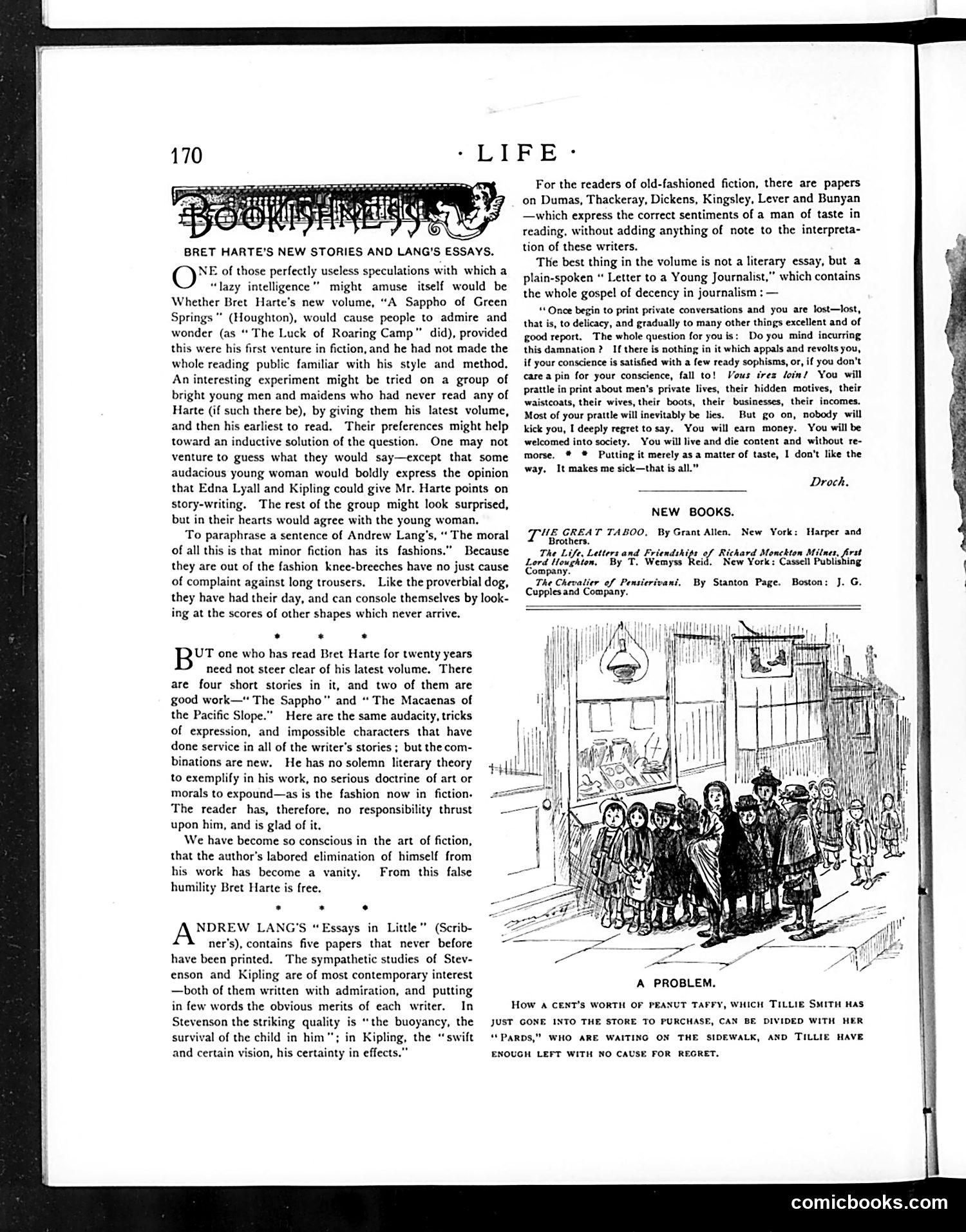
This page primarily contains literary criticism rather than political cartoons. The text reviews Bret Harte's new stories and Andrew Lang's essays, praising their literary merit while critiquing their lack of moral instruction—fashionable among contemporary fiction writers. The only illustration is titled "A Problem," depicting children on a street outside a store. The caption explains it shows Tillie Smith dividing a ten-cent piece with her "pards" (companions) who waited on the sidewalk. This appears to be a gentle social satire about childhood economics and peer obligation—a relatable domestic scenario rather than political commentary. The humor lies in the commonplace predicament of sharing limited resources among friends.
📄 Transcribed text from this page (OCR, searchable)
Machine-transcribed from the original scan — historical spelling and the odd misread are preserved.
‘LIFE: NE of those perfectly useless speculations with which a “lazy intelligence" might amuse itself would be Whether Bret Harte’s new volume, “A Sappho of Green Springs " (Houghton), would cause people to admire and wonder (as “The Luck of Roaring Camp” did), provided this were his first venture in fiction, and he had not made the whole reading public familiar with his style and method. An interesting experiment might be tried on a group of bright young men and maidens who had never read any of Harte (if such there be), by giving them his latest volume, and then his earliest to read. Their preferences might help toward an inductive solution of the question. One may not venture to guess what they would say—except that some audacious young woman would boldly express the opinion that Edna Lyall and Kipling could give Mr. Harte points on story-writing, The rest of the group might look surprised, but in their hearts would agree with the young woman. To paraphrase a sentence of Andrew Lang's, “The moral of all this is that minor fiction has its fashions.” Because they are out of the fashion knee-breeches have no just cause of complaint against long trousers. Like the proverbial dog, they have had their day, and can console themselves by look- ing at the scores of other shapes which never arrive, UT one who has read Bret Harte for twenty years need not steer clear of his latest volume, There are four short stories in it, and two of them are good work—" The Sappho" and “ The Macaenas of the Pacific Slope.” Here are the same audacity, tricks of expression, and impossible characters that have done service in all of the writer's stories ; but the com- binations are new. He has no solemn literary theory to exemplify in his work, no serious doctrine of art or morals to expound—as is the fashion now in fiction. The reader has, therefore, no responsibility thrust upon him, and is glad of it. We have become so conscious in the art of fiction, that the author's labored elimination of himself from his work has become a vanity. From this false humility Bret Harte is free. NDREW LANG'S ssays in Little” (Scrib- ner's), contains five papers that never before have been printed. The sympathetic studies of Stev- enson and Kipling are of most contemporary interest —both of them written with admiration, and putting in few words the obvious merits of each writer. In Stevenson the striking quality is “the buoyancy, the survival of the child in him"; in Kipling, the “swift and certain vision, his certainty in effects.” How A CENT’S WORTH OF PEANUT TAF: For the readers of old-fashioned fiction, there are papers on Dumas, Thackeray, Dickens, Kingsley, Lever and Bunyan —which express the correct sentiments of a man of taste in reading, without adding anything of note to the interpreta- tion of these writers. The best thing in the volume is not a literary essay, but a plain-spoken “ Letter to a Young Journalist,” which contains the whole gospel of decency in journalism : — ‘Once begin to print private conversations and you are lost—lost, that is, to delicacy, and gradually to many other things excellent and of good report. The whole question for you is: Do you mind incurring this damnation? If there is nothing in it which appals and revolts you, if your conscience is satisfied with a few ready sophisms, or, if you don't care a pin for your conscience, fall to! Vous tres loin? You will prattle in print about men's private lives, their hidden motives, their waistcoats, their wives, their boots, their businesses, their incomes, Most of your prattle will inevitably be lies. But go on, nobody will kick you, I deeply regret to say. You will earn money. You will be welcomed into society, You will live and die content and without re- * © Putting it merely as a matter of taste, I don’t like the Tt makes me sick—that is all.” morse, way, Droch. NEW BOOKS. TE GREAT TABOO, By Grant Allen, New York: Harper and jrothers. The Life, Letters and Friendshigs of Richard Monckton Milnes, first Lord Houghton, By T. Wemyss Reid. New York: Cassell Publishing Company. The Chevalier of Pensierivani, Boston: J. G. By Stanton Page. Cupples and Company. A PROBLEM. WHICH TILLIE SMITH Has JUST GONE INTO THE STORE TO PURCHASE, CAN BE DIVIDED WITH HER ‘*PARDS,” WHO ARE WAITING ON THE SIDEWALK, AND TILLIE HAVE ENOUGH LEFT WITH NO CAUSE FOR REGRET. comicbooks.com