
Life, 1891-03-19 · page 4 of 14
Life — March 19, 1891 — page 4: what you’re looking at
What you’re looking at
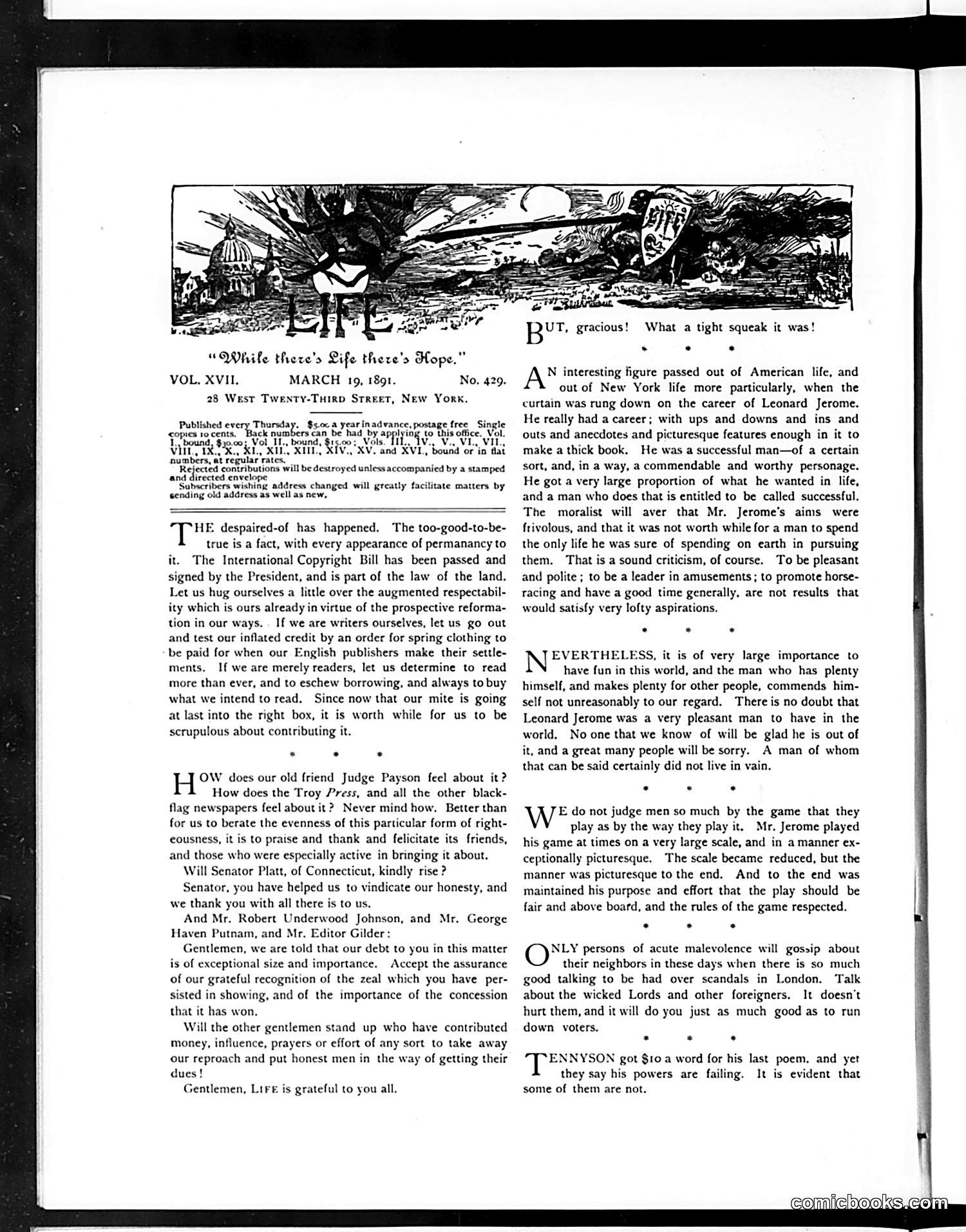
The page features editorial content about copyright law and Leonard Jerome's death. The illustration at top shows a nighttime cityscape with a moon and buildings—likely depicting New York or London. The main text discusses the International Copyright Bill's passage, praising protection for writers and publishers. It thanks supporters including Judge Payson, the Troy *Press*, Senator Platt of Connecticut, Robert Underwood Johnson, and George Haven Putnam for advocating honest copyright practices. The page also eulogizes Leonard Jerome, a prominent New York financier and sportsman, praising his successful life and generous pursuits, though noting some criticized his focus on pleasure rather than social reform. The editors defend Jerome's right to enjoy life as he wished.
📄 Transcribed text from this page (OCR, searchable)
Machine-transcribed from the original scan — historical spelling and the odd misread are preserved.
“OWMhile there's Life there's Hope.” VOL, XVII. MARCH 19, 1891. No. 429. 28 West Twenxty-Tuirp Street, New York. Published every Thursday, $s.0c a year inadwance, postage free Single copies tocents, Back numbers can be had by applying to this office, Vol. Tybound, $3.00; Vol I, bound, $15.00; Vols. HL. IV. VV. VIL VHP. IX X. XL, XID, XII, XIV, XV. and XVI, bound or'in fat numbers, at regular rates. Rejected contributions will be destroyed unless accompanied by a stamped and directed envelope Subscribers wishing address changed will greatly facilitate matters by sending old address as well as new, HE despaired-of has happened. ‘The too-good-to-be- true is a fact, with every appearance of permanancy to it. The International Copyright Bill has been passed and signed by the President, and is part of the law of the land. Let us hug ourselves a little over the augmented respectabil- ity which is ours already in virtue of the prospective reforma- tion in our ways. . If we are writers ourselves, let us go out and test our inflated credit by an order for spring clothing to be paid for when our English publishers make their settle~ ments. If we are merely readers, let us determine to read more than ever, and to eschew borrowing, and always to buy what we intend to read. Since now that our mite is going at last into the right box, it is worth while for us to be scrupulous about contributing it. OW does our old friend Judge Payson feel about it ? How does the Troy Press, and all the other black- flag newspapers feel about it? Never mind how. Better than for us to berate the evenness of this particular form of right- eousness, it is to praise and thank and felicitate its friends, and those who were especially active in bringing it about. Will Senator Platt, of Connecticut, kindly rise ? Senator, you have helped us to vindicate our honesty, and we thank you with all there is to us. And Mr. Robert Underwood Johnson, and Mr. George Haven Putnam, and Mr. Editor Gilder : Gentlemen, we are told that our debt to you in this matter is of exceptional size and importance. Accept the assurance of our grateful recognition of the zeal which you have per- sisted in showing, and of the importance of the concession that it has won. Will the other gentlemen stand up who have contributed money, influence, prayers or effort of any sort to take away our reproach and put honest men in the way of getting their dues! Gentlemen, Lire is grateful to you all. Bu: gracious!) What a tight squeak it was! . . . A’ interesting figure passed out of American life, and out of New York life more particularly, when the curtain was rung down on the career of Leonard Jerome. He really had a career; with ups and downs and ins and outs and anecdotes and picturesque features enough in it to make a thick book. He was a successful man—of a certain sort, and, in a way, a commendable and worthy personage. He got a very large proportion of what he wanted in life, and a man who does that is entitled to be called successful. The moralist will aver that Mr. Jerome’s aims were frivolous, and that it was not worth while for a man to spend the only life he was sure of spending on earth in pursuing them. That is a sound criticism, of course. To be pleasant and polite ; to be a leader in amusements ; to promote horse- racing and have a good time generally, are not results that would satisfy very lofty aspirations. EVERTHELESS, it is of very large importance to have fun in this world, and the man who has plenty himself, and makes plenty for other people, commends him- self not unreasonably to our regard. There is no doubt that Leonard Jerome was a very pleasant man to have in the world. No one that we know of will be glad he is out of it, and a great many people will be sorry. A man of whom that can be said certainly did not live in vain. . . . do not judge men so much by the game that they play as by the way they play it, Mr. Jerome played his game at times on a very large scale, and in a manner ex- ceptionally picturesque. The scale became reduced, but the manner was picturesque to the end. And to the end was maintained his purpose and effort that the play should be fair and above board, and the rules of the game respected. NLY persons of acute malevolence will gossip about their neighbors in these days when there is so much good talking to be had over scandals in London, Talk about the wicked Lords and other foreigners. It doesn’t hurt them, and it will do you just as much good as to run down voters, . * . i NYSON got $10 a word for his last poem, and yet they say his powers are failing. It is evident that some of them are not.