
A complete issue · 16 pages · 1891
Life — February 5, 1891
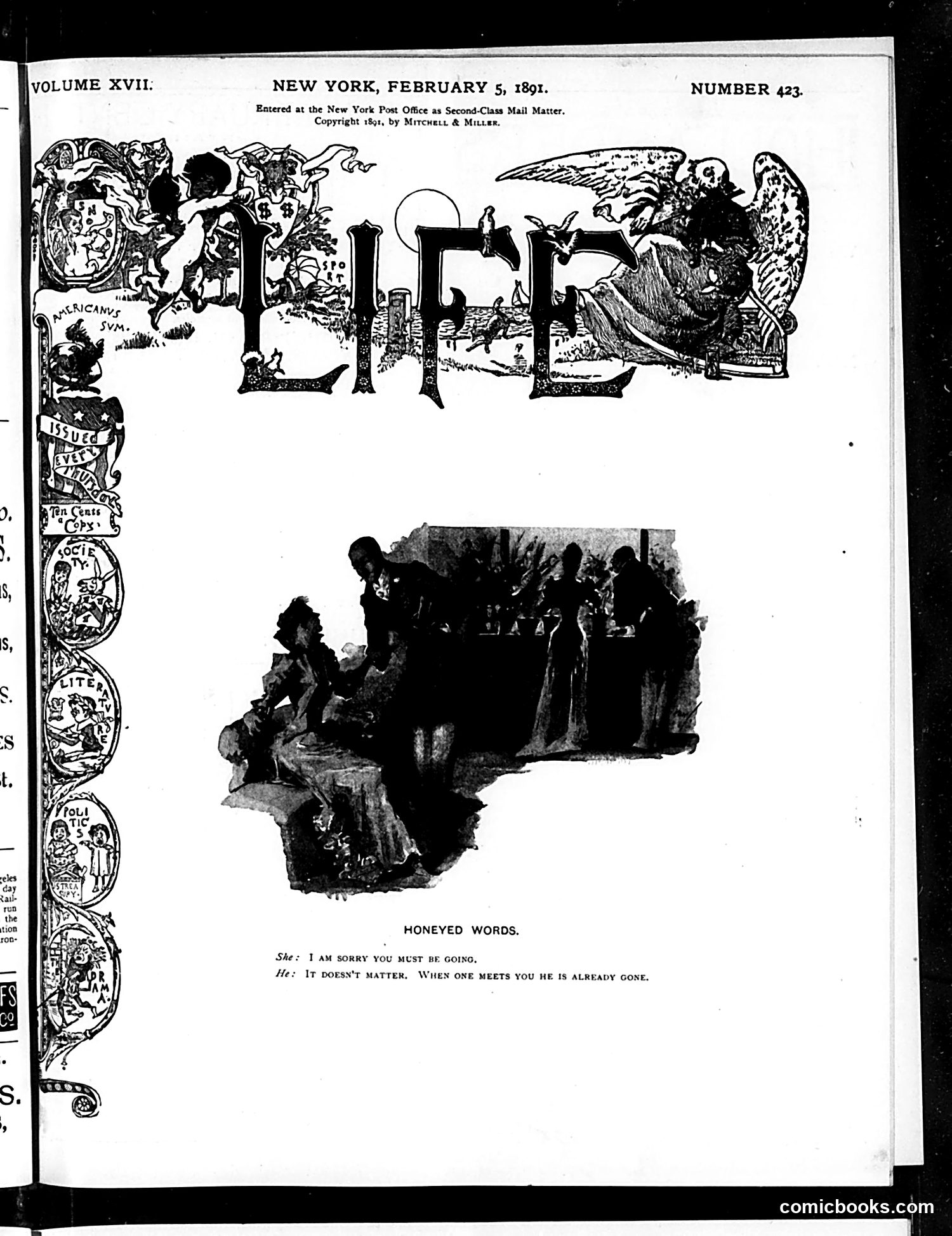
This page features an ornamental title treatment and a photograph labeled "HONEYED WORDS" depicting what appears to be a social gathering or public scene. The accompanying dialogue reads: - **She:** "I am sorry you must be going." - **He:** "It doesn't matter. When one meets you he is already gone." This is a romantic comic bit—a flirtation joke playing on the phrase "goner" (someone smitten). The man suggests that meeting the woman makes him so enamored he's already emotionally departed, making his actual physical departure irrelevant. The ornate left border contains publisher's marks and mastheads typical of Life magazine's design. The satire here is light social comedy rather than political commentary—standard fare for Life's humor content of this era.
This page is predominantly **advertising and editorial content** rather than political satire or comics. The main elements include: - A **Hollanders dress shop advertisement** (290 Fifth Avenue) promoting new summer fabrics - A **Harper's Magazine feature** describing its February issue contents, highlighting illustrations and fiction pieces - Various product advertisements (Vaseline, cucumbers cream, Scott's Emulsion cod liver oil) - An advertisement for **Life's Calendar for February** (28 pages with drawings) - Hotel and tourism advertisements **No political cartoons or satirical commentary** are visible on this page. The content reflects turn-of-the-century consumer advertising and magazine promotion rather than social or political satire typical of Life magazine's editorial voice.
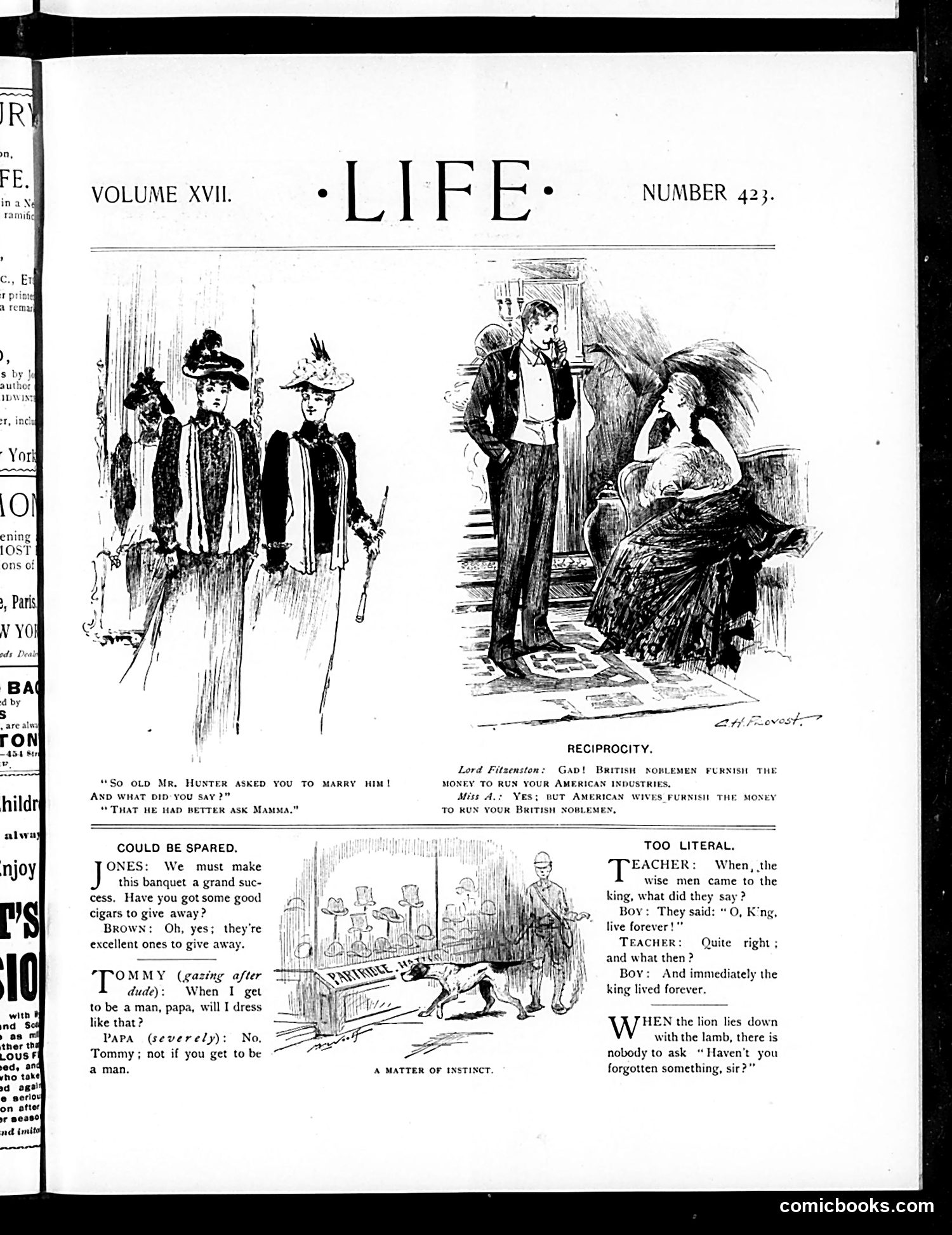
This satirical page contains several unrelated humor pieces typical of Life's format: **"Reciprocity"** (top): A cartoon mocking trade negotiations between Britain and America. A British nobleman proposes American industries fund British enterprises while Americans fund British ones—a circular arrangement mocking the absurdity of such "reciprocal" trade deals. **"Could Be Spared"** and **"Too Literal"**: Brief comedic dialogues. The first jokes about a son dressing like his father; the second plays on a child's literal interpretation of "forever" in a fairy tale. **"A Matter of Instinct"** (middle): Shows a man falling, illustrating an instinctive response. The page demonstrates Life's mix of political satire and wordplay-based humor, targeting educated readers familiar with contemporary trade disputes and literary references.
The masthead illustration at top depicts a dramatic scene with classical figures and architectural elements, likely referencing historical or mythological themes common to Life's satirical covers. The text portions discuss contemporary figures and issues: the Duke of Bedford's wealth and reputation; Superintendent Hankinson of the S.P.C.A. (Society for Prevention of Cruelty to Animals) and fashion trends regarding horse docking; Miss Lydia Thompson's return to theater; Father Ignatius and Philadelphia; and the Hutchinson family's gambling disputes in Chicago. The final item questions whether Ray Hamilton's body was properly identified—suggesting doubt about an actual event or crime. This appears to be a miscellaneous "Notes and Comments" column mixing celebrity gossip, social criticism, and current events typical of Life's satirical approach.
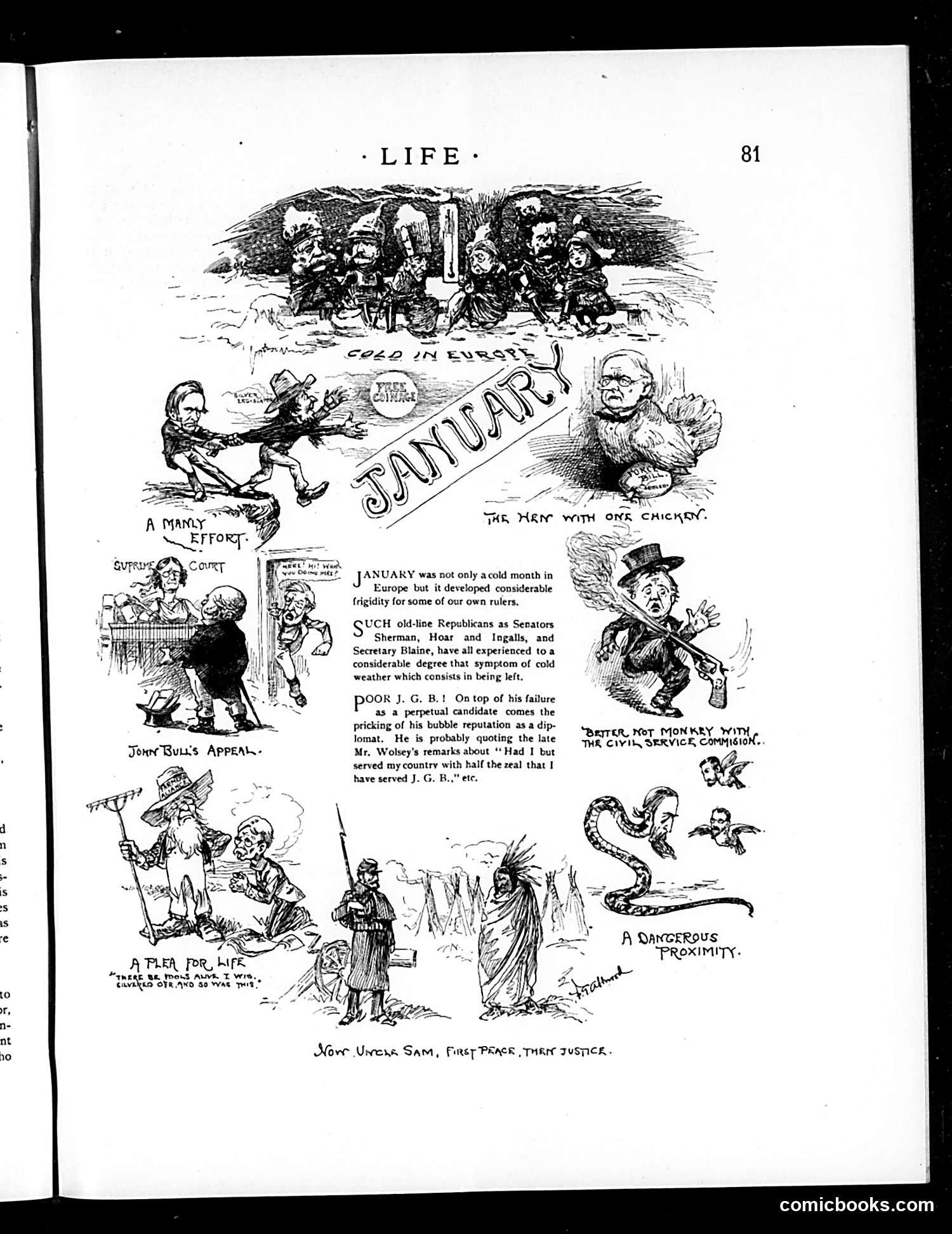
This page satirizes American political figures during a cold period in January (likely early 1900s based on style). The central cartoon "January" depicts European cold affecting U.S. Republican leaders—specifically Senators Sherman, Hoar, and Ingalls, plus Secretary Blaine—who are "left out in the cold" politically. The surrounding vignettes mock J.G. Blaine's failed presidential candidacy and Republican decline. References include "Johnny Bull's Appeal" (British interests), "A Plea for Life," and "A Dangerous Proximity" (showing a snake, likely representing political danger). The bottom caption "Not Uncle Sam, First Peace, Then Justice" suggests criticism of U.S. foreign policy priorities. The overall message ridicules Republican politicians as incompetent or abandoned by their party during a difficult political moment.
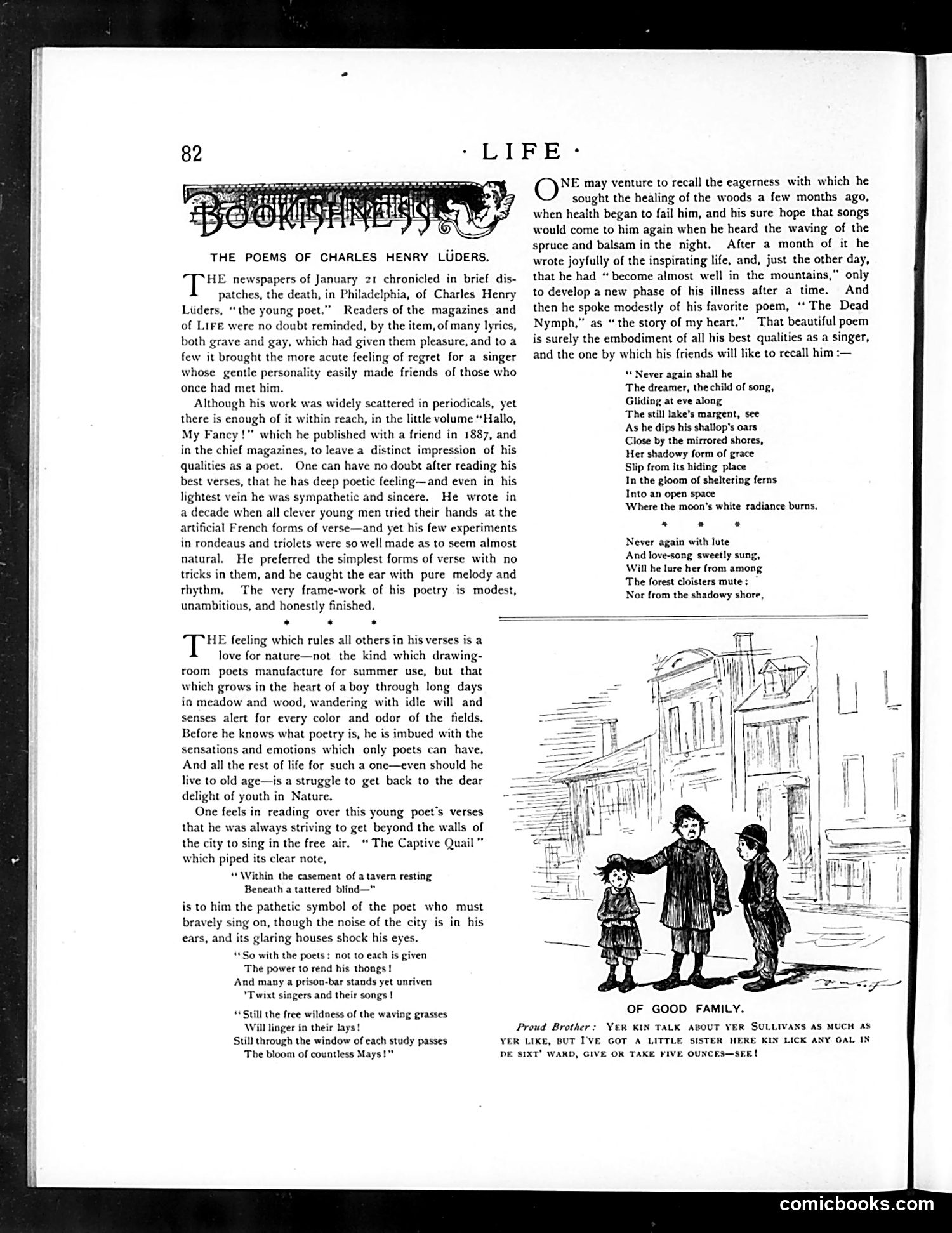
This cartoon illustrates a social commentary on class and respectability. An adult (likely a mother or governess) walks with three children through a city street. The caption's dialogue suggests the speaker is boasting about the children's "good family" status while simultaneously admitting they're impoverished—the speaker mentions having "a little sister" in a workhouse and needing to "give or take five ounces." The satire targets Victorian-era pretensions about social standing. Despite claiming genteel heritage ("good family"), the character reveals economic desperation and familial misfortune. The joke exposes the gap between claimed respectability and actual circumstances—that poverty strips away the protective shield of "good family" status that the era supposedly valued.
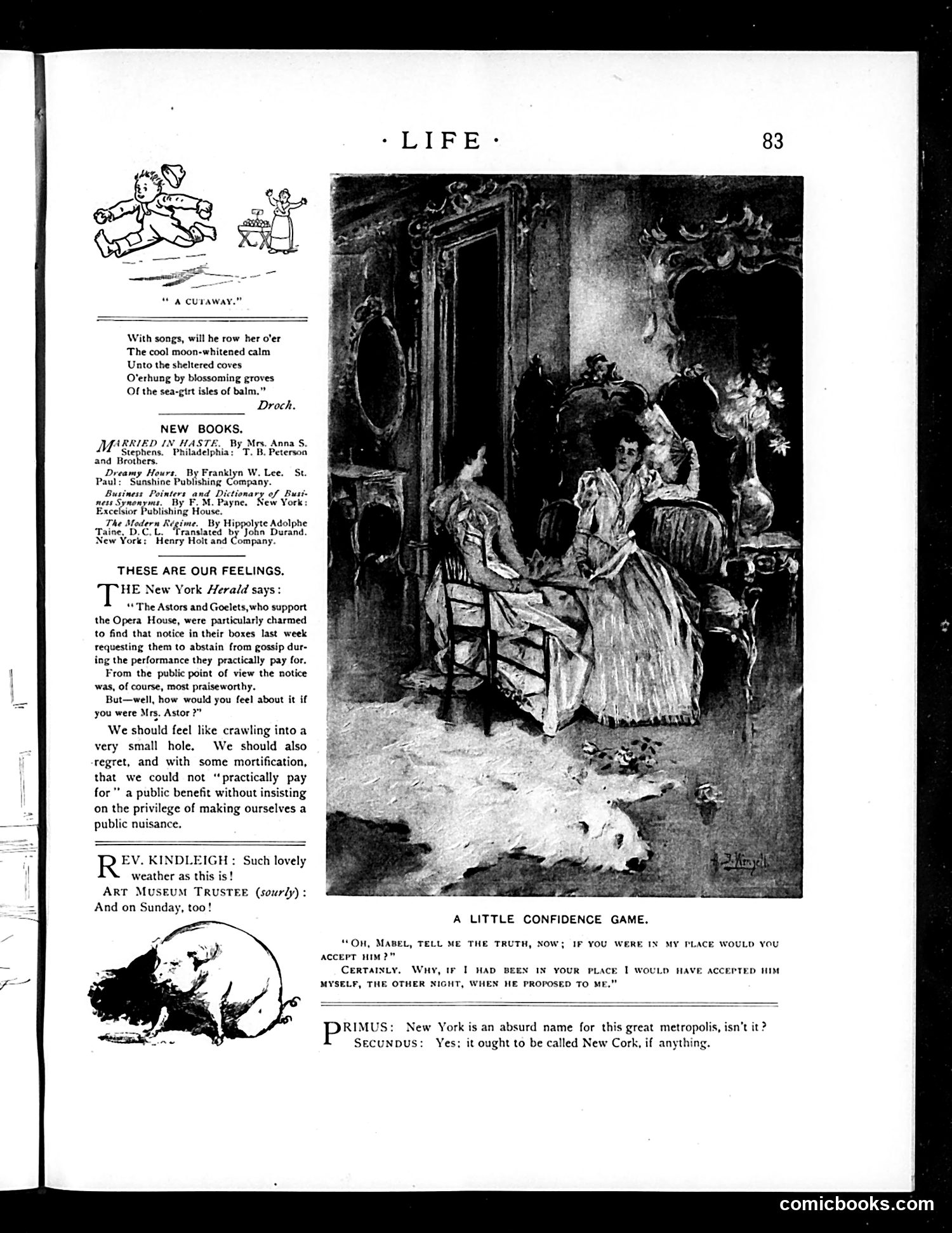
This page contains several distinct satirical elements: **"A Cutaway"** (top left): A humorous illustration of children escaping, likely commenting on childhood mischief or truancy. **"These Are Our Feelings"**: A New York Herald commentary critiquing the Astor and Goelet families (wealthy Opera House patrons) for requesting opera-goers avoid gossip during performances. The satire mocks their expectation of public silence while they benefit from public support, calling it hypocritical to demand civility without addressing their privileged status. **"A Little Confidence Game"** (center right): An illustrated scene depicting a romantic/domestic dispute, with dialogue about infidelity and trust. **Bottom dialogue**: A brief exchange (Primus/Secundus) joking that "New York" is a misnomer—it should be called "New Cork"—a pun on Irish immigration and cork/alcohol culture. The page blends social commentary on class privilege with domestic humor and ethnic jokes typical of early 20th-century American satire.
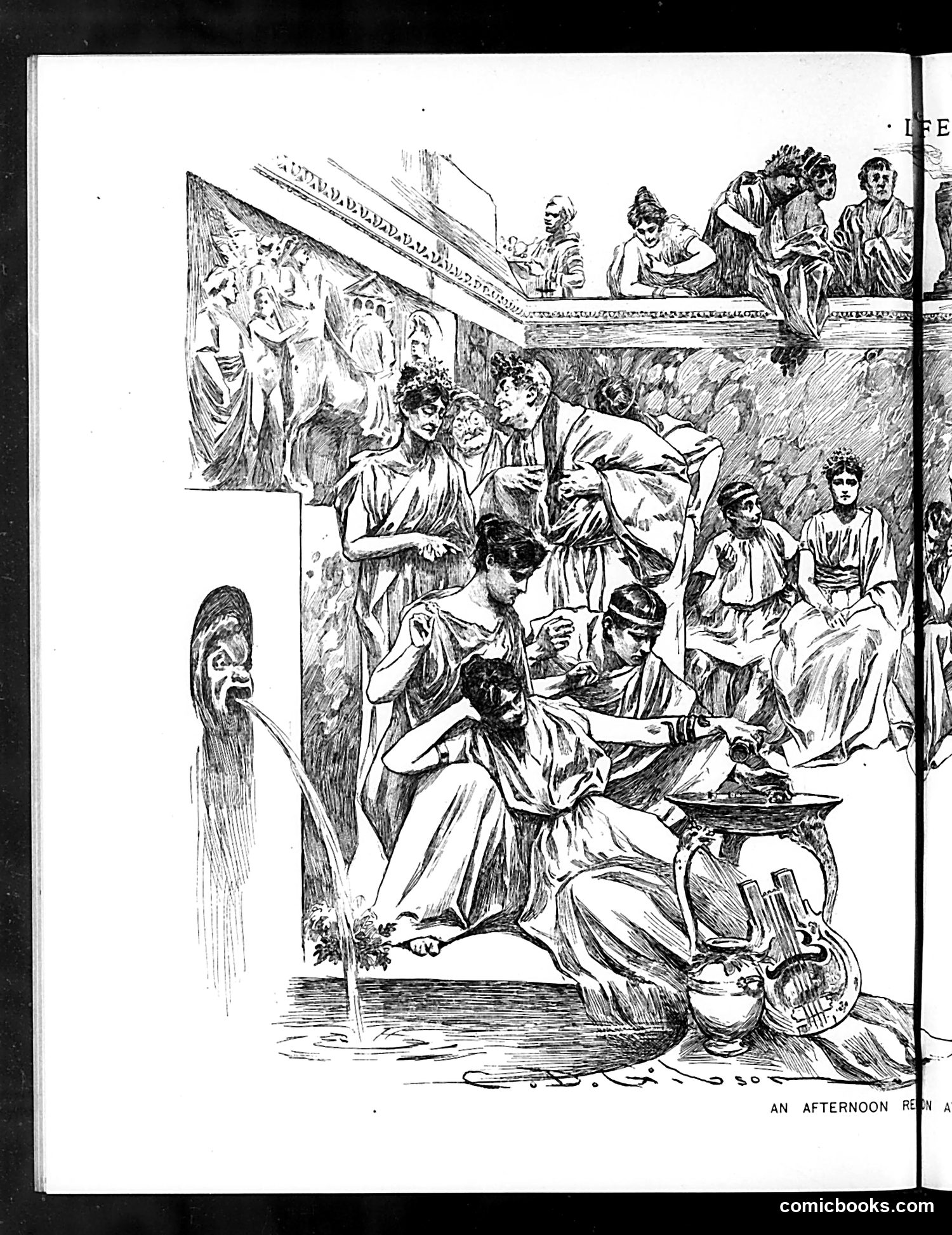
This satirical illustration depicts a classical Roman or Greek scene of leisure and excess. The composition shows figures in classical dress engaged in what appears to be a bacchanalian gathering—drinking, music-making, and socializing. The architectural setting and poses suggest an ancient symposium or entertainment. The satire likely critiques contemporary American wealth and indulgence by presenting it through classical imagery. The figures' relaxed postures, musical instruments, and abundant vessels suggest excess and hedonism. By dressing modern social behavior in ancient costume, the cartoonist appears to mock either specific wealthy individuals or broader upper-class leisure culture of the era, implying their conduct mirrors that of decadent ancient civilizations. The specific targets or contemporary references remain unclear without additional context.
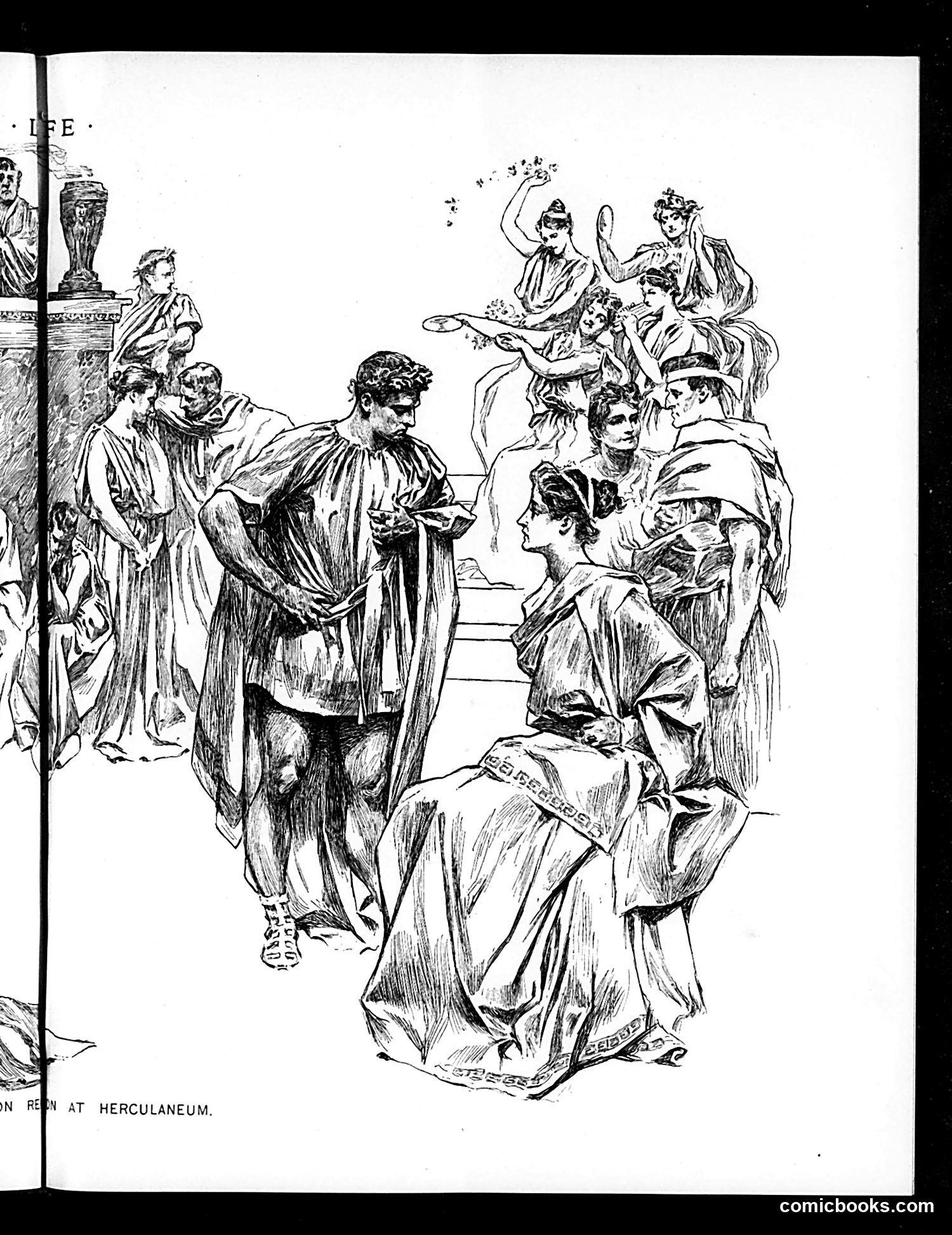
This classical-style illustration depicts "A SCENE AT HERCULANEUM" (visible in the caption), referencing the ancient Roman city buried by Mount Vesuvius in 79 AD. The satire appears to be social commentary using historical allegory. The figures are dressed in classical Roman garments, with a woman of apparent high status (seated, wearing an elaborate draped dress) receiving attention from men in togas. The grouping and composition suggest commentary on social hierarchies, gender dynamics, or power relations—likely using the "frozen in time" destruction of Herculaneum as a metaphor for critiquing contemporary social conventions or relationships that Life's satirical audience would recognize. Without additional context from surrounding pages or issue date, the specific modern parallel remains unclear, though the classical setting indicates satirical intent toward recognizable contemporary situations.
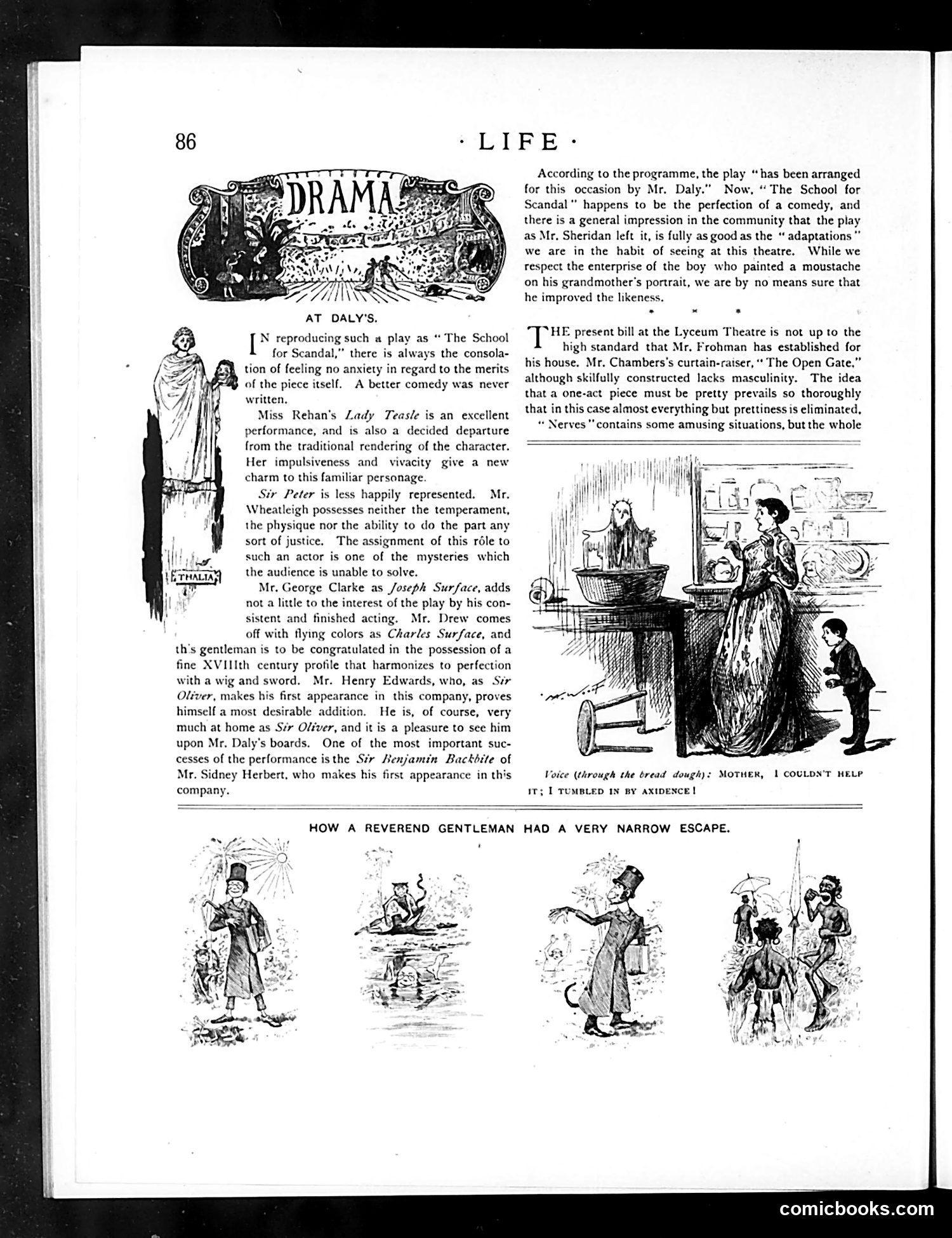
This page reviews theatrical productions at Daly's Theatre and the Lyceum Theatre. The upper section critiques performances of "The School for Scandal," praising Miss Rehan's portrayal of Lady Teazle while finding Mr. Whetleigh's performance lacking. It also praises supporting actors including George Clarke, Henry Edwards (as Sir Oliver), and Sidney Herbert in his debut. The lower section features a four-panel cartoon titled "How a Reverend Gentleman Had a Very Narrow Escape," depicting a clergyman in various misadventures involving water and potentially dangerous situations—likely humorous commentary on misfortune befalling a religious figure. The page blends theatrical criticism with illustrated humor typical of Life magazine's satirical approach.
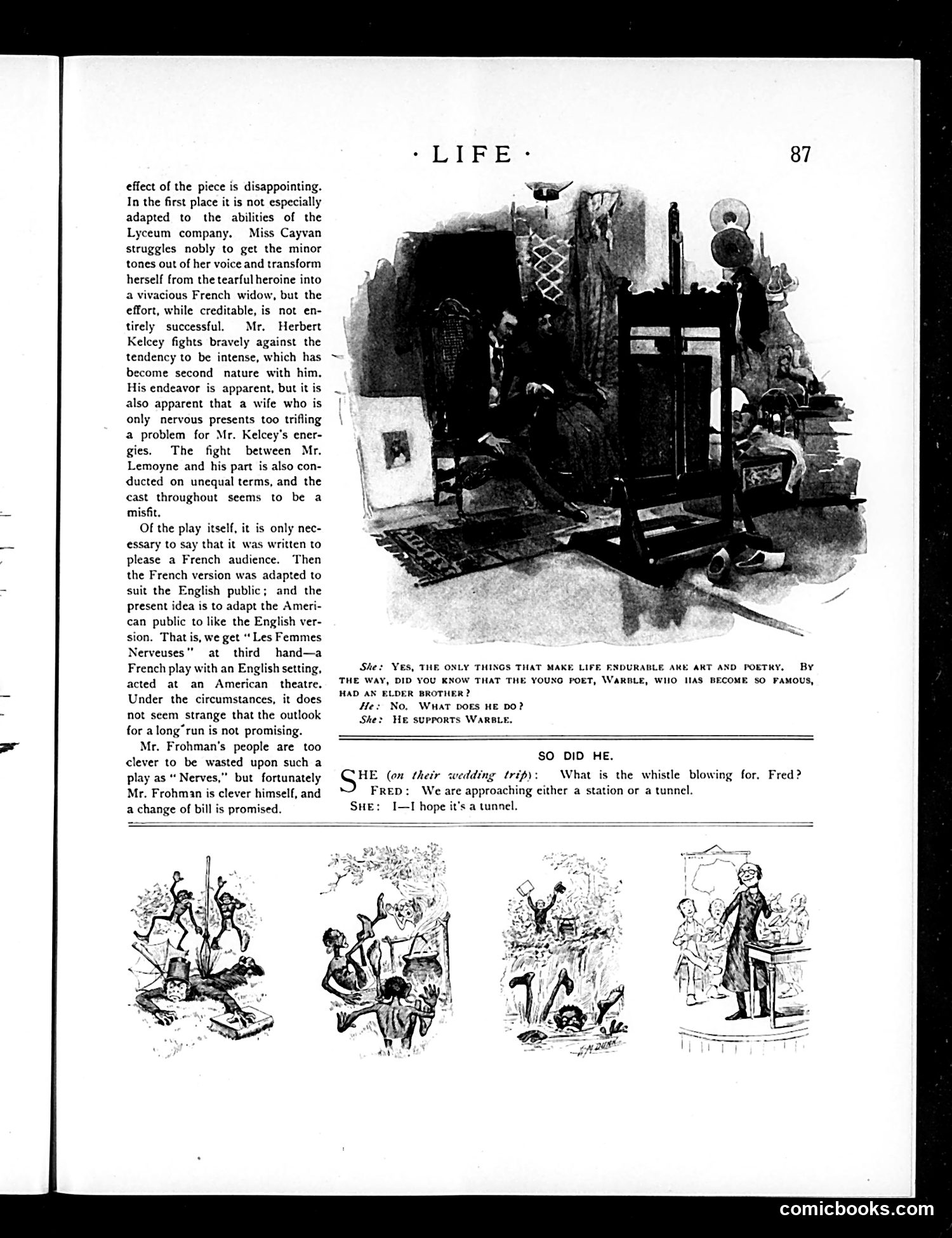
This page from *Life* magazine contains a theater review discussing an adaptation of the French play "Les Femmes Nerveuses" ("Nervous Women"). The critic discusses how the play was modified from its French original to suit English audiences, then adapted again for American audiences, arguing this multi-stage adaptation has weakened it. The large illustration shows a theatrical scene. The four smaller sketches below appear to be humorous vignettes, likely illustrating comedic scenarios related to the play's themes about nervous or anxious female characters. The dialogue excerpt shows a married couple on their honeymoon, with a joke about trains and tunnels—presumably a euphemistic reference to marital consummation that would have been considered risqué humor for the era.
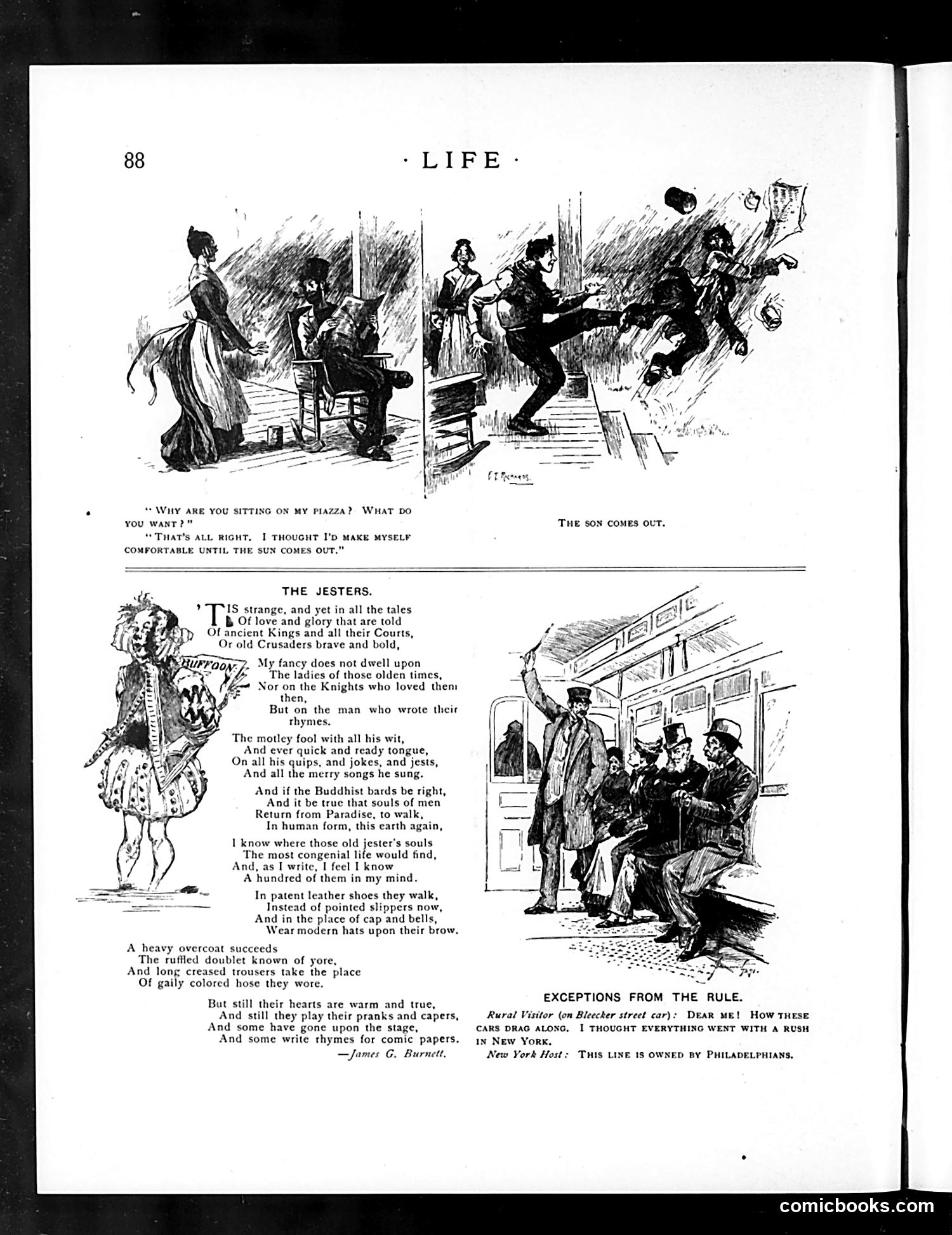
**Top Cartoon**: A man lounges uninvited on someone's porch during bad weather, claiming he'll stay comfortable "until the sun comes out." When the homeowner's son appears, the intruder flees. This is a simple comic scenario about an audacious trespasser who's emboldened by the owner's absence but cowardly when confronted. **"The Jesters" Poem**: This celebrates modern jesters—witty individuals in contemporary dress (patent leather shoes, modern hats, overcoats instead of medieval motley). The poem suggests these comedians and comic-paper writers are spiritual descendants of court jesters, keeping humor alive in modern times. It's a romantic, nostalgic tribute to comedians' social role. **Bottom Cartoon**: A rural visitor on a New York streetcar remarks that cars move slowly despite New York's reputation for speed. The host explains: the line is owned by Philadelphians. This is regional satire—a mild jab at Philadelphia's reputation as slower or less efficient than New York.
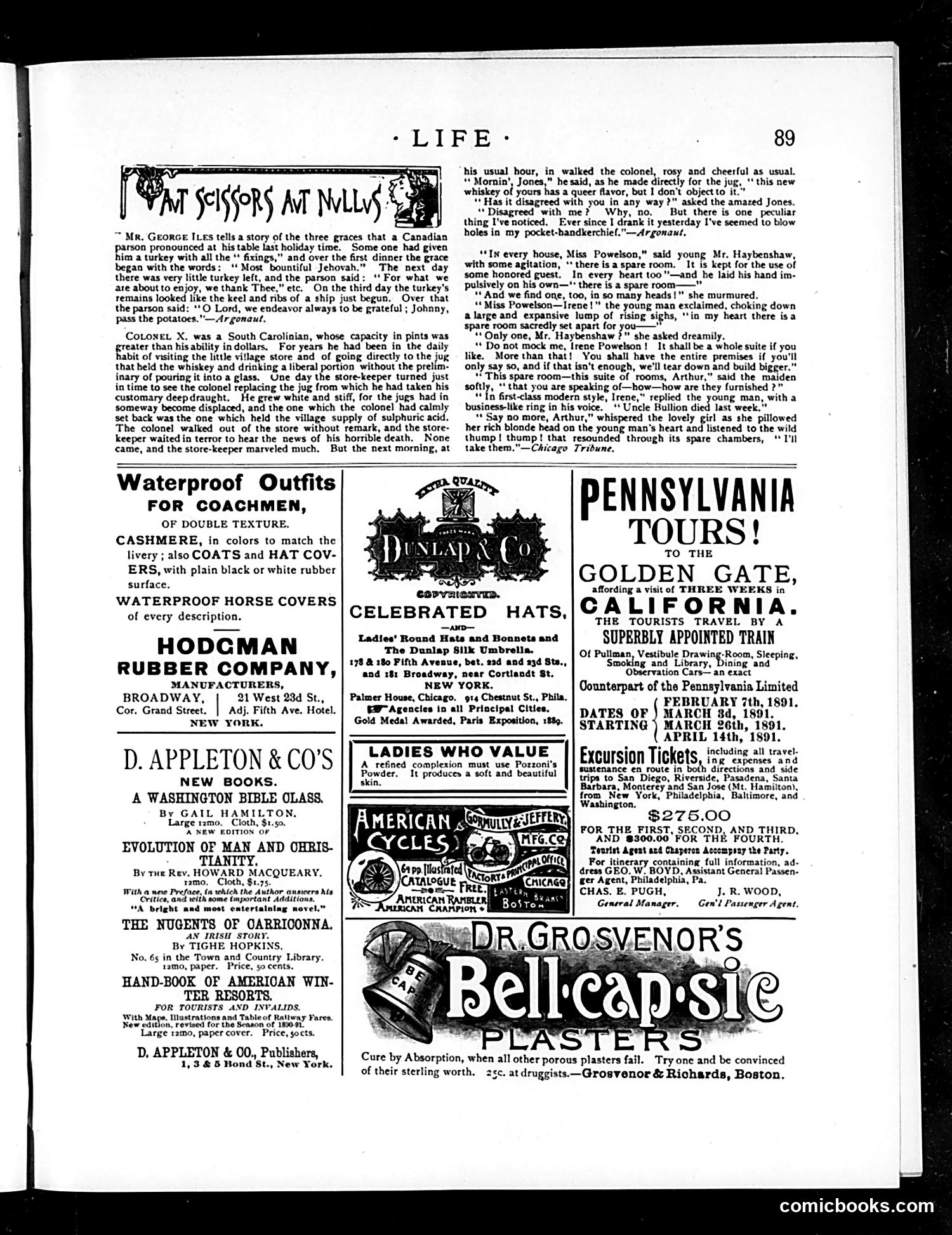
This page consists primarily of **three humorous short stories**, a common format in Life magazine during this period. There is no political cartoon visible. The jokes share similar themes—exaggerated consequences and ironic reversals: 1. **"The Three Graces"**: A Canadian parson's diminishing gratitude for leftover turkey across three dinners, with escalating desperation. 2. **"Colonel X"**: A heavy-drinking South Carolinian accidentally drinks sulphuric acid but shows no ill effects, apparently unaware he ingested poison. The joke relies on stereotyping about Southern alcoholism. 3. **"Spare Room"**: A romantic exchange where a young man proposes using his "spare room" (heart) for his beloved. Her mercenary response—asking how it's furnished—becomes charming when she learns his uncle died, making his heart "roomier" through inheritance. **The remainder of the page is advertisements** for waterproof clothing, books, bicycles, hats, and patent medicines, typical of period magazines. No satire or caricature requiring historical context appears on this specific page.
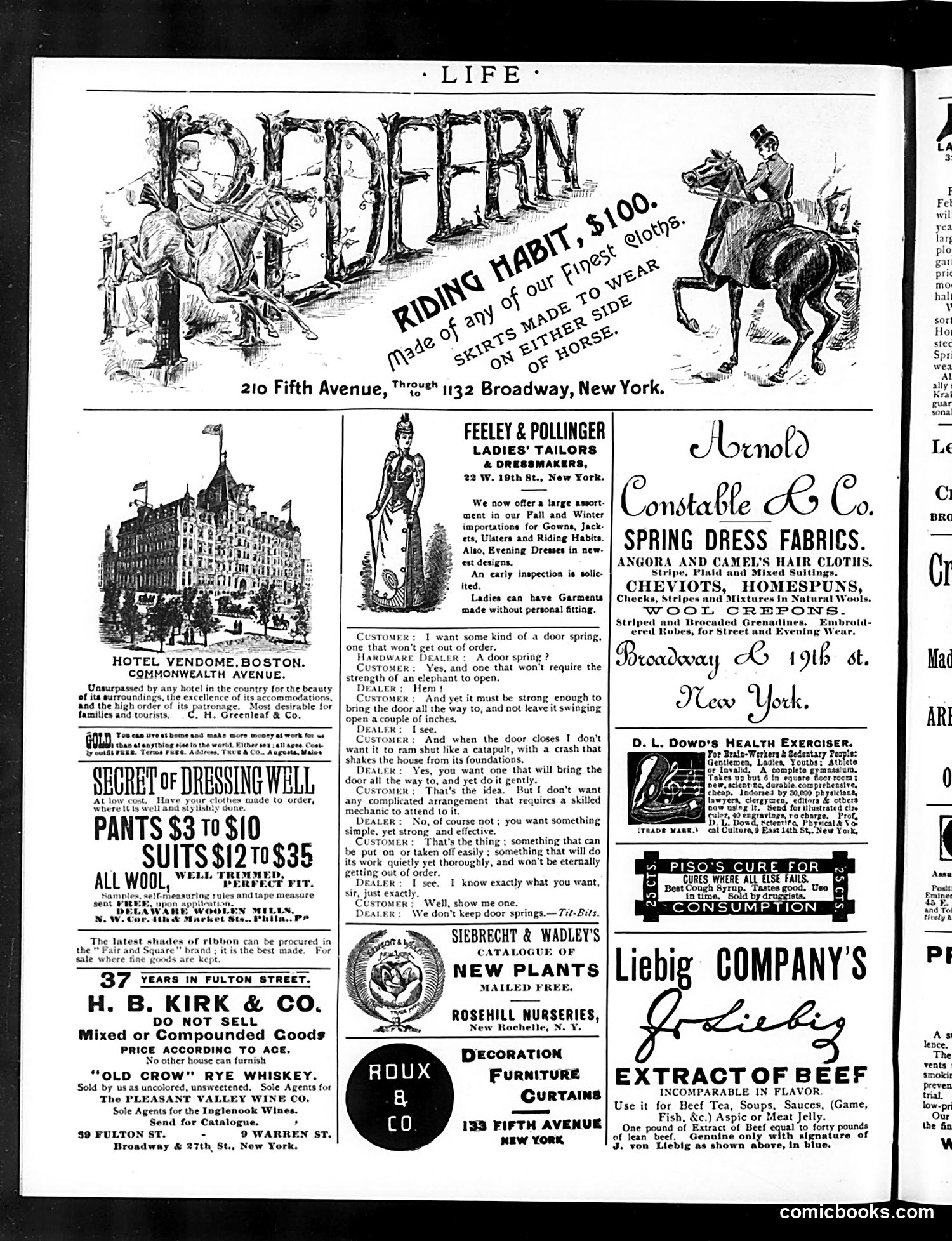
This page is primarily **advertisements** from a turn-of-the-century American magazine, with one satirical dialogue. **The main cartoon/satire** is a humorous customer-hardware dealer exchange about door springs. The joke reflects a common consumer frustration: a customer describes impossibly contradictory requirements (a spring strong yet gentle, simple yet effective, durable yet easy to adjust). The dealer, initially appearing helpful, reveals the punchline—they don't stock door springs at all. This satirizes both customer complaints and merchants' inability or unwillingness to meet exacting demands, while poking fun at the era's growing consumer culture and unrealistic expectations. **The advertisements** showcase period products: custom tailoring, whiskey, wine, dress fabrics, furniture, plant nurseries, and patent medicines (Piso's Cure, Liebig's Extract of Beef). The Liebig's ad notably claims medical benefits typical of unregulated 19th-century marketing. The Hotel Vendome ad emphasizes luxury and respectability for "families and tourists." No specific political figures or events are referenced on this page.
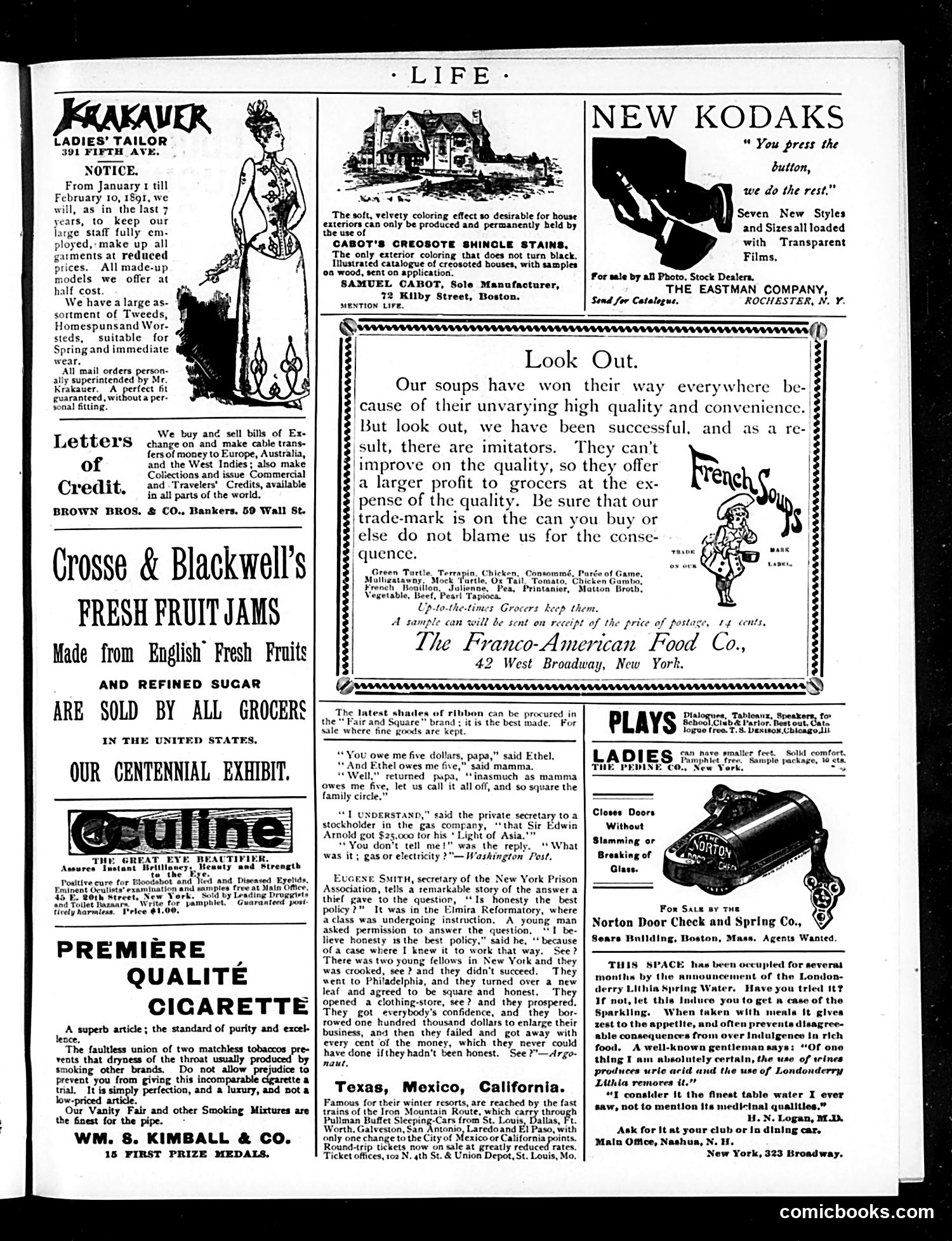
This page is primarily **advertising**, not political satire. It's a collection of commercial notices and product promotions from circa 1891, with minimal cartoon content. The only identifiable humor piece appears to be brief text jokes in the middle of the page, including wordplay about gas versus electricity in relation to Sir Edwin Arnold's poem "The Light of Asia," and a family pun about debts canceling out ("square the family circle"). The advertisements feature period products—tailor services, fruit jams, cigarettes, creosote stains, Kodak cameras ("You press the button, we do the rest"), soup brands, and door checks. There are no recognizable political figures or significant social satire visible. The page reflects late-19th-century commercial culture and consumer goods marketing rather than editorial commentary.
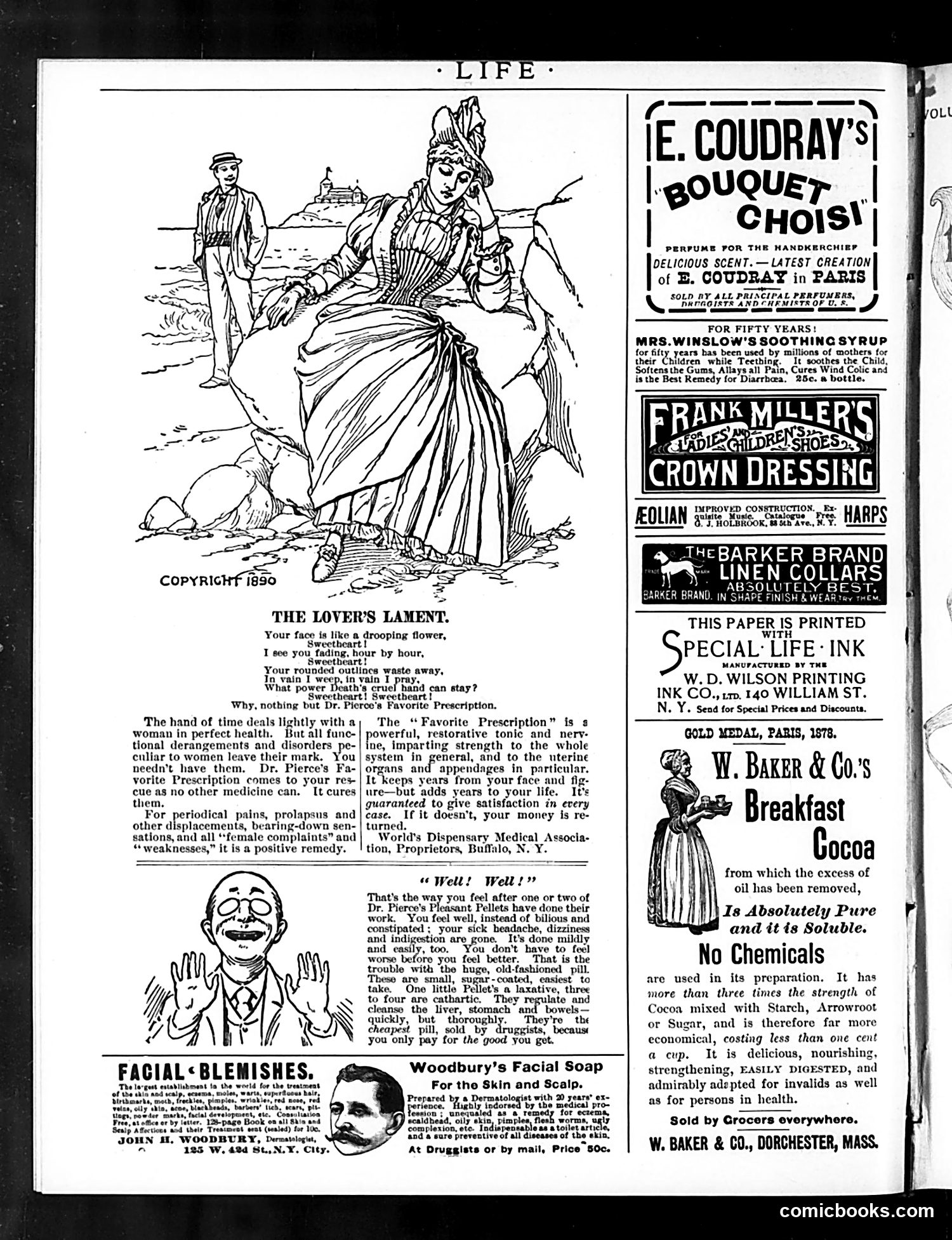
This 1890 *Life* page uses romantic poetry and a cautionary illustration to advertise Dr. Pierce's "Favorite Prescription," a patent medicine marketed to women. The satirical setup depicts a man mourning his lover's physical decline—her "rounded outlines waste away"—before the punchline: the solution is Dr. Pierce's tonic. The humor relies on period anxieties about women's health and beauty. The advertisement claims the prescription cures "female complaints" and paradoxically both removes wrinkles *and* "adds years to your life." Below, a cartoon man's exaggerated joy represents the relief patent medicines promised. The page is primarily **advertising**—six different remedies fill the margins (cocoa, soap, perfume, syrup, pills, dressing). These products exploited real medical ignorance and gender-specific insecurities to sell ineffective or dangerous substances. The satire gently mocks the desperation behind such claims while profiting from it.