
Life, 1891-02-05 · page 4 of 16
Life — February 5, 1891 — page 4: what you’re looking at
What you’re looking at
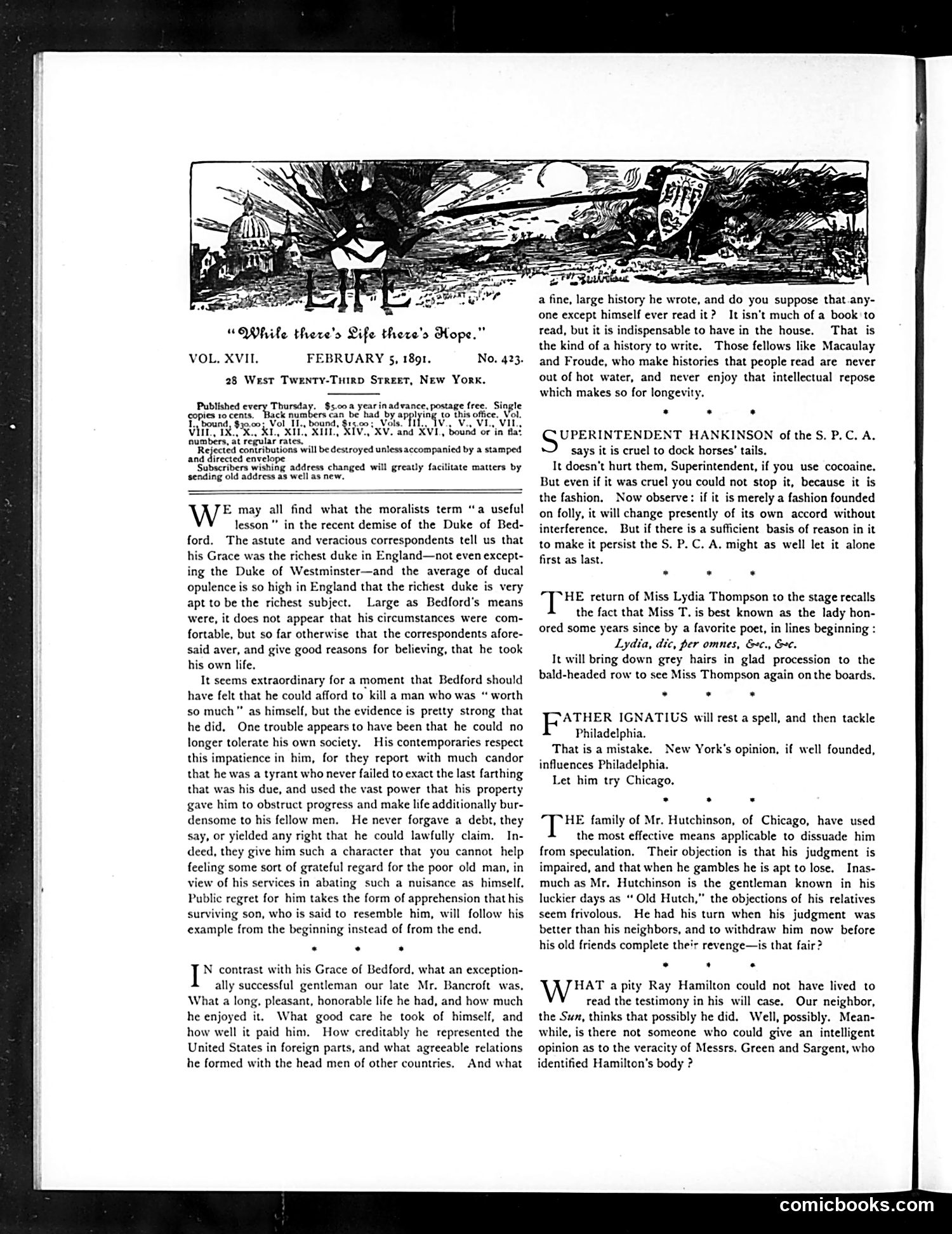
The masthead illustration at top depicts a dramatic scene with classical figures and architectural elements, likely referencing historical or mythological themes common to Life's satirical covers. The text portions discuss contemporary figures and issues: the Duke of Bedford's wealth and reputation; Superintendent Hankinson of the S.P.C.A. (Society for Prevention of Cruelty to Animals) and fashion trends regarding horse docking; Miss Lydia Thompson's return to theater; Father Ignatius and Philadelphia; and the Hutchinson family's gambling disputes in Chicago. The final item questions whether Ray Hamilton's body was properly identified—suggesting doubt about an actual event or crime. This appears to be a miscellaneous "Notes and Comments" column mixing celebrity gossip, social criticism, and current events typical of Life's satirical approach.
📄 Transcribed text from this page (OCR, searchable)
Machine-transcribed from the original scan — historical spelling and the odd misread are preserved.
“Mile there's Life there's Hope.” VOL. XVII. FEBRUARY 5, 1891. 28 West Twenty-Tuirp Street, New York. No. 423. Published every Thursday. $5.00 year inadvance, postage free. Single copies to cents, Back numbers can be had. by apply fo this office, Vol. T.,bound, $30.00; Vol. II, bound, 15.00; Vols ive VV. Vit. 1X, X, XL, XI, XHIL, XIV. XV. and XVI, bound of in flat numbers, at regular rates, Rejected contributions will be destroyed unless accompanied by a stamped and directed envelope Subscribers wishing address changed will greatly facilitate matters by sending old address as well as new. WE may all find what the moralists term ‘a useful lesson" in the recent demise of the Duke of Bed- ford. The astute and veracious correspondents tell us that his Grace was the richest duke in England—not even except- ing the Duke of Westminster—and the average of ducal opulence is so high in England that the richest duke is very apt to be the richest subject. Large as Bedford's means were, it does not appear that his circumstances were com- fortable, but so far otherwise that the correspondents afore- said aver, and give good reasons for believing, that he took his own life. It seems extraordinary for a moment that Bedford should have felt that he could afford to kill a man who was “ worth so much” as himself, but the evidence is pretty strong that he did. One trouble appears to have been that he could no longer tolerate his own society. His contemporaries respect this impatience in him, for they report with much candor that he was a tyrant who never failed to exact the last farthing that was his due, and used the vast power that his property gave him to obstruct progress and make life additionally bur- densome to his fellow men. He never forgave a debt, they say, or yielded any right that he could lawfully claim. In- deed, they give him such a character that you cannot help feeling some sort of grateful regard for the poor old man, in view of his services in abating such a nuisance as himself. Public regret for him takes the form of apprehension that his surviving son, who is said to resemble him, will follow his example from the beginning instead of from the end. I N contrast with his Grace of Bedford, what an exception- ally successful gentleman our late Mr. Bancroft was. What a long, pleasant, honorable life he had, and how much he enjoyed it. What good care he took of himself, and how well it paid him. How creditably he represented the United States in foreign parts, and what agreeable relations he formed with the head men of other countries. And what a fine, large history he wrote, and do you suppose that.any- one except himself ever read it? It isn't much of a book to read, but it is indispensable to have in the house. That is the kind of a history to write. Those fellows like Macaulay and Froude, who make histories that people read are never out of hot water, and never enjoy that intellectual repose which makes so for longevity, SG UPERINTENDENT HANKINSON of the S. P.C. A. says it is cruel to dock horses’ tails. It doesn’t hurt them, Superintendent, if you use cocoaine. But even if it was cruel you could not stop it, because it is the fashion. Now observe: if it is merely a fashion founded on folly, it will change presently of its own accord without interference. But if there is a sufficient basis of reason in it to make it persist the S. P. C. A. might as well let it alone first as last. * * . TE return of Miss Lydia Thompson to the stage recalls the fact that Miss T. is best known as the lady hon- ored some years since by a favorite poet, in lines beginning : Lydia, dic, per omnes, &-¢., Gt. It will bring down grey hairs in glad procession to the bald-headed row to see Miss Thompson again on the boards. Pa tHer IGNATIUS will rest a spell, and then tackle Philadelphia. That is a mistake. New York's opinion, if well founded, influences Philadelphia. Let him try Chicago, . . . HE family of Mr. Hutchinson, of Chicago, have used the most effective means applicable to dissuade him from speculation, Their objection is that his judgment is impaired, and that when he gambles he is apt to lose. Inas- much as Mr. Hutchinson is the gentleman known in his luckier days as “ Old Hutch,” the objections of his relatives seem frivolous. He had his turn when his judgment was better than his neighbors, and to withdraw him now before his old friends complete the'r revenge—is that fair? . ‘ . wrt a pity Ray Hamilton could not have lived to read the testimony in his will case. Our neighbor, the Su, thinks that possibly he did. Well, possibly. Mean- while, is there not someone who could give an intelligent opinion as to the veracity of Messrs. Green and Sargent, who identified Hamilton's body ? comicbooks.com