
Life, 1891-02-05 · page 6 of 16
Life — February 5, 1891 — page 6: what you’re looking at
What you’re looking at
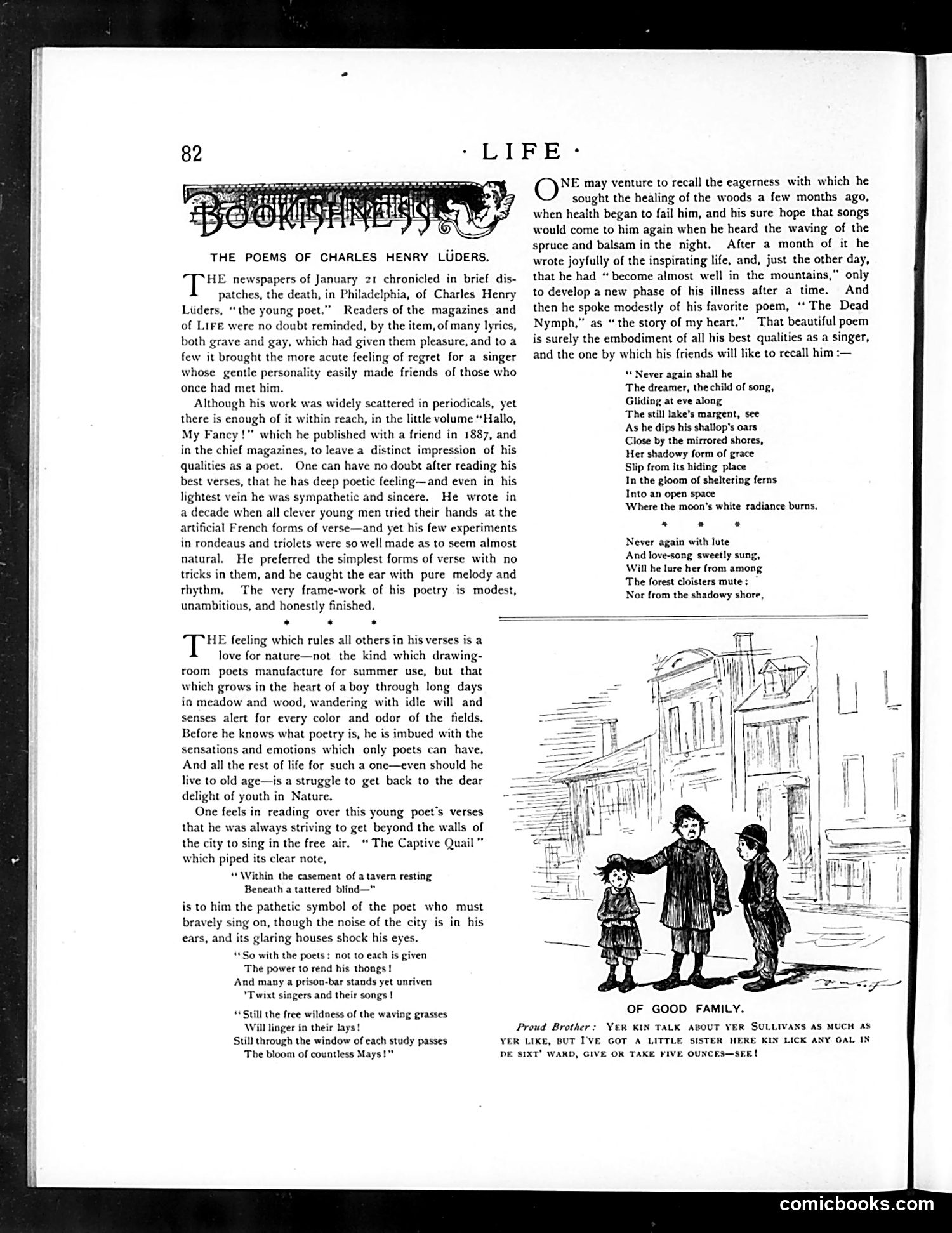
This cartoon illustrates a social commentary on class and respectability. An adult (likely a mother or governess) walks with three children through a city street. The caption's dialogue suggests the speaker is boasting about the children's "good family" status while simultaneously admitting they're impoverished—the speaker mentions having "a little sister" in a workhouse and needing to "give or take five ounces." The satire targets Victorian-era pretensions about social standing. Despite claiming genteel heritage ("good family"), the character reveals economic desperation and familial misfortune. The joke exposes the gap between claimed respectability and actual circumstances—that poverty strips away the protective shield of "good family" status that the era supposedly valued.
📄 Transcribed text from this page (OCR, searchable)
Machine-transcribed from the original scan — historical spelling and the odd misread are preserved.
-CDIFE: THE POEMS OF CHARLES HENRY LUDERS. HE newspapers of January 21 chronicled in brief dis- patches, the death, in Philadelphia, of Charles Henry Liiders, “the young poet.” Readers of the magazines and of Lire were no doubt reminded, by the item, of many lyrics, both grave and gay, which had given them pleasure, and to a few it brought the more acute feeling of regret for a singer whose gentle personality easily made friends of those who once had met him. Although his work was widely scattered in periodicals, yet there is enough of it within reach, in the little volume “Hallo, My Fancy!" which he published with a friend in 1887, and in the chief magazines, to leave a distinct impression of his qualities as a poet. One can have no doubt after reading his best verses, that he has deep poetic feeling—and even in his lightest vein he was sympathetic and sincere. He wrote in a decade when all clever young men tried their hands at the artificial French forms of verse—and yet his few experiments in rondeaus and triolets were so well made as to seem almost natural. He preferred the simplest forms of verse with no tricks in them, and he caught the ear with pure melody and rhythm. The very frame-work of his poetry is modest, unambitious, and honestly finished. NE may venture to recall the eagerness with which he sought the healing of the woods a few months ago, when health began to fail him, and his sure hope that songs would come to him again when he heard the waving of the spruce and balsam in the night. After a month of it he wrote joyfully of the inspirating life, and, just the other day, that he had “ become almost well in the mountains,” only to develop a new phase of his illness after a time. And then he spoke modestly of his favorite poem, ‘* The Dead Nymph,” as “the story of my heart.” That beautiful poem is surely the embodiment of all his best qualities as a singer, and the one by which his friends will like to recall him :— “ Never again shall he The dreamer, the child of song, Gliding at eve along ‘The still lake's margent, see As he dips his shallop's oars Close by the mirrored shores, Her shadowy form of grace Slip from its hiding place In the gloom of sheltering ferns Into an open space Where the moon's white radiance burns. * . * Never again with lute And love-song sweetly sung, Will he lure her from among The forest cloisters mute: Nor from the shadowy shore, . . . HE feeling which rules all others in his verses is a love for nature—not the kind which drawing- room poets manufacture for summer use, but that which grows in the heart of aboy through long days in meadow and wood, wandering with idle will and senses alert for every color and odor of the fields. Before he knows what poetry is, he is imbued with the sensations and emotions which only poets can have. And all the rest of life for such a one—even should he live to old age—is a struggle to get back to the dear delight of youth in Nature. One feels in reading over this young poet's verses that he was always striving to get beyond the walls of the city to sing in the free air, ‘ The Captive Quail” which piped its clear note, “Within the casement of a tavern resting Beneath a tattered blind—" is to him the pathetic symbol of the poet who must bravely sing on, though the noise of the city is in his ears, and its glaring houses shock his eyes. “So with the poets; not to each is given The power to rend his thongs ! And many a prison-bar stands yet unriven ’Twixt singers and their songs ! “Still the free wildness of the waving grasses Will linger in their lays! Still through the window of each study passes The bloom of countless Mays!” Proud Brother: YER LIKE, BUT I'VE GOT A LITTLE SISTER HERE KIN LICK ANY GAL IN DE SIXT’ WARD, GIVE OR TAKE FIVE OUNCES—SEE! OF GOOD FAMILY. YER KIN TALK ABOUT YER SULLIVANS AS MUCH AS comicbooks.com