
A complete issue · 14 pages · 1890
Life — December 11, 1890
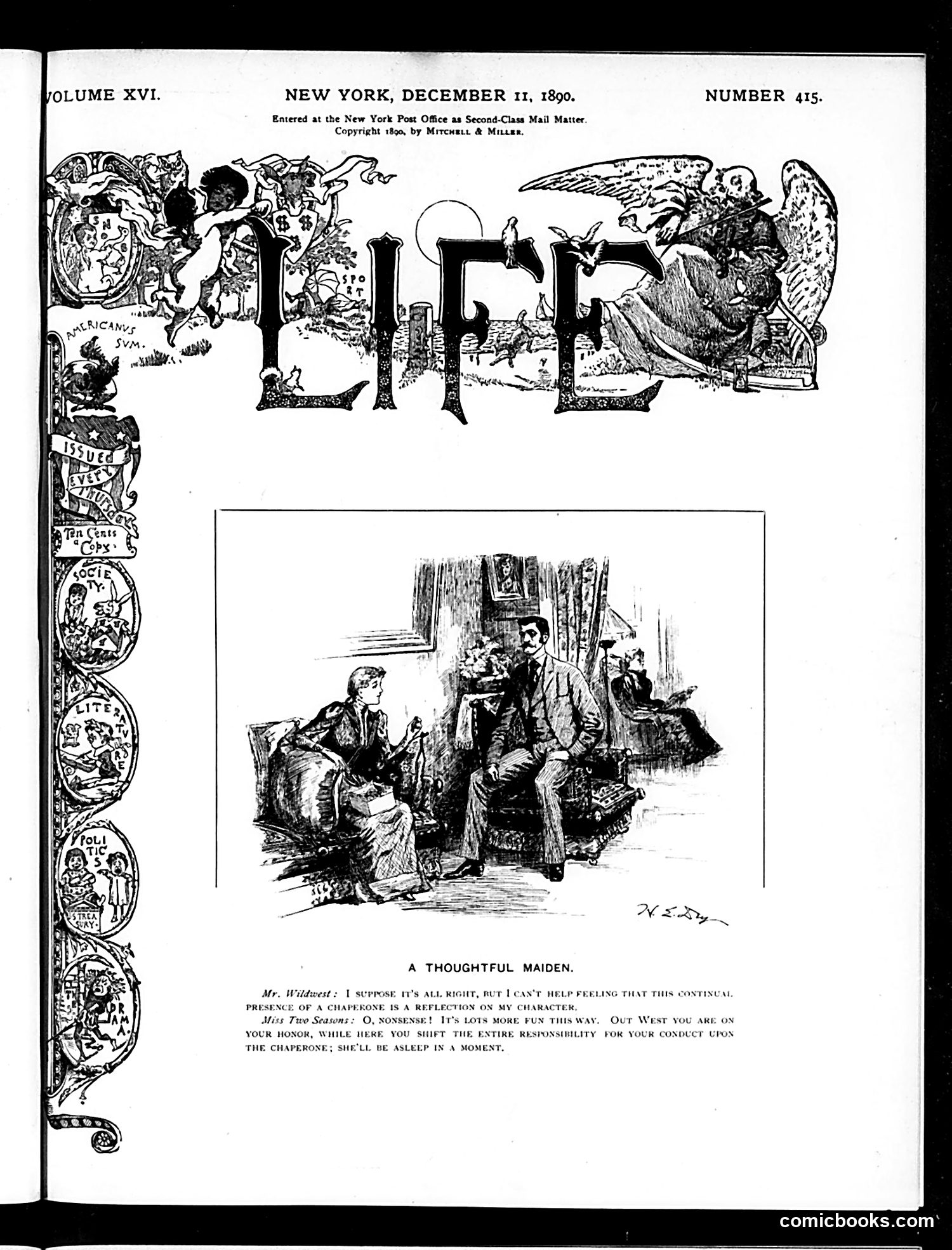
This satirical illustration depicts a social scene where a young woman is being addressed by a man (labeled "Mr. Wildshed") about the propriety of a chaperone's presence. The dialogue suggests tension between modern social expectations and Victorian conventions: the man protests that the chaperone reflects poorly on his character, while a second woman ("Miss Two Swords") defends the practice, sarcastically suggesting the West is more "fun" without such oversight—but insisting the chaperone remain to protect the young woman's reputation and propriety. The satire targets debates about women's independence and courtship norms in the 1890s, mocking both men uncomfortable with moral oversight and the rigid social rules governing female respectability.
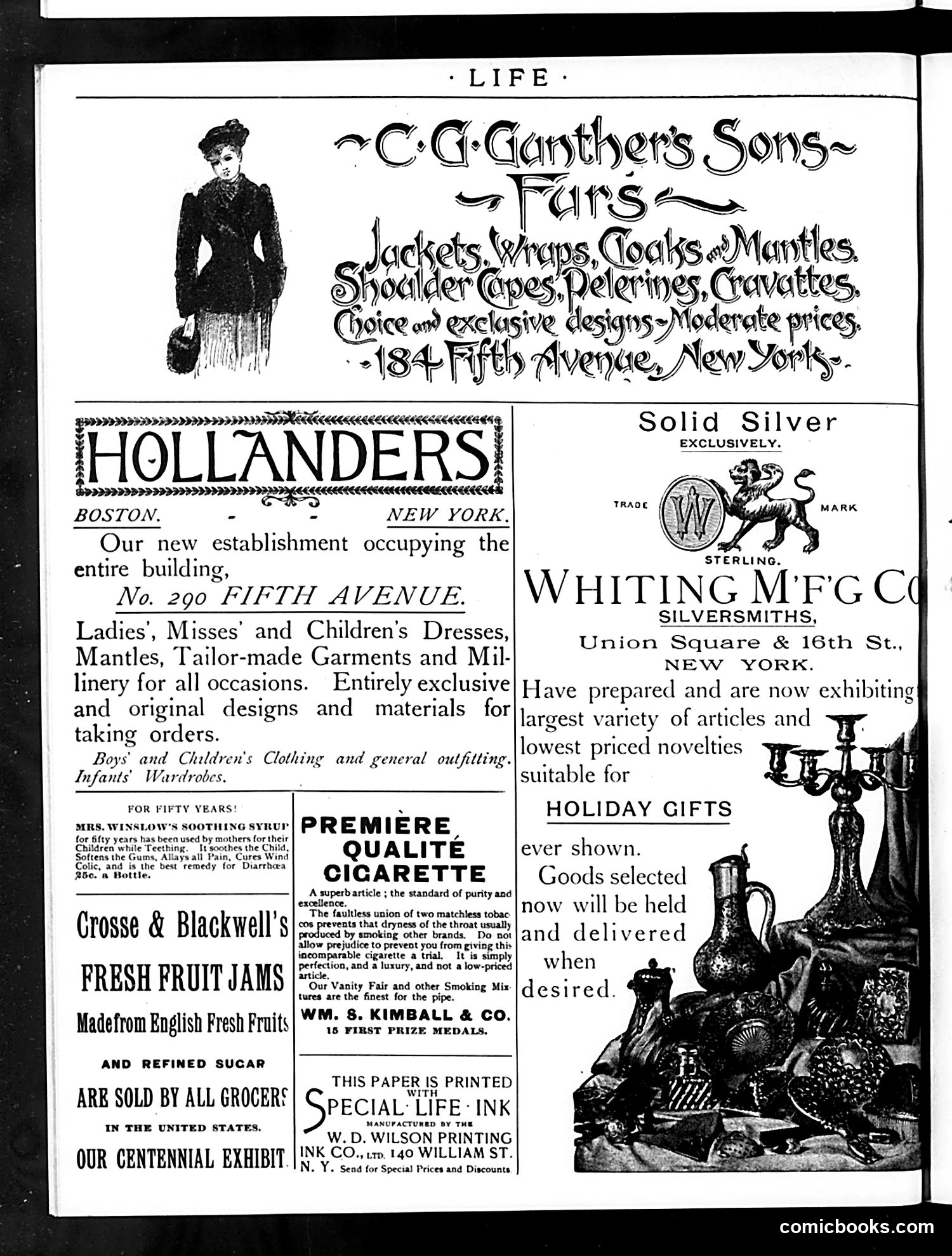
This page is primarily **advertising content**, not satirical cartoons. It contains several commercial advertisements from what appears to be a late 19th or early 20th-century *Life* magazine: - **C.G. Ganthers Sons**: A fur retailer advertising women's coats and capes - **Hollanders**: A dress and clothing shop in Boston and New York - **Crosse & Blackwell's**: Fresh fruit jams advertisement - **Premiere Qualite Cigarettes**: Tobacco product advertisement - **Whiting MFG Co.**: Silver goods and holiday gift items The page also notes the printing was done with special "Life Ink" by W.D. Wilson Printing. Rather than satire, this represents typical period magazine advertising, aimed at middle and upper-class consumers seeking fashionable clothing, luxury goods, and specialty foods.
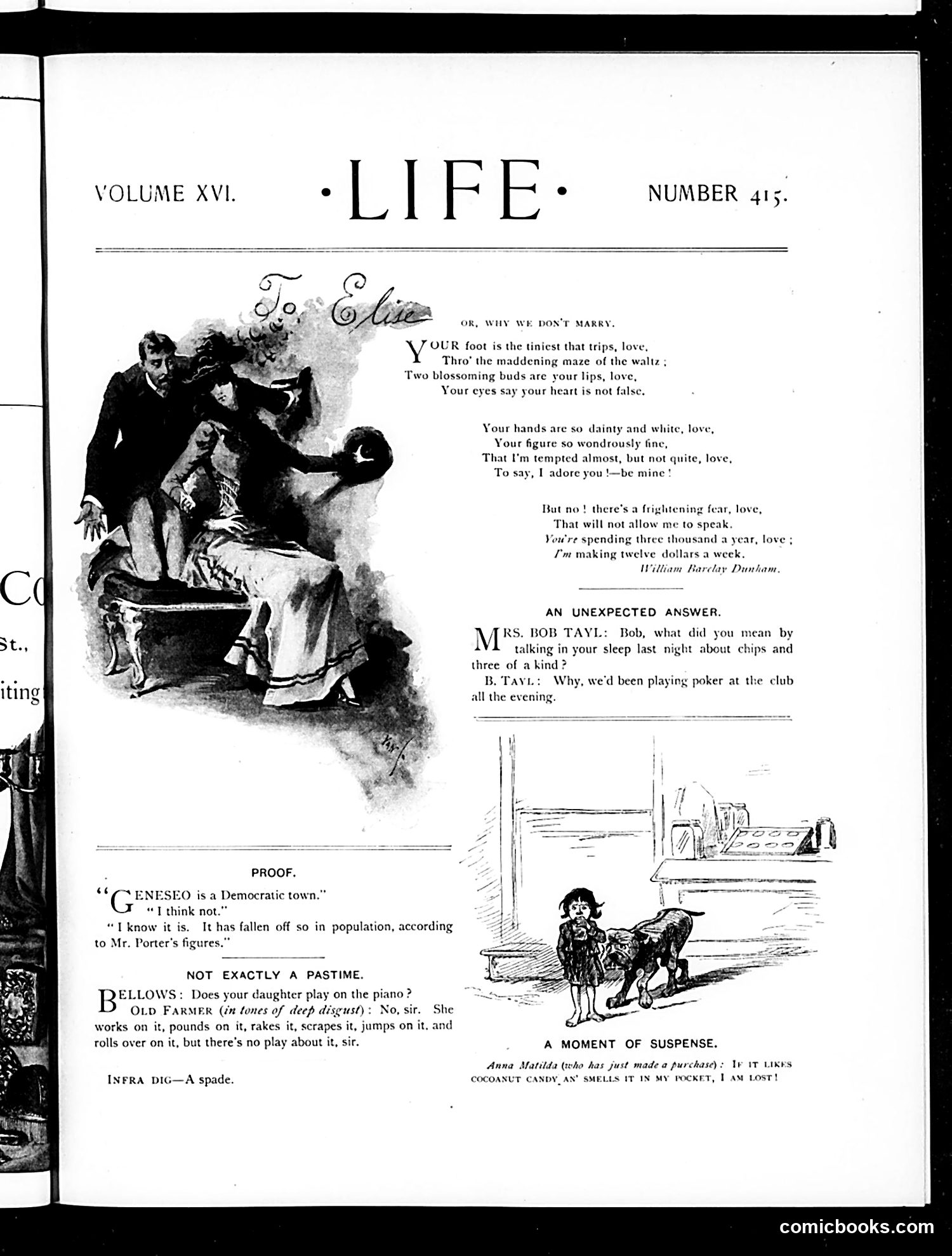
This page contains several light satirical pieces typical of early 20th-century humor magazines: **"To Eliza"** is a romantic poem mocking marriage hesitation, attributing the reluctance to financial concerns ("You're spending three thousand a year"). **"An Unexpected Answer"** jokes about a husband's sleep-talking—he mentions "chips and three of a kind," revealing his evening poker game to his wife. **"Proof"** and **"Not Exactly a Pastime"** are brief comedy sketches about small-town life and a farmer's daughter's unmusical piano playing. **"A Moment of Suspense"** depicts a child who has lost candy, worried about smelling it in her pocket. The page features typical period illustrations and offers gentle social satire targeting romance, domestic life, and rural America—standard genteel humor for Life's educated audience.
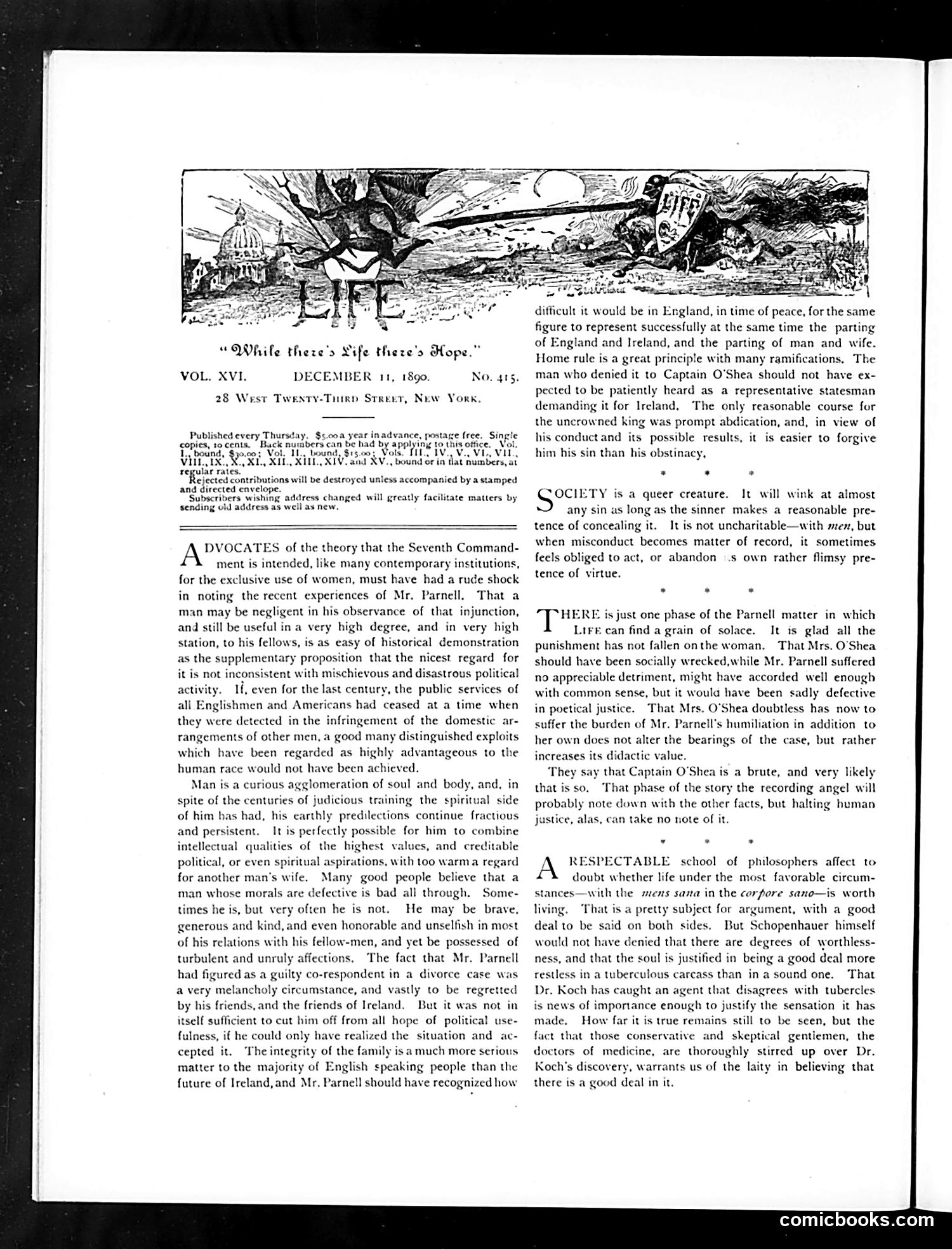
**The Cartoon:** The masthead illustration depicts a barren landscape with a gnarled tree, suggesting desolation or decay. The phrase "While there's Life there's Hope" appears as the motto. **The Editorial Content:** The article discusses **Mr. Parnell** and recent controversies surrounding him. It addresses the **Seventh Commandment** (against adultery) and argues that while Parnell's moral failings are regrettable, they shouldn't disqualify him from political leadership. The piece criticizes **Captain O'Shea** for publicly exposing the scandal rather than handling it privately, suggesting this damaged Ireland's political interests. The satire targets Victorian hypocrisy: society condemns moral transgressions when exposed publicly, yet tolerates them privately. The editorial defends Parnell's continued political utility despite his personal misconduct, reflecting Irish Home Rule politics of the era.
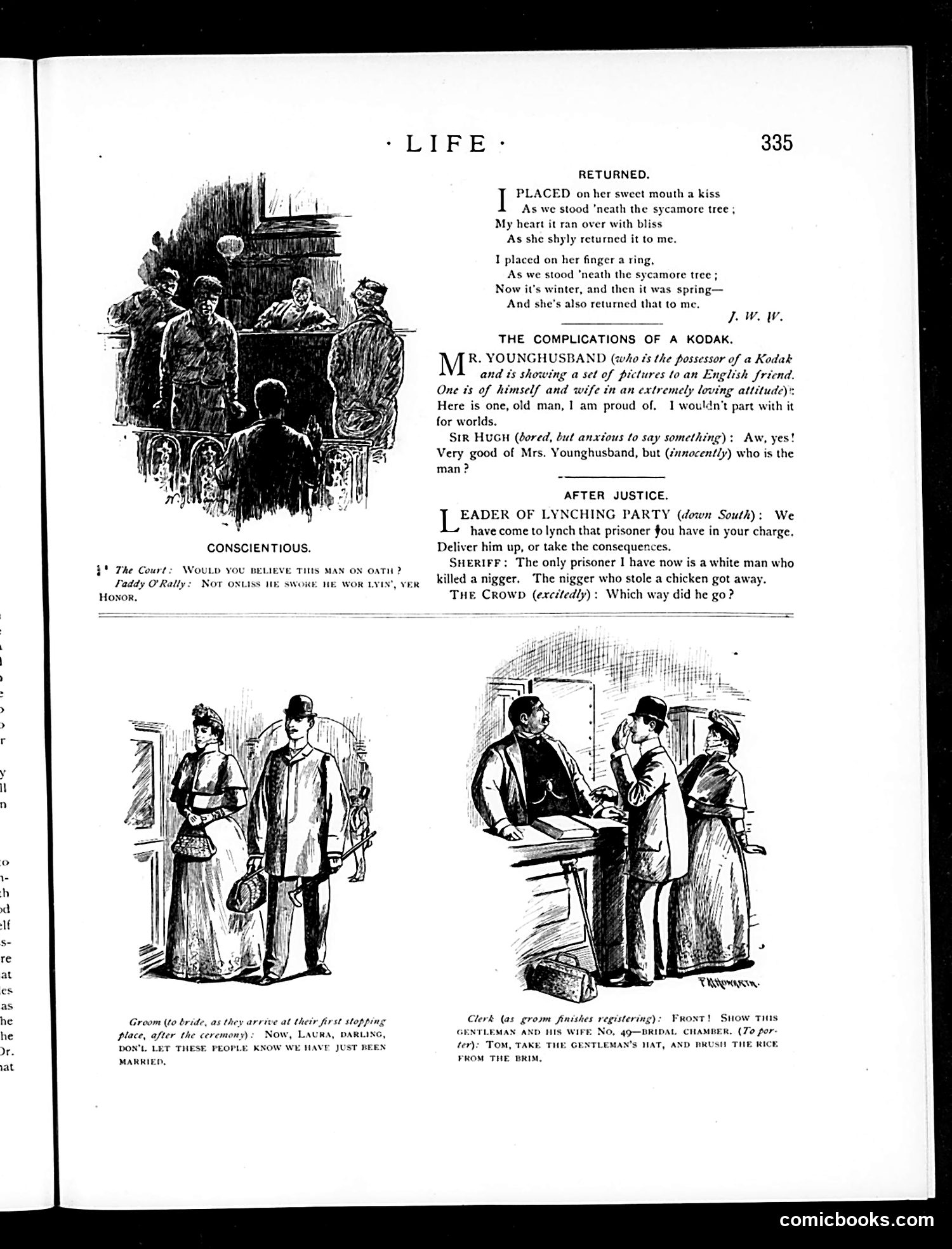
This page contains several satirical pieces: **"Returned"** is a sentimental poem about rekindled romance, apparently using seasonal metaphors. **"The Complications of a Kodak"** satirizes Mr. Younghusband showing photographs to an English friend. The joke appears to target the awkwardness of amateur photography enthusiasts boring others with personal snapshots—a timeless social phenomenon. **"After Justice"** depicts a dark satirical exchange: a lynch mob (identified as "from South") demands a prisoner from a sheriff. The sheriff reveals his only prisoner is a white man who killed a Black man, and the mob asks "which way did he go?"—dark satire on racial injustice and selective enforcement of mob violence in the American South. The illustrations feature period clothing and sketch-style artwork typical of early-20th-century Life magazine humor.
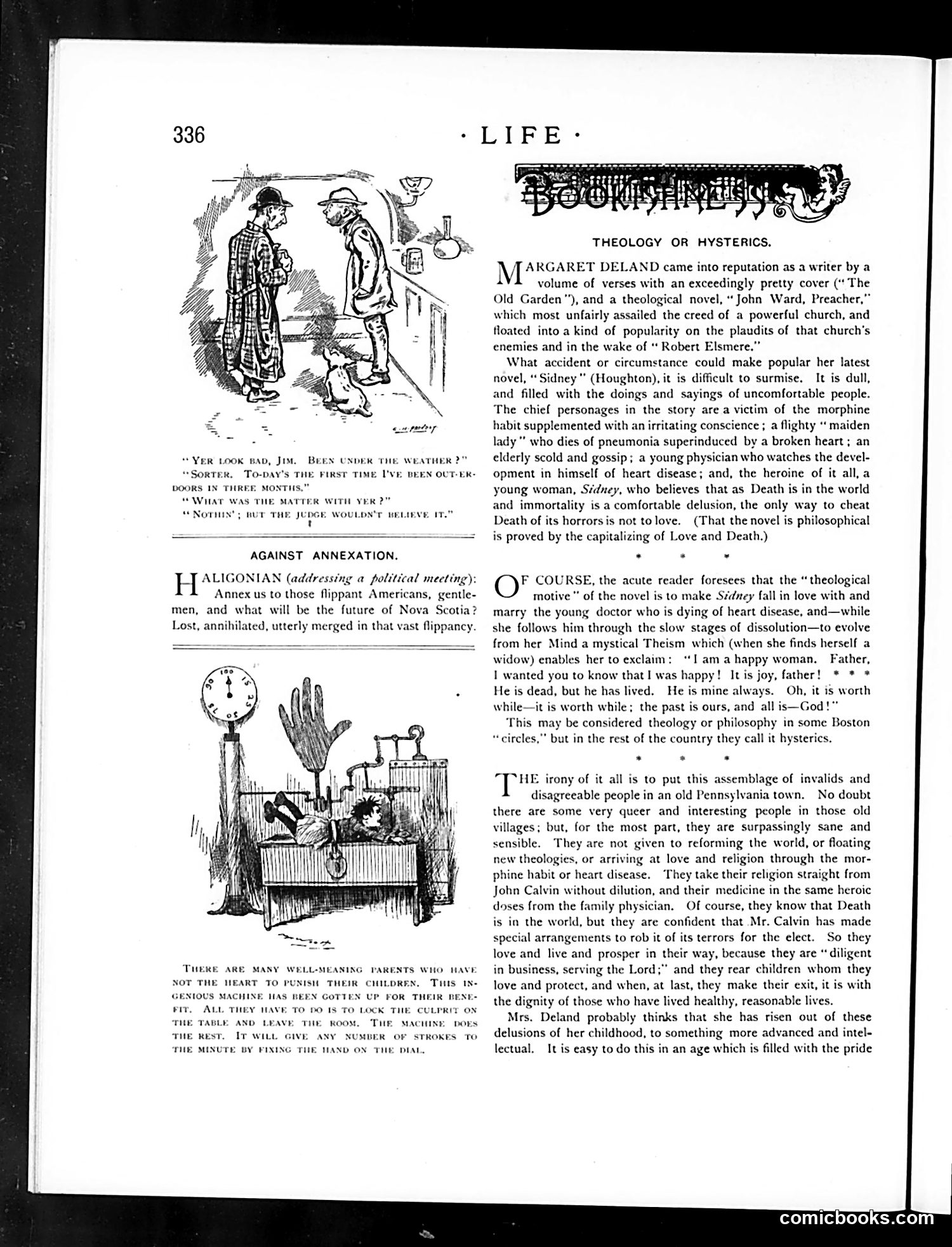
The page contains two distinct sections: **Top cartoon**: Shows two men in conversation on a street. The caption reads "VER LOOK BAD, JIM. BEN'S UNDER THE WEATHER?" with a response about someone being out sick for the first time. This appears to be a simple, everyday humor strip with no obvious political content—just workplace or neighborhood gossip about someone's illness. **Main article**: A literary review titled "Theology or Hysterics" critiquing Margaret Deland's novel *Sidney*. The reviewer dismisses the book as featuring unlikable characters and describing its philosophy as "hysterics" rather than genuine theology—mocking what the author presents as profound spiritual insight. This is cultural criticism rather than political satire. Neither section contains identifiable caricatures of public figures or political references.
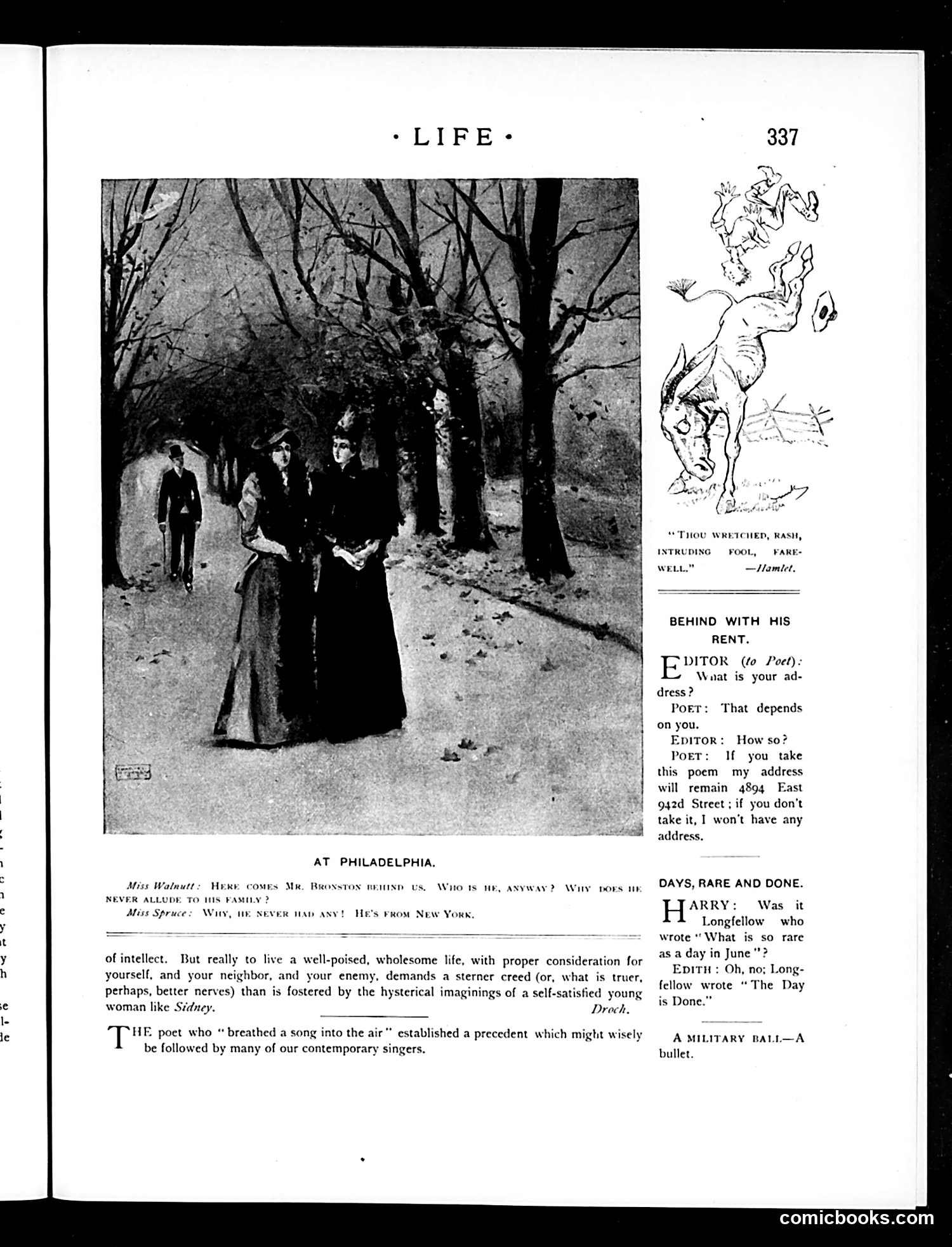
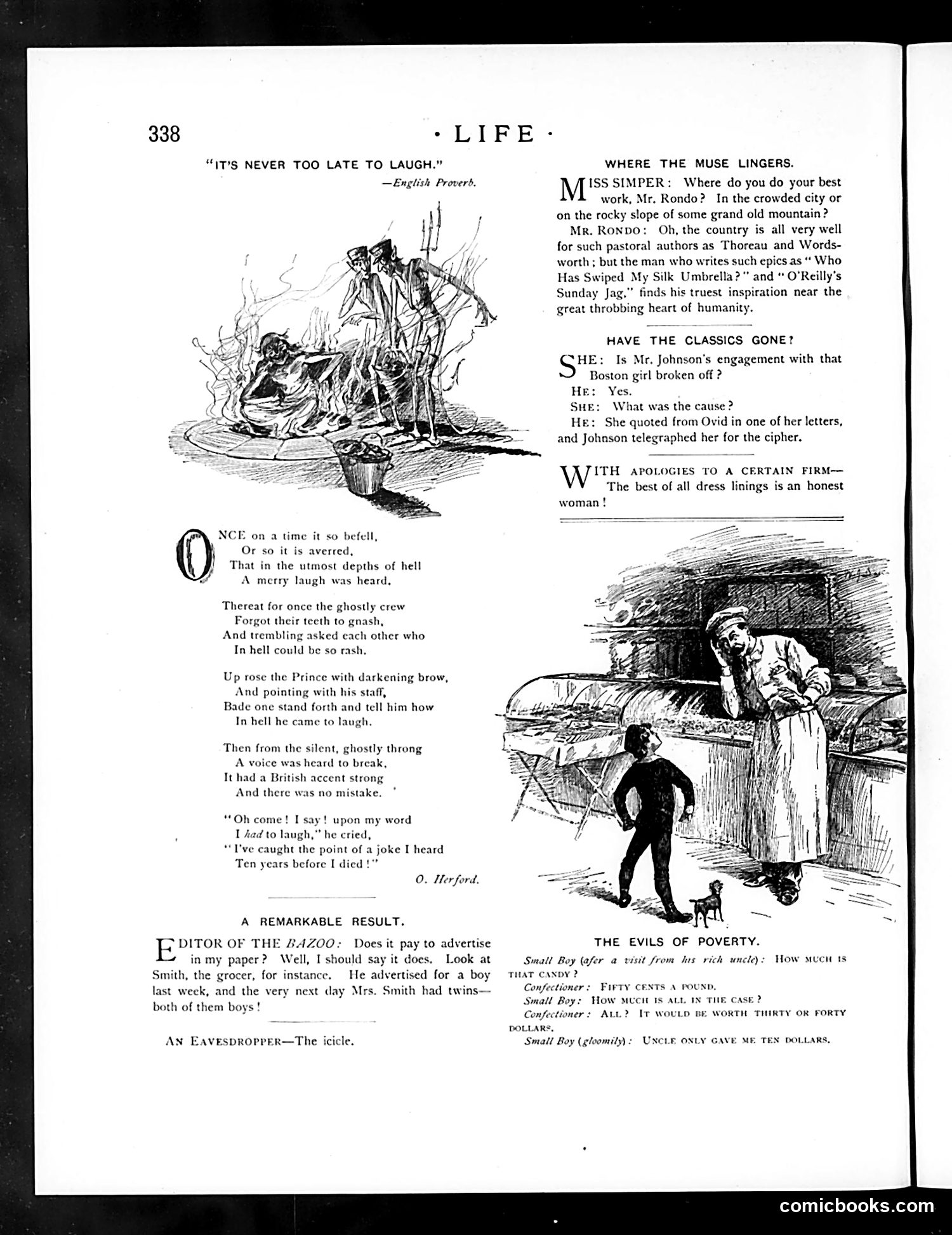
This page contains several satirical pieces typical of Life magazine's format: **"Where the Muse Lingers"** is a dialogue between Miss Simper and Mr. Rondo about where writers find inspiration—urban centers versus rural settings. Rondo argues that epic poetry about everyday urban life (referencing O'Reilly's "Who Has Swiped My Silk Umbrella?") connects better with ordinary people than pastoral works. **"Have the Classics Gone?"** jokes about a Boston girl breaking her engagement after quoting Ovid and receiving a Johnson telegram in response—suggesting the decline of classical education or romantic gestures. The remaining pieces are brief humorous observations: an apology about "honest women" as dress linings, a poem about laughter in hell, and commentary on advertising's effectiveness and poverty's hardships, all presented as typical Life magazine humor and social commentary.
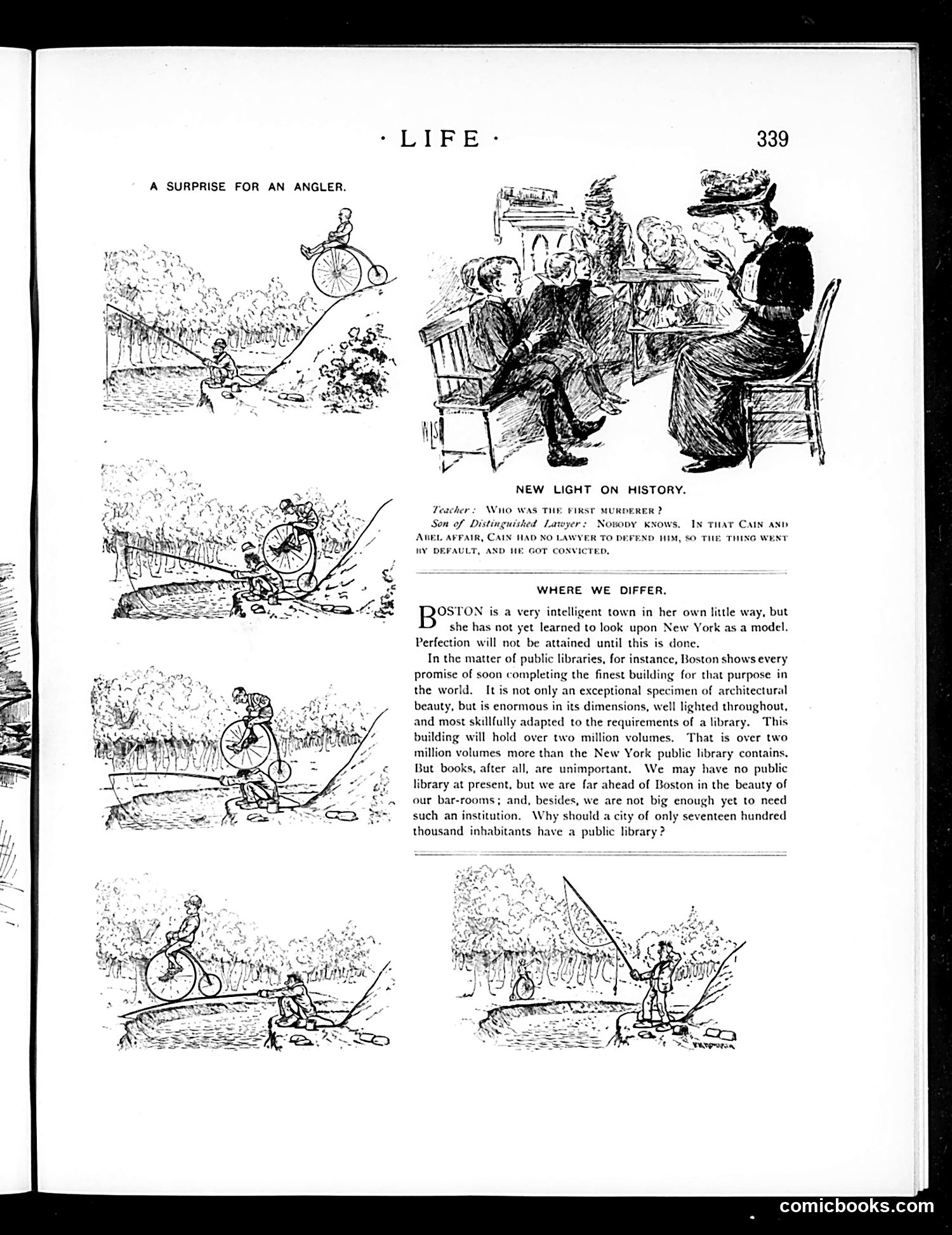
This page contains two distinct pieces: **"A Surprise for an Angler"** (left): A sequential comic strip showing a person on a penny-farthing bicycle performing increasingly dramatic stunts over a fishing hole, culminating in a splash. The humor is slapstick—the cyclist's acrobatic mishap surprises the angler. **"New Light on History"** and **"Where We Differ"** (right): A classroom scene where a teacher corrects history by noting Cain had no lawyer to defend him, so he was convicted by default. The satire mocks contemporary legal culture and litigiousness. The accompanying essay contrasts Boston and New York regarding public libraries, criticizing Boston's lack of ambition compared to New York's planned grand library building. Both pieces use humor to comment on American society—physical comedy and legal/civic culture.
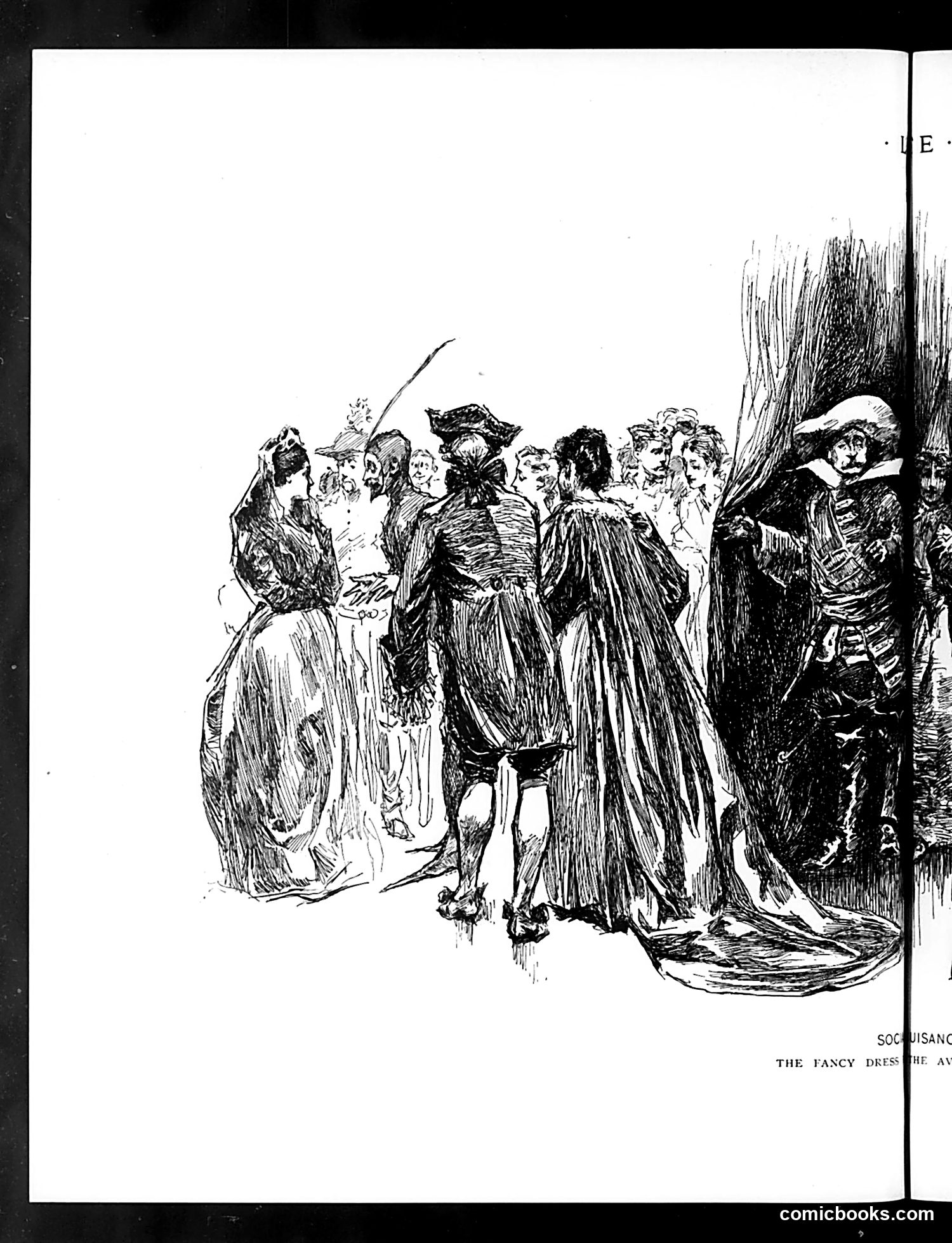
This illustration depicts an elegant social gathering, likely a fancy dress ball or costume party. The sketch shows aristocratic figures in elaborate period costumes and cloaks engaging in conversation. The satire appears to mock the pretension of high society fancy dress events—where wealthy people don costumes to appear sophisticated or historically cultured. The detailed rendering of the ornate fabrics and affected poses suggests Life magazine is ridiculing the artificiality and self-importance of such gatherings. The crowded composition and intermingling of figures in their theatrical dress emphasizes the performative nature of upper-class social rituals. Without additional context, the specific social commentary remains unclear, but the tone is distinctly mocking toward fashionable society's affectations.
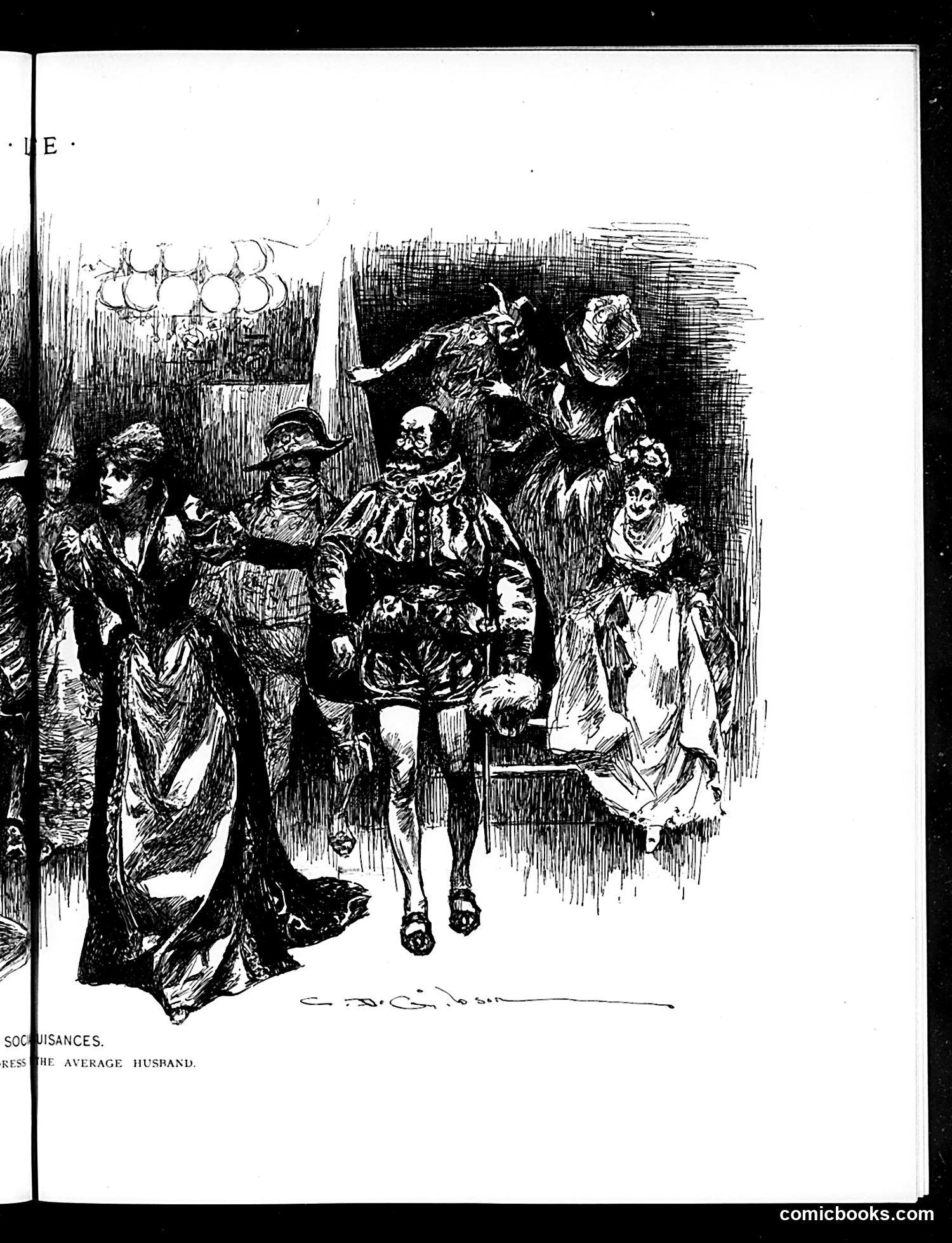
This page shows a satirical illustration titled "The Average Husband" under the heading "Annoyances" (partially visible as "SOC UISANCES"). The sketch depicts a man in military or formal dress standing surrounded by women in elaborate clothing and hats, appearing to be at some kind of social gathering or reception. The satire targets the "average husband" as a figure besieged by fashionable society women—likely commenting on how husbands were overwhelmed or inconvenienced by their wives' social obligations, shopping habits, or elaborate dress requirements of the era. The crowded, chaotic composition emphasizes the husband's isolation amid demanding female company, a common theme in early 20th-century Life magazine's humor about gender relations and domestic life.
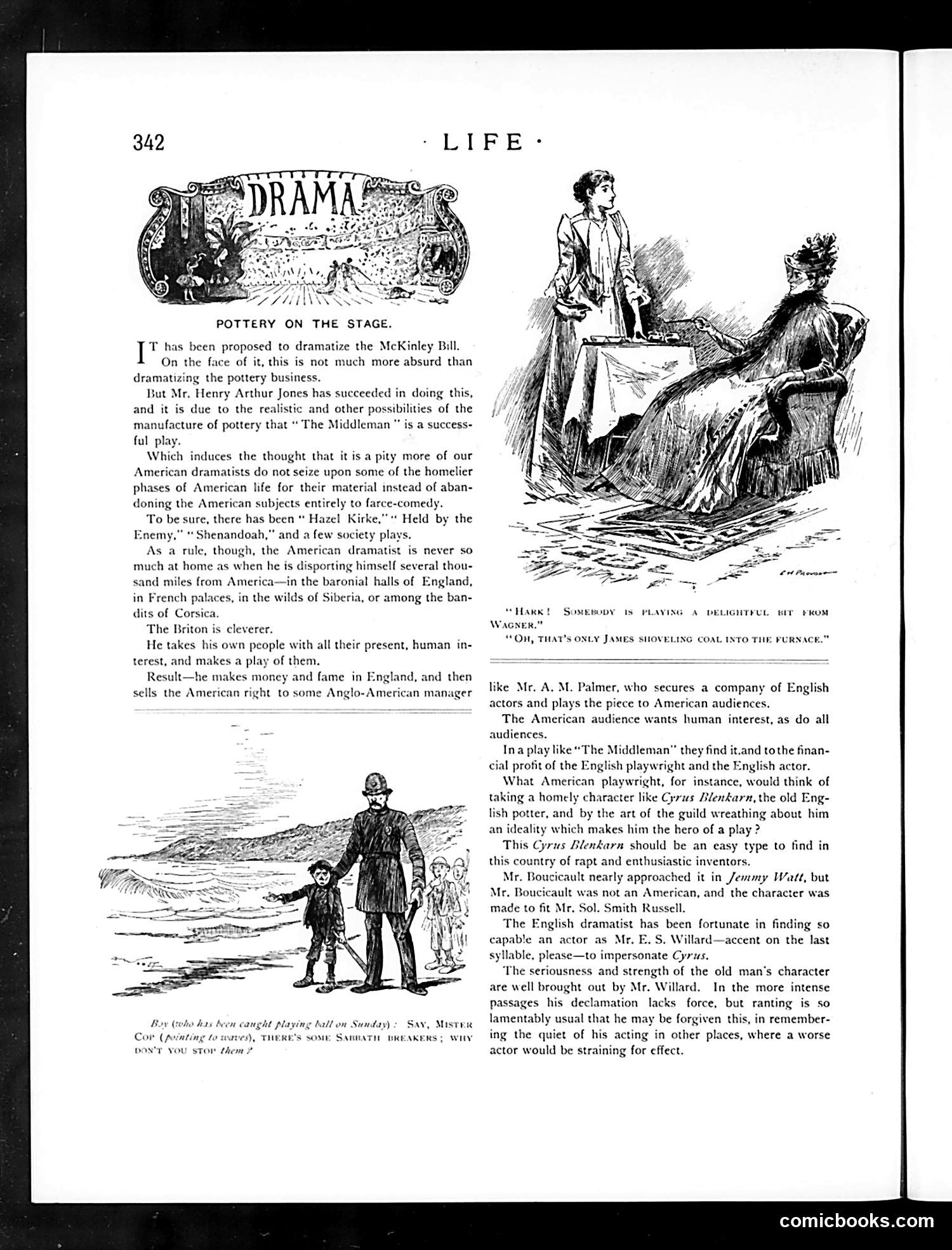
This page critiques American versus British drama. The article praises British playwright Henry Arthur Jones's play *"The Middleman,"* which dramatizes the pottery business and English potter character Cyrus Blenkarn, performed by actor E.S. Willard. The satire's point: American dramatists neglect homely American subjects and settings, instead setting plays in exotic European locations (English baronial halls, French palaces, Siberia, Corsica). British playwrights, by contrast, mine their own contemporary society for dramatic material—and profit from it. The opening joke references proposals to dramatize the McKinley Bill (a recent tariff law), suggesting that's no more absurd than dramatizing pottery—yet the play succeeds because it finds human drama in ordinary work. The lower cartoon shows a boy caught playing ball on Sunday; a man shoveling coal receives praise as entertainment ("delightful"). The joke inverts expectations: supposedly sinful Sunday play versus honest labor becomes the real drama.
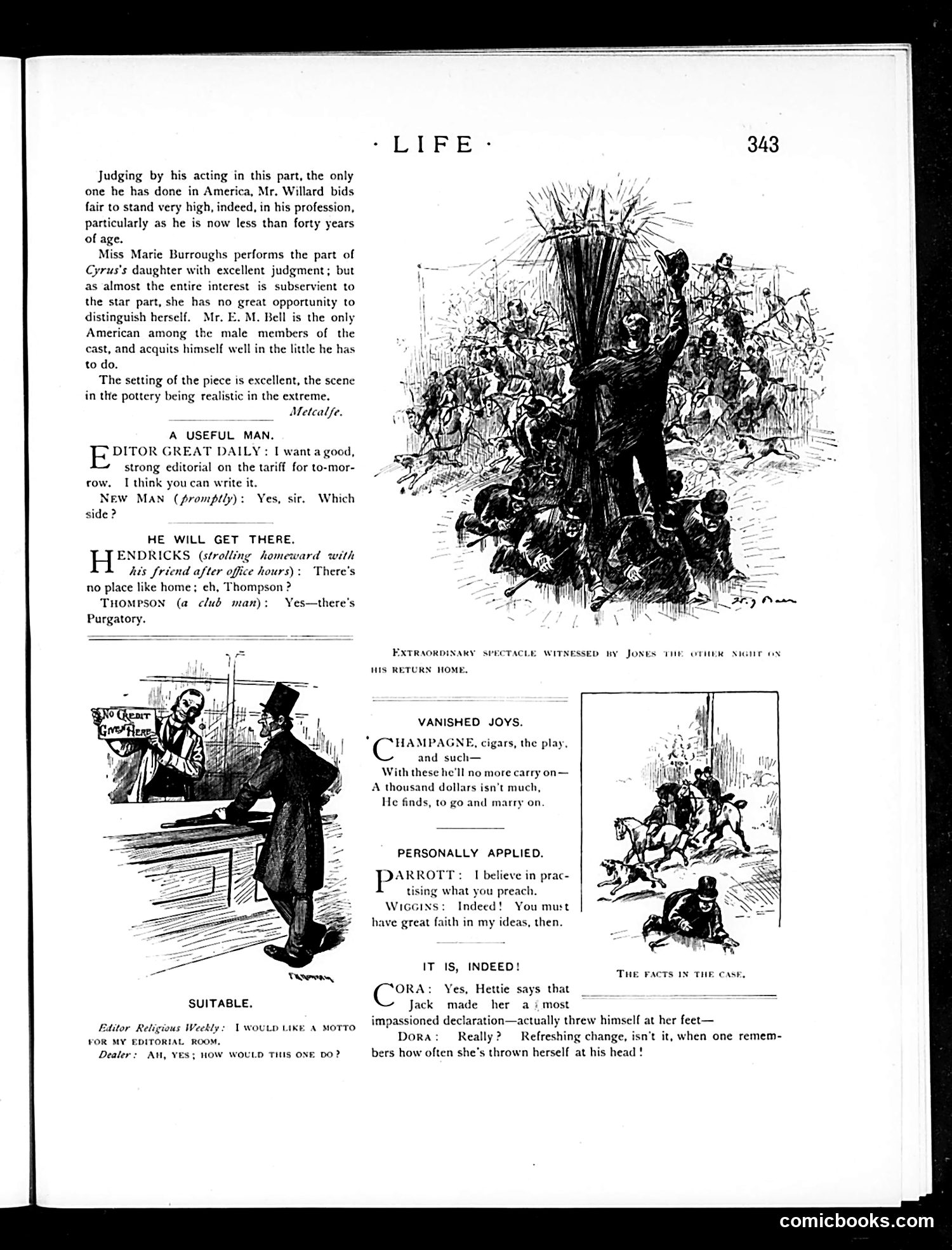
This page from Life magazine contains several brief satirical sketches mocking American social conventions and workplace absurdities: **"A Useful Man"** ridicules editorial compromise—a newspaper editor assigns a tariff editorial but the new writer immediately asks "which side?" implying editors have no principled stance. **"He Will Get There"** jokes about domestic life: a man returning home after work says there's "no place like home," but his club-member friend calls home "Purgatory"—satirizing the era's tension between domestic obligation and bachelor leisure. **"Vanished Joys"** laments married life's constraints: a man must abandon champagne, cigars, and theater since marriage costs money. **"Personally Applied"** and **"It Is, Indeed!"** mock hypocrisy and gender relations—a woman "threw herself at his feet" in passion, yet she habitually "throws herself at his head" (pursues him aggressively). The sketches reflect turn-of-century anxieties about marriage, work, and authenticity in urban American life.
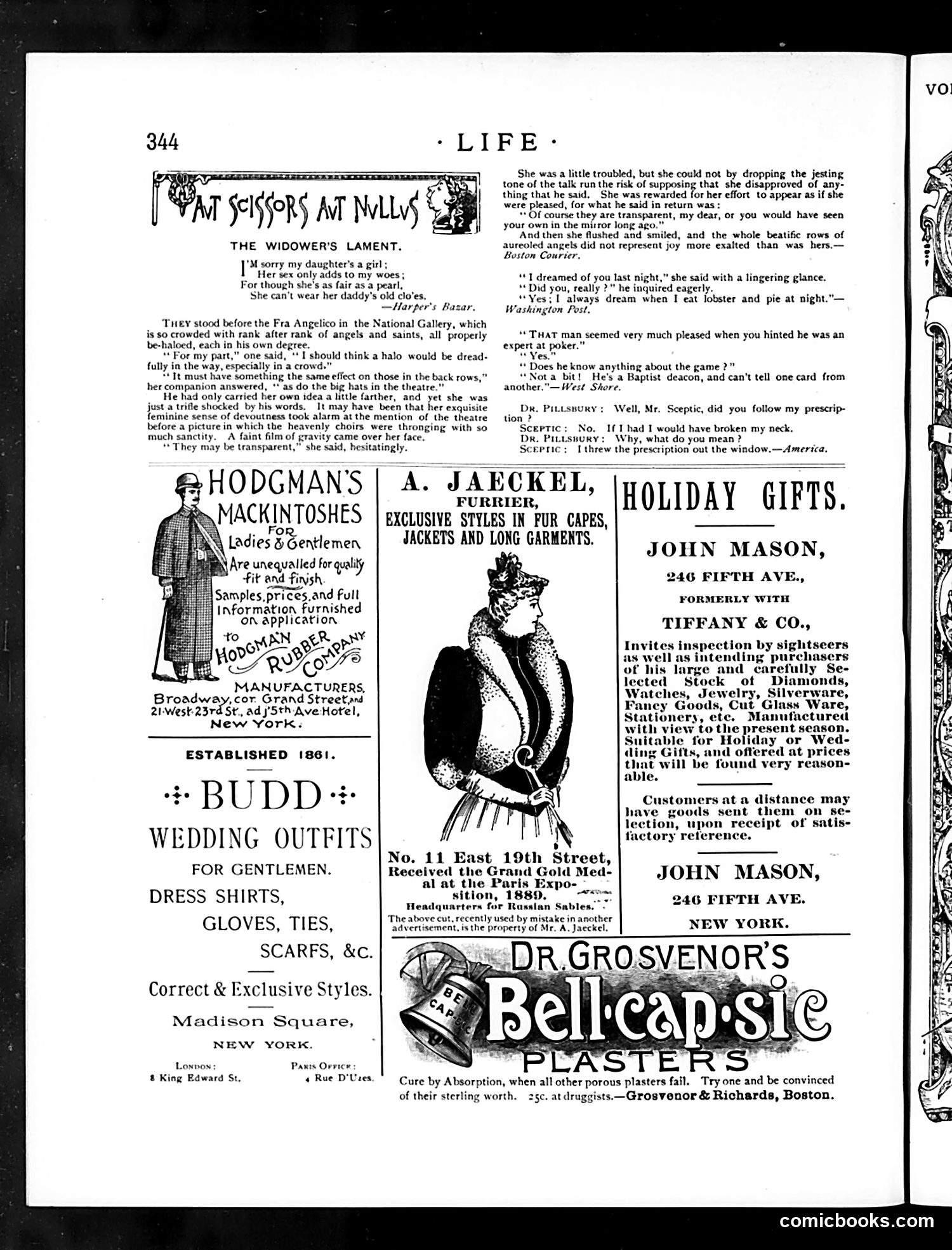
This page primarily contains **advertising**, with brief satirical content at the top. The main elements: **The Cartoons/Humor Pieces:** Several short, biting jokes exploit social conventions of the era: 1. "The Widower's Lament"—mocks sentimental Victorian family values by having a father lament having a daughter because she cannot inherit his clothing. 2. A museum scene joke—two women viewing religious art; a man compliments women by calling them "transparent," a backhanded compliment suggesting women lack substance (or that he doubts their intelligence). 3. A "poker expert" revealed to be a Baptist deacon—satirizes hypocrisy among the religious. 4. A doctor/patient exchange—mocks patients who ignore medical advice. **The Advertising:** The remainder features holiday shopping advertisements targeting wealthy New York consumers: Mackintoshes, fur capes, jewelry, and wedding outfits. Note the Jaeckel ad includes a mocking disclaimer about using someone else's cut. The page reflects late 19th-century gender attitudes, religious hypocrisy, and urban consumer culture.