
Life, 1890-12-11 · page 4 of 14
Life — December 11, 1890 — page 4: what you’re looking at
What you’re looking at
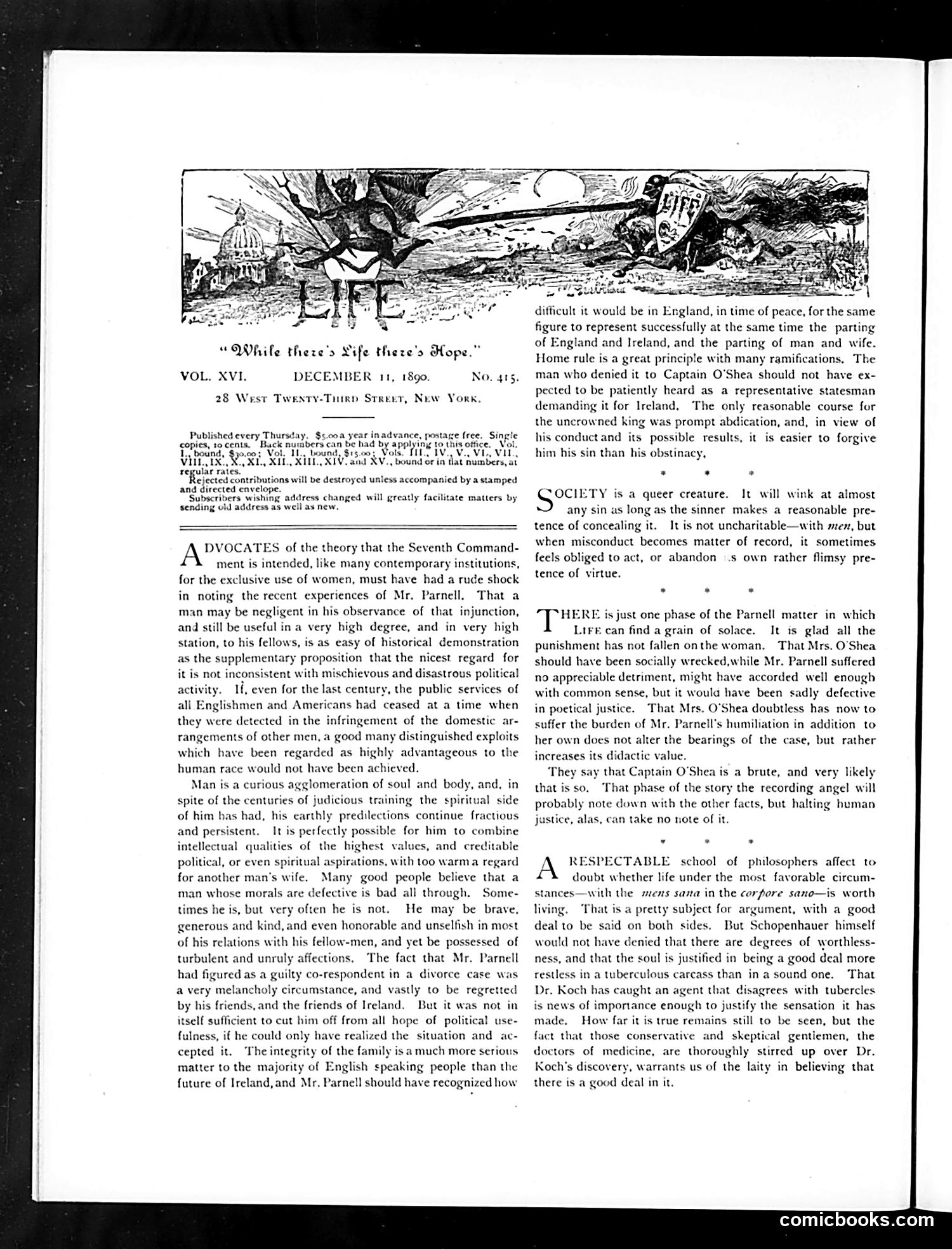
**The Cartoon:** The masthead illustration depicts a barren landscape with a gnarled tree, suggesting desolation or decay. The phrase "While there's Life there's Hope" appears as the motto. **The Editorial Content:** The article discusses **Mr. Parnell** and recent controversies surrounding him. It addresses the **Seventh Commandment** (against adultery) and argues that while Parnell's moral failings are regrettable, they shouldn't disqualify him from political leadership. The piece criticizes **Captain O'Shea** for publicly exposing the scandal rather than handling it privately, suggesting this damaged Ireland's political interests. The satire targets Victorian hypocrisy: society condemns moral transgressions when exposed publicly, yet tolerates them privately. The editorial defends Parnell's continued political utility despite his personal misconduct, reflecting Irish Home Rule politics of the era.
📄 Transcribed text from this page (OCR, searchable)
Machine-transcribed from the original scan — historical spelling and the odd misread are preserved.
“While there's Life there's Hope.” VOL. XVI. 1890. NO. 415. 28 West Twenty-Tiirp Street, New York. DECEMBER 11, Published every Thursday, $.00a year inadvance, postage free. Single copies, ro cents. Back numbers can be had by applyin hus office. Vol 1. bound, $30.00; Vol. IL, bound, $15.00; Vols. fIL, 1V., V., VL. VIL, VUL. IX), X.X0, XIL, XL, XIV and XV., bound or in dat humbers, af reguiar rates. ejected contributions will be destroyed unless accompanied by a stamped and directed envelope. rs wishing address changed will greatly facilitate matters by address a8 well as new. DVOCATES of the theory that the Seventh Command- ment is intended, like many contemporary institutions, for the exclusive use of women, must have had a rude shock That a man may be negligent in his observance of that injunction, and still be useful ina very high degree, and in very high station, to his fellows y of historical demonstration as the supplementary proposition that the nicest regard for it is not inconsistent with mischievous and disastrous political activity. If, even for the last century, the public services of all Englishmen and Americans had ceased at a time when in noting the recent experiences of Mr, Parnell, they were detected in the infringement of the domestic ar- rangements of other men, a good many distinguished exploits which have been regarded as highly advantageous to the human race would not have been achieved. Man is a curious agglomeration of soul and body, and, in spite of the centuries of judicious training the spiritual side of him has had, his earthly predilections continue fractious It is perfectly possible for him to combine ues, and cred: and persistent. intellectual qualities of the highest political, or even spiritual aspirations, with too warm a regard for another man’s wife. Many good people believe that a man whose morals are defective is bad all through. Some- times he is, but very often he is not. He may be brave, generous and kind, and even honorable and unselfish in most of his relations with his fellow-men, and yet be possessed of turbulent and unruly affections. The fact that Mr. Parnell had figured as a guilty co-respondent in a divorce case was a very melancholy circumstance, and vastly to be regretted by his friends, and the friends of Ireland. But it was not in itself sufficient to cut him off from all hope of political use- fulness, if he could only have realized the situation and ac- cepted it. ‘The integrity of the family is a much more serious matter to the majority of English speaking people than the future of Ireland,and Mr. Parnell should have recognized how difficult it would be in England, in time of peace, for the same figure to represent successfully at the same time the parting of England and Ireland, and the parting of man and wife. Home rule is a great principle with many ramifications, The man who denied it to Captain O'Shea should not have ex- pected to be patiently heard as a representative statesman demanding it for Ireland. The only reasonable course for the uncrowned king was prompt abdication, and, in view of his conduct and its possible results, it is easier to forgive him his sin than his obstinacy, * . * ~OCIETY is a queer creature. It will wink at almost any sin as long as the sinner makes a reasonable pre- tence of concealing it. It is not uncharitable—with mer, but when misconduct becomes matter of record, it sometimes feels obliged to act, or abandon .s own rather flim: tence of virtue. HERE is just one phase of the Parnell matter in which Lire can find a grain of solace. It is glad all the punishment has not fallen onthe woman. That Mrs. O'Shea should have been socially wrecked,while Mr. Parnell suffered no appreciable detriment, might have accorded well enough with common sense, but it woula have been sadly defective in poetical justice. That Mrs. O'Shea doubtless has now to suffer the burden of Mr. Parnell’s humiliation in addition to her own does not alter the bearings of the ¢, but rather increases its didactic value. ‘They say that Captain O'Shea is a brute, and very likely that is so, That phase of the story the recording angel will probably note down with the other facts, but halting human i s, can take no note of it PECTABLE school of philosophers affect to doubt whether life under the most favorable circum- A stances—with the mens sara in the corpore sano—is worth living. That is a pretty subject for argument, with a good deal to be said on both sides. But Schopenhauer himself would not have denied that there are degrees of worthless- ness, and that the soul is justified in being a good deal more restless in a tuberculous carcass than in a sound one. That Dr. Koch has caught a’ ent that disagrees with tubercles is news of importance enough to justify the sensation it has made. How far it is true remains still to be seen, but the fact that those conservative and skeptical gentiemen, the doctors of medicine, are thoroughly stirred up over Dr. Koch's discovery, warrants us of the laity in believing that there is a good deal in it. comicbooks.com