
Life, 1890-12-11 · page 12 of 14
Life — December 11, 1890 — page 12: what you’re looking at
What you’re looking at
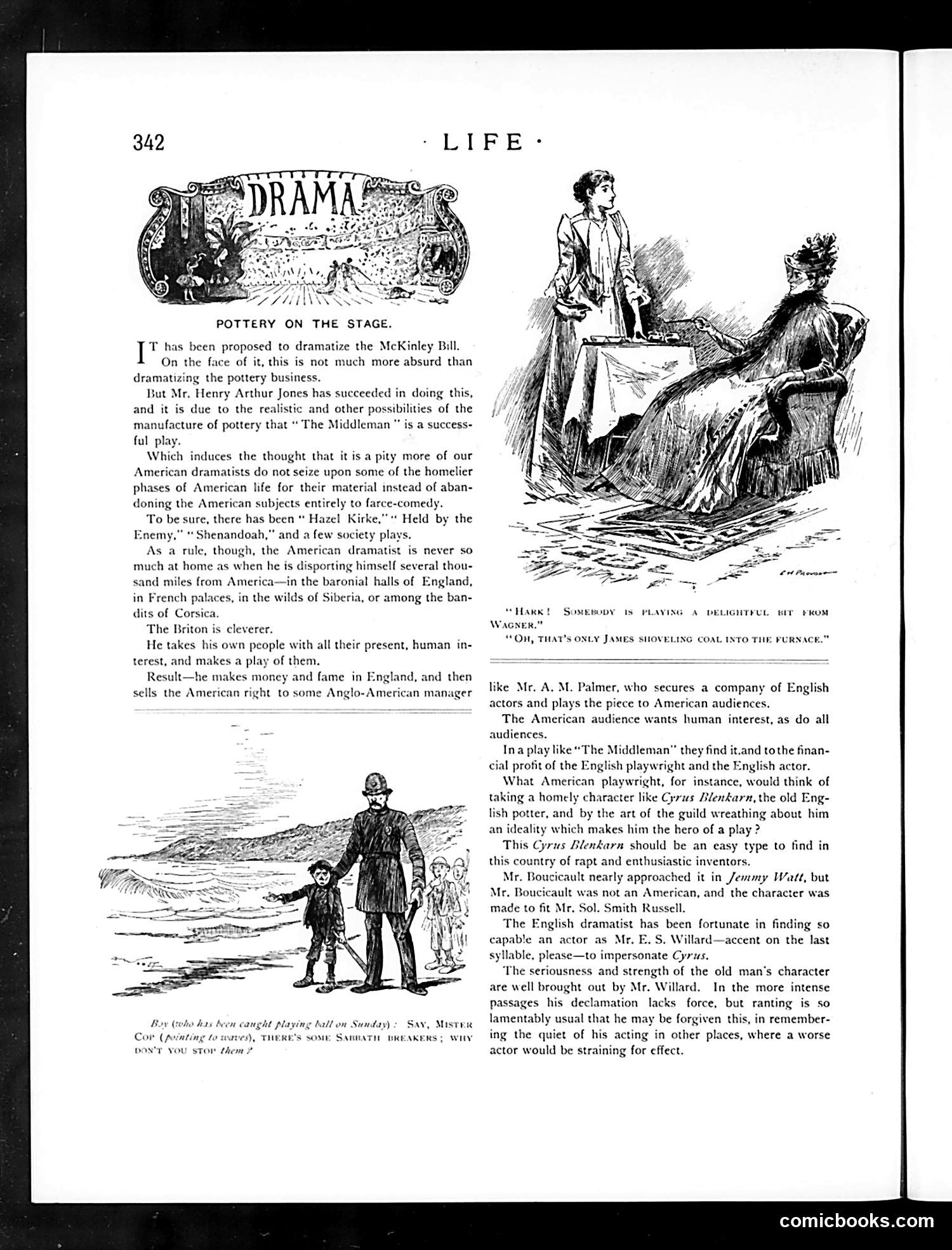
This page critiques American versus British drama. The article praises British playwright Henry Arthur Jones's play *"The Middleman,"* which dramatizes the pottery business and English potter character Cyrus Blenkarn, performed by actor E.S. Willard. The satire's point: American dramatists neglect homely American subjects and settings, instead setting plays in exotic European locations (English baronial halls, French palaces, Siberia, Corsica). British playwrights, by contrast, mine their own contemporary society for dramatic material—and profit from it. The opening joke references proposals to dramatize the McKinley Bill (a recent tariff law), suggesting that's no more absurd than dramatizing pottery—yet the play succeeds because it finds human drama in ordinary work. The lower cartoon shows a boy caught playing ball on Sunday; a man shoveling coal receives praise as entertainment ("delightful"). The joke inverts expectations: supposedly sinful Sunday play versus honest labor becomes the real drama.
📄 Transcribed text from this page (OCR, searchable)
Machine-transcribed from the original scan — historical spelling and the odd misread are preserved.
one CS MANN NSS POTTERY ON THE STAGE. T has been proposed to dramatize the McKinley Bill. On the face of it, this is not much more absurd than dramatizing the pottery business. But Mr. Henry Arthur Jones has succeeded in doing this, and it is due to the realistic and other possibilities of the manufacture of pottery that “The Middleman " is a success- ful pla: Which induces the thought that it is a pity more of our American dramatists do not seize upon some of the homelier phases of American life for their material instead of aban- doning the American subjects entirely to farce-comedy. To be sure, there has been * Hazel Kirke,” ** Held by the Enemy, henandoah,” and a few society plays. As a rule, though, the American dramatist is never so much at home as when he is disporting himself several thou- sand miles from America—in the baronial halls of England, in French palaces, in the wilds of Siberia, or among the ban- dits of Corsica. The Briton is cleverer. He takes his own people with all their present, human in- terest, and makes a play of them. Result—he makes money and fame in England, and then sells the American right to some Anglo-American manager Boy (tho has been caught playing ball on Sunday) Cor (punting to we DON'T YOU sToP them ? Say, Mistee . THERE'S SOME SANRATH BREAKERS ; WHY SOMEBODY IS PLAYING A DELIGHTFUL IT KOS “ON, THAT'S ONLY JAMES SHOVELING COAL INTO THE FURNACE.” like Mr. A, M. Palmer, who secures a company of English actors and plays the piece to American audiences. The American audience wants human interes audiences. Ina play like “The Middleman” they find it.and tothe finan- cial profit of the English playwright and the English actor. What American playwright, for instance, would think of taking a homely character like Cyrus Blenkarn, the old Eng- lish potter, and by the art of the guild wreathing about him an ideality which makes him the hero of a play ? This Cyrus Blenkarn should be an easy type to find in this country of rapt and enthusiastic inventors. Mr. Boucicault nearly approached it in Jemmy Watt, but Mr. Boucicault not an American, and the character was made to fit Mr, Sol. Smith Russell. The English dramatist has been fortunate in finding so capable an actor as Mr. Willard—accent on the last syllable, please—to impersonate Cyrus. The seriousness and strength of the old man’s character are well brought out by Mr. Willard. In the more intense passages his declamation lacks force, but ranting is so lamentably usual that he may be forgiven this, in remember- ing the quiet of his acting in other places, where a worse actor would be straining for effect. as do all comicbooks.com