
Life, 1890-12-11 · page 6 of 14
Life — December 11, 1890 — page 6: what you’re looking at
What you’re looking at
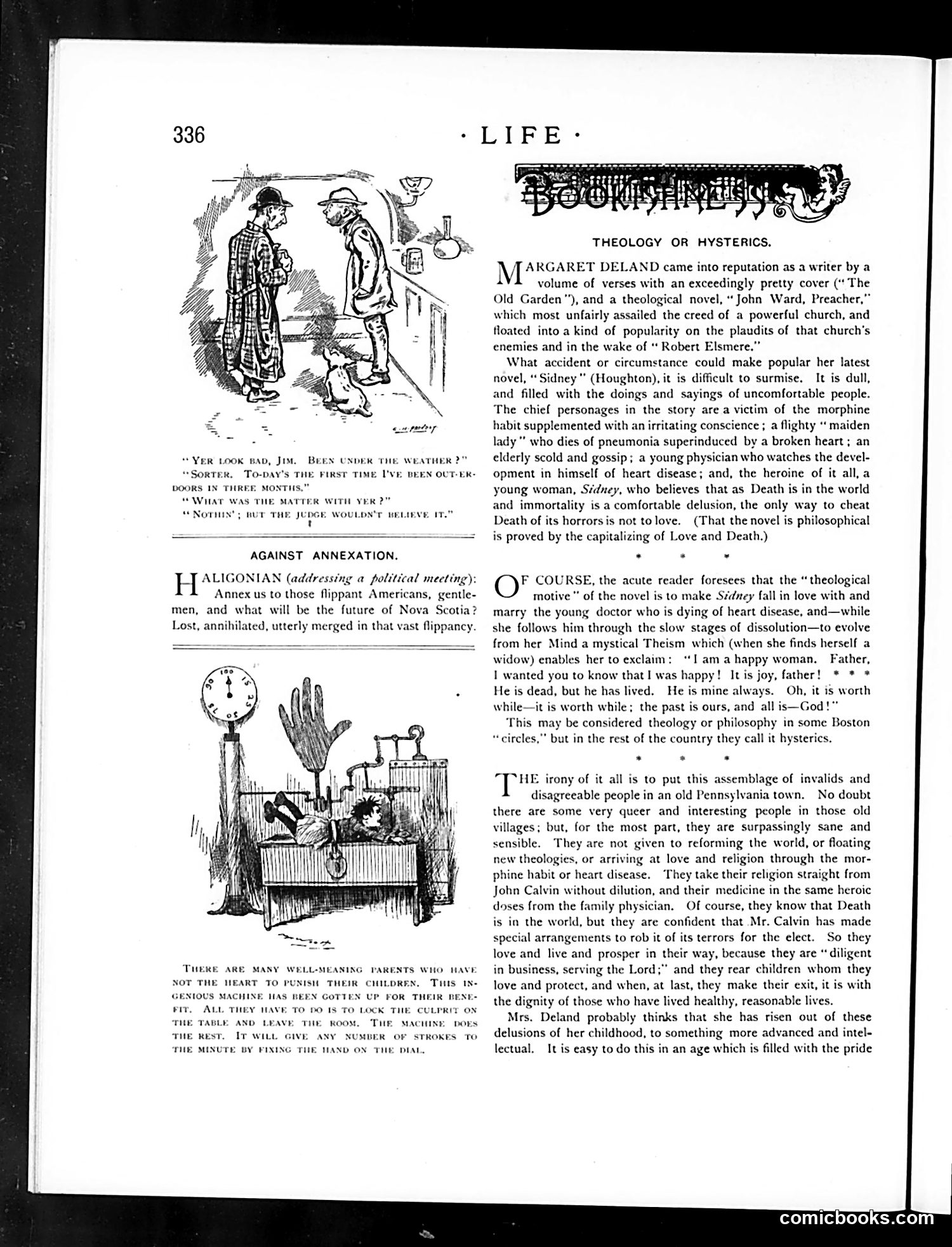
The page contains two distinct sections: **Top cartoon**: Shows two men in conversation on a street. The caption reads "VER LOOK BAD, JIM. BEN'S UNDER THE WEATHER?" with a response about someone being out sick for the first time. This appears to be a simple, everyday humor strip with no obvious political content—just workplace or neighborhood gossip about someone's illness. **Main article**: A literary review titled "Theology or Hysterics" critiquing Margaret Deland's novel *Sidney*. The reviewer dismisses the book as featuring unlikable characters and describing its philosophy as "hysterics" rather than genuine theology—mocking what the author presents as profound spiritual insight. This is cultural criticism rather than political satire. Neither section contains identifiable caricatures of public figures or political references.
📄 Transcribed text from this page (OCR, searchable)
Machine-transcribed from the original scan — historical spelling and the odd misread are preserved.
ER LOOK BAD, JIM. BEEN UNDER THE WEATHER 2” SorTER, To-ay's THE FIRST TIME I'VE BEEN OUT-ER- DOORS IN THREE MONTHS,” “WHAT WAS THE MATTER WITH VER 2” “Noriin'; WUT THE JUpeE WOULDN'T weLtEve 11" AGAINST ANNEXATION. H ALIGONIAN (addressing a political meeting): Annex us to those flippant Americans, gentle- men, and what will be the future of Nova Scotia? Lost, annihilated, utterly merged in that vast flippancy. THERE ARE Not T MANY WELL-MEANING PARENTS WHO HAVE ART TO PUNISH THEIR CHILDREN, Tuts IN- GENIOUS MACHINE HAS REEN GOTTEN UP FOR THEIR RENE- FIT, ALL THEY HAVE TO PO 18 TO LOCK THE CULPRIT ON THE TABLE AND LEAVE THE ROOM. ‘THE MACHINE DOES THE REST. TT WILL GIVE ANY NUMBER OF STROKES TO. THE MINUTE BY FIXING THE HAND ON THE DIAL. THEOLOGY OR HYSTERICS. M ARGARET DELAND came into reputation as a writer by a 1 volume of verses with an exceedingly pretty cover (“The Old Garden”), and a theological novel, “John Ward, Preacher,” which most unfairly assailed the creed of a powerful church, and floated into a kind of popularity on the plaudits of that church's enemies and in the wake of ‘* Robert Elsmere.” What accident or circumstance could make popular her latest novel, “Sidney " (Houghton), it is difficult to surmise. It is dull, and filled with the doings and sayings of uncomfortable people. The chief personages in the story are a victim of the morphine habit supplemented with an irritating conscience ; a flighty “ maiden lady " who dies of pneumonia superinduced by a broken heart; an elderly scold and gossip ; a young physician who watches the devel- opment in himself of heart disease; and, the heroine of it all, a young woman, Sidney, who believes that as Death is in the world and immortality is a comfortable delusion, the only way to cheat Death of its horrors is not to love. (That the novel is philosophical is proved by the capitalizing of Love and Death.) F COURSE, the acute reader foresees that the “theological motive" of the novel is to make Srdney fall in love with and marry the young doctor who is dying of heart disease, and—while she follows him through the slow stages of dissolution—to evolve from her Mind a mystical Theism which (when she finds herself a widow) enables her to exclaim: ‘1! ama happy woman. Father, I wanted you to know that! was happy! It is joy, father! * * * He is dead, but he has lived. He is mine always. Oh, it is worth while—it is worth while; the past is ours, and all is—God!" This may be considered theology or philosophy in some Boston “circles,” but in the rest of the country they call it hysterics. . . . ssemblage of invalids and No doubt T® irony of it all is to put this disagreeable people in an old Pennsylvania town. there are some very queer and interesting people in those old villages; but, for the most part, they are surpassingly sane and sensible. They are not given to reforming the world, or floating new theologies, or arriving at love and religion through the mor- phine habit or heart disease. They take their religion straight from John Calvin without dilution, and their medicine in the same heroic doses from the family physician. Of course, they know that Death is in the world, but they are confident that Mr. Calvin has made special arrangements to rob it of its terrors for the elect. So they love and live and prosper in their way, because they are “diligent in business, serving the Lord; and they rear children whom they love and protect, and when, at last, they make their exit, it is with the dignity of those who have lived healthy, reasonable lives. Mrs. Deland probably thinks that she has risen out of these delusions of her childhood, to something more advanced and intel- lectual. It is easy to do this in an age which is filled with the pride comicbooks.com