
A complete issue · 14 pages · 1890
Life — December 4, 1890
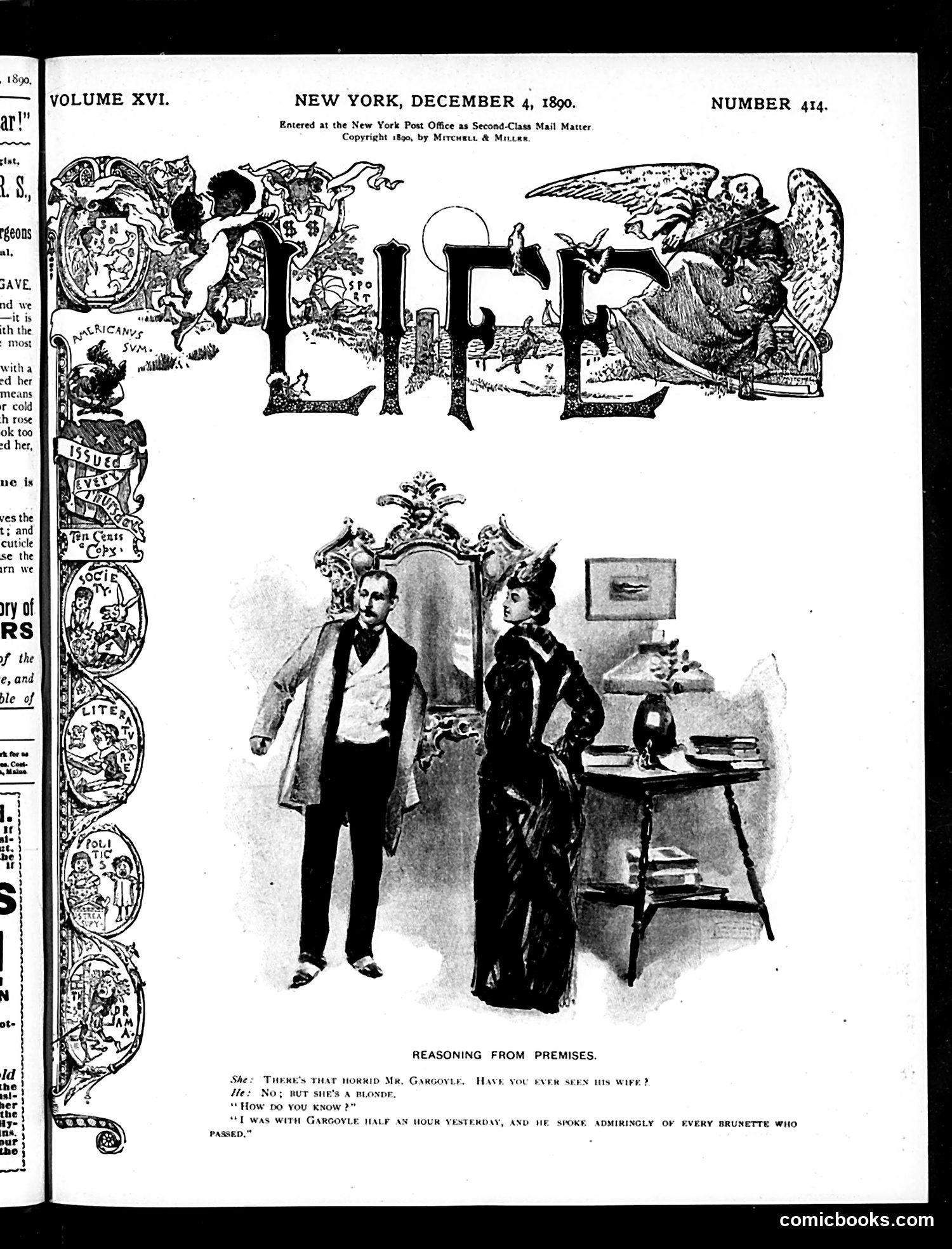
This single-panel cartoon satirizes flawed logical reasoning. A woman confronts a man about "that horrid Mr. Gargoyle," asking if he's seen his wife. The man denies it, claiming she's a blonde. The woman replies, "How do you know?" The man's absurd conclusion follows: he spent half an hour with Gargoyle yesterday and heard him "speak admiringly of every brunette who passed." The joke's logic is intentionally backwards—the man assumes that because Gargoyle praised brunettes, his wife must be blonde. The cartoon mocks people who draw ridiculous conclusions from incomplete or irrelevant premises, a common target of period satire about human reasoning and social pretension.
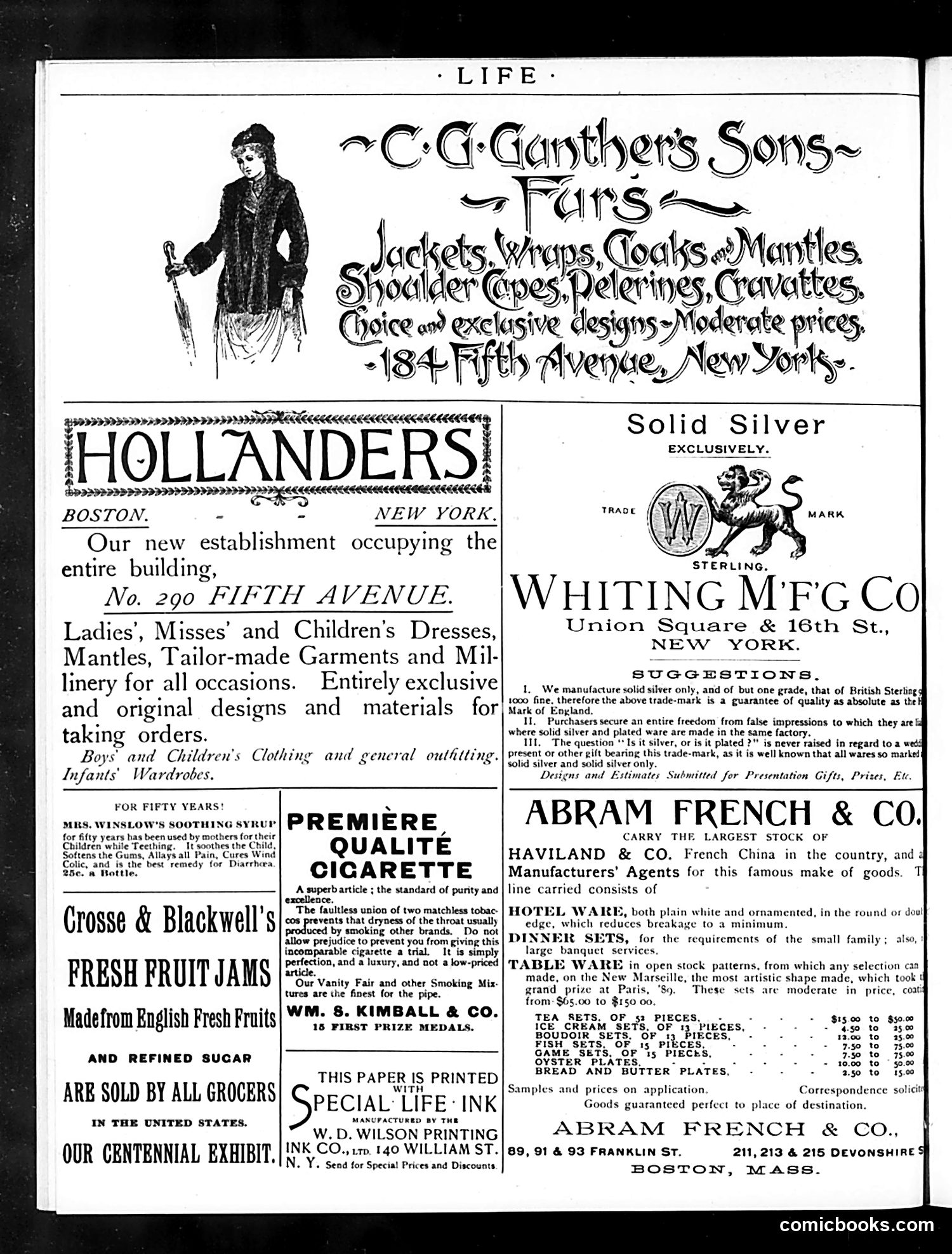
This page is **primarily advertisements**, not editorial content or cartoons. The upper portion features ads for: - **C.G. Gathers Sons** (women's furs and cloaks at 184 Fifth Avenue) - **Hollanders** (Boston/New York women's clothing) - **Whiting MFG Co** (solid silver goods) - **Abram French & Co** (French china and hotel ware) Lower ads include **Crosse & Blackwell's fruit jams**, **Wm. S. Kimball & Co** (cigarettes), and printing services. There are **no political cartoons or satirical illustrations** visible. The only illustration is a fashion figure accompanying the Gathers Sons ad—typical period advertising imagery, not satire. This appears to be a commercial advertising page from *Life* magazine, reflecting the publication's revenue model rather than editorial satire.
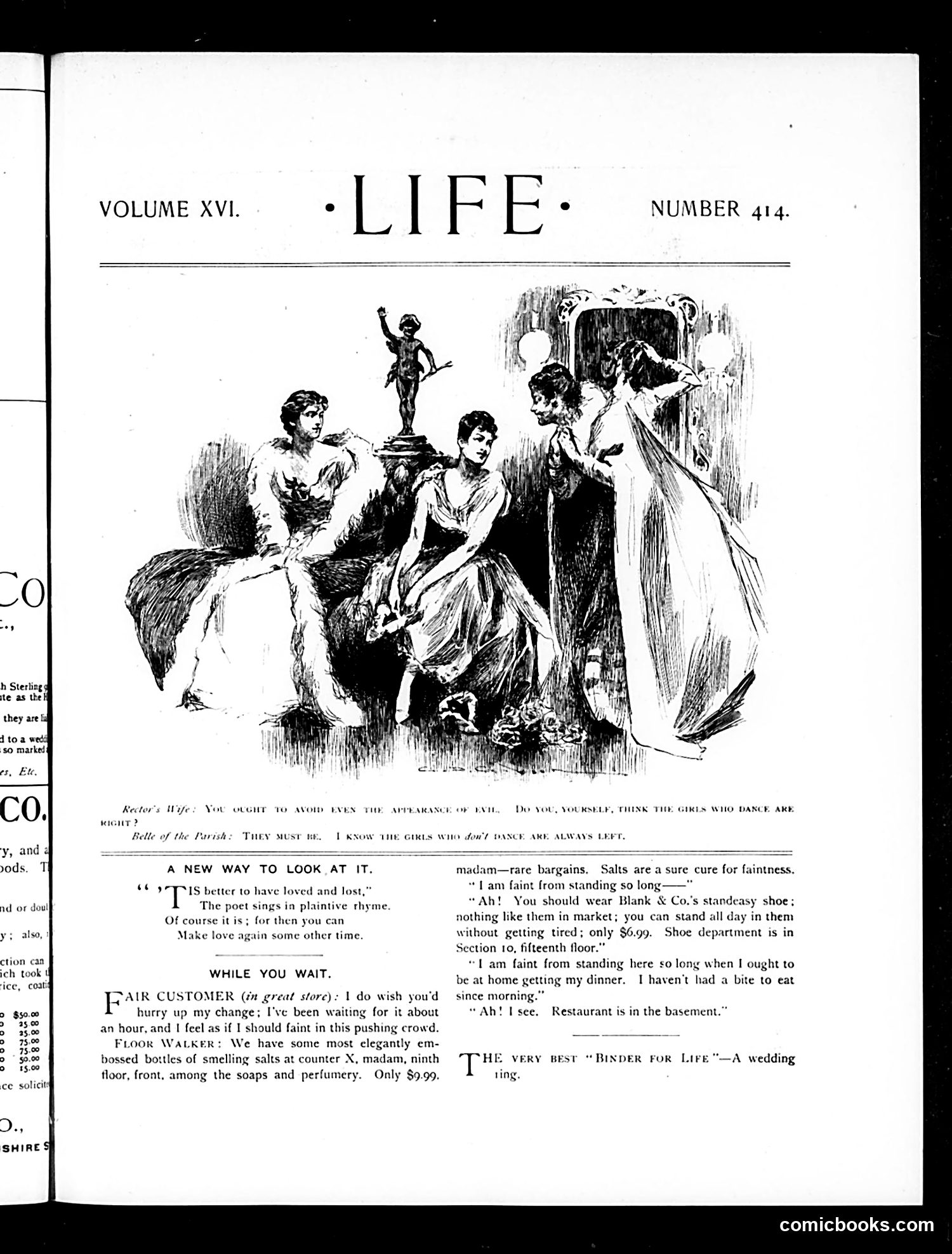
This page combines satirical commentary with advertising. The main illustration depicts women in an elegant interior, with a caption mocking social pretension: "Avoid even the appearance of evil" versus actually considering whether "the girls who dance are always left." The satire targets upper-class hypocrisy—women concerned with *appearing* virtuous rather than genuine morality. The "dancing girls" reference suggests anxieties about women's independence and nightlife. Below are humorous "overheard" conversations mocking consumer culture and retail experiences: a poet seeking sympathy, a tired shopper, and a floor walker promoting smelling salts as luxury items ($9.99). The final line advertises a "Binder for Life" wedding-related product—likely a cynical joke given the page's themes of artifice and social performance.
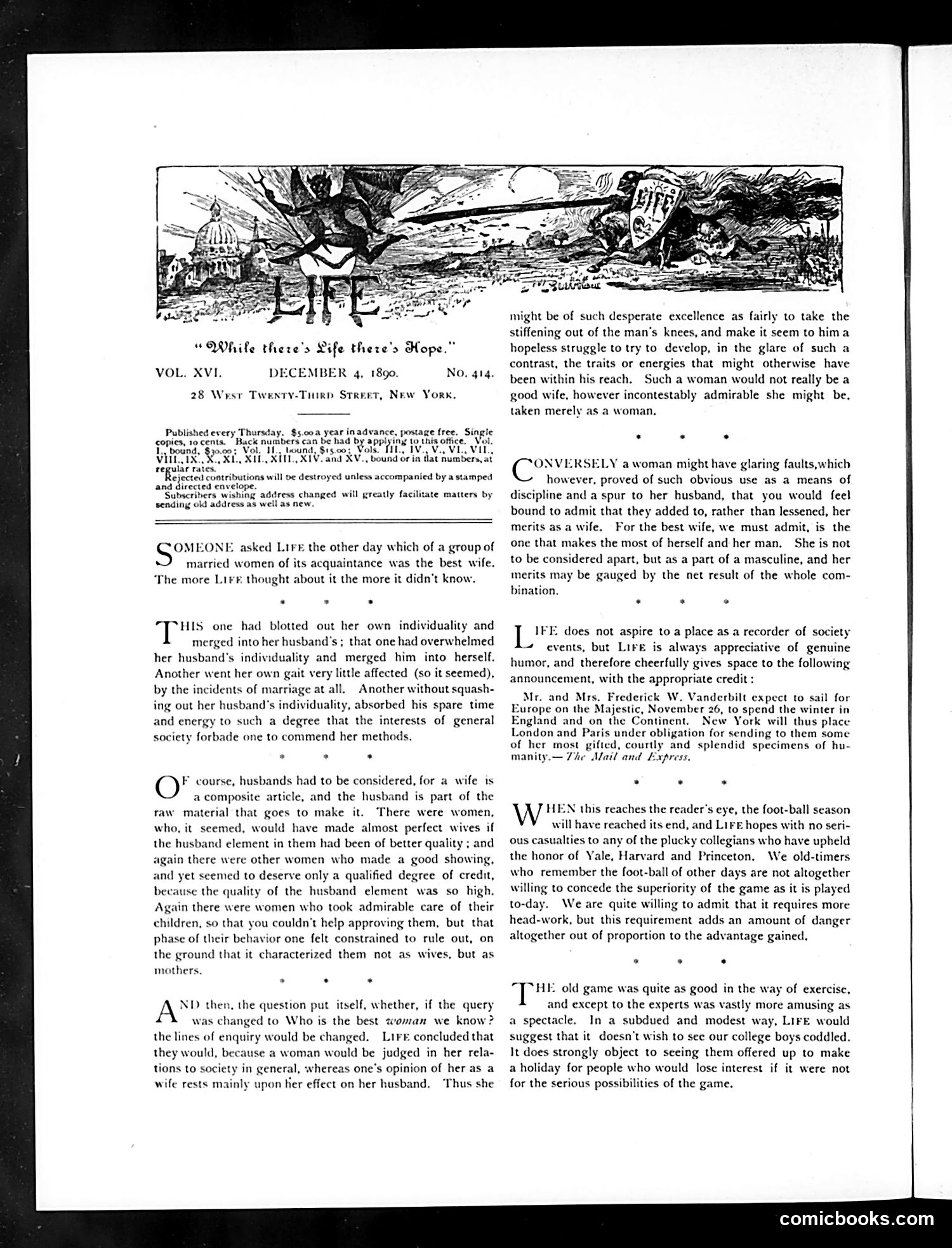
The masthead cartoon depicts a barren landscape with a gnarled tree, a dilapidated structure, and a gravestone marked "LIFE"—a darkly humorous visual pun on the magazine's own name, suggesting life's mortality and hardship. The article beneath addresses marriage and wives, debating which married woman among a social circle is "best." The discussion concludes that the ideal wife is one who maintains her individual identity while supporting her husband, rather than either completely merging into him or remaining separate. The piece critiques husbands who suppress their wives' individuality, while also questioning excessive female independence. The satire targets contemporary gender dynamics and marital expectations of the 1890s, offering surprisingly progressive commentary on partnership and mutual respect.
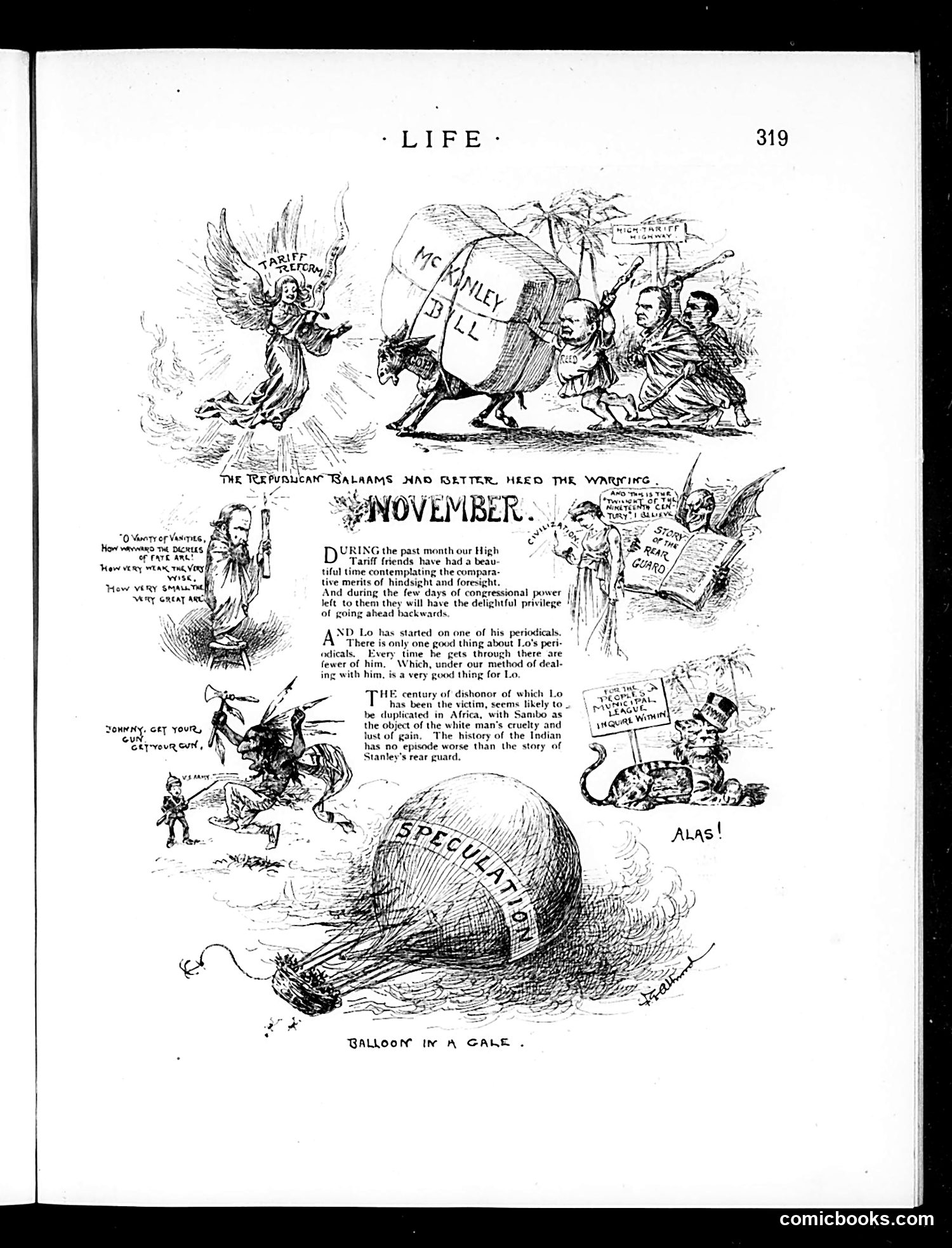
This page satirizes American politics during a period of congressional transition. The top cartoon depicts Republicans as a donkey bearing the "McKinley Bill" (a tariff measure), with figures warning of its approach—suggesting anxiety about the policy's effects. The text references "Lo" (likely a Native American figure used satirically) and discusses "the century of dishonor," referencing historical injustices. References to Stanley and African colonial ventures indicate contemporary imperial concerns. The bottom illustration, "Balloon in a Gale," shows a balloon labeled "Speculators" being battered by wind—satirizing financial speculation during economic uncertainty. Overall, the page mixes partisan criticism of Republican policies with commentary on American imperial ambitions and financial instability, using allegorical animal and balloon imagery typical of late 19th-century political cartooning.
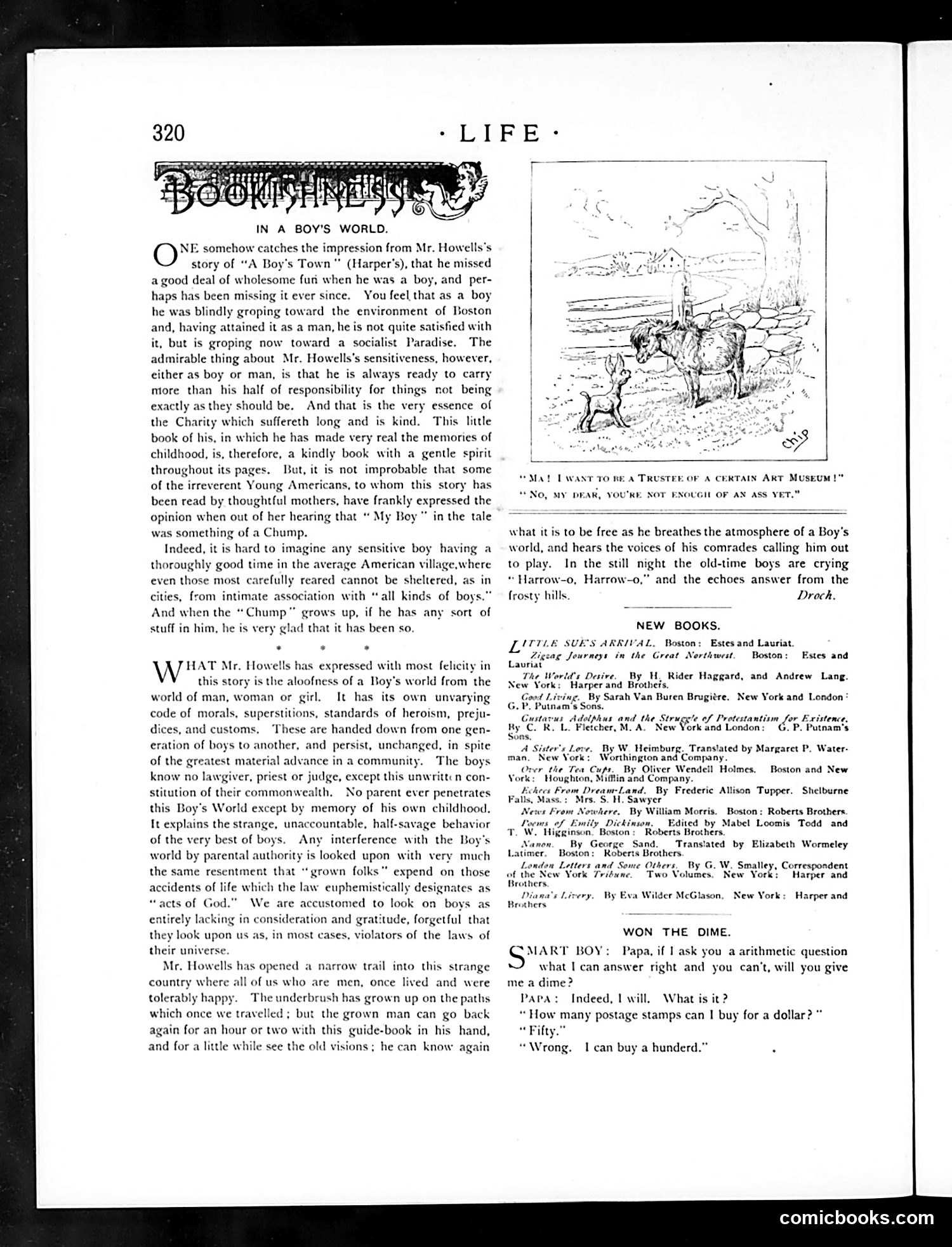
This page consists primarily of a literary essay and book reviews, not political cartoons. The only illustration is a sketch showing a rural scene with a boy and dog near a fence—accompanying an article titled "Books in a Boy's World" that discusses Mr. Howell's story "A Boy's Town." The essay argues that boys' literature should authentically capture childhood experience and the "Boy's World"—a realm with distinct values separate from adult society. It praises Howell's work for depicting boys' independence and self-governance without adult interference. The small dialogue joke at bottom ("Won the Dime") shows a father-son exchange about arithmetic and postage stamps—gentle humor about children's reasoning. This is literary criticism and book discussion, not political satire.
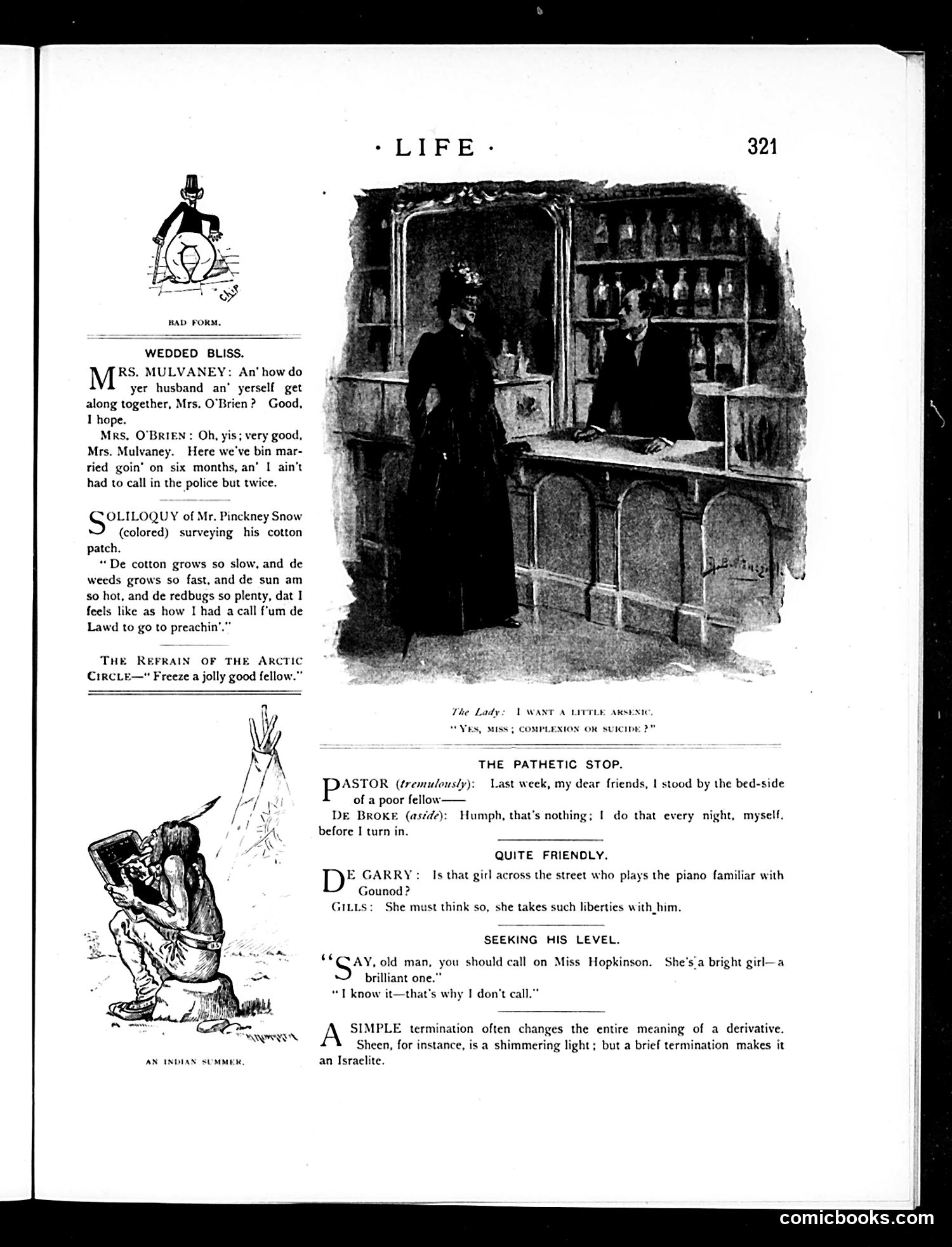
This page contains several brief humorous sketches typical of Life's satirical format: **"Wedded Bliss"** depicts a conversation between Mrs. Mulvaney and Mrs. O'Brien about married life, with O'Brien noting they've been married six months and already called police twice—suggesting domestic discord presented as comedy. **"The Pathetic Stop"** shows a pastor and Dr. Broke discussing bedside visits, with Broke claiming he performs the same duty nightly before retiring—dark humor about death. **"Quite Friendly"** and **"Seeking His Level"** are brief one-liners about social interactions. The illustrations include **"Bad Form"** (upper left), **"An Indian Summer"** (lower left)—likely visual gags unrelated to the text. The page reflects turn-of-century American humor: domestic squabbles, class commentary, and wordplay typical of Life's satirical approach.
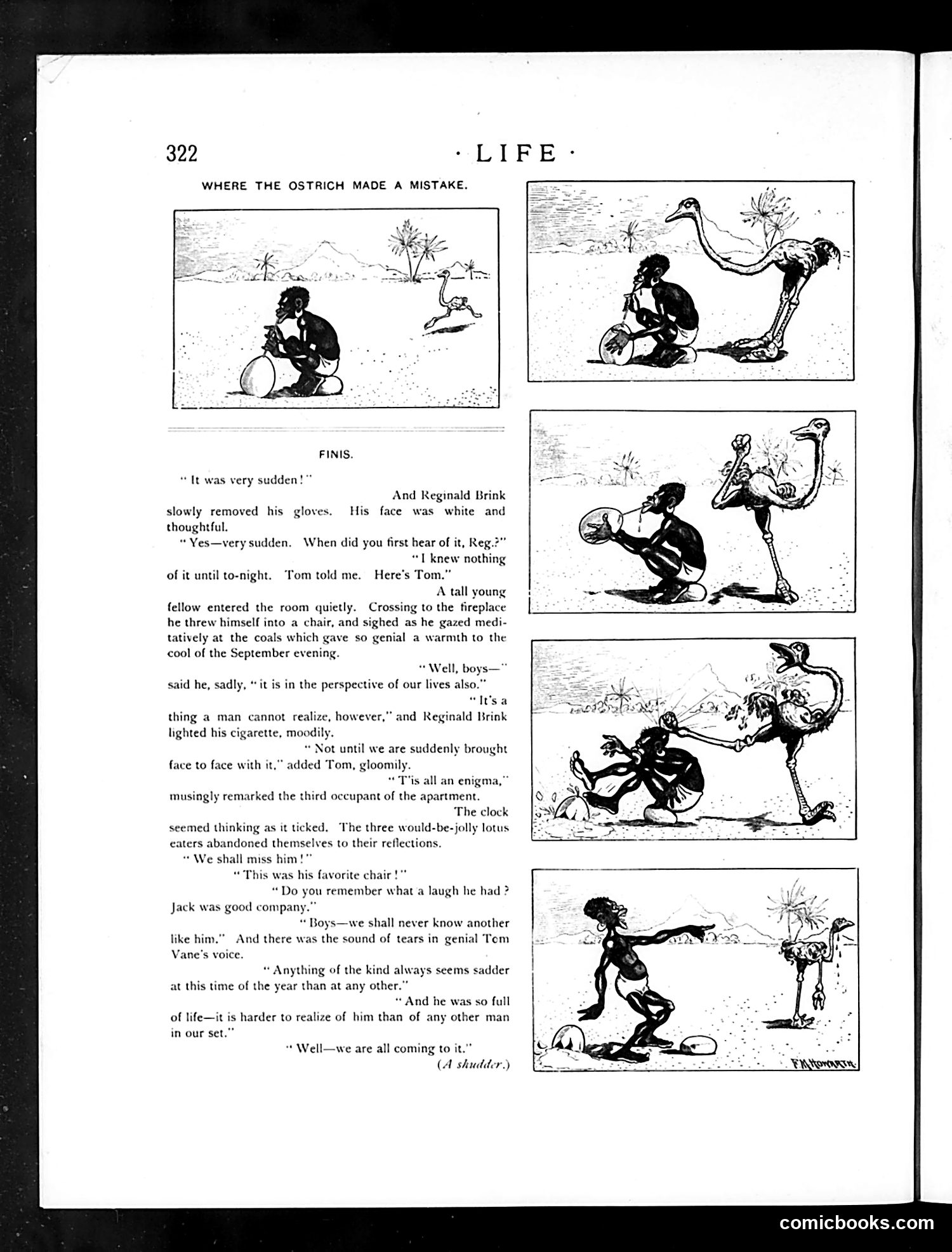
This is a humorous comic strip sequence depicting a man repeatedly being struck or chased by an ostrich. The title's wordplay suggests the ostrich made an error in judgment—presumably in choosing this particular human as a target. The accompanying text describes men mourning a deceased friend named Jack, reflecting on sudden death and mortality. The dialogue references Jack's chair, his laughter, and how "anything of the kind always seems sadder at this time of year." The visual joke—a slapstick sequence of the ostrich repeatedly getting the better of the man—serves as dark comedic commentary alongside the melancholic text about loss. The contrast between the silly cartoon violence and the somber meditation on death creates the satire: the absurdity of sudden misfortune.
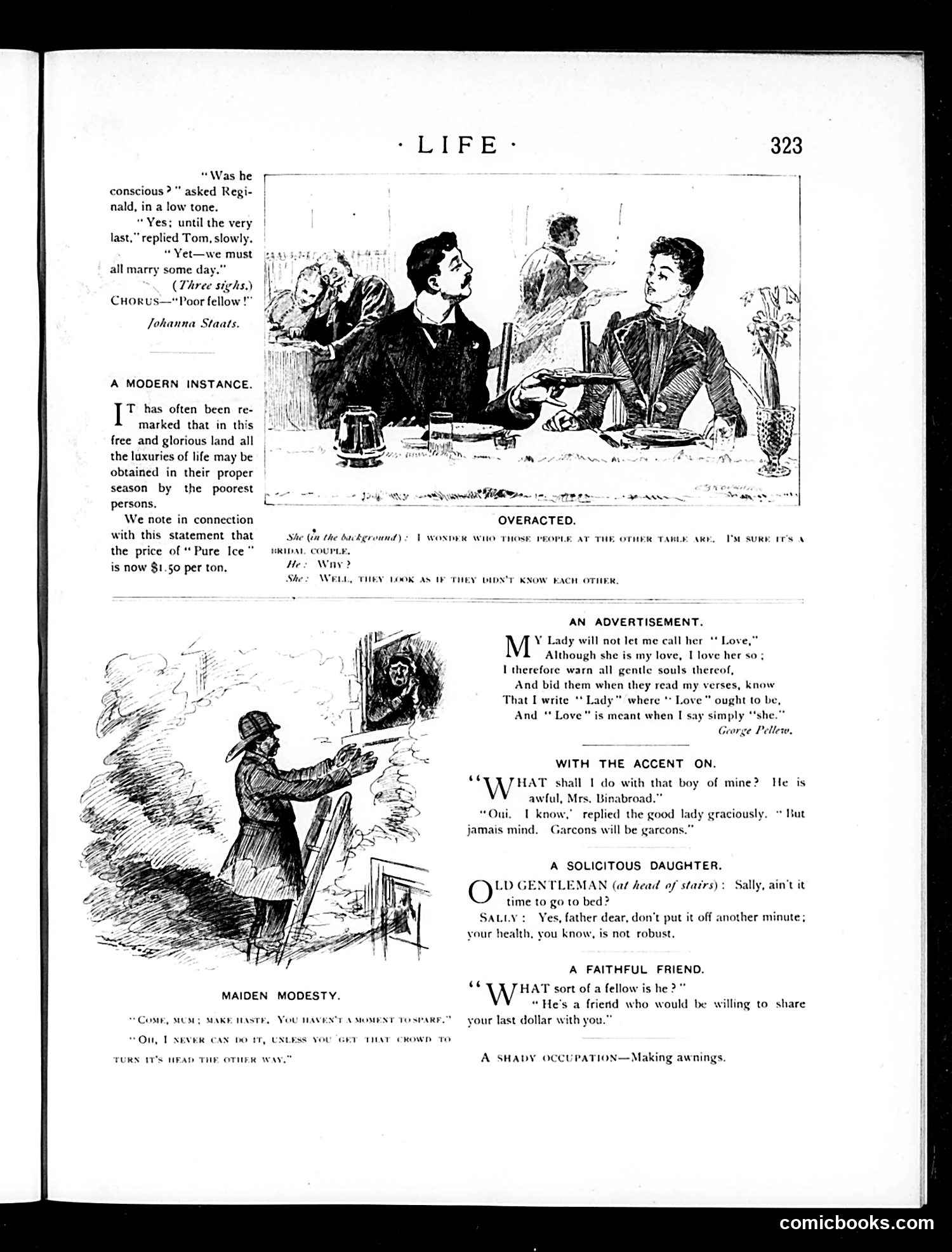
This page contains several brief humorous sketches and social commentary rather than political cartoons. **"Overacted"** (top): A couple at a restaurant appears overly formal and distant, prompting the caption about them looking like strangers. The joke satirizes affected behavior in public. **"Maiden Modesty"** (lower left): A sketch about a woman reluctant to do something, with a punchline about getting a crowd involved. This plays on Victorian-era notions of feminine propriety. The remaining sections—"An Advertisement," "With the Accent On," "A Solicitous Daughter," and "A Faithful Friend"—are brief comic vignettes about everyday social situations, relationships, and character types rather than political satire. The page emphasizes gentle social humor typical of Life magazine's satirical approach to domestic and romantic life.
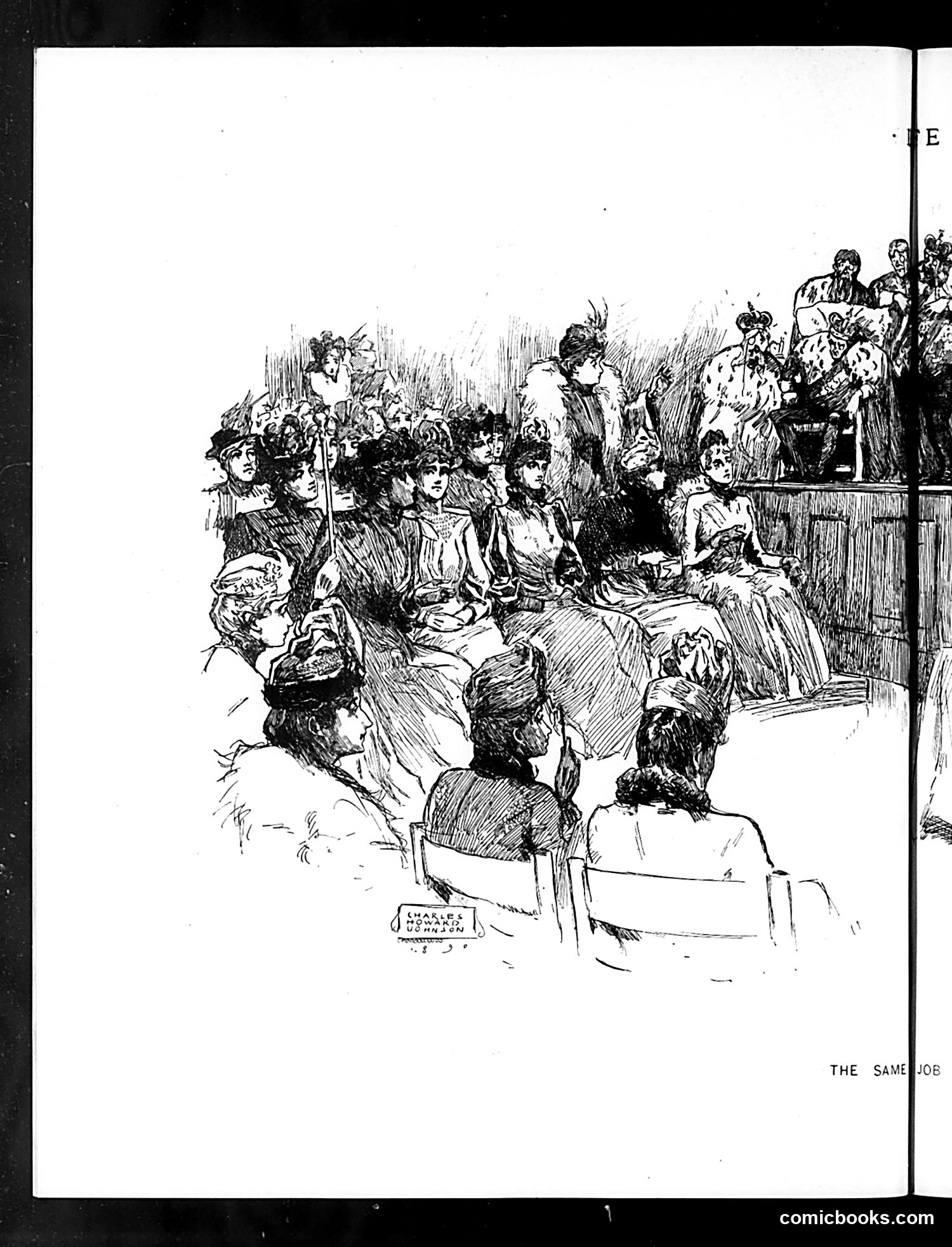
This sketch by Charles Dana Gibson depicts a fashionable social gathering, likely from the early 1900s. The title "The Same Job" appears to be satirizing the sameness of women's social roles and responsibilities—despite changes in fashion, hairstyles, and social settings, women remain occupied with the same activities: socializing, gossiping, and attending social functions. The crowded scene shows elaborately dressed women in hats and formal attire gathered together, suggesting the repetitive nature of high-society social obligations. Gibson's characteristic style captures both the elegance and the underlying monotony of these ritualized social gatherings, implying that despite women's evolving fashions and public visibility, their fundamental social function remains unchanged and constrained.
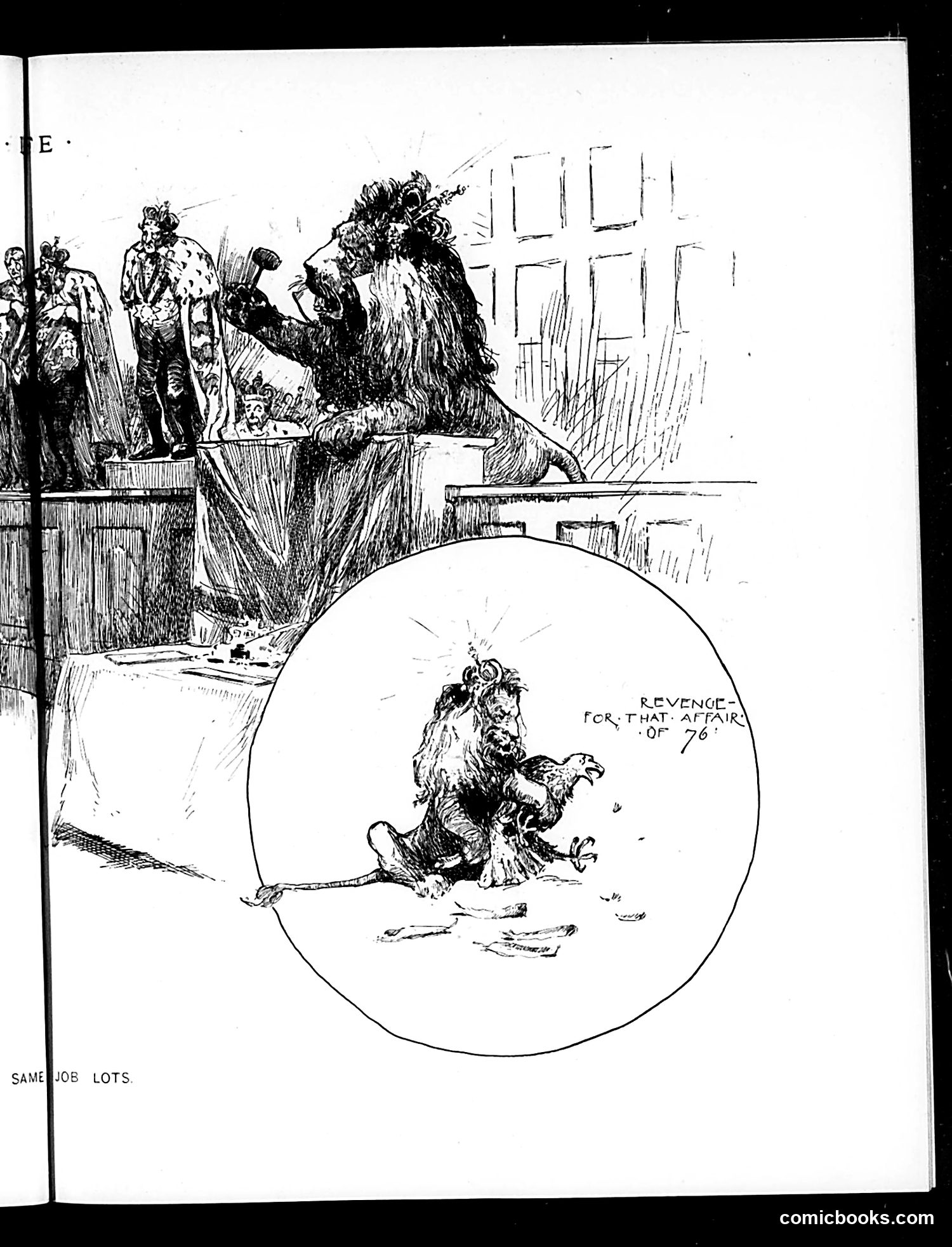
This cartoon depicts a lion being executed by guillotine before spectators, with text reading "REVENGE FOR THAT AFFAIR OF '76." The lion appears to represent **Britain**, and the reference to "1776" indicates the **American Revolution**. The cartoon satirizes French revenge against British colonial power—France supported American independence against Britain, and this image suggests France is now "executing" its former rival. The spectators observing the execution likely represent French officials or the French government celebrating this act of vengeance. The guillotine is particularly significant given **French Revolutionary imagery** (though the specific date context is unclear without seeing the full magazine issue). The caption "SAME JOB LOTS" at bottom remains unclear without additional context.
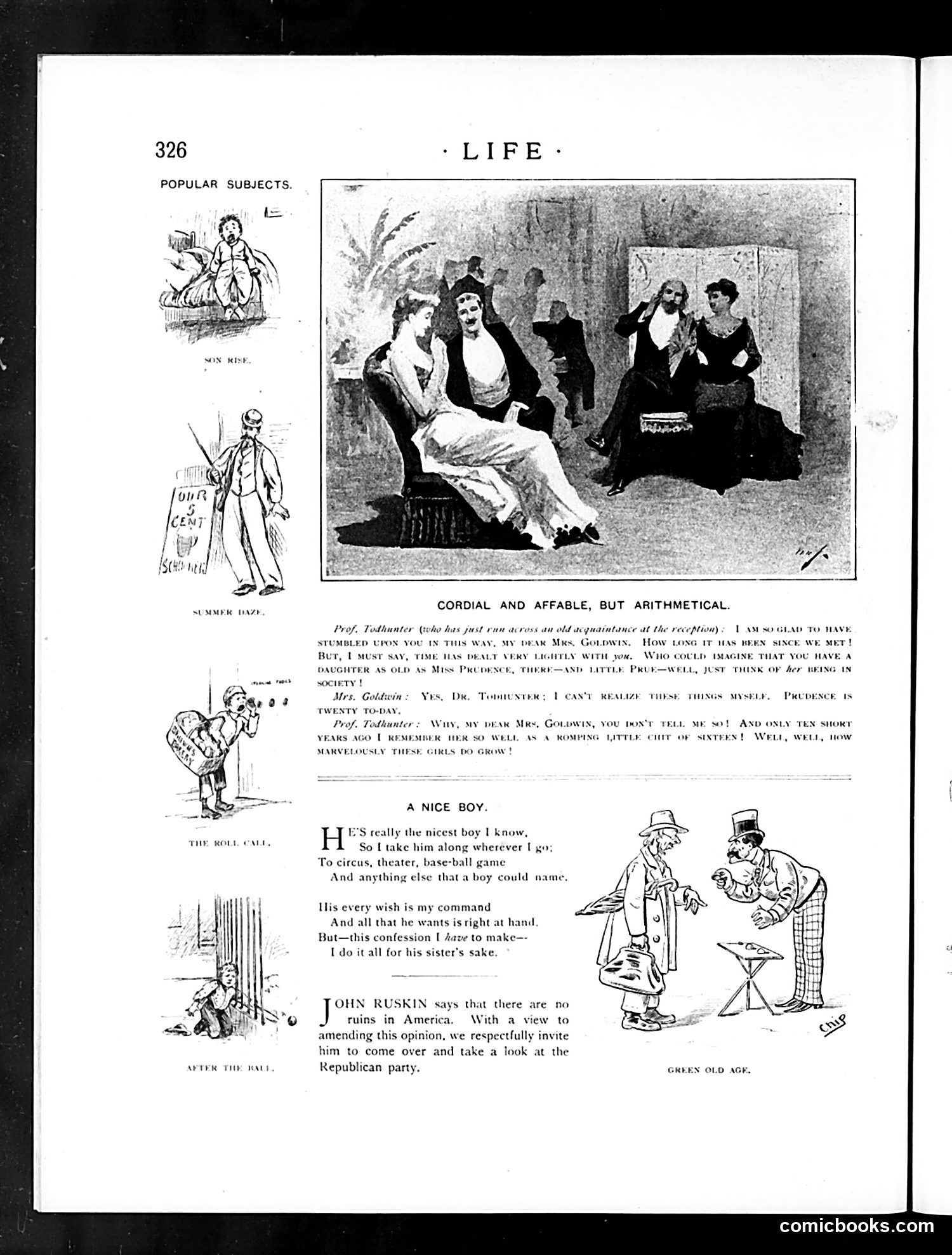
**"Cordial and Affable, But Arithmetical":** Prof. Todhunter encounters Mrs. Goldwin at a reception. He flatters her by saying time has treated her well, then commits the social gaffe of mentioning her daughter Prudence is twenty years old—and that he remembers Prudence as a sixteen-year-old girl only ten years ago. The math doesn't add up, implying Mrs. Goldwin has lied about her age or her daughter's age. The satire mocks both the professor's tactless arithmetic and the social pretense of concealing women's ages. **"A Nice Boy":** A poem about a boy whom the speaker escorts everywhere—but reveals the real motivation: doing it for the boy's sister. Social commentary on romantic interest masked by familial duty. **John Ruskin reference:** A barb at the Republican party, calling it "ruins in America"—political mockery suggesting the party is in decay or disrepair.
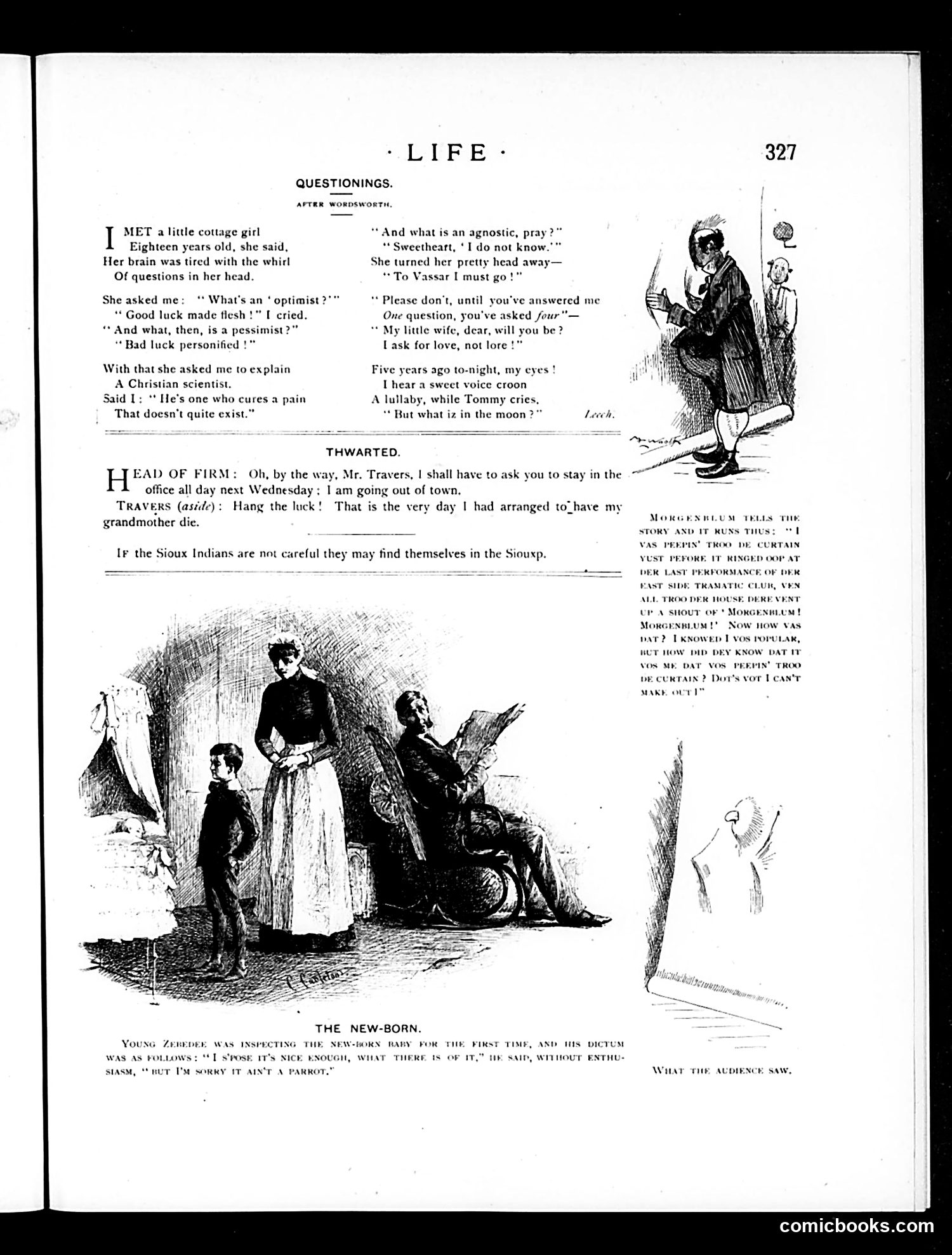
This page contains three satirical pieces: **"Questionings"** parodies Wordsworth's romantic poetry by depicting a young woman bombarded with abstract philosophical questions (agnosticism, optimism, Christian Science). The joke: she deflects intellectual inquiry with practical concerns—going to Vassar and seeking love rather than answers. **"Thwarted"** is a brief office comedy: an employee's excuse for missing work—arranging his grandmother's death—backfires when his boss demands he stay that exact day. The humor lies in the absurd timing and the employee's casual assumption he could schedule family tragedy. **"The New-Born"** and **"Morgenblum" sequence** mock theatrical pretension and ethnic stereotypes. Morgenblum (rendered in exaggerated dialect) complains about a theater crowd recognizing him, while a new father expresses disappointment that his baby isn't a parrot—reversing expectations of paternal joy. The satirical targets are American social pretension, workplace absurdity, and theatrical vanity. The ethnic caricature reflects period conventions (now offensive) common to early 20th-century American humor.
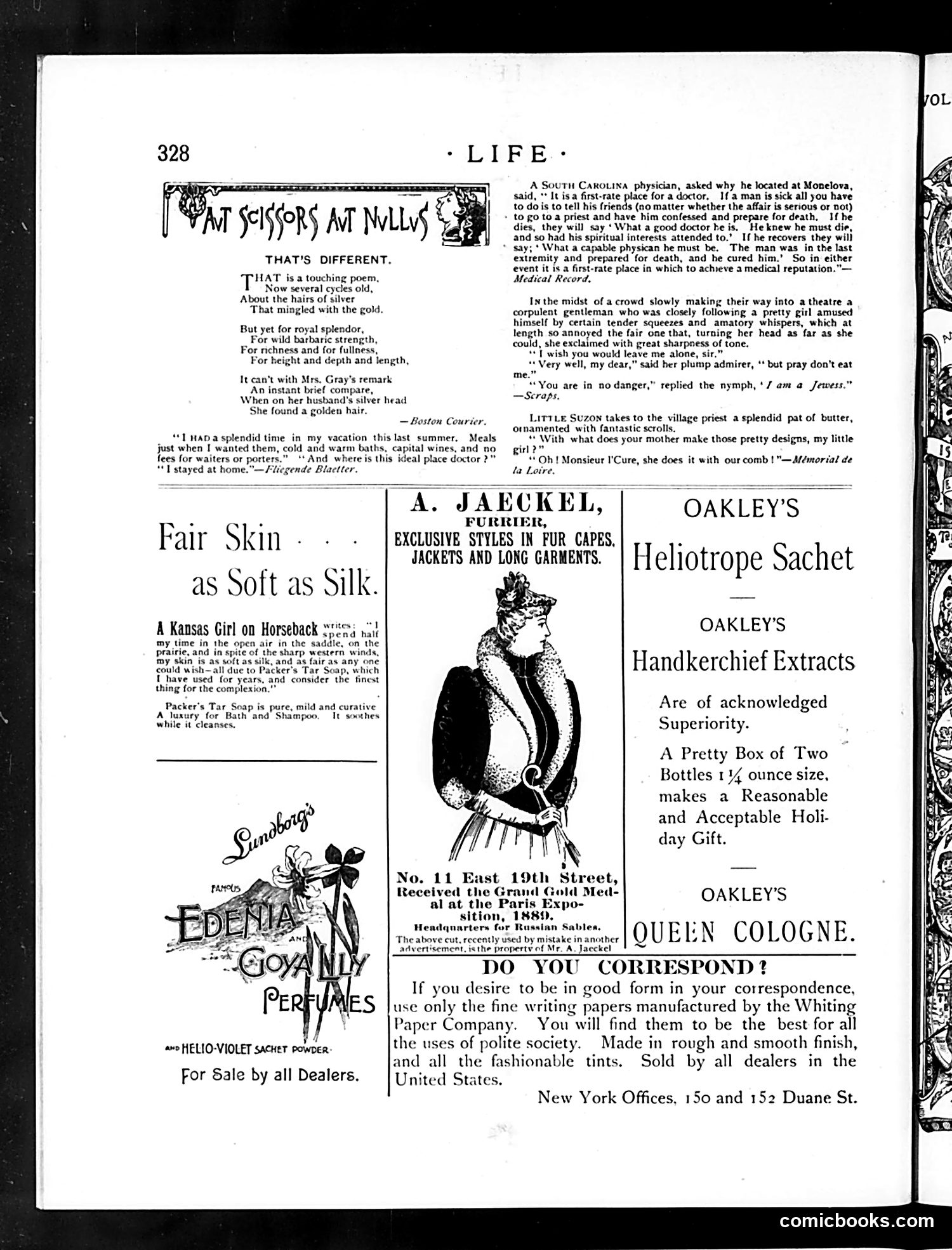
This page is primarily **advertising** interspersed with short humorous anecdotes and satirical items typical of Life magazine's format. The opening section "At Nullus" contains brief jokes: one about a woman finding a golden hair on her silver-haired husband (implying infidelity); another about a doctor in Monelova who thrives by taking credit whether patients die (receiving last rites) or recover; and theatrical/social comedy about unwanted advances and Jewish dietary laws. The bulk of the page features **period advertisements** for consumer goods: Packer's Tar Soap (marketed to a Kansas woman for complexion), A. Jaeckel's fur garments, and Oakley's perfume products (Heliotrope Sachet, Handkerchief Extracts, Queen Cologne), plus Whiting Paper Company writing supplies. The satire reflects **late-19th-century social concerns**: medical ethics, gender relations, religious stereotypes, and the emerging advertising industry's use of testimonials. The content prioritizes entertainment and commerce over sustained political commentary.