
Life, 1890-12-04 · page 6 of 14
Life — December 4, 1890 — page 6: what you’re looking at
What you’re looking at
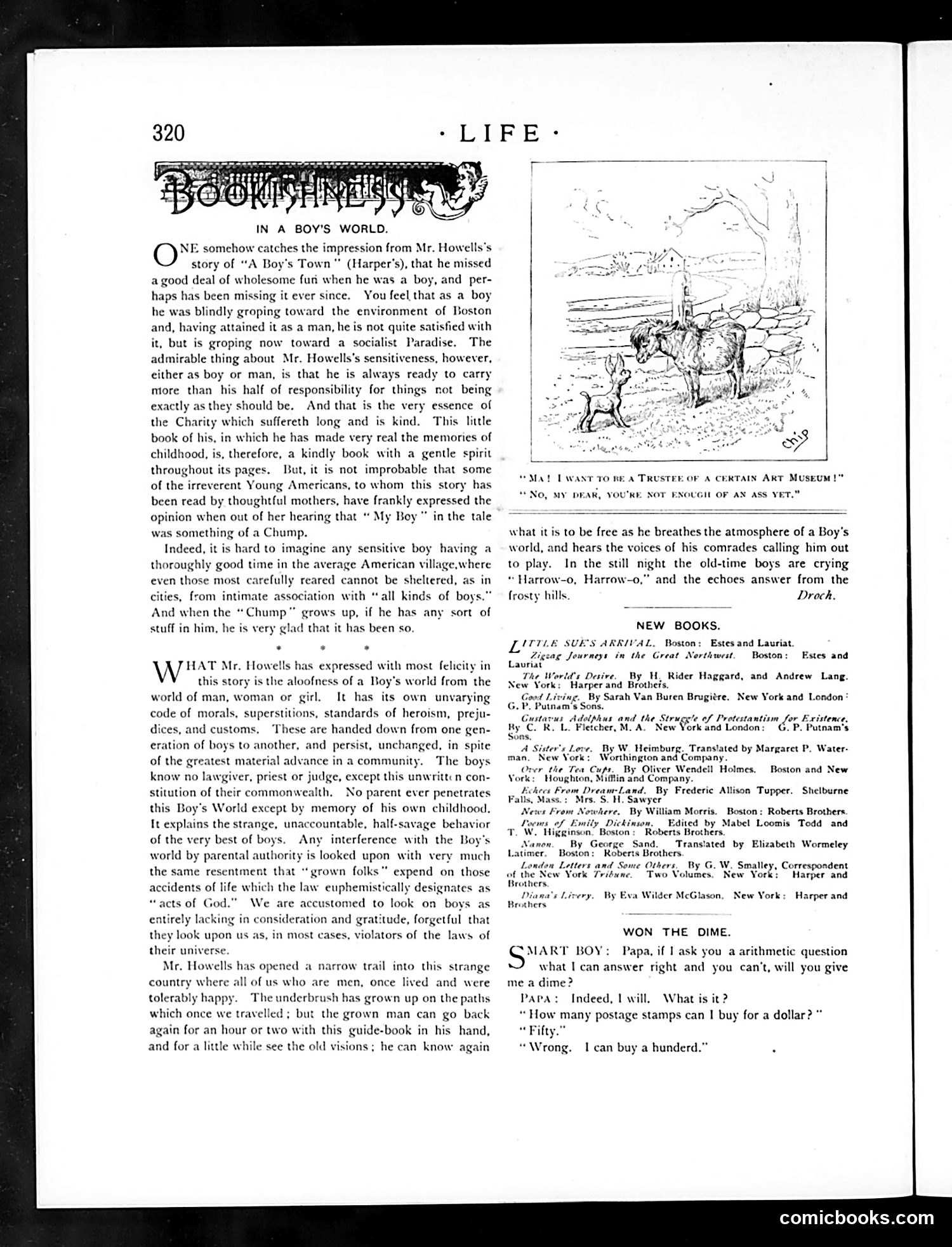
This page consists primarily of a literary essay and book reviews, not political cartoons. The only illustration is a sketch showing a rural scene with a boy and dog near a fence—accompanying an article titled "Books in a Boy's World" that discusses Mr. Howell's story "A Boy's Town." The essay argues that boys' literature should authentically capture childhood experience and the "Boy's World"—a realm with distinct values separate from adult society. It praises Howell's work for depicting boys' independence and self-governance without adult interference. The small dialogue joke at bottom ("Won the Dime") shows a father-son exchange about arithmetic and postage stamps—gentle humor about children's reasoning. This is literary criticism and book discussion, not political satire.
📄 Transcribed text from this page (OCR, searchable)
Machine-transcribed from the original scan — historical spelling and the odd misread are preserved.
IN A BOY'S WORLD. somehow catches the impression from Mr. Howells’s story of “A Boy's Town" (Harper's), that he missed a good deal of wholesome fur when he was a boy, and per- haps has been missing it ever since. You feel that as a boy he was blindly groping toward the environment of Boston and, having attained it as a man, he is not quite satisfied with it, but is groping now toward a socialist Paradise. The admirable thing about Mr. Howells’s sensitiveness, however, either as boy or man, is that he is always ready to carry more than his half of responsibility for things not being exactly as they should be, And that is the very essence of the Charity which suffereth long and is kind. This little book of his, in which he has made very real the memories of childhood, is, therefore, a kindly book with a gentle spirit throughout its pages. But, it is not improbable that some of the irreverent Young Americans, to whom this story has been read by thoughtful mothers, have frankly expressed the opinion when out of her hearing that “ My Boy" in the tale s something of a Chump. Indeed, it is hard to imagine any sensitive boy having a thoroughly good time in the average American village,where even those most carefully reared cannot be sheltered, as in cities, from intimate association with “all kinds of boys.” And when the “Chump” grows up, if he has any sort of stuff in him, he is very glad that it has been so. wat Mr. Howells has expressed with most felicity in this story is the aloofness of a Boy's world from the world of man, woman or girl. It has its own unvarying code of morals, superstitions, standards of heroism, preju- ices, and customs. on of boys to another, and persist, unchanged, in spite of the greatest material advance in a community. The boys know no lawgiver, priest or judge, except this unwrittcn con- stitution of their commonwealth. No parent ever penetrates this Boy's World except by memory of his own childhood. It explains the strange, unaccountable, half-savage behavior of the very best of boys. Any interference with the Boy world by parental authority is looked upon with very much the same resentment th: grown folks” expend on those accidents of life which the law euphemistically designates as “acts of God.” We are accustomed to look on boys as entirely lacking in consideration and gratitude, forgetful that they look upon us as, in most cases, violators of the laws of These are handed down from one gen- their universe. Mr. Howells has opened a narrow trail into this strange country where all of us who are men, once lived and were tolerably happy. The underbrush has grown up on the paths which once we travelled ; but the grown man can go bac again for an hour or two with this guide-book in his hand, and for a little while see the old visions; he can know again “Mat LWAnt To RE A TRUSTER OF A CERTAIN ART MusEUM!" + No, MY DEAR, YOU'KE NOT ENOUGIL OF AN ASS YET." what itis to be free as he breathes the atmosphere of a Boy's world, and hears the voices of his comrades calling him out to play. In the still night the old-time boys are crying * Harrow-o, Harrow-o,” and the echoes answer from the frosty hil Droch. NEW BOOKS. ITTLE SUE'S ARRIVAL, Boston: Zigcag Journeys in the Great Lavriat The Word's Desire. By H, Rider Haggard, and Andrew Lang. New York: Harper and Brotheis. Good 1. By Sarah Van Buren Brugitre. New York and London * G. P. Putnam's Sons. Gustavus Adolphus and the Struggle of Protestantism for Existence, Ry C. R. L. Fletcher, M.A. New York and London: G. P. Putnam's Ss. Estes and Lauriat. thwest. Boston: Estes and A Sister's Love. man. New Vork By W. Heimburg. Translated by Margaret P. Water- Worthington and Company. Over the Tea Cups. By Oliver Wendell Holmes, York: Houghton, Miftin and Company. Echecs From Dreanr-Land. By Frederic Allison Tupper. Falls, Mass.: Mrs. S. H. Sawyer News From Nowhere. By William Morris. Boston: Roberts Brothers Poems ef Emily Dickinson. Edited by Mabel Loomis Todd and W. Higginson. Boston: Roberts Brothers. Nanon. By George Sand. Transiated by Elizabeth Wormeley at Boston: Roberts Brothers. London Letters and Some Others. of the New York Tribune. Two Volumes. Brothers. Diana's Livery. Brothers Boston and New Shelburne By G. W. Smalley, Correspondent New York! Harper and By Eva Wilder McGlason, New Vork: Harper and WON THE DIME. Papa, if | ask you a arithmetic question SM RT BOY: what I can answer right and you can’t, will you give me a dime? Para: Indeed, | will, What is it? “How many postage stamps can I buy for a dollar?” “ Fifty.” “Wrong. 1 can buy a hunderd.” comicbooks.com