
A complete issue · 18 pages · 1890
Life — November 6, 1890
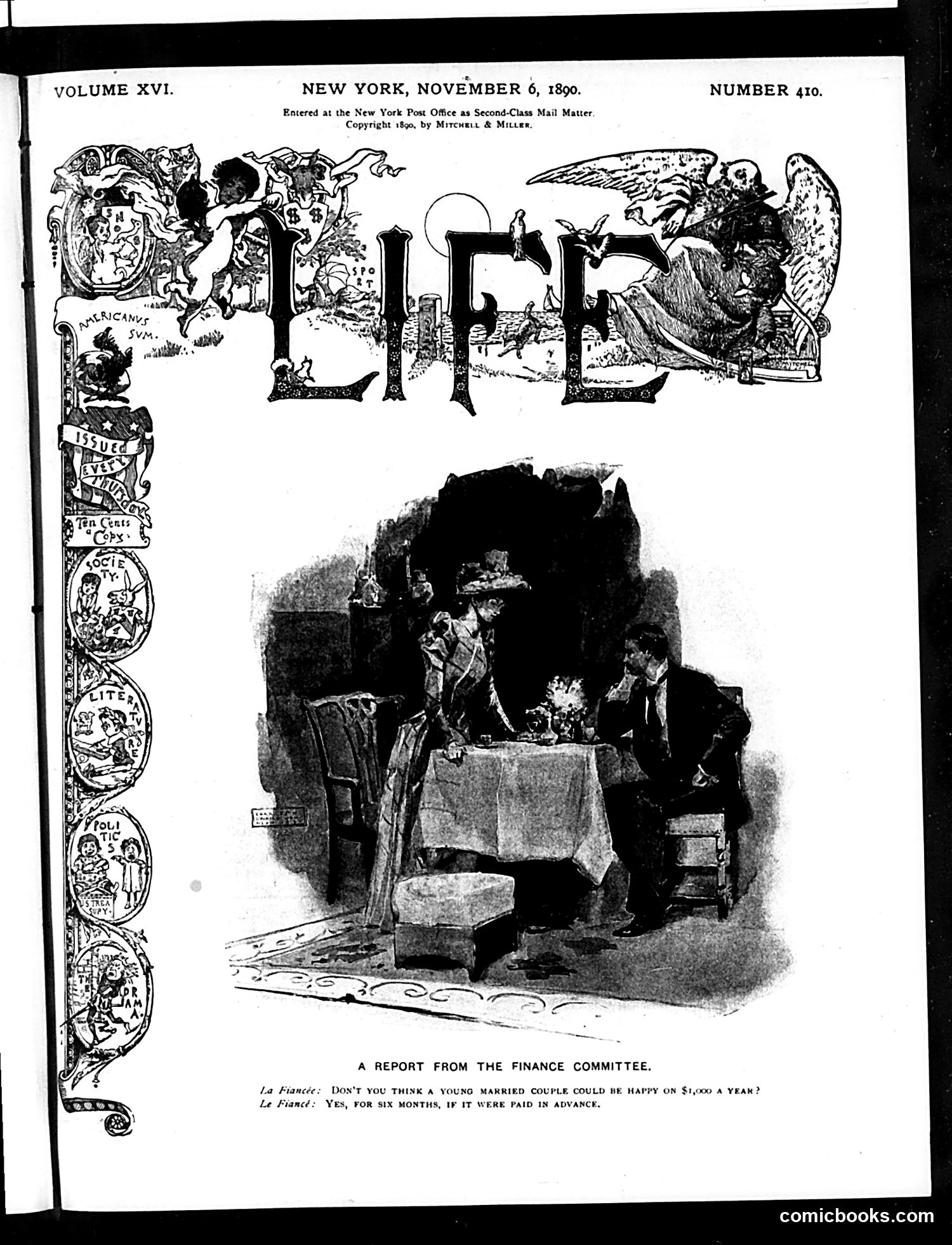
This page from Life satirizes married couples' financial struggles through "A Report from the Finance Committee." The cartoon depicts two people at a modest dining table in what appears to be a cramped apartment, with the dialogue addressing economic hardship. The caption presents an exchange about household budgeting: a character asks if a young married couple could be happy on $1,000 annually, and the response confirms yes—"if it were paid in advance." This joke targets the precarious financial situation of working-class and lower-middle-class married couples in 1890s America, where irregular income and payment delays were common hardships. The satire critiques both spousal financial stress and the unreliability of wage labor during this economic period.
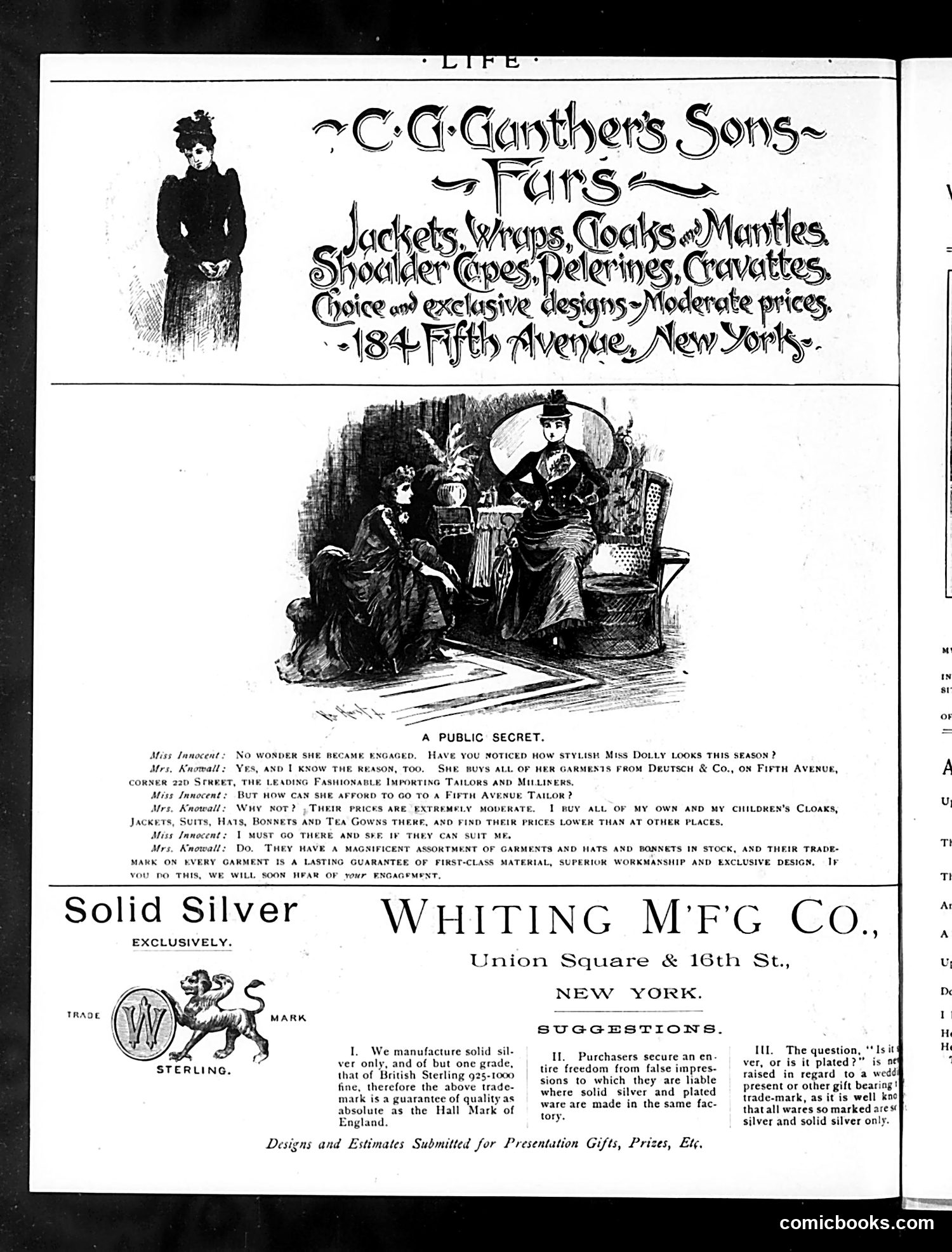
This page contains two distinct advertisements rather than political satire. **Top Ad:** C.G. Ganthers Sons advertises women's fashionable outerwear (jackets, wraps, coats, capes, cravats) at 184 Fifth Avenue, New York, using a stylized illustration of a fashionable woman in period dress. **Bottom Section:** "A Public Secret" is a humorous dialogue satirizing women's fashion shopping habits. Multiple women discuss how "stylish Miss Dolly" affords expensive garments, revealing the "secret" that C.G. Ganthers offers quality children's and women's clothing at lower prices than competitors, with superior materials and workmanship. The final advertisement promotes Whiting Manufacturing Company's solid silver goods, emphasizing that their sterling mark guarantees British quality equivalent to the Hall Mark of England.
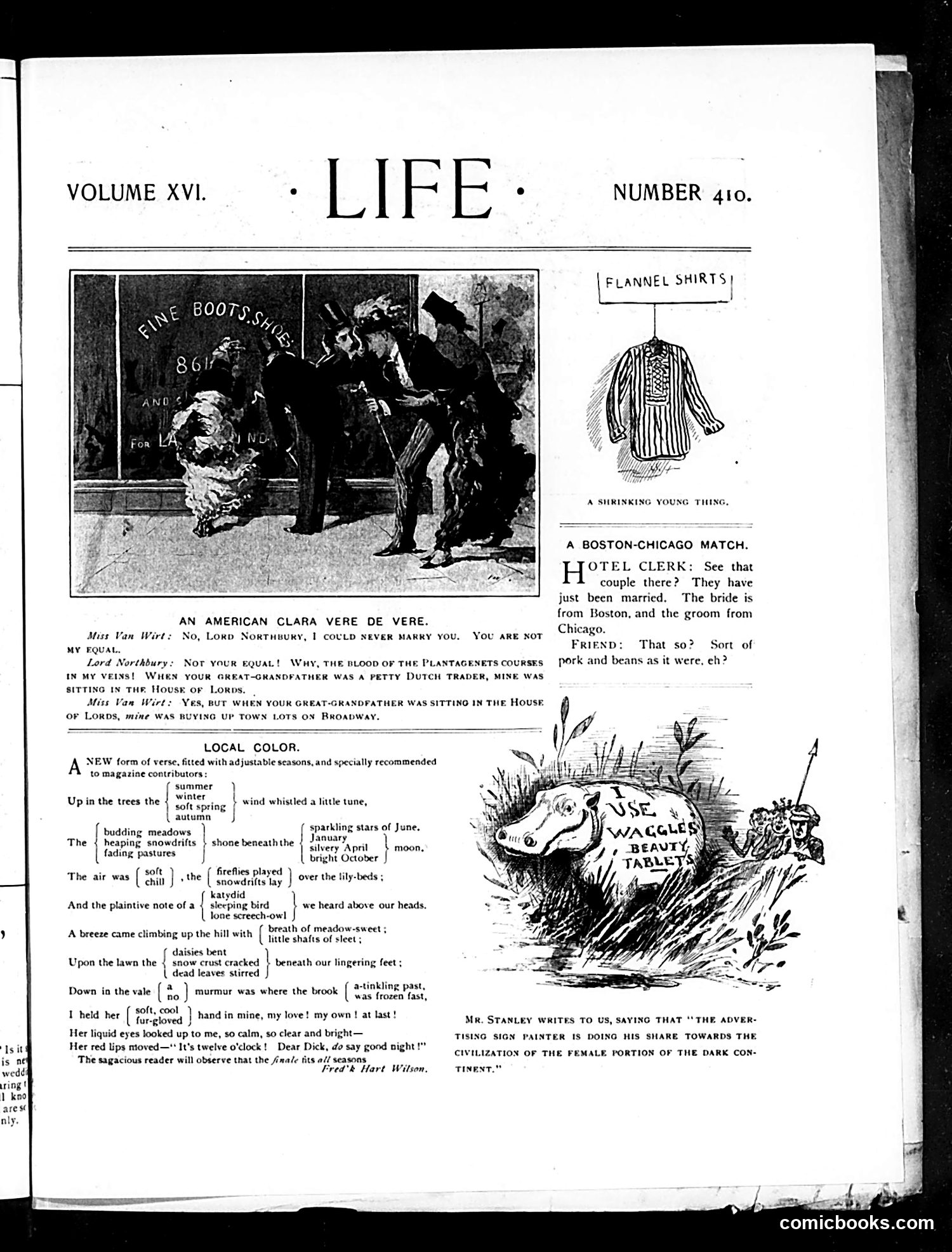
The top cartoon, "An American Clara Vere de Vere," depicts a social-climbing scenario. A woman boasts of aristocratic lineage to Lord Northbury, claiming descent from Dutch traders and nobility. The satire mocks American class pretension—the woman's claims of superior blood are undercut by her great-grandfather's actual occupation as a tradesman buying "lots on Broadway," suggesting new-money vulgarity rather than true aristocracy. The "Boston-Chicago Match" dialogue below jokes about a cross-country marriage between a Boston bride and Chicago groom, with the friend's sarcastic comment about "pork and beans" mocking Chicago's industrial, less refined reputation compared to Boston's cultural prestige. The "Local Color" section is poetry, not satire—a literary contribution to the magazine.
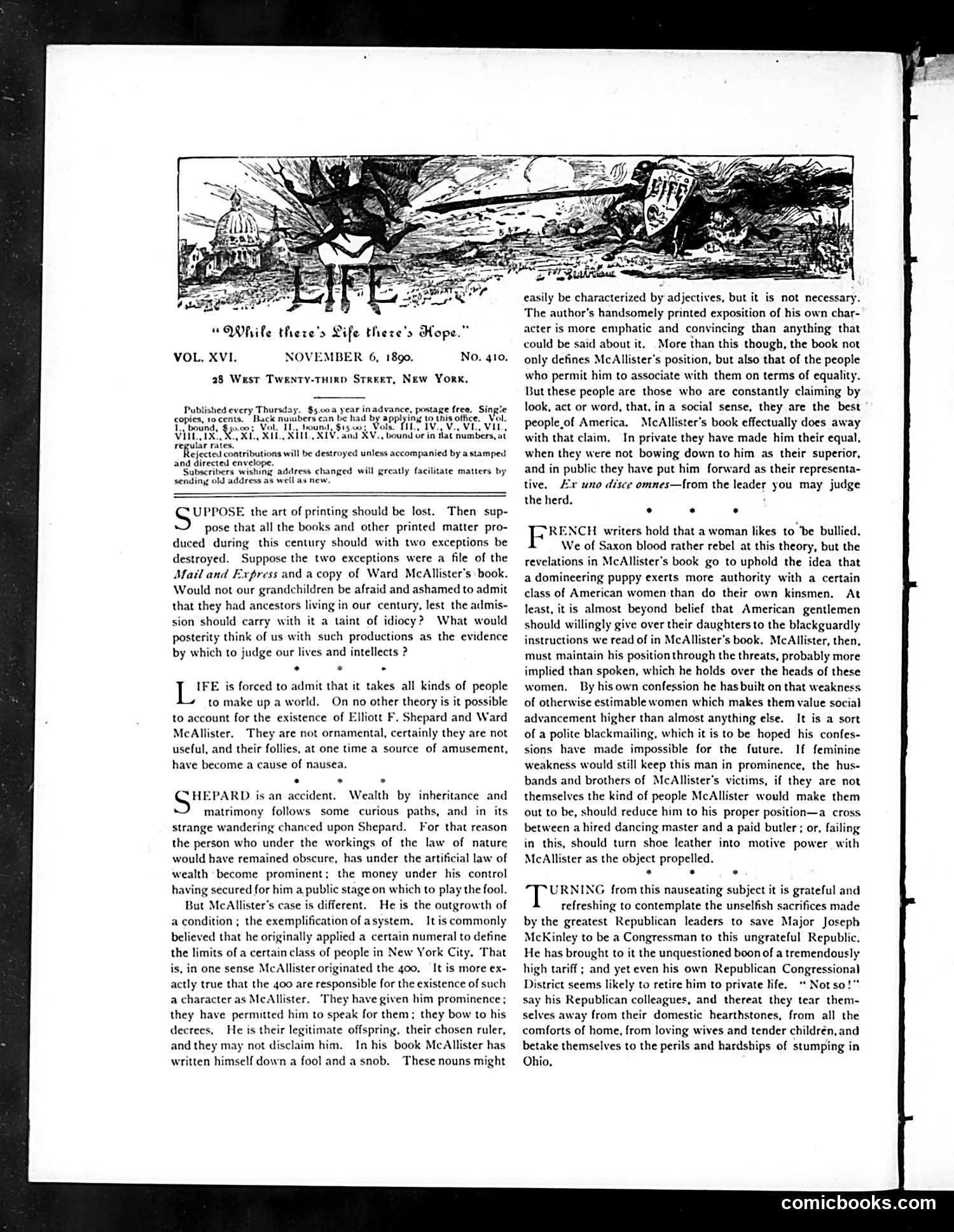
The page contains editorial text critiquing Ward McAllister, a prominent New York society figure. The cartoon at the top appears to show a wealthy man in formal dress seated beneath a large tree, likely satirizing McAllister's social prominence and pretensions. The text attacks McAllister for claiming social superiority and his role in defining New York's "elite" class. The author argues McAllister has become a snob through inherited wealth and social position, criticizing his apparent disdain for common Americans. The article questions whether such arbitrary social gatekeeping should command respect. The satire targets the artificial class distinctions McAllister represented in Gilded Age America, suggesting his authority over social standing was undeserved and ridiculous.
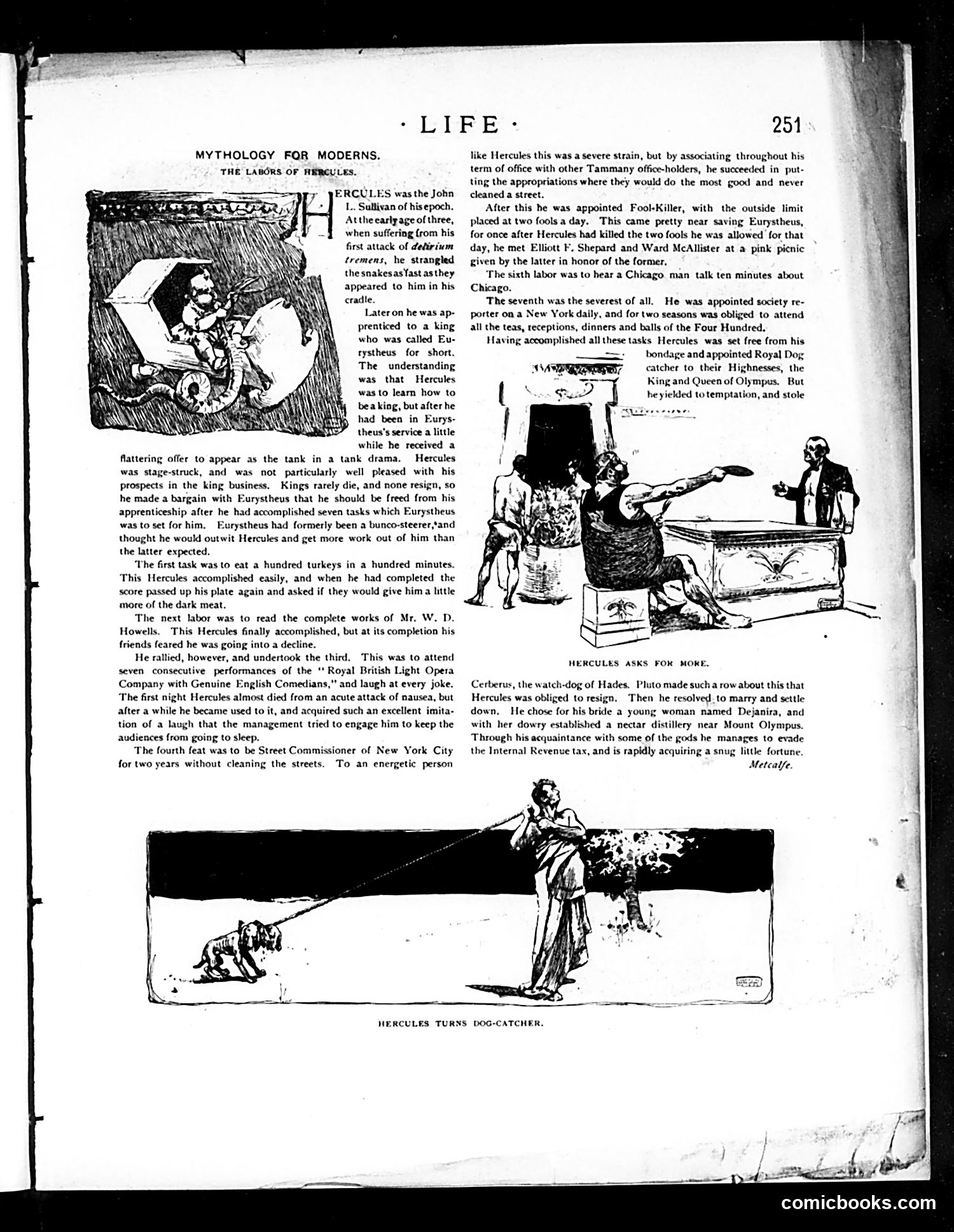
This satirical piece modernizes the Greek myth of Hercules' Twelve Labors as absurd contemporary tasks. The text describes ridiculous assignments like eating a hundred turkeys in minutes, reading W.D. Howells' complete works, and attending every society event in New York City for two seasons. The satire targets **Gilded Age excess and social climbing**. By equating mundane society obligations with impossible classical feats, the author mocks the pretensions of the wealthy leisure class. References to opera companies, street cleaning, and society reporter duties suggest criticism of both aristocratic frivolity and the emerging celebrity/media culture. The cartoon illustrations show Hercules comically performing modern labor, emphasizing the absurdity of treating social obligations as heroic achievements.
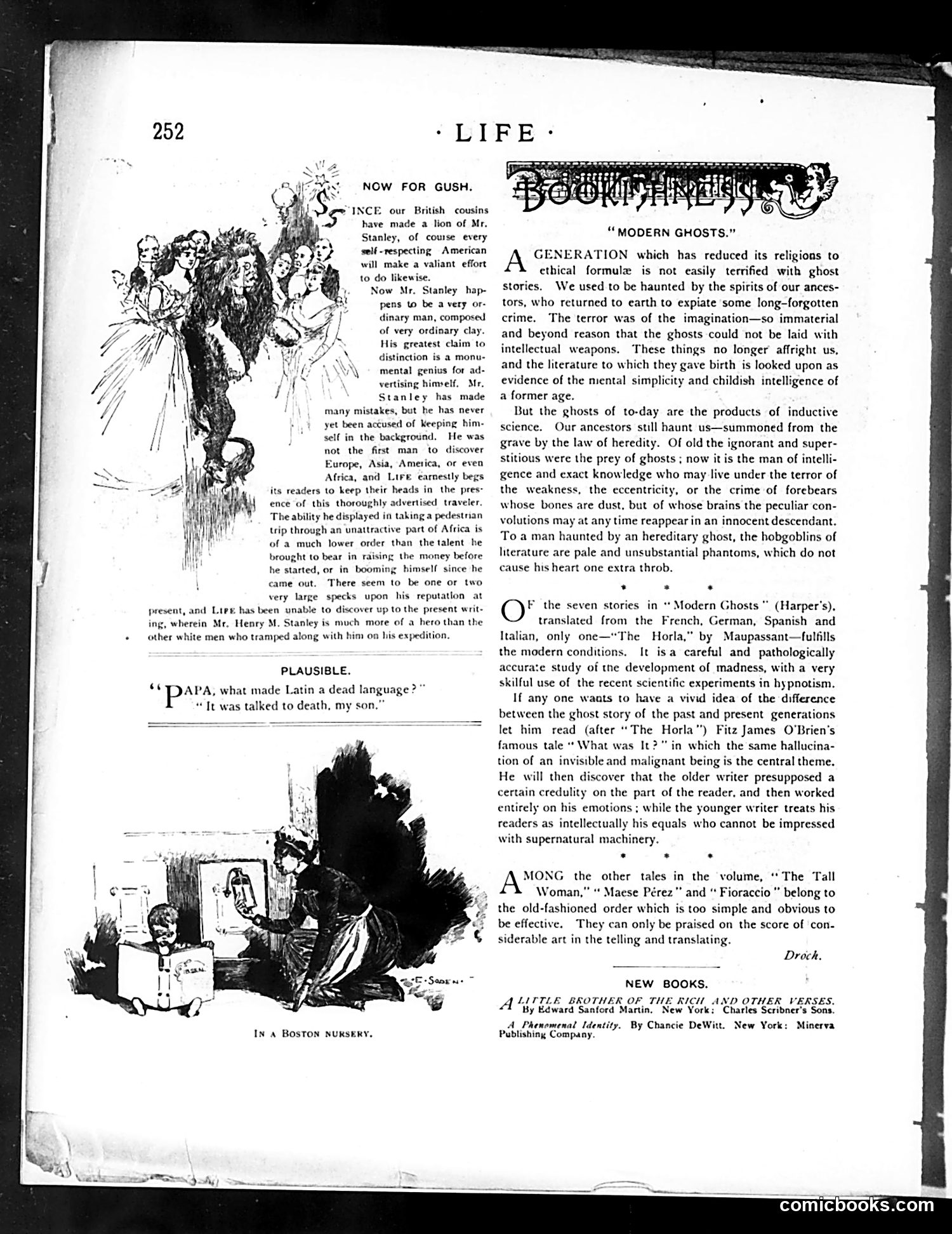
**"Now for Gush" Section:** This appears to be a humorous biographical sketch of Mr. Stanley, described as "a very ordinary man" whose greatest distinction is "a monumental genius for advertising himself." The accompanying caricature shows an exaggerated figure, likely mocking someone's self-promotional abilities. Life criticizes Stanley for raising money through publicity stunts and sensationalizing his expeditions, suggesting he's more showman than genuine explorer—a common satirical target of the era. **"Plausible" Section:** A brief joke: "Papa, what made Latin a dead language?" "It was talked to death, my son." The accompanying illustration appears to be a nursery scene. **"Modern Ghosts" Review:** The page concludes with a literary review of a story collection, discussing how modern scientific rationalism has replaced supernatural terror with psychological anxiety.
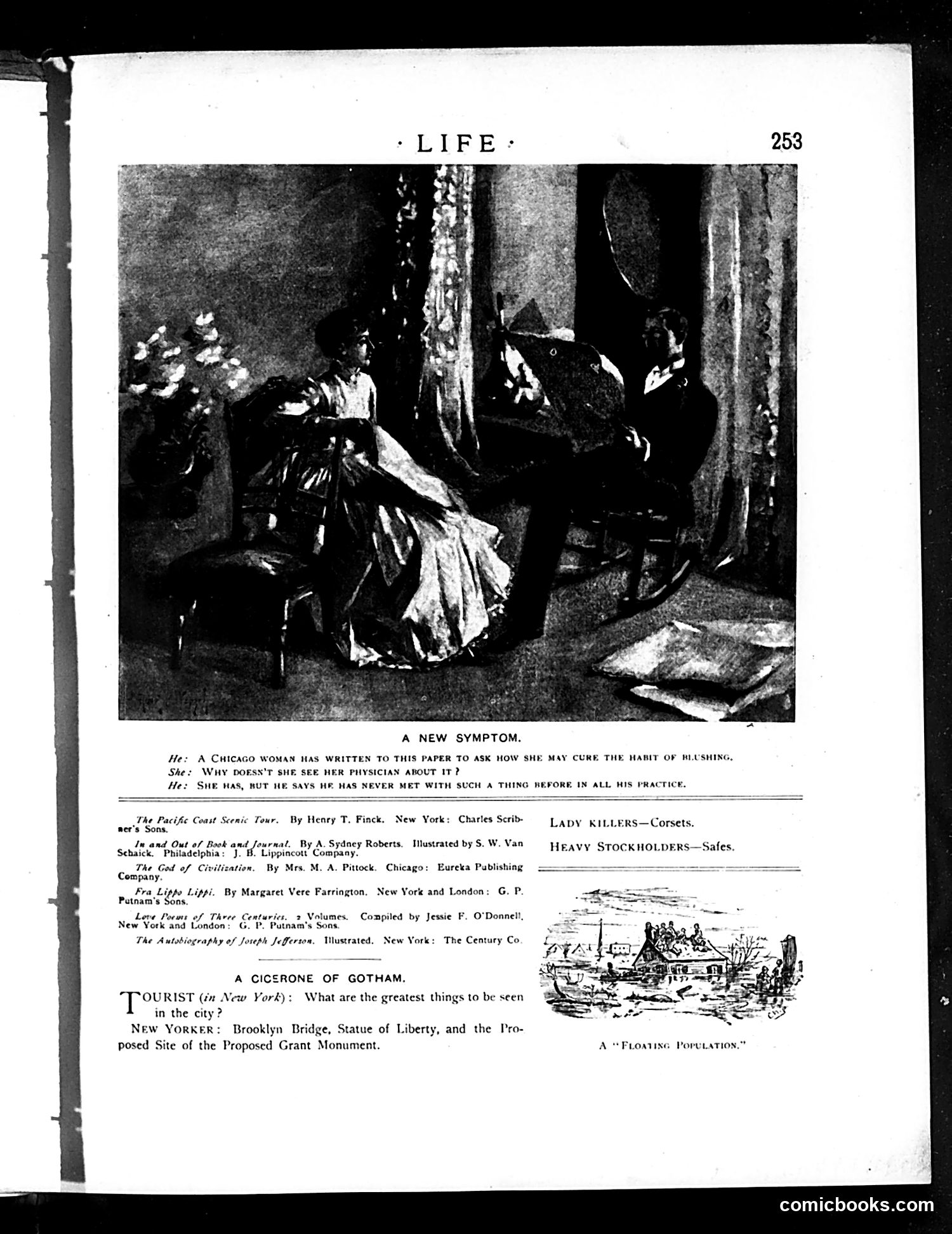
**Main Image: "A New Symptom"** This cartoon depicts a medical consultation scene. A Chicago woman has written to the magazine asking how to cure "the habit of blushing." She won't ask her physician about it. The doctor replies he's never encountered such a condition in his practice. The satire appears to target either excessive modesty or the absurdity of treating social embarrassment as a medical problem worthy of doctor consultation. The "new symptom" likely mocks either hypochondria or changing social attitudes about proper behavior for women—suggesting either her modesty is old-fashioned or her complaint is trivially self-invented. **Lower Content:** Book advertisements and a "Cicerone of Gotham" section listing New York tourist attractions (Brooklyn Bridge, Statue of Liberty, Grant Monument site).
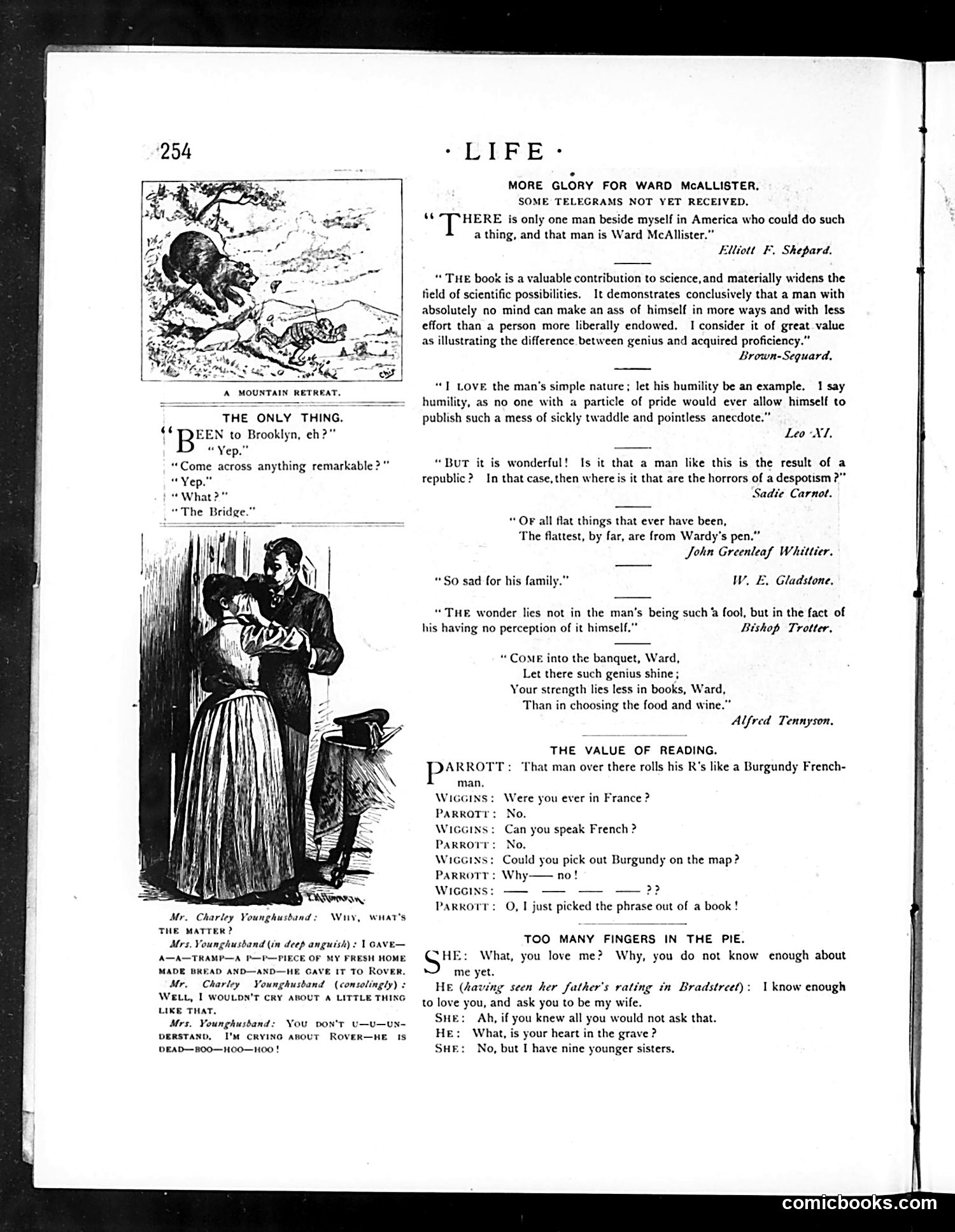
This page celebrates Ward McAllister, a prominent New York socialite and arbiter of high society etiquette in the Gilded Age. The satirical quotes mock his pretensions and limited intellect—calling his writings "sickly twaddle and pointless anecdote" (Leo XI) and suggesting he's "a fool" with "no perception of himself" (Bishop Traller). The cartoon "A Mountain Retreat" (top left) and the dialogue scenes below appear to ridicule McAllister's social observations and his role as gatekeeper of New York's elite. The piece suggests his fame rests entirely on social position rather than genuine merit or knowledge—he picks phrases "out of a book" without understanding them. The satire targets both McAllister's vapid commentary on society and, more broadly, the superficiality of Gilded Age aristocracy.
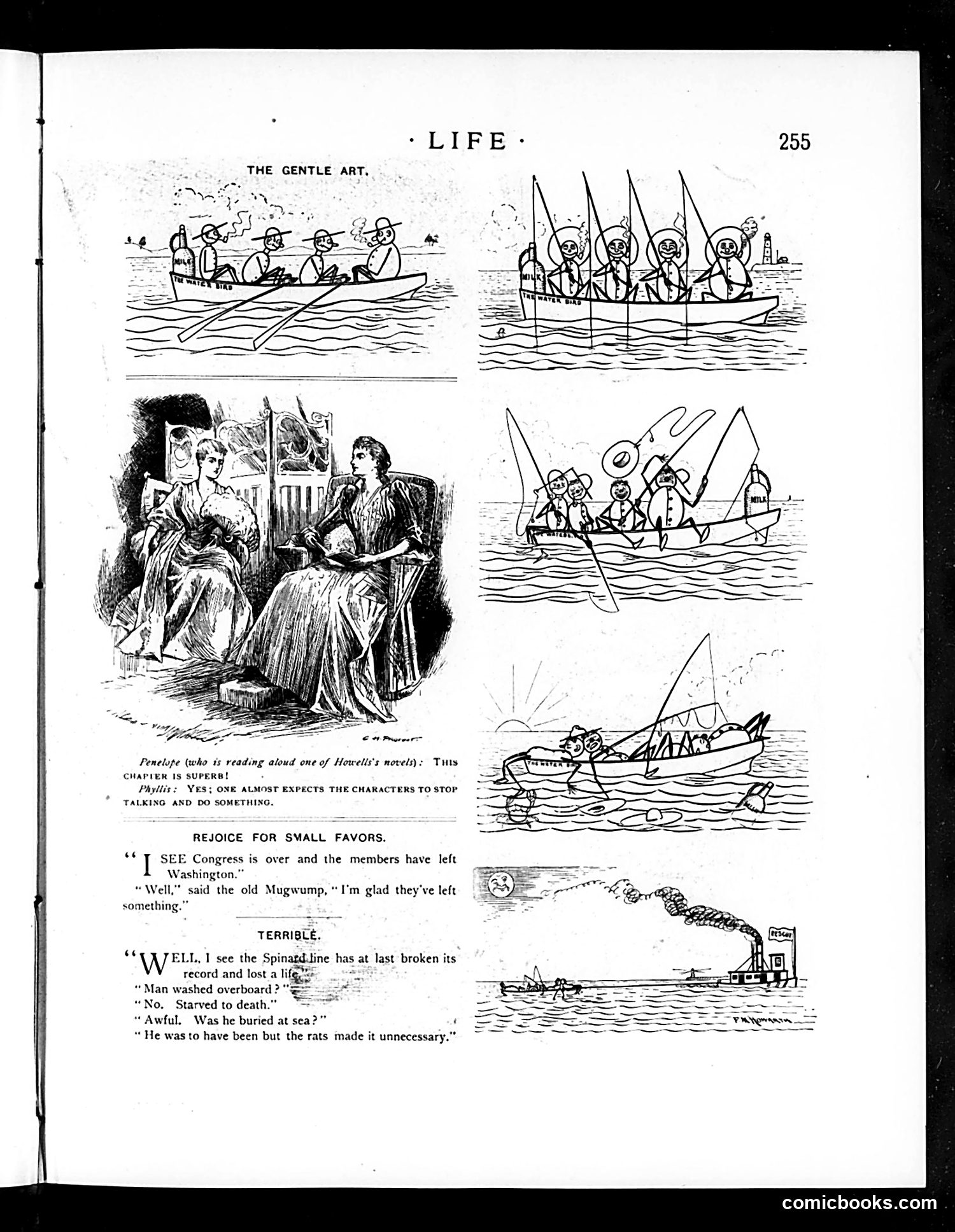
This page contains humorous sketches and brief comedic dialogues rather than political cartoons. **"The Gentle Art"** (top left) shows a couple reading aloud together, with the caption sarcastically noting that one "almost expects the characters to stop talking and do something"—mocking the tedium of domestic reading sessions. **"Rejoice for Small Favors"** features dialogue between characters discussing Congress leaving Washington, with one character (identified as "old Mugwump") expressing relief at their departure. **"Terrible"** presents a darker joke about a Spinard Line ship breaking its record with a man lost at sea—the punchline being that rats made his death "unnecessary," suggesting the ship was rat-infested enough to have killed him anyway. The right side shows various maritime comic sketches, all emphasizing nautical misadventures and gallows humor typical of early 20th-century Life magazine humor.
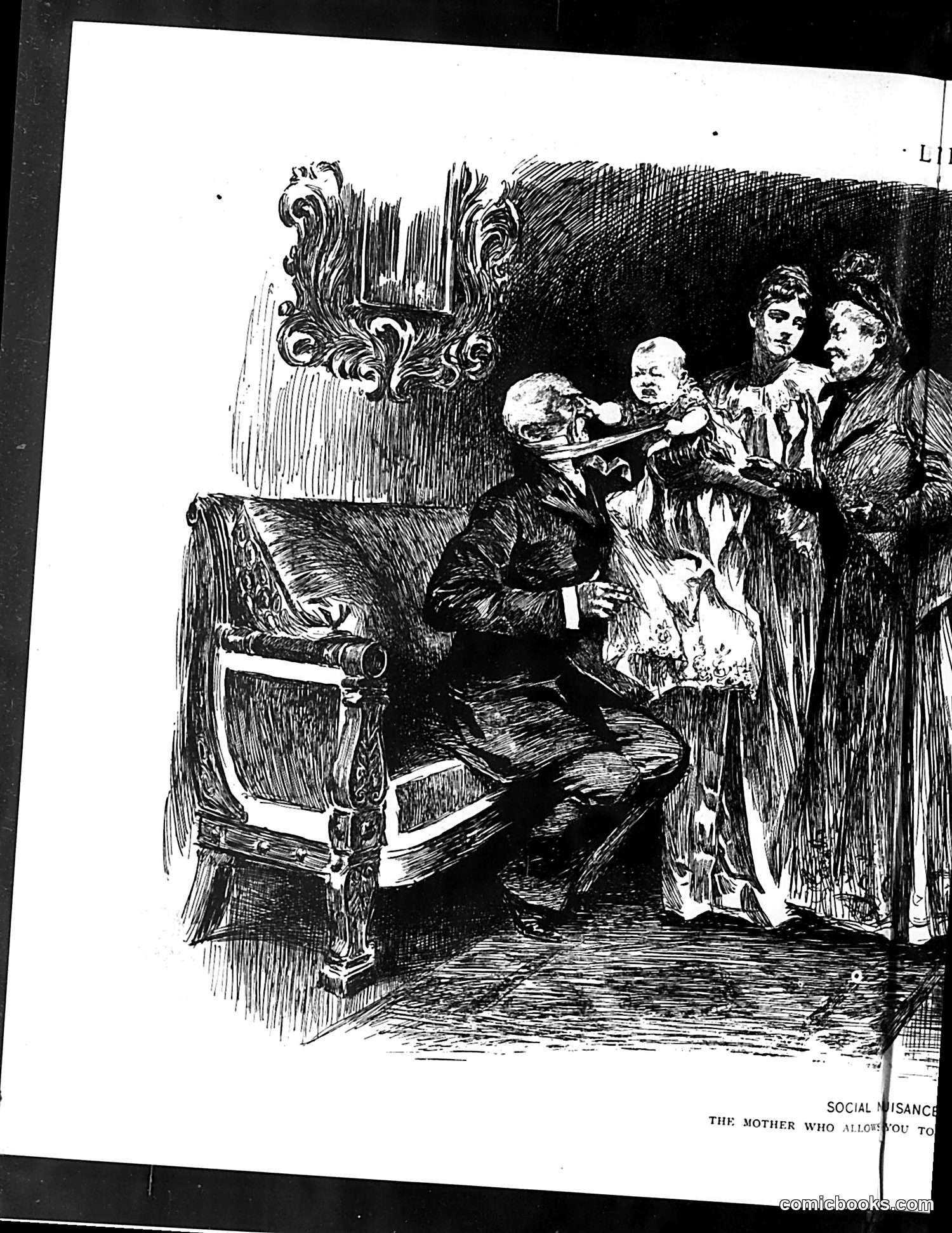
This appears to be a satirical illustration titled "Social Nuisance: The Mother Who Allows You To" (text cuts off). The image shows a well-dressed man seated in an ornate chair, holding what appears to be a telescope or similar instrument, while several children and a woman gather around him in an interior setting. The satire likely criticizes permissive parenting—specifically mothers who allow their children to disturb or interfere with adults' activities or comfort. The man's dignified pose contrasts with the children's intrusive presence, suggesting social commentary on Victorian-era parenting norms and the disruption caused by inadequately supervised children in polite society. The "social nuisance" label indicates this was part of Life magazine's regular satirical commentary on contemporary social behaviors.
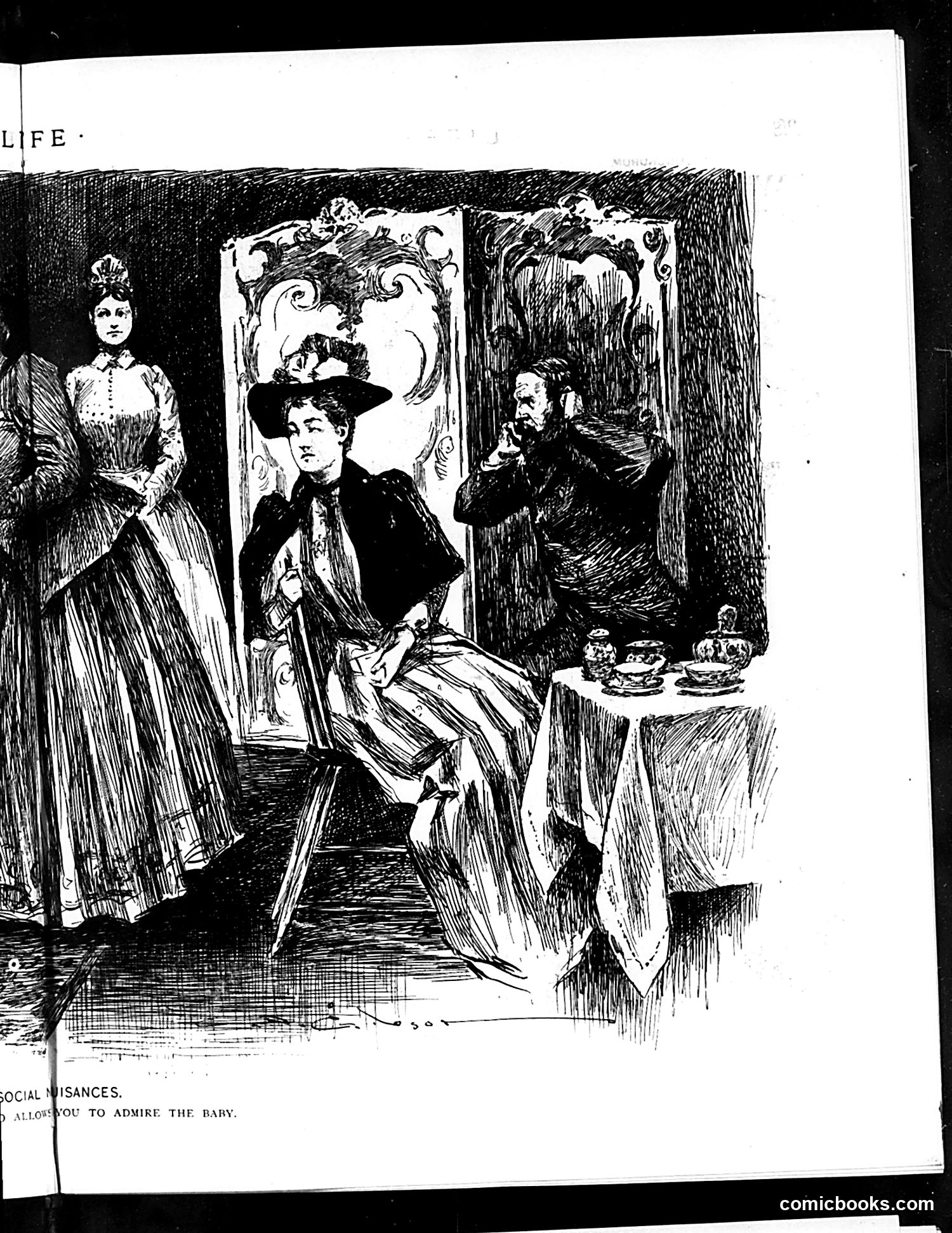
This is a satirical illustration about the social awkwardness of forced baby admiration. The scene depicts a domestic interior where a woman seated in the center displays her infant while holding court. Two other women stand awkwardly—one on the left appearing dutiful, the other partially visible on the right seeming uncomfortable. A man in the background appears to be trying to escape the situation, looking over his shoulder with evident reluctance. The satire targets the Victorian-era social convention where new mothers would insist on showing their babies to visitors, who were socially obligated to express enthusiasm regardless of genuine interest. The title labels this behavior a "social nuisance," poking fun at both the demanding mother and the trapped, unwilling admirers forced into polite participation.
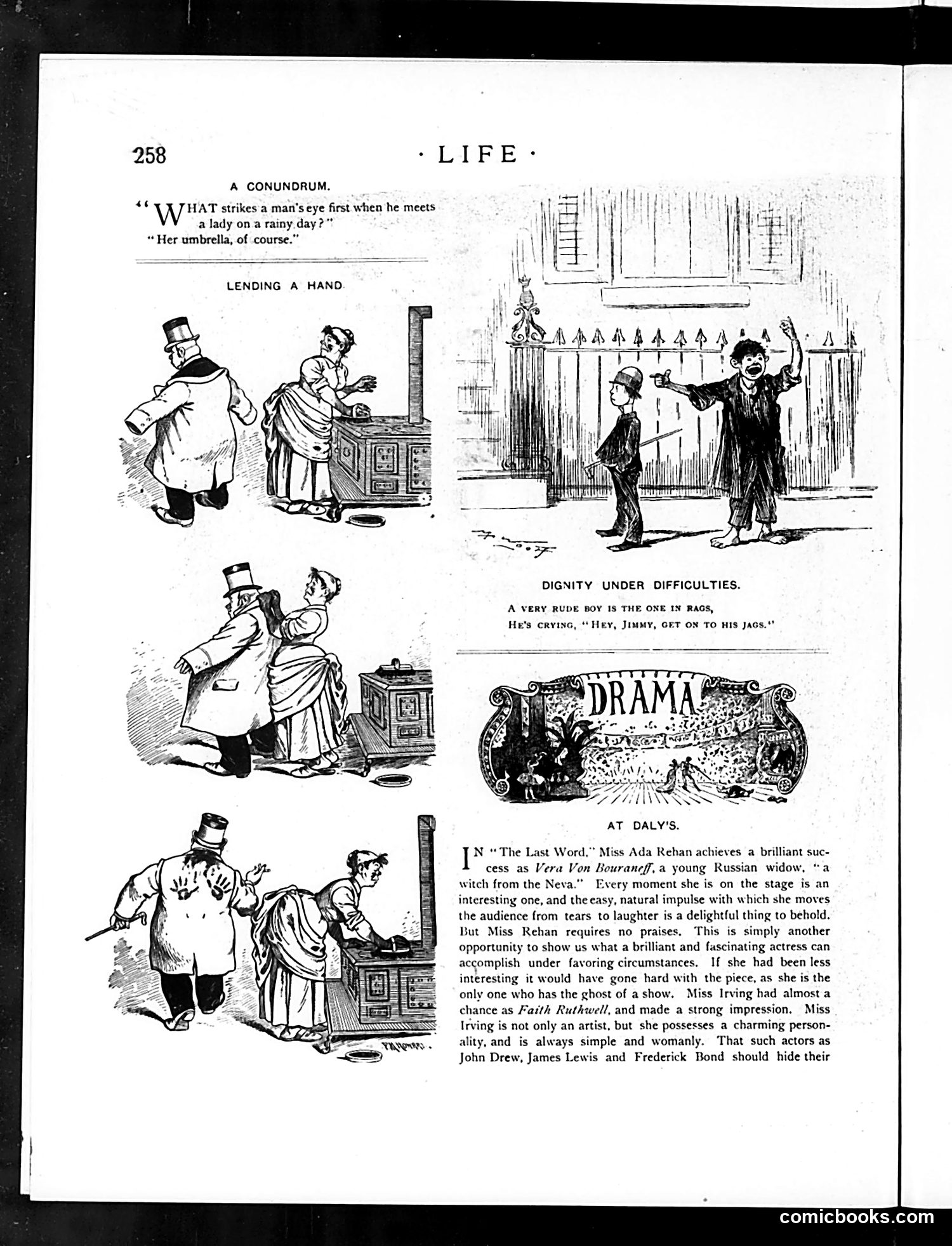
This page contains three distinct sections: **"A Conundrum"** presents a Victorian-era joke playing on double meaning: when meeting a lady in rain, what catches a man's eye first? The answer "her umbrella" is the obvious, proper response, suggesting the questioner expected something more suggestive—a mild sexual innuendo typical of period humor. **"Dignity Under Difficulties"** depicts class-based social commentary through sequential cartoon panels showing a well-dressed gentleman repeatedly helping a ragged boy, who responds with crude street language ("get on to his jags"—mock his clothes). The satire criticizes the boy's lack of gratitude and proper manners despite receiving assistance. **"At Daly's"** is a theater review of "The Last Word," praising actress Ada Rehan's performance as a Russian widow. The critic notes she carries an otherwise weak play through her talent and charm, while other actors (Irving, John Drew, James Lewis, Frederick Bond) are underutilized. These sections reflect turn-of-century concerns: sexual propriety, class distinctions, and theatrical criticism.
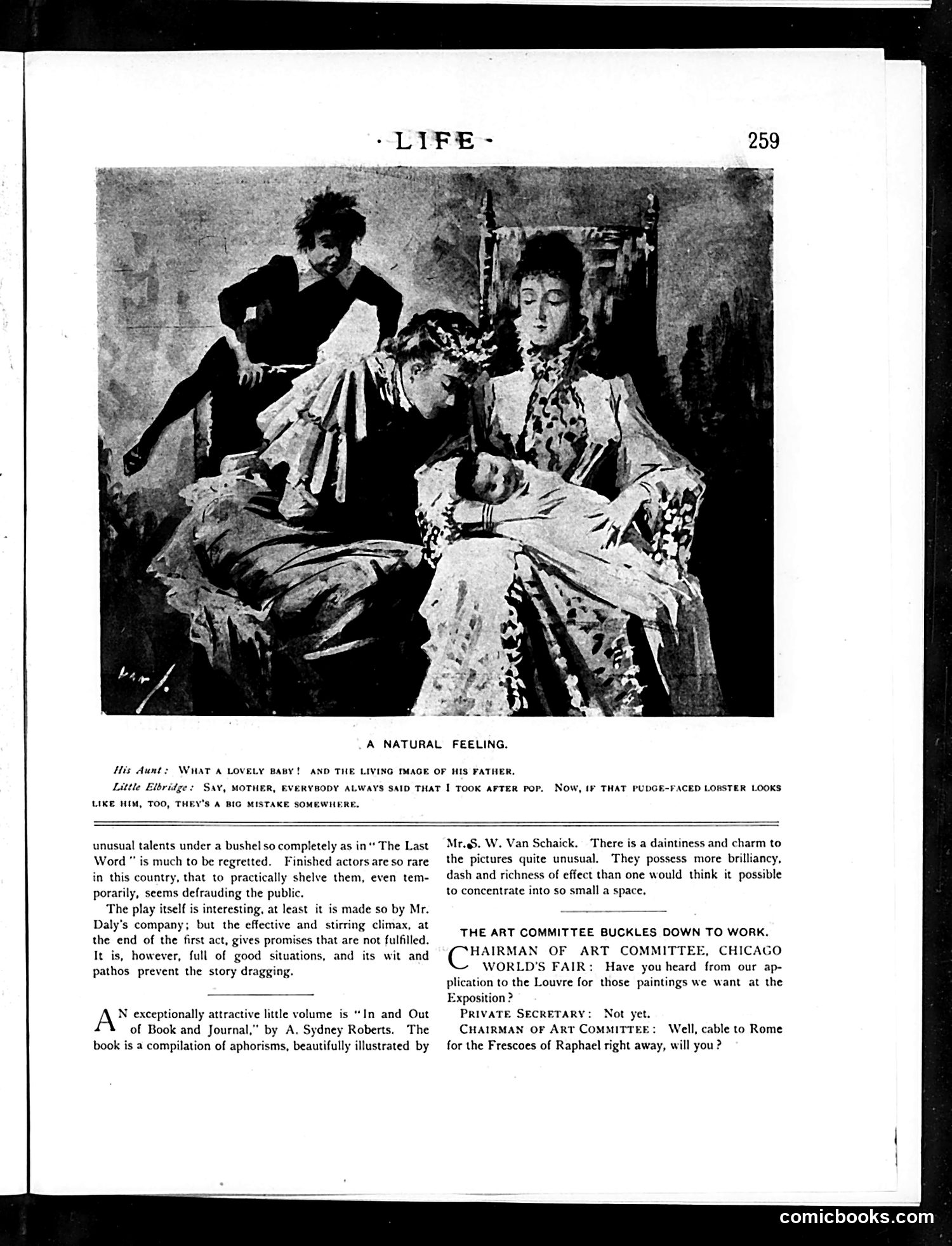
This cartoon depicts a domestic scene where a child named Little Elbridge insults his own father's appearance. When his aunt compliments the baby as "the living image of his father," Elbridge responds that everyone says he takes after his father—but then adds a cutting remark about his father's unflattering appearance ("that pudge-faced lobster"). The humor lies in the child's innocent brutality: he's simply stating what adults have apparently told him, unaware he's insulting his own father to his mother's face. The title "A Natural Feeling" suggests this is a child's naturally unfiltered honesty, lacking social restraint. The second item mocks the Chicago World's Fair Art Committee's presumption in casually requesting famous European masterpieces (paintings from the Louvre, Raphael's Frescoes) as if acquiring world-class art were a simple administrative task.
This page contains several satirical vignettes mocking human behavior and hypocrisy: **Main cartoon**: A shabby man appeals to a homeowner with an elaborate sob story about his sick daughter and lost dollar, hoping for charity. When she refuses, he adopts a peculiar principle: he won't "tamper with" anyone "thoroughly prepared" (i.e., ready to refuse him). The satire targets both the manipulative beggar's transparent con and the woman's callous deflection—suggesting neither party is acting with genuine principle. **Additional jokes** below mock socialism (the working poor want *others* to share, not themselves), vanity (Dumas's ugly wife), and financial instruments (a pun on "sight-drafts"). The page is primarily **advertisements** for period toiletries (tar soap, perfume, writing paper), occupying more space than the actual satire. The humor relies on exposing pretense and self-interest in everyday social interactions—typical of *Life* magazine's moralistic yet cynical sensibility.
This page is primarily **advertising** for late 19th-century luxury goods (fabrics, furs, typewriters, flooring). The only cartoon present is a brief two-panel joke titled "THE NEXT BEST THING." The humor relies on **absurd customer logic**: A grocer tells a customer he's out of scouring sand. Rather than accept this or buy an alternative, the customer demands sugar instead—insisting his tin *must* be scoured today "no matter what it costs." The joke satirizes **unreasonable consumer behavior** and desperation: the customer illogically substitutes an entirely different product (food) for a cleaning tool, simply because it's available. The title "The Next Best Thing" is ironic—sugar is obviously *not* suitable for scouring metal tins, making the customer's demand absurd. This reflects early advertising-era humor meant to entertain while promoting products to affluent readers.
This is primarily an **advertising and business opportunity page** with minimal satirical content. The main feature is a classified advertisement from the Pictorial Weeklies Company, recruiting newspaper entrepreneurs. The company offers a franchise model: they print 8 pages of quality content in New York weekly, leaving 8 blank pages for local publishers to fill with regional news. This allows small-town papers to compete with larger publications affordably. The single humorous story ("After the sermon...") depicts a young man from Fremont, Nebraska who refuses to choose between heaven or hell, declaring Fremont itself is "good enuff"—a mild joke about provincial contentment. The remaining content consists of period advertisements: hair styling, Belgian lamps, beauty products, band instruments, corsets, and Garfield Tea. **No political cartoons or significant satire appears.** This is a commercial page reflecting late 19th-century magazine economics and marketing strategies.
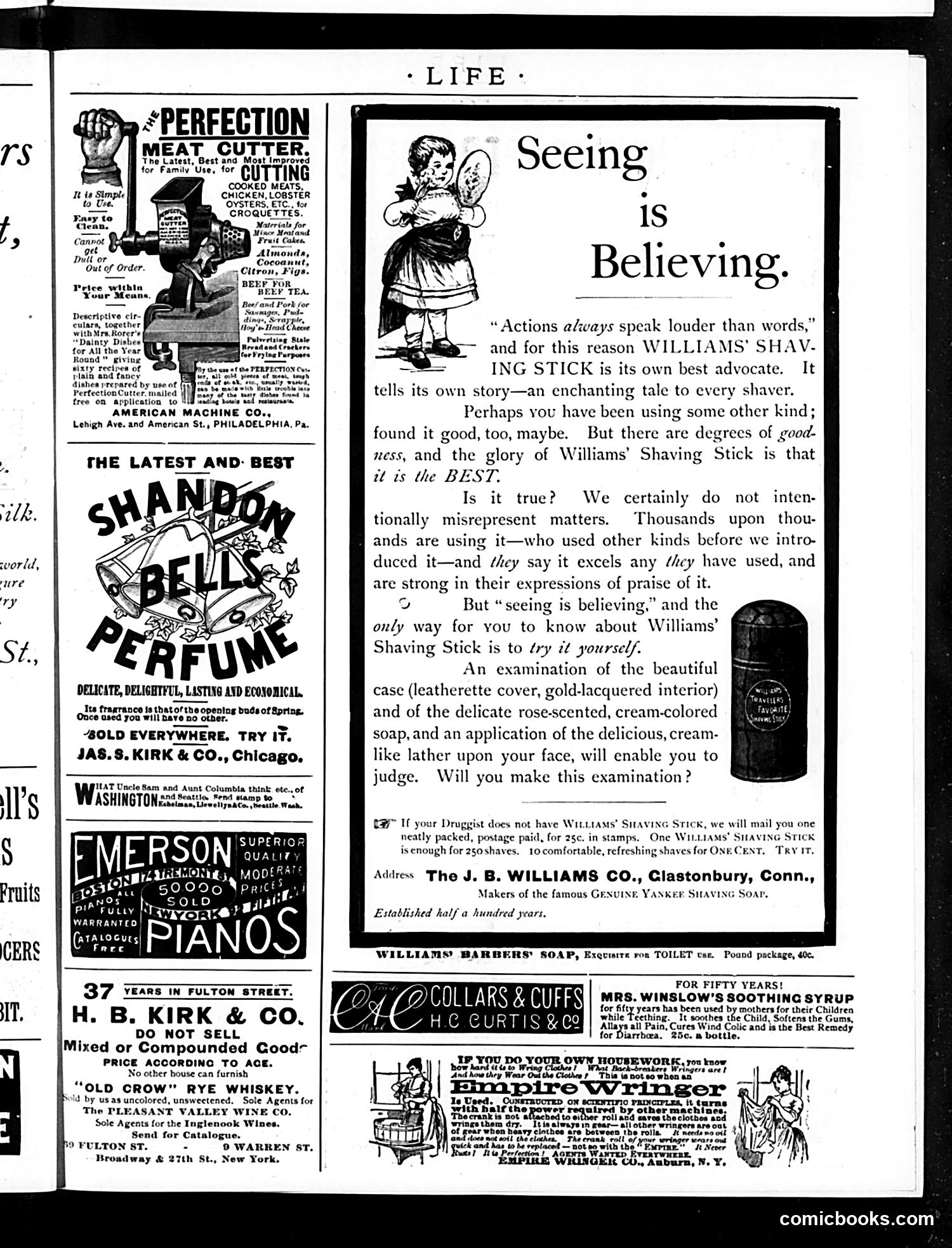
This page is primarily **advertising**, not satire or political commentary. It contains multiple product advertisements typical of early 20th-century magazines. The dominant feature is a large **Williams' Shaving Stick advertisement** (center-right), which uses the phrase "Seeing is Believing" as its hook. The ad features an illustration of a young child with a mirror, playing on the idea that consumers must try the product themselves to appreciate its superiority. The copy emphasizes that thousands have switched from competing brands and praise Williams' product as "the BEST." Surrounding this are ads for other consumer goods: a Perfection Meat Cutter, Shannon Bell Perfume, Emerson Pianos, H.B. Kirk whiskey, and Mrs. Winslow's Soothing Syrup (a patent medicine for teething children). There is **no political cartoon or satirical content** visible. This represents straightforward commercial advertising from the period, reflecting consumer culture and marketing techniques of the era.
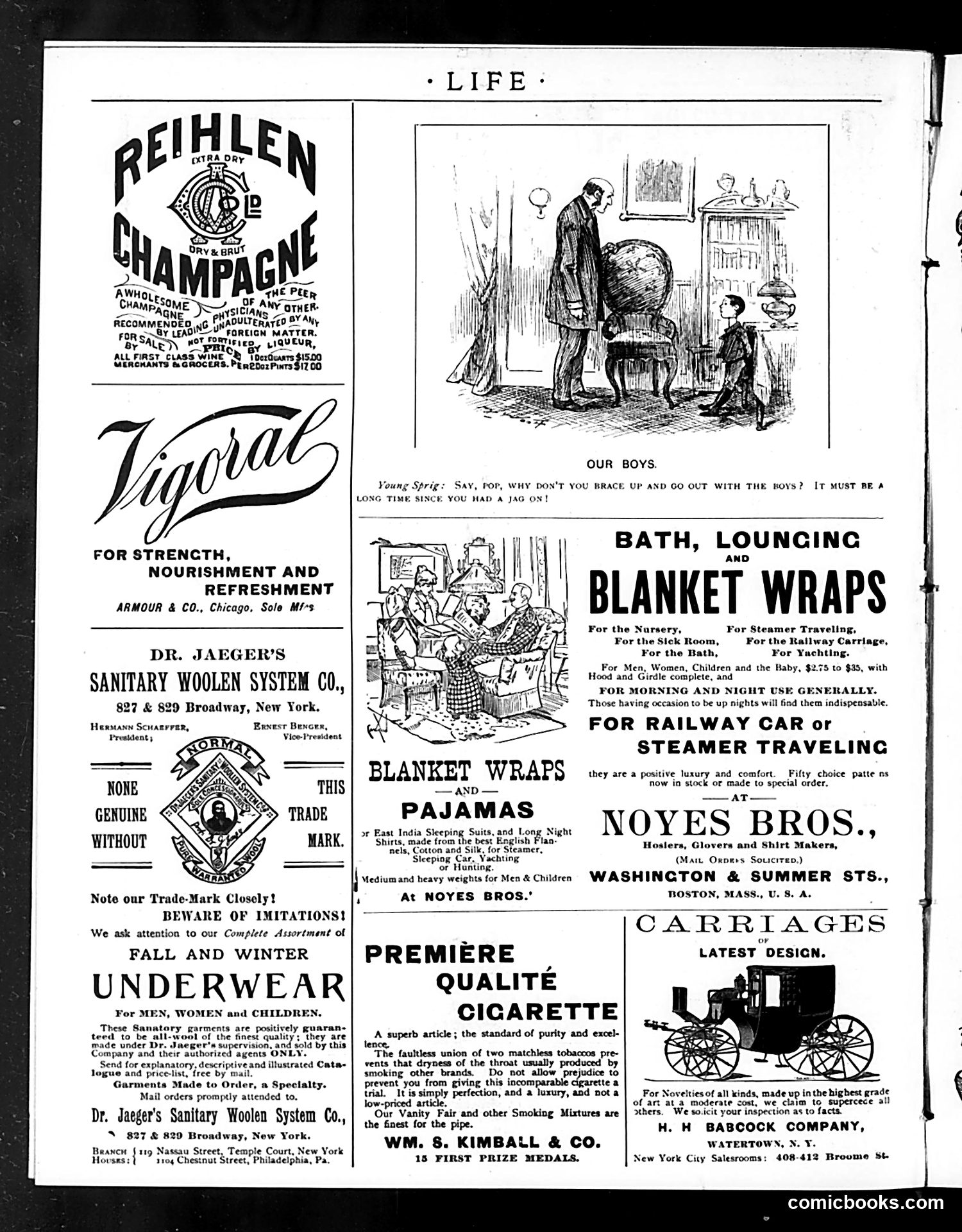
This page is primarily **advertising**, but features one small cartoon titled "Our Boys" at the top right. The cartoon depicts a domestic scene where a young boy asks his father why he doesn't "brace up and go out with the boys," noting it's been a long time since father "had a jag on" (got drunk). The father sits in an armchair while the boy stands nearby. **The satire**: This is social commentary on middle-class masculinity and alcoholism. The joke inverts typical parent-child dynamics—instead of a father scolding a son for carousing, the son is essentially mocking his father for having become domesticated and sedentary, implying the father has abandoned youthful male pastimes (drinking and socializing). The humor depends on period expectations that respectable men engaged in recreational drinking as normal social behavior. The cartoon gently ridicules Victorian-era loss of vigor in domestic life—the son sees his father's sobriety as an unmanly weakness rather than improvement. The surrounding advertisements (underwear, blankets, cigars, carriages) target similar middle and upper-class readers.