
Life, 1890-11-06 · page 6 of 18
Life — November 6, 1890 — page 6: what you’re looking at
What you’re looking at
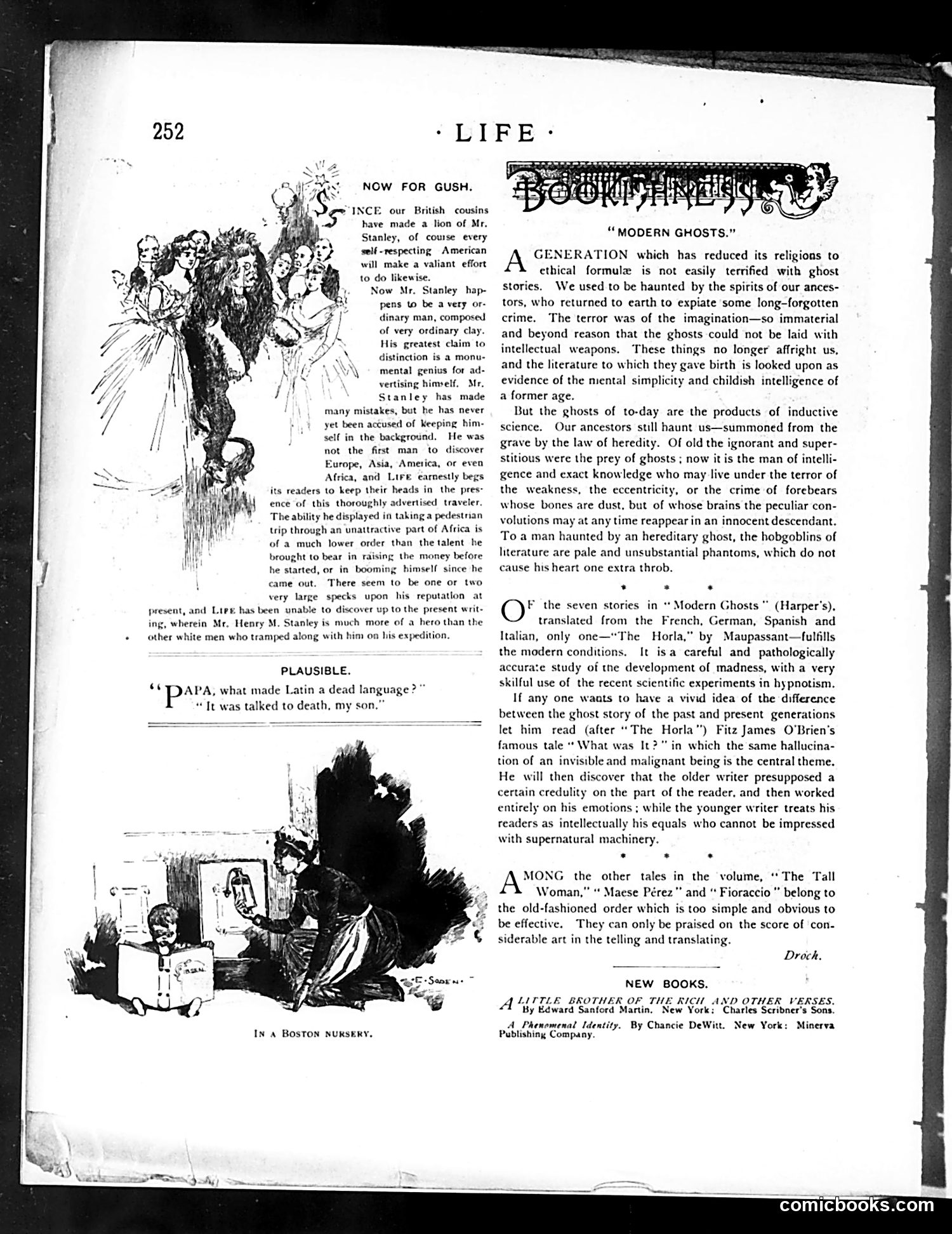
**"Now for Gush" Section:** This appears to be a humorous biographical sketch of Mr. Stanley, described as "a very ordinary man" whose greatest distinction is "a monumental genius for advertising himself." The accompanying caricature shows an exaggerated figure, likely mocking someone's self-promotional abilities. Life criticizes Stanley for raising money through publicity stunts and sensationalizing his expeditions, suggesting he's more showman than genuine explorer—a common satirical target of the era. **"Plausible" Section:** A brief joke: "Papa, what made Latin a dead language?" "It was talked to death, my son." The accompanying illustration appears to be a nursery scene. **"Modern Ghosts" Review:** The page concludes with a literary review of a story collection, discussing how modern scientific rationalism has replaced supernatural terror with psychological anxiety.
📄 Transcribed text from this page (OCR, searchable)
Machine-transcribed from the original scan — historical spelling and the odd misread are preserved.
NOW FOR GUSH. INCE. our British cousins have made a lion of Mr. Stanley, of course every self-respecting American will make a valiant effort to do likewise. Now Mr. Stanley hap- pens to be a very or- dinary man, composed of very ordinary clay. His greatest claim to distinction is a monu- mental genius for ad- vertising himvelf, Mr. Stanley has made many mistakes, but he has never yet been accused of Keeping him- self in the background, He was not the first man to discover Europe, Asia, America, or even Africa, and Lire earnestly begs its readers to keep their heads in the pres- ence of this thoroughly advertised traveler. The ability he displayed in taking a pedestrian trip through an unattractive part of Africa is of a much lower order than the talent he brought to bear in raising the money before ] he started, or in booming himself since he came out. There seem to be one or two very large specks upon his reputation at present, and Lire has been unable to discover up to the present writ- ing, wherein Mr. Henry M. Stanley is much more of a hero than the + — other white men who tramped along with him on his expedition. PLAUSIBLE. e Pp: what made Latin a dead language?” “Tt was talked to death, my son,” In 4 BOSTON NUKSERY, “MODERN GHOSTS.” A ERATION which has reduced its religions to ethical formule is not easily terrified with ghost stories. We used to be haunted by the spirits of our ances- tors, who returned to earth to expiate some long-forgotten crime. The terror was of the imagination—so immaterial and beyond reason that the ghosts could not be laid with intellectual weapons. These things no longer affright us, and the literature to which they gave birth is looked upon as evidence of the mental simplicity and childish intelligence of a former age. But the ghosts of to-day are the products of inductive science. Our ancestors still haunt us—summoned from the grave by the law of heredity. Of old the ignorant and super- stitious were the prey of ghosts ; now it is the man of intelli- gence and exact knowledge who may live under the terror of the weakness, the eccentricity, or the crime of forebears whose bones are dust, but of whose brains the peculiar con- volutions may at any time reappear in an innocent descendant. To a man haunted by an hereditary ghost, the hobgoblins of literature are pale and unsubstantial phantoms, which do not cause his heart one extra throb. * . . OF the seven stories in ‘* Modern Ghosts “ (Harper's), translated from the French, German, Spanish and Italian, only one—“The Horla,” by Maupassant—fulfills the modern conditions, It isa careful and pathologically accurate study of the development of madness, with a very skilful use of the recent scientific experiments in hypnotism. If any one waats to have a vivid idea of the difference between the ghost story of the past and present generations let him read (after “The Horla”) Fitz James O'Brien's famous tale “* What was It?" in which the same hallucina- tion of an invisible and malignant being is the central theme. He will then discover that the older writer presupposed a certain credulity on the part of the reader, and then worked entirely on his emotions ; while the younger writer treats his readers as intellectually his equals who cannot be impressed with supernatural machinery. . . . MONG the other tales in the volume, ‘ The Tall Woman," “ Maese Pérez" and “ Fioraccio " belong to the old-fashioned order which is too simple and obvious to be effective. They can only be praised on the score of con- siderable art in the telling and translating. Droch. NEW BOOKS. LITTLE BROTHER OF THE RICH AND OTHER VERSES. By Edward Sanford Martin, New York: Charles Scribner's Sons. A Phenomenal Identity. By Chancie DeWitt. New York: Minerva Publishing Company. comicbooks.com