
Life, 1890-11-06 · page 4 of 18
Life — November 6, 1890 — page 4: what you’re looking at
What you’re looking at
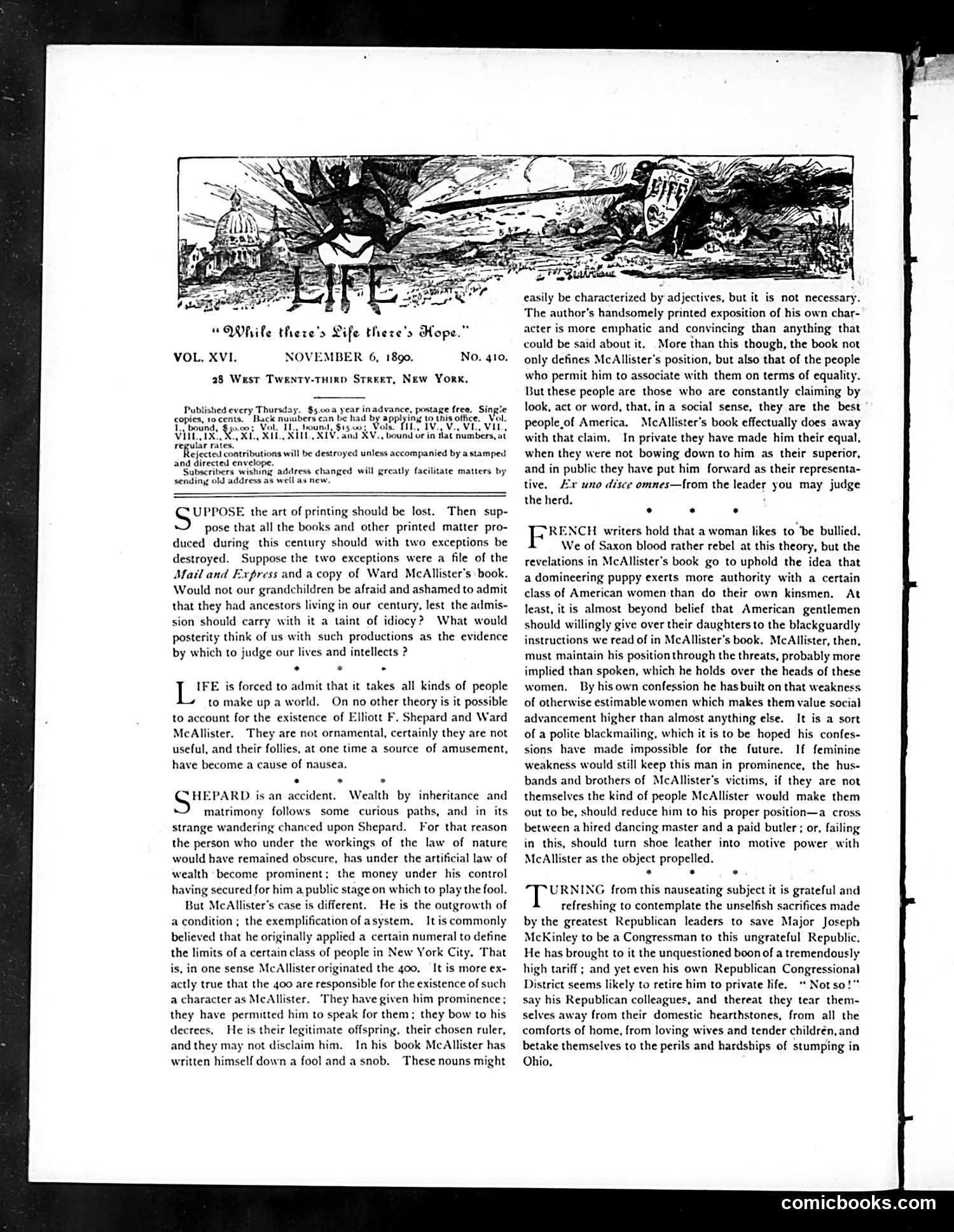
The page contains editorial text critiquing Ward McAllister, a prominent New York society figure. The cartoon at the top appears to show a wealthy man in formal dress seated beneath a large tree, likely satirizing McAllister's social prominence and pretensions. The text attacks McAllister for claiming social superiority and his role in defining New York's "elite" class. The author argues McAllister has become a snob through inherited wealth and social position, criticizing his apparent disdain for common Americans. The article questions whether such arbitrary social gatekeeping should command respect. The satire targets the artificial class distinctions McAllister represented in Gilded Age America, suggesting his authority over social standing was undeserved and ridiculous.
📄 Transcribed text from this page (OCR, searchable)
Machine-transcribed from the original scan — historical spelling and the odd misread are preserved.
“While there's Life there's Hope.” VOL. XVI. NOVEMBER 6, 1890. 28 West Twenty-tTHIRD STREET, New York, No, 410. Published every Thursday. copies, rocents, Back numbers can be hy 1,, bound, & co; Vol. IL, ound, wXT, XUL, XTX ‘ejected contributions will be destroyed unless accompanied by a stamped and directed envelope. Subscribers wishing address changed will greatly facilitate matters by sending old address a3 weil as new. plying to this office. Vol. Pee IV. Ve Vi, Vil .. bound or in flat number: UPPOSE the art of printing should be lost. Then sup- pose that all the books and other printed matter pro- duced during this century should with two exceptions be destroyed. Suppose the two exceptions were a file of the Mail and Express and a copy of Ward McAllister’s book. Would not our grandchildren be afraid and ashamed to admit that they had ancestors living in our century, lest the admis- sion should carry with it a taint of idiocy? What would posterity think of us with such productions as the evidence by which to judge our lives and intellects ? IFE is forced to admit that it takes all kinds of people to make up a world. On no other theory is it possible to account for the existence of Elliott F. Shepard and Ward McAllister, They are not ornamental, certainly they are not useful, and their follies, at one time a source of amusement, have become a cause of nausea. . . . ~HEPARD is an accident. Wealth by inheritance and matrimony follows some curious paths, and in its strange wandering chanced upon Shepard. For that reason the person who under the workings of the law of nature would have remained obscure, has under the artificial law of wealth become prominent; the money under his control having secured for him a public stage on which to play the fool. But McAllister’s case is different. He is the outgrowth of a condition ; the exemplification of asystem. It is commonly believed that he originally applied a certain numeral to detine the limits of a certain class of people in New York City, That is, in one sense McAllister originated the 400, It is more ex- actly true that the 400 are responsible for the existence of such a character as McAllister. They have given him prominence; they have permitted him to speak for them; they bow to his decrees, He is their legitimate offspring, their chosen ruler, and they may not disclaim him. In his book McAllister has written himself down a fool and a snob. These nouns might easily be characterized by adjectives, but it is not necessary. ‘The author's handsomely printed exposition of his own char- acter is more emphatic and convincing than anything that could be said about it. More than this though, the book not only defines McAllister’s position, but also that of the people who permit him to associate with them on terms of equality. But these people are those who are constantly claiming by look, act or word, that, in a social sense, they are the best people.of America. McAllister’s book effectually does away with that claim. In private they have made him their equal, when they were not bowing down to him as their superior, and in public they have put him forward as their representa- tive, Ex uno disce omnes—from the leader you may judge the herd. . . . {RENCH writers hold that a woman likes to ‘be bullied. We of Saxon blood rather rebel at this theory, but the revelations in McAllister's book go to uphold the idea that a domineering puppy exerts more authority with a certain class of American women than do their own kinsmen. At least, it is almost beyond belief that American gentlemen should willingly give over their daughters to the blackguardly instructions we read of in McAllister’s book. McAllister, then, must maintain his position through the threats, probably more implied than spoken, which he holds over the heads of these women. By his own confession he has built on that weakness of otherwise estimable women which makes them value social advancement higher than almost anything else. It is a sort of a polite blackmailing, which it is to be hoped his confes- sions have made impossible for the future. If feminine weakness would still keep this man in prominence, the hus- bands and brothers of McAllister's victims, if they are not themselves the kind of people McAllister would make them out to be, should reduce him to his proper position—a cross between a hired dancing master and a paid butler ; or, failing in this, should turn shoe leather into motive power with McAllister as the object propelled. . . . URNING from this nauseating subject it is grateful and refreshing to contemplate the unselfish sacrifices made by the greatest Republican leaders to save Major Joseph McKinley to be a Congressman to this ungrateful Republic. He has brought to it the unquestioned boon of a tremendously high tariff; and yet even his own Republican Congressional District seems likely to retire him to private life. ‘ Not so!" say his Republican colleagues, and thereat they tear them- selves away from their domestic hearthstones, from all the comforts of home, from loving wives and tender childrén, and betake themselves to the perils and hardships of stumping in Ohio. comicbooks.com