
A complete issue · 16 pages · 1890
Life — October 23, 1890
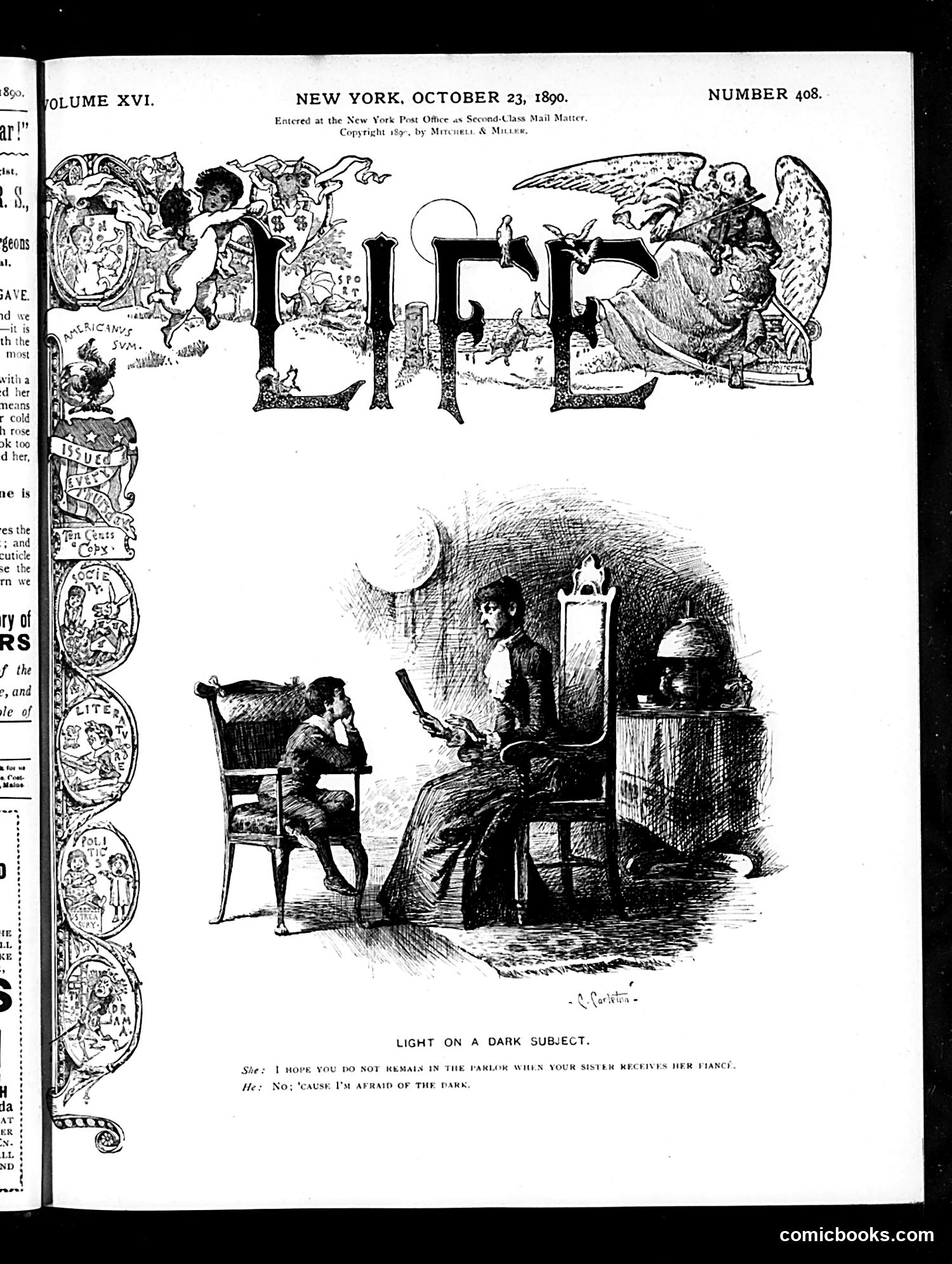
This single-panel cartoon depicts an interior scene with two figures in what appears to be a parlor. A woman sits in a chair holding what looks like a letter or document, while a man stands nearby. The caption reads: "She: I hope you do not remain in the parlor when your sister receives her fiancé. He: No, 'cause I'm afraid of the dark." The humor is a Victorian-era joke playing on propriety and courtship customs. The implication is that when a young woman's fiancé visits, the couple would be left alone in the parlor—traditionally considered a darkened or dimly-lit room suitable for romance. The man's quip about being "afraid of the dark" sarcastically suggests he wishes to avoid witnessing intimate behavior between the engaged couple, which would be considered improper to observe.
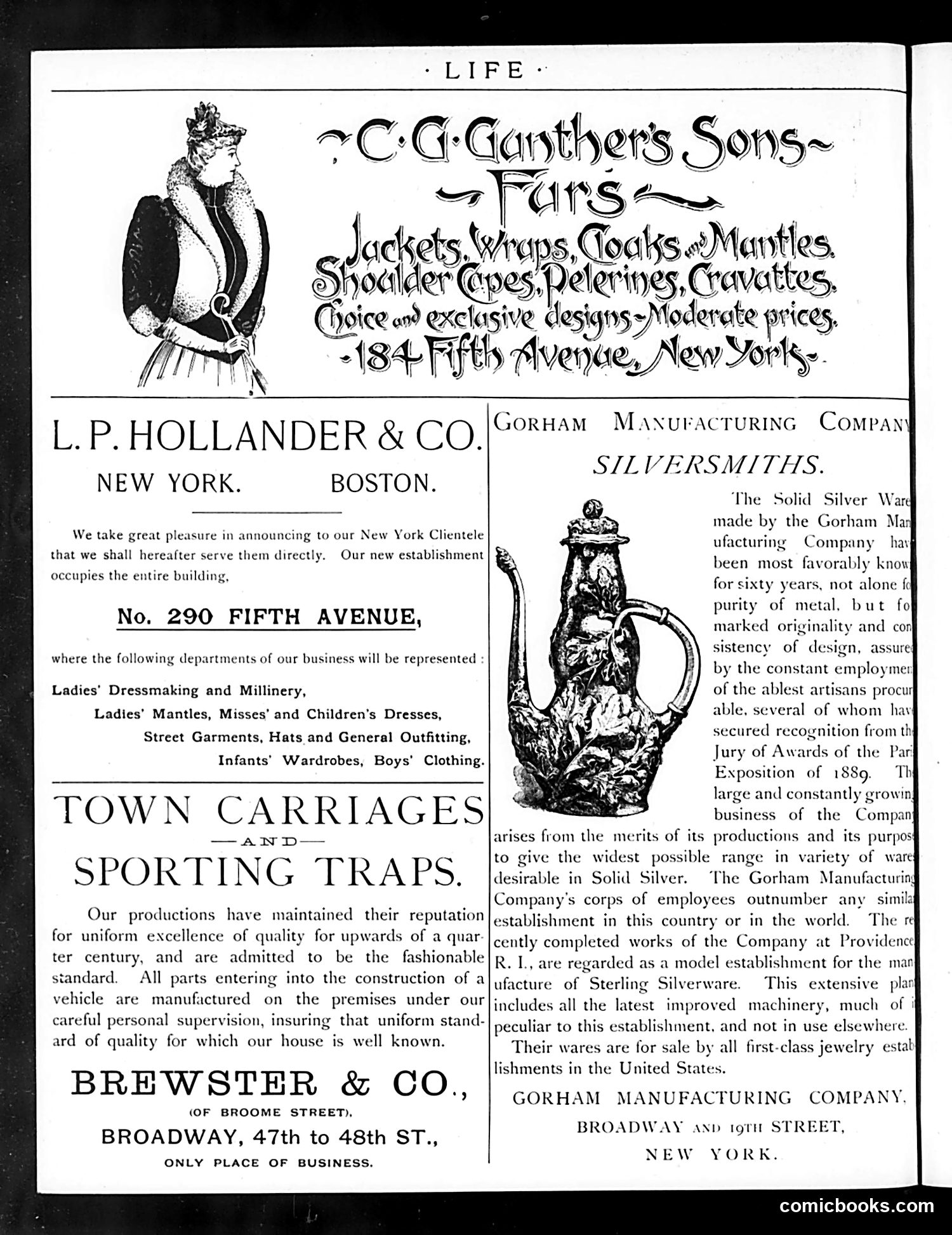
This page is **primarily advertising**, not satire or political commentary. It contains four separate advertisements: 1. **C.G. Ganthers Sons** - A furrier selling women's outerwear (jackets, wraps, coats, mantles) at 184 Fifth Avenue, New York. 2. **L.P. Hollander & Co.** - A dressmaking and clothing business announcing a new establishment at No. 290 Fifth Avenue, listing various departments. 3. **Brewster & Co.** - A carriage and sporting trap manufacturer on Broadway (47th-48th Street), claiming a quarter-century reputation for quality. 4. **Gorham Manufacturing Company** - Silversmiths advertising their sterling silver wares, established for sixty years, located on Broadway and 19th Street. These are luxury goods advertisements targeting affluent New York consumers. No political satire or social commentary is present.
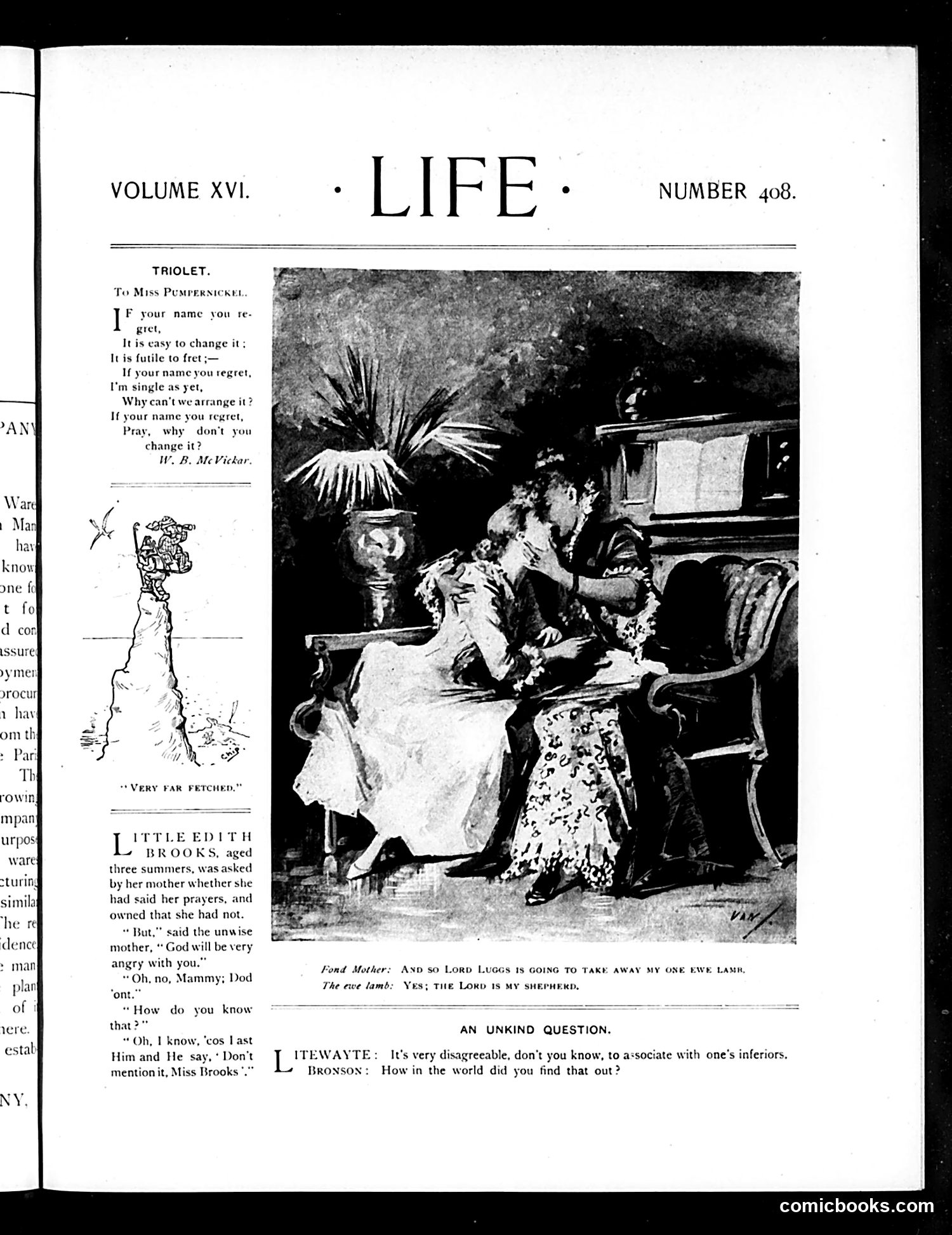
This page contains three satirical pieces: 1. **"Triolet to Miss Pumpernickle"** - A humorous poem by W.D. Nesbit suggesting a woman named Pumpernickle change her unfortunate surname, accompanied by a small illustration titled "Very Far Fetched." 2. **"Little Edith Brooks"** - A morality tale about a child who prayed to God, but her mother doubted divine intervention, leading to sarcastic commentary on parental skepticism. 3. **"An Unkind Question"** - A brief comic dialogue where Litewayte accuses Bronson of associating with "inferiors," and Bronson asks how he discovered this—likely satirizing class consciousness and social snobbery among the upper classes. The page primarily focuses on satire of social pretension, naming conventions, and class attitudes typical of early-20th-century American humor.
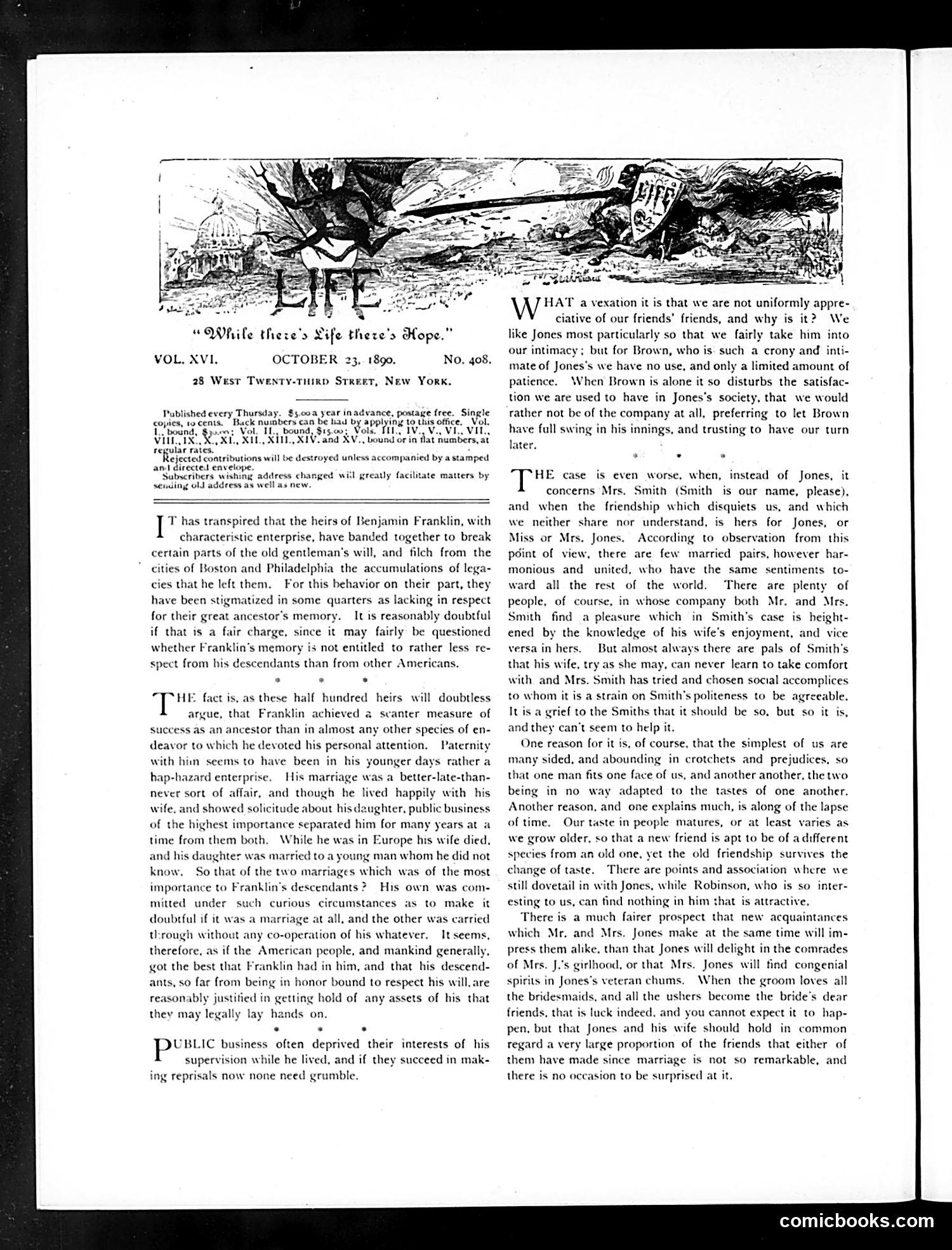
The cartoon at the page top shows a figure wielding a large scythe labeled "Life" near the U.S. Capitol building, with "Pity" visible on a sign. This appears to be Death or a grim reaper figure, satirizing Life magazine's editorial power or influence over American politics and institutions. The accompanying text discusses Benjamin Franklin's heirs breaking apart his will and real estate holdings in Boston and Philadelphia, satirizing wealthy descendants who lack respect for their ancestor's legacy. The article then shifts to discussing social friction between friends—specifically the discomfort when one couple (the Smiths) socializes with another (the Joneses), suggesting class or taste incompatibilities that strain friendships. The satire targets both inherited privilege and social pretension among the wealthy.
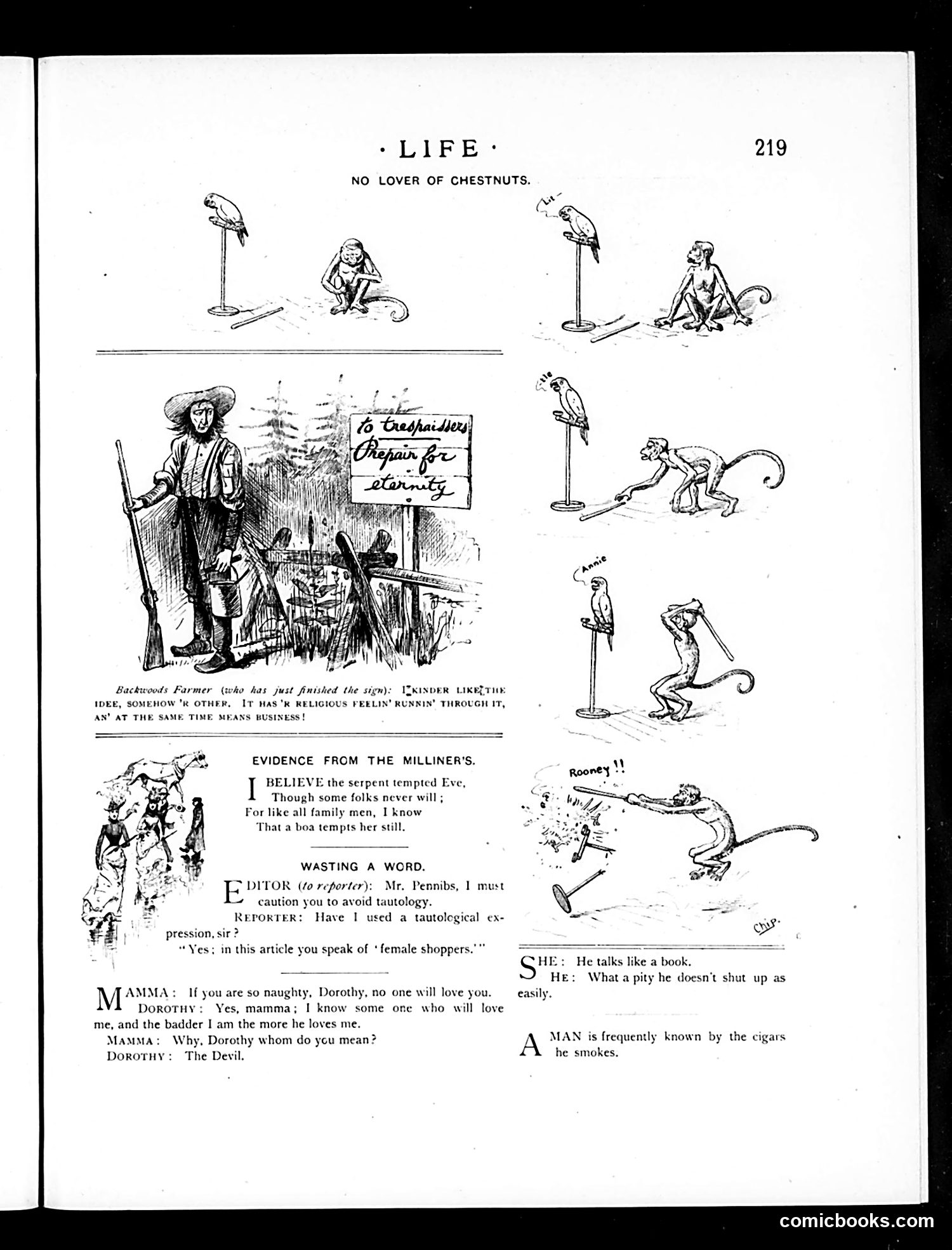
This page contains several unrelated satirical pieces typical of early 20th-century Life magazine humor: **Top section ("No Lover of Chestnuts"):** Visual gags showing monkeys attempting to use perches and tails, likely satirizing human behavior through animal comparison—a common device. **"Backwoods Farmer" cartoon:** A rustic figure with a sign reading "Preparedness Prepare for eternity" appears to critique naive or religious responses to contemporary concerns, possibly referencing WWI-era "preparedness" debates. **Remaining sections** include brief witty exchanges (about "female shoppers," a naughty girl named Dorothy) and aphorisms about men and cigars—standard light satirical commentary on gender relations and social habits. The page lacks coherent political messaging, instead offering miscellaneous humor typical of Life's general-interest satire format.
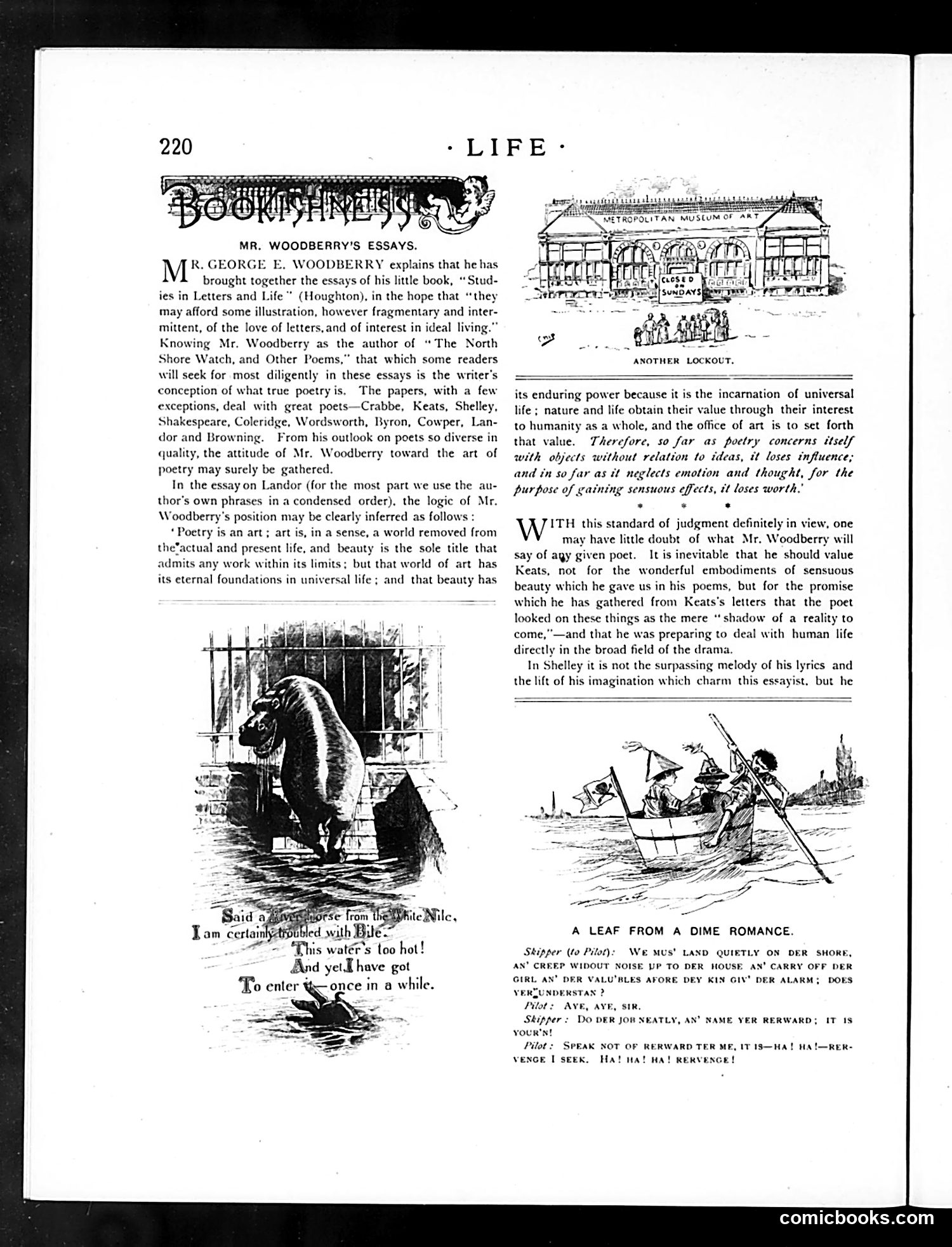
This page features "Mr. Woodberry's Essays," a literary criticism column discussing George E. Woodberry's book on poetry and ideal living. The text analyzes Woodberry's views on poets like Keats and Shelley, emphasizing that poetry operates in a realm removed from practical life, focused on universal beauty and human experience. The accompanying illustrations are literary vignettes rather than political satire. The left image shows a crocodile in water (likely illustrating a poem or literary reference), while the right depicts a nautical scene with sailors in a boat, captioned "A Leaf from a Dime Romance"—a humorous reference to cheap serialized adventure fiction popular in that era. This page emphasizes high literary culture versus commercial entertainment.
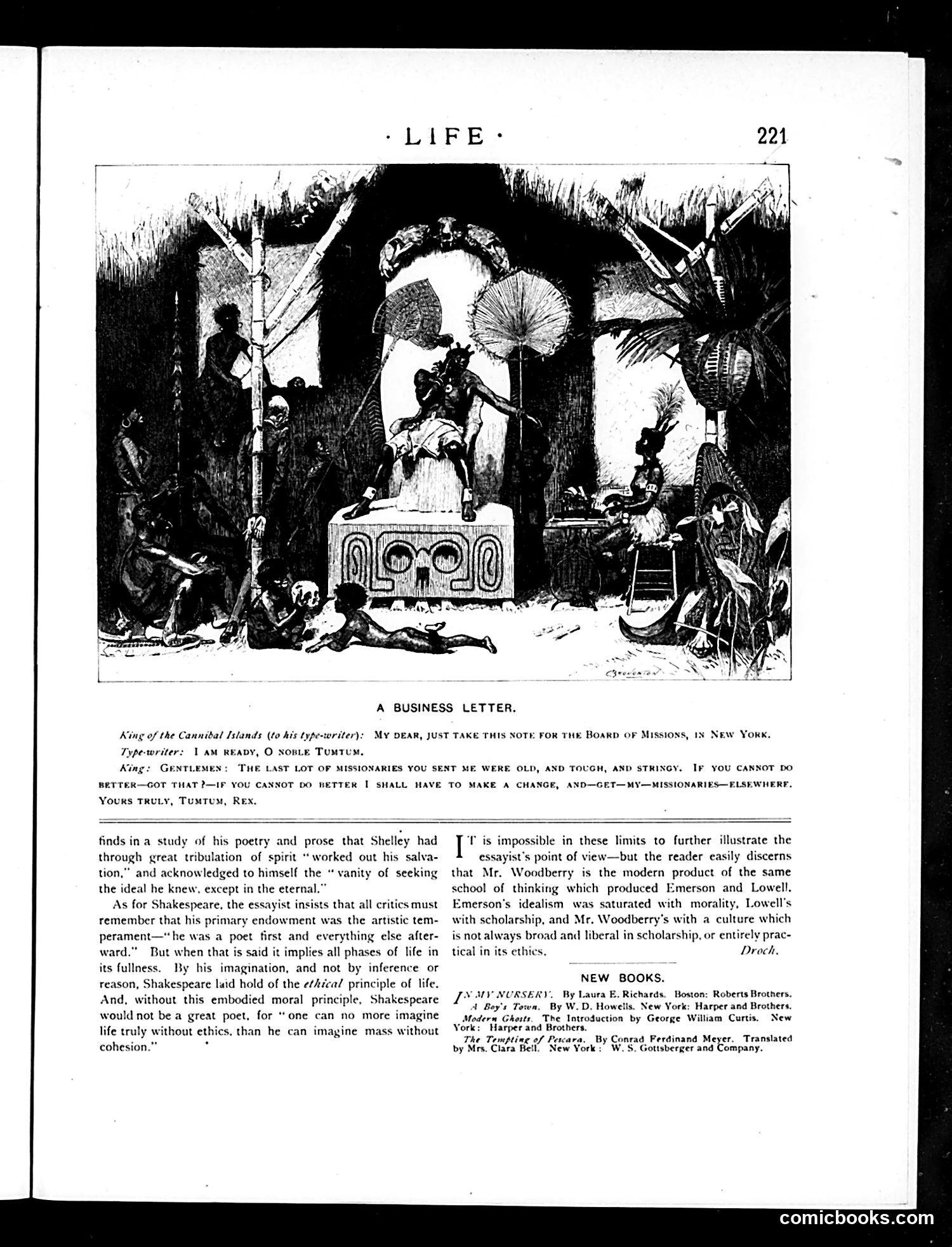
This satirical cartoon depicts a "King of the Cannibal Islands" sending a complaint letter to a New York missionary board. The king complains that the missionaries they sent were "old, and tough, and stringy," threatening to take his business elsewhere unless they provide better quality replacements. The satire mocks both colonial-era missionary efforts and racist stereotypes about cannibals. It critiques the patronizing, commercial attitude toward missionary work—treating conversion efforts as a mere business transaction. The joke also implies the missionaries themselves were poor quality or ineffective. This reflects late 19th/early 20th-century skepticism about the actual benefits and sincerity of religious imperialism in colonized territories.
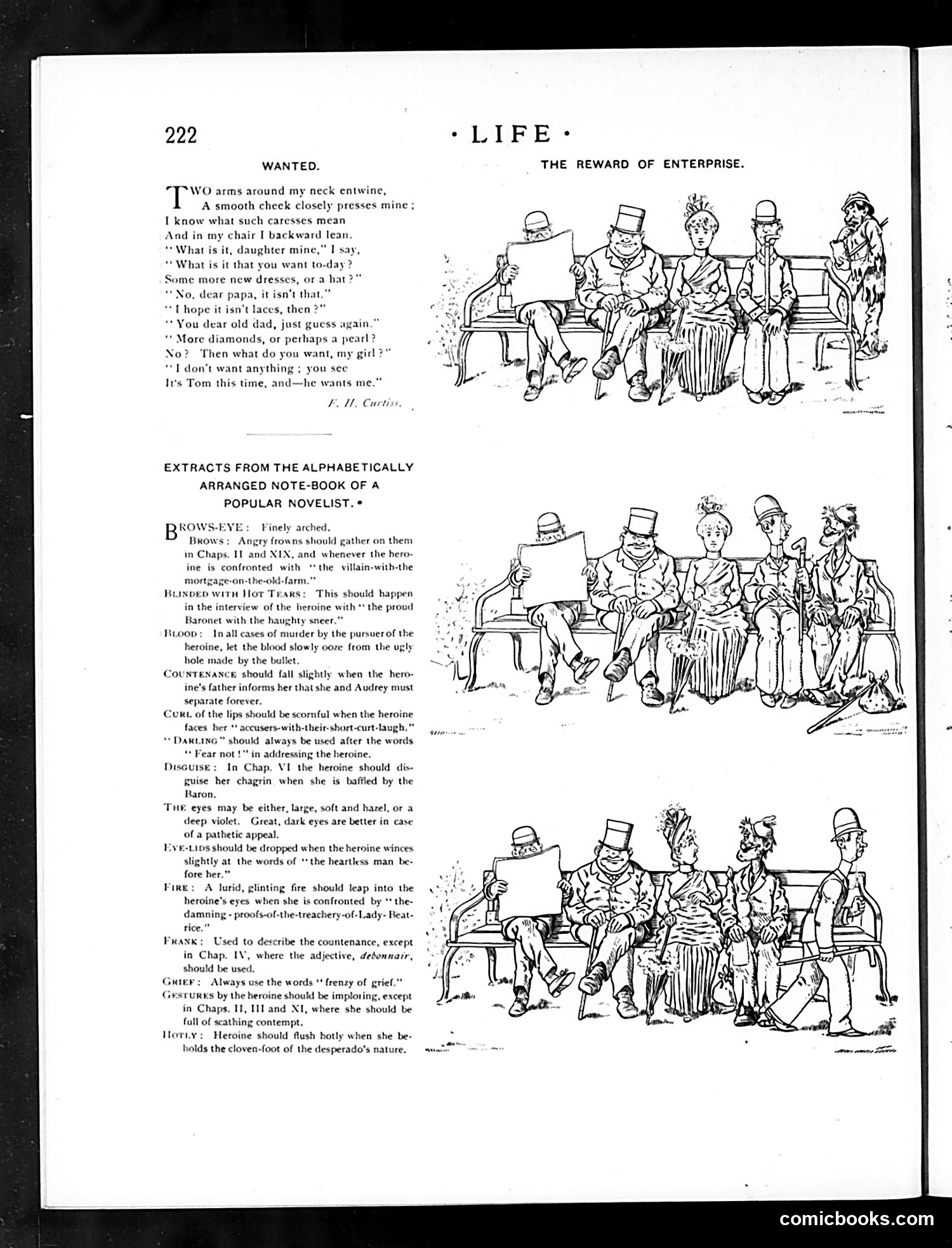
This page contains two sections: **Top:** A poem titled "WANTED" by F. H. Crofts, accompanied by an illustration showing five figures on a bench. The poem is a domestic comedy—a woman confronts her husband about his backward chair-leaning posture and questions what he wants from life, implying he desires material goods (diamonds, pearls) when he actually just wants her companionship. The cartoon illustrates this intimate marital dialogue. **Bottom:** "Extracts from the Alphabetically Arranged Note-Book of a Popular Novelist" provides writing advice about literary devices—how to portray brows, tears, horror, countenances, curls, darling, disguise, eyes, fire, grace, grief, oysters, and haughtiness in fiction. The three accompanying illustrations show groups seated together, likely demonstrating these emotional expressions. This is satirical commentary on formulaic novel-writing conventions of the era.
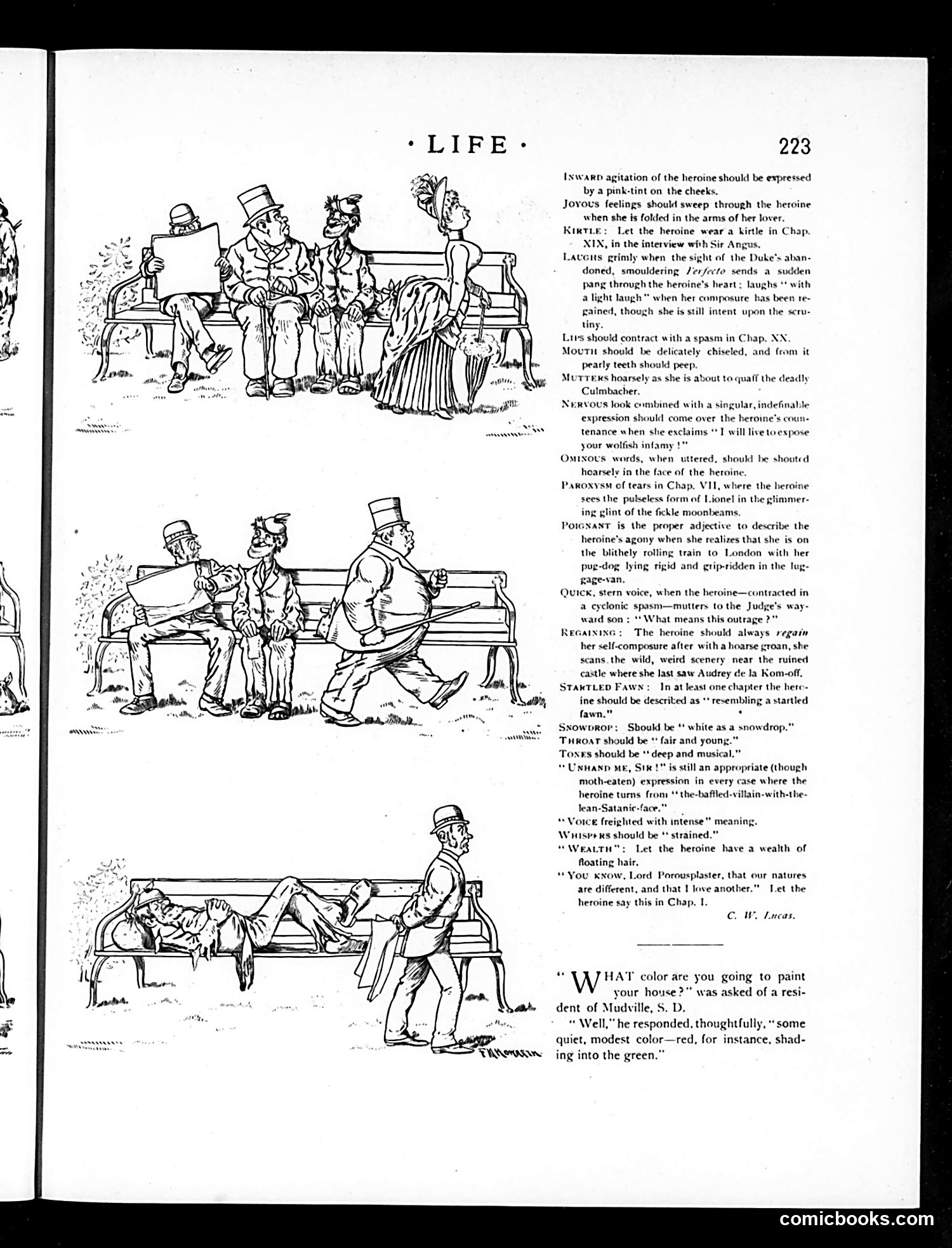
This page contains **theatrical stage directions** for performing a literary work (appears to be from a classic novel, possibly Victorian-era fiction based on references to "Chap. XIX" and "Chap. XX"). The three cartoons illustrate **how actors should physically perform specific scenes**—showing a character on a bench in different poses and interactions. The detailed instructions cover stage business like facial expressions, voice modulation, and physical comedy (a pug-dog moment, a character fainting). This is **not political satire** but rather **practical guidance for theater performers**, explaining how to execute dramatic moments effectively for an audience. The humor lies in the specificity of these technical instructions, making theatrical performance itself the subject of gentle mockery.
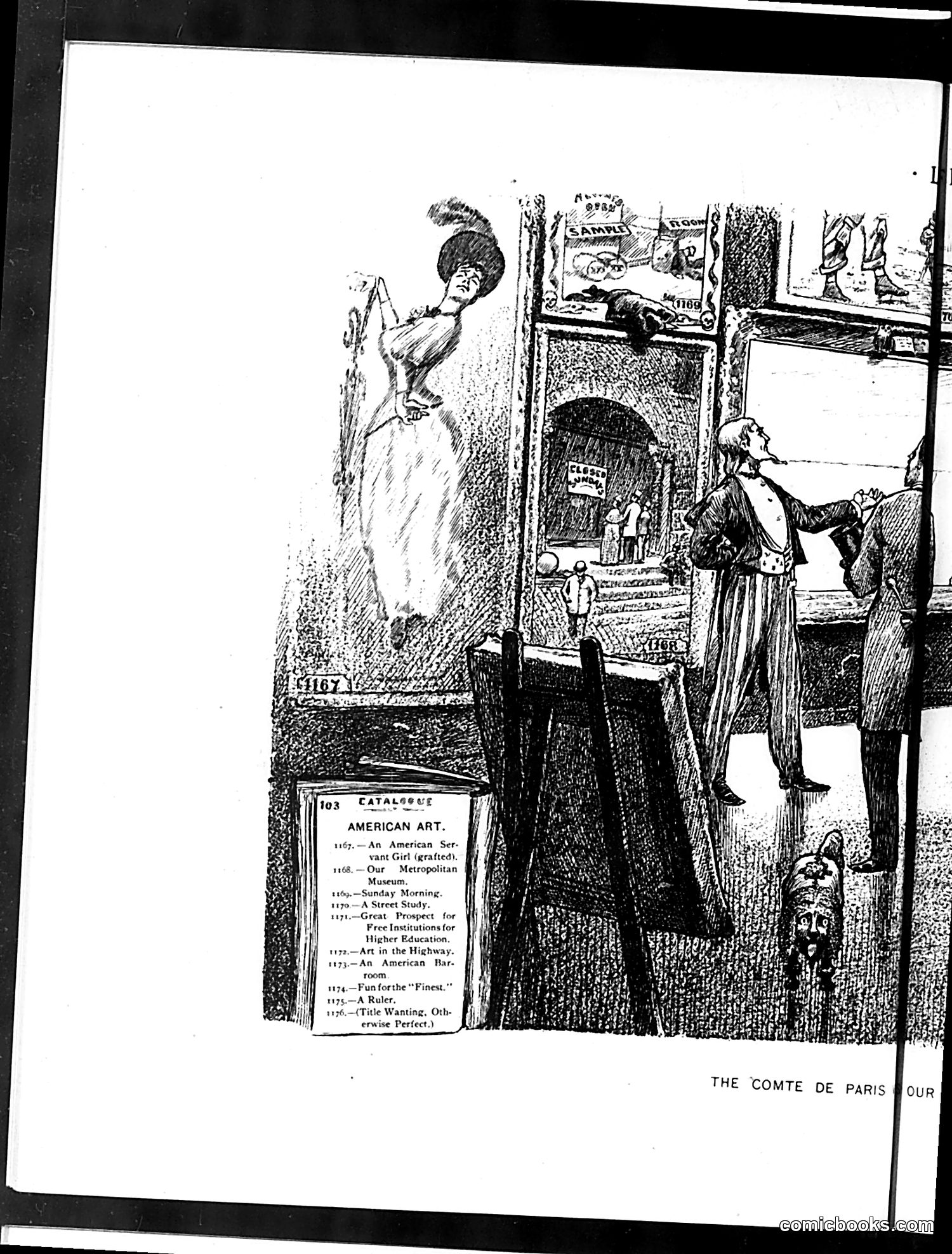
This page features a satirical illustration titled "The Comte de Paris" alongside a catalog listing American artworks (numbers 1167-1176). The drawing depicts what appears to be a well-dressed gentleman in formal attire examining or interacting with artwork in a museum or gallery setting, while other figures observe. The satire likely mocks either the French aristocrat's (the Comte de Paris's) pretensions regarding American art, or conversely, Americans' reverence for European nobility's aesthetic judgments. The catalog listing of American works suggests commentary on how American artists were being evaluated or valued, possibly ironizing the tension between American artistic independence and European cultural authority during the late 19th century. The specific point of the joke remains unclear without additional historical context about the Comte's actual activities or statements regarding American art.
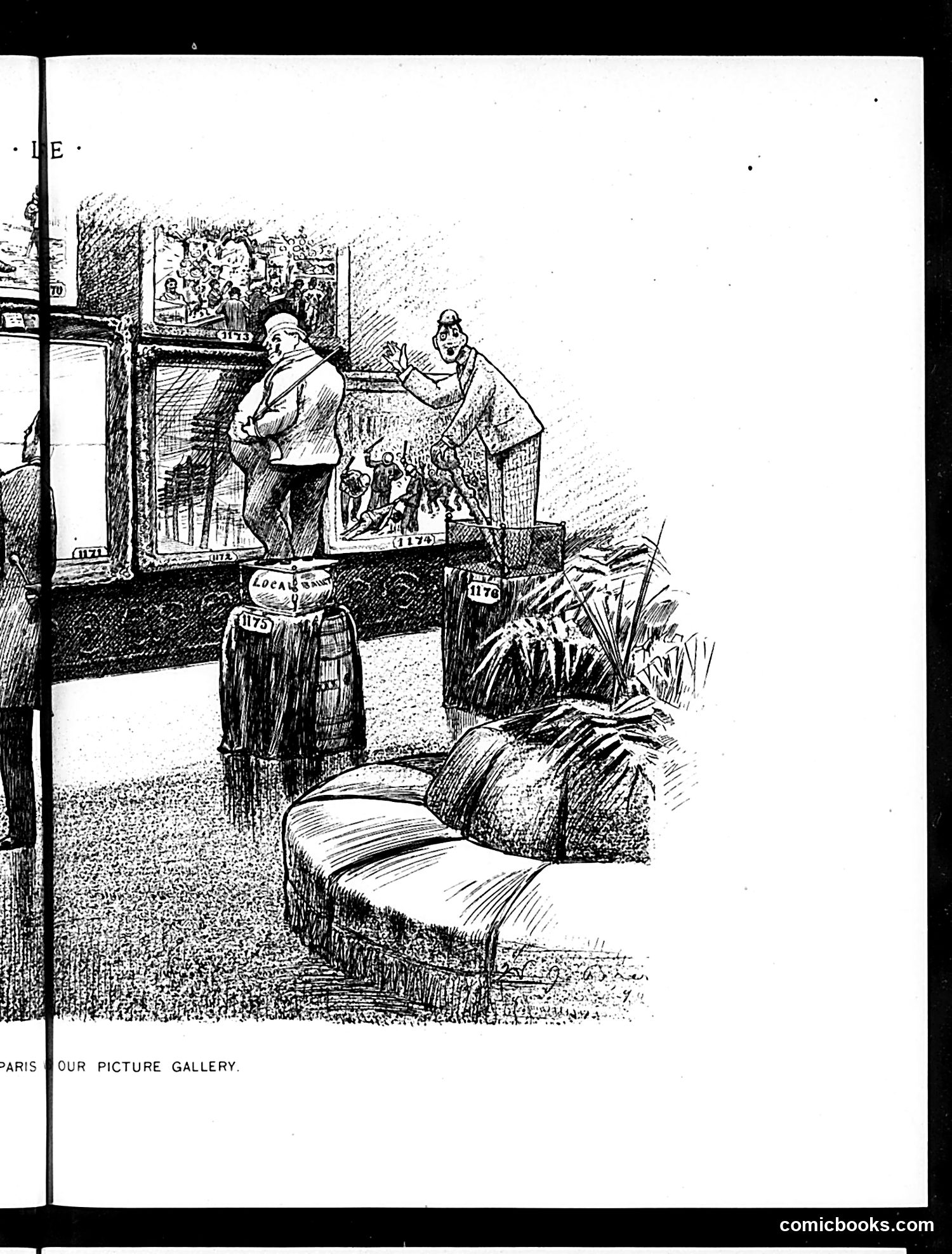
This appears to be a satirical illustration from Life magazine depicting a Parisian art gallery scene. The image shows well-dressed visitors viewing artwork displayed in a storefront window. There are numbered items (1173, 1174, 1175, 1176) visible, suggesting catalog entries or price tags. The satire likely mocks the pretensions of art collectors and gallery-goers—their self-important posturing while examining works. The crude, rough sketching style itself may be ironic commentary on what's being presented as fine art. The title "Our Picture Gallery" suggests this is Life's own satirical take on contemporary art world pretension and commercialization, a common target of 19th-century American humor magazines.
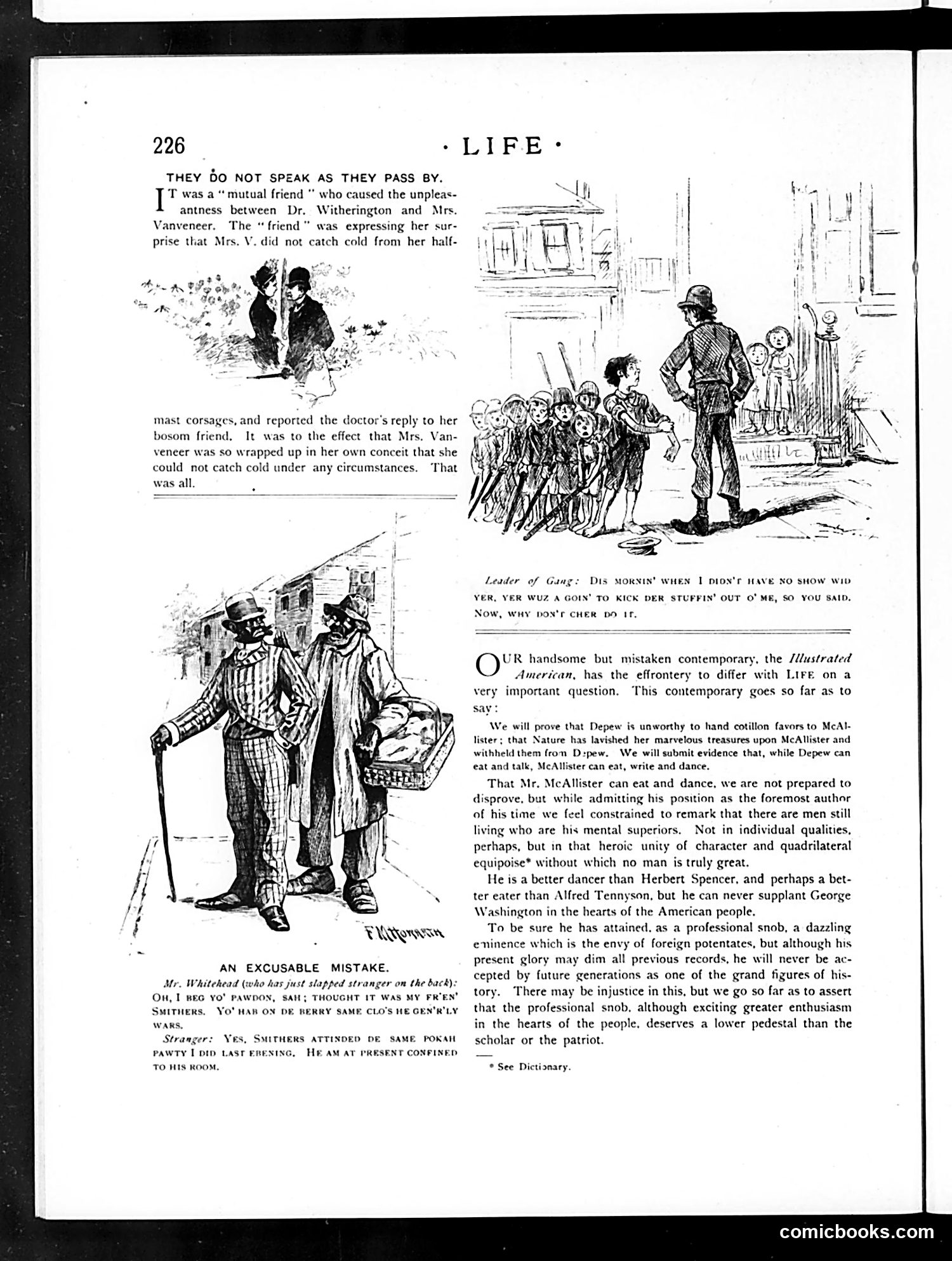
This page contains three separate comic vignettes satirizing social pretension and etiquette: **"They Do Not Speak As They Pass By"** mocks shallow gossip culture—a "mutual friend" spreads a catty remark from Dr. Witherington about Mrs. Vanveneer's vanity, causing a rift between acquaintances who now ignore each other. **"An Excusable Mistake"** depicts a man slapping a stranger on the back, mistaking him for a friend in similar clothes. The humor lies in the awkward explanation that they both attended the same poker party. **Main Editorial:** Life attacks its rival publication, the *Illustrated American*, which has foolishly championed **Ward McAllister**—a famous Gilded Age society figure and etiquette authority—over **Chauncey Depew** (a politician and speaker). Life's lengthy rebuttal argues that while McAllister may excel at social performance, he cannot rival genuine historical figures like George Washington. The satire mocks McAllister as a mere "professional snob" whose fame, though dazzling, represents shallow society obsession rather than true greatness.
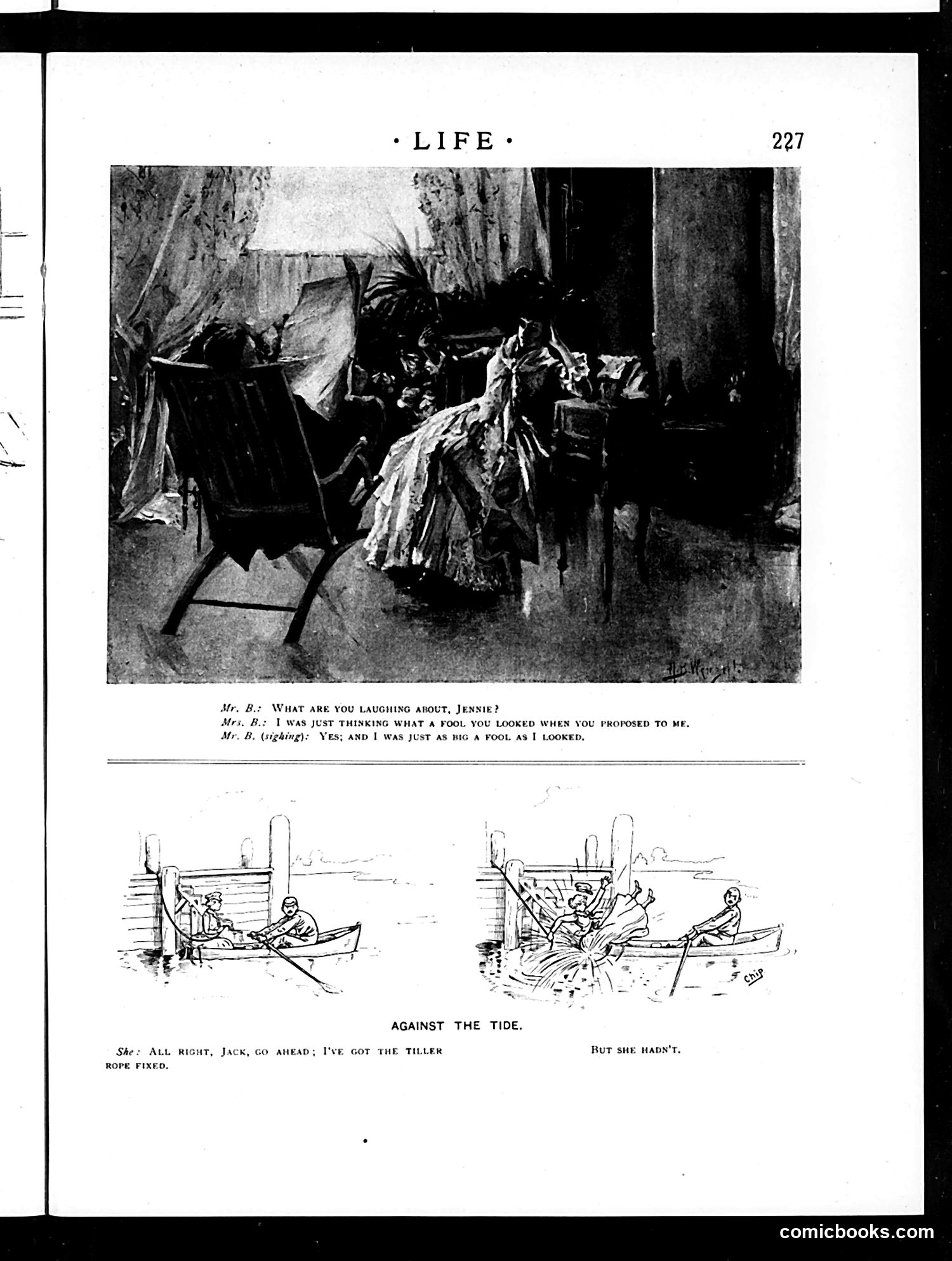
This page contains two separate comic sketches mocking married life and gender dynamics in early 20th-century America. **Top panel**: A married couple exchanges barbs about their engagement. The wife jokes that her husband looked foolish when proposing; he ruefully agrees he was "just as big a fool as I looked." The humor targets masculine vanity and the regret husbands supposedly felt after marriage. **Bottom panels** ("Against the Tide"): Two sketches show a couple in a rowboat. In the first, the wife confidently tells her husband to row ahead while she handles the tiller rope. In the second, the boat has capsized—she "hadn't" fixed it properly. The joke mocks women's claimed competence in traditionally male roles (boating) and suggests their incompetence causes domestic disaster. Both sketches reflect period attitudes about marriage as a battle between spouses, with women portrayed as either shrewish or incompetent.
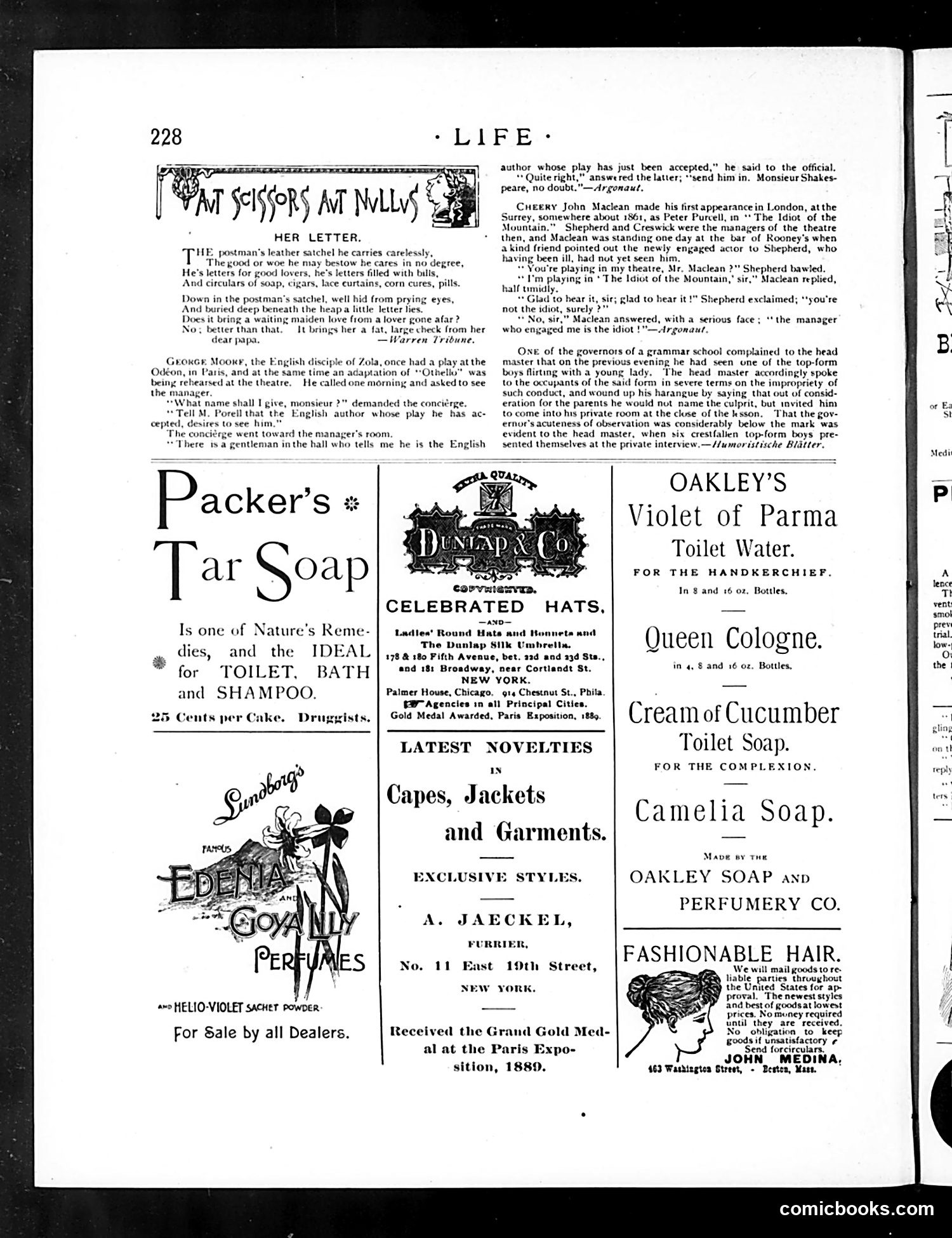
This page is primarily **advertisements for toiletries and fashion** (Packer's Tar Soap, Oakley's perfumes, A. Jaeckel's furs) interspersed with **four brief humorous anecdotes**. The jokes target pretension and pomposity: 1. A postman delivers a letter containing a father's check—better than romantic love. 2. An English playwright (modeled on George Moore, adapting Othello) is mistaken for Shakespeare by a theater manager—satirizing theatrical snobbery. 3. Actor John Maclean, newly hired, responds to a theater manager's question about performing in "The Idiot of the Mountain" by sarcastically blaming the manager for hiring him—self-deprecating wit about theatrical absurdity. 4. Six schoolboys visit a headmaster expecting punishment for one boy's flirtation; all six appear—mocking authority's inability to identify actual wrongdoing. The humor is gentle Victorian satire about social awkwardness, mistaken identity, and institutional incompetence.
This is primarily an **advertising page** from Life magazine, not a political cartoon or satirical content page. The page consists entirely of commercial advertisements from the late 19th or early 20th century. The only narrative humor appears in a small **anecdote** accompanying the Kimball cigarette ad: a man drowning in a river claims he's "drowning just for fun" when asked why he doesn't live in a more fashionable neighborhood. This is mild satire on wealth-consciousness—suggesting someone might endure death rather than admit financial hardship. The rest of the page advertises period products: blanket wraps and pajamas for travel, corsets, cigarettes, pianos, perfume, children's medicine, and beauty products. The ads reflect consumer culture and gendered marketing of the era (corsets for women's "perfect figure," grooming products emphasizing feminine beauty standards). No political figures or events are referenced. This is essentially a commercial page showcasing products marketed to middle and upper-class consumers.
This page is primarily **advertising**, not political satire. It contains commercial advertisements typical of the 1890s era, including: - **Caligraph typewriter** - marketed for speed and durability - **Insurance products** - deferred annuity bonds and life insurance - **Personal care items** - hair treatments (Barry's Tricopherous), furniture polish (Andina), cough medicine (Scott's Emulsion), and skin products (Adipo-Malene) - **Financial services** - letters of credit and banking The most notable content is a **testimonial from Sir Erasmus Wilson**, a prominent dermatologist and president of the Royal College of Surgeons, endorsing the importance of soap for skin care. The advertisement quotes his observations about proper skin-washing practices. The page reflects late-Victorian consumer culture and marketing strategies that relied on celebrity endorsements and pseudo-scientific claims to promote various products.