
Life, 1890-10-23 · page 4 of 16
Life — October 23, 1890 — page 4: what you’re looking at
What you’re looking at
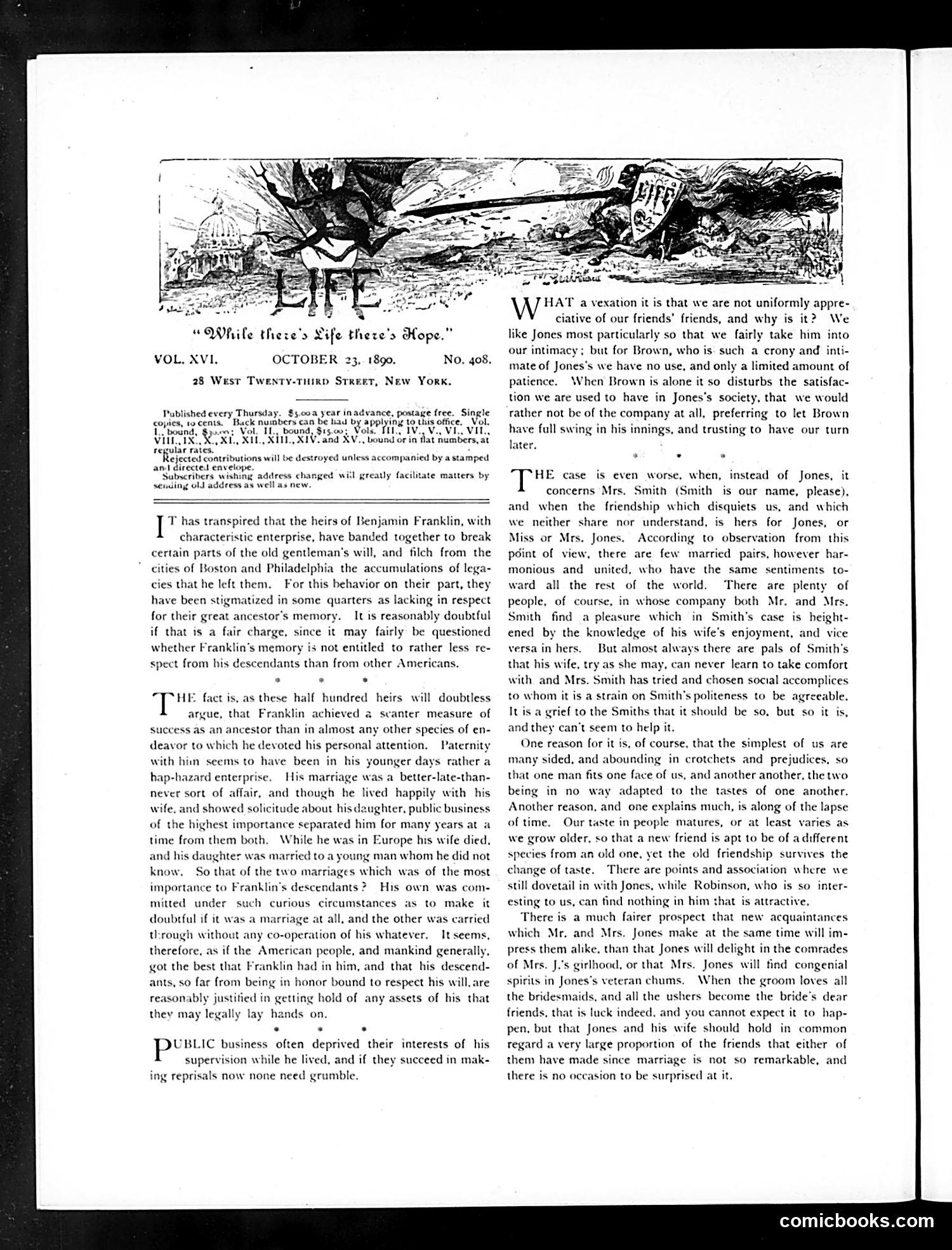
The cartoon at the page top shows a figure wielding a large scythe labeled "Life" near the U.S. Capitol building, with "Pity" visible on a sign. This appears to be Death or a grim reaper figure, satirizing Life magazine's editorial power or influence over American politics and institutions. The accompanying text discusses Benjamin Franklin's heirs breaking apart his will and real estate holdings in Boston and Philadelphia, satirizing wealthy descendants who lack respect for their ancestor's legacy. The article then shifts to discussing social friction between friends—specifically the discomfort when one couple (the Smiths) socializes with another (the Joneses), suggesting class or taste incompatibilities that strain friendships. The satire targets both inherited privilege and social pretension among the wealthy.
📄 Transcribed text from this page (OCR, searchable)
Machine-transcribed from the original scan — historical spelling and the odd misread are preserved.
“While there's Life there's Hope.” VOL, XVI. OCTOBER 23, 1890, 28 West Twenty-tTHirp Street, New York, No. 408. Published every Thursday. $5.coa year inadvance, postage free. Single copies, ro cents. Back nuinbers can be liad by applying to this office. Vol. 1., bound, $j.09; Vol. IL, bound, $15.00; Vols. Il., 1V., V., VI. VIL, ViPS, ORE, NIL XH RY Y., bound or in flat Aumbers, at regular rates, ejected contributions will be destroyed unless accompanied by a stamped an directed envelope. Subscribers wishing address changed will greatly facil sending old address as well as new I as transpired that the heirs of Benjamin Franklin, with characteristic enterprise, have banded together to break certain parts of the old gentleman's will, and filch from the cities of Boston and Philadelphia the accumulations of le; cies that he left them. For this behavior on their part, they have been stigmatized in some quarters as lacking in respect for their great ancestor's memory. It is reasonably doubtful if that is a fair charge, since it may fairly be questioned whether Franklin’s memory is not entitled to rather less re- spect from his descendants than from other Americans. te matters by * * . HE fact is, as these half hundred heirs will doubtless argue, that Franklin achieved a scanter measure of success as an ancestor than in almost any other species of en- deavor to which he devoted his personal attention. Paternity with him seems to have been in his younger days rather a hap-hazard enterprise. never sort of affair, and though he lived happily with his ughter, public business His marriage was a better-late-than- wife, and showed solicitude about his of the highest importance separated him for many ye: time from them both. While he was in Europe his wife died, and his daughter was married to a young man whom he did not know. importance to Franklin's descendants ? ata So that of the two marriages which was of the most His own was com- mitted under such curious circumstances as to make it doubtful if it was a marriage at all, and the other was carried through without any co-operation of his whatever, It seems, therefore, as if the American people, and mankind generally, got the best that Franklin had in him, and that his descend- ants, so far from being in honor bound to respect his will. are reasonably justitied in getting hold of any assets of his that they may legally lay hands on. . . . UBLIC business often deprived their interests of his supervision while he lived, and if they succeed in mak- ing reprisals now none need grumble. W HAT a vexation it is that we are not uniformly appre- ciative of our friends’ friends, and why is it? We like Jones most particularly so that we fairly take him into our intimacy; but for Brown, who is: such a crony and inti- mate of Jones's we have no use, and only a limited amount of patience. When Brown is alone it so disturbs the satisfac- tion we are used to have in Jones's society, that we would rather not be of the company at all, preferring to let Brown have full swing in his innings, and trusting to have our turn later. HE case is even worse, when, instead of Jones, it concerns Mrs. Smith (Smith is our name, please), and when the friendship which disquiets us, and which We neither share nor understand, is hers for Jones, or According to observation from this. point of view, there are few married pairs, however har- monious and united, who have the same sentiments to- ward all the rest of the world. There are plenty of people, of course, in whose company both Mr. and Mrs. Smith find a pleasure which in Smith's case is height- ened by the knowledge of his wife’s enjoyment, and vic versa in hers. But almost always there are pals of Smith's that his wife, try as she may, can never learn to take comfort with and Mrs. Smith has tried and chosen social accomplices to whom it is a strain on Smith's politeness to be agreeable. It is a grief to the Smiths that it should be so, but so it is, and they can’t seem to help it. One reason for it is, of course, that the simplest of us are many sided, and abounding in crotchets and prejudices, so that one man fits one face of us, and another another, the two being in no way adapted to the tastes of one another. Another reason, and one explains much, is along of the lapse of time. Our taste in people matures, or at least varies as we grow older, so that a new friend is apt to be of adifferent pecies from an old one, yet the old friendship survives the change of taste. There are points and association where we sull dovetail in with Jones, while Robinson, who is so inter- esting to us, can find nothing in him that is attractive. There is a much fairer prospect that new acquaintances which Mr. and Mrs. Jones make at the same time will im- press them alike, than that Jones will delight in the comrades of Mrs. J.’s girlhood, or that Mrs. Jones will find congenial spirits in Jones's veteran chums, When the groom loves all nd all the ushers become the bride's dear friends, that is luck indeed, and you cannot expect it to hap- pen, but that Jones and his wife should hold in common regard a very large proportion of the friends that either of Miss or Mrs. Jones. the bridesmaids, them have made since marriage is not so remarkable, and there is no occasion to be surprised at it. comicbooks.com