
Life, 1890-10-23 · page 7 of 16
Life — October 23, 1890 — page 7: what you’re looking at
What you’re looking at
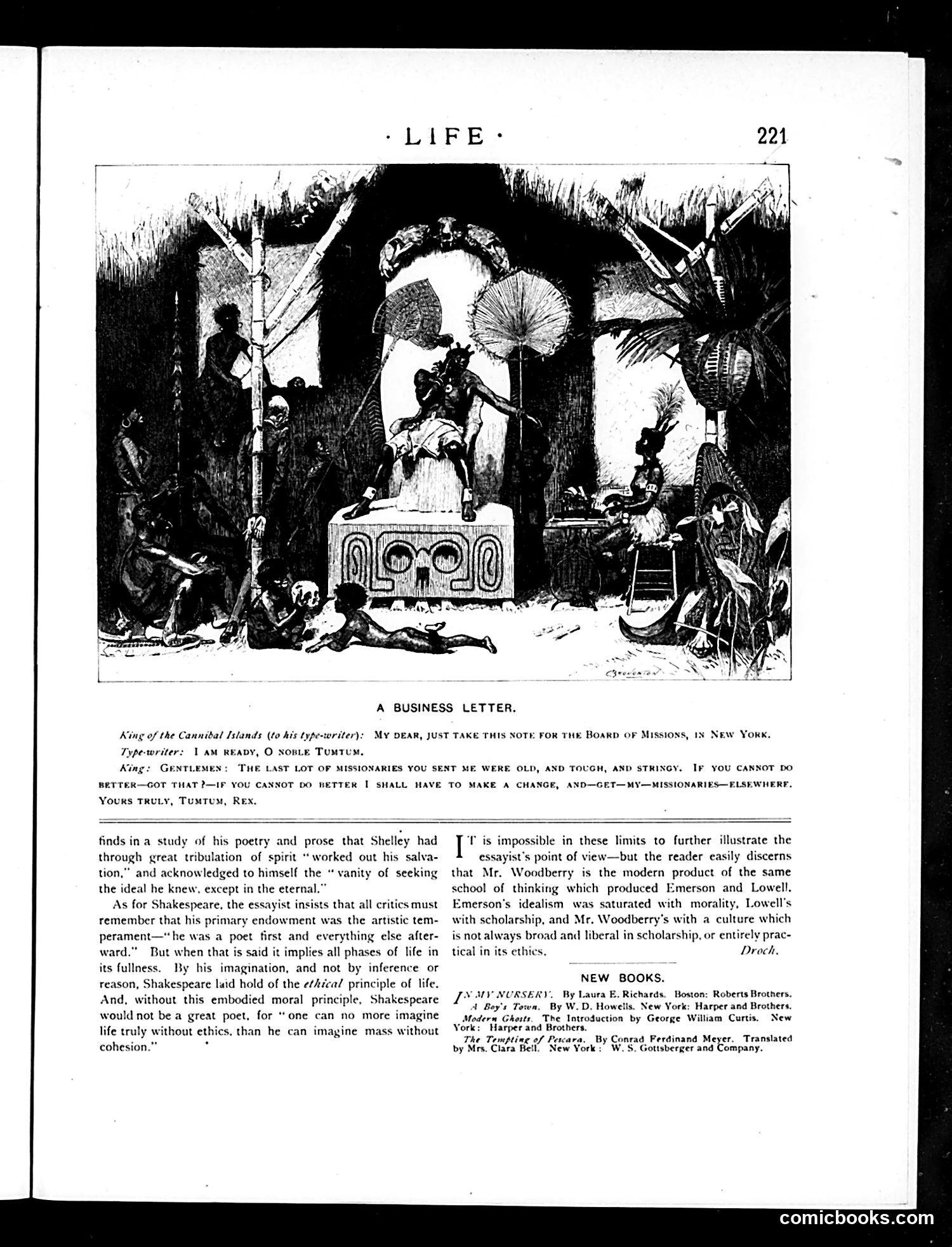
This satirical cartoon depicts a "King of the Cannibal Islands" sending a complaint letter to a New York missionary board. The king complains that the missionaries they sent were "old, and tough, and stringy," threatening to take his business elsewhere unless they provide better quality replacements. The satire mocks both colonial-era missionary efforts and racist stereotypes about cannibals. It critiques the patronizing, commercial attitude toward missionary work—treating conversion efforts as a mere business transaction. The joke also implies the missionaries themselves were poor quality or ineffective. This reflects late 19th/early 20th-century skepticism about the actual benefits and sincerity of religious imperialism in colonized territories.
📄 Transcribed text from this page (OCR, searchable)
Machine-transcribed from the original scan — historical spelling and the odd misread are preserved.
A BUSINESS LETTER. King of the Cannibal Islands (to his typewriter): 1 am READY, O NOBLE TustUs. Gentiem! Type-writer: King: My DEAR, JUST TAKE TH ‘THE LAST LOT OF MISSIONARIES YOU SENT ME WERE OLD, AND TOUGH, AND STRINGY. NOTE FOR THE BOARD OF Missions, IN New York. IF YOU CANNOT DO BETTER—GOT THAT ?2—IF YOU CANNOT DO KETTER I SHALL HAVE TO MAKE A CHANGE, AND—GET—MY—MISSIONARIES—ELSEWHERE, Yours Truty, Tumtum, Rex, finds ina study of his poetry and prose that Shelley had through great tribulation of spirit “worked out his salva- tion,” and acknowledged to himself the “ vanity of seeking the ideal he knew, except in the eternal.” As for Shakespeare, the essayist insists that all critics must remember that his primary endowment was the artistic tem- perament—“he was a poet first and everything else after- ward.” But when that is said it implies all phases of life in its fullness. By his imagination, and not by inference or reason, Shakespeare laid hold of the e¢héca/ principle of life. And, without this embodied moral principle, Shakespeare would not be a great poet, for “one no more imagine life truly without ethics. than he can imagine mass without cohesion.” . is impossible in these limits to further illustrate the essayist’s point of view—but the reader easily discerns I i) that Mr. Woodberry is the modern product of the same school of thinking which produced Emerson and Lowell. Emerson's idealism was saturated with morality, Lowell's with scholarship, and Mr. Woodberry’s with a culture which is not always broad and liberal in scholarship, or entirely prac- tical in its ethics. Droch. NEW BOOKS. By Laura E. Richards, Boston: Roberts Brothers. By W. D, Howells. New York: Harper and Brothers. The Introduction by George William Curtis. New York: Harper and Brothers. The Tempting of Percara. By Conrad Ferdinand Meyer. Translated by Mrs. Clara Bell, New York: W.S. Gottsberger and Company. comicbooks.com