
Life, 1890-10-23 · page 6 of 16
Life — October 23, 1890 — page 6: what you’re looking at
What you’re looking at
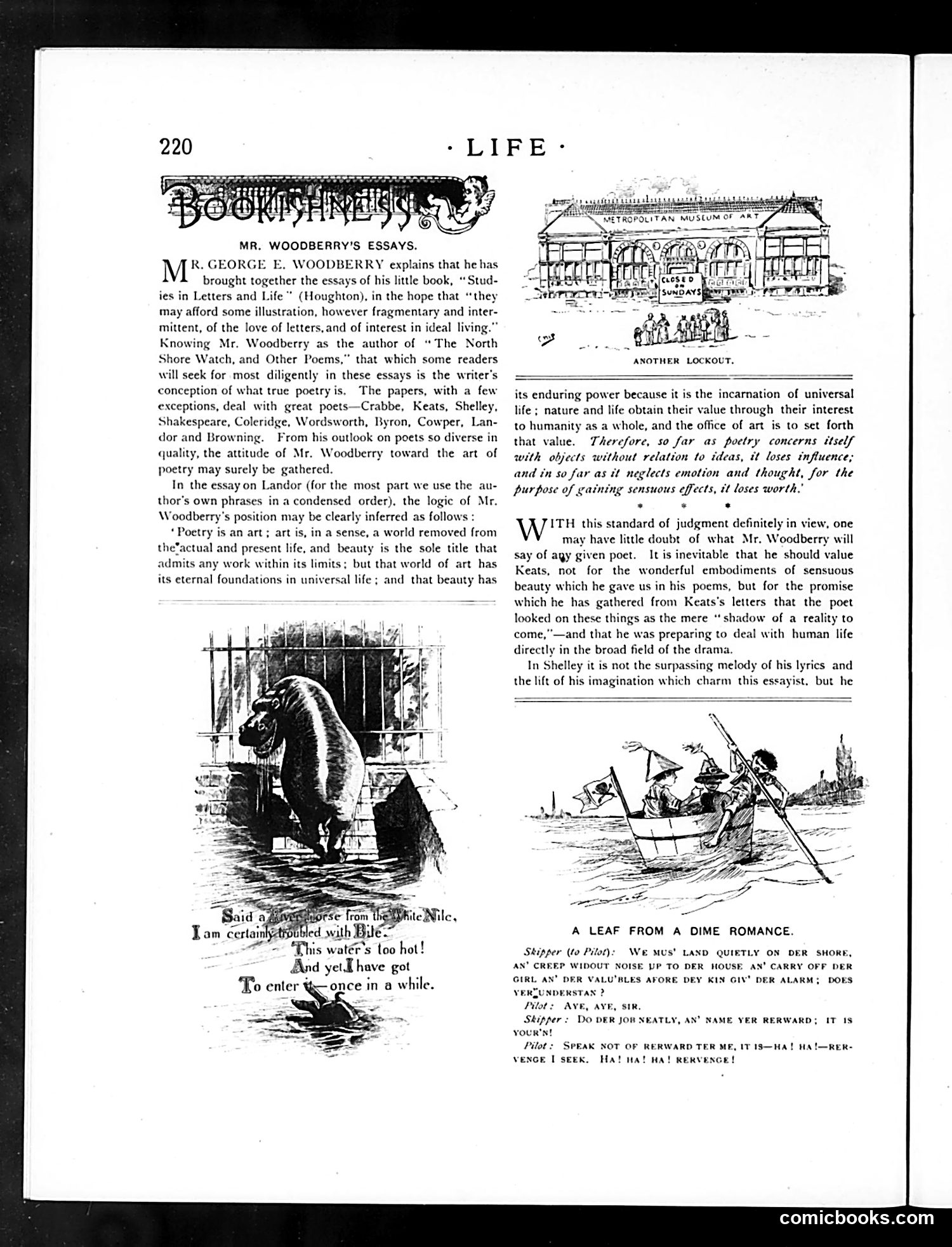
This page features "Mr. Woodberry's Essays," a literary criticism column discussing George E. Woodberry's book on poetry and ideal living. The text analyzes Woodberry's views on poets like Keats and Shelley, emphasizing that poetry operates in a realm removed from practical life, focused on universal beauty and human experience. The accompanying illustrations are literary vignettes rather than political satire. The left image shows a crocodile in water (likely illustrating a poem or literary reference), while the right depicts a nautical scene with sailors in a boat, captioned "A Leaf from a Dime Romance"—a humorous reference to cheap serialized adventure fiction popular in that era. This page emphasizes high literary culture versus commercial entertainment.
📄 Transcribed text from this page (OCR, searchable)
Machine-transcribed from the original scan — historical spelling and the odd misread are preserved.
MR. WOODBERRY'S ESSAYS. R. GEORGE E, WOODBERRY explains that he has brought together the essays of his little book, “ Stud- ies in Letters and Life” (Houghton), in the hope that “they may afford some illustration, however fragmentary and inte! mittent, of the love of letters, and of interest in ideal living Knowing Mr. Woodberry as the author of “The North Shore Watch, and Other Poems,” that which some readers will seek for most diligently in these essays is the writer's conception of what true poetr: The papers, with a few exceptions, deal with great poets—Crabbe, Keats, Shelley, Shakespeare, Coleridge, Wordsworth, Byron, Cowper, Lan- dor and Browning. From his outlook on poets so diverse in quality, the attitude of Mr. Woodberry toward the art of poetry may surely be gathered. In the essay on Landor (for the most part we use the au- thor’s own phrases in a condensed order), the logic of Mr. Woodberry’s position may be clearly inferred as follow ‘Poetry is an art; art is, in a sense, a world removed from thefactual and present life, and beauty is the sole title that admits any work within its limits; but that world of art has its eternal foundations in universal life; and that beauty has This watér's too hot! And yetEhave got To enter once in a while. ANOTHER LOCKOUT. its enduring power because it is the incarnation of universal life; nature and life obtain their value through their interest to humanity as a whole, and the office of art is to set forth that value. Therefore, so far as poetry concerns itself with objects without relation to ideas, it loses influence; and in so far as it neglects emotion and thought, for the purpose of gaining sensuous effects, it loses worth. . . . ITH this standard of judgment definitely in view, one may have little doubt of what Mr. Woodberry will say of ayy given poet. It is inevitable that he should value Keats, not for the wonderful embodiments of sensuous beauty which he gave us in his poems, but for the promise which he has gathered from Keats's letters that the poet looked on these things as the mere “shadow of a reality to come,”—and that he was preparing to deal with human life directly in the broad field of the drama. In Shelley it is not the surpassing melody of his lyrics and the lift of his imagination which charm this essayist, but he A LEAF FROM A DIME ROMANCE. Skipper (to Pilot): We MUS' LAND QUIETLY ON DER SHORE, AN’ CREEP WIDOUT NOISE UP TO DER HOUSE AN’ CARRY OFF DER GIRL AN’ DER VALU'RLES AFORE DEY KIN GIV' DER ALARM; DOES VERIUNDERSTAN ? Pilot: AVE, AYE, SiR. Skipper: Do DER Jon your's! Pilot: SPEAK NOT OF RERWARD TER ME, IT IS—HA! HA!RER- VENGE I SEEK. Ha! Hal HA! RERVENGE! EATLY, AN’ NAME YER RERWARD; IT 18 comicbooks.com