
A complete issue · 18 pages · 1890
Life — October 16, 1890
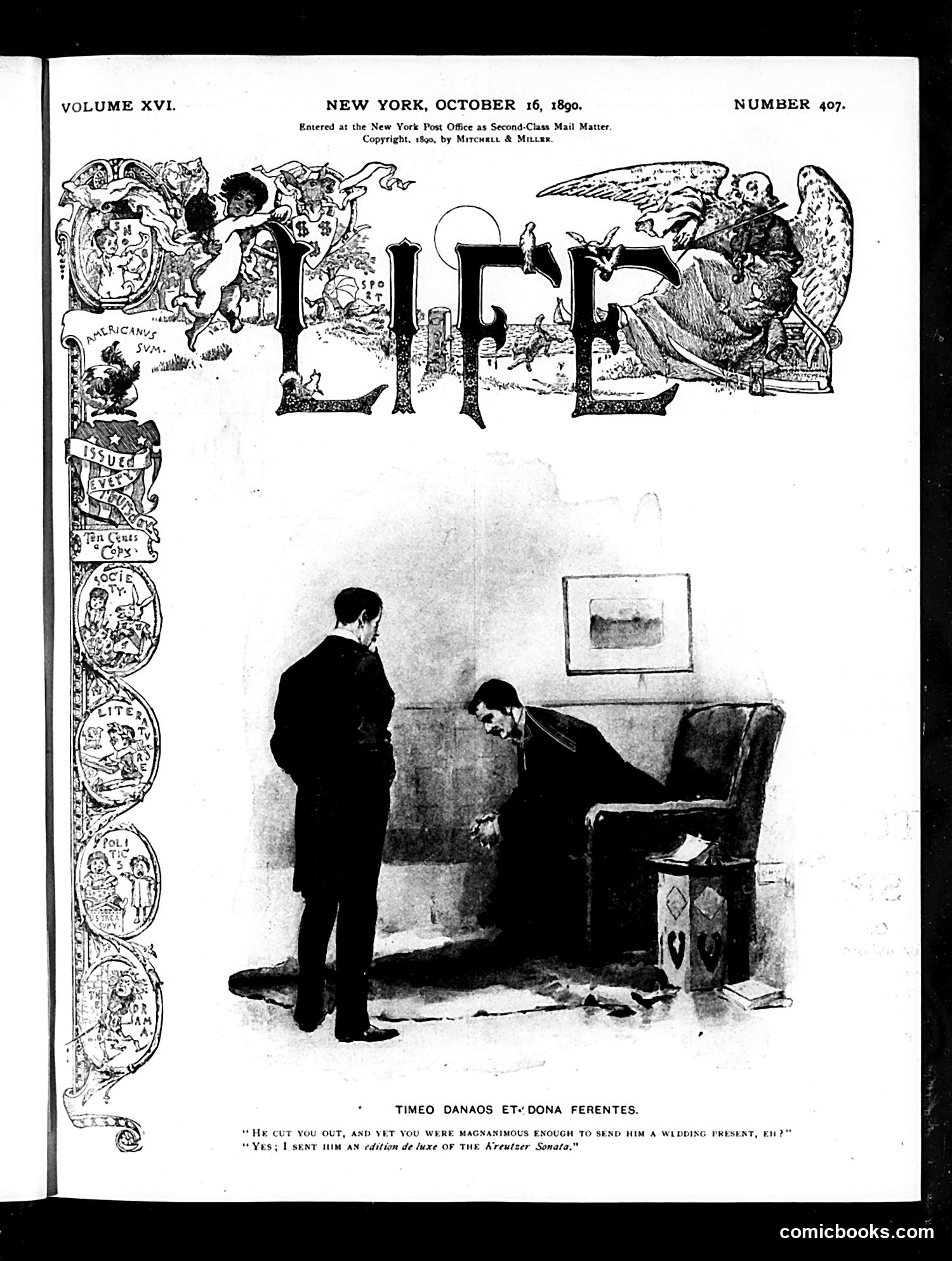
This is the cover of *Life* magazine (October 16, 1890). The main illustration shows two men in formal dress: one standing, one seated at a desk examining what appears to be a musical score or document. The caption reads: "TIMEO DANAOS ET DONA FERENTES" (a Latin phrase meaning "I fear the Greeks bearing gifts"). The dialogue indicates one man sent the other a wedding present—specifically an "edition de luxe" of the Kreutzer Sonata (a Beethoven composition). This appears to satirize the controversy surrounding Tolstoy's novella *The Kreutzer Sonata* (1889), which dealt provocatively with marriage and sexuality. The joke suggests giving someone this particular work as a wedding gift would be tactless or insulting, given its scandalous content about marital discord.
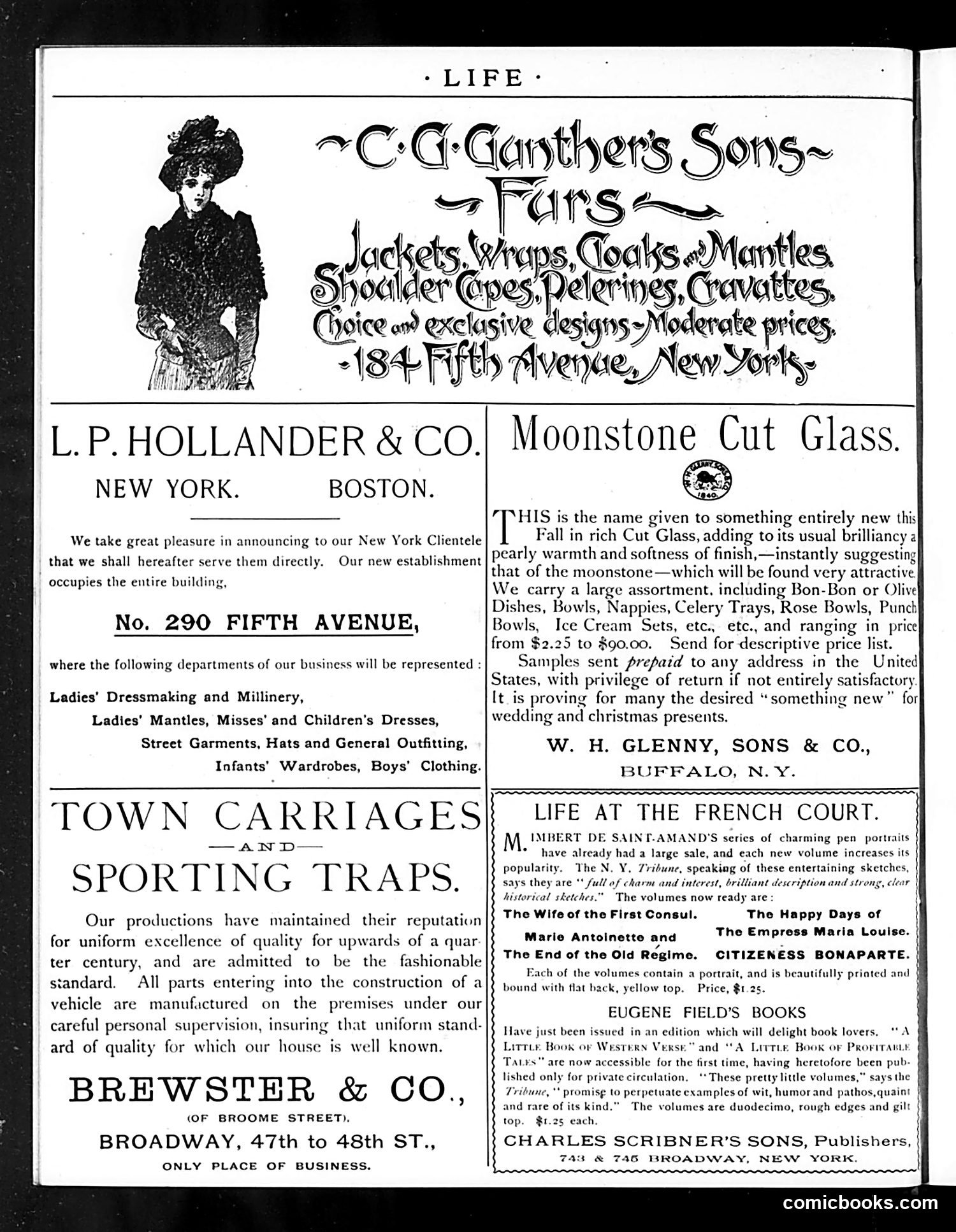
This page is **primarily advertisements** with no political cartoons or satirical content visible. The ads promote: - **C.G. Ganthers Sons**: A fur retailer on Fifth Avenue, New York, advertising jackets, wraps, cloaks, and other fur garments with "moderate prices" - **L.P. Hollander & Co.**: A department store at 290 Fifth Avenue offering dressmaking, millinery, children's clothing, and related services - **Brewster & Co.**: A carriage and sporting trap manufacturer claiming century-old quality standards - **W.H. Glenny, Sons & Co.**: Buffalo-based seller of "Moonstone Cut Glass"—described as a new product combining cut glass brilliance with a softer finish The remaining content includes book advertisements and literary announcements, with no discernible political satire or social commentary present on this page.
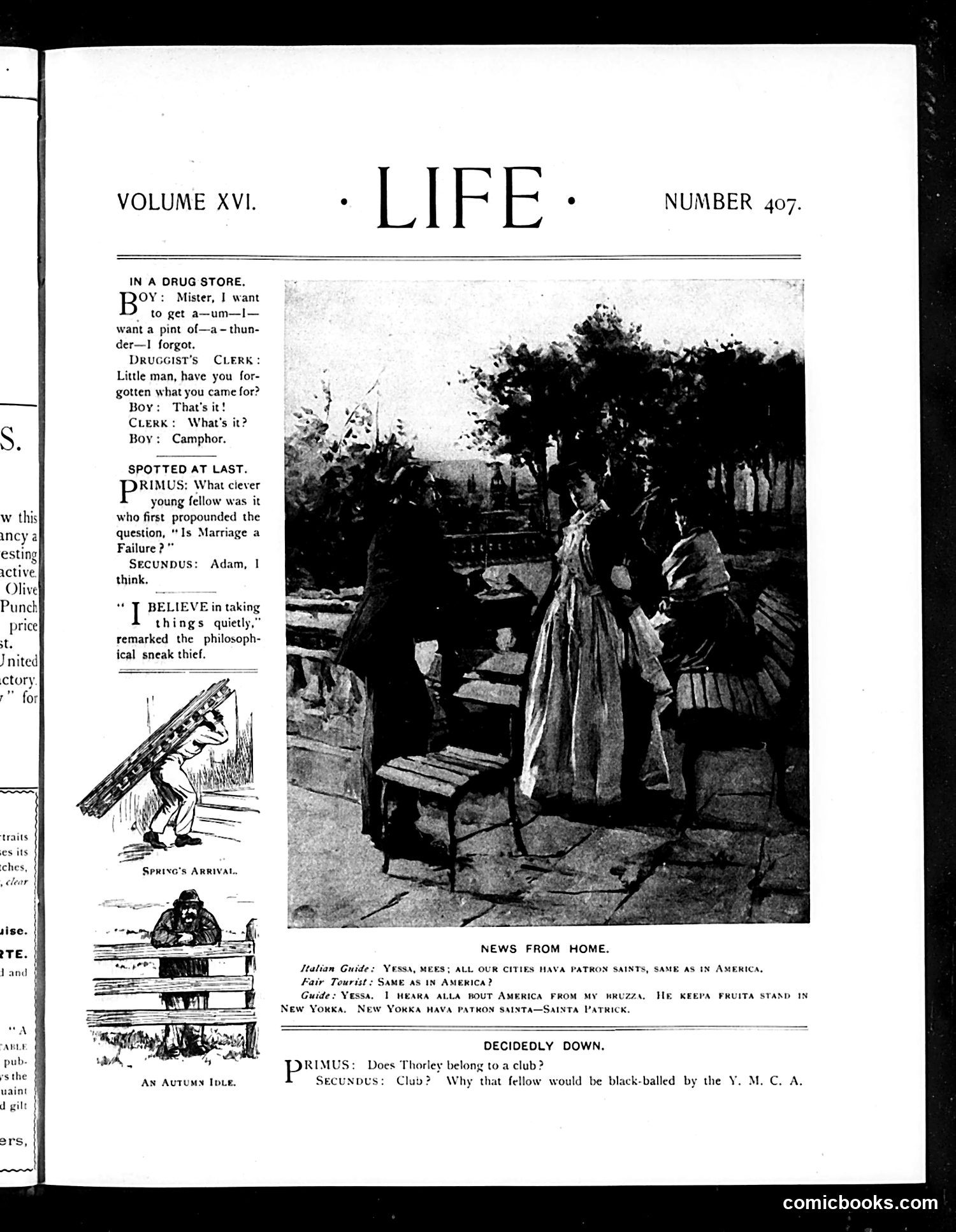
This page contains several short humorous dialogues and illustrations typical of Life's satirical format: **"In a Drug Store"** mocks a forgetful boy who can't remember what he wanted to purchase—a common comedic premise about absent-mindedness. **"Spotted at Last"** features philosophers debating whether "Marriage is a Failure," with one character's response about "taking things quietly" satirizing pretentious intellectual discourse. **"News from Home"** shows a scene with an Italian guide and fair tourist discussing patron saints in America, likely satirizing European visitors' surprise at American religious practices. **"Decidedly Down"** jokes about club membership and social status through dialogue about someone named Thorley. The illustrations and brief comedic sketches reflect Life's typical early-20th-century humor focusing on everyday social situations and class dynamics.
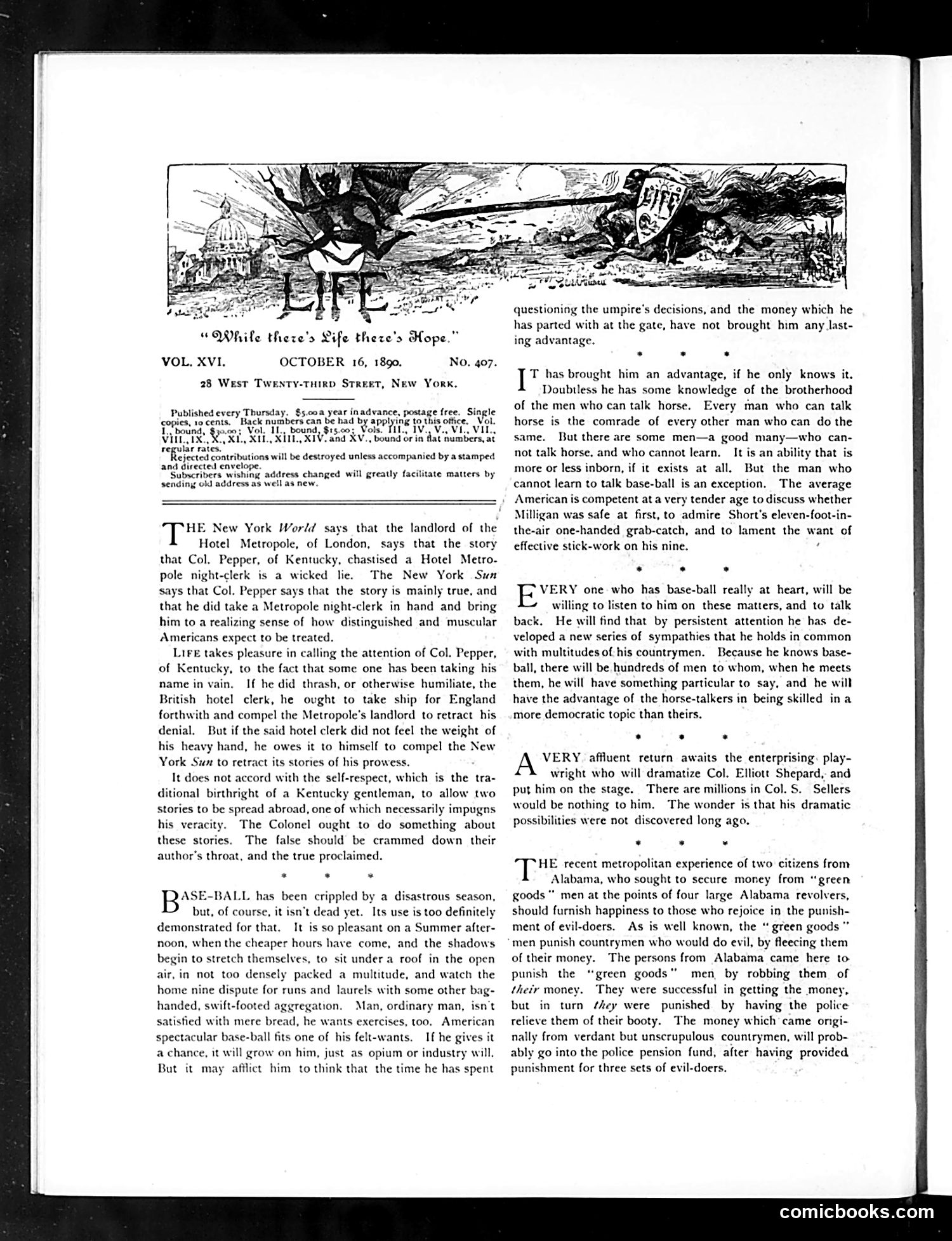
The cartoon at top left, titled "While there's Life there's Mops," depicts a figure with an exaggerated face emerging from or associated with a mop. The image's meaning is unclear without additional context, though the title suggests wordplay on the phrase "while there's life there's hope." The page's main text discusses Col. Pepper of Kentucky and disputes over stories about him allegedly thrashing a Hotel Metropole desk clerk in London. Life satirizes both the British hotel's claims and American newspapers amplifying the story, questioning whether a Kentucky gentleman should tolerate such public humiliation. The remainder addresses baseball culture and dramatic possibilities in theater, suggesting Life's typical satirical commentary on American society and institutions.
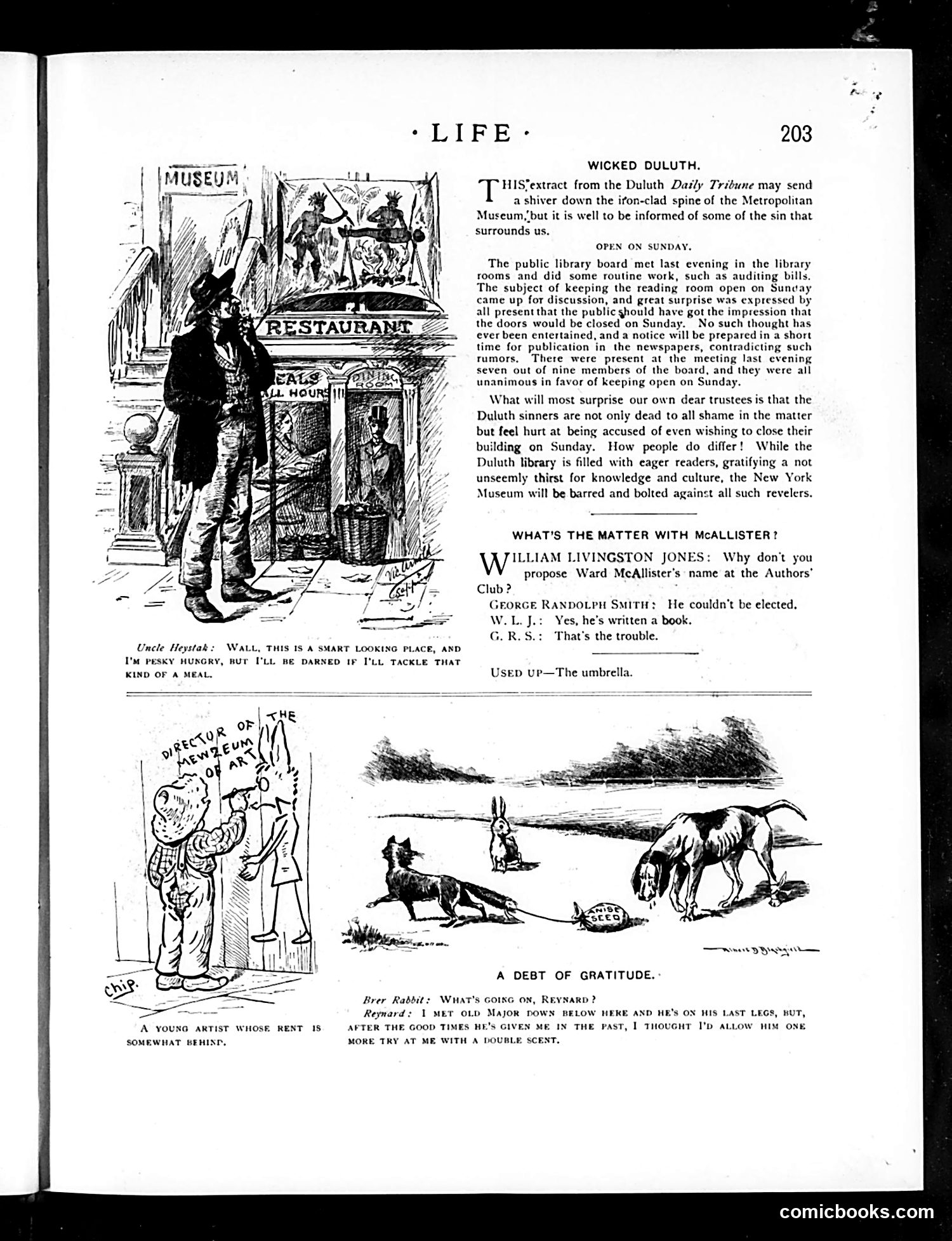
**"Wicked Duluth" Section:** This discusses the Duluth public library board's debate over Sunday hours. The satire mocks moral hypocrisy: library trustees opposed opening on Sundays to avoid "sin," yet ironically, the New York Museum faces criticism for *closing* on Sundays. The piece ridicules how people selectively apply moral arguments. **"What's the Matter with McAllister?":** A brief exchange jokes that Ward McAllister couldn't be elected to the Authors' Club despite being a published author—the implication being McAllister's unworthiness despite his literary credentials. **Bottom Cartoons:** "A Young Artist Whose Rent Is Somewhat Behind" shows financial desperation; "A Debt of Gratitude" depicts animals—the rabbit thanks a dog for helping an aging Major, showing gratitude for past kindness.
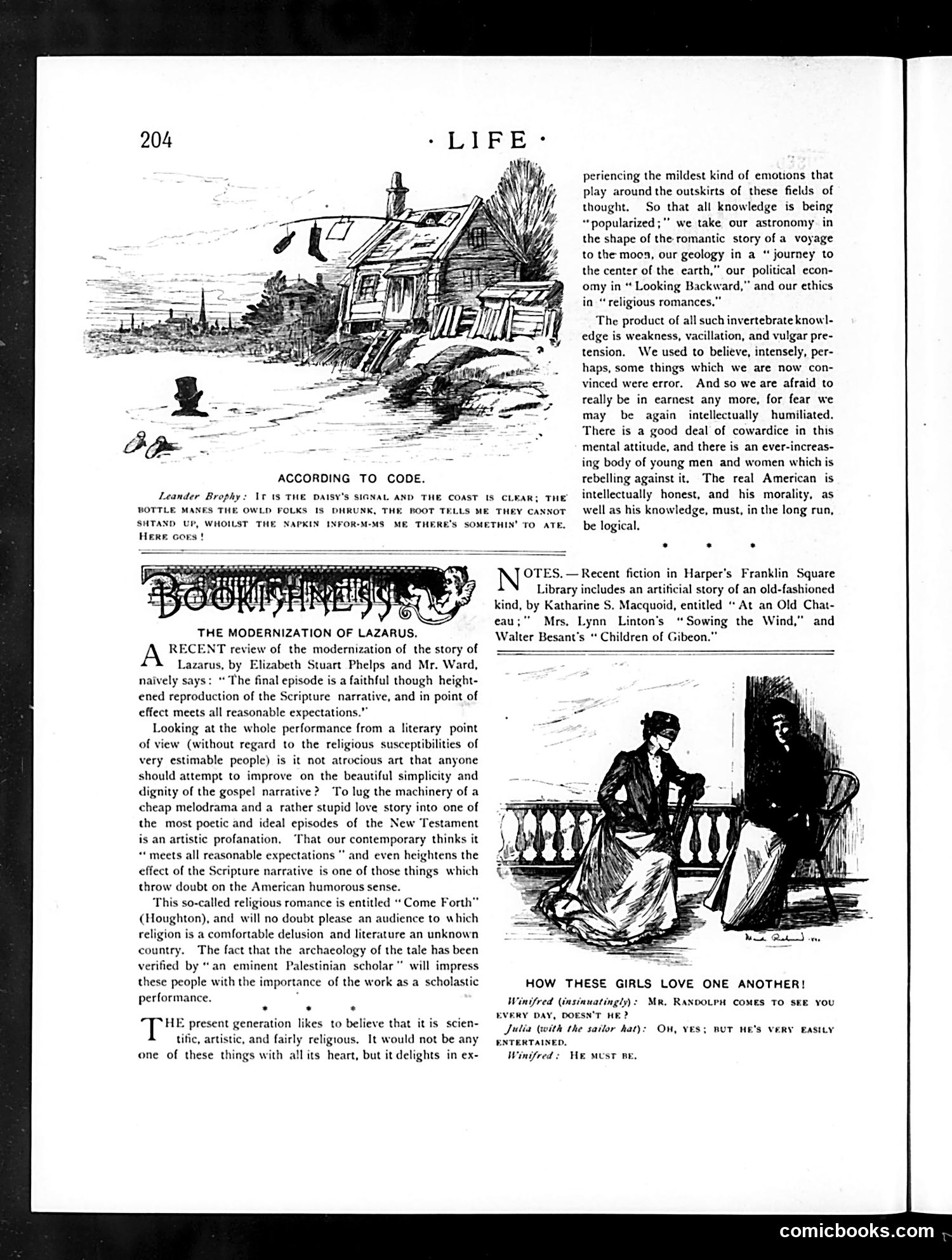
The page contains two distinct sections: **Top cartoon "According to Code"**: A sketch of a dilapidated seaside cottage with the caption about a sailor's "signal and the coast is clear." This appears to be a mild romantic/social satire about coastal rendezvous, using nautical signaling as pretext for intimate meetings. **Bottom section "Bookishness"**: A critical essay titled "The Modernization of Lazarus" discusses theatrical adaptations of biblical narratives, arguing that contemporary attempts to make scripture "modern" trivialize sacred material. The author questions whether artistic updating of gospel stories constitutes inappropriate profanation. **Illustration**: Shows two women on a balcony in what appears to be a social scene, captioned "How These Girls Love One Another!" with dialogue suggesting easy entertainment expectations. The overall page reflects early 20th-century concerns about cultural modernization and artistic propriety.
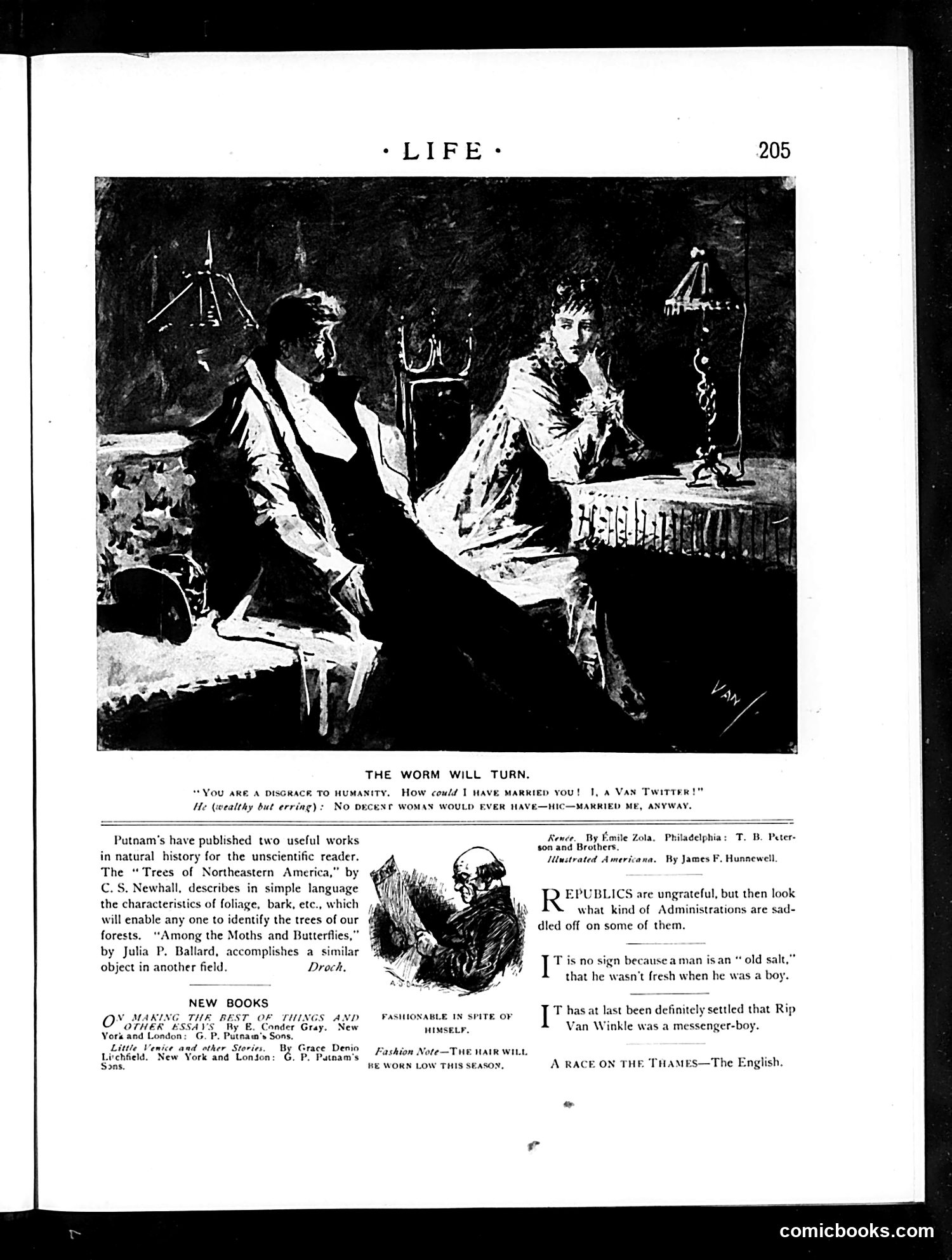
The main illustration titled "THE WORM WILL TURN" depicts a domestic conflict scene. A man in formal attire confronts a woman in elaborate dress, with the caption quoting him: "You are a disgrace to humanity. How could I have married you! I, a Van Twitter!" The woman replies (with sarcasm noted): "No decent woman would ever have—married me, anyway." This satirizes upper-class pretension and marital discord among the wealthy. "Van Twitter" appears to be a fictional name mocking aristocratic Dutch-descended New York society families. The joke targets both the husband's insufferable snobbery and the wife's pointed comeback, suggesting even "decent women" wouldn't marry such an arrogant man. The page also contains book reviews and fashion notes unrelated to the cartoon's social commentary.
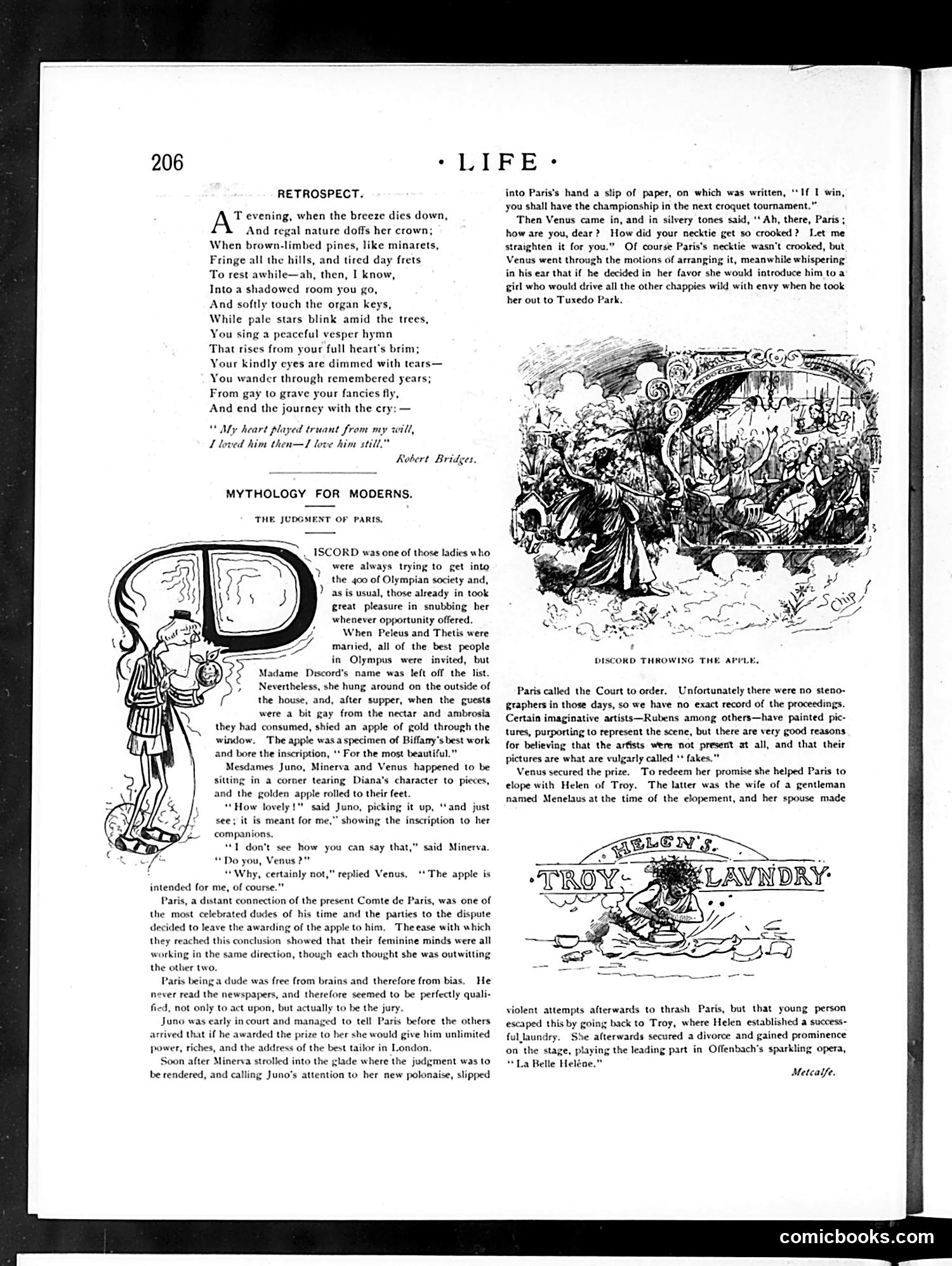
This page contains two distinct pieces: **"Retrospect"** (top): A sentimental poem about nature and loss, attributed to Robert Bridges. **"Mythology for Moderns: The Judgment of Paris"** (main content): A satirical retelling of the classical myth. The text and illustration show Discord throwing an apple into a social gathering, with the caption "DISCORD THROWING THE APPLE." The satire mocks high society by treating a mundane social rivalry—competing women vying for attention—as if it were the classical myth. The humor derives from treating trivial modern social drama with grandiose mythological language. Paris is depicted as "a dude" and a society judge, chosen to arbitrate between competing ladies (Venus, Juno, Minerva) over who deserves an award. The satire critiques both pretentious society and the vanity it encourages.
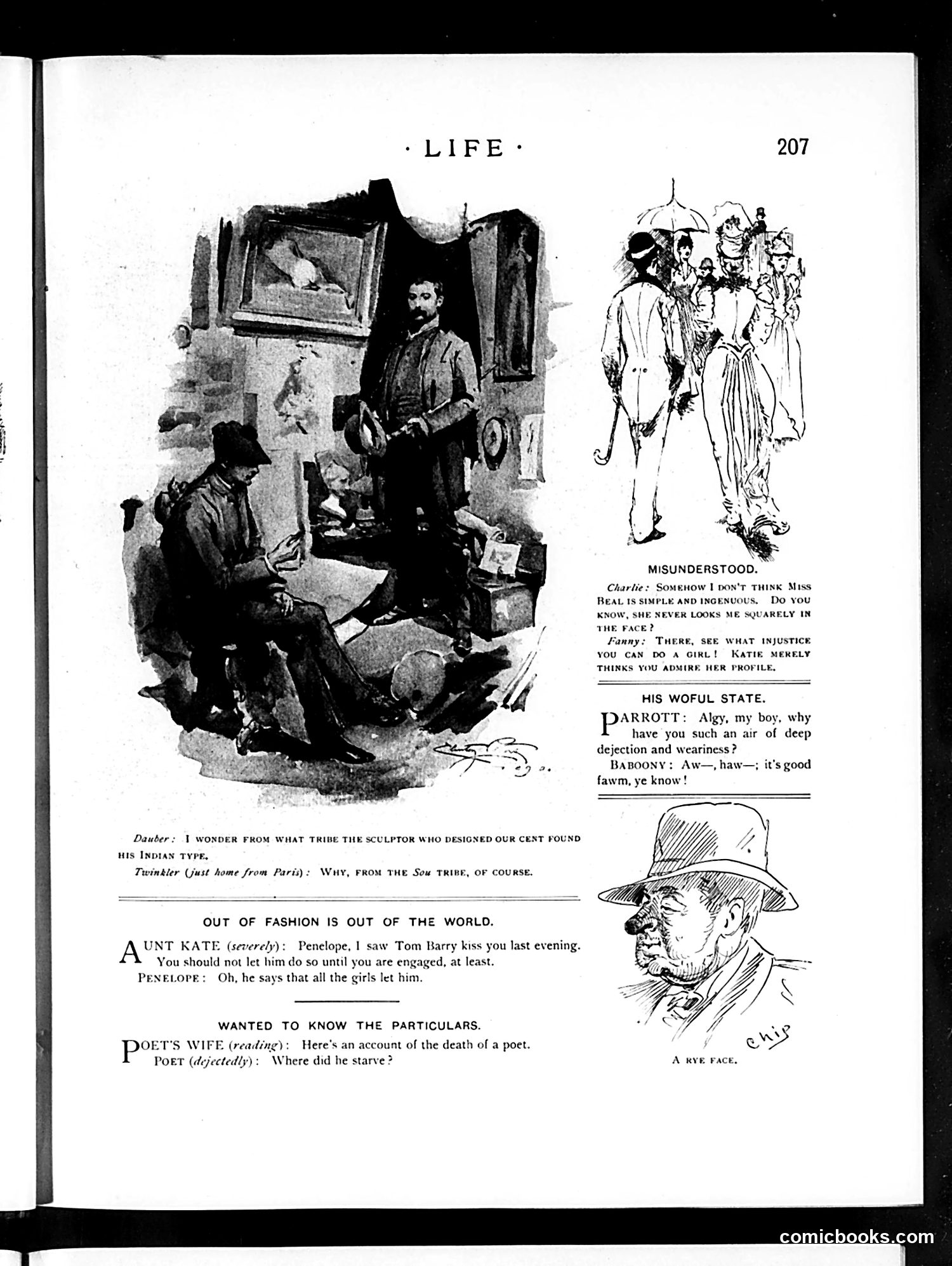
This page contains four separate satirical jokes typical of early 20th-century Life magazine humor: 1. **"Misunderstood"** and **"His Woeful State"**: Social comedy sketches about romantic misunderstandings and class pretension. 2. **"Out of Fashion is Out of the World"**: Mocks Aunt Kate's outdated social rules about engagement etiquette, contrasting with modern dating behavior where "all the girls let him" kiss them. 3. **"Wanted to Know the Particulars"**: A dark joke where a Poet's Wife reading about a poet's death asks practically where he starved—satirizing both the stereotypical suffering poet and the wife's mercenary concerns. The sketches use exaggerated character types and verbal wit typical of Edwardian-era magazine humor, targeting social pretension, changing morality, and class anxieties of the period.
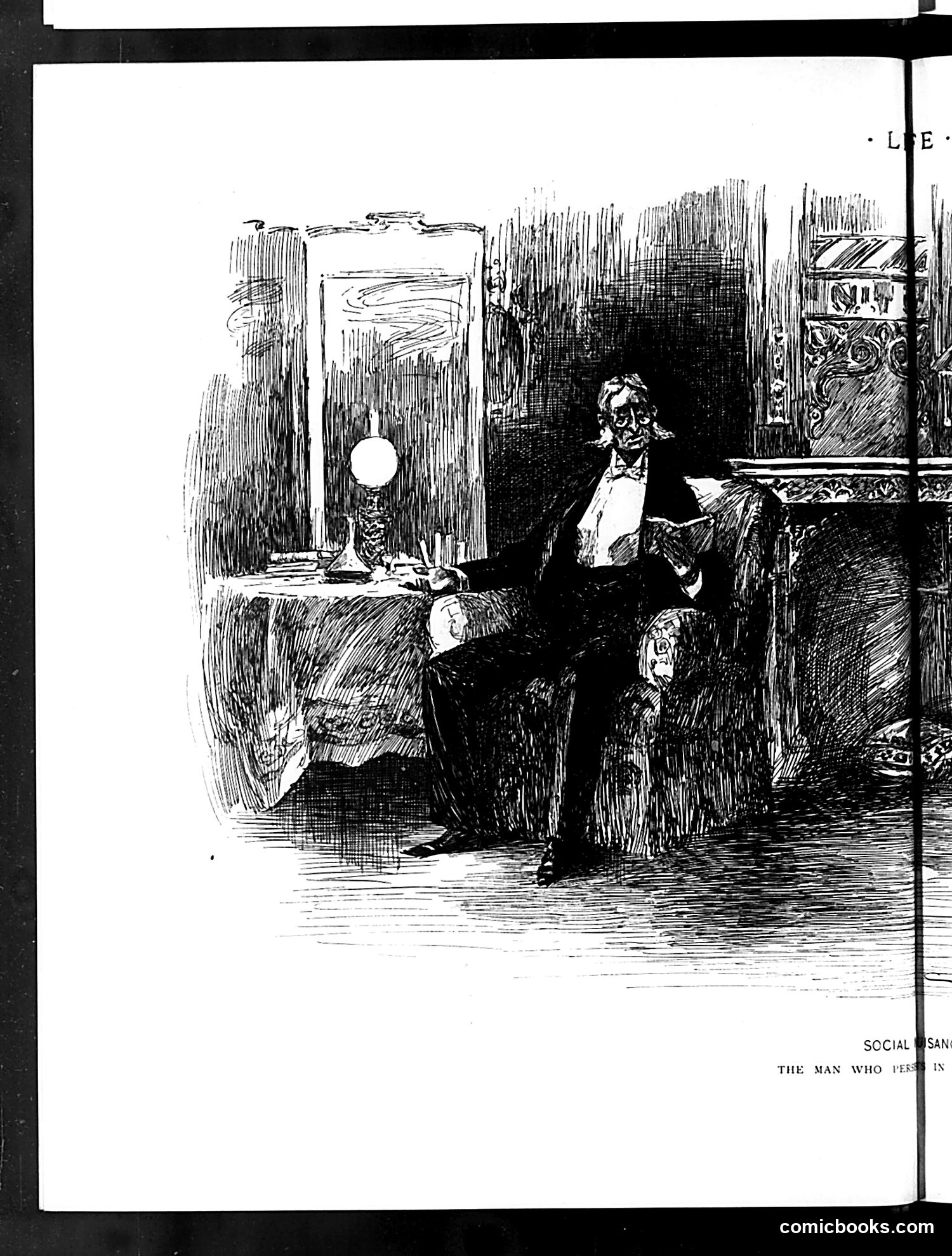
This appears to be a satirical illustration from *Life* magazine depicting a well-dressed gentleman in formal attire seated at a desk or table in an ornate interior. The partial text visible reads "SOCIAL SAN" and "THE MAN WHO FEELS IN," suggesting this is part of a series on social types or behaviors. The sketch uses heavy cross-hatching typical of late 19th/early 20th-century satirical illustration. The figure's posture and setting suggest commentary on a particular social character or personality type—likely someone engaged in intrigue, deception, or social maneuvering, though the complete caption is cut off. Without the full title and context, the specific target of this satire remains unclear.
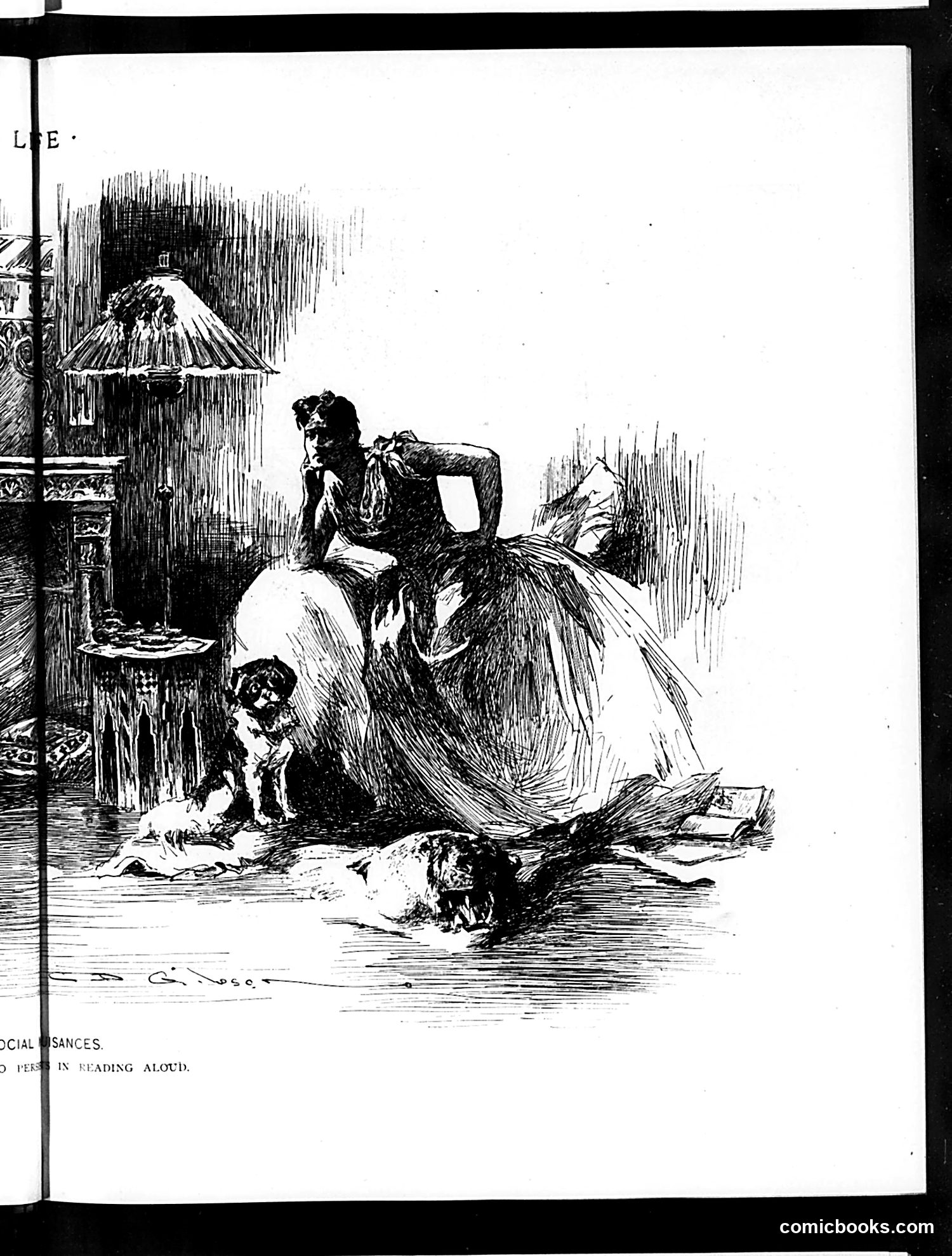
This is a sketch titled "Social Dances" with the subtitle "A Person in Reading Aloud." The illustration shows a woman in an elaborate ball gown reading aloud to an assembled group that includes at least two small dogs and what appears to be an attendant or companion. The scene takes place in an ornate interior with decorative furniture visible. The satire appears to target the pretentiousness of Victorian-era "social dances" and cultural gatherings. By depicting a woman reading to dogs and servants as if they were distinguished guests at a formal social event, the cartoonist mocks the affected seriousness and empty ritual of such occasions. The humor lies in the absurdity of treating mundane domestic activities as if they were refined cultural performances.
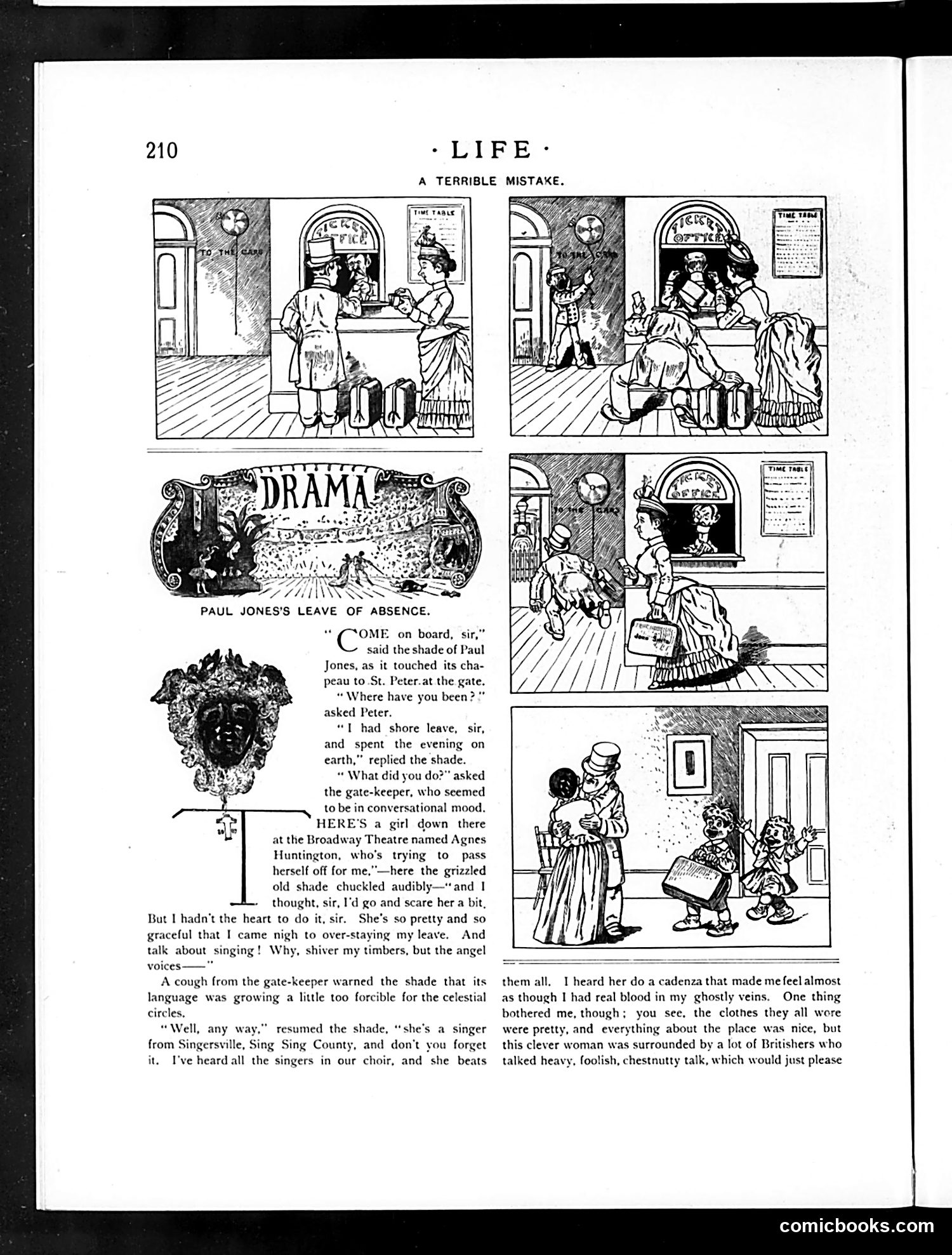
This is a satirical dialogue between the ghost of Paul Jones (the Revolutionary War naval hero) and St. Peter at heaven's gate. Jones describes visiting Earth and attending a Broadway Theatre performance by actress Agnes Huntington, who was apparently performing in a play about or impersonating Paul Jones. The joke's point: Jones was charmed by Huntington's singing talent and beauty—nearly overstaying his heavenly leave—but was annoyed by the British actors surrounding her on stage, whom he mocks for their affected speech and "chestnutty" (hackneyed, repetitive) dialogue. The satire targets both the theatrical production (apparently featuring British performers) and perhaps anti-British sentiment more broadly. The humor relies on the incongruity of a famous American naval figure's ghost critiquing a stage performance, and his complaint that even a talented American singer cannot overcome being surrounded by tedious British company.
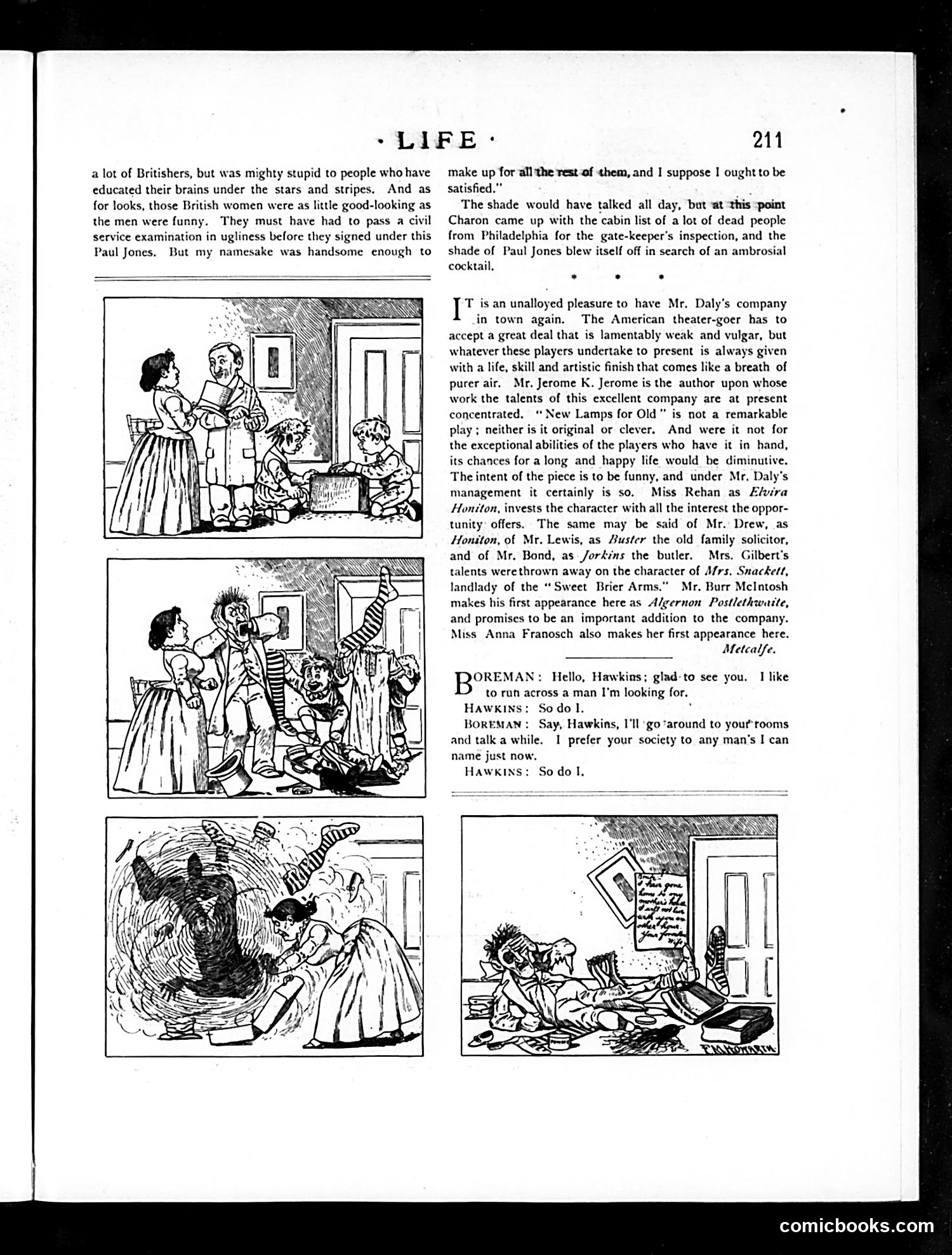
This page contains theater criticism and comedy dialogue, not political satire. **The Main Content:** A favorable review of a theatrical production of "New Lamps for Old" (adapted from Jerome K. Jerome's work) performed by Mr. Daly's company. The critic praises the actors' skill and artistic quality, noting the play itself is unremarkable but elevated by the performers—particularly Miss Rehan as Elvira Honiton and other cast members. **The Comics:** Four illustrated scenes depicting domestic/workplace situations. The dialogue excerpt shows two men, Boreman and Hawkins, meeting and preferring each other's company to that of unnamed third parties—a simple comedic premise about friendship. **Historical Note:** The page opens with commentary on Paul Jones (likely the Revolutionary War naval figure), mocking British people's appearance and wit compared to Americans—typical 19th-century American jingoism. The satire here targets theater quality and mediocre playwriting rather than political issues.
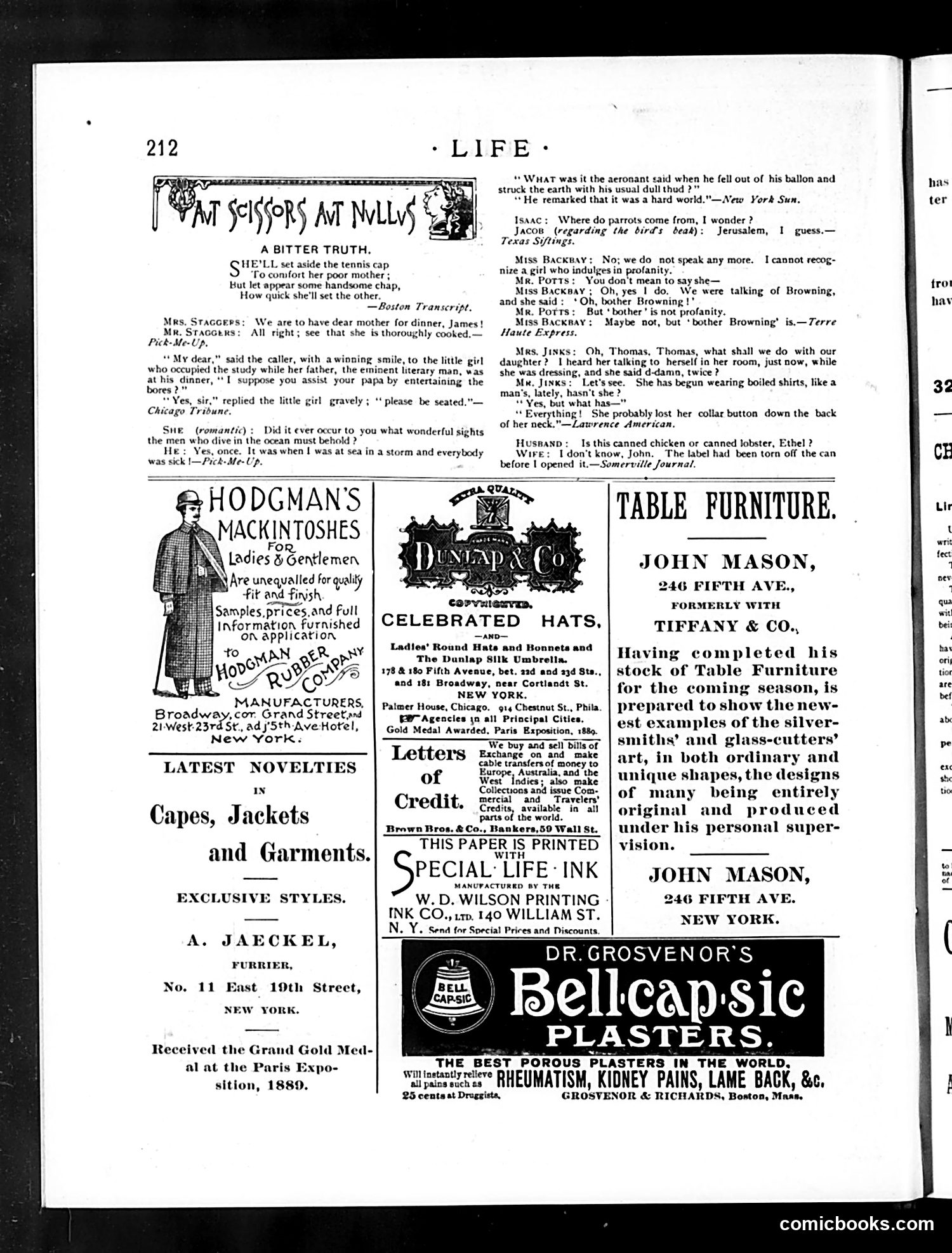
This page consists primarily of **humorous short jokes and advertisements**, not political satire. The humor reflects late-Victorian social attitudes about gender and propriety. Key jokes: - A woman abandons her tennis cap (intellectual appearance) when an attractive man arrives—satirizing women's superficiality - A girl assists her father by "entertaining bores"—dark humor about women's expected social role - Two jokes mock wives' domestic incompetence (not knowing what canned food is; the husband's lost collar button causing the wife to curse) - A joke about parrots from "Jerusalem" references Jewish stereotypes via the character name "Jacob" The page reveals period attitudes: women are depicted as frivolous, profane when frustrated, intellectually pretentious, and domestically inept. The humor punches down at women and ethnic minorities. The remaining content is **commercial advertising** for mackintoshes, hats, furniture, and banking services—typical of magazine revenue models then.
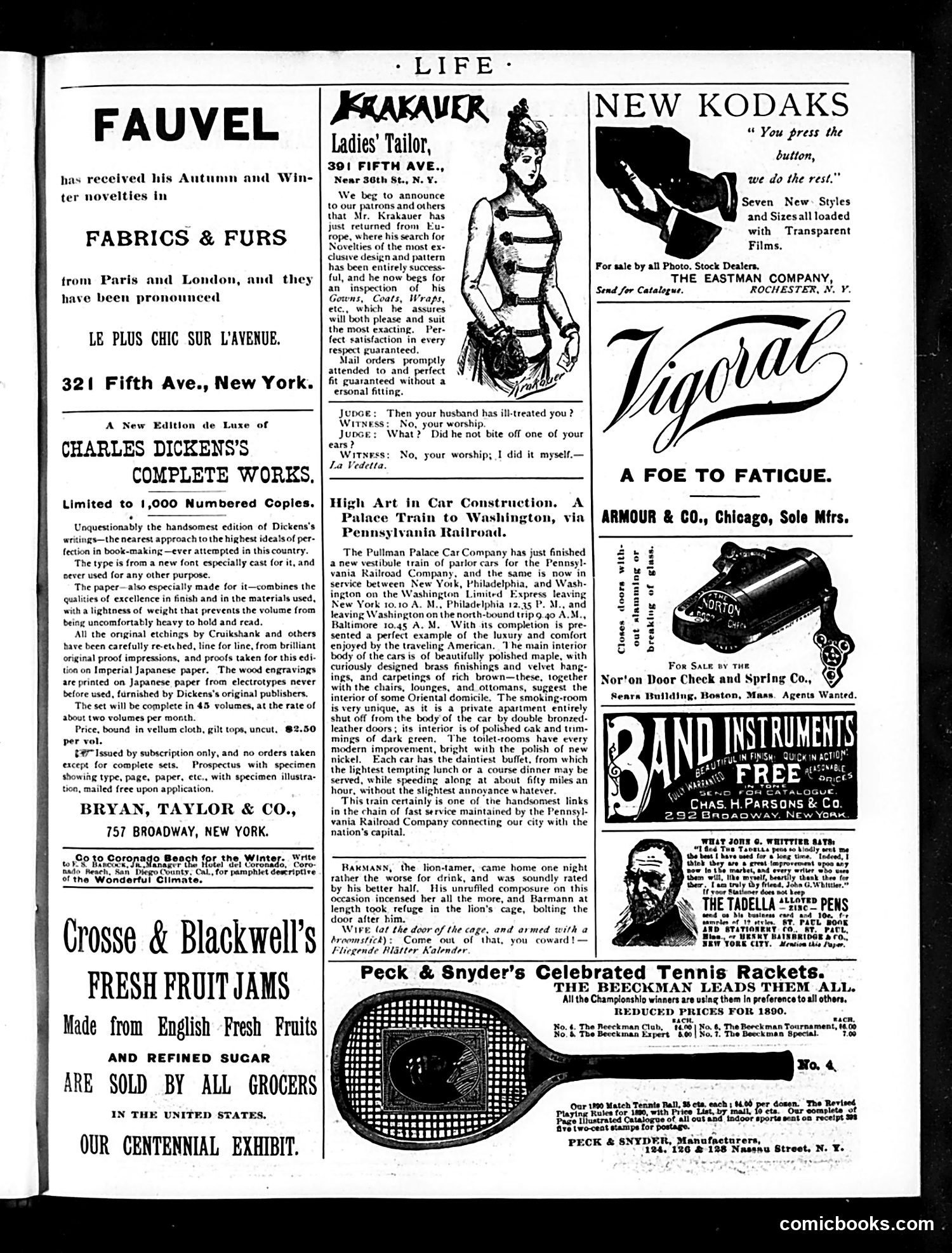
This page is **primarily advertisements and product notices** with minimal satirical content. The only notable joke appears in a brief anecdote labeled "La Vedetta" (likely an Italian publication reference). A judge asks a woman witness if her husband ill-treated her by biting off her ear. She denies this, then reveals *she* bit off her own ear—a dark absurdist humor playing on domestic violence expectations and the woman's surprising agency/self-harm. The rest of the page comprises luxury goods advertisements: Fauvel fabrics and furs (Fifth Avenue), Bryan Taylor's deluxe edition of Dickens's complete works, Krakauer ladies' tailoring, Crosse & Blackwell jams, and descriptions of Pullman Palace railway cars. These represent high-end consumer goods marketed to affluent readers—typical Life magazine advertising rather than satirical commentary. The page reflects 1890s consumer culture targeting wealthy urban audiences rather than political satire.
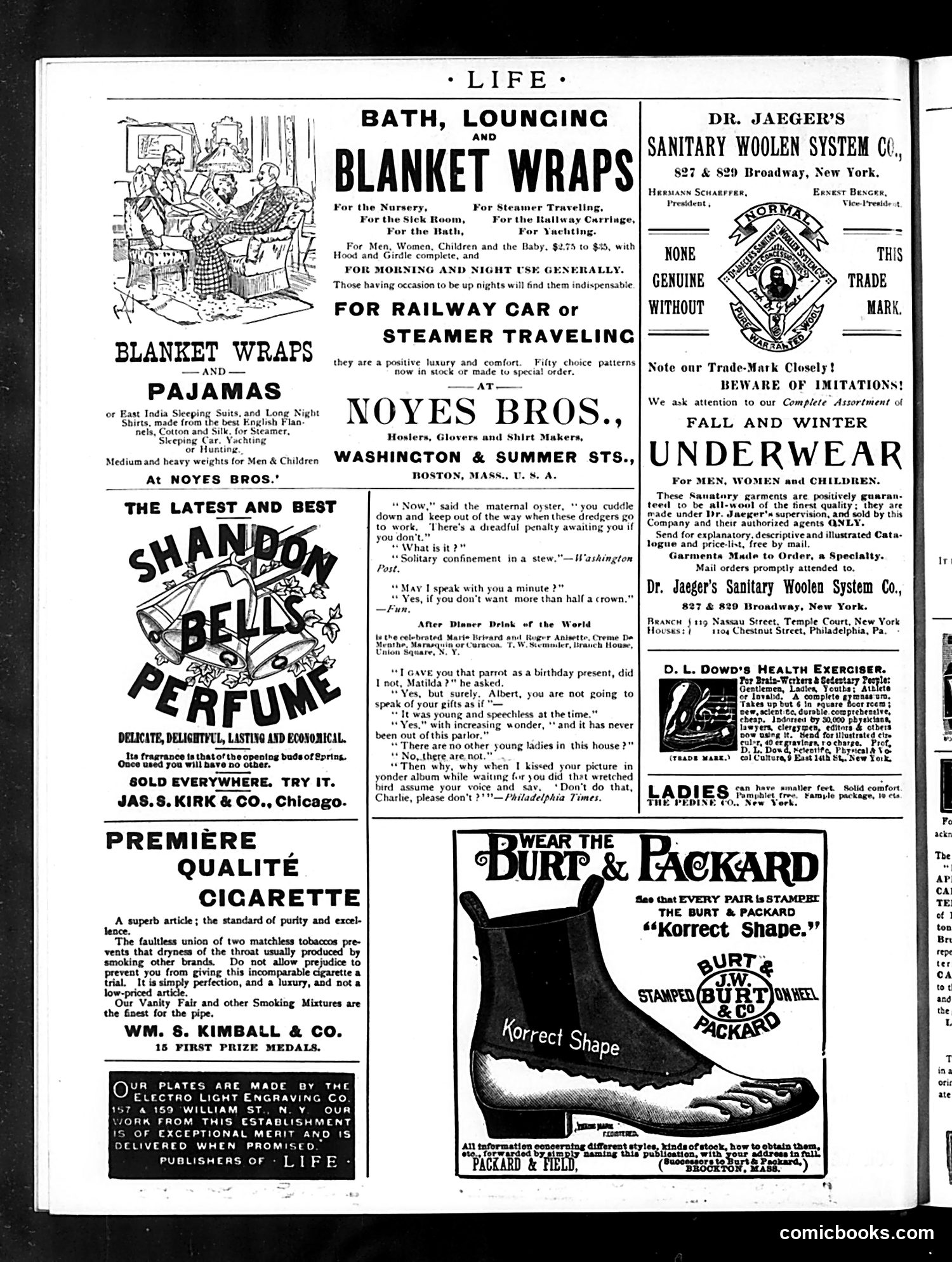
This page is primarily **advertisements** from a turn-of-the-century Life magazine, with minimal editorial cartoon content. The main humorous pieces are brief **joke vignettes** in text form: 1. **The oyster joke**: A mother oyster warns her child about dredgers, threatening "solitary confinement in a stew"—a pun on the punishment fitting the crime. 2. **The parrot anecdote**: A husband questions why a parrot he gave his wife now mimics her voice saying "Don't do that, Charlie"—implying infidelity or the wife spending time with another man. It's a setup for Victorian-era marital humor based on jealous suspicion. The rest is product advertising: blanket wraps, pajamas, perfume, cigarettes, and Dr. Jaeger's wool underwear system (a legitimate health trend of the era claiming wool prevented illness). No political satire or caricatures appear on this page—it's a typical commercial section of the publication.
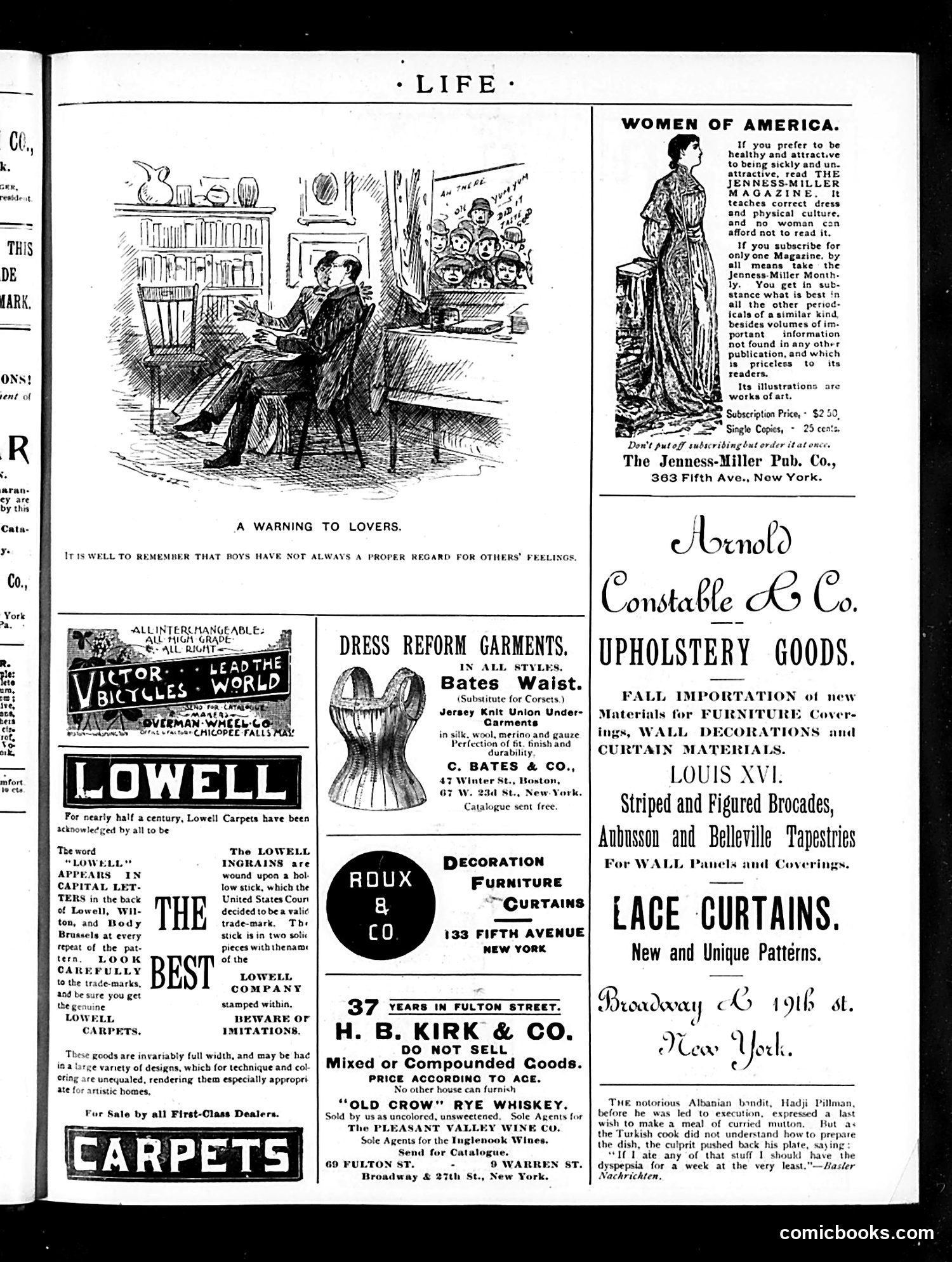
The cartoon depicts a domestic scene with a young couple: a man lounging casually in a chair while a woman sits nearby, apparently knitting or doing needlework. The caption reads: "It is well to remember that boys have not always a proper regard for others' feelings." The satire targets masculine insensitivity in romantic relationships. The joke appears to be that the lounging man is indifferent to his female companion's emotional state or comfort—he's self-absorbed and relaxed while she attends to domestic tasks. The title "A Warning to Lovers" suggests this is cautionary advice to women about male behavior. This reflects turn-of-the-century social commentary about gender dynamics and courtship expectations. The cartoon gently mocks men for their lack of consideration toward their romantic partners, a common theme in Life's satirical observations about American social life. The page is primarily advertisements for carpets, clothing, furniture, and magazines, with this single cartoon as editorial content.
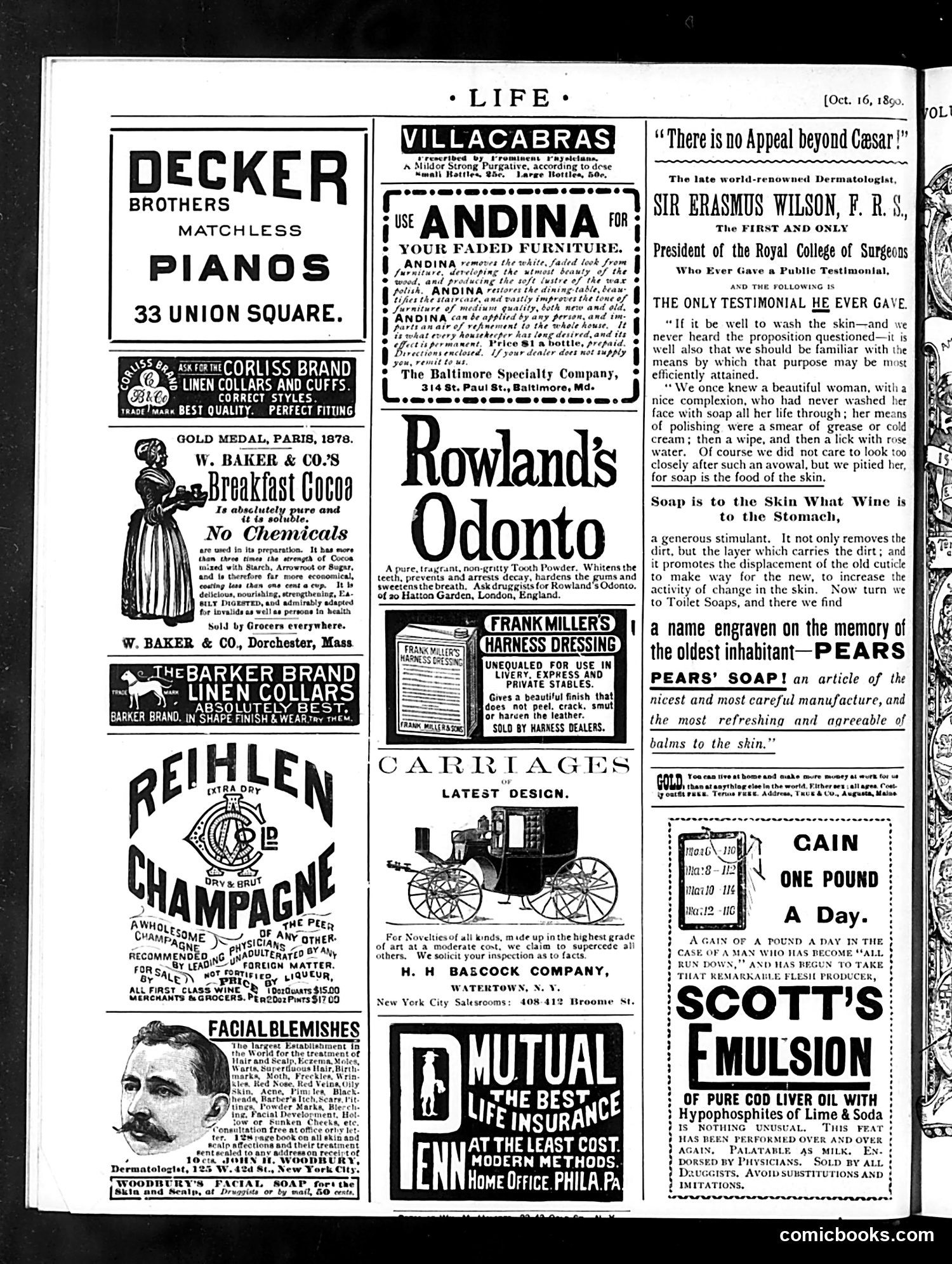
This page is primarily **advertising**, not political satire. It consists almost entirely of commercial advertisements typical of the 1890s era. The most notable content is a lengthy endorsement from **Sir Erasmus Wilson, F.R.S.**, a renowned dermatologist and president of the Royal College of Surgeons. The testimonial promotes the health benefits of soap, arguing that "Soap is to the Skin What Wine is to the Stomach"—a stimulant that removes dirt and promotes skin renewal. Wilson's endorsement was apparently significant enough to be highlighted prominently, as the advertisement notes it was "THE FIRST AND ONLY" public testimonial he ever gave. The page also advertises consumer goods typical of the era: pianos, breakfast cocoa, linen collars, tooth powder, furniture polish, and life insurance—all using the era's standard marketing appeals to quality, scientific advancement, and genteel respectability.