
Life, 1890-10-16 · page 8 of 18
Life — October 16, 1890 — page 8: what you’re looking at
What you’re looking at
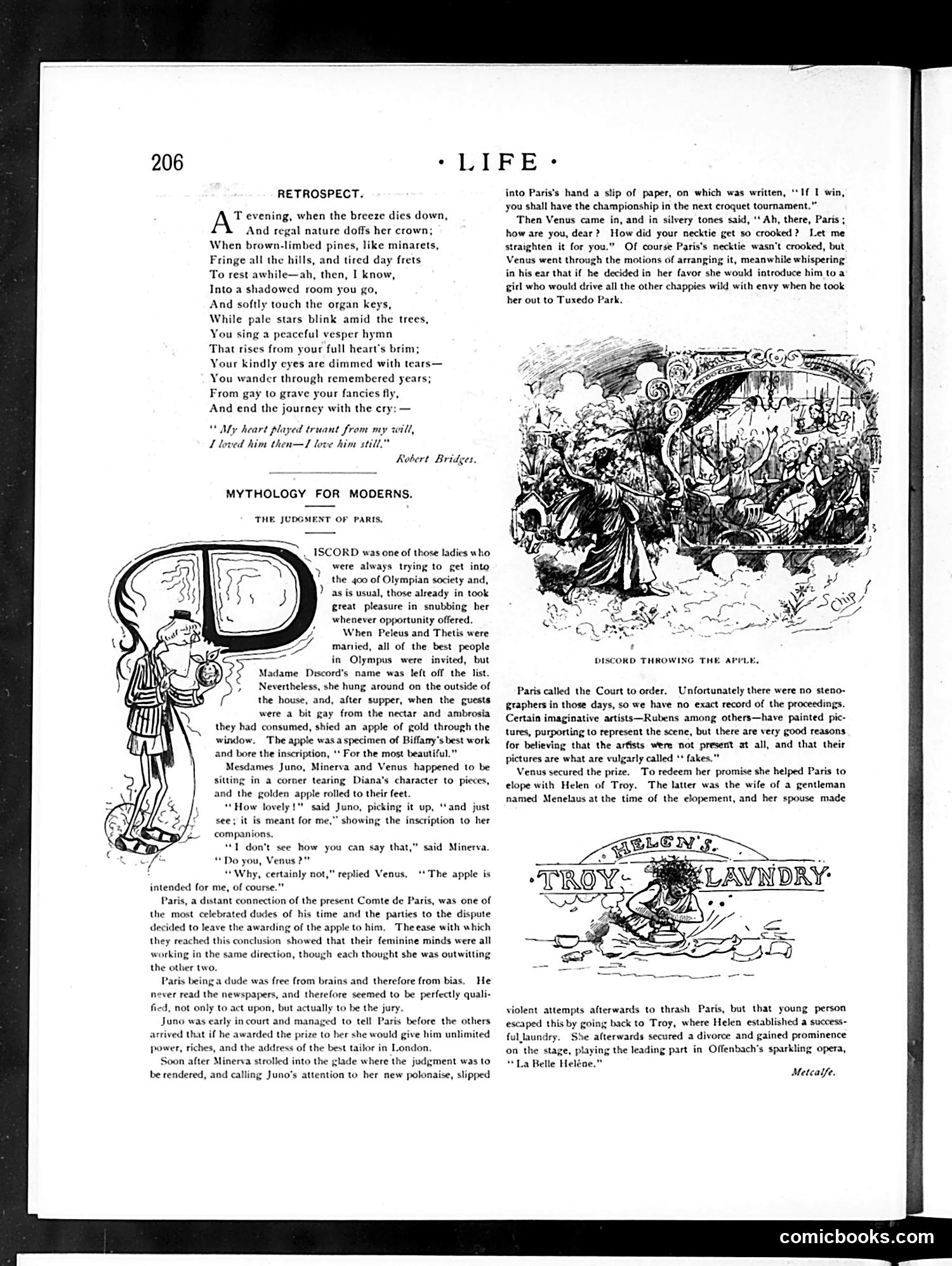
This page contains two distinct pieces: **"Retrospect"** (top): A sentimental poem about nature and loss, attributed to Robert Bridges. **"Mythology for Moderns: The Judgment of Paris"** (main content): A satirical retelling of the classical myth. The text and illustration show Discord throwing an apple into a social gathering, with the caption "DISCORD THROWING THE APPLE." The satire mocks high society by treating a mundane social rivalry—competing women vying for attention—as if it were the classical myth. The humor derives from treating trivial modern social drama with grandiose mythological language. Paris is depicted as "a dude" and a society judge, chosen to arbitrate between competing ladies (Venus, Juno, Minerva) over who deserves an award. The satire critiques both pretentious society and the vanity it encourages.
📄 Transcribed text from this page (OCR, searchable)
Machine-transcribed from the original scan — historical spelling and the odd misread are preserved.
* LIFE RETROSPECT. T evening, when the breeze dies down, And regal nature doffs her crown; When brown-limbed pines, like minarets, Fringe all the hills, and tired day frets To rest awhile—ah, then, I know, Into a shadowed room you go, And softly touch the organ keys, While pale stars blink amid the trees, You sing a peaceful vesper hymna That rises from your full heart's brim; Your kindly eyes are dimmed with tears— You wander through remembered years; From gay to grave your fancies fl And end the journey with the cry: — “ My heart played truant from my will, ‘d him then—I love him still. rt Bridges. MYTHOLOGY FOR MODERNS. THE JUDGMENT OF PARIS, —————— . ; Ae ISCORD was one of those ladies who were always trying to get into the 4oo of Olympian society and, as is usual, those already in took great pleasure in snubbing her whenever opportunity offered. When Peleus and Thetis were manied, all of the best people in Olympus were invited, but Madame Discord's name was left off the list. S Nevertheless, she hung around on the outside of (the house, and, after supper, when the guests were a bit gay from the nectar and ambrosia they had consumed, shied an apple of gold through the ‘The apple was a specimen of Biffany’s best work and bore the inscription, ** For the most beautiful Mesdames Juno, Minerva and Venus happened to be sitting in a corner tearing Diana's character to pieces, and the golden apple rolled to their feet. “How lovely!" said Juno, picking it up, “and just see; it is meant for me,” showing the inscription to her companions, “1 don't see how you can say that,” said Minerva. “Do you, Venus ?” “Why, certainly not," replied Venus. intended for me, of course.” Paris, a distant connection of the present Comte de Paris, was one of the most celebrated dudes of his time and the parties to the dispute decided to leave the awarding of the apple to him. The ease with which they reached this conclusion showed that their feminine minds were all working in the same direction, though each thought she was outwitting the other two. Paris beinga dude was free from brains and therefore from bias. He never read the newspapers, and therefore seemed to be perfectly quali- fied, not only to act upon, but actually to be the jury. Juno was early in court and managed to tell Paris before the others arrived that if he awarded the prize to her she would give him unlimited power, riches, and the address of the best tailor in London. Soon after Minerva strolled into the glade where the judgment was to be rendered, and calling Juno's attention to her new polonaise, slipped window. “The apple is into Paris's hand a slip of paper, on which was written, “If 1 win, you shall have the championship in the next croquet tournament.” Then Venus came in, and in silvery tones said, ‘* Ab, there, Paris ; how are you, dear? How did your necktie get so crooked? Let me straighten it for you.” Of course Paris's necktie wasn’t crooked, but Vents went through the motions of arranging it, meanwhile whispering in his ear that if he decided in her favor she would introduce him to a girl who would drive all the other chappies wild with envy when he took her out to Tuxedo Park. DISCORD THROWING THE APILE. Paris called the Court to order. Unfortunately there were no steno- graphers in those days, so we have no exact record of the proceedings. Certain imaginative artists—Rubens among others—have painted pic- tures, purporting to represent the scene, but there are very good reasons for believing that the arfists were not present at all, and that their pictures are what are vulgarly called ** fakes." Venus secured the prize. To redeem her promise she helped Paris to elope with Helen of Troy, The latter was the wife of a gentleman named Menelaus at the time of the elopement, and her spouse made violent attempts afterwards to thrash Paris, but that young person escaped this by going back to Troy, where Helen established a success- fullaundry. She afterwards secured a divorce and gained prominence on the stage, playing the leading part in Offenbach’s sparkling opera, “+ La Belle Heléne.” Metcalfe. comicbooks.com