
Life, 1890-10-16 · page 4 of 18
Life — October 16, 1890 — page 4: what you’re looking at
What you’re looking at
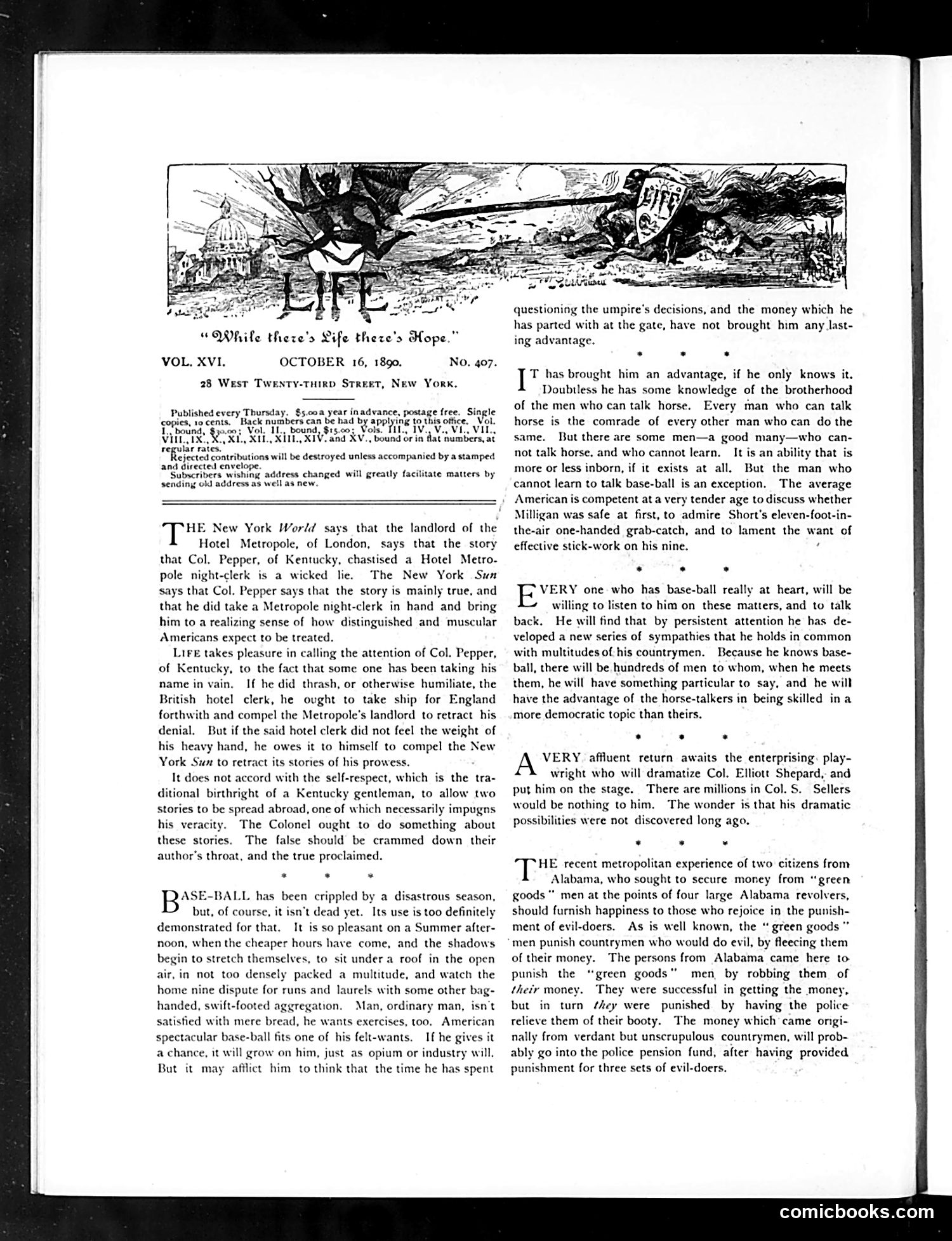
The cartoon at top left, titled "While there's Life there's Mops," depicts a figure with an exaggerated face emerging from or associated with a mop. The image's meaning is unclear without additional context, though the title suggests wordplay on the phrase "while there's life there's hope." The page's main text discusses Col. Pepper of Kentucky and disputes over stories about him allegedly thrashing a Hotel Metropole desk clerk in London. Life satirizes both the British hotel's claims and American newspapers amplifying the story, questioning whether a Kentucky gentleman should tolerate such public humiliation. The remainder addresses baseball culture and dramatic possibilities in theater, suggesting Life's typical satirical commentary on American society and institutions.
📄 Transcribed text from this page (OCR, searchable)
Machine-transcribed from the original scan — historical spelling and the odd misread are preserved.
“While there's Life there's Hope.” VOL, XVI. OCTOBER 16, 1890. 28 West Twenty-tHirp Street, New York. No, 407. Published every Thursday. $5.00a year inadvance, postage free. Single es, 1 cents. Back numbers can be had by applying to this office. Vol. T"bound, §yc02 Vo IL, bound, $15.00; Vols Lite IV V.. Vic. VIl., VIL IX, 111, X1Vland XV., bound or in fat numbers, at regular rat ‘ejected contributions will be destroyed unless accompanied by a stamped and directed envelope. Subscribers wishing address changed will greatly facilitate matters by sending ok) address a3 well as new. HE New York World s: that the landlord of the Hotel Metropole, of London, says that the story that Col. Pepper, of Kentucky, chastised a Hotel Metro. pole night-clerk is a wicked lic. The New York Sun says that Col. Pepper says that the story is mainly true, and that he did take a Metropole night-clerk in hand and bring him to a realizing sense of how distinguished and muscular Americans expect to be treated. Lire takes pleasure in calling the attention of Col. Pepper, of Kentucky, to the fact that some one has been taking his name in vain. If he did thrash, or otherwise humiliate, the British hotel clerk, he ought to take ship for England forthwith and compel the Metropole’s landlord to retract his denial. But if the said hotel clerk did not feel the weight of his heavy hand, he owes it to himself to compel the New York Sux to retract its stories of his prowess It does not accord with the self-respect, which is the tra- ditional birthright of a Kentucky gentleman, to allow two stories to be spread abroad, one of which necessarily impugns his veracil The Colonel ought to do something about these stories. The false should be crammed down their author's throat, and the true proclaimed. * . . B*s 2-BALL has been crippled by a disastrous season, but, of course, it isn’t dead yet. Its use is too definitely demonstrated for that. It is so pleasant on a Summer after- noon, when the cheaper hours have come, and the shadows begin to stretch themselves, to sit under a roof in the open air, in not too densely packed a multitude, and watch the home nine dispute for runs and laurels with some other bag- handed, swift-footed aggregation. Man, ordinary man, isn’t satistied with mere bread, he wants exercises, too, American spectacular base-ball fits one of his felt-wants. If he gives it a chance, it will grow on him, just as opium or industry will, But it may afflict him to think that the time he has spent questioning the umpire’s decisions, and the money which he has parted with at the gate, have not brought him any last- ing advantage. . . . T has brought him an advantage, if he only knows it. Doubtless he has some knowledge of the brotherhood of the men who can talk horse. Every man who can talk horse is the comrade of every other man who can do the But there are some men—a good many—who can- It is an ability that is same. not talk horse. and who cannot learn. more or less inborn, if it exists at all, But the man who cannot learn to talk base-ball is an exception. The average American is competent ata very tender age to discuss whether Milligan was safe at first, to admire Short's eleven-foot-in- the-air one-handed grab-catch, and to lament the want of effective stick-work on his nine. : . . . E ERY one who has base-ball really at heart, will be willing to listen to him on these matters, and to talk back. He will find that by persistent attention he has de- veloped a new series of sympathies that he holds in common with multitudes of his countrymen. Because he knows base- ball, there will be hundreds of men to whom, when he meets them, he will have something particular to say, and he will have the advantage of the horse-talkers in being skilled ina more democratic topic than theirs. . . . A VERY affluent return awaits the enterprising. play- wright who will dramatize Col. Elliott Shepard, and put him on the stage. There are millions in Col. S. Sellers would be nothing to him. The wonder is that his dramatic possibilities were not discovered long ago. TH recent metropolitan experience of two citizens from Alabama, who sought to secure money from “green goods” men at the points of four large Alabama revolvers, should furnish happiness to those who rejoice in the punish- ment of evil-doers. As is well known, the “ green goods " men punish countrymen who would do evil, by fleecing them of their money. The persons from Alabama came here to punish the ‘green goods” men by robbing them of their money. They were successful in getting the money, but in turn ¢hey were punished by having the police relieve them of their booty. The money which came ongi- nally from verdant but unscrupulous countrymen, will prob- ably go into the police pension fund, after having provided punishment for three sets of evil-doers. comicbooks.com