
Life, 1890-10-16 · page 6 of 18
Life — October 16, 1890 — page 6: what you’re looking at
What you’re looking at
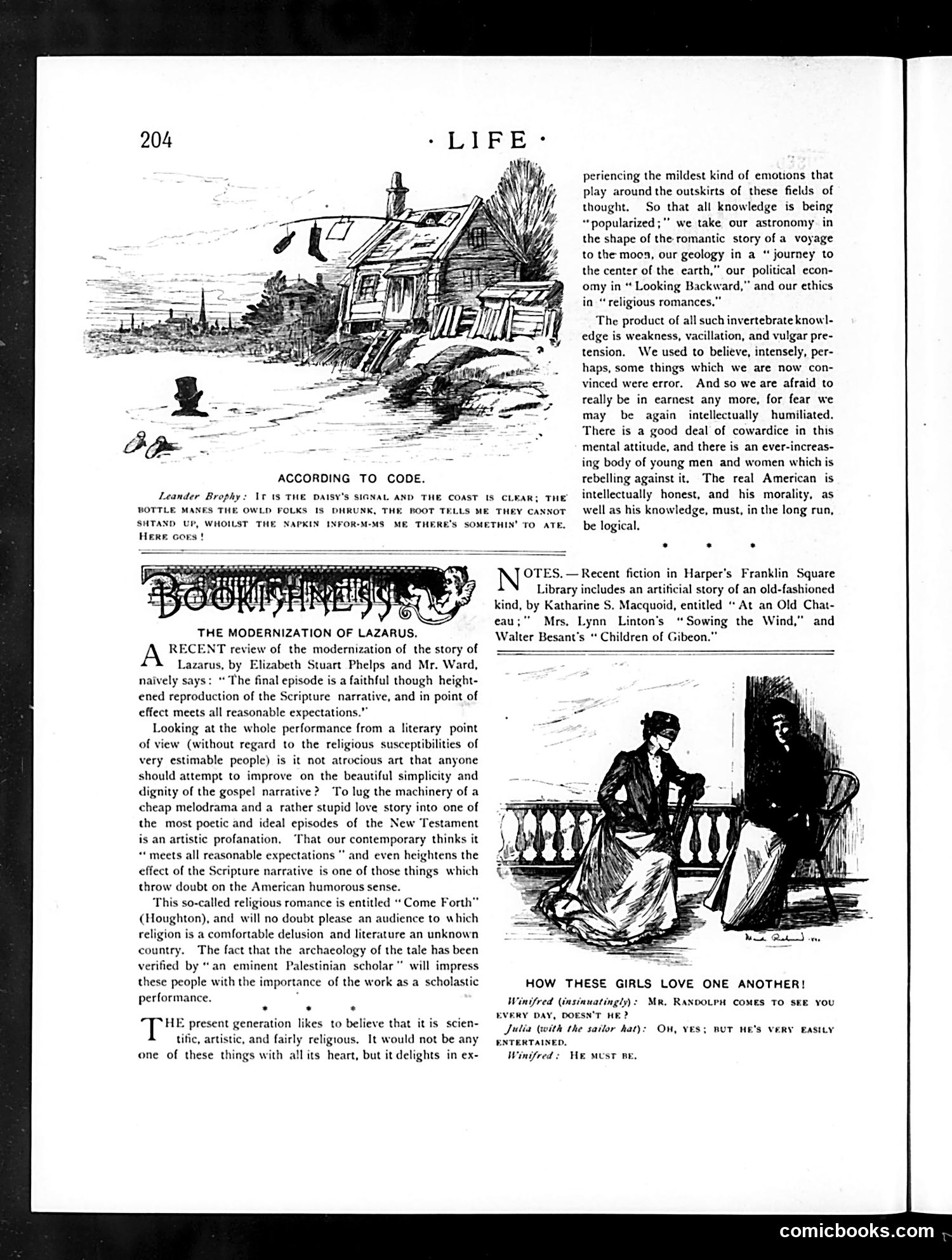
The page contains two distinct sections: **Top cartoon "According to Code"**: A sketch of a dilapidated seaside cottage with the caption about a sailor's "signal and the coast is clear." This appears to be a mild romantic/social satire about coastal rendezvous, using nautical signaling as pretext for intimate meetings. **Bottom section "Bookishness"**: A critical essay titled "The Modernization of Lazarus" discusses theatrical adaptations of biblical narratives, arguing that contemporary attempts to make scripture "modern" trivialize sacred material. The author questions whether artistic updating of gospel stories constitutes inappropriate profanation. **Illustration**: Shows two women on a balcony in what appears to be a social scene, captioned "How These Girls Love One Another!" with dialogue suggesting easy entertainment expectations. The overall page reflects early 20th-century concerns about cultural modernization and artistic propriety.
📄 Transcribed text from this page (OCR, searchable)
Machine-transcribed from the original scan — historical spelling and the odd misread are preserved.
ACCORDING TO CODE. Leander Broph; SHTAND Here Gores! Ip tS THE DAISY’S SIGNAL AND THE COAST IS CLEAR; THE BOTTLE MANES THE OWLD FOLKS IS DHRUNK, THE ROOT TELLS ME THEY CANNOT , WHOILST THE NAPKIN INFOR-M-MS ME THERE'S SOMETHIN’ TO ATE. periencing the mildest kind of emotions that play around the outskirts of these fields of thought. So that all knowledge is being “popularized; "" we take our astronomy. in the shape of the romantic story of a voyage to the moon, our geology in a “ journey to the center of the earth,” our political econ- omy in “ Looking Backward,” and our ethics in “religious romances.” The product of all such invertebrate knowl- edge is weakness, vacillation, and vulgar pre- tension. We used to believe, intensely, per- haps, some things which we are now con- vinced were error. And so we are afraid to really be in earnest any more, for fear we may be again intellectually humiliated. There is a good deal of cowardice in this mental attitude, and there is an ever-increas- ing body of young men and women which is rebelling against it. The real American is intellectually honest, and his morality, as well as his knowledge, must, in the long run, be logical. THE MODERNIZATION OF LAZARUS, RECENT review of the modernization of the story of Lazarus, by Elizabeth Stuart Phelps and Mr. Ward, naively says: “ The final episode is a faithful though height- ened reproduction of the Scripture narrative, and in point of effect meets all reasonable expectations.” Looking at the whole performance from a literary point of view (without regard to the religious susceptibilities of very estimable people) is it not atrocious art that anyone should attempt to improve on the beautiful simplicity and dignity of the gospel narrative? To lug the machinery of a cheap melodrama and a rather stupid love story into one of the most poetic and ideal episodes of the New Testament is an artistic profanation, That our contemporary thinks it “meets all reasonable expectations " and even heightens the effect of the Scripture narrative is one of those things which throw doubt on the American humorous sense. This so-called religious romance is entitled “Come Forth” (Houghton), and will no doubt please an audience to which religion is a comfortable delusion and literature an unknown country. The fact that the archaeology of the tale has been verified by “an eminent Palestinian scholar” will impress these people with the importance of the work as a scholastic performance. ¢ | “HE present generation likes to believe that it is scien- tific, artistic, and fairly religious. It would not be any one of these things with all its heart, but it delights in ex- —Recent fiction in Harper's Franklin Square Library includes an artificial story of an old-fashioned kind, by Katharine S. Macquoid, entitled “ At an Old Chat- eau;" Mrs, Lynn Linton’s “Sowing the Wind,” and HOW THESE GIRLS LOVE ONE ANOTHER! Winifred (insinuatingly) : EVERY DAY, DOESN'T HE? Julia (with the sailor hat): ENTERTAINED, Winifred : Mr. RANDOLPH COMES TO SEE YOU OW, YES; BUT HE'S VERY EASILY HE Must BE, comicbooks.com ,