
A complete issue · 14 pages · 1890
Life — September 25, 1890
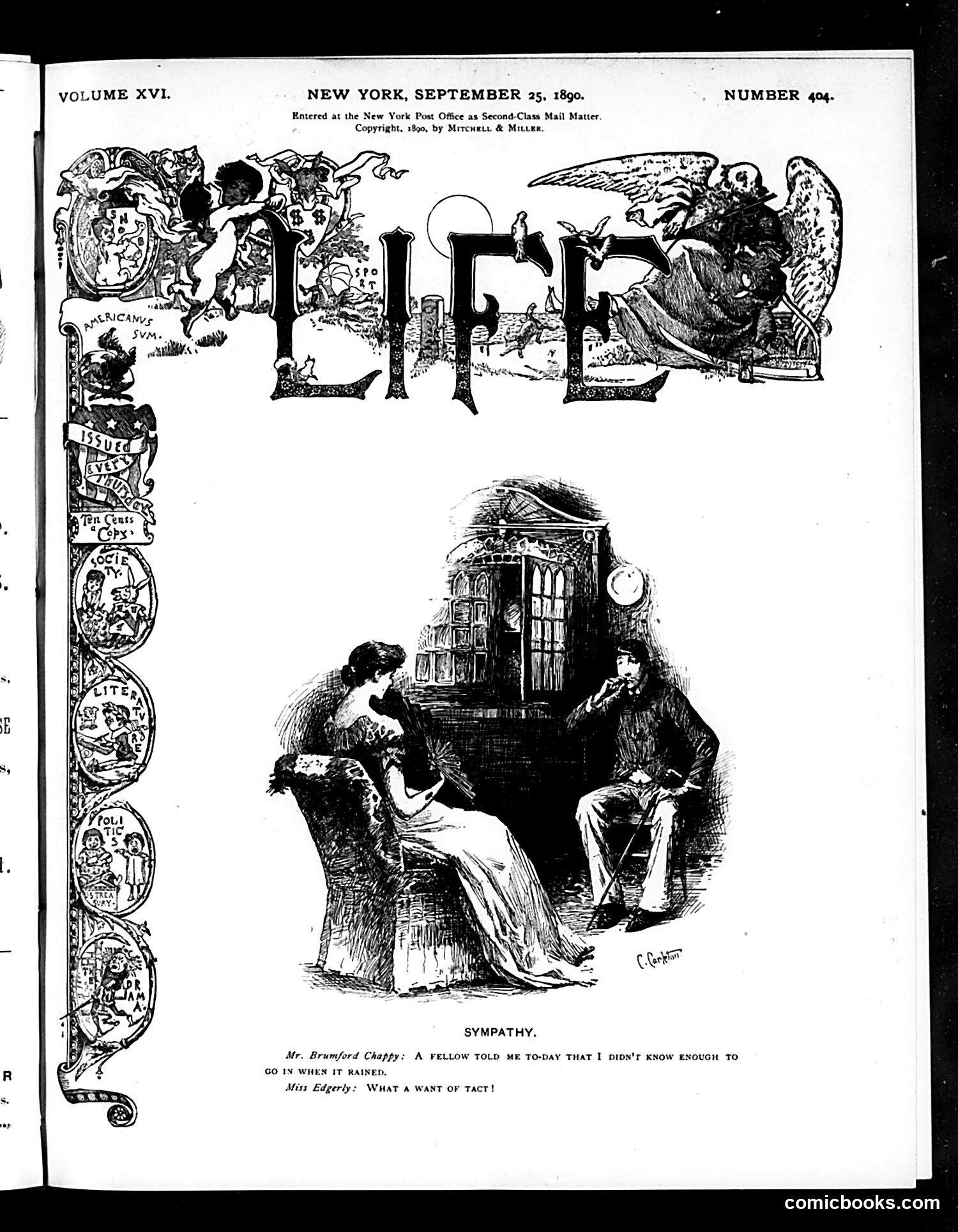
The main cartoon titled "SYMPATHY" depicts a domestic scene where Mr. Bramford Chappy complains to Miss Edgerly that he lacked the sense to go inside when it rained. Miss Edgerly responds "What a want of tact!"—meaning his complaint itself was tactless. This is a social satire about Victorian etiquette and courtship. The joke mocks both parties: Chappy for his poor judgment and lack of social grace in complaining to a lady, and Edgerly for her cutting, unsympathetic response that reveals her own rudeness despite her privileged position. The cartoon satirizes the rigid, often hypocritical social conventions governing interactions between men and women of the era, where appearances of politeness masked genuine unkindness.
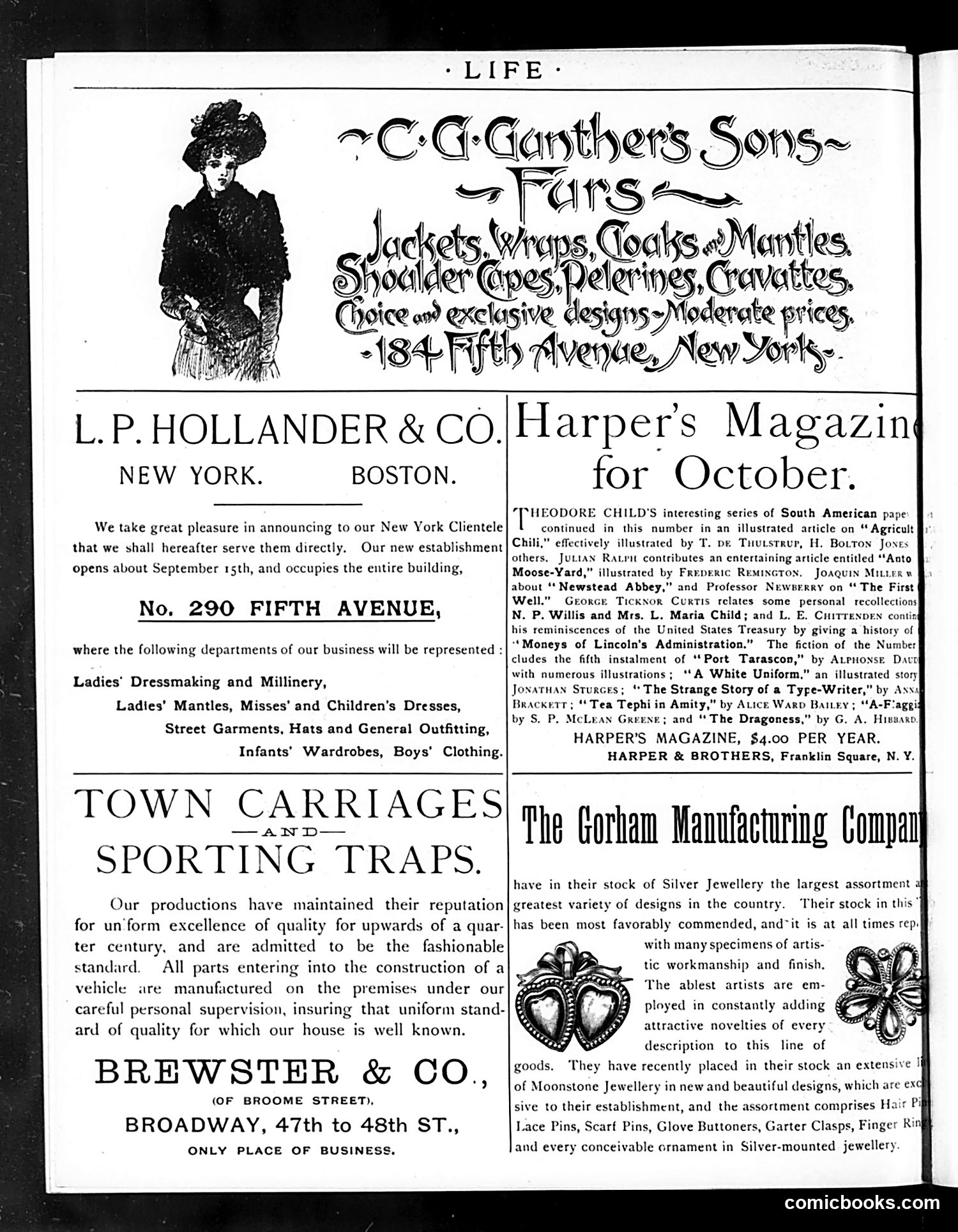
This page is primarily **advertising, not satire or political commentary**. It contains four commercial advertisements from what appears to be an early 1900s issue of Life magazine: 1. **C.G. Ganthers Sons** - fur clothing retailer at 184 Fifth Avenue 2. **L.P. Hollander & Co.** - announcing a new New York location for dressmaking and millinery 3. **Brewster & Co.** - town carriages and sporting traps (vehicles) 4. **The Gorham Manufacturing Company** - silver jewelry There is also a small announcement for **Harper's Magazine's October issue**, listing articles by notable contributors like Theodore Child and Julian Ralph. The single illustration shows a fashionably dressed woman modeling what appears to be fur clothing—typical advertising imagery of the era. This is a straightforward commercial page with no apparent political satire or social commentary.
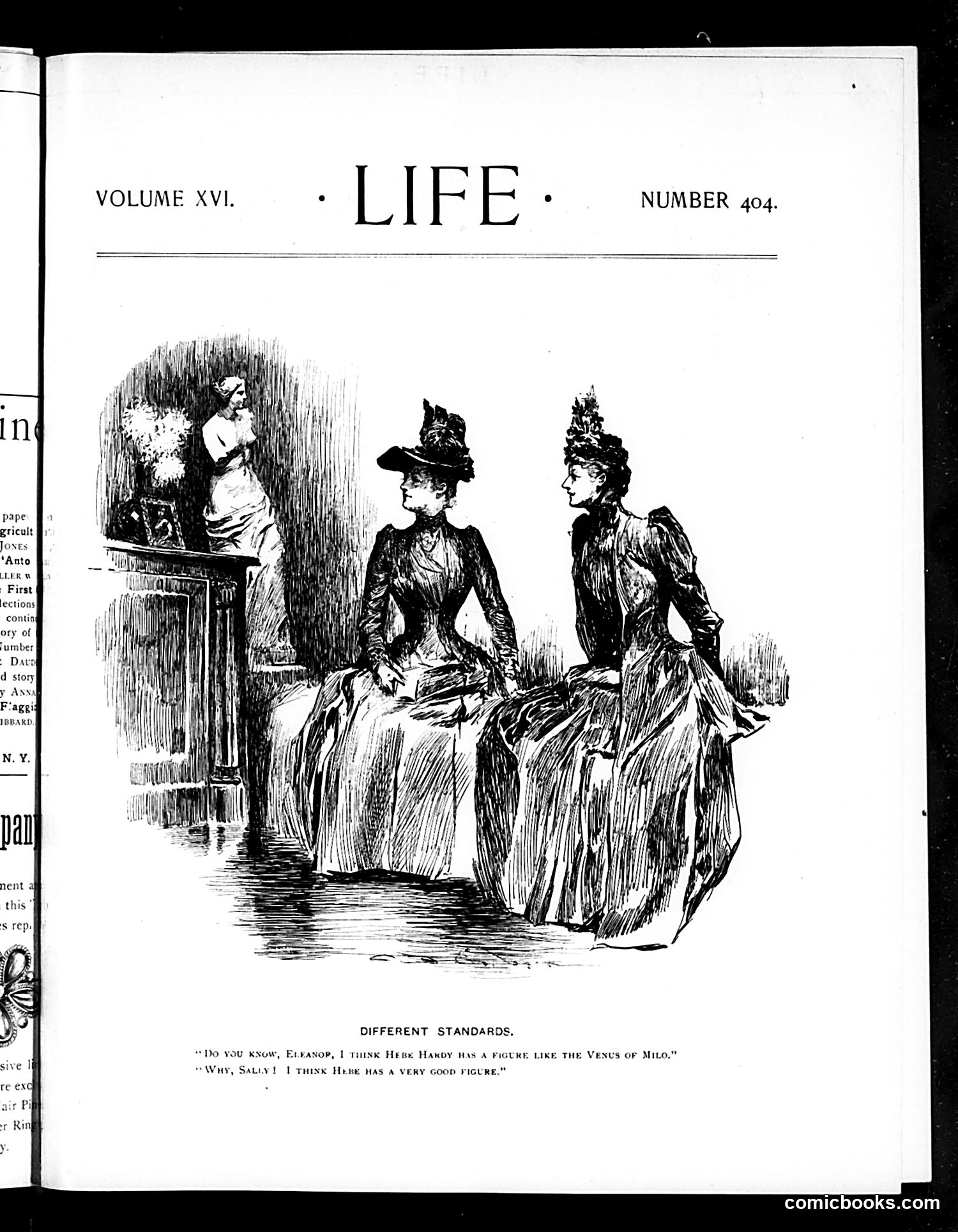
This cartoon satirizes the hypocrisy of aesthetic judgment based on gender. Two women are viewing a classical sculpture (visible on the left). One remarks to "Eleanor" that she thinks "Here Hardy has a figure like the Venus of Milo"—a high classical compliment. The other woman ("Sally") responds that she thinks "Here has a very good figure." The joke exposes how the same physical attribute—a woman's body—receives different evaluations depending on context. When comparing a woman to famous art, it's deemed refined; when discussing a woman directly, it's treated as mere physical appraisal. The cartoon mocks the pretentious double standard in how women's appearances were discussed in polite society versus casual conversation.
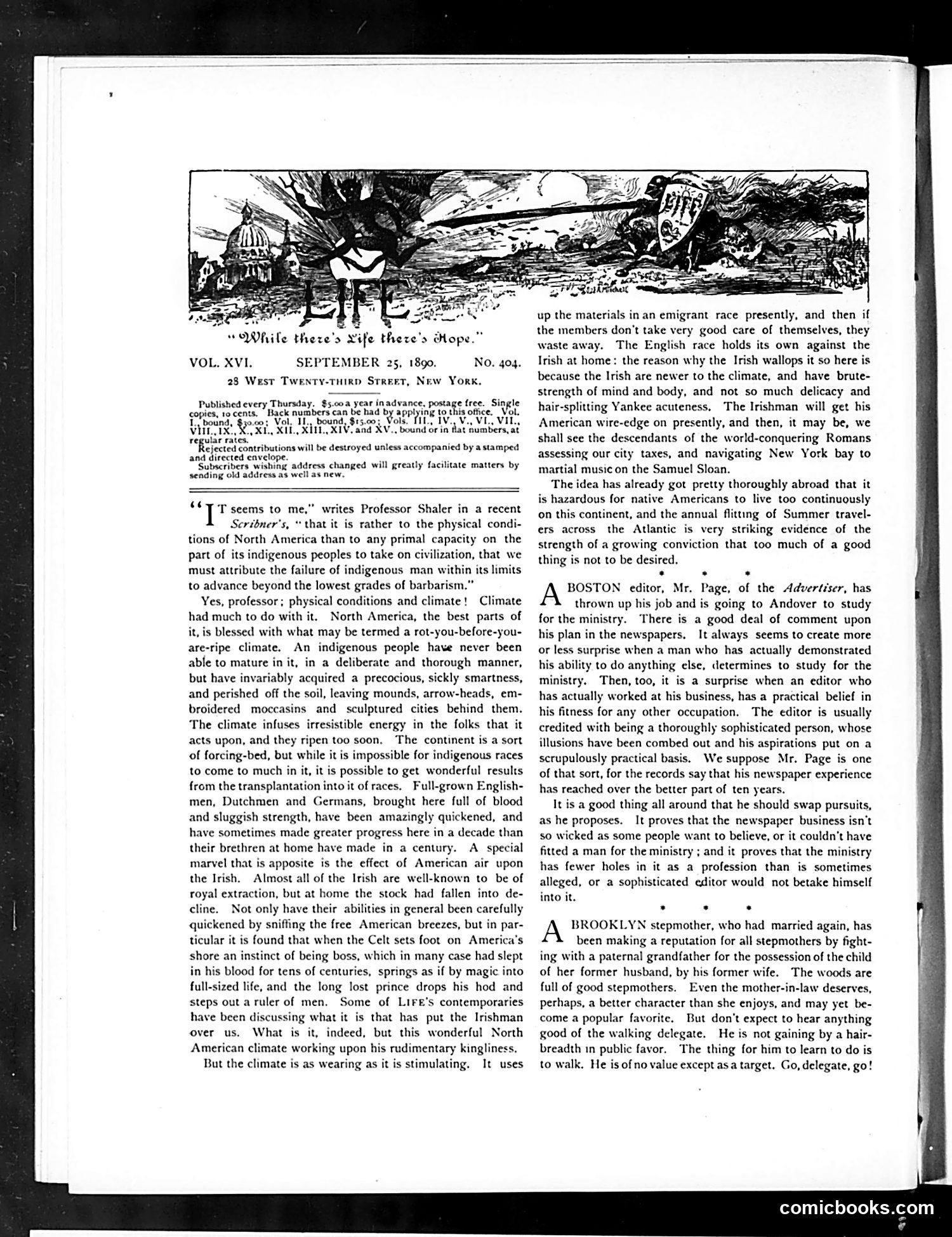
The masthead cartoon depicts a landscape with a church dome (likely representing civilization) contrasting with wilderness and what appears to be Native American imagery on the right—visualizing the "frontier" concept central to American expansion mythology of this era. The accompanying text discusses racial and climate theories popular in 1890, arguing that North America's climate supposedly limited indigenous peoples' capacity for civilization, while English and German immigrants supposedly thrived there. The piece reflects the pseudo-scientific racism of the period, claiming climate explained why European settlers "progressed" while Native Americans allegedly remained "barbaric." The text also includes satirical gossip items about Boston editors and Brooklyn society figures—typical Life magazine content mixing social commentary with tabloid-style humor.
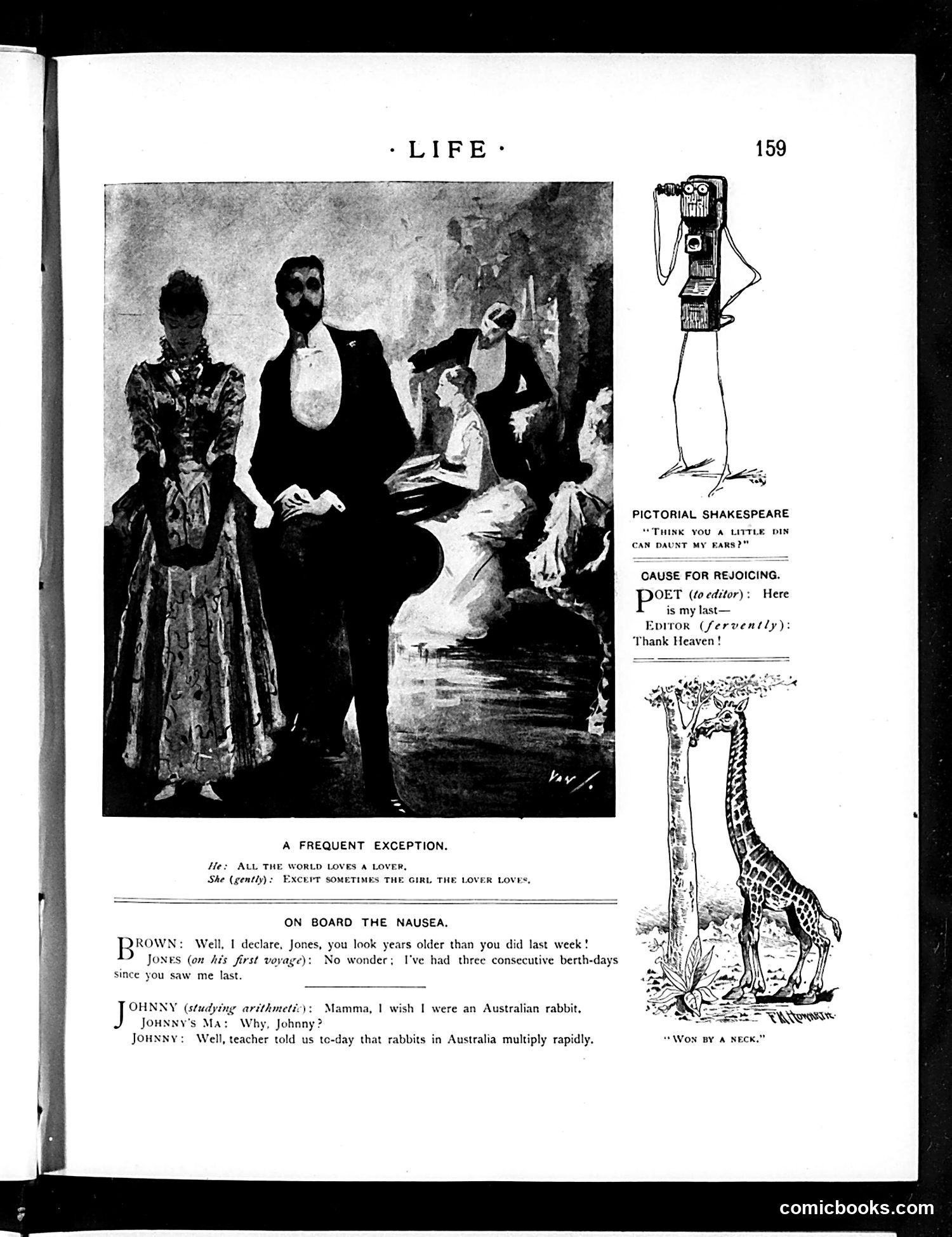
This page from *Life* magazine (page 159) contains several humor pieces: **"A Frequent Exception"**: A theatrical scene where a man tells a woman that "all the world loves a lover," but she replies that sometimes "the girl, the lover loves"—suggesting women's romantic agency and independence, a notable social commentary for the era. **"On Board the Nausea"**: A dialogue where Mr. Brown tells Jones he looks years older after three consecutive "berth-days" at sea. Jones responds that he's had three birthdays since their last meeting. The humor relies on the pun between "berth" (ship sleeping quarters) and "birth." **"Cause for Rejoicing"**: A brief editor/poet exchange about submitting manuscripts. The page reflects early-20th-century concerns about courtship dynamics and includes wordplay typical of the magazine's satirical humor.
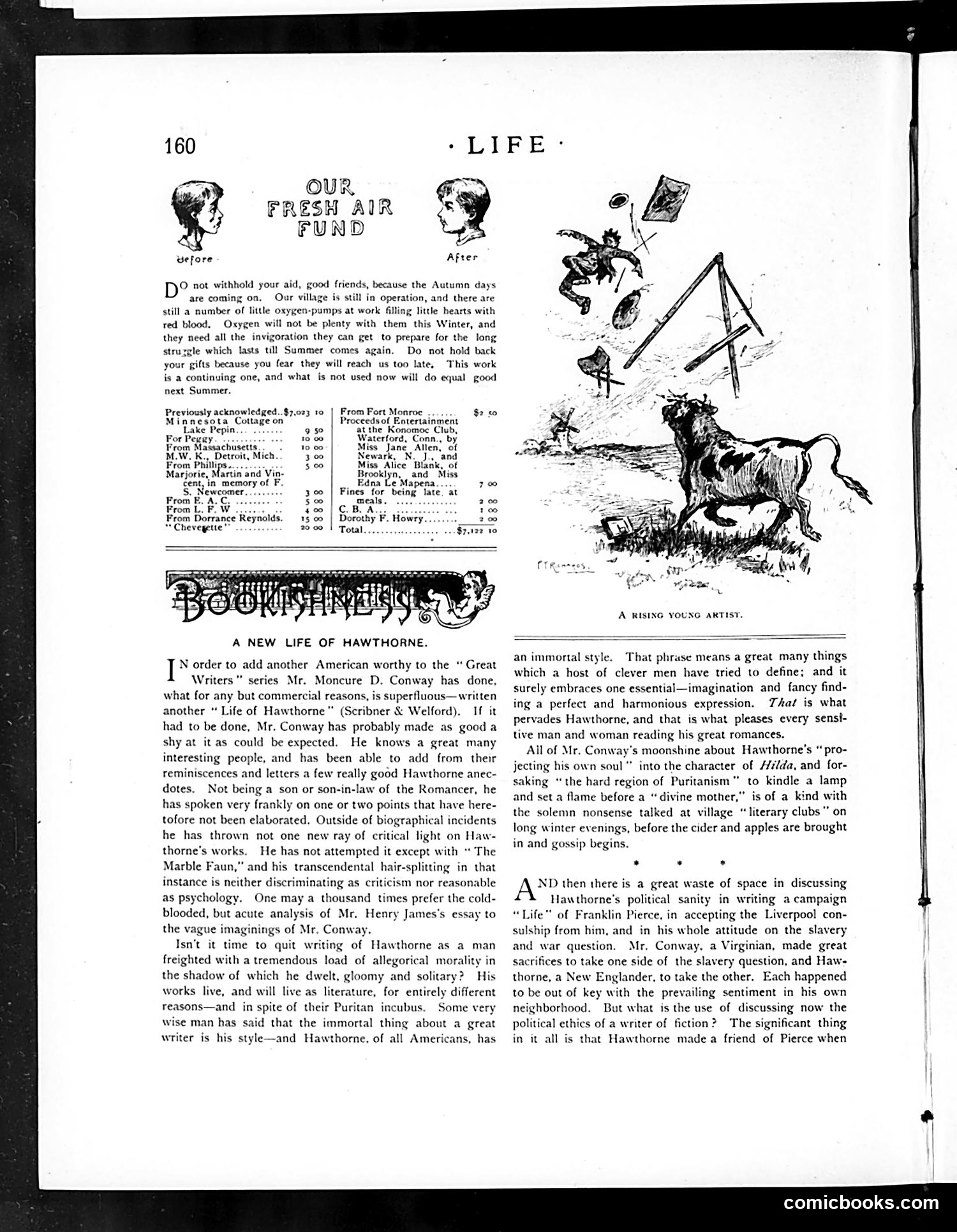
The page contains two distinct elements: **Upper left:** A fundraising appeal for a Fresh Air Fund, showing a boy "before" and "after" receiving outdoor air exposure. The text urges donations to send children to camps, noting these efforts are "continuing one, and what is not used now will do equal good next Summer." This reflects Progressive-era charitable concerns about urban children's health. **Right side:** "A Rising Young Artist" depicts a young person sketching outdoors with insects and animals, satirizing artistic pretension or perhaps the romanticization of nature study among aspiring artists. **Lower section:** A lengthy essay about Nathaniel Hawthorne's literary legacy, discussing Moneure D. Conway's new biography. The piece analyzes Hawthorne's style and political views, particularly regarding slavery and Franklin Pierce.
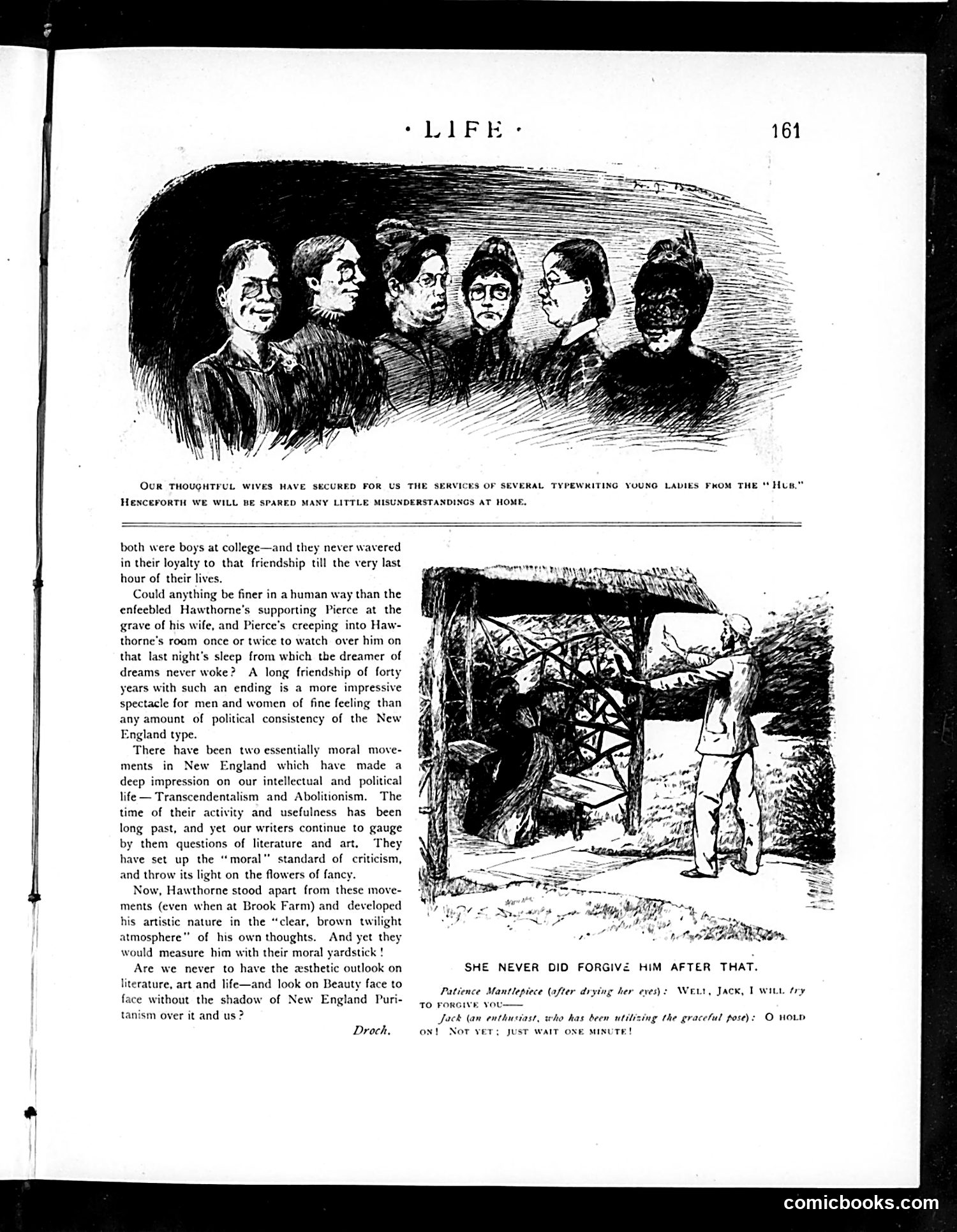
**Top Illustration:** Six portrait sketches labeled as "typewriting young ladies from the 'Hub'" (Boston). The caption notes these women provide typewriter services, helping prevent "misunderstandings at home"—suggesting their professional work reduces domestic friction. **Bottom Illustration:** Titled "She Never Did Forgive Him After That," depicting a woman and man near a rustic structure, illustrating a domestic dispute. The dialogue references "Patience Mantelpiece" and involves Jack attempting reconciliation after some offense, with Droch (the author) commenting on the woman's inability to forgive. **Context:** This page satirizes emerging female employment (typewriters were new technology), New England Puritanism, and marital discord—common Life magazine themes reflecting early 1900s social anxieties about women's work and relationships.
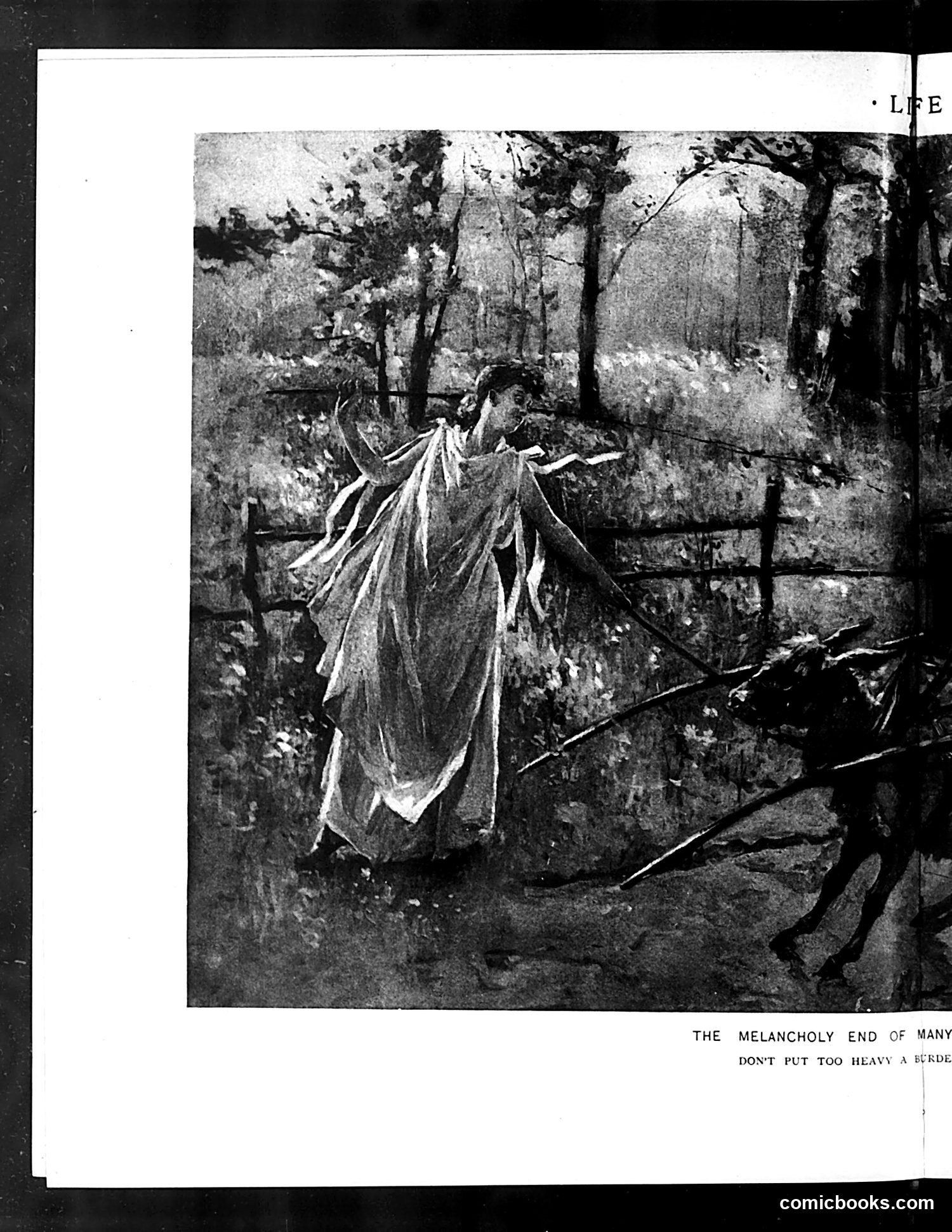
This black-and-white photograph shows a figure in flowing, tattered garments standing in a wooded area near a fence. The caption reads: "THE MELANCHOLY END OF MANY / DON'T PUT TOO HEAVY A BURDEN..." The image appears to be a visual metaphor or satirical commentary on burden and collapse. The figure's drooping posture and deteriorating clothing suggest exhaustion or failure under weight. The incomplete caption suggests the joke concerns someone or something that couldn't bear an excessive load—likely a political or social critique from Life magazine's satirical tradition. Without the complete caption or additional context, the specific target of satire remains unclear, though it appears to critique overambition, poor leadership, or unsustainable policies that "break" under pressure.
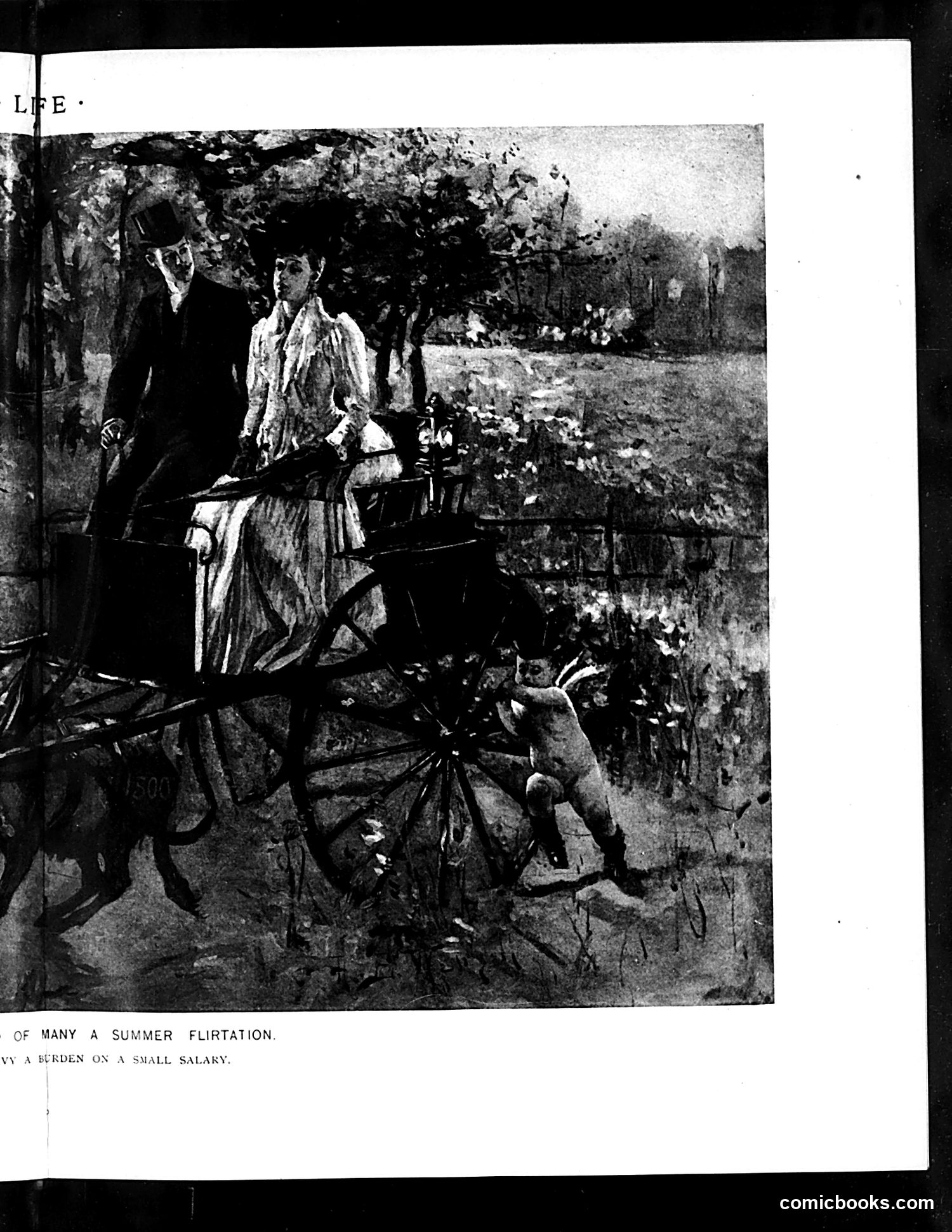
This page from *Life* magazine shows a romantic scene with the caption "OF MANY A SUMMER FLIRTATION" and a subtitle mentioning "A BURDEN ON A SMALL SALARY." The image depicts a well-dressed man and woman in a horse-drawn carriage, positioned in an idyllic park or garden setting with trees and foliage. The satire appears to target the financial burden of courtship and romance on men of modest means. The subtitle's reference to "small salary" suggests the joke centers on how expensive summer romantic activities—carriage rides, outings, entertainment—strain the budgets of working-class or lower-middle-class suitors. This reflects early 20th-century social commentary about dating costs and economic pressures on young men trying to court women while maintaining respectability and impressing their companions.
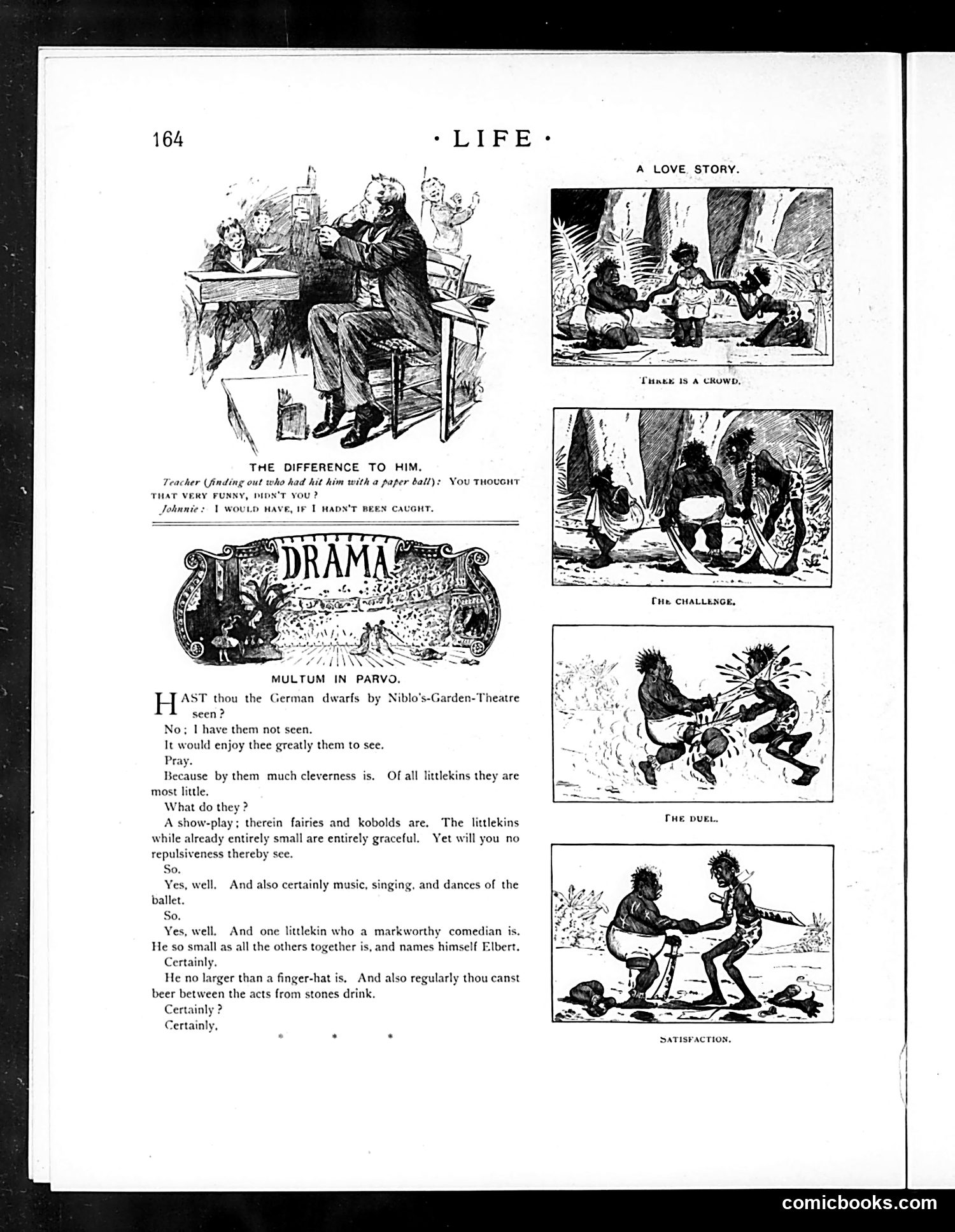
**Left side - "The Difference to Him":** A humorous sketch showing a teacher catching a student (Johnny) with a paper ball. The teacher assumed Johnny threw it; Johnny claims he would have if he hadn't been caught. The joke relies on the irony of Johnny's excuse—he's admitting guilt while technically denying the act. **Right side - "A Love Story" (Drama section):** A four-panel sequential comic depicting what appears to be a romantic conflict between two small figures (possibly elves or fantastical characters based on the "Multum in Parvo" reference to German dwarfs). The panels show: a crowd gathering, a challenge issued, a duel occurring, and finally satisfaction or reconciliation. It's a satirical miniature melodrama about love and honor.
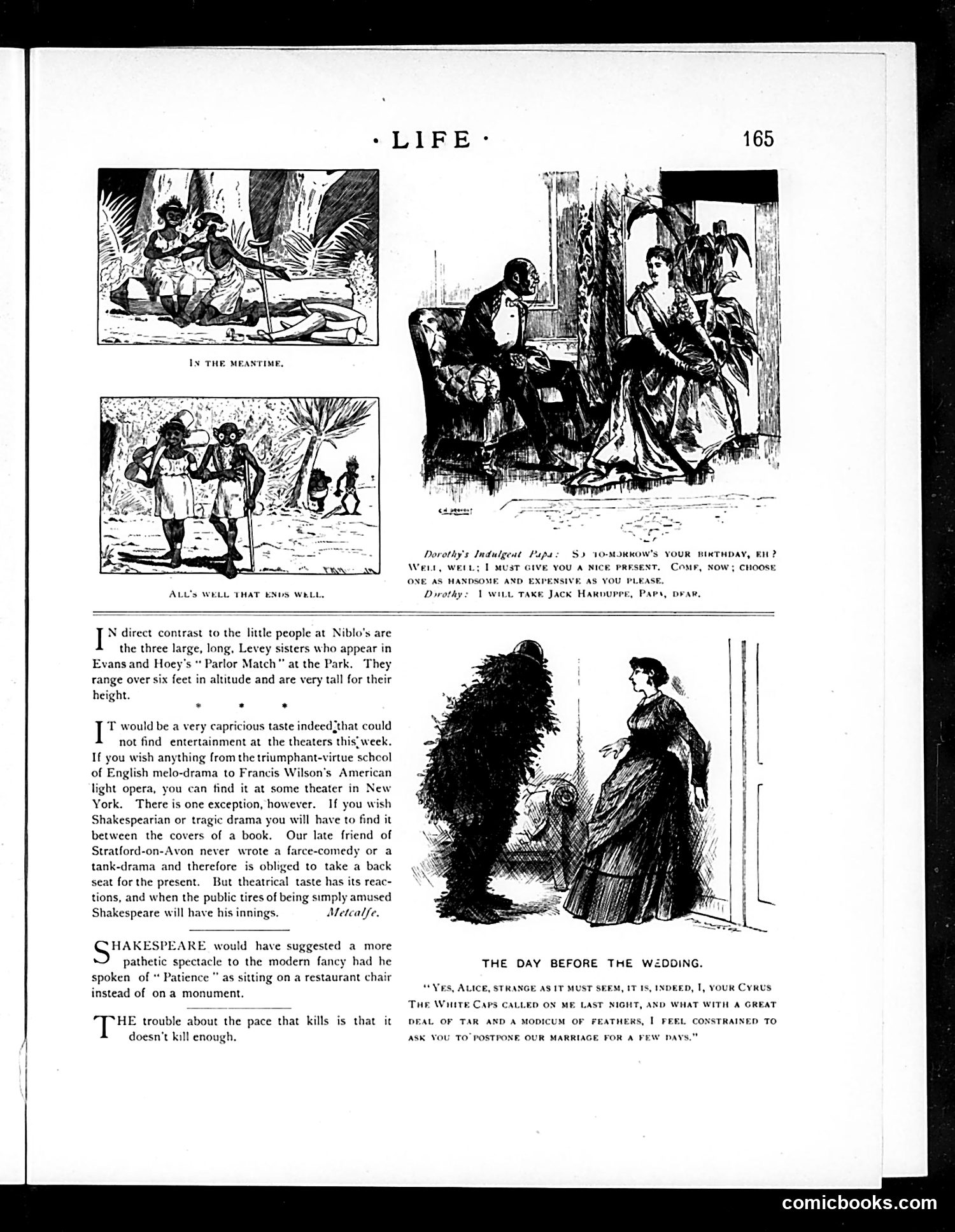
This page from *Life* magazine contains satirical commentary and illustrated vignettes. The main content includes: **Text commentary** mocking the theatrical entertainment options available that week, suggesting the quality is poor. The author notes that if you want Shakespeare or serious drama, you're out of luck—theaters are offering only light farces and melodramas. There's a quip that "the trouble about the pace that kills is that it doesn't kill enough," likely criticizing the overly hectic pace of modern life. **Illustrations** show social scenes: one depicts "Dorothy's Indulgent Papa" offering an expensive birthday gift, and another titled "The Day Before the Wedding" shows a woman in an elaborate feathered costume discussing wedding postponement due to acquiring "a great deal of tar and a modicum of feathers." The overall tone is satirical commentary on contemporary theater quality and upper-class social life.
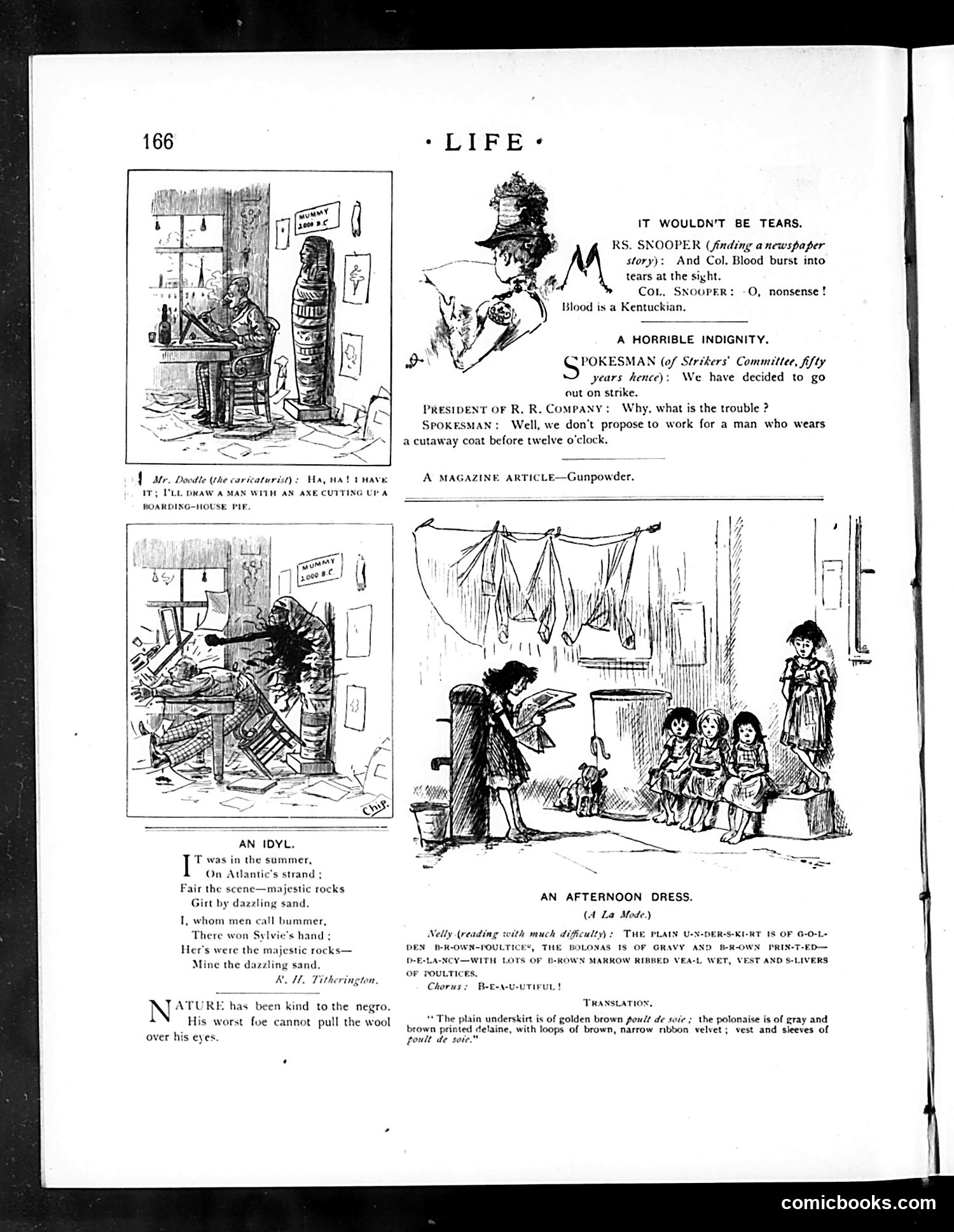
This page contains three separate satirical pieces: 1. **"An Idyl"** - A poem by H. H. Titherington accompanying a seaside illustration, celebrating nature's indifference to racial prejudice. 2. **"It Wouldn't Be Tears"** - A brief comic dialogue mocking Colonel Blood's emotional response to a newspaper story, with a pun about "blood" being Kentuckian (implying toughness). 3. **"A Horrible Indignity"** - A labor dispute satire where striking workers refuse to work for a company president who wears a cutaway coat before noon—a commentary on class pretension and labor grievances over perceived disrespect. 4. **"An Afternoon Dress"** - A satirical fashion piece with illustration, mocking elaborate women's fashions ("La Mode") through exaggerated description of an impractical, over-decorated dress design. The page emphasizes class conflict and social absurdities typical of early 20th-century American satire.
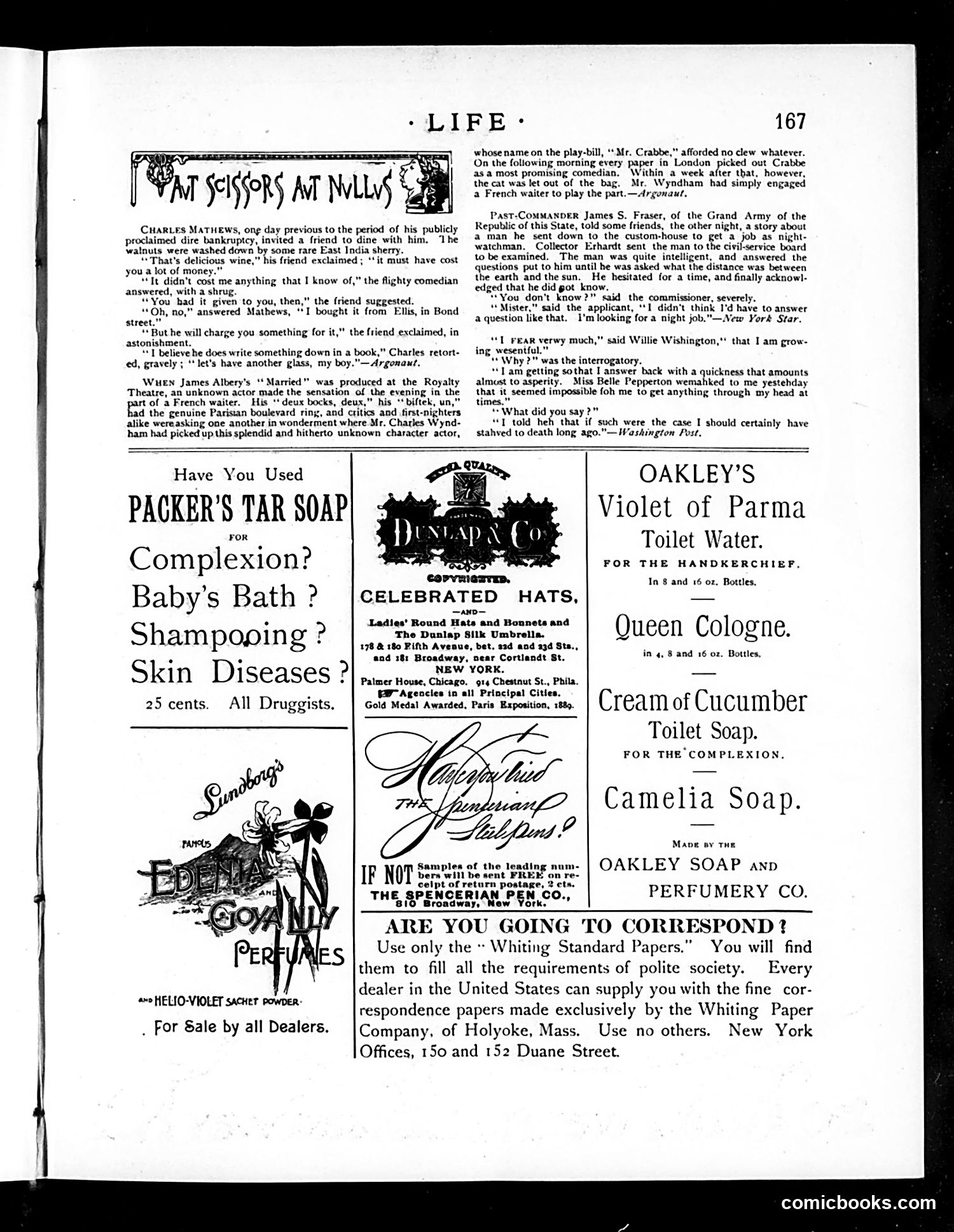
This page contains **humorous anecdotes** rather than political cartoons. The title "Wit: Scissors at Nulls" indicates a collection of brief comedic stories targeting theatrical and social pretension. The three main jokes ridicule: 1. **Charles Mathews** (a real 19th-century comedian): A wealthy man dining lavishly while claiming bankruptcy, suggesting financial dishonesty dressed as wit. 2. **James Albery's play "Married"**: An unknown actor playing a French waiter gained acclaim, but was revealed to be an actual French waiter hired for authenticity—satirizing how audiences mistake realism for talent. 3. **Willie Wishington**: A vain man responds rudely when criticized for being slow-witted, then boasts he'd have starved otherwise—mocking self-deluding arrogance. The **advertisements below** (Packer's Tar Soap, Dunlap Hats, Oakley's perfumes, Whiting Paper) represent typical Victorian-era consumer goods marketing, completely unrelated to the satirical content above.
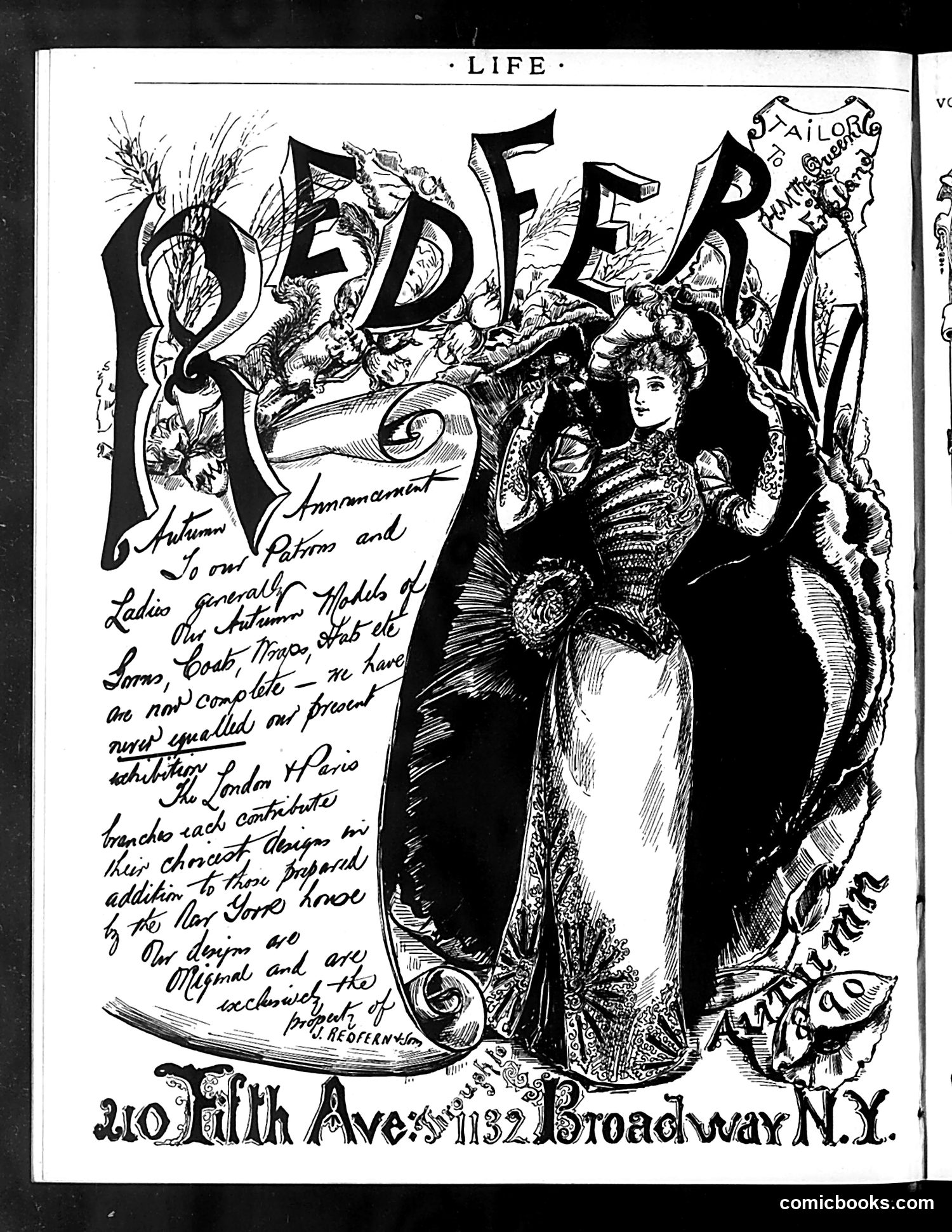
This appears to be a **full-page advertisement** for "Older," likely a fashion or lifestyle brand, rather than a political cartoon. The large decorative typography spells out the product name, surrounded by ornamental autumn foliage illustrations. The handwritten text (partially legible) discusses "Ladies generally" and "Autumn Hats"—suggesting this advertises women's seasonal fashions. The elegantly dressed female figure in the center, wearing elaborate clothing with decorative elements, exemplifies the fashionable woman the advertisement targets. The address "210 Fifth Avenue, 1132 Broadway, N.Y." indicates this is a New York City retailer. This is vintage commercial advertising rather than satire or political commentary—typical of Life magazine's mixed content of ads and editorial material.