
Life, 1890-09-25 · page 7 of 14
Life — September 25, 1890 — page 7: what you’re looking at
What you’re looking at
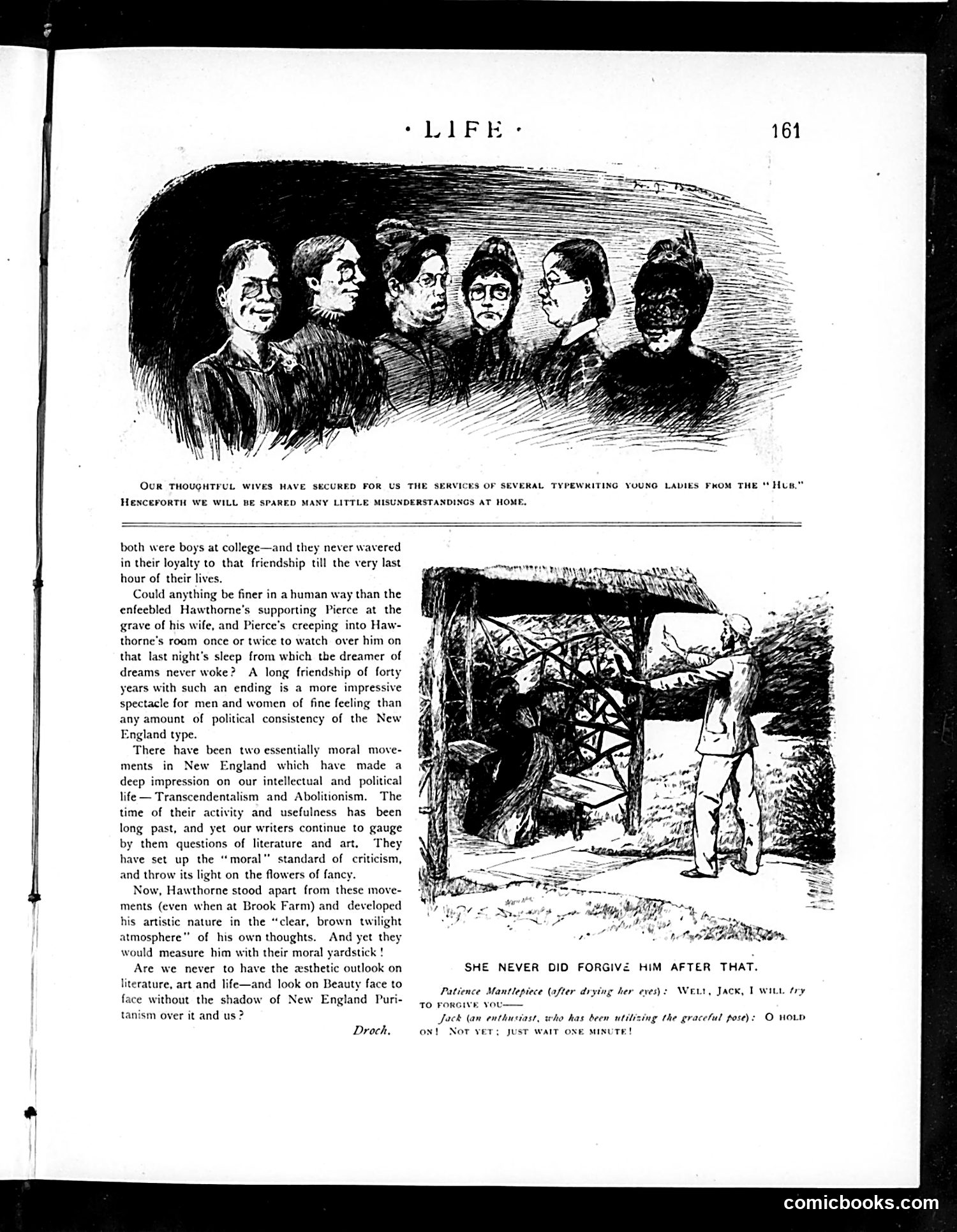
**Top Illustration:** Six portrait sketches labeled as "typewriting young ladies from the 'Hub'" (Boston). The caption notes these women provide typewriter services, helping prevent "misunderstandings at home"—suggesting their professional work reduces domestic friction. **Bottom Illustration:** Titled "She Never Did Forgive Him After That," depicting a woman and man near a rustic structure, illustrating a domestic dispute. The dialogue references "Patience Mantelpiece" and involves Jack attempting reconciliation after some offense, with Droch (the author) commenting on the woman's inability to forgive. **Context:** This page satirizes emerging female employment (typewriters were new technology), New England Puritanism, and marital discord—common Life magazine themes reflecting early 1900s social anxieties about women's work and relationships.
📄 Transcribed text from this page (OCR, searchable)
Machine-transcribed from the original scan — historical spelling and the odd misread are preserved.
OUR THOUGHTFUL WIVES HAVE SECURED FOR US THE SERVICES OF SEVERAL TYPEWRITING YOUNG LADIES FROM THE * HUB.” HENCEFORTH WE WILL BE SPARED MANY LITTLE MISUNDERSTANDINGS AT HOME. both were boys at college—and they never wavered in their loyalty to that friendship till the very last hour of their lives. Could anything be finer in a human way than the enfeebled Hawthorne's supporting Pierce at the grave of his wife, and Pierce’s creeping into Haw- thorne’s roam once or twice to watch over him on that last night's sleep from which the dreamer of dreams never woke? A long friendship of forty years with such an ending is a more impressive spectacle for men and women of fine feeling than any amount of political consistency of the New England type. There have been two essentially moral move- ments in New England which have made a deep impression on our intellectual and_ political life — Transcendentalism and Abolitionism. The time of their activity and usefulness has been long past, and yet our writers continue to gauge by them questions of literature and art, They have set up the “moral” standard of criticism, and throw its light on the flowers of fancy. Now, Hawthorne stood apart from these move- ments (even when at Brook Farm) and developed his artistic nature in the “clear, brown twilight atmosphere” of his own thoughts. And yet they would measure him with their moral yardstick ! Are we never to have the zxsthetic outlook on ‘ature, art and life—and look on Beauty face to without the shadow of New England Puri- tanism over it and us ? Droch, SAR (2 ee * ty GED a0, SHE NEVER DID FORGIVE HIM AFTER THAT. Patience Mantlepiece (after drying her eves): Weir, Jack, T wits. try TO FORGIVE You— Jack (an enthusiast, who has been utilising the graceful pose): O WOLD on! Not yer: JUST Walt ove suNUTE! comicbooks.com