
Life, 1890-09-25 · page 4 of 14
Life — September 25, 1890 — page 4: what you’re looking at
What you’re looking at
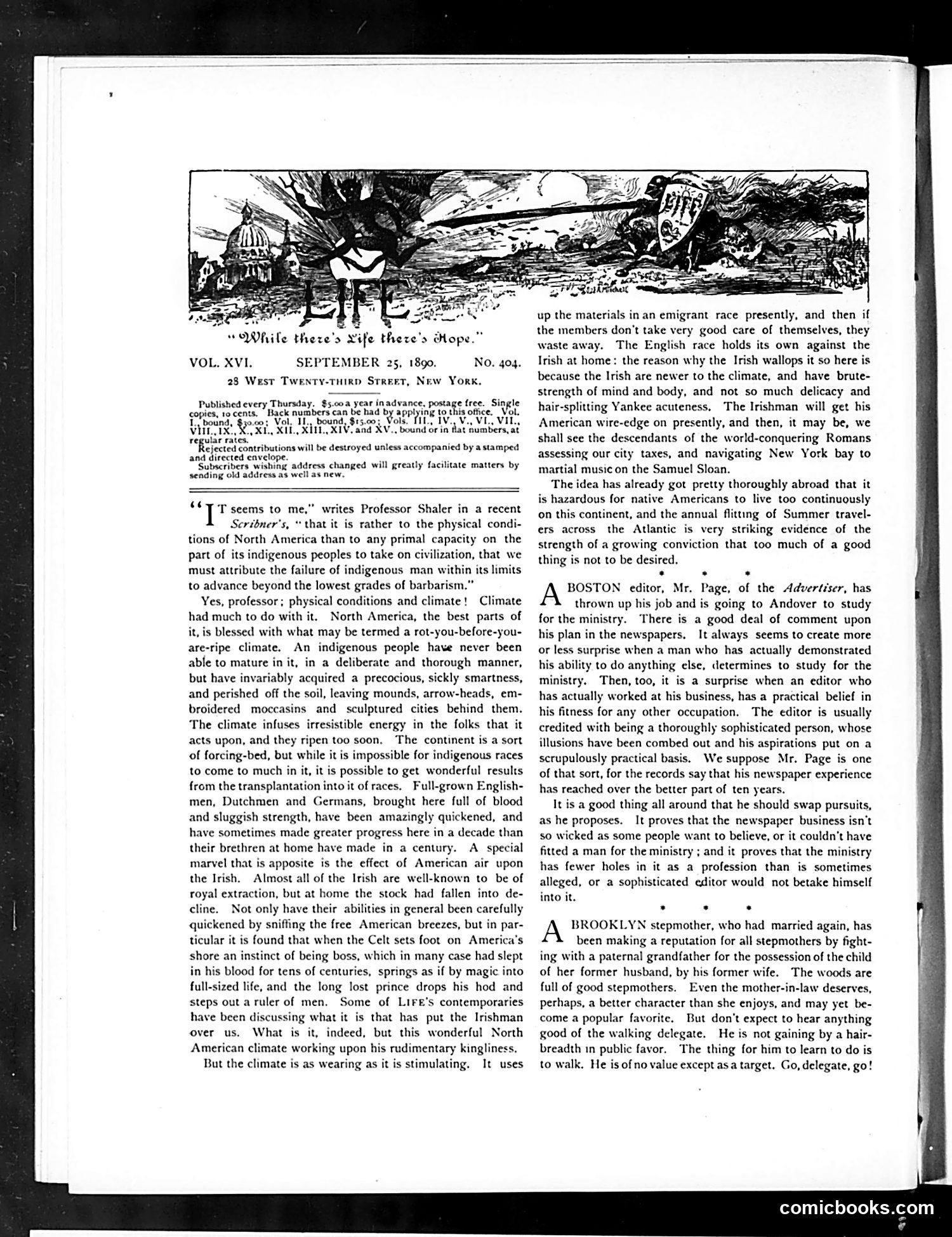
The masthead cartoon depicts a landscape with a church dome (likely representing civilization) contrasting with wilderness and what appears to be Native American imagery on the right—visualizing the "frontier" concept central to American expansion mythology of this era. The accompanying text discusses racial and climate theories popular in 1890, arguing that North America's climate supposedly limited indigenous peoples' capacity for civilization, while English and German immigrants supposedly thrived there. The piece reflects the pseudo-scientific racism of the period, claiming climate explained why European settlers "progressed" while Native Americans allegedly remained "barbaric." The text also includes satirical gossip items about Boston editors and Brooklyn society figures—typical Life magazine content mixing social commentary with tabloid-style humor.
📄 Transcribed text from this page (OCR, searchable)
Machine-transcribed from the original scan — historical spelling and the odd misread are preserved.
“Mile there's VOL. XVI. SEPTEMBER 25, 1890. No. 404. 28 West Twenty-THirp Street, New York. Life there's Hope.” Published every Thursday. $5.coa year inadvance, postage free. Single copies, to Gens. Back nur can be had by applying 10, fie ote. Vou bound, Goocot Val 1d, $15.00; Vols. VETS BRE, MA, Xie eI ana RV regular rates. Reject contributions wil be destroyed unless accompanied by a stamped and directed envelope. ‘Subscribers wishing address changed will greatly facilitate matters by sending old address as well as new. ound or ta dat’ auabern ad ‘TT seems to me,” writes Professor Shaler in a recent Sceriéner's, “ that it is rather to the physical condi- tions of North America than to any primal capacity on the part of its indigenous peoples to take on civilization, that we must attribute the failure of indigenous man within its limits to advance beyond the lowest grades of barbarism. Yes, professor; physical conditions and climate! Climate had much to do with it. North America, the best parts of it, is blessed with what may be termed a rot-you-before-you- are-ripe climate. An indigenous people have never been able to mature in it, in a deliberate and thorough manner, but have invariably acquired a precocious, sickly smartness, and perished off the soil, leaving mounds, arrow-heads, em- broidered moccasins and sculptured cities behind them. The climate infuses irresistible energy in the folks that it acts upon, and they ripen too soon, The continent is a sort of forcing-bed, but while it is impossible for indigenous races to come to much in it, it is possible to get wonderful results from the transplantation into it of races. Full-grown English- men, Dutchmen and Germans, brought here full of blood and sluggish strength, have been amazingly quickened, and have sometimes made greater progress here in a decade than their brethren at home have made in a century. A_ special marvel that is apposite is the effect of American air upon the Irish. Almost all of the Irish are well-known to be of royal extraction, but at home the stock had fallen into de- cline. Not only have their abilities in general been carefully quickened by sniffing the free American breezes, but in par- ticular it is found that when the Celt sets foot on America’s shore an instinct of being boss, which in many case had slept in his blood for tens of centuries, springs as if by magic into full-sized life, and the long lost prince drops his hod and steps out a ruler of men, Some of Lire's contemporaries have been discussing what it is that has put the Irishman over us. What is it, indeed, but this wonderful North American climate working upon his rudimentary kingliness. But the climate is as wearing as it is stimulating. It uses up the materials in an emigrant race presently, and then if the members don’t take very good care of themselves, they waste away. The English race holds its own against the Irish at home: the reason why the Irish wallops it so here is because the Irish are newer to the climate, and have brute- strength of mind and body, and not so much delicacy and hair-splitting Yankee acuteness. The Irishman will get his American wire-edge on presently, and then, it may be, we shall see the descendants of the world-conquering Romans assessing our city taxes, and navigating New York bay to martial music on the Samuel Sloan. ‘The idea has already got pretty thoroughly abroad that it is hazardous for native Americans to live too continuously on this continent, and the annual flitting of Summer travel- ers across the Atlantic is very striking evidence of the strength of a growing conviction that too much of a good thing is not to be desired. . . . BOSTON editor, Mr. Page, of the Advertiser, has thrown up his job and is going to Andover to study for the ministry. There is a good deal of comment upon his plan in the newspapers. It always seems to create more or less surprise when a man who has actually demonstrated his ability to do anything else, determines to study for the inistry. Then, too, it is a surprise when an editor who has actually worked at his business, has a practical belief in his fitness for any other occupation. The editor is usually credited with being a thoroughly sophisticated person, whose illusions have been combed out and his aspirations put on a scrupulously practical basis. We suppose Mr. Page is one of that sort, for the records say that his newspaper experience has reached over the better part of ten years. It is a good thing all around that he should swap pursuits, as he proposes. It proves that the newspaper business isn’t so wicked as some people want to believe, or it couldn't have fitted a man for the ministry ; and it proves that the ministry has fewer holes in it as a profession than is sometimes alleged, or a sophisticated editor would not betake himself into it. . . . BROOKLYN stepmother, who had married again, has been making a reputation for all stepmothers by fight- ing with a paternal grandfather for the possession of the child of her former husband, by his former wife. The woods are full of good stepmothers. Even the mother-in-law deserves, perhaps, a better character than she enjoys, and may yet be- come a popular favorite. But don’t expect to hear anything good of the walking delegate. He is not gaining by a hair- breadth in public favor. The thing for him to learn to do is to walk. He is of no value except asa target. Go, delegate, go! comicbooks.com 3